
Life, 1916-01-13 · page 12 of 44
Life — January 13, 1916 — page 12: what you’re looking at
What you’re looking at
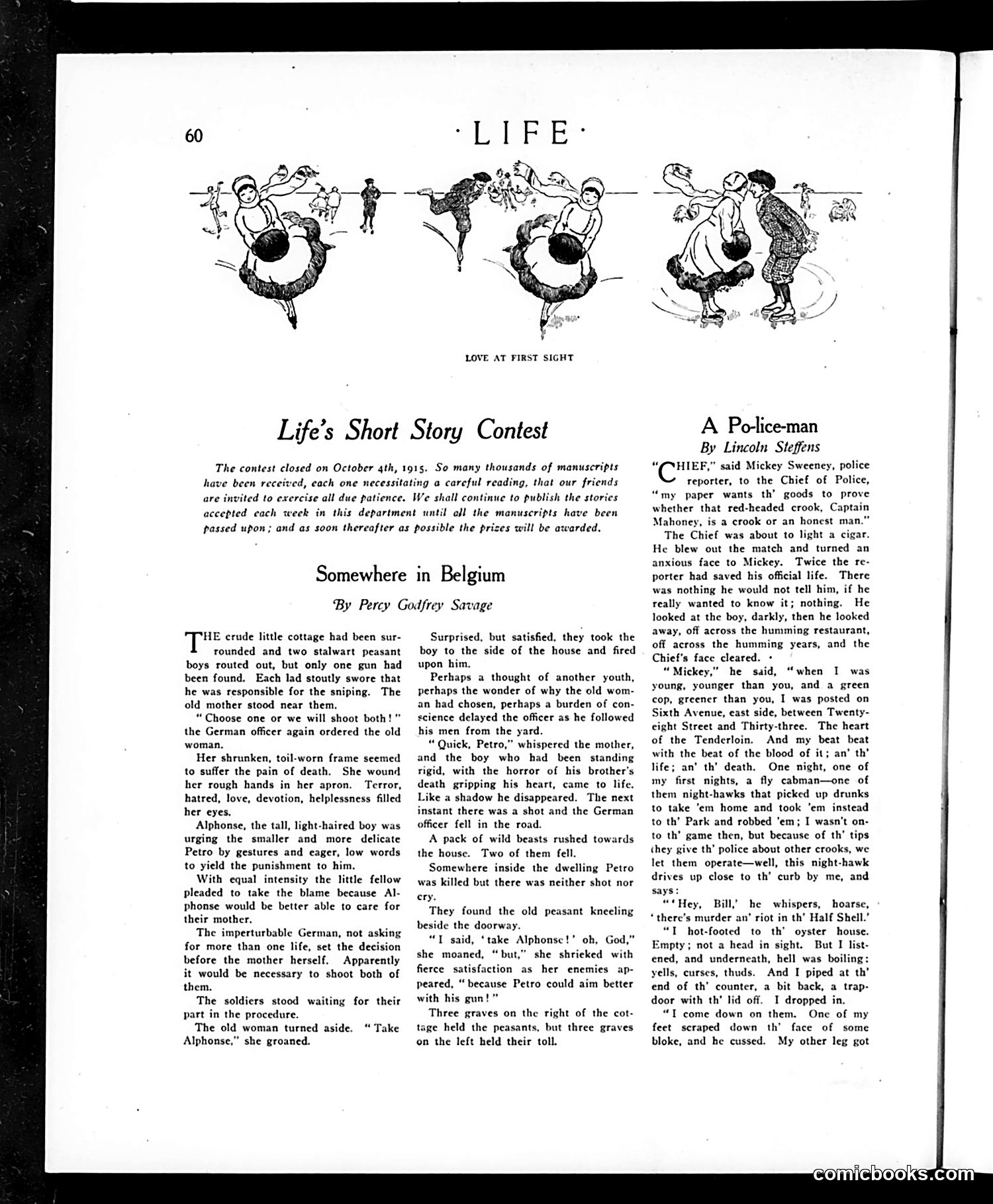
The cartoon at the top depicts a romantic encounter involving couples in various stages of courtship—some dancing, skating, and socializing. The strip's title suggests a humorous take on instantaneous romantic attraction. Below are two short stories: "Somewhere in Belgium" by Percy Golffrey Savage, set during World War I, depicts German soldiers and Belgian civilians during wartime occupation. "A Po-lice-man" by Lincoln Steffens is a police procedural anecdote about a beat cop named Mickey Sweeney. This page represents *Life* magazine's typical blend of satirical humor, romantic comedy, and contemporary fiction reflecting early 20th-century American interests—combining light entertainment with social commentary.
📄 Transcribed text from this page (OCR, searchable)
Machine-transcribed from the original scan — historical spelling and the odd misread are preserved.
LOVE AT FIRST SIGHT Life’s Short Story Contest The contest closed on October 4th, 1915. So many thousands of manuscripts have been receiv d, each one necessitating a careful reading, that our friends are invited to exercise all due patience. We shall continue to publish the stories accepted each week in this department until all the manuscripts have been passed upon; and as soon thereafter as possible the prizes will be awarded. Somewhere in Belgium By Percy Godfrey Savage 'HE crude little cottage had been sur- rounded and two stalwart peasant boys routed out, but only one gun had been found. Each lad stoutly swore that he was responsible for the sniping. The old mother stood near them. “ Choose one or we will shoot both!” the German officer again ordered the old woman. Her shrunken, toil-worn frame seemed to suffer the pain of death. She wound her rough hands in her apron. Terror, hatred, love, devotion, helplessness filled her eyes. Alphonse, the tall, light-haired boy was urging the smaller and more delicate Petro by gestures and eager, low words to yield the punishment to him, With equal intensity the little fellow pleaded to take the blame because Al- phonse would be better able to care for their mother. The imperturbable German, not asking for more than one life, set the decision before the mother herself. Apparently it would be necessary to shoot both of them. The soldiers stood waiting for their part in the procedure. The old woman turned aside. Alphonse,” she groaned. “Take Surprised, but satisfied, they took the boy to the side of the house and fired upon him. Perhaps a thought of another youth, perhaps the wonder of why the old wom- an had chosen, perhaps a burden of con- science delayed the officer as he followed his men from the yard. “Quick, Petro,” whispered the mother, and the boy who had been standing rigid, with the horror of his brother's death gripping his heart, came to life. Like a shadow he disappeared. The next instant there was a shot and the German officer fell in the road. A pack of wild beasts rushed towards the house. Two of them fell. Somewhere inside the dwelling Petro was killed but there was neither shot nor cry. They found the old peasant kneeling beside the doorway. “T said, ‘take Alphonse!’ oh, God,” she moaned, “but,” she shrieked with fierce satisfaction as her enemies ap- peared, “because Petro could aim better with his gun!” Three graves on the right of the cot- tage held the peasants, but three graves on the left held their toll. A Po-lice-man By Lincoln Steffens “CHIEF,” said Mickey Sweeney, police reporter, to the Chief of Police, “my paper wants th’ goods to prove whether that red-headed crook, Captain Mahoney, is a crook or an honest man.” The Chief was about to light a cigar. He blew out the match and turned an anxious face to Mickey. Twice the re- porter had saved his official life. There was nothing he would not tell him, if he really wanted to know it; nothing. He looked at the boy, darkly, then he looked away, off across the humming restaurant, off across the humming years, and the Chief's face cleared. + “Mickey,” he said, “when I young, younger than you, and a green cop, greener than you, I was posted on Sixth Avenue, east side, between Twenty- cight Street and Thirty-three. The heart of the Tenderloin. And my beat beat with the beat of the blood of it; an’ th’ life; an’ th’ death, One night, one of my first nights, a fly cabman—one of them night-hawks that picked up drunks to take ‘em home and took ‘em instead to th’ Park and robbed ‘em; I wasn't on- to th’ game then, but because of th’ tips they give th’ police about other crooks, we let them operate—well, this night-hawk drives up close to th’ curb by me, and says: “*Hey, Bill,’ he whispers, hoarse, ‘there's murder an’ riot in th’ Half Shell.” “I hot-footed to th’ oyster house. Empty; not a head in sight. But I list- ened, and underneath, hell was boiling: yells, curses, thuds. And I piped at th’ end of th’ counter, a bit back, a trap- door with th’ lid off. I dropped in. “T come down on them. One of my feet scraped down th’ face of some bloke, and he cussed. My other leg got was