
Life, 1916-01-13 · page 26 of 44
Life — January 13, 1916 — page 26: what you’re looking at
What you’re looking at
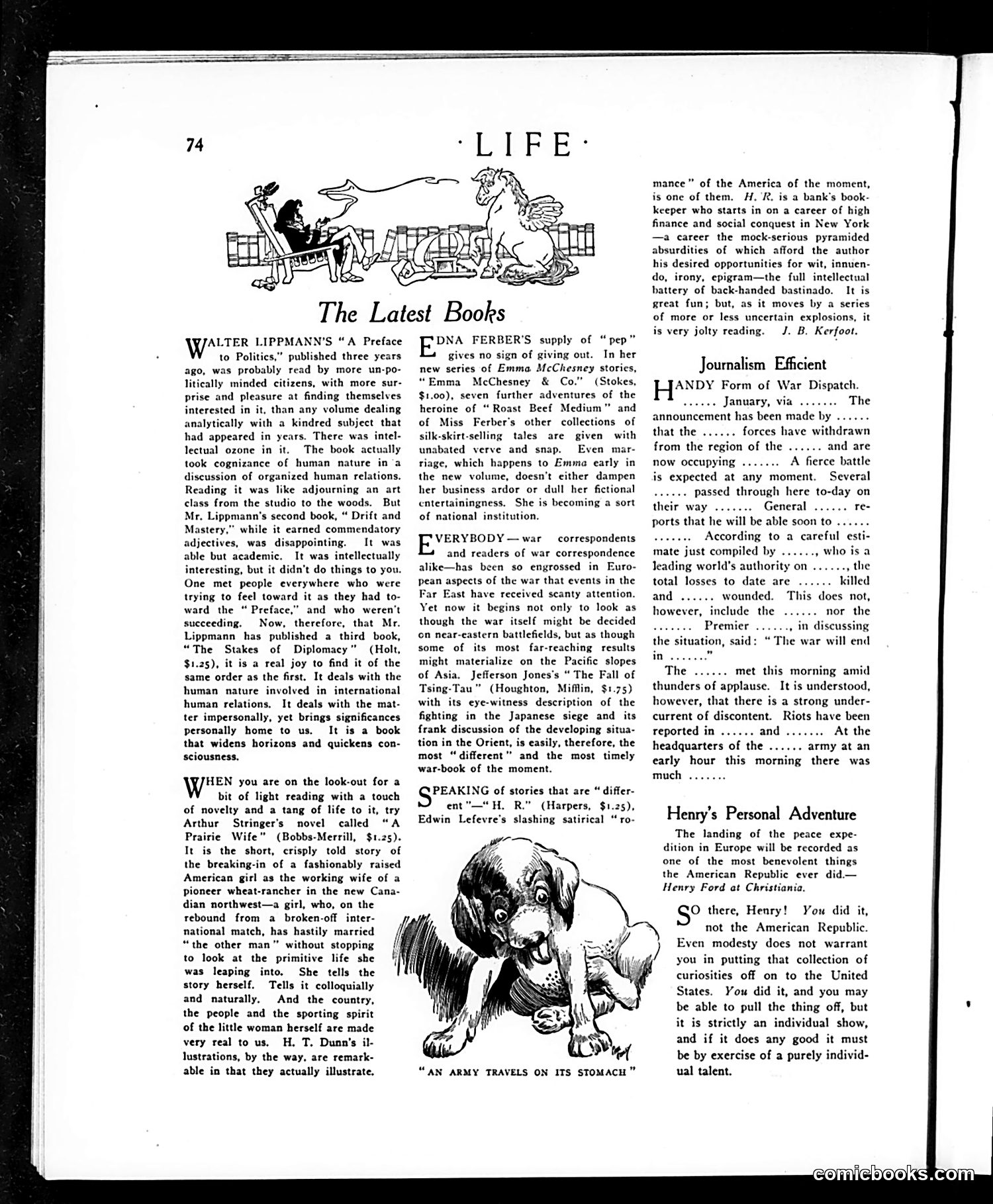
This is a book review section from Life magazine featuring critical commentary on contemporary publications. The main illustration—a dog lying down with the caption "An Army Travels on Its Stomach"—is a visual pun referencing the military aphorism while depicting a literal interpretation. The reviews discuss works by Walter Lippmann (political analysis), Edna Ferber (popular fiction about a saleswoman character), Arthur Stringer (frontier romance), and Jefferson Jones (war reportage about the Russo-Japanese conflict). The satirical edge comes through in the frank assessments: Lippmann's second book "Drift and Mastery" is dismissed as "able but academic" and disappointing compared to his first work. Ferber's commercial success is noted with slight condescension—she's "becoming a sort of national institution." The page reflects Life's role as a publication for intellectually-engaged readers who appreciated both serious analysis and popular culture, with a tone that's sophisticated but accessible.
📄 Transcribed text from this page (OCR, searchable)
Machine-transcribed from the original scan — historical spelling and the odd misread are preserved.
The Latest Books ‘ALTER LIPPMANN’S “A Preface to Politics,” published three years ago, was probably read by more un-po- itically minded citizens, with more sur- prise and pleasure at finding themselves interested in it, than any volume dealing analytically with a kindred subject that had appeared in years. There was intel- lectual ozone in it, The book actually took cognizance of human nature in a discussion of organized human relations. Reading it was like adjourning an art class from the studio to the woods. But Mr. Lippmann’s second book, “ Drift and Mastery,” while it earned commendatory adjectives, was disappointing. It was able but academic. It was intellectually interesting, but it didn’t do things to you. One met people everywhere who were trying to feel toward it as they had to- ward the “ Preface,” and who weren't succeeding. Now, therefore, that Mr. Lippmann has published a third book, “The Stakes of Diplomacy” (Holt, $1.25), it is a real joy to find it of the same order as the first. It deals with the human nature involved in international human relations, It deals with the mat- ter impersonally, yet brings significances personally home to us. It is a book that widens horizons and quickens con- sciousness, HEN you are on the look-out for a bit of light reading with a touch of novelty and a tang of life to it, try Arthur Stringers novel called “A Prairie Wife” (Bobbs-Merrill, $1.25). It is the short, crisply told story of the breaking-in of a fashionably raised American girl as the working wife of a pioneer wheat-rancher in the new Cana- dian northwest—a girl, who, on the rebound from a broken-off inter- national match, has hastily married “the other man” without stopping to look at the primitive life she was leaping into. She tells the story herself. Tells it colloquially and naturally. And the country, the people and the sporting spirit of the little woman herself are made very real to us. H, T. Dunn's il- lustrations, by the way, are remark- able in that they actually illustrate, DNA FERBER'S supply of “pep” gives no sign of giving out. In her new series of Emma McChesney stori “Emma McChesney & Co.” (Stokes, $1.00), seven further adventures of the heroine of “Roast Beef Medium" and of Miss Ferber’s other collections of silk-skirt-selling tales are given with unabated verve and snap. Even mar- riage, which happens to Emma early in the new volume, doesn't either dampen iness ardor or dull her fictional ingness. She is becoming a sort of national institution. VERYBODY— war correspondents and readers of war correspondence alike—has been so engrossed in Euro- pean aspects of the war that events in the Far East have received scanty attention. Yet now it begins not only to look as though the war itself might be decided on near-eastern battlefields, but as though some of its most far-reaching results might materialize on the Pacific slopes of Asia. Jefferson Jones's “ The Fall of Tsing-Tau” (Houghton, Mifflin, $1.75) with its eye-witness description of the fighting in the Japanese siege and its frank discussion of the developing situa- tion in the Orient, is easily, therefore, the most “different” and the most timely war-book of the moment. PEAKING of stories that are “ differ- ent"—“H. R.” (Harpers, $1.25), Edwin Lefevre’s slashing satirical “ ro- “AN ARMY TRAVELS ON ITS STOMACH” mance” of the America of the moment, is one of them. H.R. is a bank's book- keeper who starts in on a career of high finance and social conquest in New York —a career the mock-serious pyramided absurdities of which afford the author his desired opportunities for wit, innuen- do, irony, epigram—the full intellectual battery of back-handed bastinado. It is great fun; but, as it moves by a series of more or less uncertain explosions, it is very jolty reading. J. B. Kerfoot. Journalism Efficient H‘4%»Y Form of War Dispatch. » January, via announcement has been made by that the forces have withdrawn from the region of the . and are now occupying . A fierce battle is expected at any moment. Several passed through here to-day on General ports that he will be able soon to . According to a careful esti- mate just compiled by . , who is a leading world’s authority on total losses to date are . and . wounded. TI however, include the ‘ Premier the situation, sai in. The + met this morning amid thunders of applause. It is understood, however, that there is a strong under- current of discontent. Riots have been reported in ...... and At the headquarters of the army at an early hour this morning there was much . jis does not, nor the in discussing The war will end Henry's Personal Adventure The landing of the peace expe- dition in Europe will be recorded as one of the most benevolent things the American Republic ever did.— Henry Ford at Christiania. O there, Henry! You did it, not the American Republic. Even modesty does not warrant you in putting that collection of curiosities off on to the United States. You did it, and you may be able to pull the thing off, but it is strictly an individual show, and if it does any good it must be by exercise of a purely individ- ual talent.