
Life, 1916-01-13 · page 20 of 44
Life — January 13, 1916 — page 20: what you’re looking at
What you’re looking at
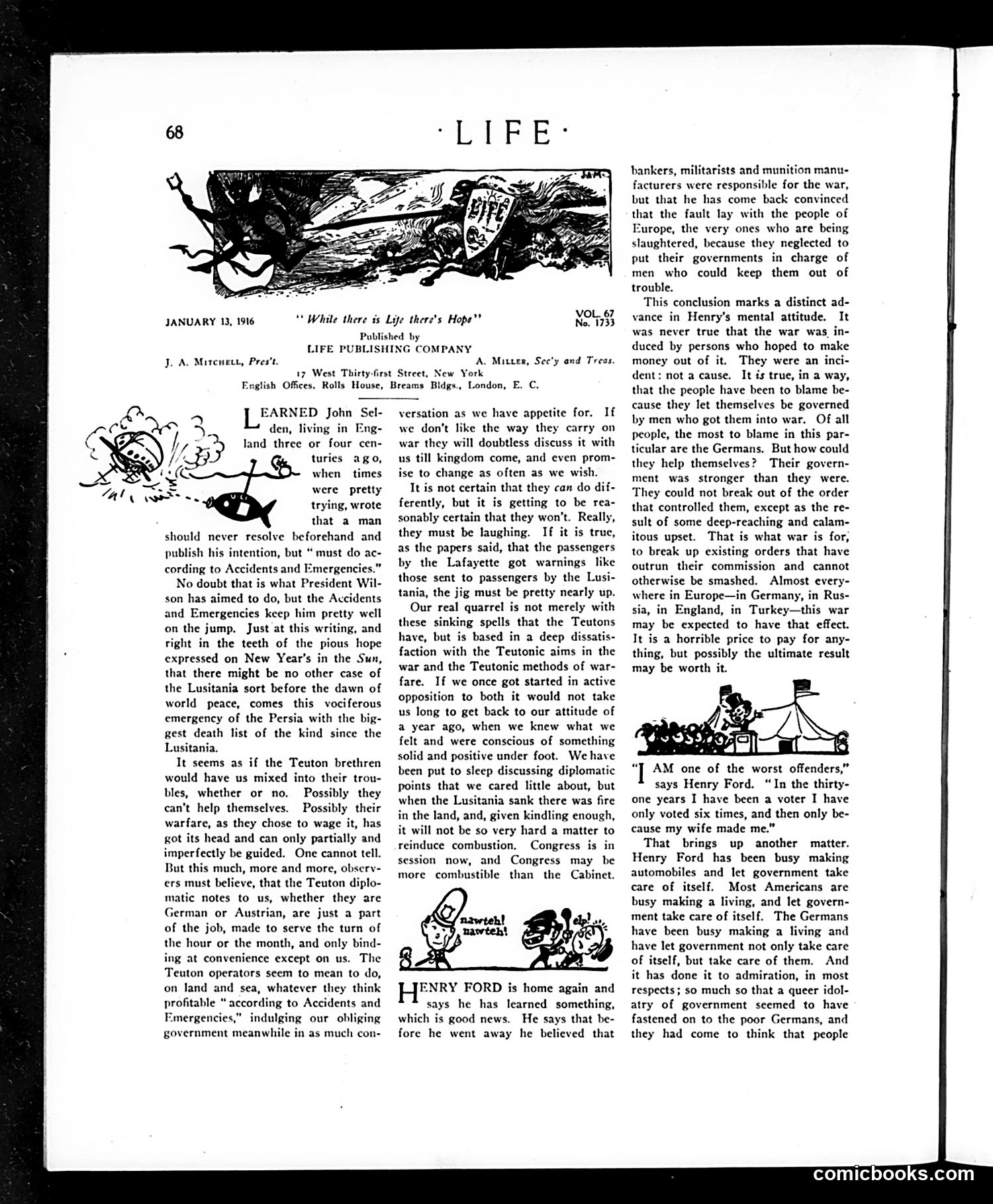
This page critiques President Wilson's cautious WWI policy and comments on Henry Ford's evolving views on war responsibility. **Main Editorial Content:** The article attacks Germany's submarine warfare (referencing the *Lusitania* sinking of 1915 and the recent *Persia* disaster), arguing that German diplomatic promises are meaningless delaying tactics. The writer suggests German military action operates beyond their government's control and criticizes Wilson for passively accepting German explanations rather than taking decisive action. The piece implies Congress might be more willing than Wilson's Cabinet to pursue active opposition to Germany. **Henry Ford Section:** Ford recently returned from a peace mission abroad. The article notes he now blames ordinary Europeans for the war (by neglecting proper governance) rather than bankers and munitions manufacturers—his previous position. The writer presents this as Ford's "advance in mental attitude," though with apparent irony, suggesting Ford's revised blame-the-people conclusion is conveniently less radical than his original industrialist-blame theory. The cartoons (visible but not clearly legible) likely satirize these diplomatic failures and Ford's changed perspective.
📄 Transcribed text from this page (OCR, searchable)
Machine-transcribed from the original scan — historical spelling and the odd misread are preserved.
JANUARY 13, 1916 “While there is Life there's Hope” Published by LIFE PUBLISHING COMPANY J. A. Mircnett, Pres't. ARNED John Sel- den, living in Eng- land three or four cen- & turies ago, when times were pretty trying, wrote that a man should never resolve beforehand and publish his intention, but “ must do ac- cording to Accidents and Emergencies.” No doubt that is what President Wil- son has aimed to do, but the Accidents and Emergencies keep him pretty well on the jump. Just at this writing, and right in the teeth of the pious hope expressed on New Year’s in the Sun, that there might be no other case of the Lusitania sort before the dawn of world peace, comes this vociferous emergency of the Persia with the big- gest death list of the kind since the Lusitania, It seems as if the Teuton brethren would have us mixed into their trou- bles, whether or no. Possibly they can’t help themselves. Possibly their warfare, as they chose to wage it, has got its head and can only partially and imperfectly be guided. One cannot tell. But this much, more and more, obs: ers must believe, that the Teuton diplo- matic notes to us, whether they are German or Austrian, are just a part of the job, made to serve the turn of the hour or the month, and only bind- ing at convenience except on us. The Teuton operators seem to mean to do, on land and sea, whatever they think profitable “according to Accidents and Emergencies,” indulging our obliging government meanwhile in as much con- A. Mitter, Sec’y and Treas. 17 West Thirty-first Street, New York English Offices, Rolls House, Breams Bldgs. London, E. C. versation as we have appetite for. If we don’t like the way they carry on war they will doubtless discuss it with us till kingdom come, and even prom- ise to change as often as we wish. It is not certain that they can do dif- ferently, but it is getting to be rea- sonably certain that they won't. Really, they must be laughing. If it is true, as the papers said, that the passengers by the Lafayette got warnings like those sent to passengers by the Lusi- tania, the jig must be pretty nearly up. Our real quarrel is not merely with these sinking spells that the Teutons have, but is based in a deep dissatis- faction with the Teutonic aims in the war and the Teutonic methods of war- fare. If we once got started in active opposition to both it would not take us long to get back to our attitude of a year ago, when we knew what we felt and were conscious of something solid and positive under foot. We have been put to sleep discussing diplomatic points that we cared little about, but when the Lusitania sank there was fire in the land, and, given kindling enough, it will not be so very hard a matter to reinduce combustion. Congress is in session now, and Congress may be more combustible than the Cabinet. RY FORD is home again and says he has learned something, which is good news. He says that be- fore he went away he believed that bankers, militarists and munition manu- facturers were responsible for the war, but that he has come back convinced that the fault lay with the people of Europe, the very ones who are being slaughtered, because they neglected to put their governments in charge of men who could keep them out of trouble. This conclusion marks a distinct ad- vance in Henry’s mental attitude. It was never true that the war was in- duced by persons who hoped to make money out of it. They were an inci- dent: not a cause. It és true, in a way, that the people have been to blame be- cause they let themselves be governed by men who got them into war. Of all people, the most to blame in this par- ticular are the Germans. But how could they help themselves? Their govern- ment was stronger than they were. They could not break out of the order that controlled them, except as the re- sult of some deep-reaching and calam- itous upset. That is what war is for, to break up existing orders that have outrun their commission and cannot otherwise be smashed. Almost every- where in Europe—in Germany, in Rus- sia, in England, in Turkey—this war may be expected to have that effect. It is a horrible price to pay for any- thing, but possibly the ultimate result may be worth it. says Henry Ford. “In the thirty- one years I have been a voter I have only voted six times, and then only be- cause my wife made me.” That brings up another matter. Henry Ford has been busy making automobiles and let government take care of itself. Most Americans are busy making a living, and let govern- ment take care of itself. The Germans have been busy making a living and have let government not only take care of itself, but take care of them. And it has done it to admiration, in most respects; so much so that a queer idol- atry of government seemed to have fastened on to the poor Germans, and they had come to think that people comicbooks.com