
Life, 1916-01-13 · page 28 of 44
Life — January 13, 1916 — page 28: what you’re looking at
What you’re looking at
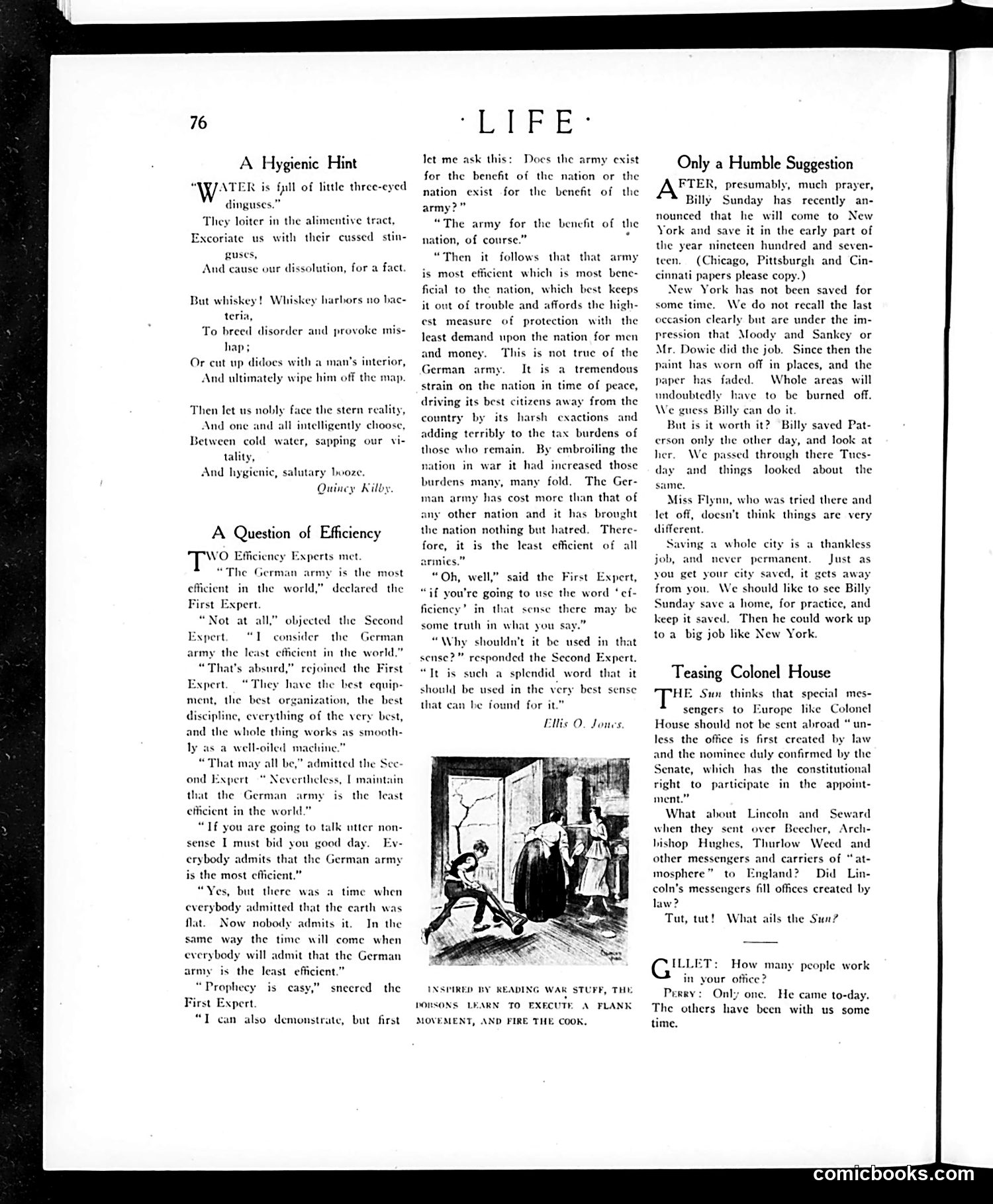
This page contains three satirical pieces targeting early 20th-century issues: **"A Question of Efficiency"**: Two debate whether the German army is most or least efficient. The Second Expert argues it's inefficient because, though militarily organized, it drains the nation economically and diplomatically, producing only "hatred." The joke exposes how "efficiency" depends entirely on one's definition—a critique of Germany's militarism disguised as logical debate. **"A Hygienic Hint"**: A humorous poem mocking those who fear bacteria in water but trust whiskey's safety. It's absurdist satire on public health anxieties. **"Only a Humble Suggestion"**: Mocks evangelist Billy Sunday's announced 1917 revival crusade in New York, sarcastically suggesting the city needs "saving" like Paterson did recently (apparently unsuccessfully). The tone is skeptical of religious salvation campaigns' lasting impact. The page reflects pre-WWI American attitudes toward German expansion and contemporary debates over faith, science, and national efficiency.
📄 Transcribed text from this page (OCR, searchable)
Machine-transcribed from the original scan — historical spelling and the odd misread are preserved.
A Hygienic Hint ATER is fyll of little three-eyed dinguses.” They loiter in the alimentive tra Excoriate us with their cussed stin- guses, And cause our dissolution, for a fact But whiskey! Whiskey harbors no bac- teria, To breed disorder and provoke mis- hap; Or cut up didoes with a man’s interior, ‘And ultimately wipe him off the map. Then let us nobly face the stern reality And one and all intelligently choos Between cold water, sapping our vi- tality, And hygienic, salutary booze. Quincy Kilby. A Question of Efficiency WO Efficiency Experts met. “The German army is the most efficient in the world,” declared the First Expert. “Not at Expert “yt army the least efficient in the world.” “That's Expert They have ment, the best organization, the best 1," objected the Second consider the German psurd,” rejoined the First best equip- discipline, everything of the very best, and the whole thing works as smooth- ly as a well-oiled machine “That may all be,” admitted the See- ond Expert“ Nevertheless, | maintain that Teast the German army is. the efficient in the world.” “If you are going to sense I must bid you good day erybody admits that the German army kK utter non Ev- is the most efficient.” everybody admitted that the earth was flat. Now nobody admits it. In the same way the time will come when everybody will admit that the German is the least efficient.” s, but there was a time when army “Prophecy is casy,” sneered the rst Expert “T can also demonstrate, but first “LPe - Jet me ask this: Does the army exist the nation or the the benefit of the for the benefit of nation exist for army?” “The army for the ben it of the nation, of course.” . “Then it is most efficient which is most bene- ficial to the nation, which best keeps it out of trouble and affords the high- est measure of protection with the least demand upon the nation for men and money. This is not true of the army. It is a tremendous follows that that army German strain on the nation in time of peace, driving its best citizens away from the country by its harsh exactions and adding terribly to the tax burdens of those who remain. By embroiling the ition in war it had increased those burdens many, many fold. The Ger- man army has cost more than that of any other nation and it has brought the nation nothing but hatred. There- fore, it efficient of all armies.” “Oh, well,” said the First: Expert, “if you're going to use the word ‘ef- is the least ficiency’ in that sense there may be some truth in what you say. “Why shouldn't it be used in that sense?” responded the Second Expert. “Tt is such a splendid word that it should be used in the very best sense that can be found for it.” Ellis O. Jones INSPIRED RY READING WAR STUFF, THE PORSONS LEARN TO EXECUTE A PLANK MOVEMENT, AND FIRE THE COOK. Only a Humble Suggestion FTER, presumably, much prayer, Billy Sunday has recently an- nounced that he will come to New York and save it in the early part of the year nineteen hundred and seven- te (Chicago, Pittsburgh and Cin- cinnati papers please copy.) New York has not been saved for some time. We do not recall the last occasion clearly but are under the im- pression that Moody and Sankey or Mr. Dowie did the job. Since then the paint has worn off in places, and the paper has faded. Whole areas will undoubtedly have to be burned off. We guess Billy can do it But is it worth it? Billy saved Pat- erson only the other day, and look at her. We passed through there Tues- day and things looked about the me. Miss Flynn, who tried there and let off, doesn't think things are very different. Saving a whole city is a thankless 1 and never permanent je Just as you get your city saved, it gets away from you. We should like to see Billy Sunday save a home, for practice, and keep it saved. Then he could work up toa big job like New York. Teasing Colonel House THe Sun thinks that special mes- sengers to Europe like Colonel House should not be sent abroad “ un- less the office is first created by law and the nominee duly confirmed by the Senate, which has the constitutional right to participate in the appoint- ment.” What about Lincoln and Seward when they sent over Beecher, Arch- bishop Hughes, Thurlow Weed and other messengers and carriers of “at- mosphere” to I nd? Did) Lin- coln’s messengers fill offices created by law Tut, tut! What ails the Sun? ILLET: How many people work in your office? Perey: Only one. He came to-day. The others have been with us some time. comicbooks.com