
Life, 1916-01-13 · page 13 of 44
Life — January 13, 1916 — page 13: what you’re looking at
What you’re looking at
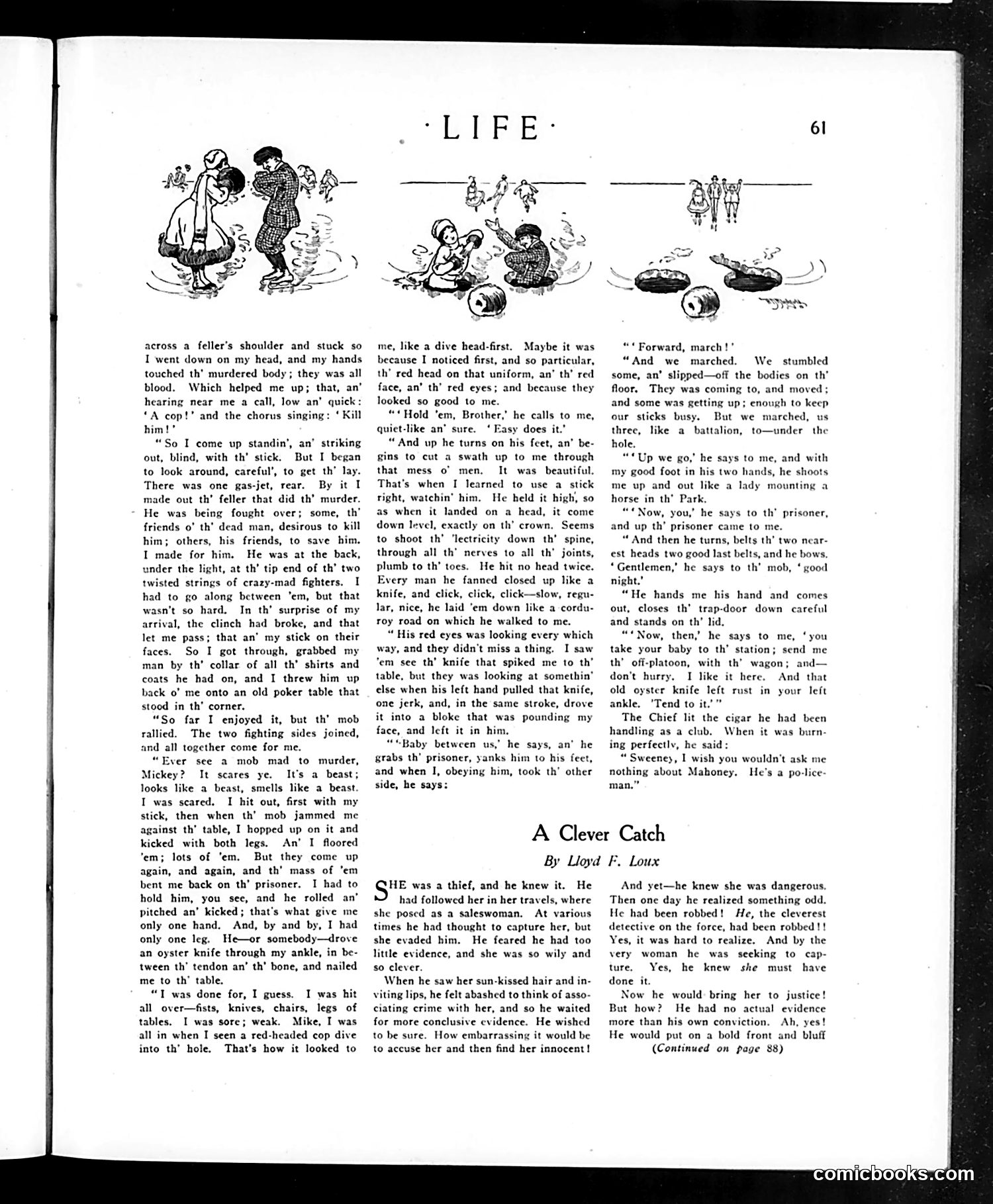
This page contains two distinct sections: **Upper portion:** A sequential comic strip (no clear title visible) depicting what appears to be a street fight or brawl. The illustrations show figures fighting with sticks or clubs, with accompanying narrative text describing violent action in working-class dialect ("'A cop!' an' th' others singin' 'Kill 'im!"). The scene satirizes street violence, possibly gang activity or lower-class urban conflict common to early 20th-century American life. **Lower portion:** "A Clever Catch" by Lloyd F. Loux—a short story about a detective pursuing a female thief posing as a saleswoman. The narrative explores themes of justice, evidence, and deception. Both pieces appear aimed at working-class readers, using humor and action to comment on contemporary urban crime and social dynamics.
📄 Transcribed text from this page (OCR, searchable)
Machine-transcribed from the original scan — historical spelling and the odd misread are preserved.
across a feller’s shoulder and stuck so I went down on my head, and my hands touched th’ murdered body; they was all blood. Which helped me up; that, an’ hearing near me a call, low an’ quick: “A cop!’ and the chorus singing: ‘Kill him!" “So I come up standin’, an’ striking out, blind, with th’ stick, But I began to look around, careful’, to get th’ lay. There was one gas-jet, rear. By it I made out th’ feller that did th’ murder. He was being fought over; some, th’ friends 0’ th’ dead man, desirous to kill him; others, his friends, to save him. I made for him. He was at the back, under the light, at th’ tip end of th’ two twisted strings of crazy-mad fighters. I had to go along between ‘em, but that wasn't so hard. In th’ surprise of my arrival, the clinch had broke, and that let me pass; that an’ my stick on their faces. So I got through, grabbed my man by th’ collar of all th’ shirts and coats he had on, and I threw him up back 0’ me onto an old poker table that stood in th’ corner. “So far I enjoyed it, but th’ mob rallied. The two fighting sides joined, d all together come for me. Ever see a mob mad to murder, Mickey? It scares ye. It’s a beast; looks like a beast, smells like a beast. I was scared. I hit out, first with my stick, then when th’ mob jammed me against th’ table, I hopped up on it and kicked with both legs. An’ I floored ‘em; lots of ‘em. But they come up again, and again, and th’ mass of ‘em bent me back on th’ prisoner. I had to hold him, you see, and he rolled an’ pitched an’ kicked; that’s what give me only one hand. And, by and by, I had only one leg. He—or somebody—drove an oyster knife through my ankle, in be- tween th’ tendon an’ th’ bone, and nailed me to th’ table. “T was done for, I guess. I was hit all over—fists, knives, chairs, legs of tables. I was sore; weak. Mike, I was all in when I seen a red-headed cop dive into th’ hole. That's how it looked to me, like a dive head-first. Maybe it was because I noticed first, and so particular, th’ red head on that uniform, an’ th’ red face, an’ th’ red eyes; and because they looked so good to me. “Hold ‘em, Brother,’ he calls to me, quict-like an’ sure. ‘Easy does it.’ “And up he turns on his feet, an’ be- gins to cut a swath up to me through that mess o’ men, It was beautiful. That's when I learned to use a stick right, watchin’ him. He held it high, so as when it landed on a head, it come down level, exactly on th’ crown. Seems to shoot th’ ‘lectricity down th’ spine, through all th’ nerves to all th’ joints, plumb to th’ toes. He hit no head twice. Every man he fanned closed up like a knife, and click, click, click—slow, regu- lar, nice, he laid ‘em down like a cordu- roy road on which he walked to me. “ His red eyes was looking every which way, and they didn’t miss a thing. I saw ‘em see th’ knife that spiked me to th’ table, but they was looking at somethin’ else when his left hand pulled that knife, one jerk, and, in the same stroke, drove it into a bloke that was pounding my face, and left it in him. ““Baby between us,’ he says, an’ he grabs th’ prisoner, yanks him to his feet, and when I, obeying him, took th’ other side, he says: “* Forward, march!" “And we marched. We stumbled some, an’ slipped—off the bodies on th’ floor, They was coming to, and moved; and some was getting up; enough to keep our sticks busy. But we marched, us three, like a battalion, to—under the hole. “© Up we go,’ he says to me, and with my good foot in his two hands, he shoots me up and out like a lady mounting a horse in th’ Park, “*Now, you,’ he says to th’ prisoner, and up th’ prisoner came to me. “And then he turns, belts th’ two near- est heads two good last belts, and he bows. ‘Gentlemen,’ he says to th’ mob, ‘good night.’ “He hands me his hand and comes out, closes th’ trap-door down careful ands on th’ lid, “*Now, then,’ he says to me, ‘you take your baby to th’ statio1 nd me th’ off-platoon, with th’ wagon; and— don’t hurry, I like it here. And that old oyster knife left rust in your left ankle. ‘Tend to it.’" The Chief lit the cigar he had been handling as a club. When it was burn- ing perfectly, he said: “ Sweeney, I wish you wouldn't ask n nothing about Mahoney. He's a po-lice- man.” A Clever Catch By Lloyd F. Loux HE was a thief, and he knew it. He had followed her in her travels, where she posed as a saleswoman. At various times he had thought to capture her, but she evaded him. He feared he had too little evidence, and she was so wily and so clever. When he saw her sun-kissed hair and in- viting lips, he felt abashed to think of asso- ciating crime with her, and so he waited for more conclusive evidence. He wished to be sure. How embarrassing it would be to accuse her and then find her innocent! And yet—he knew she was dangerous. Then one day he realized something odd. He had been robbed! He, the cleverest detective on the force, had been robbed! ! Yes, it was hard to realize, And by the very woman he was seeking to cap- ture. Yes, he knew she must have done it. Now he would: bring her to justice! But how? He had no actual evidence more than his own conviction. Ah, yes! He would put on a bold front and bluff (Continued on page 88)