
Life, 1916-01-13 · page 24 of 44
Life — January 13, 1916 — page 24: what you’re looking at
What you’re looking at
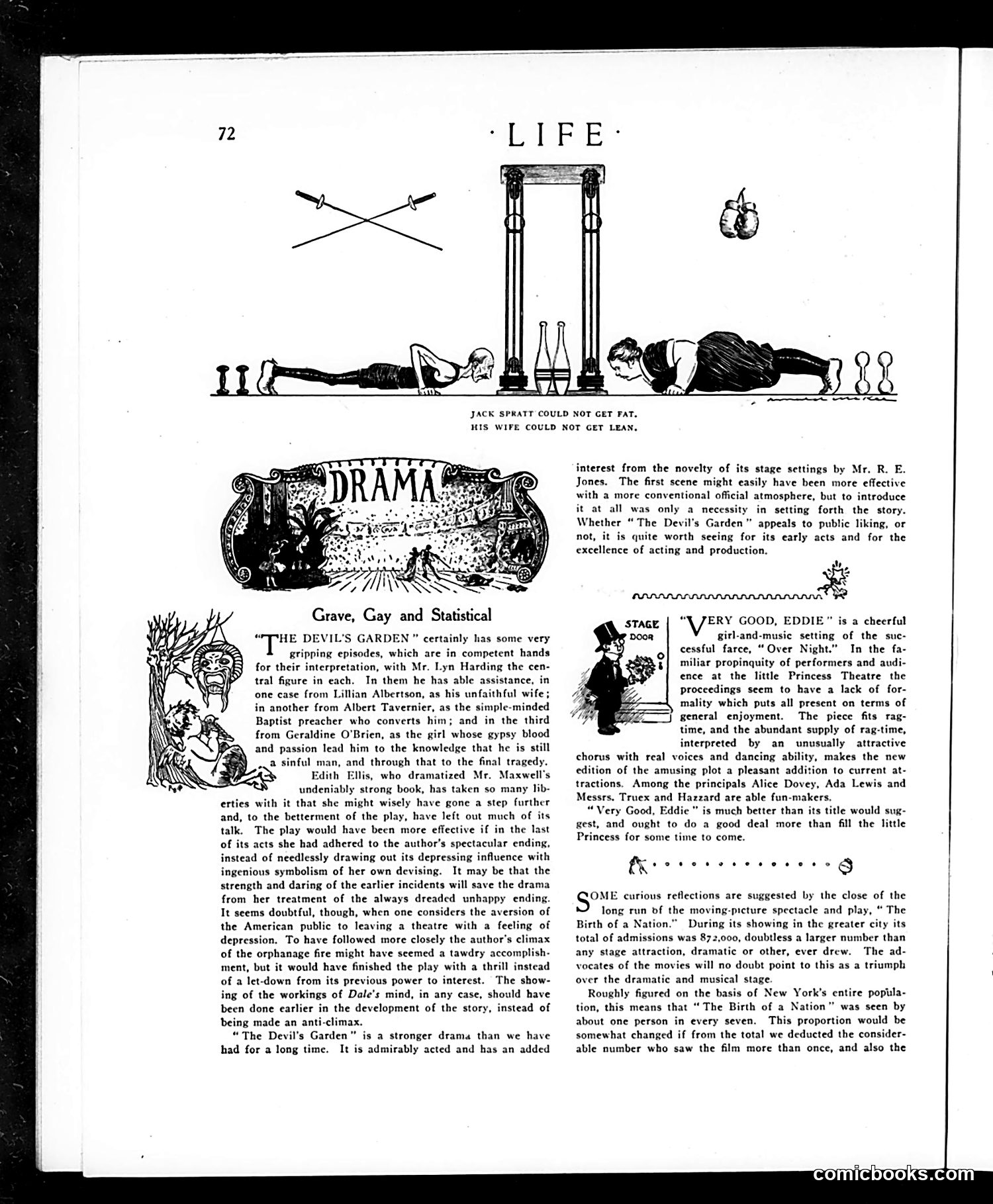
The top cartoon illustrates the nursery rhyme "Jack Spratt" through physical comedy: two figures in contrasting body types performing exercises on a see-saw apparatus, captioned "Jack Spratt could not get fat, his wife could not get lean." This is satirical commentary on body standards and marital discord through exercise. The page reviews three theatrical productions: "The Devil's Garden" (a serious drama with Lyn Harding), "Very Good, Eddie" (a lighthearted musical farce at the Princess Theatre), and discusses "The Birth of a Nation" film's box office success. The reviews critique dramatic versus entertainment value. The critic praises "Devil's Garden" for strong acting and design but faults its depressing ending, arguing American audiences prefer uplifting conclusions. "Very Good, Eddie" receives praise for cheerful ragtime entertainment with capable performers. The final section notes the film "Birth of a Nation" exceeded typical stage attendance numbers—a notable comparison between emerging cinema and traditional theater audiences of the era.
📄 Transcribed text from this page (OCR, searchable)
Machine-transcribed from the original scan — historical spelling and the odd misread are preserved.
JACK SPRATT COULD NOT GET PAT. MIS WIFE COULD NOT GET LEAN. Grave, Gay and Statistical “PHE DEVIL'S GARDEN” certainly has some very gripping episodes, which are in competent hands for their interpretation, with Mr. Lyn Harding the cen- tral figure in each. In them he has able assistance, in one case from Lillian Albertson, as his unfaithful wife; in another from Albert Tavernier, as the simple-minded Baptist preacher who converts him; and in the third from Geraldine O'Brien, as the girl whose gypsy blood and passion lead him to the knowledge that he is still a sinful man, and through that to the final traged Edith Ellis, who dramatized Mr. Maxwell's undeniably strong book, has taken so many lib- erties with it that she might wisely have gone a step further and, to the betterment of the play, have left out much of its talk. The play would have been more effective if in the last of its acts she had adhered to the author's spectacular ending instead of needlessly drawing out its depressing influence with ingenious symbolism of her own devising. It may be that the strength and daring of the earlier incidents will save the drama from her treatment of the always dreaded unhappy ending. It seems doubtful, though, when one considers the aversion of the American public to leaving a theatre with a feeling of depression. To have followed more closely the author's climax of the orphanage fire might have seemed a tawdry accomplish- ment, but it would have finished the play with a thrill instead of a let-down from its previous power to interest. The show- ing of the workings of Dale's mind, in any case, should have been done earlier in the development of the story, instead of being made an anti-climax. “The Devil’s Garden” is a stronger drama than we have had for a long time. It is admirably acted and has an added interest from the novelty of its stage settings by Mr. R. E. Jones. The first scene might easily have been more effective with a more conventional official atmosphere, but to introduce it at all was only a necessity in setting forth the story. Whether “ The Devil's Garden” appeals to public liking, or not, it is quite worth seeing for its early acts and for the excellence of acting and production. nA ss ERY GOOD, EDDIE” is a cheerful girl-and-music setting of the suc- cessful farce, “Over Night.” In the fa- miliar propinquity of performers and audi- ence at the little Princess Theatre the proceedings seem to have a lack of for- mality which puts all present on terms of general enjoyment. The piece fits rag- time, and the abundant supply of rag-time, interpreted by an unusually attractive chorus with real voices and dancing ability, makes the new edition of the amusing plot a pleasant addition to current at- tractions. Among the principals Alice Dovey, Ada Lewis and Messrs. Truex and Hazzard are able fun-makers, “Very Good, Eddie” is much better than its title would sug- gest, and ought to do a good deal more than fill the little Princess for some time to come. Koc creer cree g OME curious reflections are suggested by the close of the long run bf the moving-picture spectacle and play, “ The Birth of a Nation.” During its showing in the greater city its total of admissions was 872,000, doubtless a larger number than any stage attraction, dramatic or other, ever drew. The ad- vocates of the movies will no doubt point to this as a triumph over the dramatic and musical stage. Roughly figured on the basis of New York's entire popula- tion, this means that “The Birth of a Nation” was seen by about one person in every seven. This proportion would be somewhat changed if from the total we deducted the consider- able number who saw the film more than once, and also the