
Life, 1916-01-13 · page 21 of 44
Life — January 13, 1916 — page 21: what you’re looking at
What you’re looking at
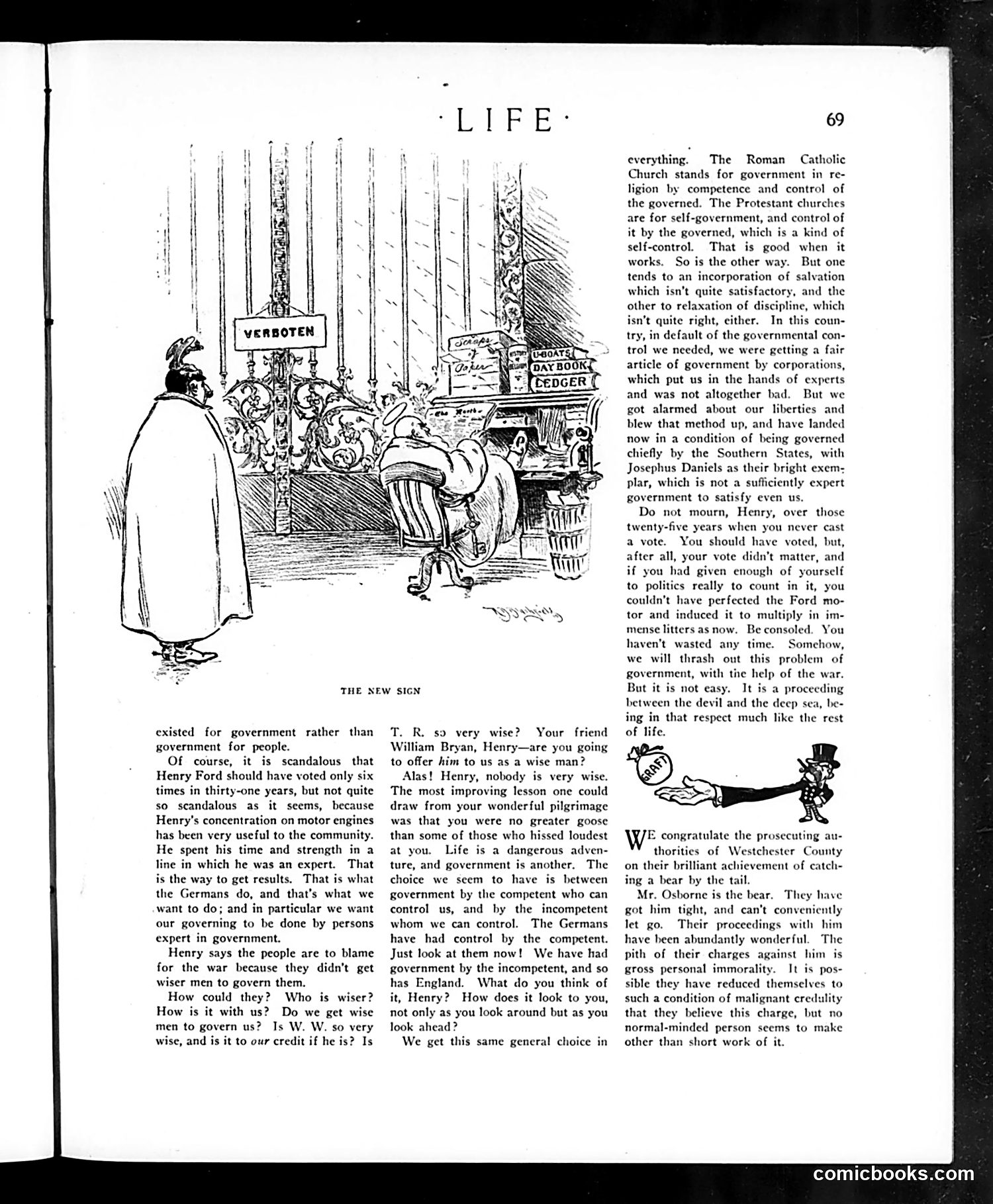
The cartoon depicts a figure (likely representing Henry Ford, based on the text) observing a shop display labeled "VERBOOTEN" (mimicking German signage). The satire critiques Ford's recent pacifist peace mission and his minimal voting record (only 3 times in 31 years). The text argues that while Ford's expertise in manufacturing justified his focus away from politics, society faces an impossible choice: government by competent experts who control citizens (like Germany), or government by incompetent people whom citizens can control (like America and England under Josephus Daniels). The piece satirizes Ford's moral authority to lecture others on governance while dismissing his own civic participation. The "new sign" appears to reference how post-WWI America increasingly copied authoritarian structures despite claiming to value democracy—a darkly ironic observation about choosing between tyranny and incompetence, with no satisfactory option available.
📄 Transcribed text from this page (OCR, searchable)
Machine-transcribed from the original scan — historical spelling and the odd misread are preserved.
THE NEW SIGN existed for government rather than government for people. Of course, it is scandalous that Henry Ford should have voted only s times in thirty-one years, but not quite so scandalous as it seems, because Henry's concentration on motor engines has been very useful to the community. He spent his time and strength in a line in which he was an expert. That the way to get results. That is what the Germans do, and that’s what we want to do; and in particular we want our governing to be done by persons expert in government. Henry says the people are to blame for the war because they didn’t get wiser men to govern them. How could they? Who is wiser? How is it with us? Do we get wise men to govern us? Is W. W. so very wise, and is it to our credit if he is? Is T. R. so very wise? Your friend William Bryan, Henry—are you going to offer him to us as a wise man? Alas! Henry, nobody is very wise. The most improving lesson one could draw from your wonderful pilgrimage was that you were no greater goose than some of those who hissed loudest at you. Life is a dangerous adven- ture, and government is another. The choice we scem to have is between government by the competent who can control us, and by the incompetent whom we can control. The Germans have had control by the competent. Just look at them now! We have had government by the incompetent, and so has England. What do you think of it, Henry? How does it look to you, not only as you look around but as you look ahead ? We get this same general choice in 69 everything. The Roman Catholic Church stands for government in re- ligion by competence and control of the governed. The Protestant churches are for self-government, and control of it by the governed, which is a kind of self-control. That is good when it works. So is the other way. But one tends to an incorporation of salvation which isn’t quite satisfactory, and the other to relaxation of discipline, which n’t quite right, either. In this coun- try, in default of the governmental con- trol we needed, we were getting a fair article of government by corporations, which put us in the hands of experts and was not altogether bad. But we got alarmed about our liberties and blew that method up, and have landed now in a condition of being governed chiefly by the Southern States, with Josephus Daniels as their bright exem; plar, which is not a sufficiently expert government to satisfy even us. Do not mourn, Henry, over those twenty-five years when you never cast a vote. You should have voted, but, after all, your vote didn’t matter, and if you had given enough of yourself to politics really to count in it, you couldn't have perfected the Ford mo- tor and induced it to multiply in im- mense litters as now. Be consoled. You haven't wasted any time. Somehow, we will thrash out this problem of government, with the help of the war. But it is not easy, It is a proceeding between the devil and the deep sea, be- ing in that respect much like the rest thorities of Westchester County on their brilliant achievement of catch- ing a bear by the tail. Mr. Osborne is the bear. They have got him tight, and can't conveniently let go. Their proceedings with him have been abundantly wonderful. The pith of their charges against him is gross personal immorality. It is pos- sible they have reduced themselves to such a condition of malignant credulity that they believe this charge, but no normal-minded person seems to make other than short work of it. comicbooks.com