
Life, 1916-01-13 · page 25 of 44
Life — January 13, 1916 — page 25: what you’re looking at
What you’re looking at
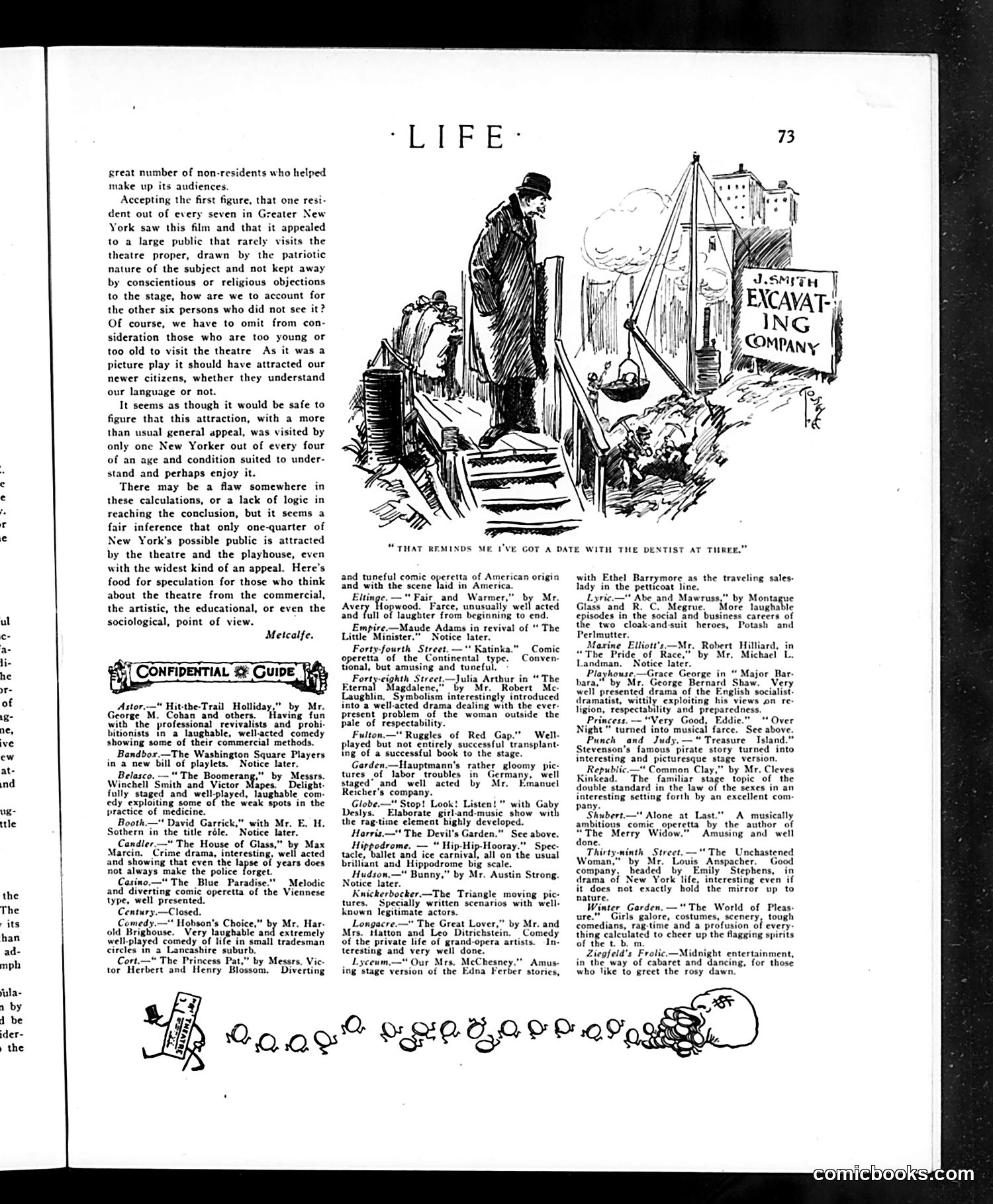
This page from Life magazine contains theater reviews and listings rather than political cartoons. The main illustration shows a man and child outside the "Smith Excavating Company," with the caption "That reminds me I got a date with the dentist at there." The joke is a visual pun: the "excavating company" sign evokes dental work (excavation = drilling/extraction), which the man humorously conflates with an actual dentist appointment. It's gentle, domestic humor typical of early 20th-century American magazines. The bulk of the page is a "Confidential Guide" to New York theaters, listing current productions with brief critical assessments. These include comedies, operettas, and dramas—establishments like the Astor, Belasco, and Empire theaters. The reviews reflect theatrical tastes of the era, favoring accessible comedies and well-acted pieces. This is primarily entertainment journalism, not satire.
📄 Transcribed text from this page (OCR, searchable)
Machine-transcribed from the original scan — historical spelling and the odd misread are preserved.
nd ug ttle the The its han ad- mph yula- a by d be ider- ) the great number of non-residents who helped make up its audiences. Accepting the first figure, that one resi- dent out of every seven in Greater New York saw this film and that it appealed to a large public that rarely visits the theatre proper, drawn by the patriotic nature of the subject and not kept away by conscientious or religious objections to the stage, how are we to account for the other six persons who did not sce it? Of course, we have to omit from con- sideration those who are too young or too old to visit the theatre As it was a picture play it should have attracted our newer citizens, whether they understand our language or not. It seems as though it would be safe to figure that this attraction, with a more than usual general appeal, was visited by only one New Yorker out of every four of an age and condition suited to under- stand and perhaps enjoy it. There may be a flaw somewhere in these calculations, or a lack of logic in reaching the conclusion, but it seems a fair inference that only one-quarter of New York's possible public is attracted by the theatre and the playhouse, even with the widest kind of an appeal. Here's food for speculation for those who think about the theatre from the commercial, the artistic, the educational, or even the sociological, point of view. Metcalfe. a CONFIDENTIAL %¢ GUIDE i Astor.—" Hit-the-Trail Holliday,” by Mr. George M. Cohan and others. Having fun with the professional revivalists and prohi- bitionists in a laughable, well-acted comedy showing some of their commercial methods. _ Bandbor.—The Washington Square Players in a new bill of playlets. Notice later, Belasco. —“ The Boomerang,” by Messrs. Winchell Smith and Victor Mapes. Delis fully staged and well-played, laughable com- edy exploiting some of the weak spots in the practice of medicine. Booth.—"' David Garrick,” with Mr. E. H. Sothern in the title réle. Notice later. Candler.—" The House of Glass,” by Max Marcin. Crime drama, interesting, well acted and showing that even'the lapse of years does not always make the police forget. Casino. The Blue Paradise.’ Melodic and diverting comic operetta of the Viennese type, well presented. Century.—Closed. Comedy.—** Hobson's Choie old Brighouse. Very laughabl well-played comedy of life in circles in a Lancashire suburb. Cort.- The Princess Pat,” by Messrs. Vic- tor Herbert and Henry Blossom. Diverting iby Mr. Har. extremely 1 tradesman “THAT REMINDS M and tuneful comic operetta of American origin and with the scene laid in America, Eltinge, — "Fait. and Warmer.” by Me: Avery Hopwood. Farce, unusually well acted and full of laughter from beginning to end. _Empire.—Maude Adams in revival of “ The Little Minister.” Notice later. Forty-fourth Street. —“* Katinka.” Comic operetta of the Continental type. Conven tonal, but amusing and tuneful. Forty-eighth Street—Julia Arthur in “ The Eternal Magdalene,” by Mr. Robert Me- Laughlin. Symbolism interestingly introduced into a well-acted drama dealing with the ever- present problem of the woman outside the pale of respectability. Fulton.—* Ruggles of Red Gap." Well- played but not entirely successful transplant. ing of a successful book to the stage. Garden.—Hauptmann’s rather gloomy pic- tures of labor troubles in Germany, well staged” and well acted by Mr. Emanuel Reicher’s company. Globe.—" Stop! Look! Listeni” with Gab Deslys. Elaborate girl-and-music show with the rag-time element highly developed. Horris.— The Devil's Garden.” See above. Hippodrome. — “ Hip-Hip-Hooray.” Spec tacle, ballet and ice carnival, all on the usual brilliant and Hippodrome big scale. Hudson,—" Bunny,” by Mr. Austin Strong. Notice later. Knickerbocker—The Triangle moving pic- tures. Specially written scenarios with well- known legitimate actors. Longacre.—" The Great Lover,” by Mr. and Mrs, Hatton and Leo Ditrichstein. Comedy of the private life of grand-opera artists. In- teresting and very well done, _ Lyceum.— Our Mrs. McChesney.” Amus- ing ‘stage version of the Edna Ferber stories, QQ. ASF MLHEP- GA & O.0% GOT A DATE WITH THE DENTIST AT THREE.” with Ethel Barrymore as the traveling sales: lady in the petticoat line. Lyric.—" Abe and Mawruss,” by Montague Glass and R. C, Megrue. More laughable episodes in the social and business careers of the two cloak-and-suit heroes, Potash and Perlmutter. Marine Eltiott’s—Mr, Robert Hilliard, in “The Pride of Race,” by Mr. Michael Landman. ‘otice later. Playhouse. —Grace Ge bara,” by Mr baw. Very well presented drama of the English socialist: dramatist, wittily exploiting his views on re- ligion, respectability and preparedness. Princess. "Very Good, Eddie.” “ Over Night” turned into musical farce. See above. Punch and Judy, —“ Treasure Island.” Stevenson's famous pirate story turned into interesting and picturesque stage version. Republic.—* Common Clay,” by Mr. Cleves Kinkead. The familiar stage topic of the double standard in the law of the sexes in an interesting setting forth by an excellent com: pany. Shubert—" Alone at Last." A musically ambitions comic operetta by the author of “The Merry Widow.” Amusing and well done. Thirty-ninth Street.—" The Unchastened Woman,” by Mr. Louis Anspacher. Good company, headed by Emily Stephens, in drama of New York life, interesting even if it does not exactly hold the mirror up to nature. Major Bar- Garden, —“The World of Pleas- ure.” irls galore, costumes, scenery, tough comedians, rag-time and a profusion of every: thing calculated to cheer up the flagging spirits of the tb. m, Ziegfeld’s Frolic—Midnight entertainment, in‘the way of cabaret and dancing, for those who like to greet the rosy dawn. EES