
Life, 1916-01-13 · page 16 of 44
Life — January 13, 1916 — page 16: what you’re looking at
What you’re looking at
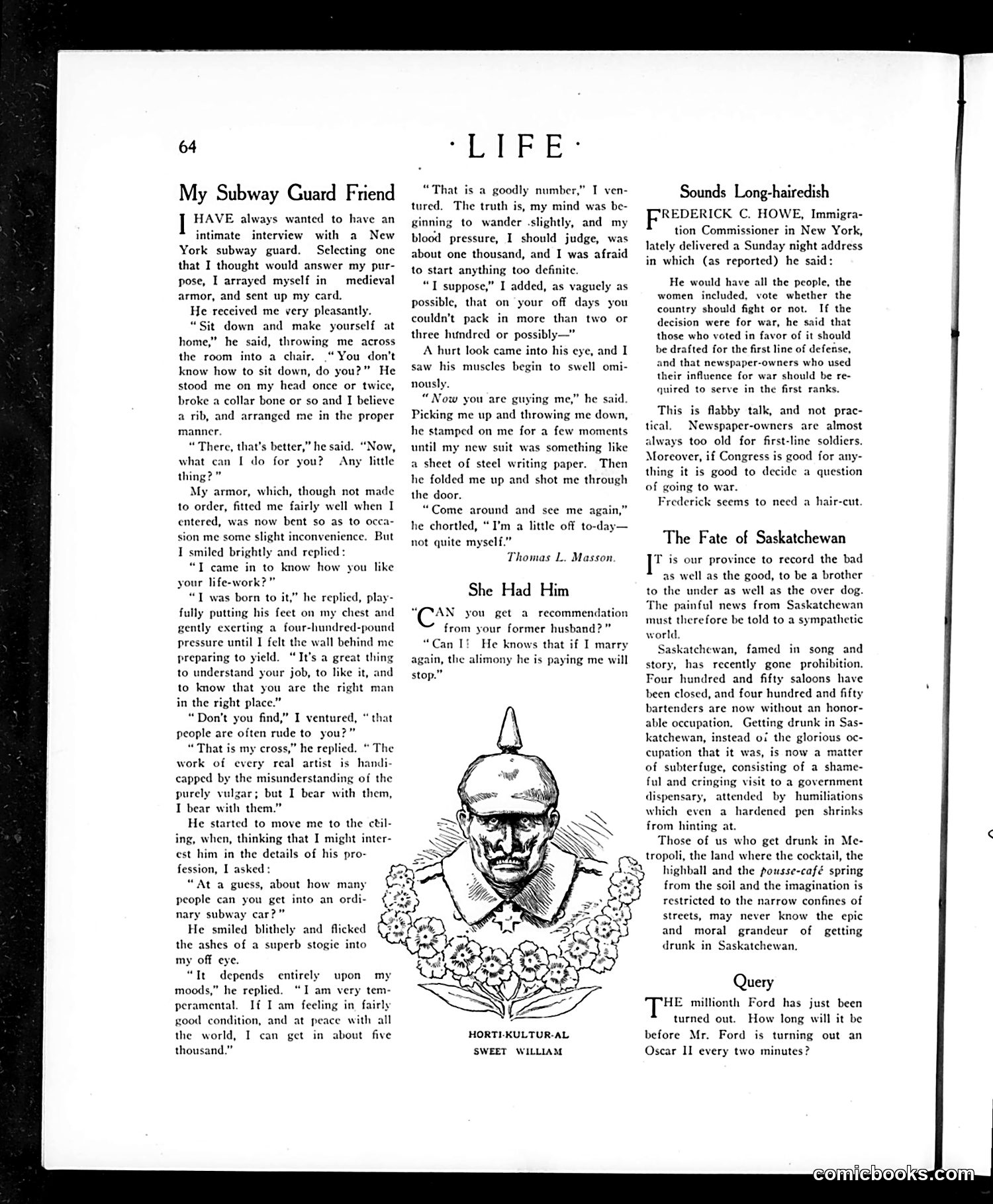
This page contains three separate satirical pieces: **"My Subway Guard Friend"** is a humorous essay about interviewing a New York City subway guard. The joke satirizes both the guard's brutal treatment of passengers (throwing the narrator around, breaking ribs) and his pompous pride in his work. The exaggeration—claiming he can pack 5,000 people into one car depending on his "mood"—mocks the overcrowded conditions of early-20th-century New York subways and the guard's perceived indifference to passenger welfare. **"She Had Him"** is a brief joke about divorce and alimony: a woman confidently states her ex-husband will provide a recommendation because he knows remarriage would end his alimony payments—a practical threat rather than genuine endorsement. **"Sounds Long-hairedish"** critiques immigration commissioner Frederick C. Howe's idealistic proposal that citizens vote on war and that pro-war newspaper owners be conscripted. Life's editors dismiss this as impractical, noting newspaper owners are too old for combat, and suggest Howe needs a "hair-cut"—period slang implying he's an impractical intellectual.
📄 Transcribed text from this page (OCR, searchable)
Machine-transcribed from the original scan — historical spelling and the odd misread are preserved.
64 My Subway Guard Friend HAVE always wanted to have an intimate interview with a New York subway guard. Selecting one that I thought would answer my pur- pose, I arrayed myself in medieval armor, and sent up my card. He received me very pleasantly. “Sit down and make yourself at home,” he said, throwing me across the room into a chair. “You don't know how to sit down, do you?” He stood me on my head once or twice, broke a collar bone or so and I believe a rib, and arranged me in the proper manner. “There, t better,” he said. “Now, what can I do for you? Any little thing?” My armor, which, though not made to order, fitted me fairly well when I entered, was now bent so as to occa- sion me some slight inconvenience. But I smiled brightly and replied: “T came in to know how you like your life-work?” “T was born to it,” he replied, play- fully putting his feet on my chest and gently exerting a four-hundred-pound pressure until I felt the wall behind me preparing to yield. “It’s a great thing to understand your job, to like it, and to know that you are the right man in the right place.” “Don’t you find,” I ventured, “that people are often rude to you? “That is my cross,” he replied. “ The work of every real artist is handi- capped by the misunderstanding of the purely vulgar; but I bear with them, I bear with them.” He started to move me to the ctil- ing, when, thinking that I might inter- est him in the details of his pro- fession, I asked: At a guess, about how many people can you get into an ordi- nary subway car?” He smiled blithely and flicked the ashes of a superb stogie into my off eye. “Tt depends entirely upon my moods,” he replied. “I am very tem- peramental. If I am feeling in fairly good condition, and at peace with all the world, I can get in about five thousand.” “LIP E® “That is a goodly number,” I ven- tured. The truth is, my mind was be- ginning to wander slightly, and my blood pressure, I should judge, was about one thousand, and I was afraid to start anything too definite. “I suppose,” I added, as vaguely as possible, that on your off days you couldn’t pack in more than two or three hundred or possibly—” A hurt look came into his eye, and 1 saw his muscles begin to swell omi- nously. “ Now you are guying me,” he said Picking me up and throwing me down, he stamped on me for a few moments until my new suit was something like a sheet of steel writing paper. Then he folded me up and shot me through the door. “Come around and see me again,” he chortled, “I’m a little off to-d; not quite mysel Thomas L. Masson She Had Him “CAN you get_a recommendation from your former husband?” “Can I! He knows that if I marry again, the alimony he is paying me will stop.” HORTI-KULTUR-AL SWEET WILLIAM Sounds Long-hairedish REDERICK C. HOWE, Immigra- tion Commissioner in New York, lately delivered a Sunday night address in which (as reported) he said: He would have all the people, the women included, vote whether the country should fight or not. If the decision were for war, he said that those who voted in favor of it should be drafted for the first line of defense, and that newspaper-owners who used their influence for war should be re- quired to serve in the first ranks. This is flabby talk, and not prac- tical. Newspaper-owners are almost always too old for first-line soldier Moreover, if Congress is good for any- thing it is good to decide a question of going to war. Frederick seems to need a hair-cut. The Fate of Saskatchewan I" is our province to record the bad as well as the good, to be a brother to the under as well as the over dog. The painful news from Saskatchewan must therefore be told to a sympathetic world. Saskatchewan, famed in song and story, has recently gone prohibition. Four hundred and fifty saloons have been closed, and four hundred and fifty bartenders are now without an honor- able occupation. Getting drunk in Sas- katchewan, instead of the glorious oc- cupation that it was, is now a matter of subterfuge, consisting of a shame- ful and cringing visit to a government dispensary, attended by humiliations which even a hardened pen shrinks from hinting at. Those of us who get drunk in Me- tropoli, the land where the cocktail, the highball and the pousse-café spring from the soil and the imagination is restricted to the narrow confines of Streets, may never know the epic and moral grandeur of getting drunk in Saskatchewan, Query i Bate millionth Ford has just been turned out. How long will it be before Mr. Ford is turning out an Oscar II every two minutes?