
A complete issue · 48 pages · 1915
Life — July 15, 1915
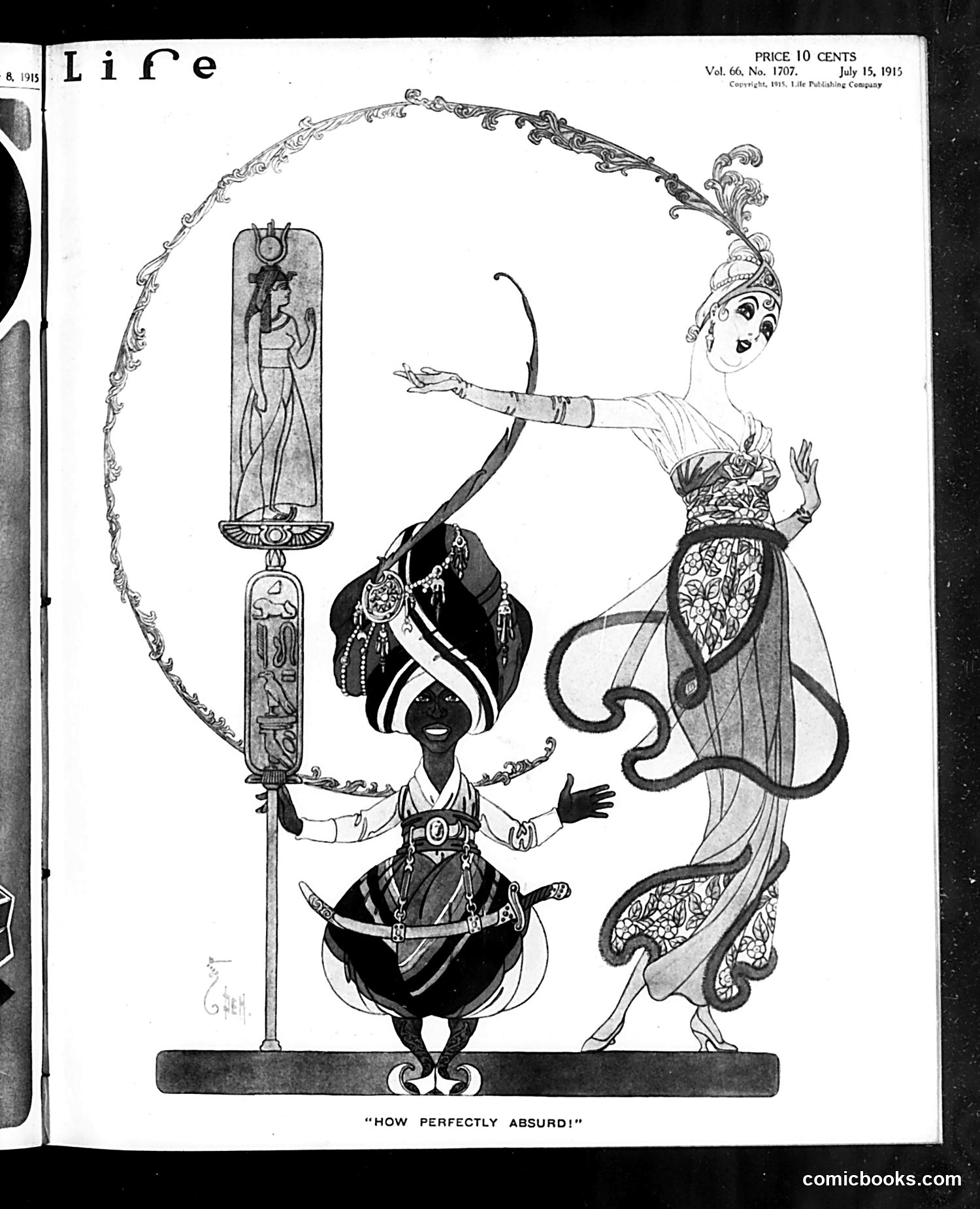
This July 1915 *Life* cartoon satirizes Egyptian-themed fashion and exoticism popular in early 20th-century American high society. The illustration shows a fashionable woman in an elaborate Egyptian-inspired costume performing what appears to be a theatrical or dance pose, flanked by Egyptian hieroglyphic imagery and decorative elements. The caption "How Perfectly Absurd!" suggests mockery of the era's enthusiasm for Egyptology and orientalist aesthetics—treating ancient Egyptian culture as fashionable costume rather than serious history. The exaggerated poses and styling ridicule wealthy Americans' adoption of "exotic" themes as entertainment and status symbols. The central figure's dramatic gesturing emphasizes the performative absurdity *Life's* editors found in this trend.
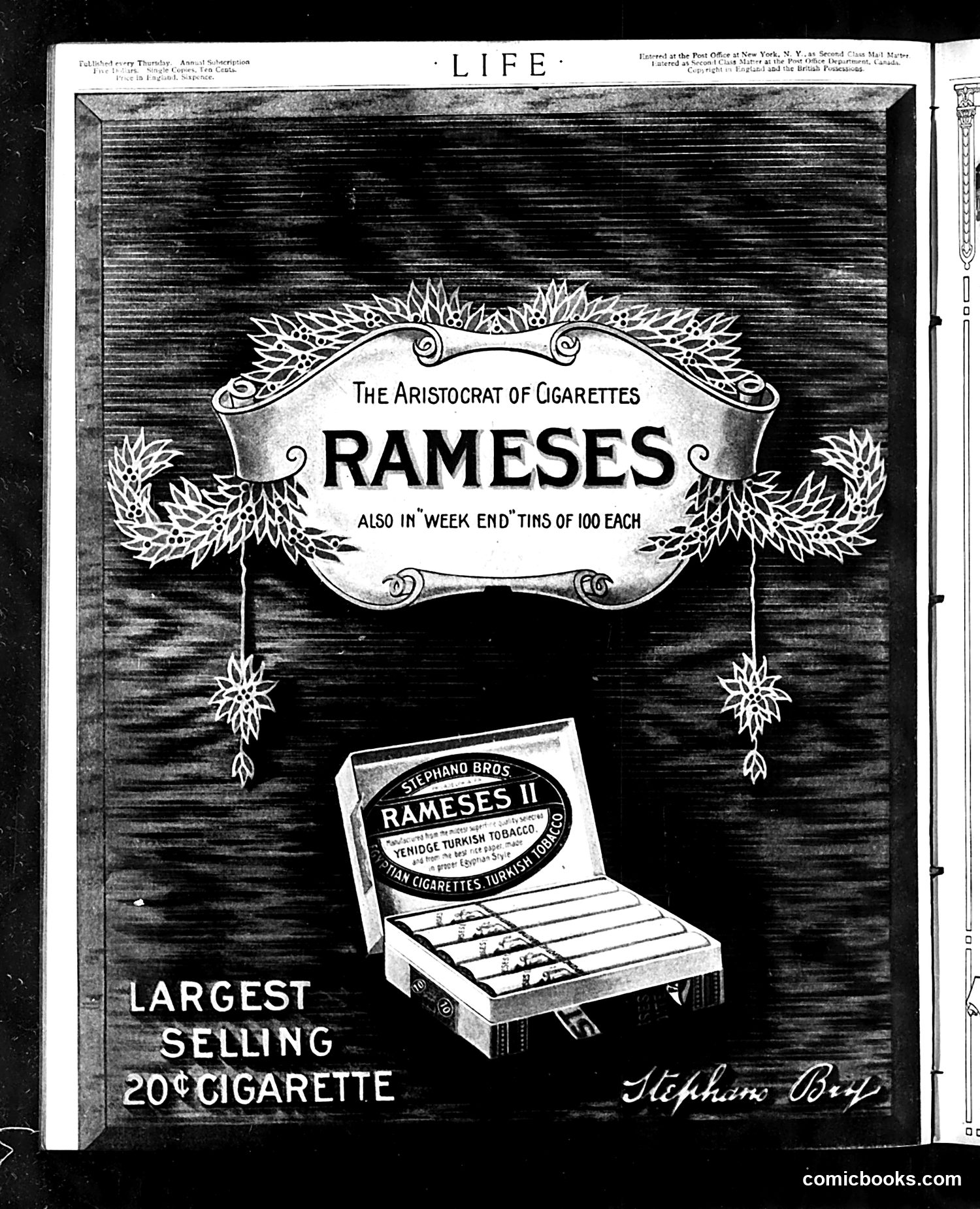
This page is primarily an **advertisement**, not a political cartoon. It promotes Rameses cigarettes, manufactured by Stephano Bros., describing them as "The Aristocrat of Cigarettes" and "Largest Selling 20¢ Cigarette." The ad highlights that Rameses also come in "Week End" tins of 100 each. A product box image shows "Rameses II" labeled as "Yehidgé Turkish Tobacco" with "Turkish Cigarettes Turkish Tobacco." The decorative elements—ornamental borders and star motifs—are typical of early 20th-century commercial design. The signature "Stephano Bros" appears at bottom. There is **no satire or political commentary** evident. This is straightforward product marketing using period advertising conventions to appeal to consumers.
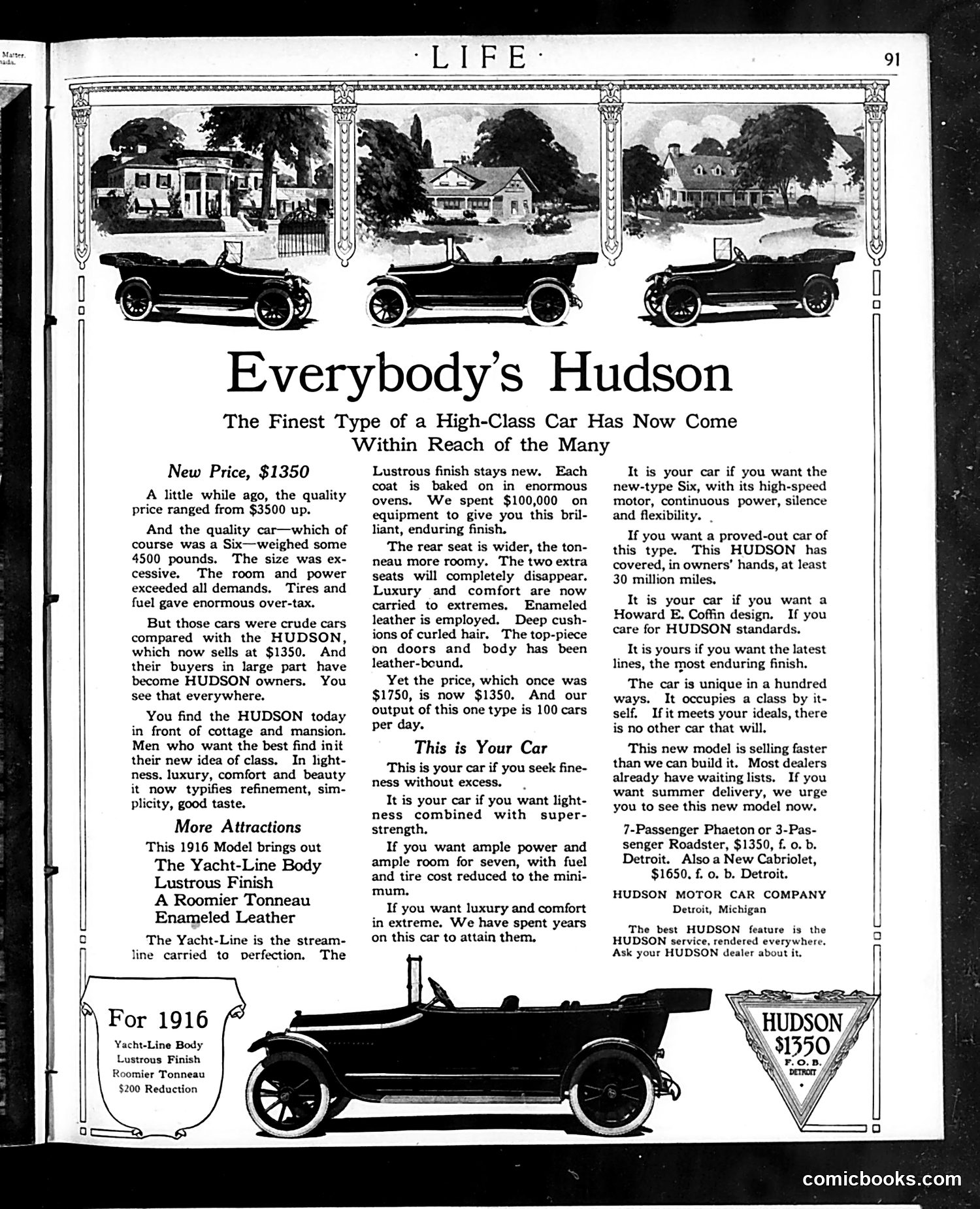
This page is **primarily advertising, not satire or political commentary**. It's a 1916 Hudson Motor Car Company advertisement from *Life* magazine. The ad promotes Hudson's new $1,350 automobile as now affordable to the average person—"Everybody's Hudson." The headline claims "The Finest Type of a High-Class Car Has Now Come Within Reach of the Many," positioning the car as democratizing luxury. The three house illustrations at top suggest different customer lifestyles the car serves. The text emphasizes features: the "Yacht-Line Body," roomier rear seat, and Howard E. Coffin's engineering design. The only potential humor lies in the gentle marketing premise: that this previously exclusive vehicle is now accessible to "everybody"—playing on early-twentieth-century aspirations toward upward mobility through consumer goods. This reflects period advertising trends rather than political satire.
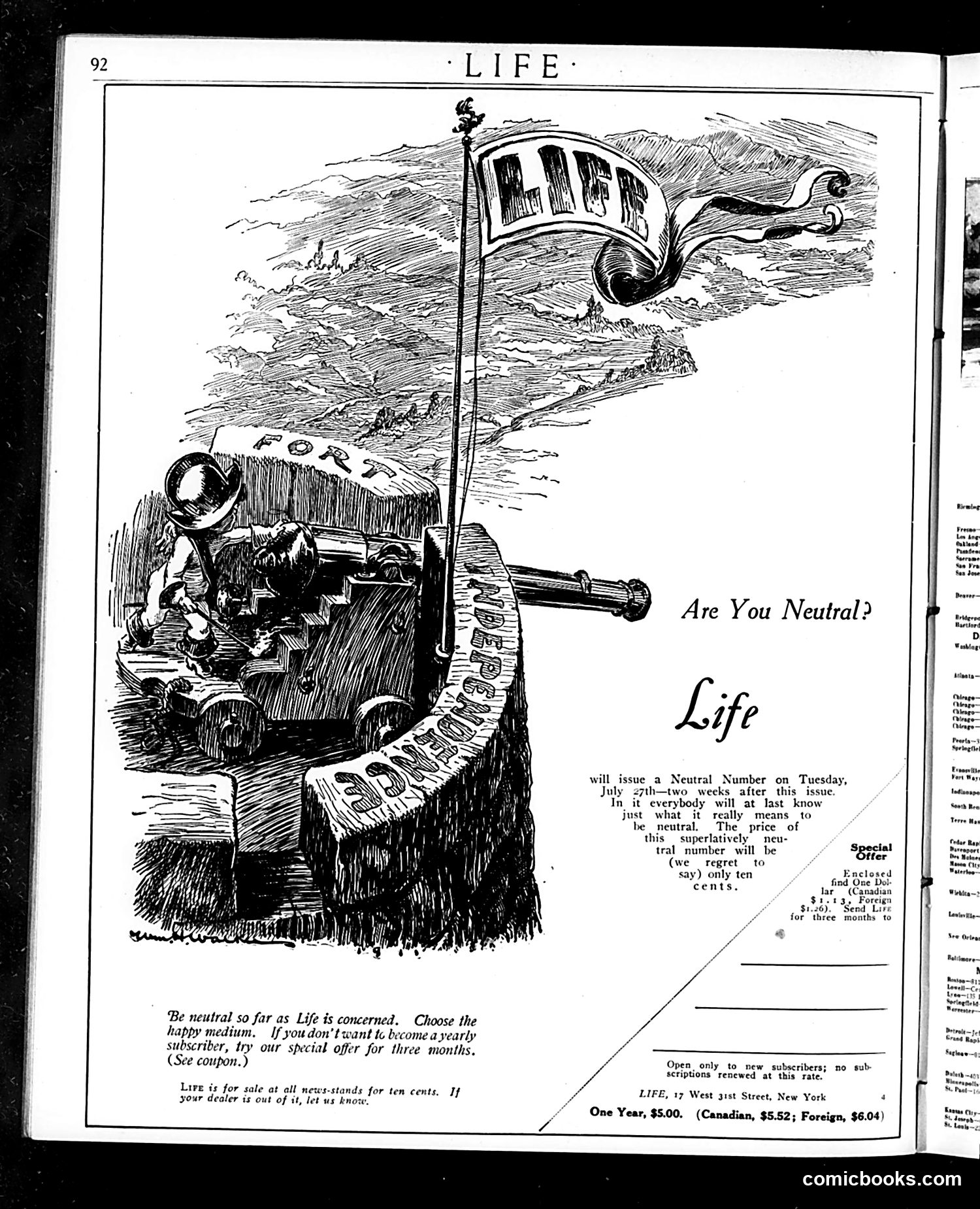
This page is primarily an **advertisement for Life magazine's upcoming "Neutral Number"** (July 27th), rather than editorial content. The cartoon depicts a figure operating a cannon from a fortified position, with a "LIFE" flag flying above. The image appears to reference **World War I and debates over American neutrality**—a major political issue in the 1910s as the U.S. debated intervention in the European conflict. The accompanying text asks "Are You Neutral?" and invites readers to subscribe, suggesting the magazine will explore what "neutrality" actually means during wartime. The satire implies that true neutrality may be impossible or hypocritical—the armed fortification undermines any claim of peaceful non-involvement. The special offer advertises a ten-cent trial subscription for three months.
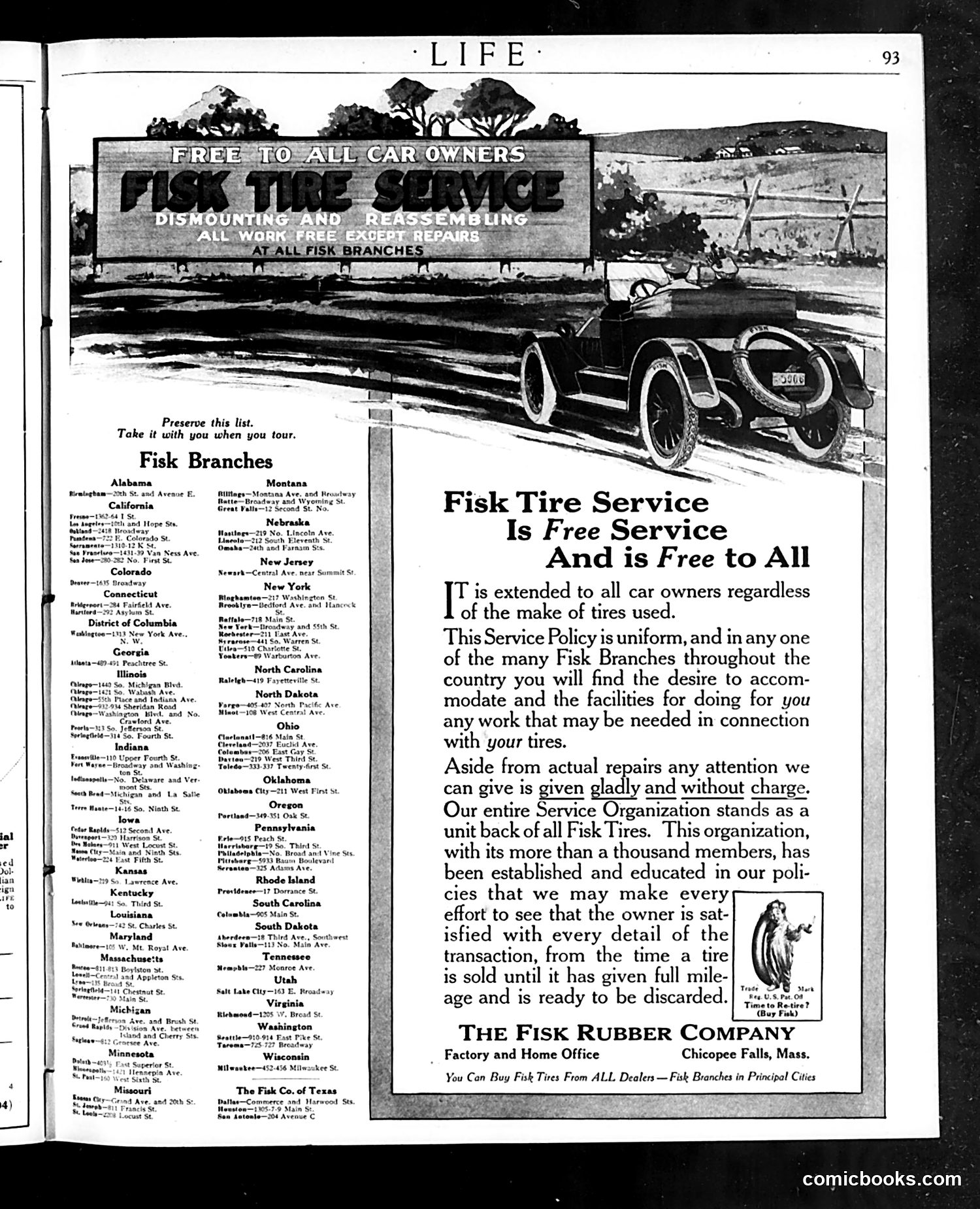
This page is primarily **advertising, not editorial content or satire**. It features a full-page advertisement for Fisk Tire Service, a rubber company based in Chicopee Falls, Massachusetts. The ad promotes free tire service available to all car owners at Fisk branch locations nationwide, regardless of tire brand. The visual shows a vintage automobile next to a large billboard advertising "Fisk Tire Service." The only potentially humorous element is a small illustration labeled "Trade Mark — Mark Fisk's Sleepy Gypsy" in the lower right, which appears to be the company's mascot or logo—a drowsy figure associated with the Fisk brand. The bulk of the page consists of an extensive directory listing Fisk branches across American states and cities.
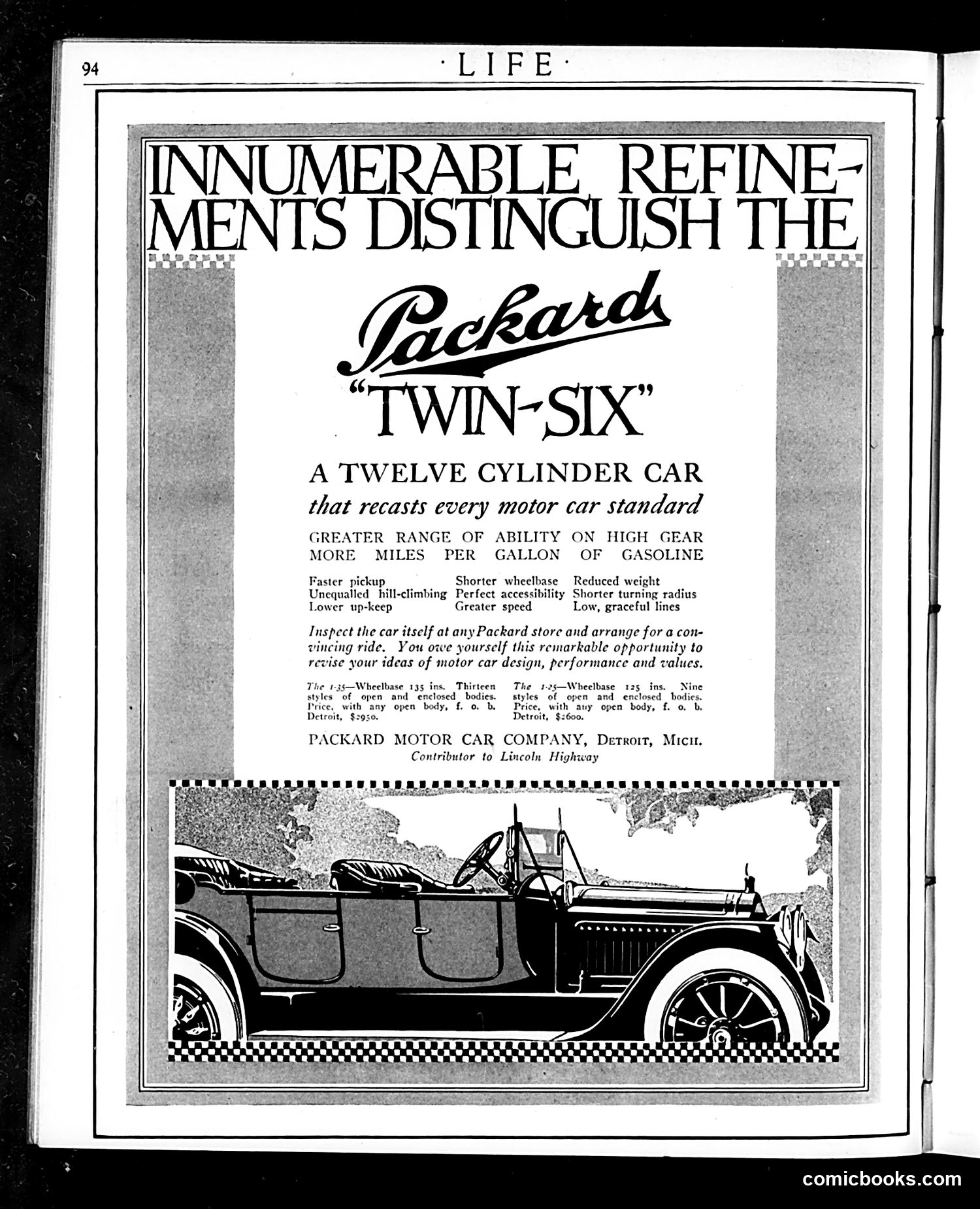
This is **not a cartoon or satire**—it's a straightforward automobile advertisement from *Life* magazine (page 94). The Packard Motor Car Company is promoting their "Twin-Six," a twelve-cylinder luxury vehicle. The ad emphasizes technical refinements and performance features: faster pickup, unequaled hill-climbing ability, greater fuel efficiency, and improved accessibility. The visual shows a side-profile illustration of an open-air automobile. The ad invites readers to inspect the car at Packard dealerships and experience a test drive. Two models are mentioned with different wheelbases and pricing ("f.o.b. Detroit"). This represents early 20th-century automotive advertising targeting affluent consumers interested in engineering sophistication and luxury features.
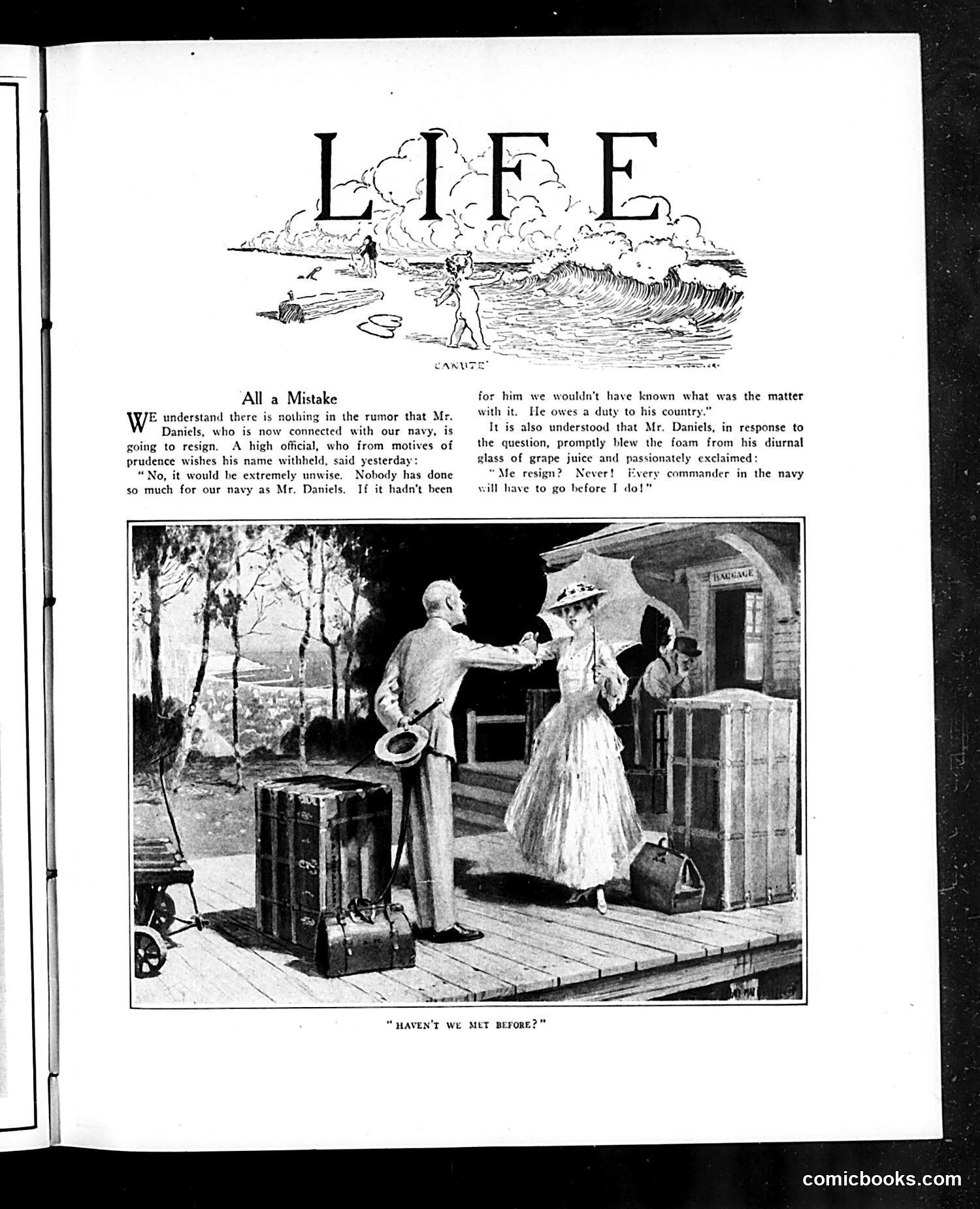
This page satirizes a naval resignation controversy involving someone named **Mr. Daniels**. The article states Daniels, connected to the navy, is resigning due to "motives of prudence," and a high official claims this would be "extremely unwise" — suggesting Daniels is important and his departure controversial. The illustration below shows a man in a straw hat at a train station confronting a woman, with the caption "HAVEN'T WE MET BEFORE?" The satire appears to mock Daniels by suggesting his resignation stems from a personal/romantic entanglement rather than legitimate reasons, implying the "mistake" is either the resignation itself or the circumstances forcing it. The overall tone is darkly humorous commentary on political scandal.
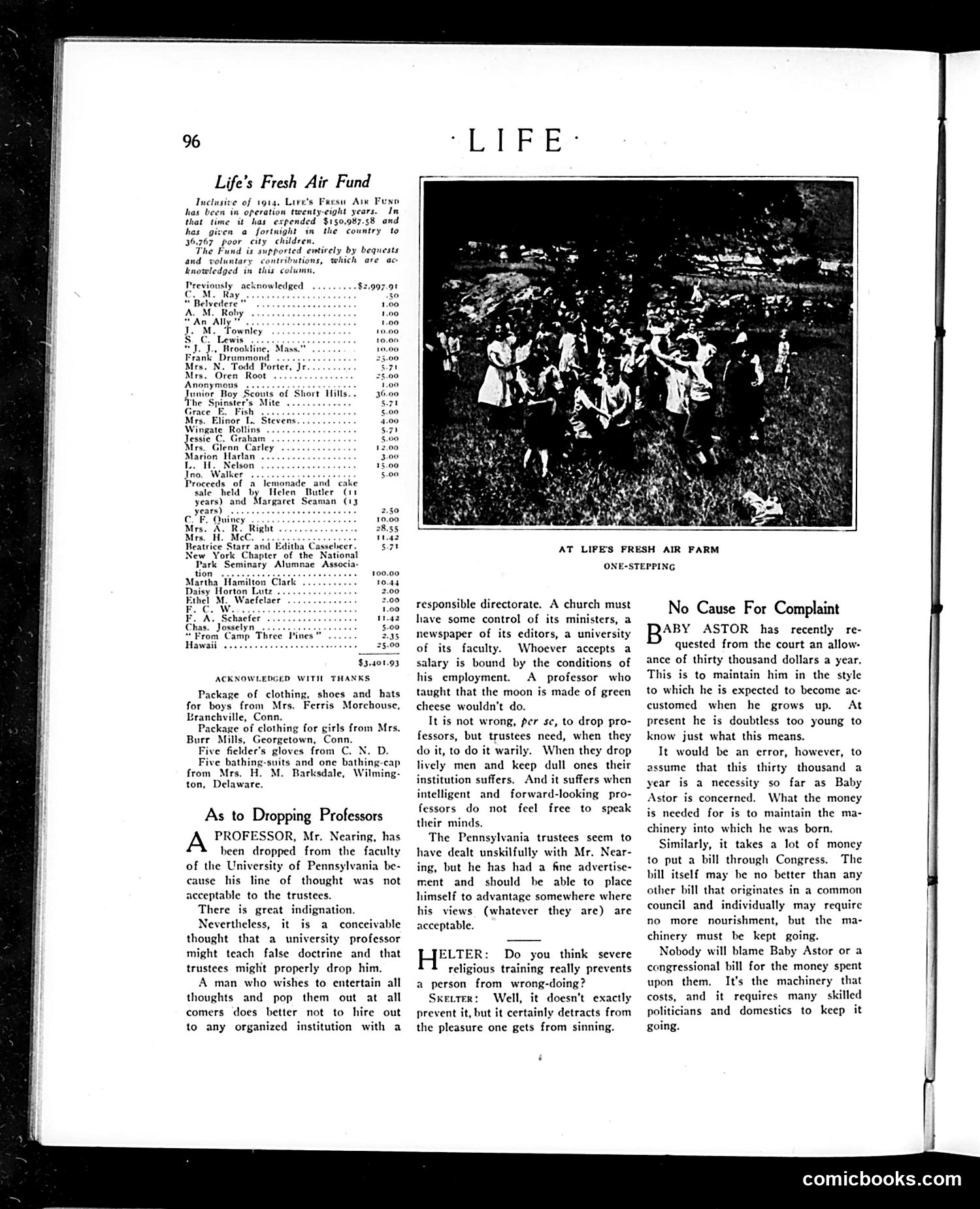
This page contains a photograph titled "At Life's Fresh Air Farm—One-Stepping" showing a group of children and adults at what appears to be a recreational facility or summer camp. The text sections address two separate topics: 1. **"Life's Fresh Air Fund"** lists donors and contributions to a charitable program providing outdoor recreation for children. 2. **"As to Dropping Professors"** and **"No Cause For Complaint"** discuss institutional governance, specifically addressing whether universities should retain professors who teach controversial ideas or hold unpopular views. The dialogue debates whether religious training prevents wrongdoing and whether salary restrictions are justified for maintaining institutional stability. The content reflects early 20th-century concerns about academic freedom and institutional control rather than satirizing specific political figures.
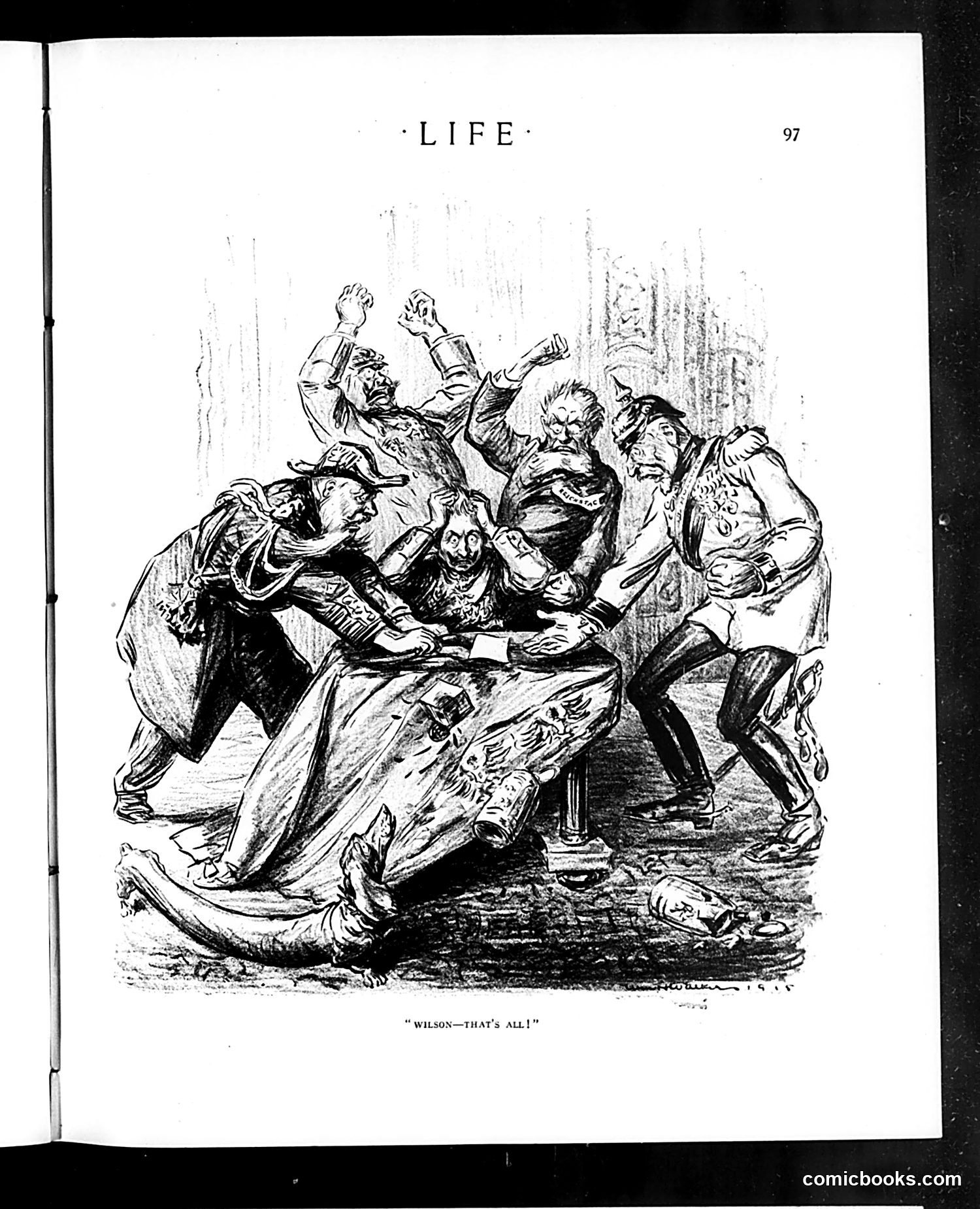
This Life magazine cartoon depicts a group of men gathered around a fallen figure labeled "Wilson" (likely President Woodrow Wilson), appearing to celebrate or declare victory over him. The men's exaggerated facial expressions and aggressive postures suggest triumph or vindication. The caption "WILSON—THAT'S ALL!" implies finality—suggesting Wilson's political end or defeat. Without additional context visible on this page, the specific historical moment is unclear, though this likely references a significant political setback during Wilson's presidency (1913-1921), possibly related to legislative defeat, treaty rejection, or party conflict. The satirical style mocks Wilson through caricature while celebrating his opponents' success.
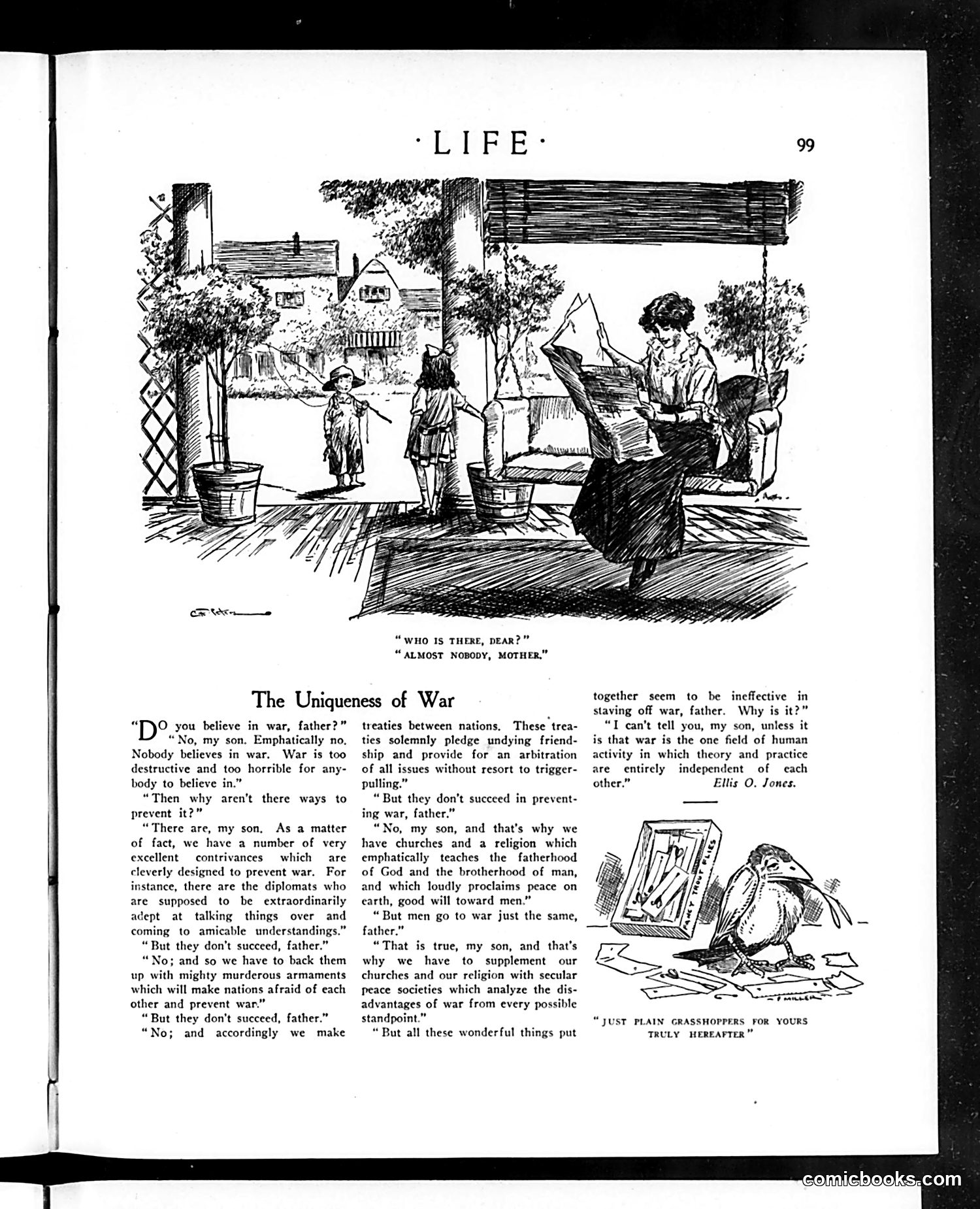
This page presents a satirical dialogue between a father and son about preventing war. The main cartoon depicts a domestic scene where a child asks "Who is there, dear?" and the mother replies "Almost nobody, Mother." The accompanying text is a philosophical debate: the son asks if war can be prevented, and the father explains various institutional attempts—diplomacy, churches, religion teaching brotherhood, and "secular peace societies." Yet each solution fails because "men go to war just the same." The satire's point: despite elaborate intellectual and religious frameworks designed to prevent conflict, they remain ineffective. The cartoon's casual domestic setting underscores the disconnect between lofty peacetime ideals and war's persistent reality. A quote by Elis O. Jones reinforces this cynicism about humanity's inability to transcend warfare regardless of theory or practice.
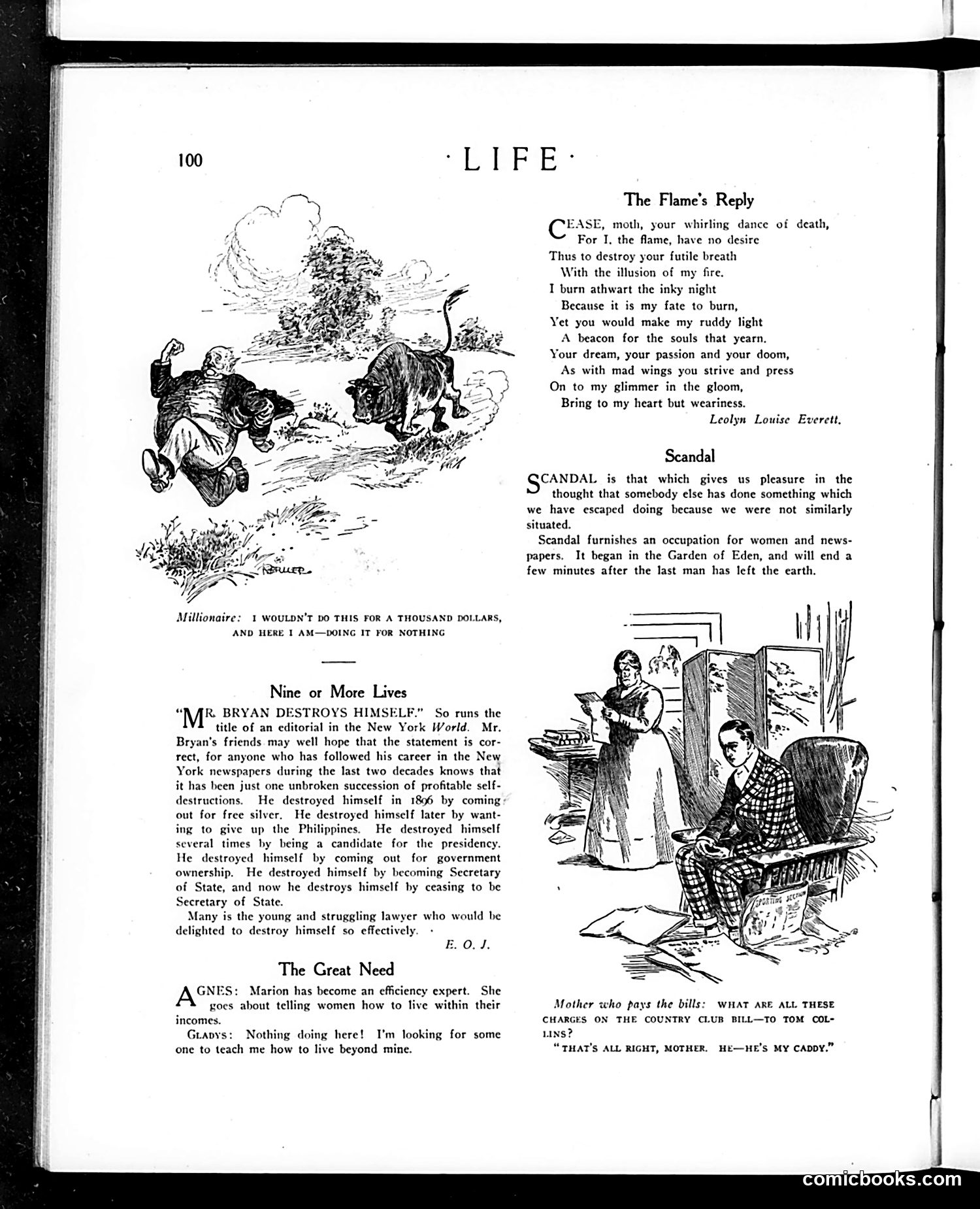
This page contains several satirical pieces: **"The Flame's Reply"** - A poem by Leolyn Louise Everett responding to a moth's courtship with a flame, using extended metaphor about fate and self-destruction. **"Scandal"** - A brief commentary defining scandal as pleasure derived from others' misfortunes, positioned as women's and newspaper gossip-mongers' primary occupation. **"Nine or More Lives"** - Satirizes William Jennings Bryan's political career through the metaphor of cats with multiple lives. The piece catalogs his repeated self-destructions: failed silver campaigns, presidential runs, and political positions—mocking his persistent political ambitions despite repeated failures. **"The Great Need"** - A brief dialogue where Gladys seeks instruction on living beyond her means, a jab at consumerism and financial excess. **Right cartoon** - Shows a mother questioning country club expenses, with a son claiming his caddy requires such spending—satirizing extravagant leisure spending and class pretension.
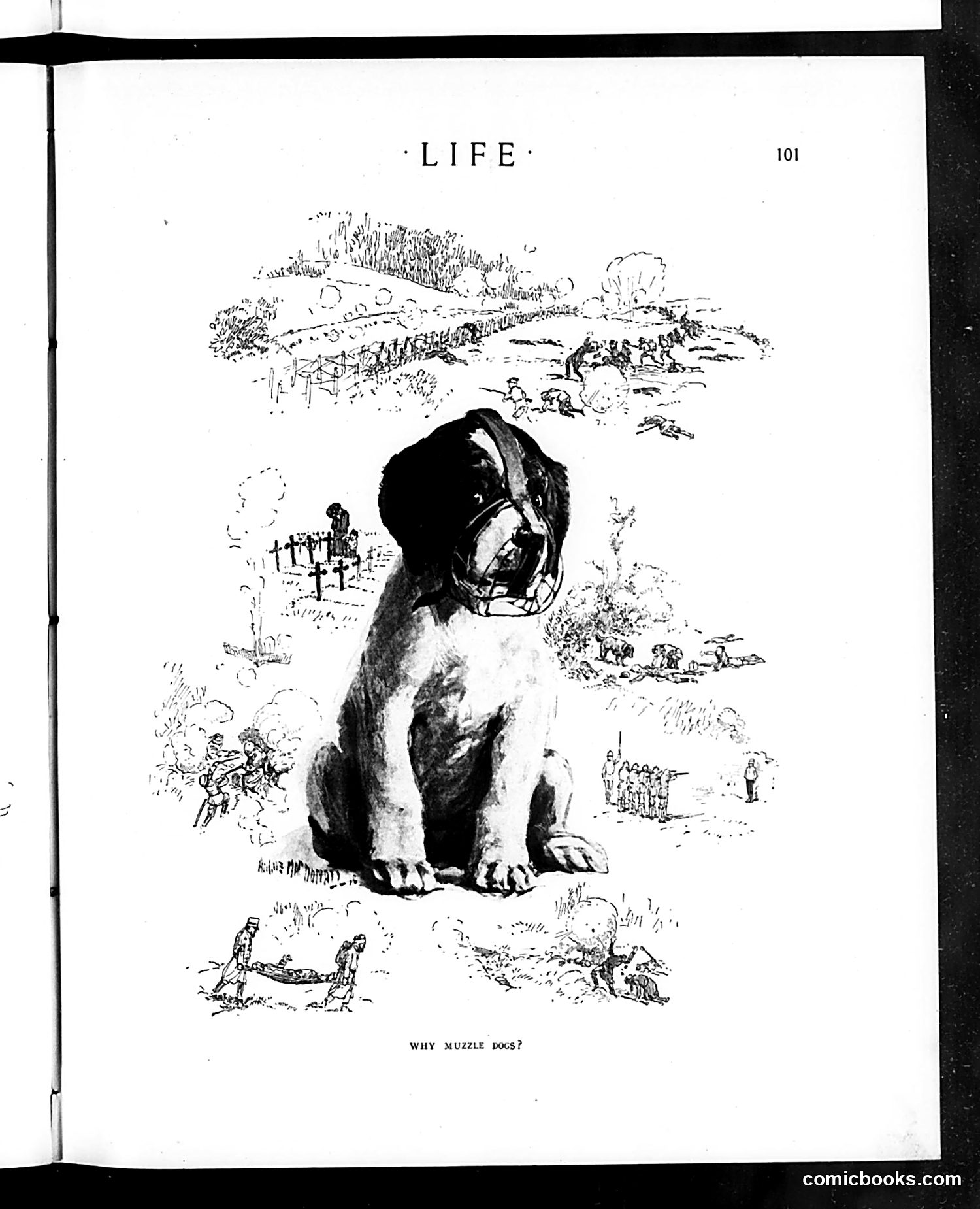
This page from *Life* magazine (page 101) features a single satirical illustration titled "WHY MUZZLE DOGS?" The image shows a large dog wearing a muzzle, surrounded by smaller sketched scenes depicting human activities—violence, conflict, and social disorder. The satire appears to criticize muzzle laws or restrictions on dogs by suggesting that humans, not dogs, are the real source of violence and chaos in society. The juxtaposition of the restrained dog against scenes of human aggression implies the hypocrisy of controlling animals while allowing humans to behave destructively. This likely reflects early-20th-century social commentary about regulation, morality, and human nature, using the dog as a metaphor to critique society's selective enforcement of order.
This page contains **no political cartoon or satire**. It is a literary contest announcement and the opening of a short story titled "The Clearest Call" by Brevard Mays Connor. The header explains Life's short story contest, offering $1,000, $500, and $250 prizes for stories under 1,500 words, paid at ten cents per word for accepted submissions. The story itself—appearing to be religious or philosophical fiction—depicts a Reverend Paul Templeton at a hospital bedside, dealing with themes of faith, prayer, and moral crisis. The narrative contains no satirical content or political references visible on this page. This is straightforward magazine fiction content, not humor or social commentary.
This page contains two short stories rather than political cartoons: 1. **"The Aviator"** by Hornell Hart describes a WWI pilot in aerial combat, focused on the technical and sensory experience of dogfighting. The narrative emphasizes the pilot's perspective during a bombardment of a fortress. 2. **"The Gretchen Plan"** by William Johnston presents a domestic wartime scenario about a village (Eisen) facing population imbalance—fifty-one soldiers returning from war but eighty-one unmarried women remaining. The story explores the social problem of unequal gender ratios post-war. Neither piece contains satirical political cartoons or caricatures. Instead, both are illustrated fiction exploring WWI's impacts: military combat experience and civilian social consequences of mass male casualties.
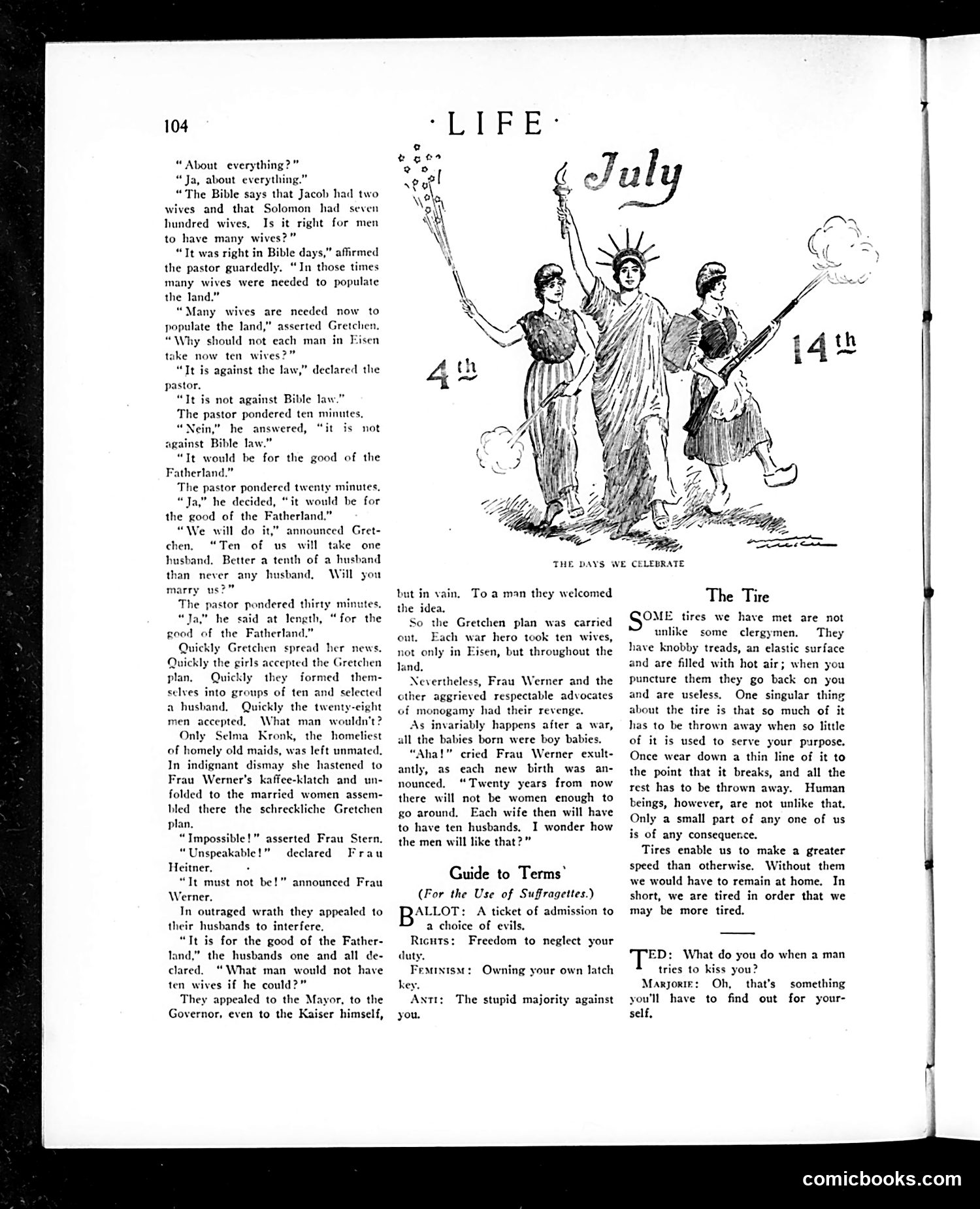
This Life magazine satire mocks German wartime efforts to increase population through polygamy. During World War I, Germany faced manpower shortages, so the story imagines a pastor in the town of Eisen persuaded by a clever young woman named Gretchen that men should take ten wives each—"for the good of the Fatherland." The joke works on multiple levels: it satirizes both German militarism's desperation and the absurdity of male enthusiasm for the arrangement. When respectable women try to stop it, they're powerless. The final twist—that all babies born are boys, so women will eventually need ten husbands each—turns the tables, suggesting the folly of such schemes. The page also includes unrelated satirical definitions mocking suffragettes and a tire advertisement. The cartoon illustrates the Fourth and Fourteenth of July celebrations with patriotic female figures.
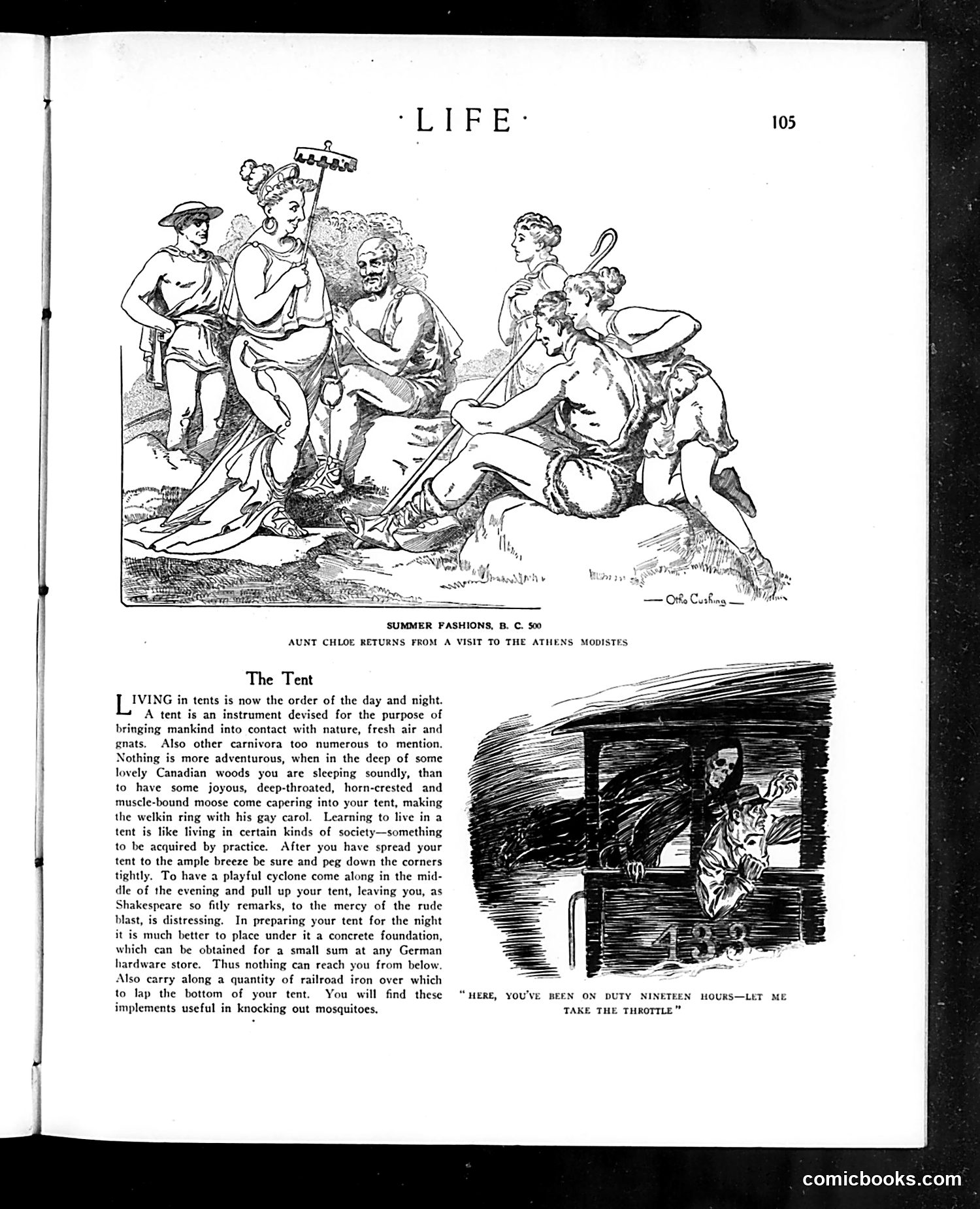
The page contains two distinct pieces of satire: **Top cartoon:** "Aunt Chloe Returns from a Visit to the Athens Modistes" depicts a woman in elaborate, impractical classical Greek-style drapery surrounded by cherubs and admirers. This mocks the fashion trend of adopting Greco-Roman aesthetics—"modistes" (fashionable dressmakers) were creating exaggerated classical-inspired garments. The satire ridicules both the absurdity of wearing such impractical clothing and the pretension of fashionable society imitating ancient styles. **"The Tent" article:** This is humorous camping advice that exaggerates practical problems into absurdity—casually mentioning moose attacks, cyclones, and mosquitoes while recommending concrete foundations and railroad iron for a tent. The tone suggests satirizing both the camping craze (apparently popular at the time) and overwrought outdoor-living advice manuals. The lower cartoon shows a weary railway worker, illustrating the text's practical concerns about outdoor hardship, though the connection to tenting is unclear.
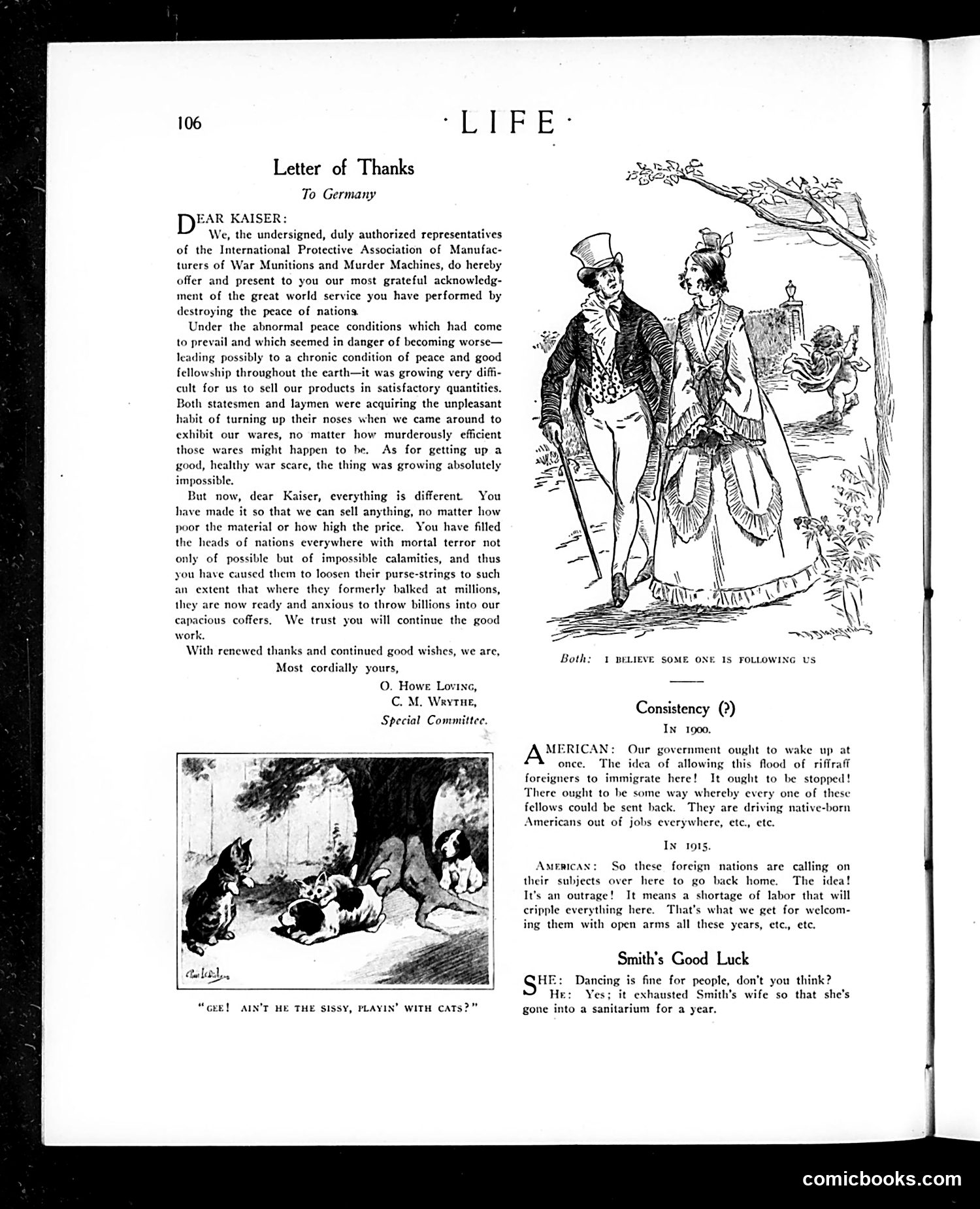
**"Letter of Thanks to Germany"** is a bitter satirical open letter from fictional munitions manufacturers thanking the Kaiser for starting World War I. The satire exposes how arms dealers profited from the war: before 1914, peace made it "impossible" to sell weapons, but the Kaiser's aggression created demand, allowing manufacturers to sell poor-quality materiel at inflated prices to terrified nations. This mocks both German militarism and American war profiteers. **"Consistency (?)"** contrasts American immigration attitudes between 1900 and 1915. In 1900, Americans opposed foreign immigration as job-stealing. By 1915, those same foreigners were being recalled home by their nations for WWI service—and Americans now complained about labor shortages. The satire ridicules American hypocrisy and short-sighted self-interest. **"Smith's Good Luck"** is a brief joke: dancing exhausted Smith's wife so severely she required sanitarium care—suggesting either extreme fragility or that dancing itself was dangerously strenuous.
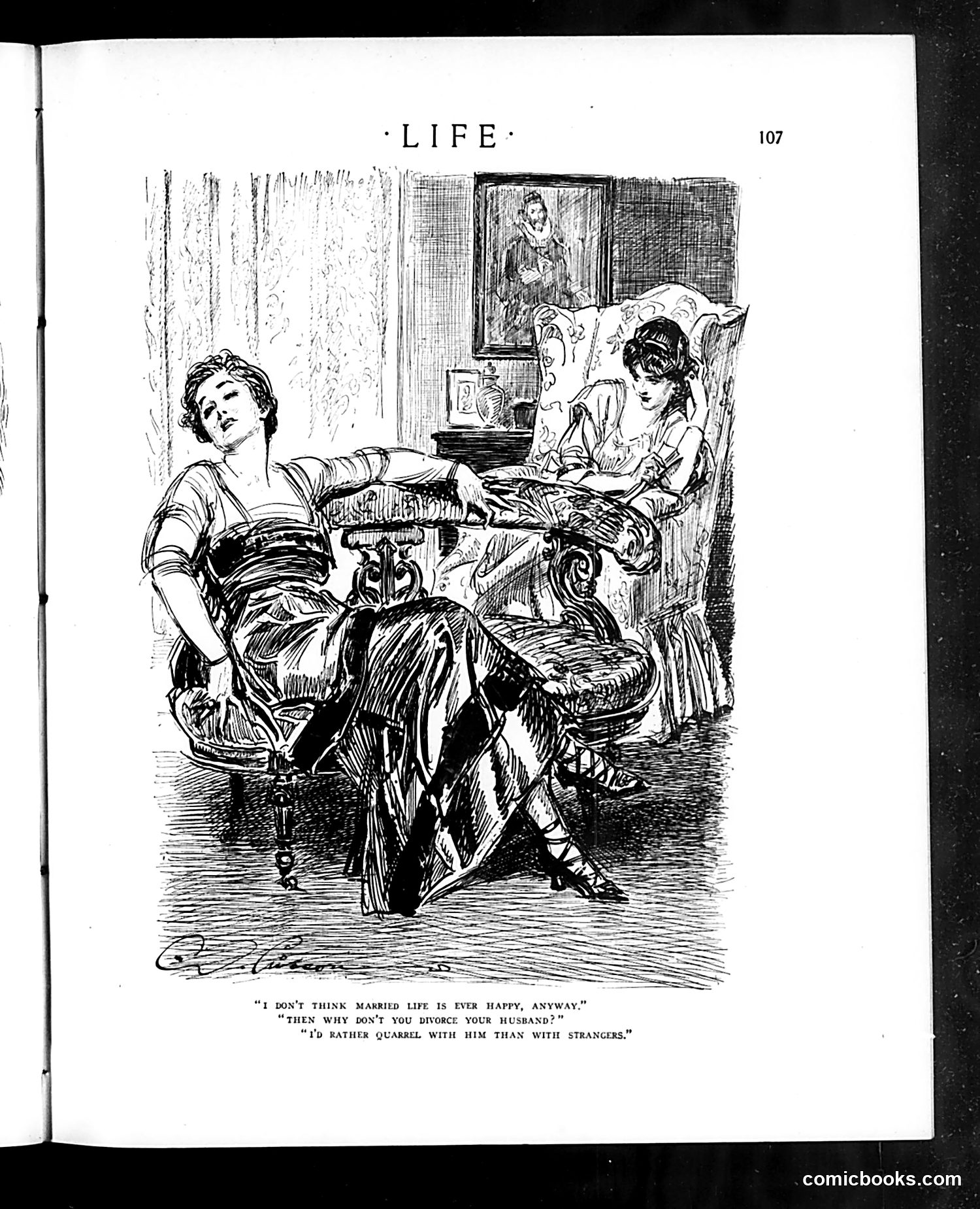
This cartoon satirizes married life and divorce through a domestic scene. A woman sits conversing with what appears to be a friend or confidante, expressing cynicism about marriage's happiness. When asked why she doesn't divorce her unhappy husband, she responds that she'd rather endure quarrels with him than deal with strangers—likely referring to the legal complexities, social judgment, or practical difficulties of divorce proceedings. The joke critiques both marriage's disappointments and the era's divorce process as potentially more unpleasant than staying in an unhappy union. It reflects early-20th-century attitudes where divorce, though increasingly available, remained socially stigmatized and legally cumbersome, making many women choose marital discontent over the alternative.
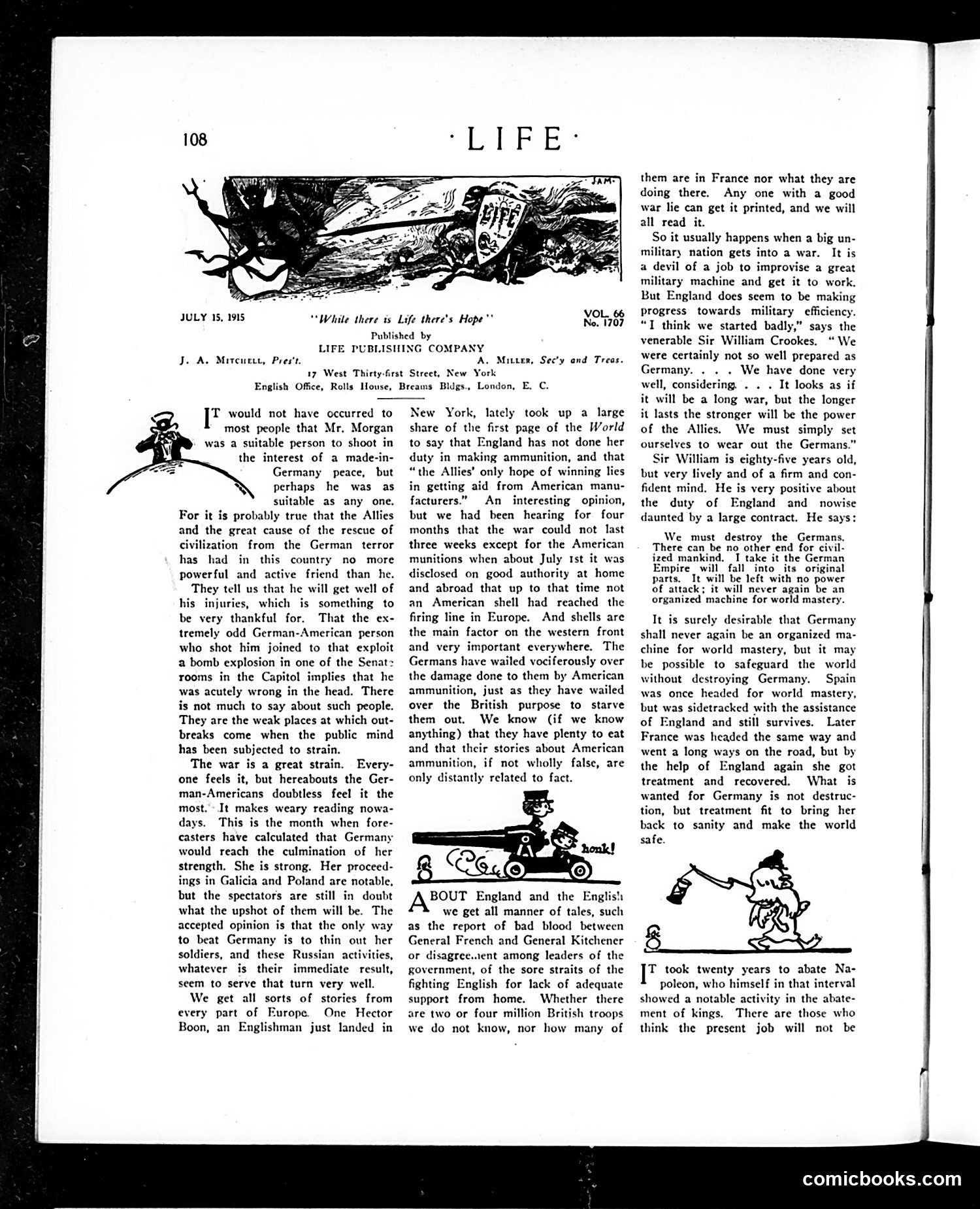
This editorial page addresses recent violence and wartime strain in America during WWI. The text references an attack on **J.P. Morgan**, the prominent banker and Allied supporter, by an unnamed German-American assailant who also planted a bomb in the Capitol. Life treats this as symptomatic of public anxiety rather than a serious political act. The main satirical targets are: 1. **Exaggerated war claims**—Life debunks British and German propaganda about American ammunition's impact and German food shortages, noting both sides make inflated claims for public consumption. 2. **English unpreparedness**—The magazine cites Sir William Crookes admitting Britain "started badly" militarily compared to Germany, contradicting official optimism. The cartoon (appears to show military equipment or machinery) likely illustrates the difficulty of rapidly industrializing for war. The satire emphasizes how total war strains civilian populations and generates misinformation.
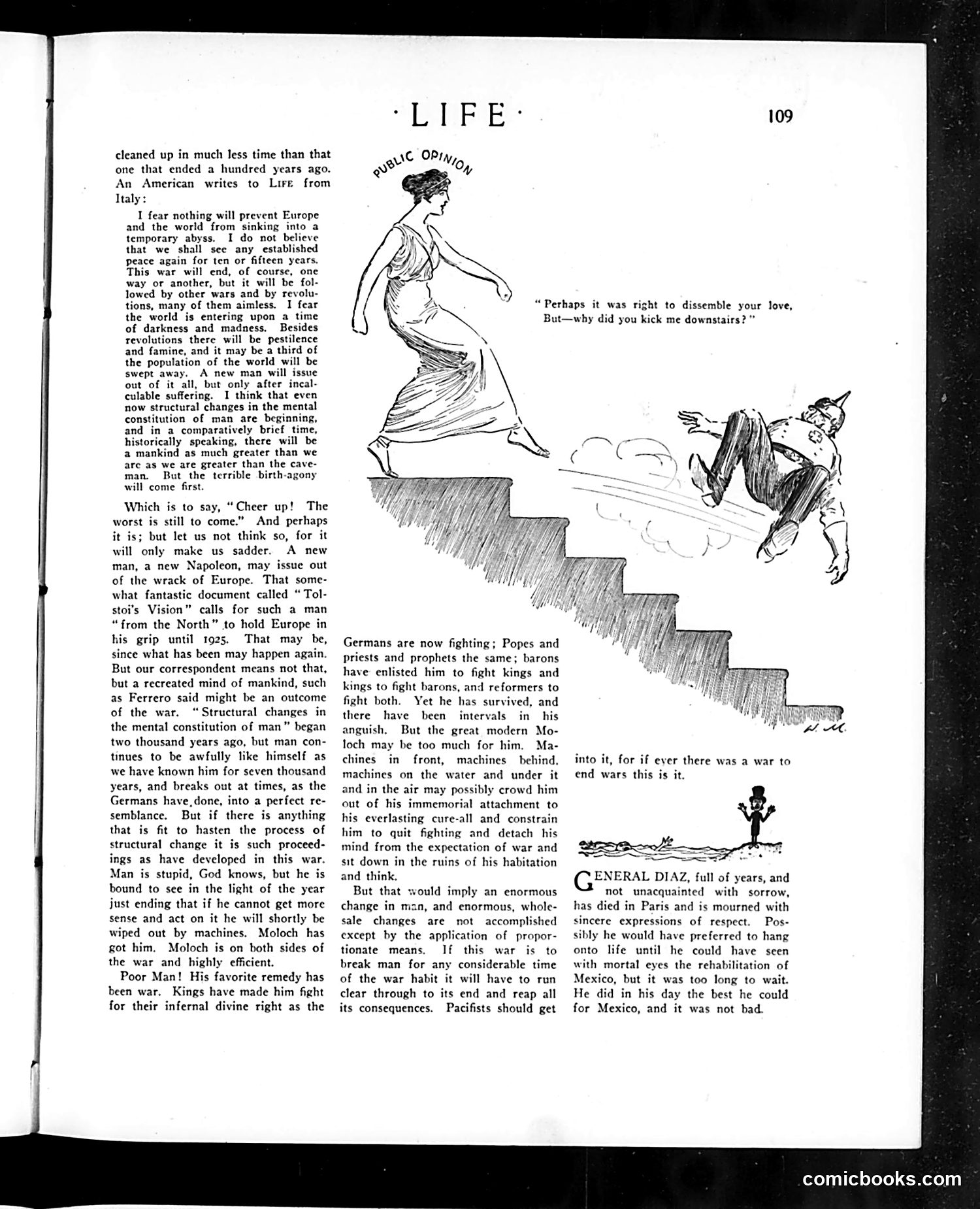
This page contains two distinct editorial pieces from WWI-era Life magazine: **Main Editorial Essay:** A pessimistic letter from an American correspondent in Italy predicts Europe faces 15+ years of war, revolution, famine, and social collapse before humanity undergoes "structural change" and produces a "new man." The essay sardonically notes that while this sounds bleak ("the worst is still to come"), mankind must endure this suffering to evolve beyond its war-making nature. It references Tolstoy's prophecy of a Napoleon-like figure emerging "from the North" by 1925, and argues that only catastrophic machine warfare will finally force humanity to abandon its ancient habit of warfare. **Political Cartoon:** Depicts "Public Opinion" (personified as a woman) kicking a small, demon-like figure down stairs, accompanying a domestic dispute caption. This satirizes public sentiment during WWI—blaming war itself rather than human actors for conflict. **Brief Obituary:** Notes General Díaz's death in Paris, suggesting he would have preferred continued life over military involvement. The page reflects deep wartime anxiety about civilization's future.
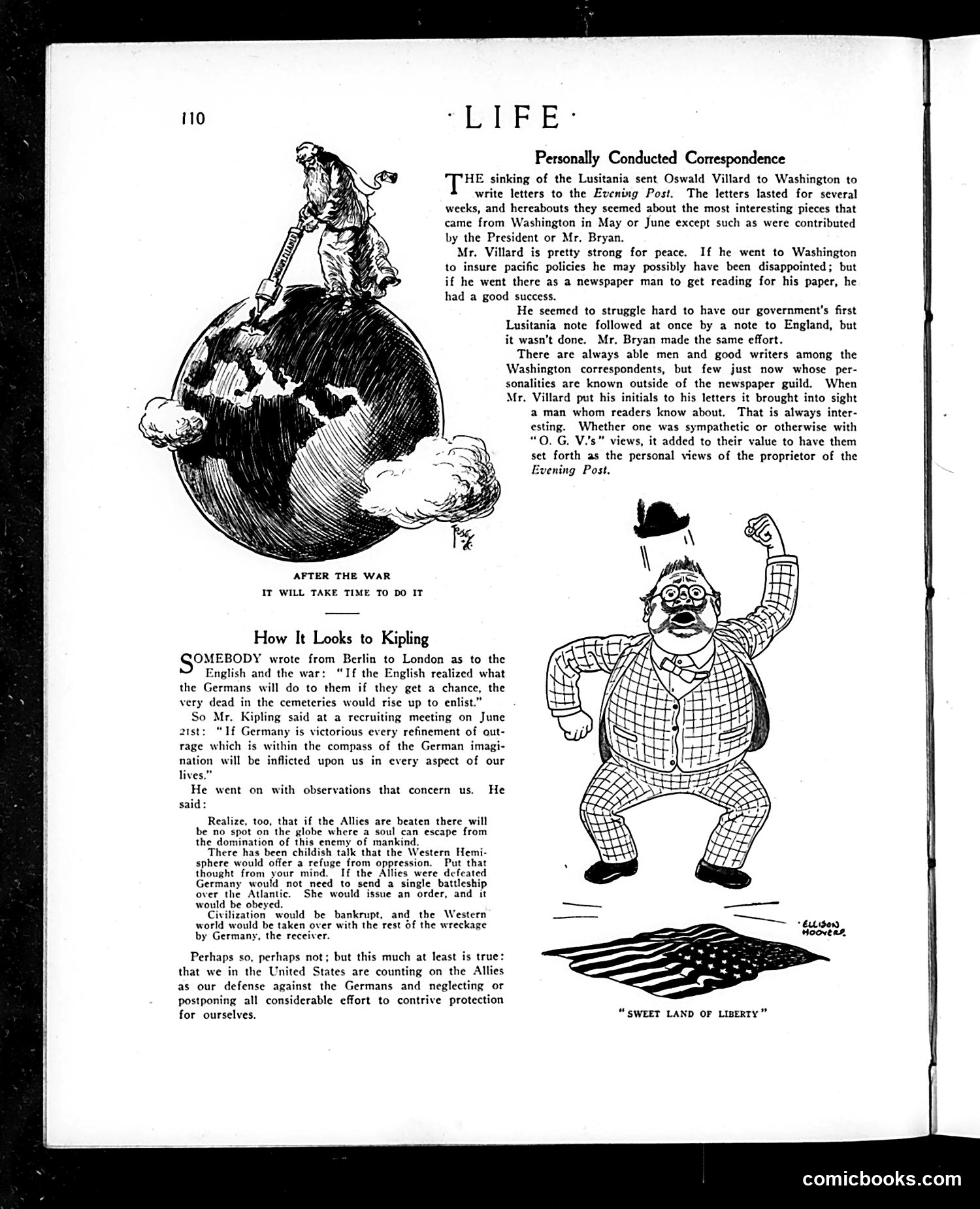
This page contains two sections discussing American responses to World War I: **"Personally Conducted Correspondence"** discusses Oswald Villard, editor of the *Evening Post*, who traveled to Washington following the Lusitania sinking (1915) to write letters advocating for pacifism. The piece notes Villard's influence came from his public prominence, regardless of whether readers agreed with his anti-war stance. **"How It Looks to Kipling"** presents writer Rudyard Kipling's opposing view: a fierce pro-Allied argument that German victory would threaten even the Western Hemisphere, making American neutrality foolish. Kipling argues civilization itself depends on Allied victory. The satirical illustrations reinforce this tension: the top cartoon shows the earth struggling under wartime burden; the bottom cartoon titled "Sweet Land of Liberty" depicts Uncle Sam as a bloated, complacent figure dancing on the American flag—mocking American isolationism while the war rages. The page essentially contrasts pacifist and interventionist positions in 1915 America, with the cartoons suggesting the magazine favored Kipling's interventionist stance over Villard's pacifism.
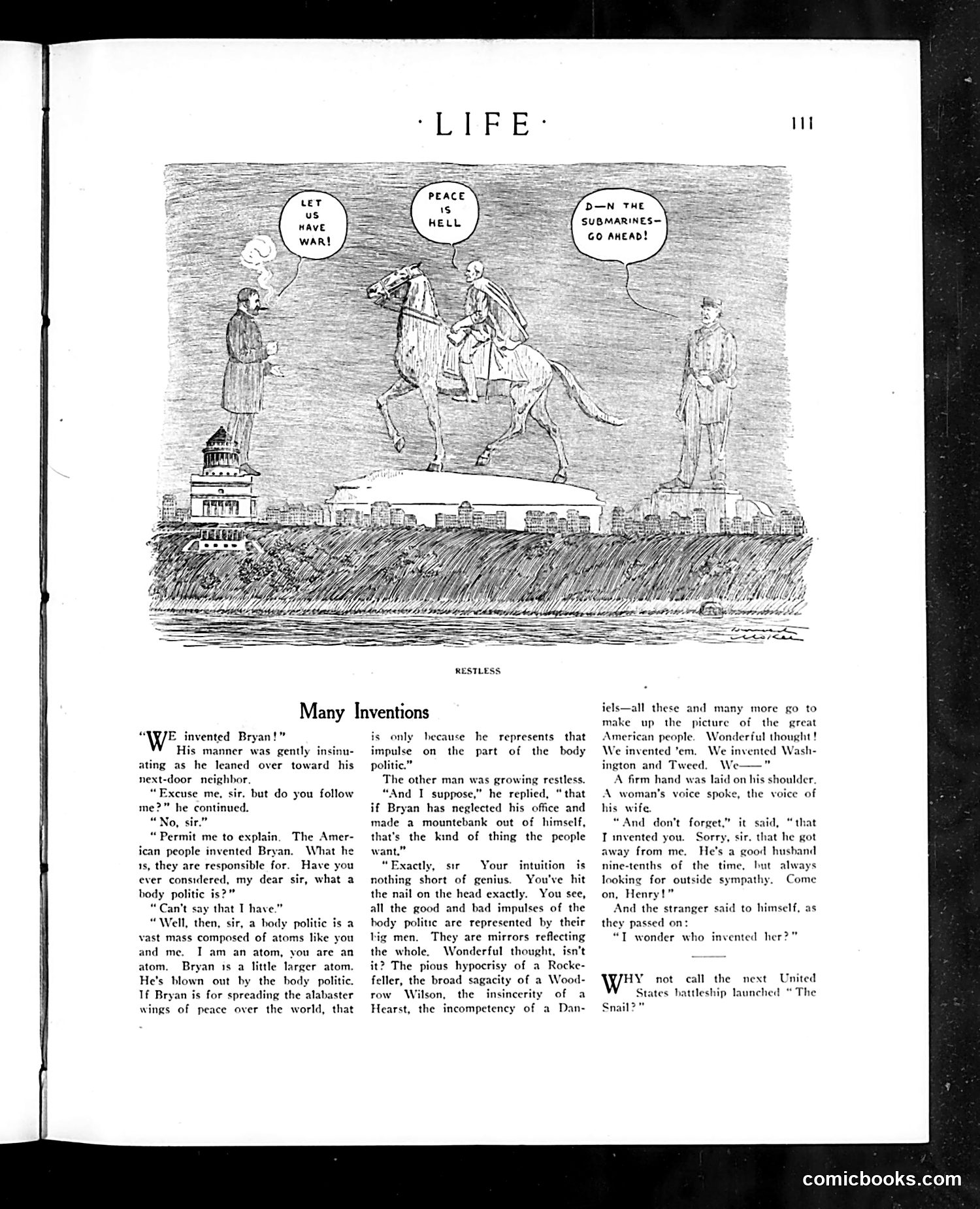
The cartoon and accompanying text satirize **William Jennings Bryan**, a prominent American political figure known for his idealistic rhetoric about peace. The top cartoon shows figures on horseback advocating conflicting positions—one demanding war, another promoting peace ("Peace is Hell"), a third urging submarine warfare—illustrating the chaos of political debate. The accompanying text mocks Bryan through a tedious philosophical monologue claiming the American people "invented" Bryan as their reflection, using pseudo-intellectual metaphors about the "body politic." The satire's point: Bryan is portrayed as both pretentious (the boring lecturer) and as a mere product of public opinion rather than a genuine leader. His pacifist stance is undermined by the cartoon's suggestion that war rhetoric dominates regardless. The wife's interruption—sarcastically noting her husband is "a good husband nine-tenths of the time"—deflates his earnestness further. The final quip about naming a battleship "The Snail" mocks pacifists by equating peace advocacy with slowness and impotence.
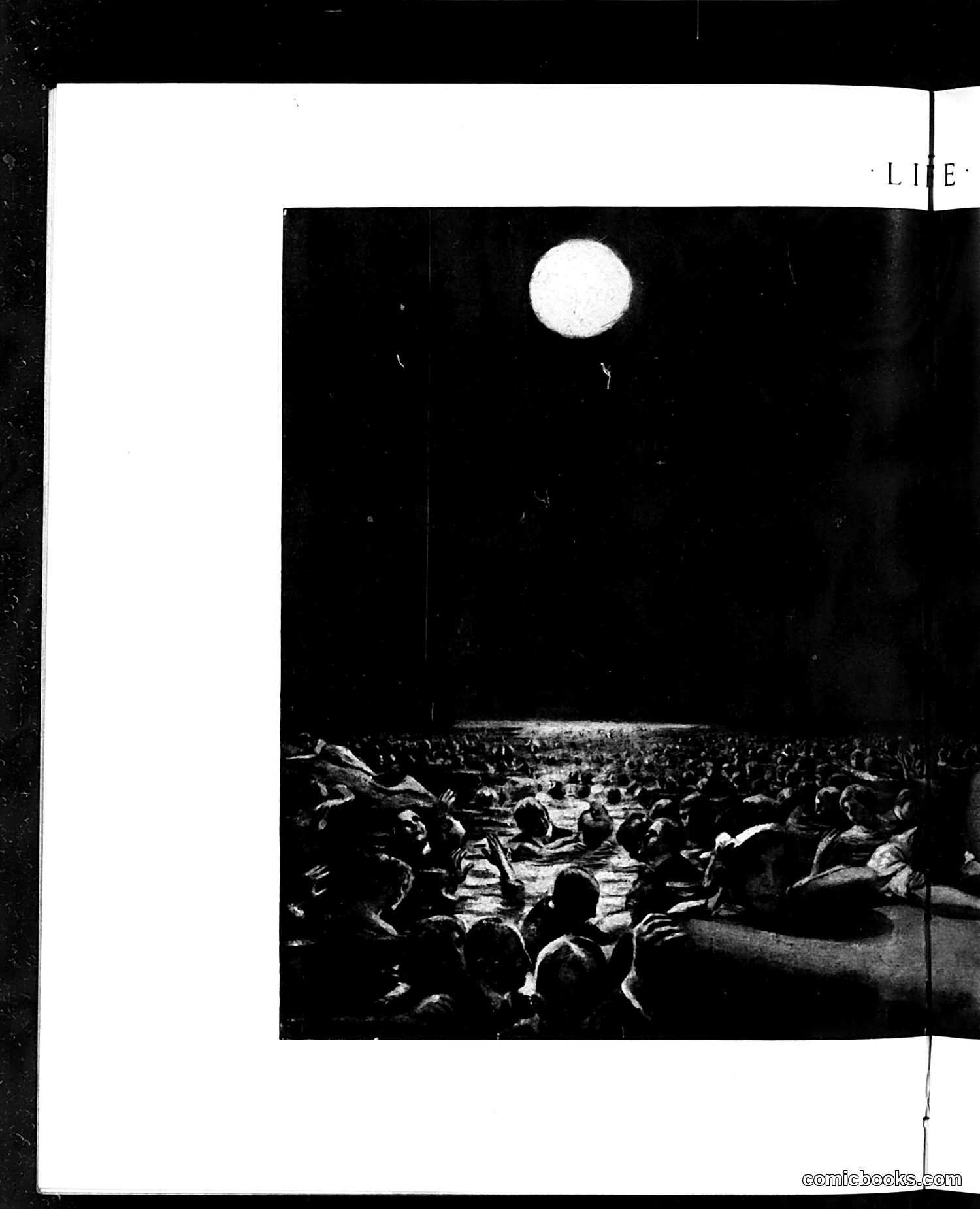
I can see this is a page from Life magazine showing a dramatic black and white illustration of a large crowd of people gathered at night under a full moon. The scene appears to depict some kind of mass gathering or congregation, rendered in stark, high-contrast style that emphasizes the crowd's scale and the nighttime setting. However, without visible text or captions on this particular page image, I cannot definitively identify which specific political event, social phenomenon, or satirical commentary this illustration references. The style and subject matter suggest it may relate to an early 20th-century social or political gathering, but I cannot assert specific details about figures, references, or the intended satire without OCR text that clearly accompanies the image itself.
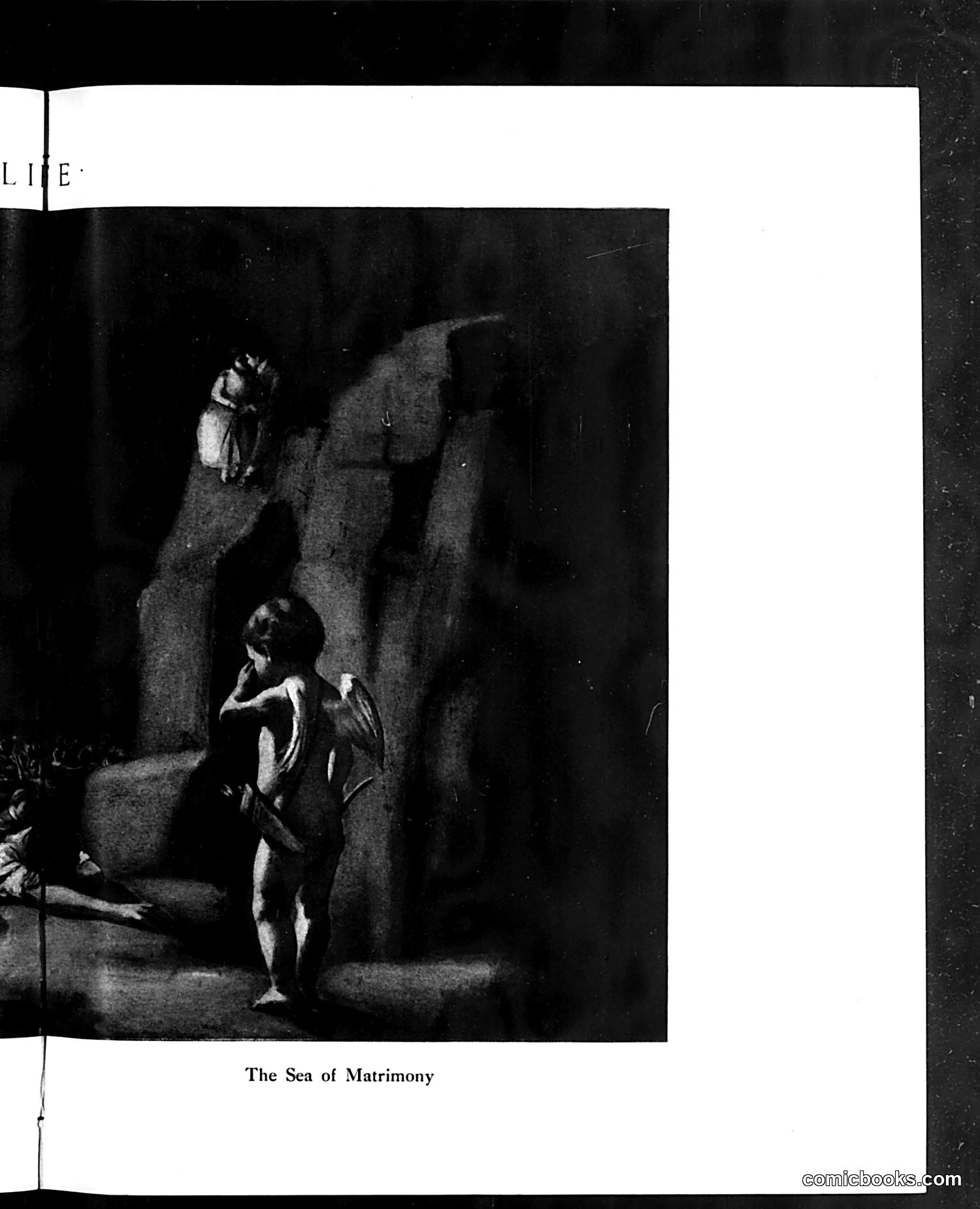
This appears to be a theatrical or allegorical illustration from Life magazine depicting marriage as a treacherous sea voyage. The image shows two figures in what looks like a dramatic scene—one elevated above the other in a rocky, cave-like setting with stark lighting. The title "The Sea of Matrimony" uses a common metaphor treating marriage as a dangerous journey or turbulent waters. Without additional context about the specific publication date or accompanying text, the precise satirical point remains unclear. However, the theatrical staging and dramatic composition suggest Life is commenting on marriage as perilous, uncertain, or morally complex—likely mocking either romantic idealization of matrimony or contemporary marriage troubles.
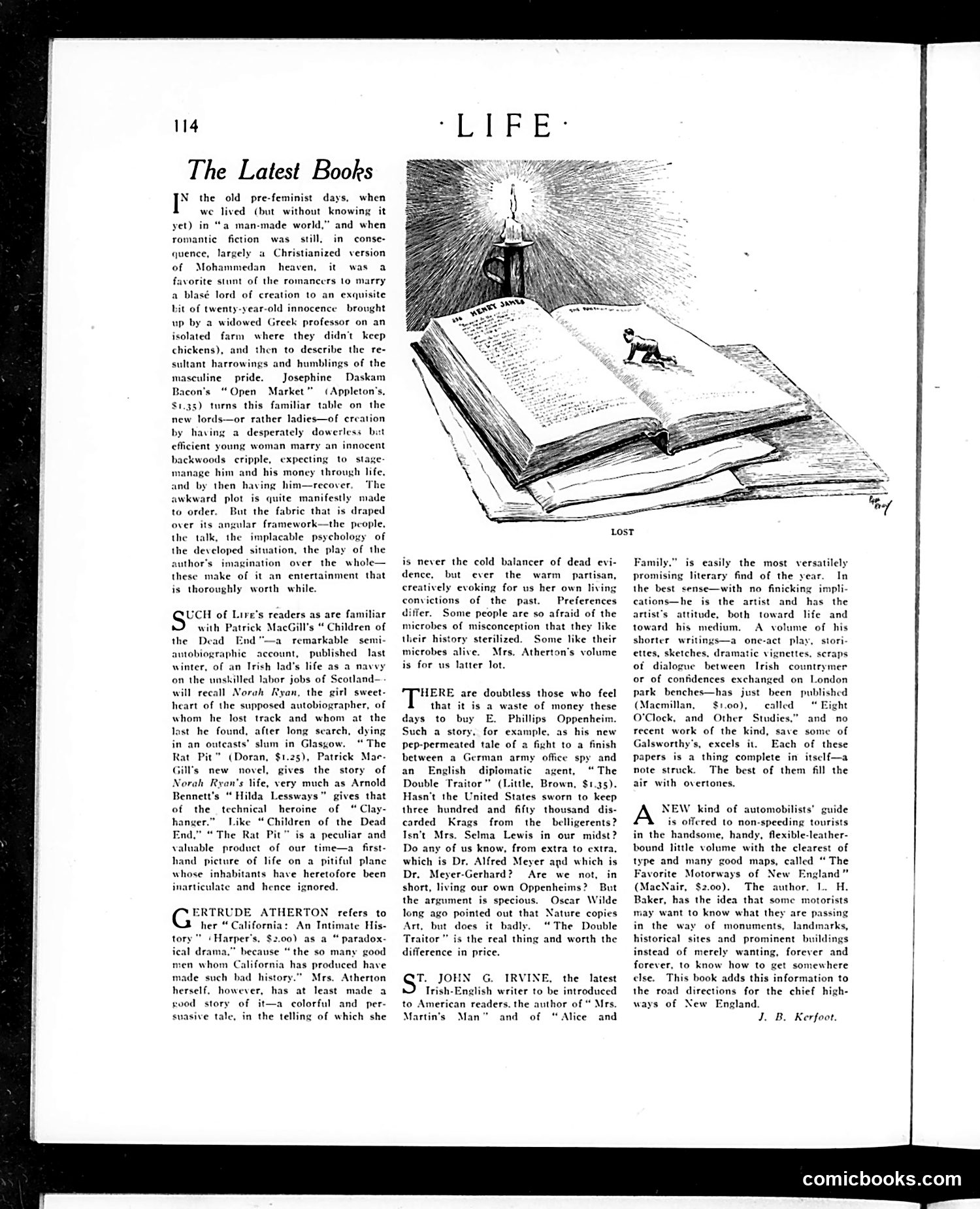
This is a literary review column, not a political cartoon. The page features book reviews and criticism rather than satire or caricature. The key content includes: - A review of Josephine Daskam Bacon's "Open Market," which inverts the romantic trope of an innocent young woman paired with a jaded older man—here, an efficient poor woman marries a wealthy backwoods man - Discussion of Patrick MacGill's "Children of the Dead End" and the sequel "The Rat Pit," praised as authentic working-class literature - Gertrude Atherton's "California: An Intimate History," noted for passionate rather than objective historical narrative - E. Phillips Oppenheim's spy thriller "The Double Traitor," with ironic commentary that real wartime espionage makes fiction seem tame The small illustration shows an open book with a church or lighthouse, labeled "LOST"—likely accompanying the literary discussion but without clear specific reference.
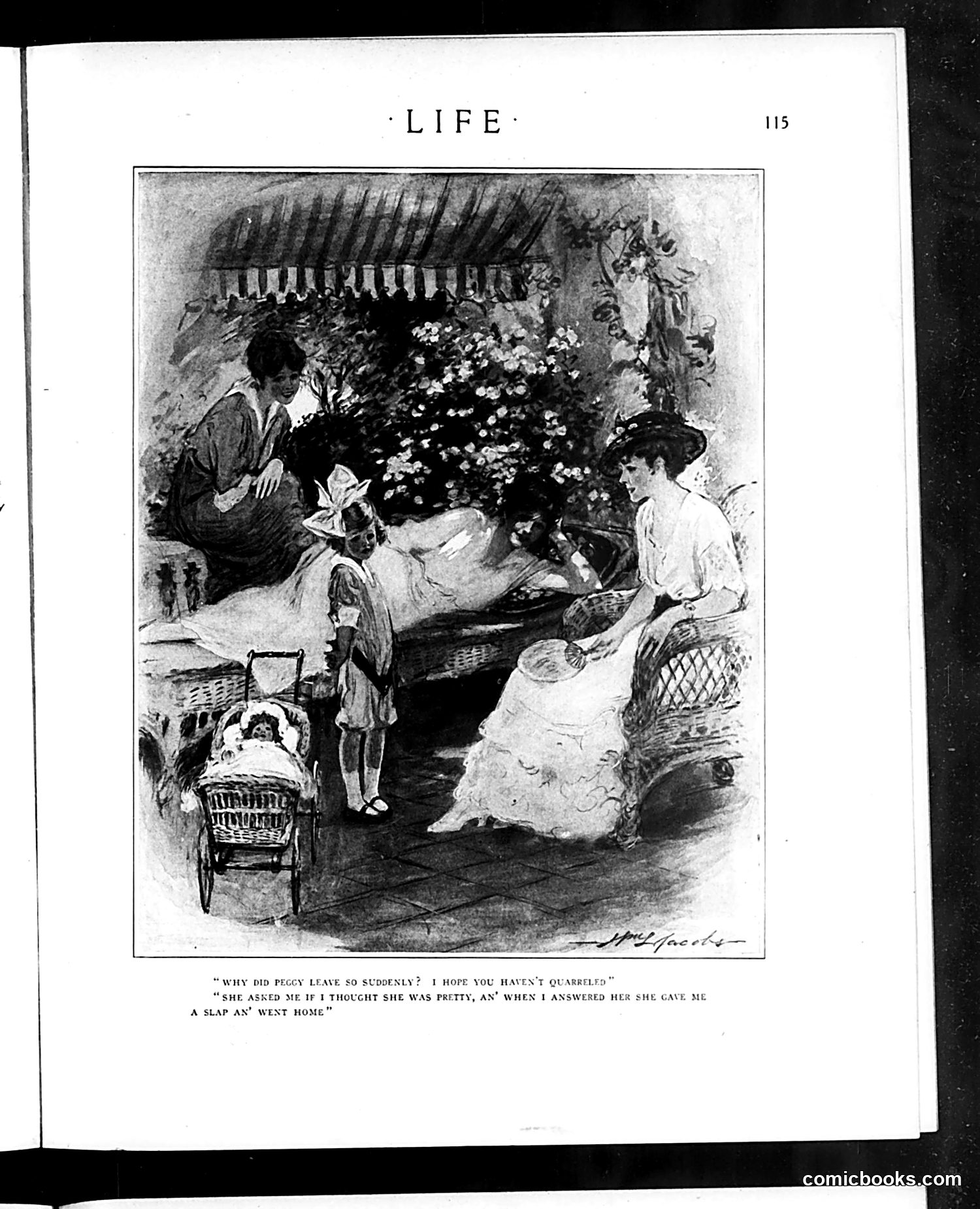
This is a humorous domestic scene illustrating a common social awkwardness. A man explains to a woman why his female friend Peggy departed abruptly: when Peggy asked if he thought she was pretty, his honest answer prompted her to slap him and leave angry. The joke relies on the "no-win" scenario of answering a woman's appearance question—implying that Peggy either took offense at being called pretty (perhaps interpreting it as presumptuous), or more likely, received an unflattering answer she didn't expect. The cartoon satirizes the social convention where women ask questions they may not truly want answered honestly, and the resulting awkwardness when men do so. The illustrated figures appear to be early 20th-century middle-class Americans in a garden setting.
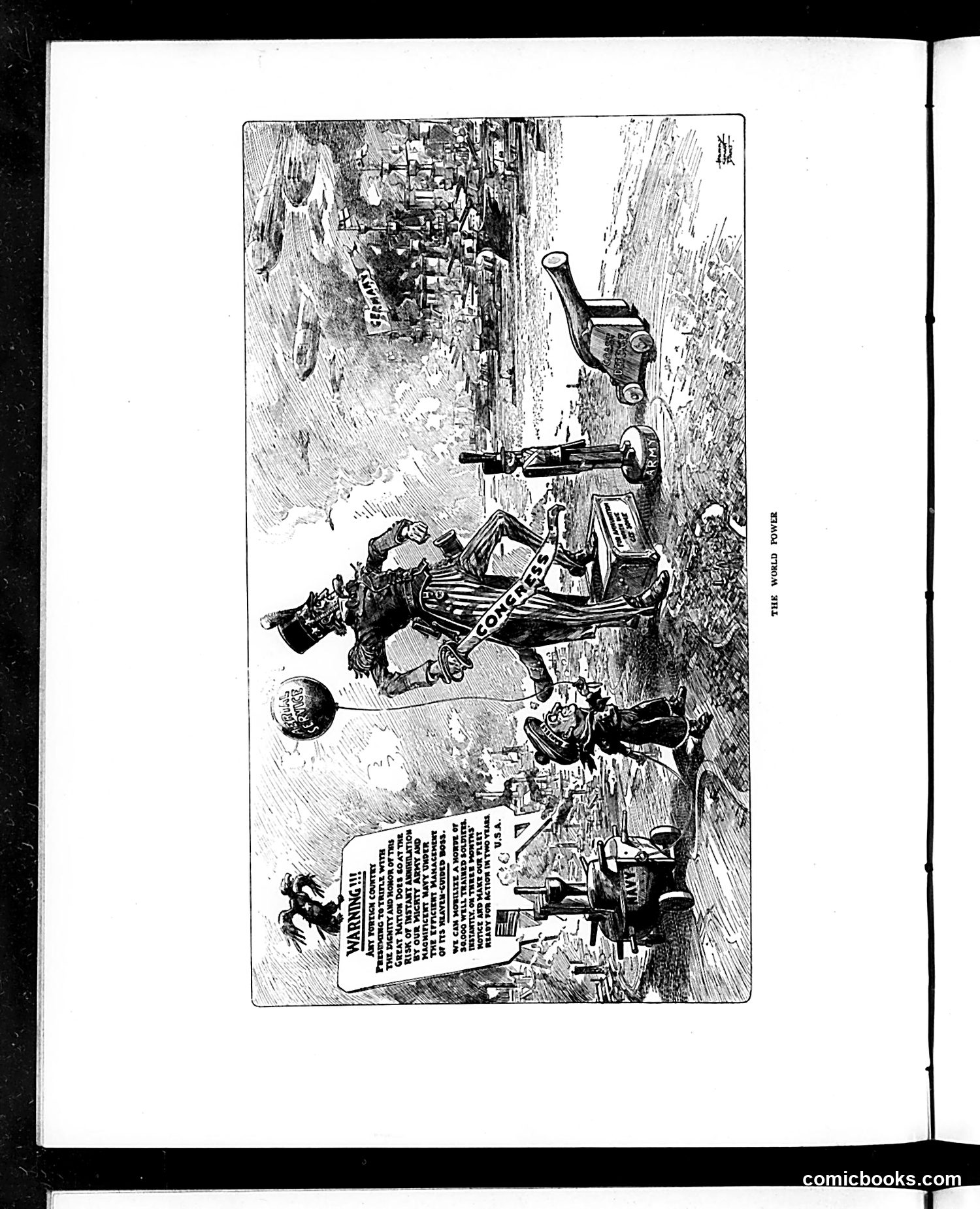
I can see this is a satirical illustration from Life magazine, but the image is rotated and the OCR text is corrupted/unclear, making it difficult to read the caption or identify specific details with confidence. What I can observe: The illustration appears to depict a street scene with multiple figures and vehicles, rendered in period engraving style. There are what appear to be early automobiles and people in period clothing. The composition suggests social commentary typical of Life's satirical approach. However, without legible text identifying the subjects, figures, or specific event being mocked, I cannot reliably explain what political or social satire this cartoon presents to a modern reader. The OCR corruption prevents me from determining the cartoon's actual subject or point.
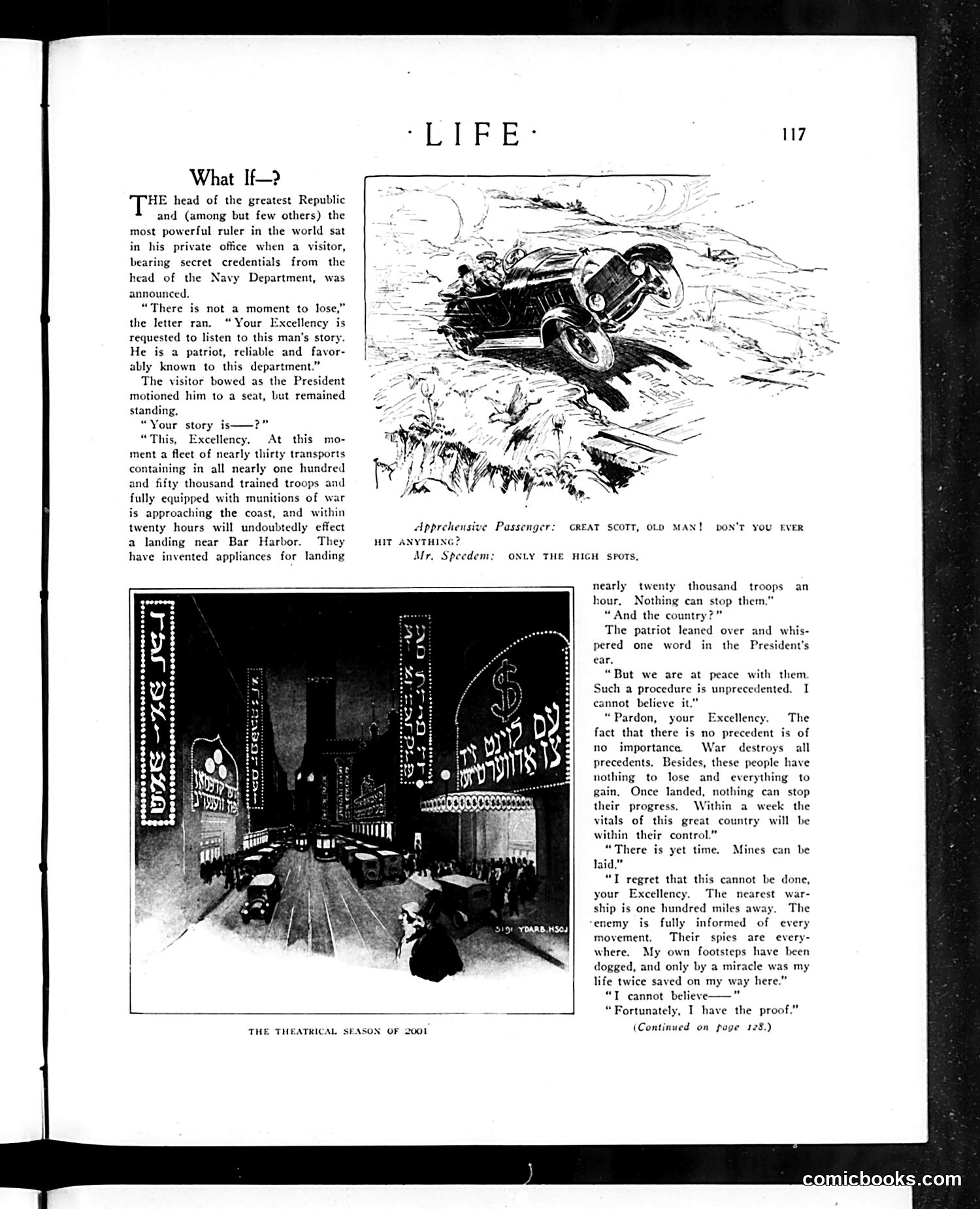
This *Life* magazine piece presents a speculative fiction scenario (labeled "The Theatrical Season of 2001"), imagining an unnamed foreign power launching a surprise military invasion of the U.S. East Coast near Bar Harbor with 150,000 troops. A patriotic naval officer warns the President that the invasion is imminent and unstoppable—the enemy has superior landing technology, intelligence networks, and strategic advantage. The satire critiques American complacency and unpreparedness for modern warfare. The "theatrical season" subtitle suggests this scenario feels absurdly theatrical or implausible to contemporary readers, yet the story treats it as credible military strategy. The accompanying illustration shows a Broadway theater street scene (likely Times Square), contrasting civilian entertainment with the grave warning. The lower cartoon about "Mr. Speedem" hitting only "high spots" likely mocks reckless speed or careless navigation—a humorous counterpoint to the serious invasion narrative. The piece satirizes both American isolationism and anxiety about technological military superiority.
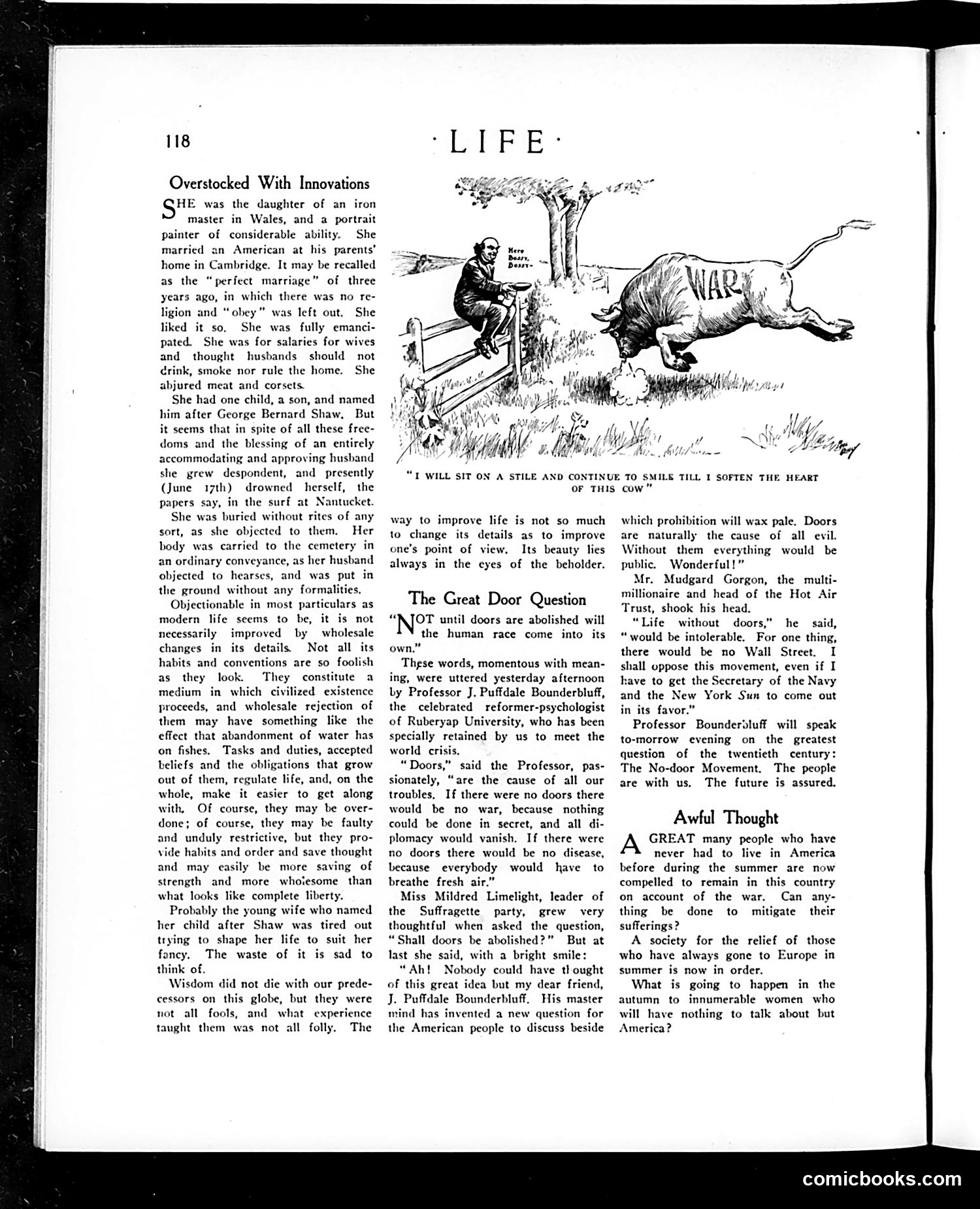
This page contains two satirical pieces mocking progressive reform movements of the early 20th century. **"Overstocked With Innovations"** tells of a Welsh woman who embraced radical modernism—rejecting religion, marriage conventions, meat, corsets, and traditional funeral rites. She drowned herself despite (or because of) her freedoms. The piece sarcastically argues that wholesale rejection of established social customs, while well-intentioned, can be destructive. Life suggests that traditional practices, though imperfect, provide necessary structure for civilized life. **"The Great Door Question"** satirizes intellectual reformers and suffragettes by having a fictitious "Professor Puffdale Bounderbluff" propose abolishing doors as the solution to war, disease, and secrecy. The suffragette leader and a millionaire head humorously endorse this absurd idea. The cartoon (showing a man sitting on a stile trying to "soften the heart" of a cow) reinforces the mockery of overambitious social engineering schemes that ignore practical reality.
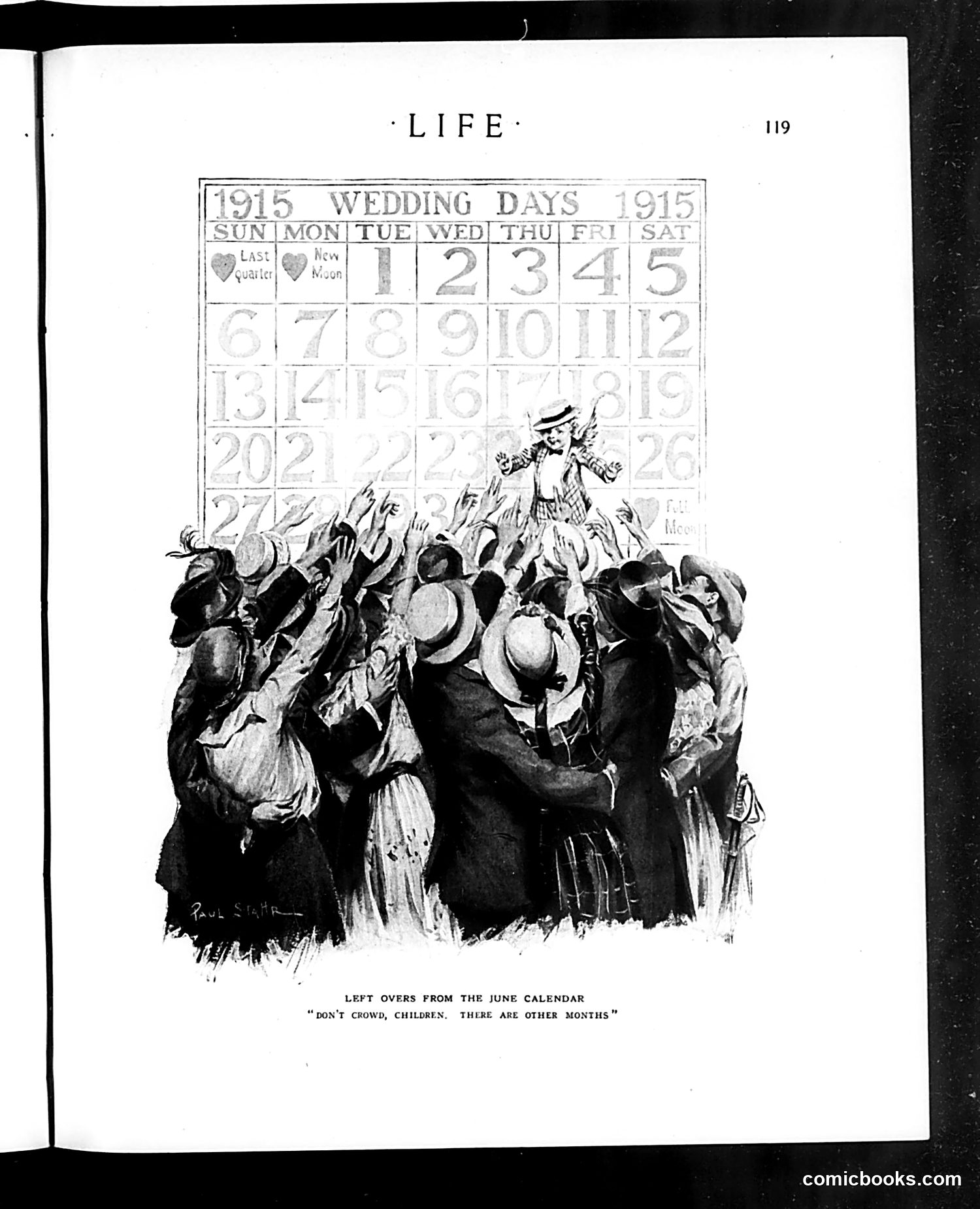
This Life magazine cartoon satirizes the June wedding season rush. The 1915 calendar header emphasizes "WEDDING DAYS," with a cupid figure presiding over the dates. Below, a crowd of eager couples and wedding guests throng around the calendar, desperate to book June dates—the traditional "wedding month." The caption's instruction to "Don't crowd, children. There are other months" mocks this stampede mentality, suggesting couples mindlessly follow convention rather than choosing dates rationally. The satire targets both the commercial pressure surrounding weddings and society's unthinking conformity to seasonal expectations. The packed, chaotic illustration emphasizes how absurd this concentrated demand has become—everyone wanting the same month simultaneously.
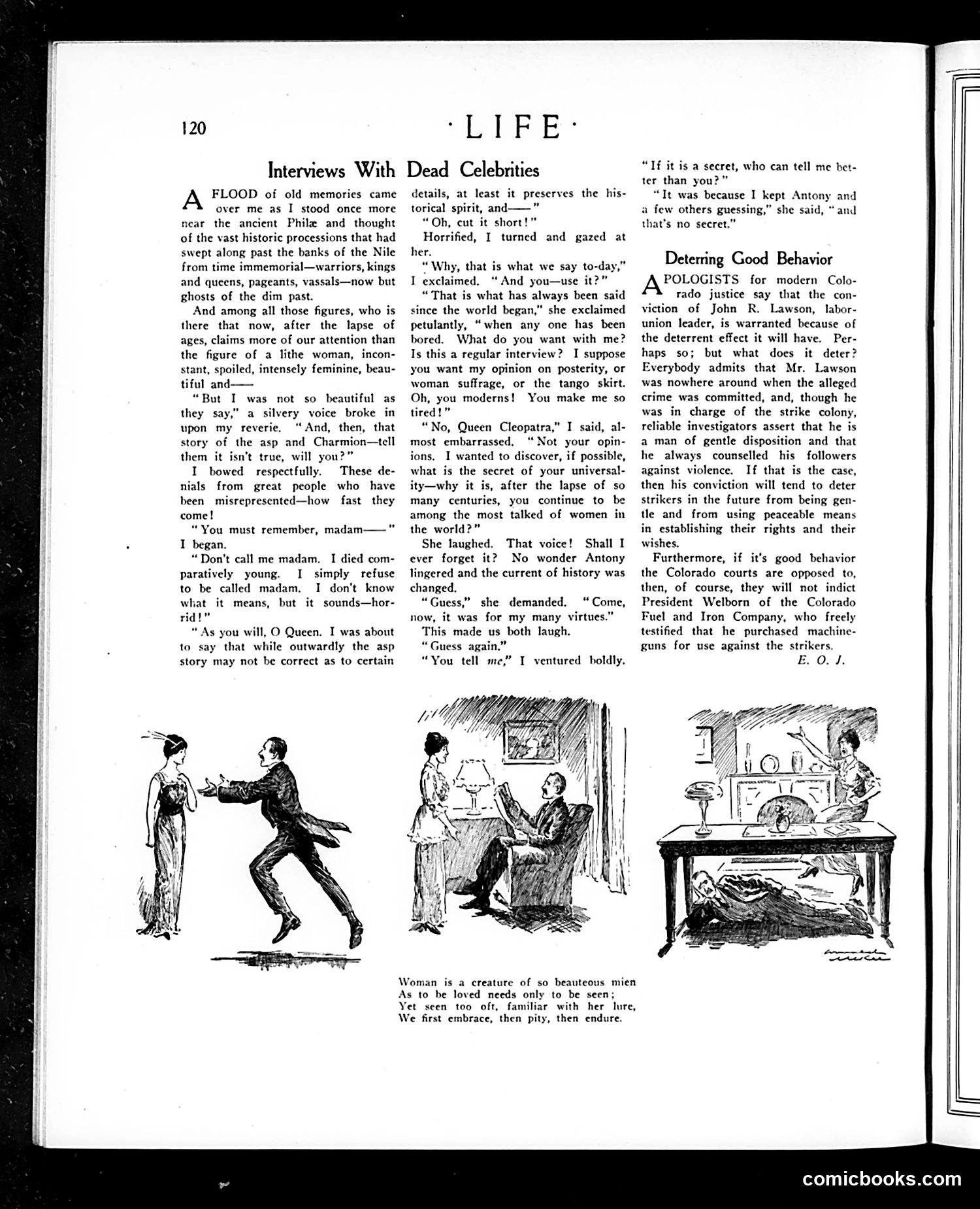
This page contains two distinct pieces of satire: **"Interviews With Dead Celebrities"** presents a fictionalized conversation between the author and **Cleopatra**. The satire mocks both historical revisionism and modern affectations—Cleopatra insists her death-by-asp story is exaggerated, complains about being called "madam," and uses contemporary slang ("You make me so tired!"). The joke exposes how we mythologize historical figures while she pragmatically credits her fame to keeping men "guessing"—reducing grand history to romantic manipulation. **"Deterring Good Behavior"** critiques the conviction of **John R. Lawson**, a labor union leader, for crimes he didn't commit. The satire's bitter irony: the courts claim conviction deters bad behavior, yet Lawson was peaceful and non-violent. The real criminals—**President Welborn** of Colorado Fuel and Iron Company, who purchased machine-guns against strikers—face no prosecution. The piece exposes how "justice" punishes labor activists while protecting corporate interests.
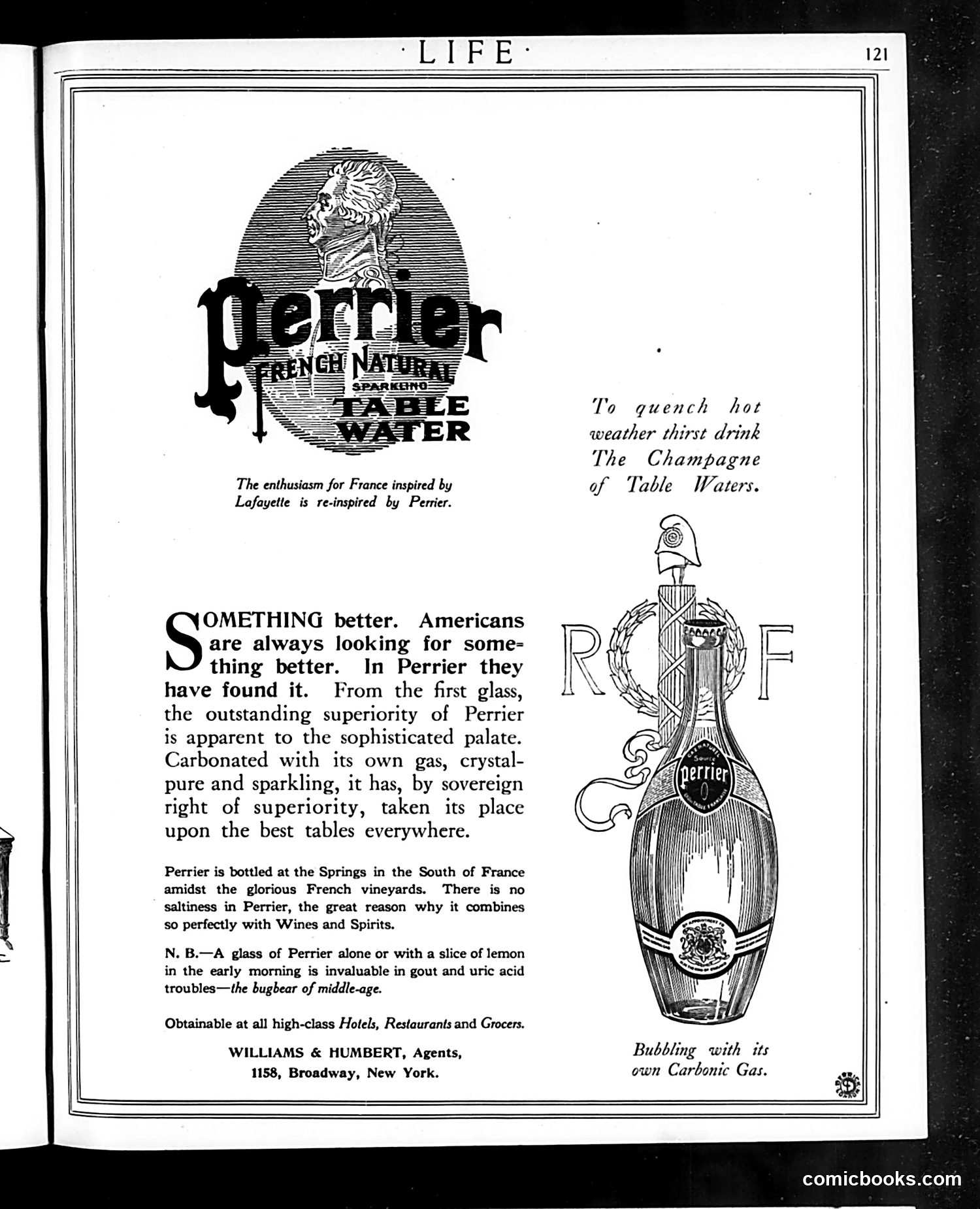
This is primarily a **product advertisement**, not political satire. It's a Perrier sparkling water ad from Life magazine's advertising section. The page references **Lafayette** and French patriotism to market the product. The text claims Americans' enthusiasm for France (inspired by the Revolutionary War hero Lafayette) should extend to appreciating French products like Perrier. This is straightforward advertising rhetoric: French = superior and refined. The caricatured head at top appears to be a generic "Frenchman" figure (possibly meant to evoke Lafayette), used as a branding element. The elaborate bottle illustration emphasizes the product's sophisticated European origins. The note about gout and "uric acid troubles" being "the bugbear of middle-age" reflects period medical beliefs—sparkling water was marketed as a health tonic for aging wealthy gentlemen, the magazine's target demographic. This is **commercial advertising leveraging Francophilia**, not political commentary or satire.
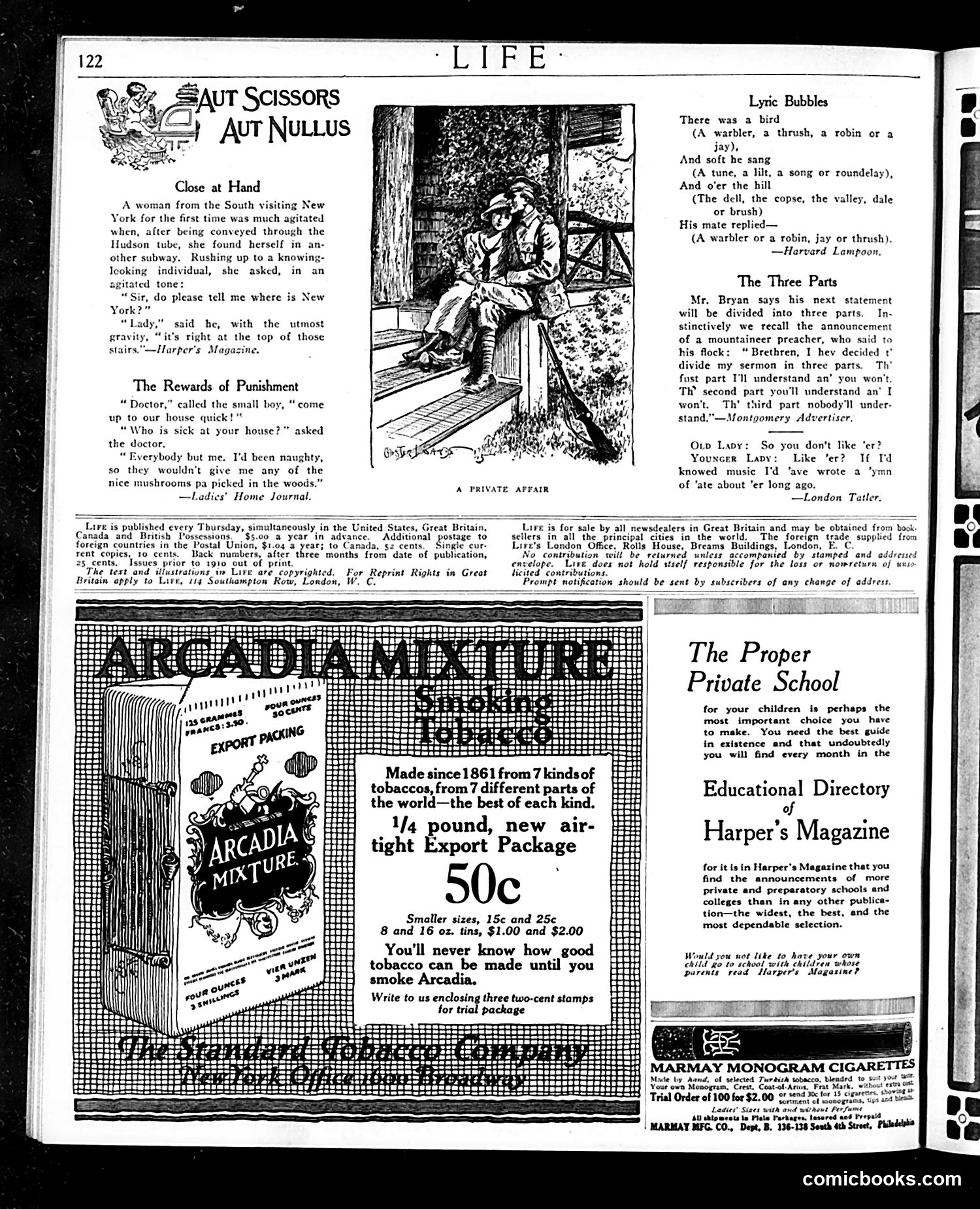
This page contains three brief satirical anecdotes under "Aut Scissors / Aut Nullus" (a Latin phrase suggesting sharp wit): 1. **"Close at Hand"**: A Southern woman newly arrived in New York, confused by the subway system, asks a stranger where New York is—not realizing she's already there. The joke mocks Southern unfamiliarity with modern urban infrastructure. 2. **"The Rewards of Punishment"**: A boy summons a doctor, claiming everyone at home is sick except himself. The twist: his family won't give him mushrooms because he misbehaved, so he's excluded from the spoils. It's mild dark humor about parental discipline. 3. **"The Three Parts"**: A quip mocking William Jennings Bryan's announced three-part statement, comparing it to a preacher's sermon where neither speaker nor audience understands anything. This appears political satire of Bryan's speaking style or clarity. The page is mostly **advertisements** (Arcadia tobacco, Harper's Magazine's educational directory, Marmay cigarettes), typical of *Life*'s format.
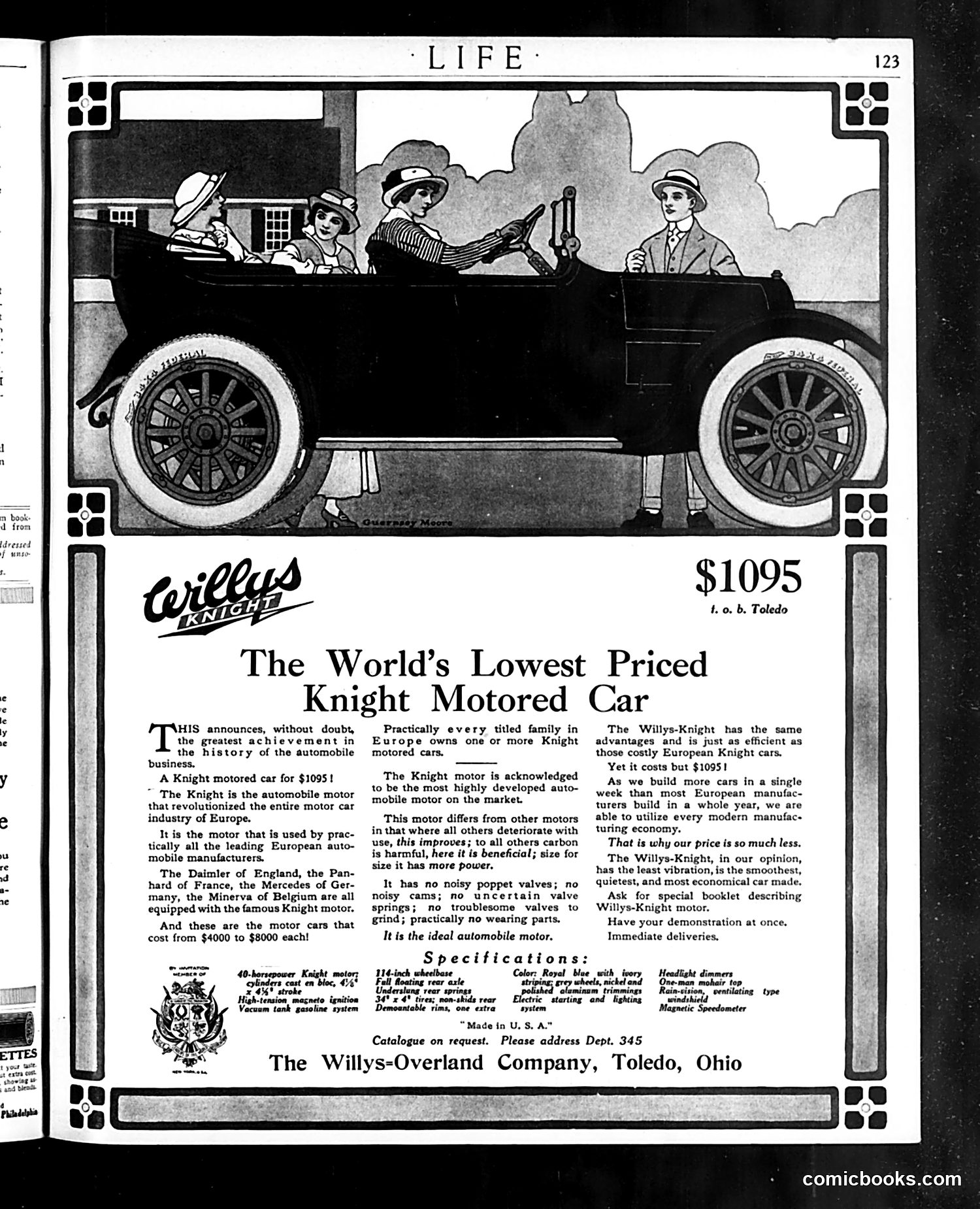
This is primarily a **car advertisement**, not satire or political commentary. The page promotes the Willys-Knight automobile at $1,095. The illustration shows four well-dressed men in a motorcar—representing the vehicle's appeal to middle-class and aspirational buyers. The ad's rhetorical strategy is its actual "joke": it emphasizes that the Knight motor technology was used exclusively in expensive European luxury cars ($4,000-$8,000) owned by European nobility and titled families, yet Willys-Overland could offer the same motor at a fraction of the price through American mass-production efficiency. The satire is implicit: the ad mocks European exclusivity and high prices by democratizing access to the same prestigious technology. For modern readers, this reflects early automotive manufacturing's shift toward affordability and assembly-line production—a significant economic and social development of the era. The page includes detailed mechanical specifications and claims about the Knight motor's superior design and durability.
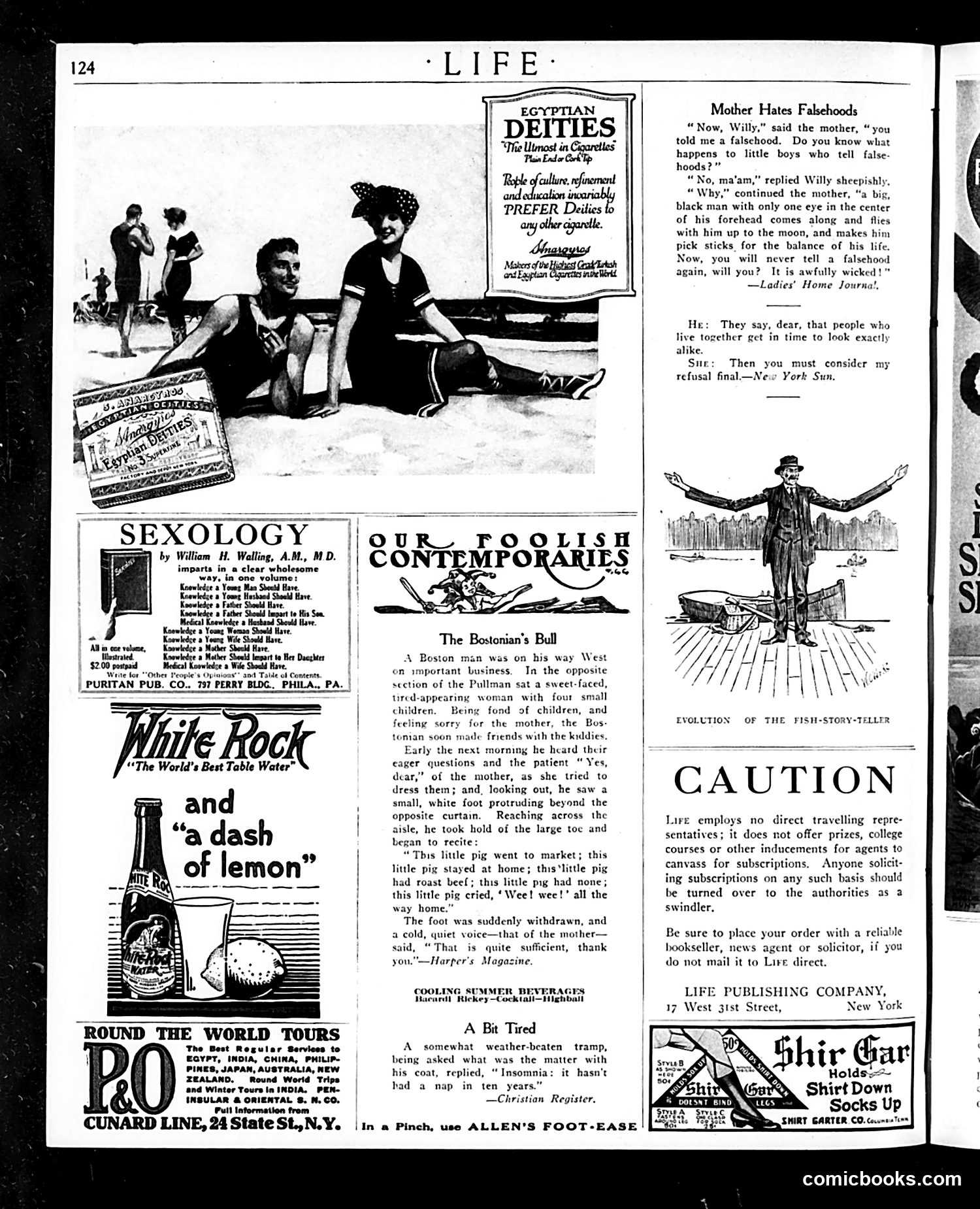
This page is primarily **advertising with interspersed humor snippets** rather than political cartoons. The main illustrated content shows "The Bostonian's Bull"—a joke about a Boston businessman on a train who recites the nursery rhyme "This little pig went to market" to a stranger's children by touching their mother's foot protruding from behind a curtain. The punchline: the mother coldly shuts him down, finding his familiarity inappropriate. Other humor items mock social pretension and relationships: - "Mother Hates Falsehoods" uses exaggerated parental threats (a one-eyed moon-man) as satire of Victorian child-rearing - A gender-relations joke where a woman refuses a man after learning couples eventually look alike - "A Bit Tired" uses a tramp's pun about his coat's insomnia The page is dominated by **product advertisements** (Egyptian Deities cigarettes, White Rock water, P&O cruise lines, Shirt Garters) typical of Life's business model. No significant political content or identifiable caricatures appear.
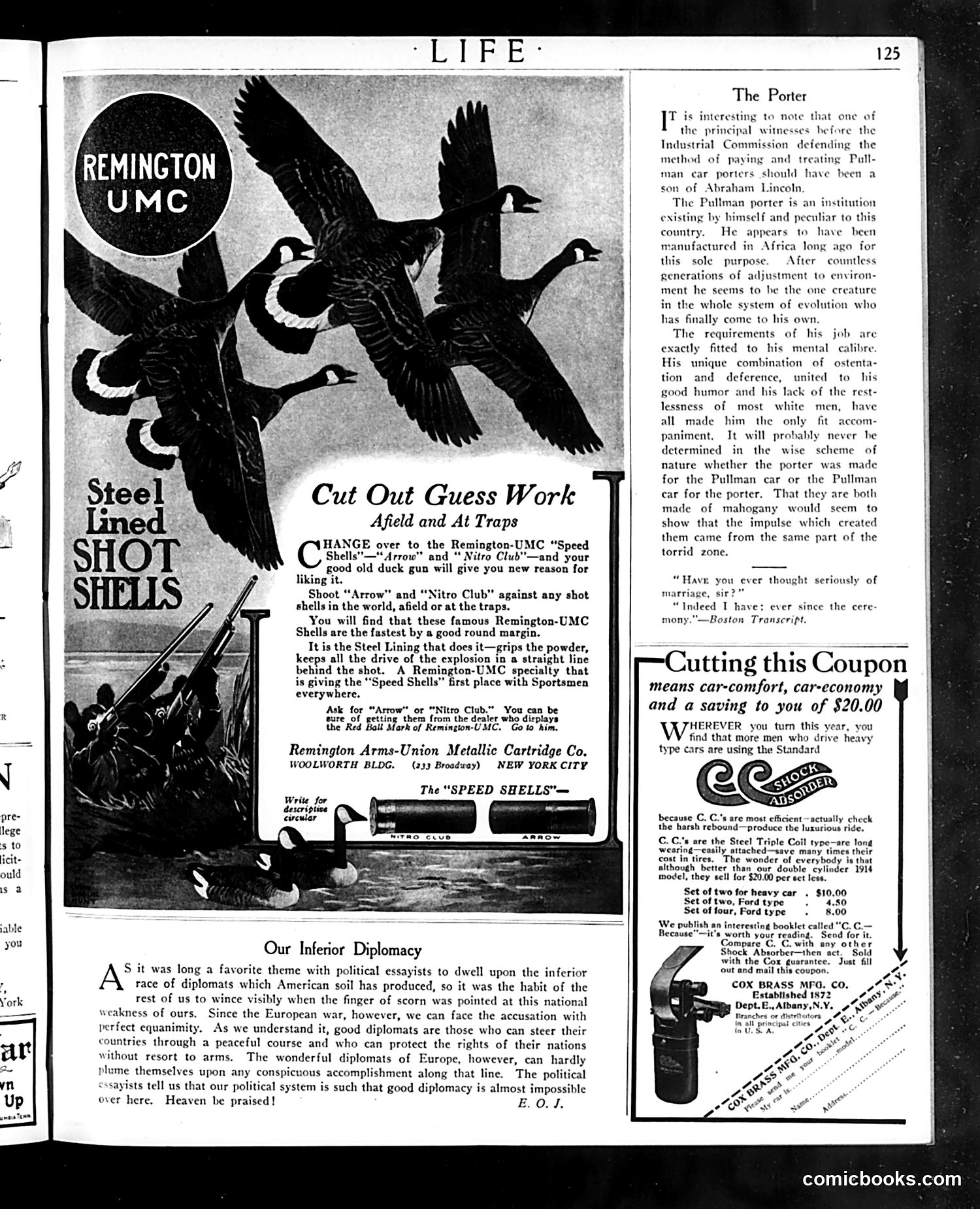
This page is primarily **advertising** with minimal editorial content. The main advertisements are: 1. **Remington-UMC ammunition** (top): Promotes "Speed Shells" shotgun ammunition for hunting, emphasizing steel-lined shells for superior performance. 2. **Standard automobile shock absorbers** (right): Offers a $20 discount coupon for "C.C." shock absorbers, targeting drivers of heavy vehicles. 3. **Cox Brass shock absorbers** (bottom right): A competing product. The editorial content includes: - **"The Porter"**: A commentary on Pullman car porters, noting that a Lincoln descendant testified before an Industrial Commission. The piece uses deeply problematic racial stereotyping, characterizing porters as naturally suited to servitude through supposed African origins and describing them as made of "mahogany." - **"Our Inferior Diplomacy"** (fragment): Discusses American diplomatic capabilities compared to European nations, apparently criticism of pre-WWI U.S. foreign policy. The page reflects early 20th-century attitudes and advertising conventions.
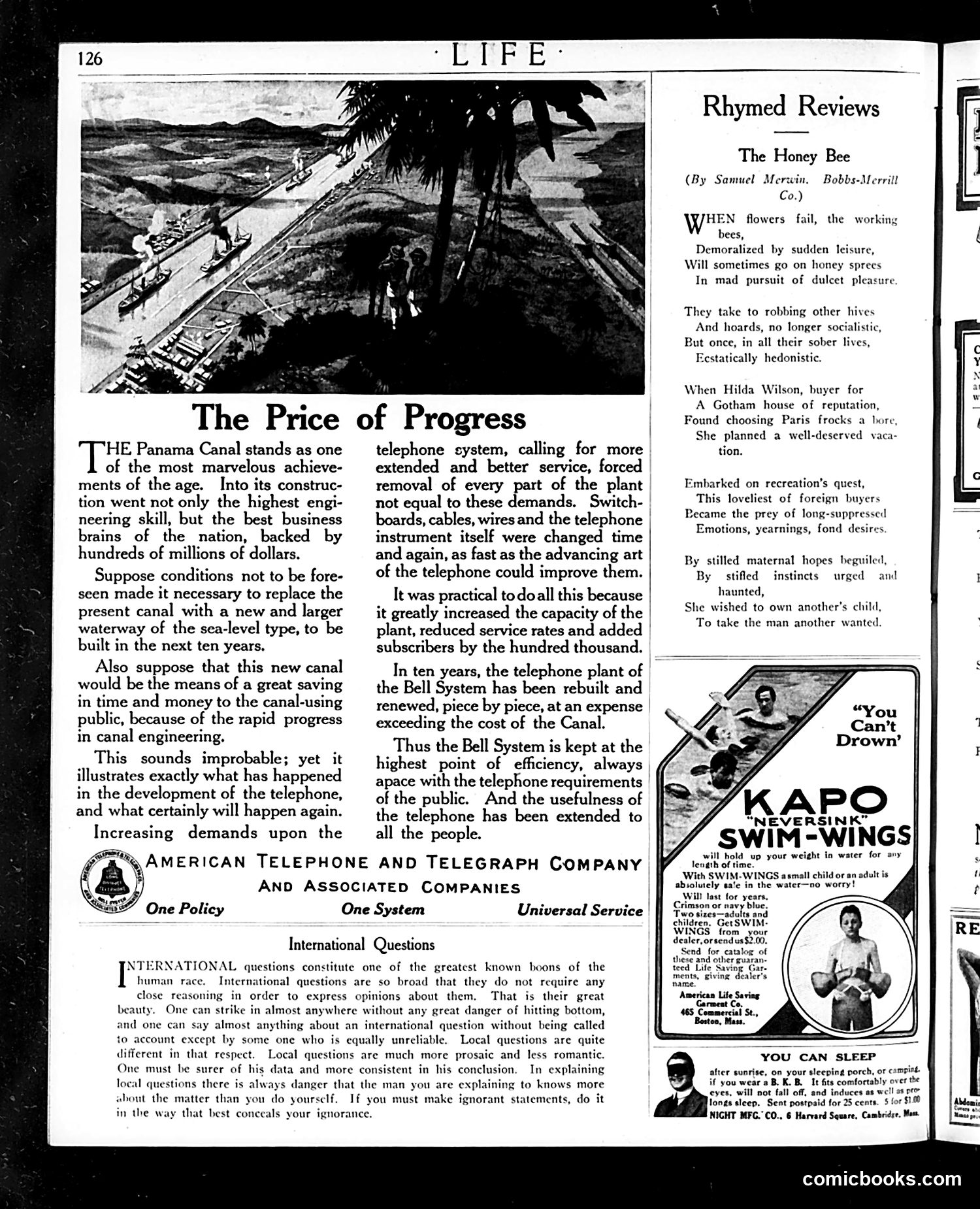
**Main Article ("The Price of Progress"):** This is corporate advocacy for AT&T. It uses the Panama Canal as an analogy: just as that engineering marvel required massive investment, AT&T claims it has spent more than the Canal's cost rebuilding its telephone infrastructure to meet growing demand. The argument: constant modernization of switchboards, cables, and equipment—though expensive—ultimately benefits the public through expanded service and lower rates. This is essentially a defense of AT&T's business practices and infrastructure spending. **"Rhymed Reviews":** A book review of Samuel Merwin's *The Honey Bee*. The review summarizes the plot: when working bees have leisure, they abandon socialistic behavior to indulge hedonistically (robbing hives). Similarly, a wealthy New York fashion buyer abandons her professional duties for vacation, where suppressed maternal and romantic desires surface—she wants another woman's child and another woman's man. **Advertisements:** Include Kapo Neversink Swim-Wings (water safety device) and sleep products. The page is primarily editorial and advertising rather than political satire.
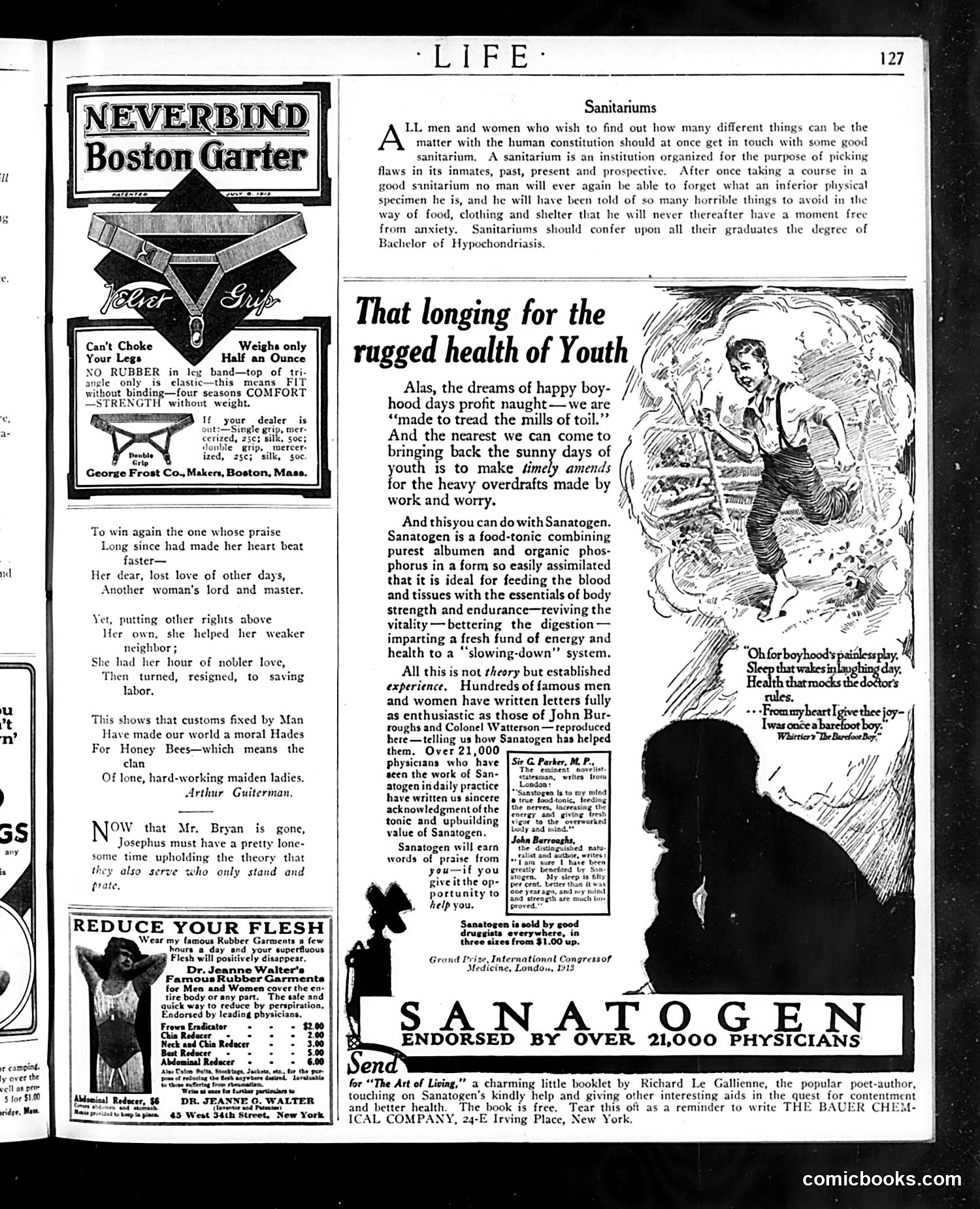
This page blends satirical editorial content with period advertisements, typical of early 20th-century Life magazine. **The "Sanitariums" section** sarcastically critiques the health-obsessed culture of the era. The author mocks sanitariums—fashionable wellness institutions popular among the wealthy—as places that manufacture hypochondria by cataloging imagined ailments rather than genuinely healing patients. The invented degree "Bachelor of Hypochondriasis" is the joke's punchline. **The remaining content is largely advertising**, including: - "Neverbind Boston Garter" (elastic leg wear) - "Reduce Your Flesh" rubber garments claiming to slim via perspiration - "Sanatogen," a patent tonic promising energy restoration These ads ironically surround the sanitarium satire, underscoring Life's point: the wellness industry profits from convincing ordinary people they're physically deficient. The magazine mocks both the institutions and the commercial products promising quick fixes to manufactured health anxieties—a critique remarkably relevant to modern wellness marketing.
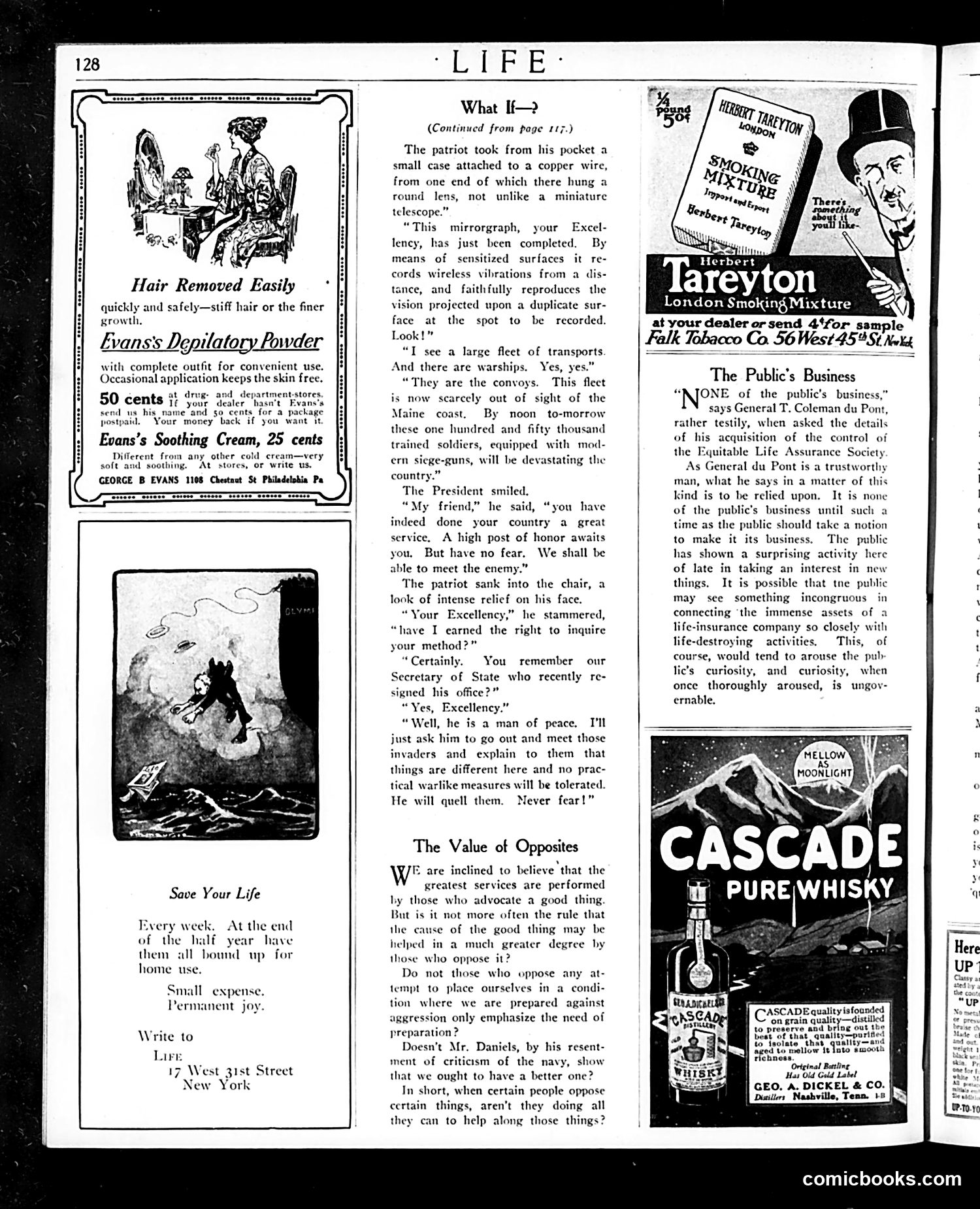
This page contains a serialized satirical story titled "What If—?" that imagines an invasion of America. A patriot shows the President a futuristic "mirrorgraph" device detecting an enemy fleet of 150,000 soldiers approaching the Maine coast. The President confidently responds that he'll simply send the pacifist Secretary of State to negotiate with the invaders, assuring the patriot they'll "quell them. Never fear!" The satire targets American pacifism and isolationism circa World War I era, mocking the notion that diplomatic persuasion alone could stop military aggression. The President's absurd solution—using a peace advocate against armed invasion—ridicules the anti-preparedness movement. The page also includes commentary on "The Value of Opposites," arguing that critics of military readiness inadvertently strengthen the case for preparedness by exposing its necessity. The rest consists of period advertisements and an article questioning General du Pont's acquisition of the Equitable Life Assurance Society, wondering about potential conflicts between insurance and "life-destroying activities."
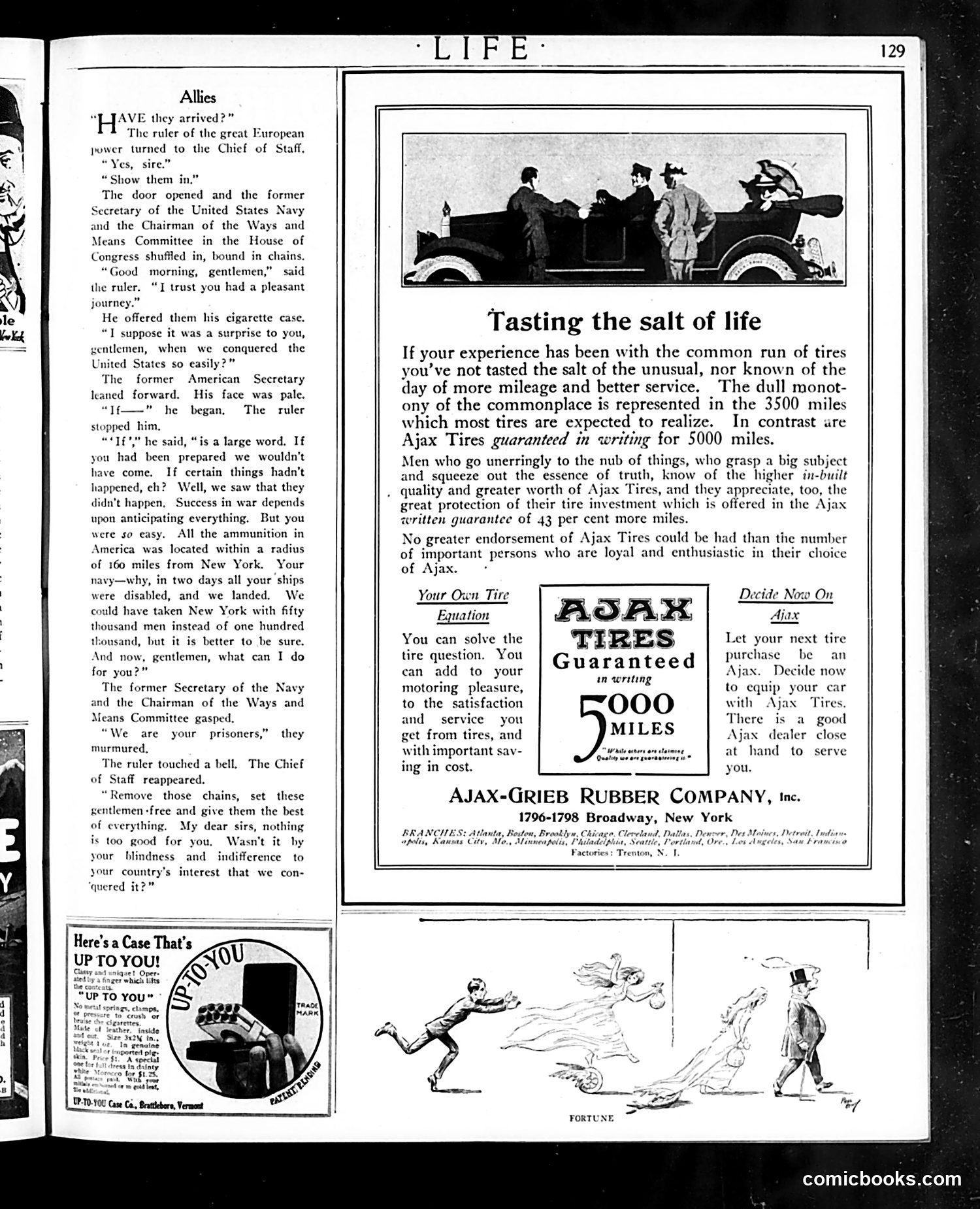
This story depicts a cautionary fantasy where a European power has conquered the United States. The satire targets American political leadership—specifically the former Secretary of the Navy and Chairman of the Ways and Means Committee (representing military and fiscal authority)—who are brought before the conquering ruler in chains. The ruler's explanation for America's defeat centers on negligence: ammunition was concentrated near New York, the navy was unprepared and easily destroyed, and American leaders failed through "blindness and indifference to your country's interest." **The Point:** This is pre-WWI or WWI-era propaganda warning against isolationism, military unpreparedness, and political complacency. It suggests that America's vulnerability stems not from external threat alone, but from internal failure of leadership to anticipate danger and maintain readiness. The story uses dark humor to shame policymakers into taking national defense seriously. The page also contains an Ajax Tires advertisement, unrelated to the satire.
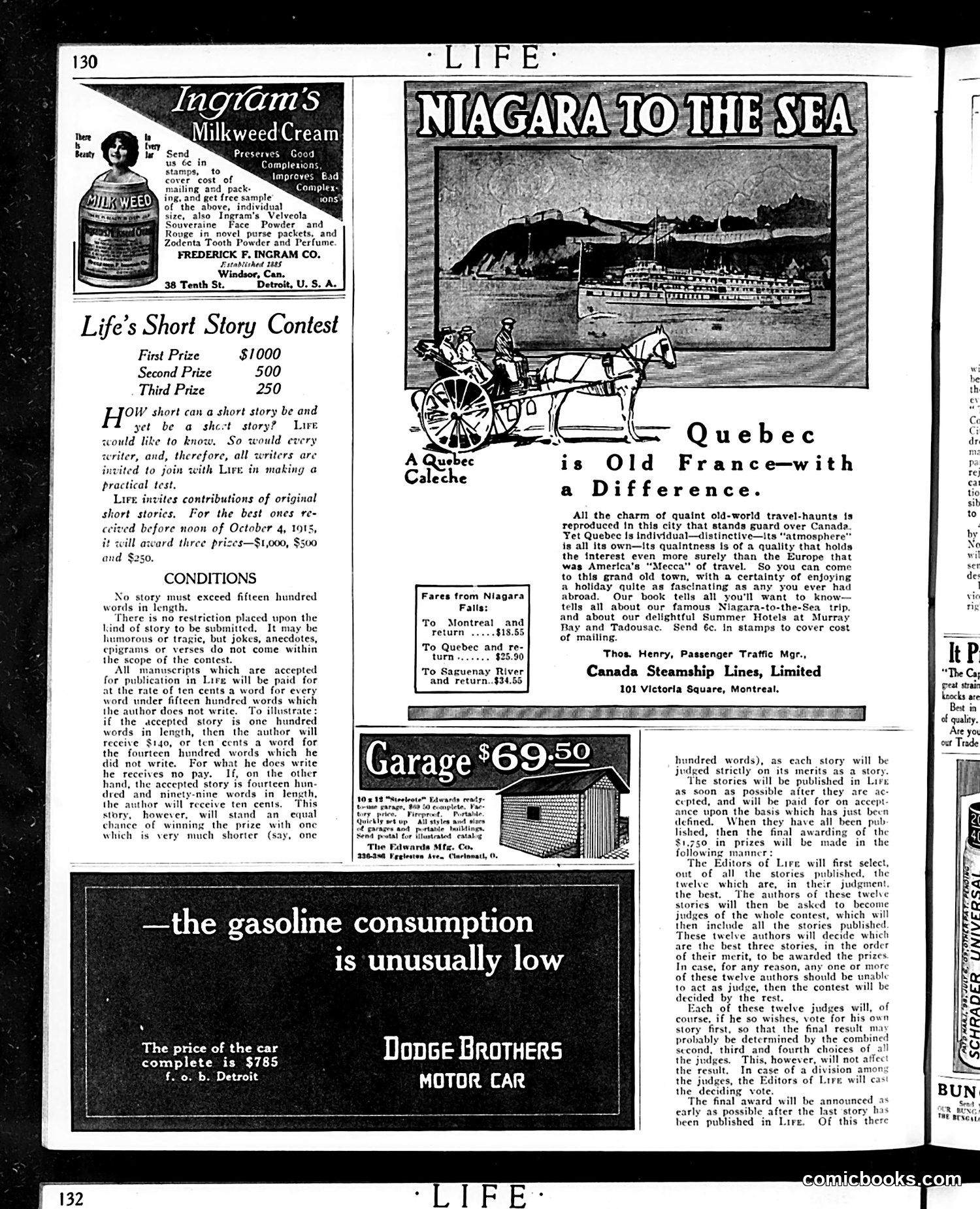
This page consists primarily of **advertisements and contest announcements**, not political satire or comics. The main content includes: 1. **Ingram's Milkweed Cream ad** - a cosmetics advertisement promising improved complexion 2. **Life's Short Story Contest** - announcing $1,000 first prize for original short stories under 1,500 words, with detailed submission rules and judging procedures 3. **"Niagara to the Sea" travel advertisement** - promoting Quebec as a tourist destination comparable to Old France, with steamship fare information 4. **Dodge Brothers Motor Car ad** - highlighting the vehicle's low gasoline consumption, priced at $785 5. **Garage advertisement** - featuring a "$69.50" prefabricated structure This appears to be a standard magazine page from the early 20th century mixing editorial content with commercial advertising. There is no political cartoon or satirical commentary present.
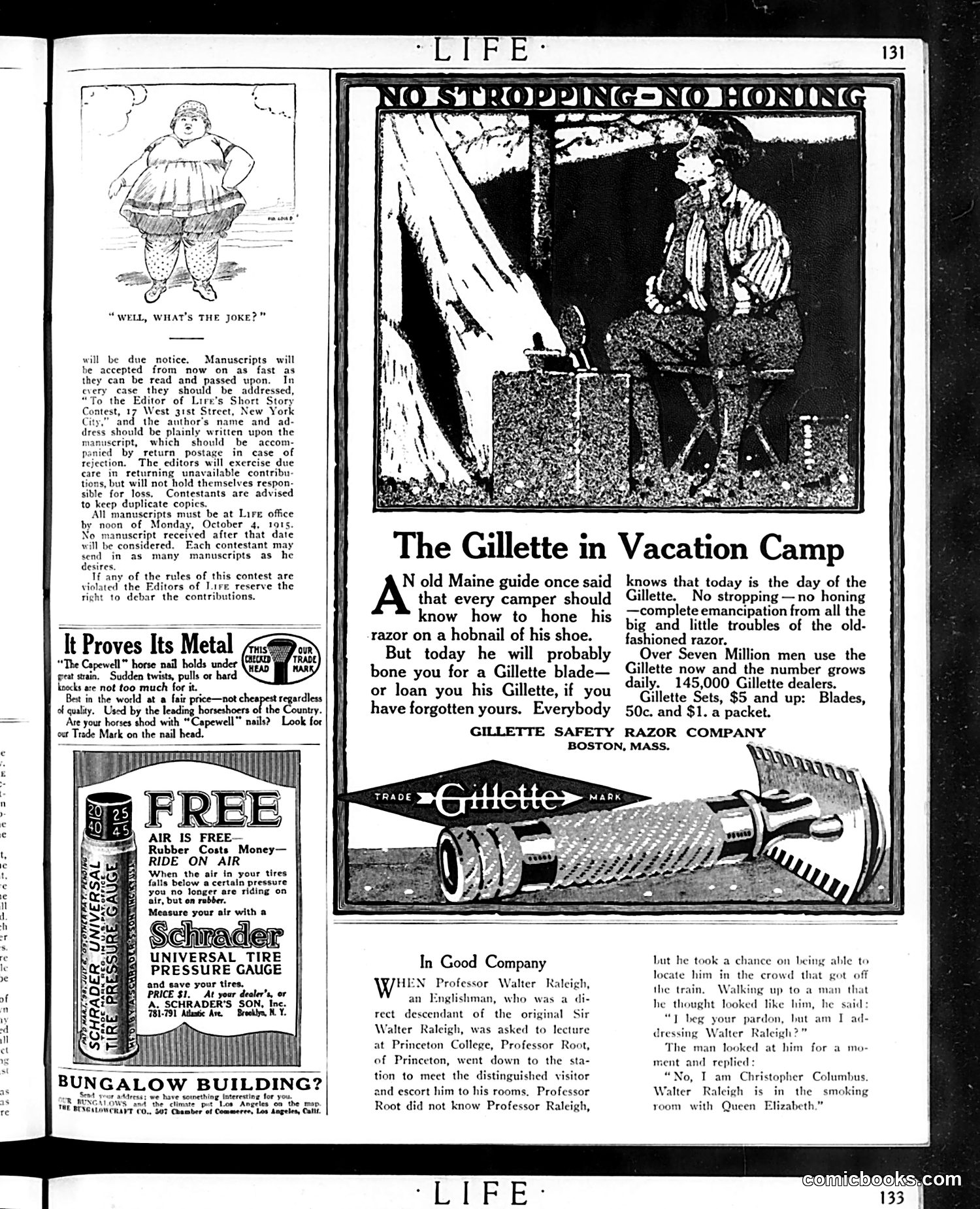
This page is primarily **advertising** with minimal editorial content. The main cartoon—"Well, What's the Joke?"—shows a rotund woman in an old-fashioned dress and appears to be a simple visual gag about female body shape, typical of early 20th-century humor that would be considered crude by modern standards. The bulk of the page contains product advertisements (Capewell horse nails, Schrader tire gauges, Gillette razors, and bungalow construction) and announces a **short-story writing contest** for Life magazine, with a October 4, 1915 deadline. The only substantive editorial piece is "In Good Company," a brief anecdote about Professor Walter Raleigh (descendant of the famous explorer) being mistaken for Christopher Columbus at Princeton—a mild humor piece playing on confusion between historical figures. The punchline references Columbus, Raleigh, and Queen Elizabeth appearing together anachronistically.
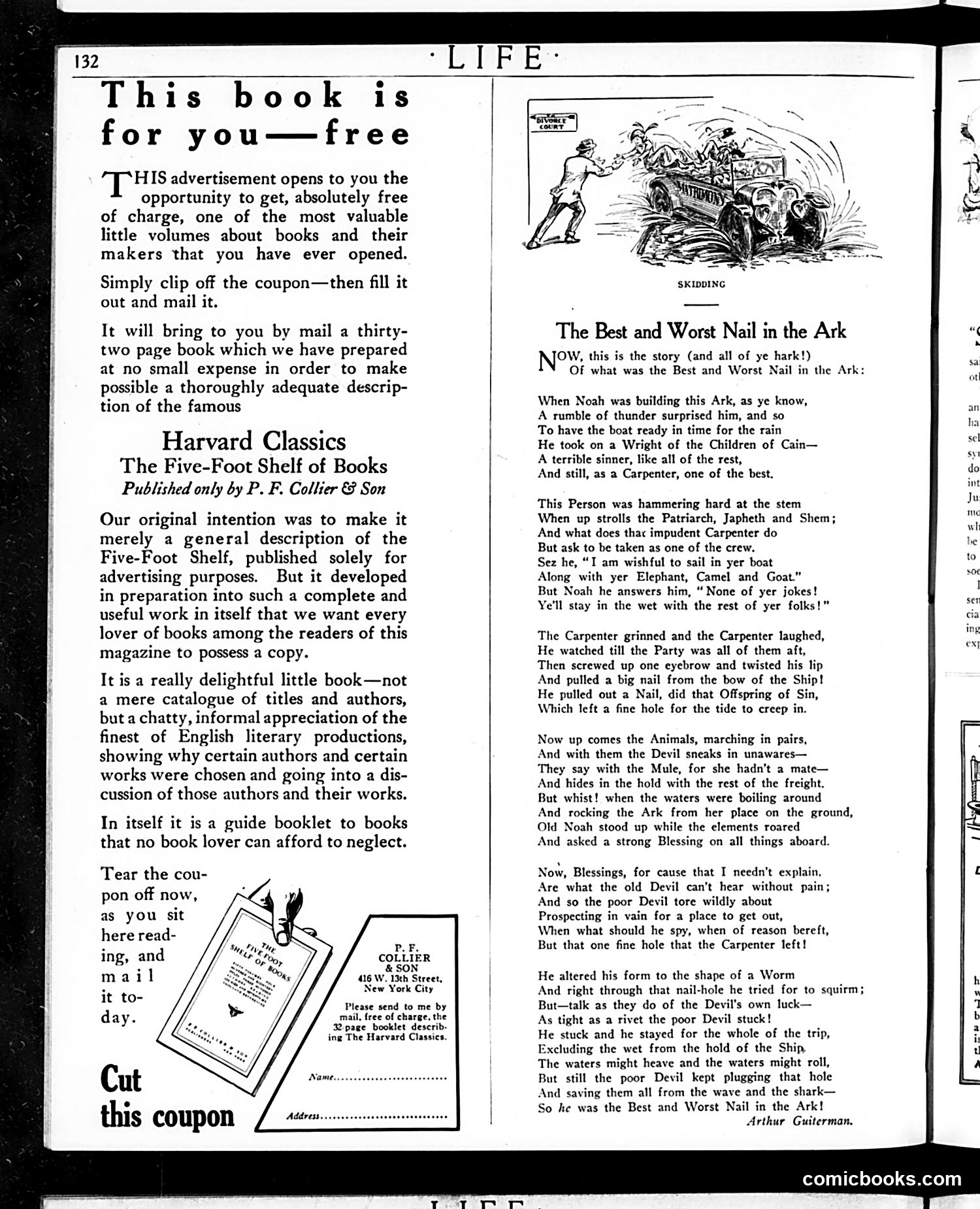
This page is primarily **advertising** for the Harvard Classics "Five-Foot Shelf of Books," published by P.F. Collier & Son. The left column promotes a free 32-page descriptive booklet about this famous literary collection, with a tear-off coupon for mail order. The right side features a humorous narrative poem titled "The Best and Worst Nail in the Ark" by Arthur Guiterman. It's a comic retelling of Noah's Flood story where a rejected carpenter sabotages the Ark by removing a nail from its bow, creating a leak. The Devil later discovers this hole while trying to escape the Ark's blessing and transforms into a worm to escape—but gets stuck in the nail hole, ironically becoming the Ark's savior by plugging the leak throughout the voyage. The "satire" here is lighthearted wordplay on the carpenter being simultaneously the "best" (skillful) and "worst" (traitorous) nail-worker aboard.
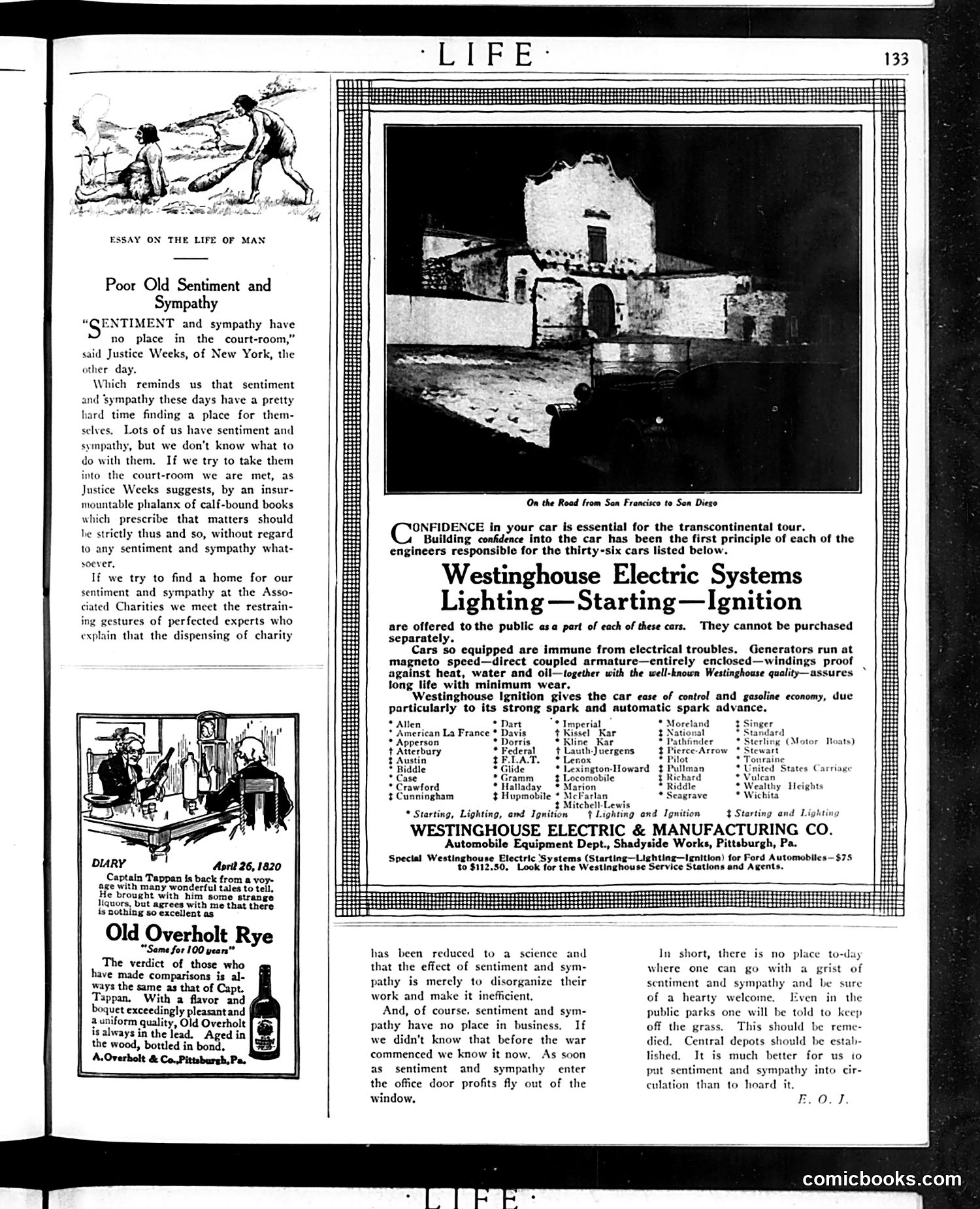
This page satirizes the modern elimination of sentiment and sympathy from American institutions. The essay "Poor Old Sentiment and Sympathy" argues that Justice Weeks of New York speaks a harsh truth: emotion has no place in courtrooms, charities, or business. The author laments that sentiment—once valued—is now systematically excluded from law, charitable work, and commerce as inefficient obstacles. The satire targets post-WWI society's embrace of cold rationalism and efficiency. The writer suggests sentiment is homeless in modern America: courts reject it via legal precedent, charities dismiss it as counterproductive, and business considers it profit-killing. He proposes ironically that "central depots" should be established to house displaced sentiment and sympathy. The page's advertisements (Westinghouse electrical systems, Old Overholt whiskey) underscore the commercialized, mechanized world the essay critiques—a world prioritizing technological confidence and product quality over human feeling.
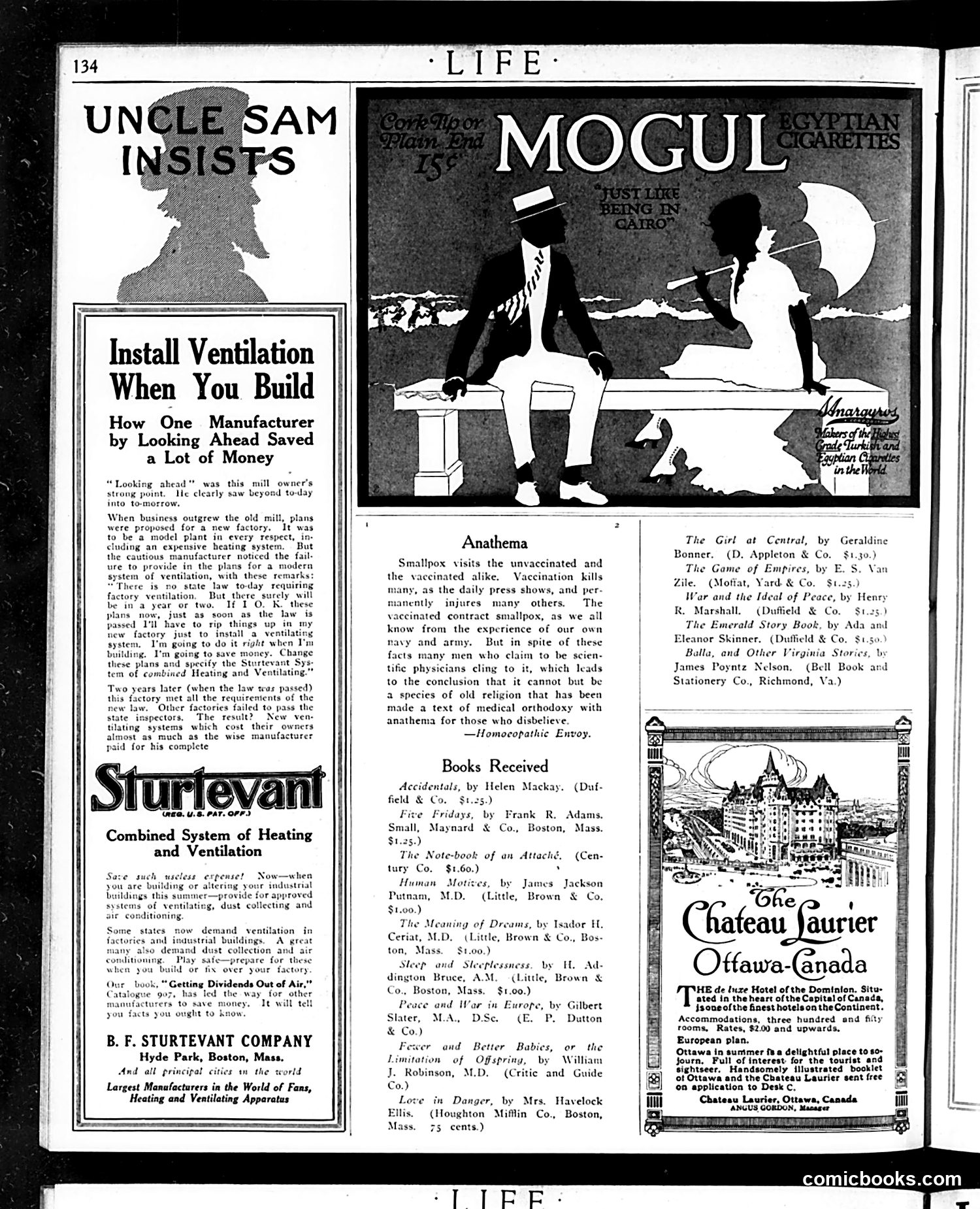
This page mixes advertising with editorial content. The main cartoon appears to be **"Mogul"** (top right), depicting two figures in Egyptian/colonial dress against a Cairo backdrop—likely satirizing British imperial pretensions in Egypt, though the specific political moment is unclear from the image alone. The left side features a **Sturtevant Company advertisement** disguised as editorial advice: a mill owner "looking ahead" installs ventilation before regulations require it, saving money when laws eventually pass. This is corporate puffery presenting foresight as wisdom. The **"Anathema" section** critiques anti-vaccination activists as religiously dogmatic rather than scientific, dismissing their arguments despite documented vaccine side effects the author acknowledges. The **"Books Received"** section lists newly published works, mostly on psychology, dreams, and social topics typical of early 20th-century intellectual interests. The **Chateau Laurier advertisement** promotes an Ottawa luxury hotel. Overall, this is primarily a vehicle for advertising and book notices, with light satirical editorial content.
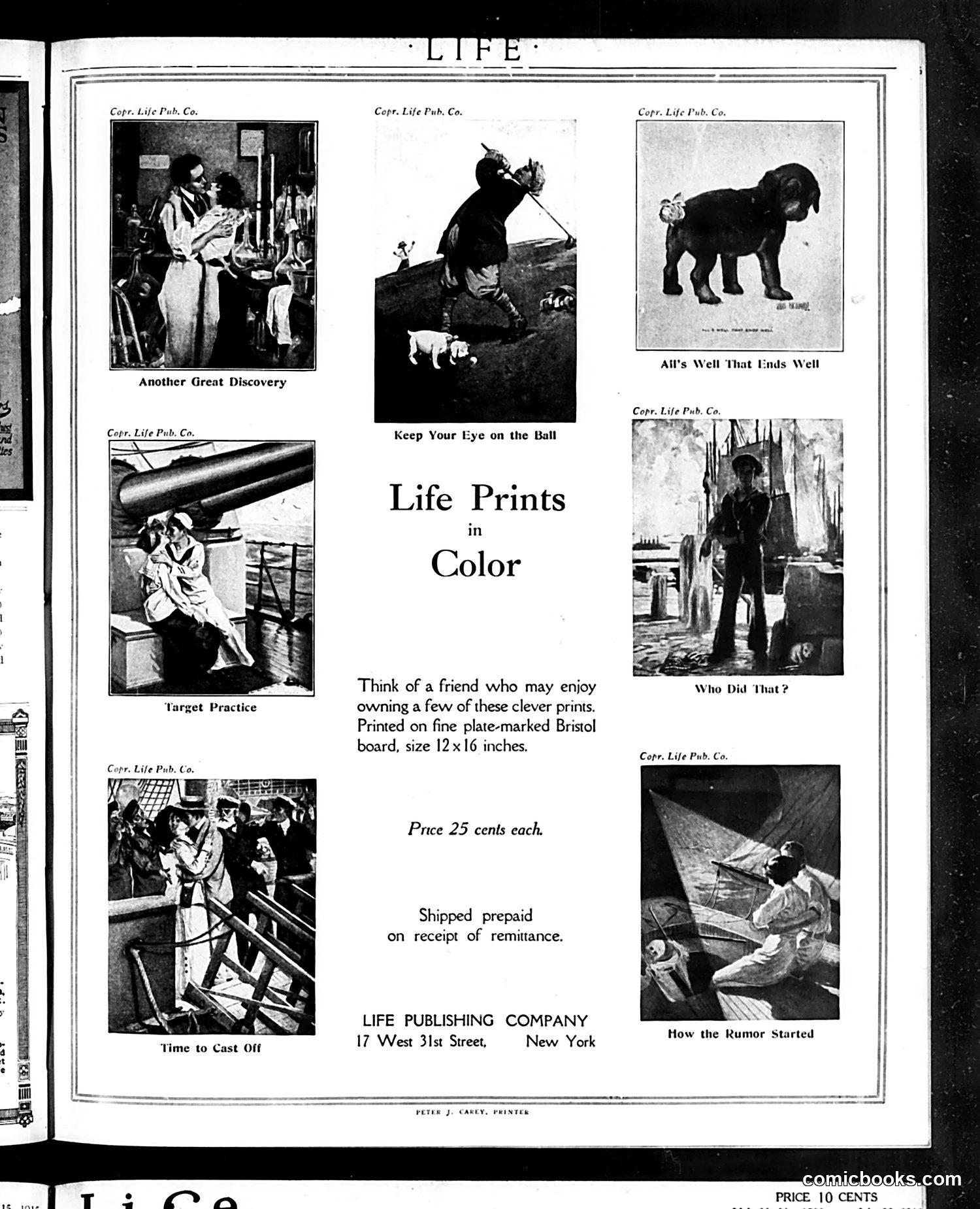
This page is primarily a **product advertisement** for "Life Prints in Color"—a mail-order offering by Life Publishing Company. Rather than political satire, it promotes decorative prints (12x16 inches, 25 cents each) featuring six humorous illustrated scenes with comic captions. The images appear to depict everyday situations played for laughs: a couple in what seems an intimate discovery, a man with binoculars watching something, a dog, a woman in an industrial setting, people on what appears to be a ship, and a person in a boat. The titles—"Another Great Discovery," "Keep Your Eye on the Ball," "Target Practice," "Time to Cast Off," "Who Did That?" and "How the Rumor Started"—suggest domestic comedy and slapstick humor typical of early 20th-century entertainment. The advertisement is straightforward marketing, not political commentary.
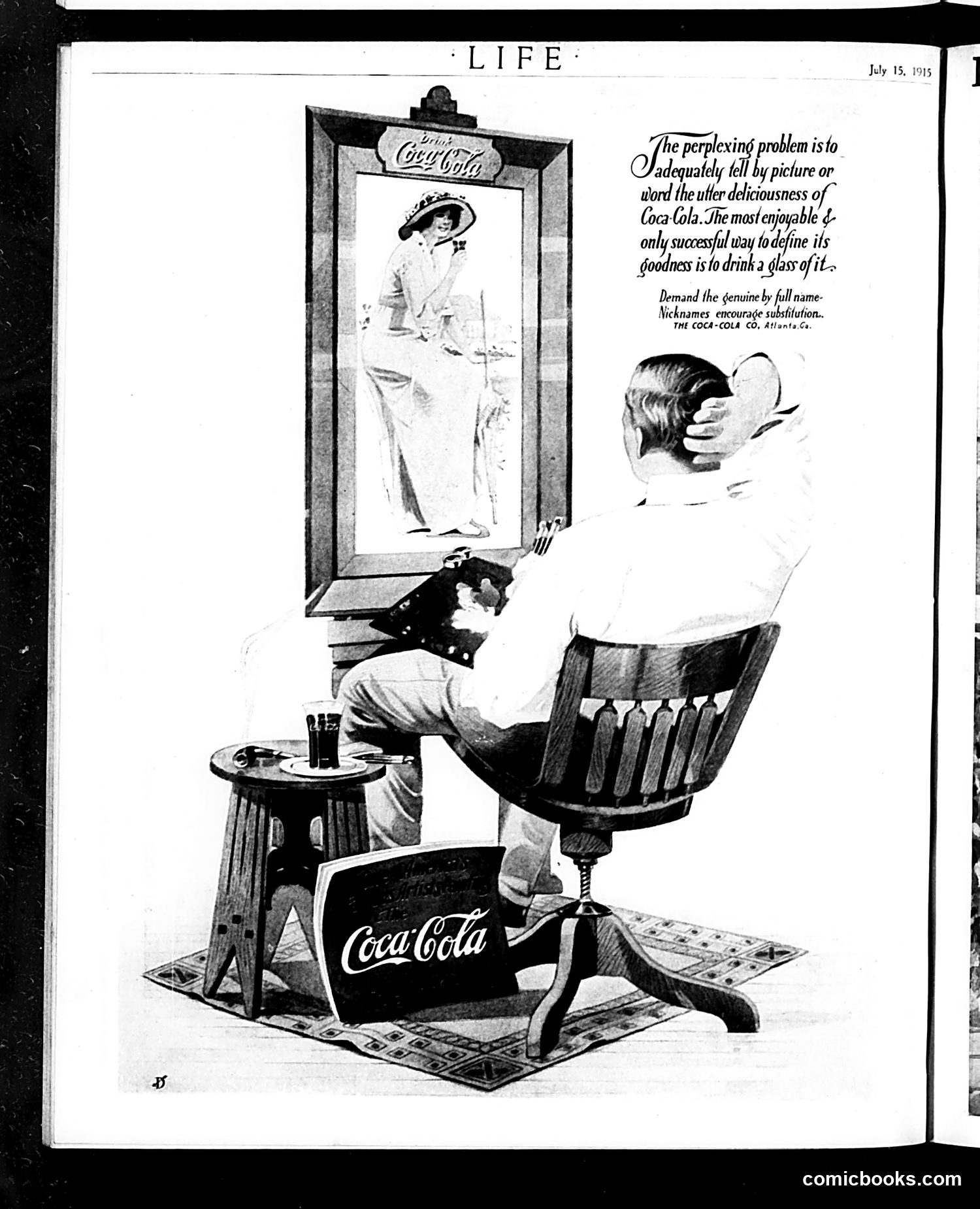
This is a **Coca-Cola advertisement** disguised as editorial commentary, published July 15, 1915. The image shows a man viewing a framed portrait of an elegant woman in a hat. The accompanying text argues that Coca-Cola's appeal cannot be adequately described in words or pictures—it must be experienced by drinking it. The satire is subtle: the ad playfully suggests that just as one cannot truly appreciate a beautiful woman's charm through her portrait alone, one cannot understand Coca-Cola's "deliciousness" through advertising claims. Only direct consumption reveals the truth. The final line warns consumers to demand "the genuine by full name" and avoid substitutes—reflecting early 20th-century concerns about counterfeit sodas and imitations flooding the market.