
Life, 1915-07-15 · page 45 of 48
Life — July 15, 1915 — page 45: what you’re looking at
What you’re looking at
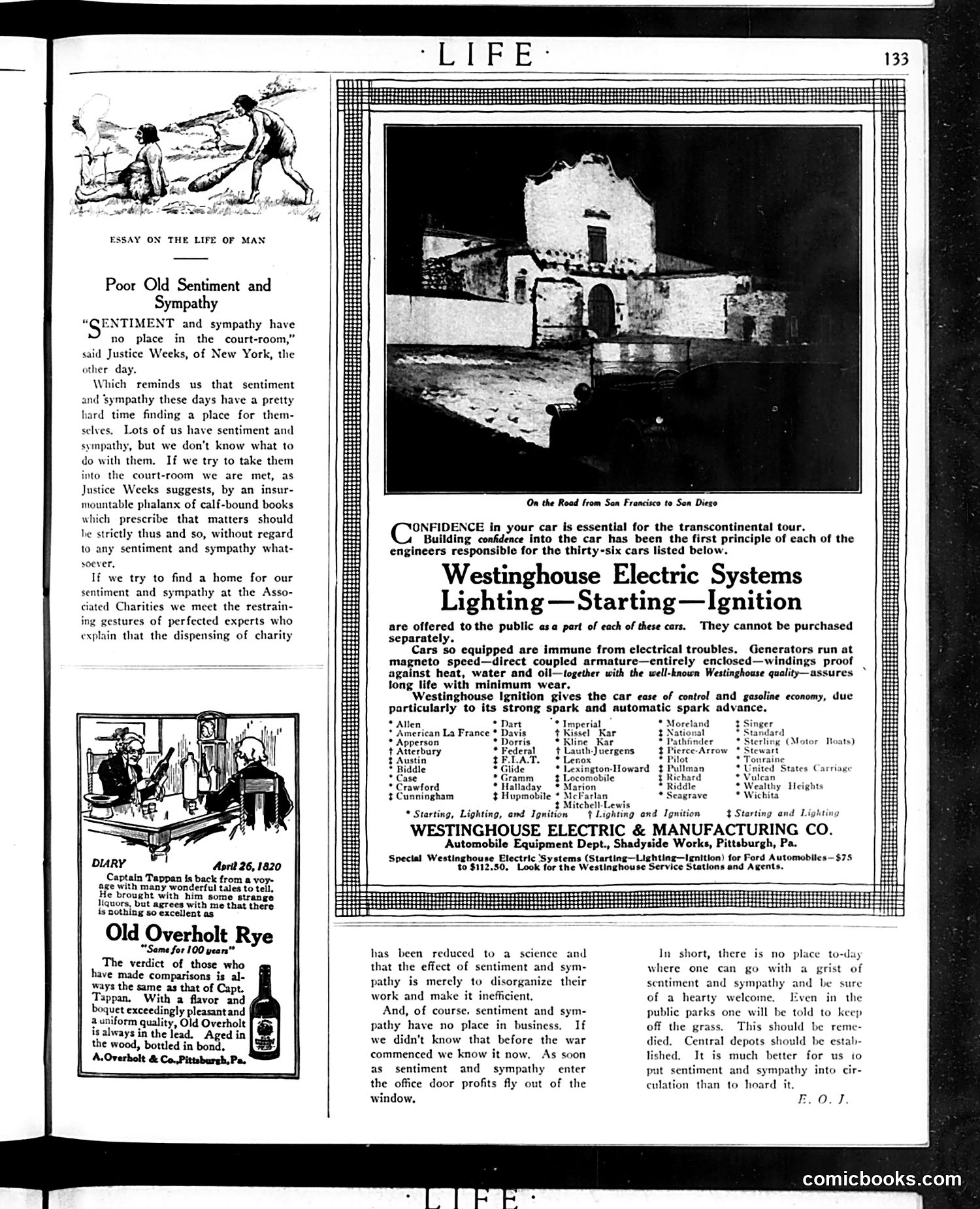
This page satirizes the modern elimination of sentiment and sympathy from American institutions. The essay "Poor Old Sentiment and Sympathy" argues that Justice Weeks of New York speaks a harsh truth: emotion has no place in courtrooms, charities, or business. The author laments that sentiment—once valued—is now systematically excluded from law, charitable work, and commerce as inefficient obstacles. The satire targets post-WWI society's embrace of cold rationalism and efficiency. The writer suggests sentiment is homeless in modern America: courts reject it via legal precedent, charities dismiss it as counterproductive, and business considers it profit-killing. He proposes ironically that "central depots" should be established to house displaced sentiment and sympathy. The page's advertisements (Westinghouse electrical systems, Old Overholt whiskey) underscore the commercialized, mechanized world the essay critiques—a world prioritizing technological confidence and product quality over human feeling.
📄 Transcribed text from this page (OCR, searchable)
Machine-transcribed from the original scan — historical spelling and the odd misread are preserved.
ESSAY ON THE LIFE OF MAN Poor Old Sentiment and Sympathy ENTIMENT and sympathy have no place in the court-room,” said Justice Weeks, of New York, the + day. Which reminds us that sentiment and sympathy these days have a pretty hard time finding a place for them- selves. Lots of us have sentiment and sympathy, but we don’t know what to do with them. If we try to take them into the court-room we are met, as Justice Weeks suggests, by an insur- mountable phalanx of calf-bound books which prescribe that matters should he strictly thus and so, without regard to any sentiment and sympathy what- soever, If we try to find a home for our sentiment and sympathy at the Asso- ciated Charities we meet the restrain- ing gestures of perfected experts who explain that the dispensing of charity April 26, 1820 Captain Tappan is back from a voy- ‘age with many wonderful tales to tell. iz brought with him some strange wors, but agrees with me th: is nothing so excellentas ae Old Overholt Rye “Same for 100 years” The verdict of those who have made comparisons is al- ways the same as that of Capt. Tappan. With a flavor and boquet exceedingly pleasantand a uniform quality, Old Overholt is always in the lead. Aged in the wood, bottled in bond. A.Overholt & Co.,Pittsbursh,Pa. CONEICENCE: in your car is essential for the transcontinental tour. Building confidence into the car has been the first principle of each of the engineers responsible for the thirty-six cars listed below. Westinghouse Electric Systems Lighting — Starting —Ignition are offered tothe public asa part of each of these cars. They cannot be purchased separately. Cars so equipped are immune from electrical troubles. Generators run at magneto speed—direct coupled armature—entirely enclosed—windings proof against heat, water and oil—together with the well-known Westinghouse quality—assures long life with minimum wear. Westinghouse Ignition gives the car ease of control and gasoline economy, due particularly to its strong spark and automatic spark advance. + Allen * Dart * Imperial + American La France * Davis t Kissel Kar * Apperson ‘Dorris, * Kline Kar t Atterbury * Federal $ Lauth-Juergens 2F.LAT. * Lenox * Biddle ide * Lexington-Howard Pullman 1c t Locomobile 2 Austin Case * Gramm * Crawford * Halladay t Cunningham $ Hupmobite * Mca H Mike Lighting and Ignition Starting and Lighting WESTINGHOUSE ELECTRIC & MANUFACTURING CO. Automobile Equipment Dept., Shadyside Works, Pittsburgh, Pa. Special Westinghouse Electric Systems (Starting—Lighting—Ignition) for Ford Automobiles—$75 to $112.50, Look for the Westinghouse Service Stations and Agents. * Starting, Lighting, amd Ignition On the Road from San Francisco to Son Dieso * Moreland 2 Singer tional * Standard *Pathinder — ¢ Ster 2 Pierce-Arrow * * Pitot : } Richard * Riddle * Seagrave has been reduced to a science and that the effect of sentiment and sym- pathy is merely to disorganize their work and make it inefficient, And, of course, sentiment and sym- pathy have no place in business. If we didn’t know that before the war commenced we know it now, As soon as sentiment and sympathy enter the office door profits fly out of the window. In short, there is no place to-day where one can go with a grist of sentiment and sympathy and be sure of a hearty welcome. Even in the public parks one will be told to keep off the grass. This should be reme- died. Central depots should be estab- lished. It is much better for us to put sentiment and sympathy into cir- culation than to hoard it. comicbooks.com