
Life, 1915-07-15 · page 14 of 48
Life — July 15, 1915 — page 14: what you’re looking at
What you’re looking at
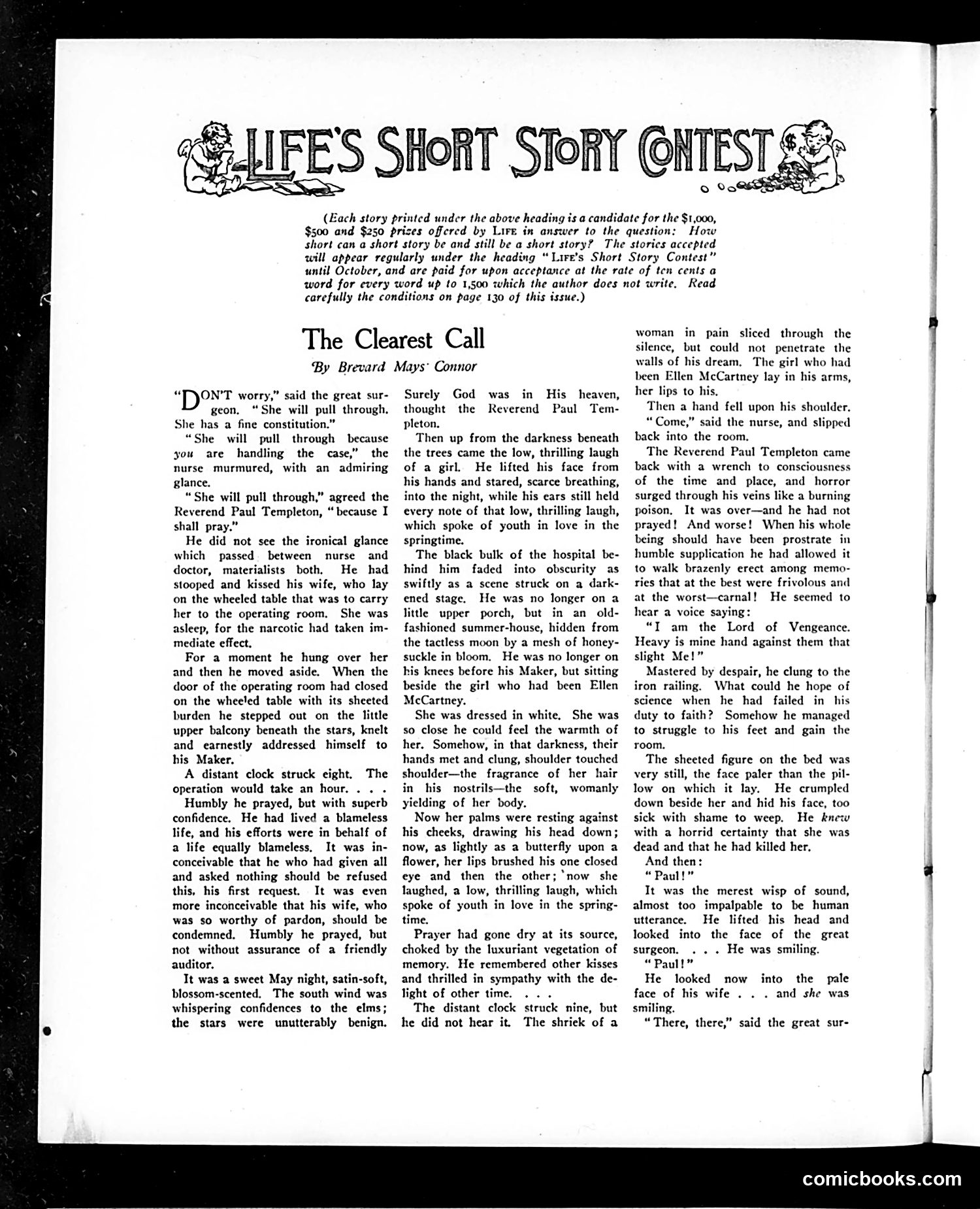
This page contains **no political cartoon or satire**. It is a literary contest announcement and the opening of a short story titled "The Clearest Call" by Brevard Mays Connor. The header explains Life's short story contest, offering $1,000, $500, and $250 prizes for stories under 1,500 words, paid at ten cents per word for accepted submissions. The story itself—appearing to be religious or philosophical fiction—depicts a Reverend Paul Templeton at a hospital bedside, dealing with themes of faith, prayer, and moral crisis. The narrative contains no satirical content or political references visible on this page. This is straightforward magazine fiction content, not humor or social commentary.
📄 Transcribed text from this page (OCR, searchable)
Machine-transcribed from the original scan — historical spelling and the odd misread are preserved.
(Each story printed under the above heading is a candidate for the $1,000, $500 and $250 prises offered by Lire in answer to the question: How short can a short story be and still be a short story? The storics accepted will appear regularly under the heading “Lire’s Short Story Contest” until October, and are paid for upon acceptance at the rate of ten cents a word for every word up to 1,500 which the author does not write, Read carefully the conditions on page 130 of this issue.) The Clearest Call ‘By Brevard Mays’ Connor geon, has a fine constitution.” She will pull through because you are handling the case,” the nurse murmured, with an admiring glance. “She will pull through,” agreed the Reverend Paul Templeton, “because I shall pray.” He did not see the ironical glance which passed between nurse and doctor, materialists both, He had stooped and kissed his wife, who lay on the wheeled table that was to carry her to the operating room. She was asleep, for the narcotic had taken im- mediate effect. For a moment he hung over her and then he moved aside. When the door of the operating room had closed on the wheeled table with its sheeted burden he stepped out on the little upper balcony beneath the stars, knelt and earnestly addressed himself to his Maker. A distant clock struck eight. The operation would take an hour. . . . Humbly he prayed, but with superb confidence, He had lived a blameless life, and his efforts were in behalf of a life equally blameless, It was in- conceivable that he who had given all and asked nothing should be refused this, his first request. It was even more inconceivable that his wife, who was so worthy of pardon, should be condemned. Humbly he prayed, but not without assurance of a friendly auditor. It was a sweet May night, satin-soft, blossom-scented. The south wind was whispering confidences to the elms; the stars were unutterably benign. “Dot worry,” said the great sur- “She will pull through, Surely God was in His heaven, thought the Reverend Paul Tem- pleton, Then up from the darkness beneath the trees came the low, thrilling laugh of a girl. He lifted his face from his hands and stared, scarce breathing, into the night, while his ears still held every note of that low, thrilling laugh, which spoke of youth in love in the springtime. The black bulk of the hospital be- hind him faded into obscurity as swiftly as a scene struck on a dark- ened stage. He was no longer on a little upper porch, but in an old- fashioned summer-house, hidden from the tactless moon by a mesh of honey- suckle in bloom. He was no longer on his knees before his Maker, but sitting beside the girl who had been Ellen McCartney. She was dressed in white, She was so close he could feel the warmth of her. Somehow, in that darkness, their hands met and clung, shoulder touched shoulder—the fragrance of her hair in his nostrils—the soft, womanly yielding of her body. Now her palms were resting against his cheeks, drawing his head down; now, as lightly as a butterfly upon a flower, her lips brushed his one closed eye and then the other;‘now she laughed, a low, thrilling laugh, which spoke of youth in love in the spring- time. Prayer had gone dry at its source, choked by the luxuriant vegetation of memory. He remembered other kisses and thrilled in sympathy with the de- light of other time. . . . The distant clock struck nine, but he did not hear it, The shriek of a woman in pain sliced through the silence, but could not penetrate the walls of his dream, The girl who had been Ellen McCartney lay in his arms, her lips to his, Then a hand fell upon his shoulder, “Come,” said the nurse, and slipped back into the room. The Reverend Paul Templeton came back with a wrench to consciousness of the time and place, and horror surged through his veins like a burning poison, It was over—and he had not prayed! And worse! When his whole being should have been prostrate in humble supplication he had allowed it to walk brazenly erect among memo- ries that at the best were frivolous and at the worst—carnal! He seemed to hear a voice saying: “Iam the Lord of Vengeance. Heavy is mine hand against them that slight Me!” Mastered by despair, he clung to the iron railing. What could he hope of science when he had failed in his duty to faith? Somehow he managed to struggle to his feet and gain the room, The sheeted figure on the bed was very still, the face paler than the pil- low on which it lay. He crumpled down beside her and hid his face, too sick with shame to weep. He knew with a horrid certainty that she was dead and that he had killed her. And then: “Paul!” It was the merest wisp of sound, almost too impalpable to be human utterance. He lifted his head and looked into the face of the great surgeon, . . . He was smiling. “Paull” He looked now into the pale face of his wife . . . and she was smiling. “There, there,” said the great sur- comicbooks.com —