
Life, 1915-07-15 · page 22 of 48
Life — July 15, 1915 — page 22: what you’re looking at
What you’re looking at
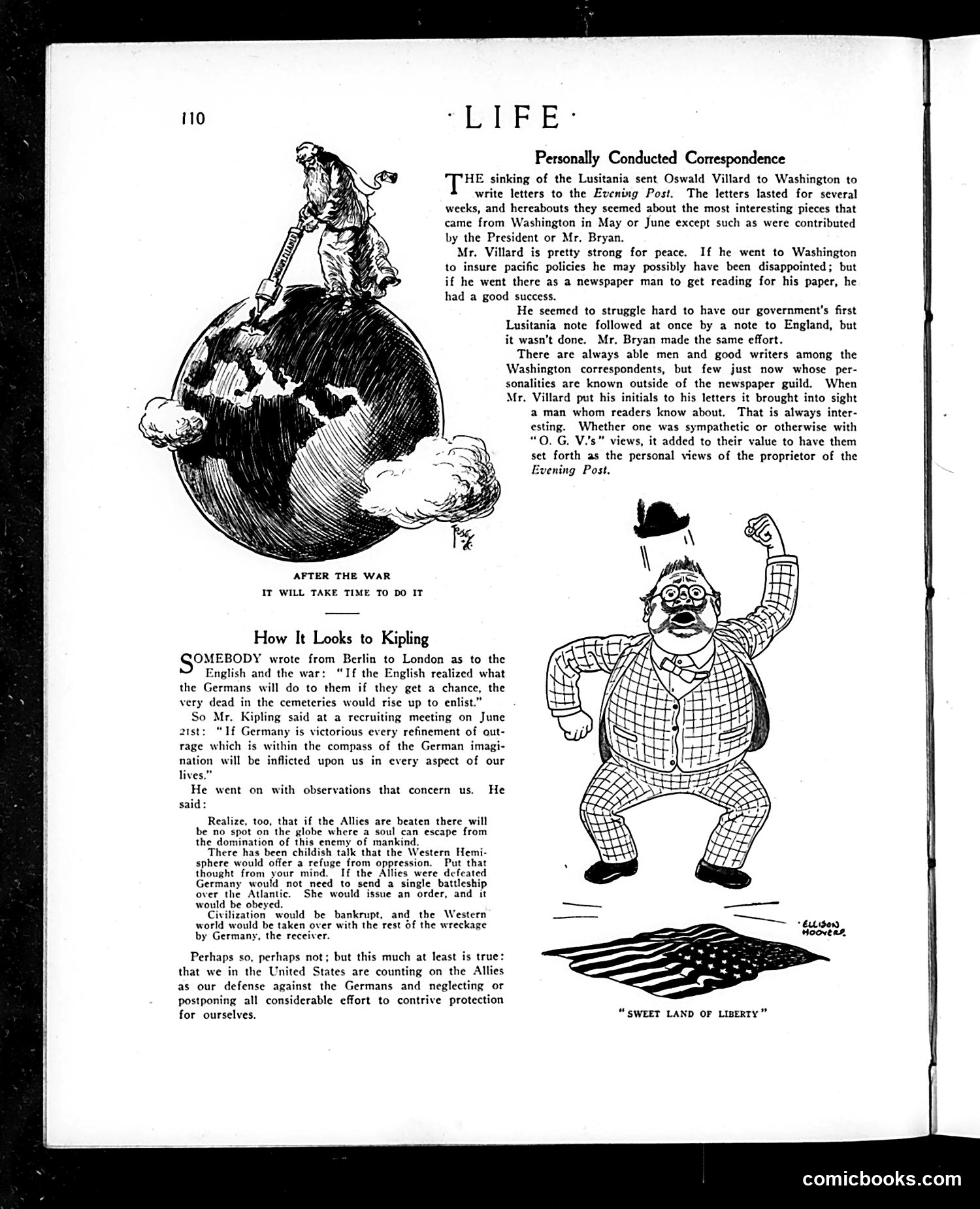
This page contains two sections discussing American responses to World War I: **"Personally Conducted Correspondence"** discusses Oswald Villard, editor of the *Evening Post*, who traveled to Washington following the Lusitania sinking (1915) to write letters advocating for pacifism. The piece notes Villard's influence came from his public prominence, regardless of whether readers agreed with his anti-war stance. **"How It Looks to Kipling"** presents writer Rudyard Kipling's opposing view: a fierce pro-Allied argument that German victory would threaten even the Western Hemisphere, making American neutrality foolish. Kipling argues civilization itself depends on Allied victory. The satirical illustrations reinforce this tension: the top cartoon shows the earth struggling under wartime burden; the bottom cartoon titled "Sweet Land of Liberty" depicts Uncle Sam as a bloated, complacent figure dancing on the American flag—mocking American isolationism while the war rages. The page essentially contrasts pacifist and interventionist positions in 1915 America, with the cartoons suggesting the magazine favored Kipling's interventionist stance over Villard's pacifism.
📄 Transcribed text from this page (OCR, searchable)
Machine-transcribed from the original scan — historical spelling and the odd misread are preserved.
hE E * Personally Conducted Correspondence HE sinking of the Lusitania sent Oswald Villard to Washington to write letters to the Evening Post. The letters lasted for several weeks, and hereabouts they seemed about the most interesting pieces that came from Washington in May or June except such as were contributed by the President or Mr. Bryan. Mr. Villard is pretty strong for peace. If he went to Washington to insure pacific policies he may possibly have been disappointed; but if he went there as a newspaper man to get reading for his paper, he had a good success. He seemed to struggle hard to have our government's first Lusitania note followed at once by a note to England, but it wasn’t done. Mr. Bryan made the same effort. There are always able men and good writers among the Washington correspondents, but few just now whose per- sonalities are known outside of the newspaper guild. When Mr, Villard put his initials to his letters it brought into sight a man whom readers know about. That is always inter- esting. Whether one was sympathetic or otherwise with “O. G. V's” views, it added to their value to have them set forth as the personal views of the proprietor of the Evening Post. AFTER THE WAR WILL TAKE TIME TO DO IT How It Looks to Kipling OMEBODY wrote from Berlin to London as to the English and the war: “If the English realized what the Germans will do to them if they get a chance, the very dead in the cemeteries would rise up to enlist.” So Mr. Kipling said at a recruiting meeting on June 2ist: “If Germany is victorious every refinement of out- rage which is within the compass of the German imagi- nation will be inflicted upon us in every aspect of our lives.” He went on with observations that concern us. He said: Realize, too, that if the Allies are beaten there will be no spot on the globe where a soul can escape from the domination of this enemy of mankind, ‘There has been childish talk that the Western Hemi- sphere would offer a refuge from oppression. Put that thought from your mind. If the Allies were defeated Germany would not need to send a single battleship over the Atlantic. She would issue an order, and it would be obeyed. : Civilization would be bankrupt, and the Western world would be taken over with the rest of the wreckage by Germany, the receiver. Perhaps so, perhaps not; but this much at least is true: that we in the United States are counting on the Allies as our defense against the Germans and neglecting or postponing all considerable effort to contrive protection for ourselves. “ SWEET LAND OF LIBERTY” comicbooks.com