
Life, 1915-07-15 · page 26 of 48
Life — July 15, 1915 — page 26: what you’re looking at
What you’re looking at
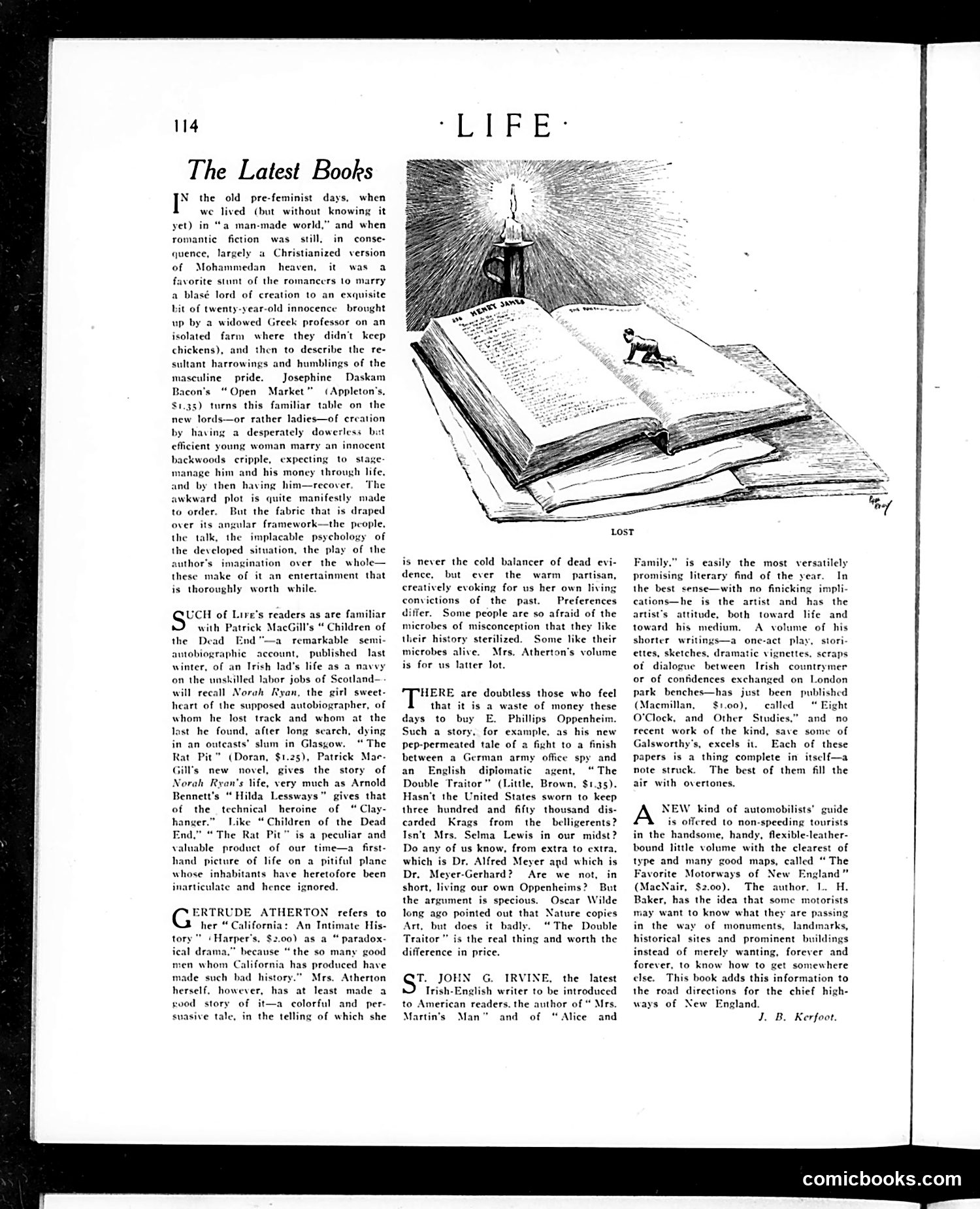
This is a literary review column, not a political cartoon. The page features book reviews and criticism rather than satire or caricature. The key content includes: - A review of Josephine Daskam Bacon's "Open Market," which inverts the romantic trope of an innocent young woman paired with a jaded older man—here, an efficient poor woman marries a wealthy backwoods man - Discussion of Patrick MacGill's "Children of the Dead End" and the sequel "The Rat Pit," praised as authentic working-class literature - Gertrude Atherton's "California: An Intimate History," noted for passionate rather than objective historical narrative - E. Phillips Oppenheim's spy thriller "The Double Traitor," with ironic commentary that real wartime espionage makes fiction seem tame The small illustration shows an open book with a church or lighthouse, labeled "LOST"—likely accompanying the literary discussion but without clear specific reference.
📄 Transcribed text from this page (OCR, searchable)
Machine-transcribed from the original scan — historical spelling and the odd misread are preserved.
114 The Latest Books I the old pre-feminist days, when we lived (but without knowing it yet) in “a man-made world,” and when romantic fiction still, in) conse- quence, largely a Christianized version of Mohammedan heaven, it was a favorite stunt of the romancers 10 marry a blasé lord of creation to an exquisite Lit of twenty-year-old innocence brought up by a widowed Greek professor on an isolated farm where they didn't keep chickens), and then to describe the re- sultant harrowings and humblings of the masculine pride. Josephine Daskam Bacon's “Open Market” (Appleton’s, $1.33) turns this familiar table on the new lords—or rather ladies—of creation by having a desperately dowerless but efficient young woman marry an innocent backwoods cripple, expecting to stage manage him and his money through life. and by then having him—recover. The awkward plot is quite manifestly made to order. But the fabric that is draped over its angular framework—the people, the talk, the implacable psychology of the developed situation, the play of the author's imagination over the whole— these make of it an entertainment that is thoroughly worth while. UCH of Live's readers as are familiar with Patrick MacGill’s “ Children of the Dead End"—a remarkable semi- wtobiographie account, published last winter, of an Irish lad’s life as a navvy on the unskilled labor jobs of Scotland- will recall Norah Ryan, the girl sweet heart of the supposed autobiographer, of whom he lost track and whom at the last he found, after long search, dying in an outeasts’ slum in Glasgow. “ The Rat Pit (Doran, $1.25), Patrick Mae- I's new novel, gives the story of Norah Ryan's life, very much as Arnold Bennett's “Hilda Lessways” gives that of the technical heroine of “ Clay- hanget Like “Children of the Dead End.” “ The Rat Pit is a peculiar and valuable product of our time—a_first- hand picture of life on a pitiful plane whose inhabitants have heretofore been inarticulate and hence ignored. ERTRUDE ATHERTON refers to her “California: An Intimate H tory” ‘Harper's, $2.00) paradox- ical drama,” because “the so many good men whom California has produced have made such bad history.”| Mrs. Atherton herself. however, has at least made a good story of it—a colorful and per- suasive tale, in the telling of which she is never the cold balancer of dead evi- dence, but ever the warm partisan, creatively evoking for us her own living convictions of the past. Preferences differ. Some people are so afraid of the microbes of misconception that they like their history sterilized. Some like their microbes alive. Mrs, Atherton’s volume is for us latter lot. HERE are doubtless those who feel that it is a waste of money these days to buy E. Phillips Oppenheim. Such a story, for example, as his new pep-permeated tale of a fight to a finish between a German army office spy and an English diplomatic agent, “The Double Traitor” (Little, Brown, $1.35). Hasn't the United States sworn to keep three hundred and fifty thousand dis. carded Krags from the belligerents? Isn't Mrs. Selma Lewis in our midst? Do any of us know, from extra to extra, which is Dr. Alfred Meyer apd which is Dr. Meyer-Gerhard? Are we not, in short, living our own Oppenheims? But the argument is specious. Oscar Wilde long ago pointed out that Nature copies Art, but does it badly. “The Double Traitor” is the real thing and worth the difference in price. T. JOHN G. IRVINE, the latest Trish, lish writer to be introduced to American readers. the author of “ Mrs. Martin’s Man and of “Alice and casily the most versatilely promising literary find of the y In the best sense—with no finicking impli- cations—he is the artist and has the artist's attitude, both toward life and toward his medium. A volume of his shorter writings—a one-act play, stori- ettes, sketches, dramatic vignettes. scraps of dialogue between Irish countrymer or of confidences exchanged on London park benches—has just been published (Macmillan, $1.00), called“ Eight O'Clock, and Other Studies,” and no recent work of the kind, save some of Galsworthy’s, excels it. Each of these papers is a thing complete in itsclf—a note struck. The best of them fill the air with overtones. NEW kind of automobilists’ guide is offered to non-speeding tourists in the handsome, handy, flexible-leather- bound little volume with the clearest of type and many good maps, called “ The Favorite Motorways of New England” (MacNair, $2.00). The author. 1. H. Baker, has the idea that some motorists may want to know what they are passing in the way of monuments, landmarks, historical sites and prominent buildings instead of merely wanting, forever and forever, to know how to get somewhere else. This book adds this information to the road directions for the chief high- ways of New England. J. B. Kerfoot. comicbooks.com