
Life, 1915-07-15 · page 20 of 48
Life — July 15, 1915 — page 20: what you’re looking at
What you’re looking at
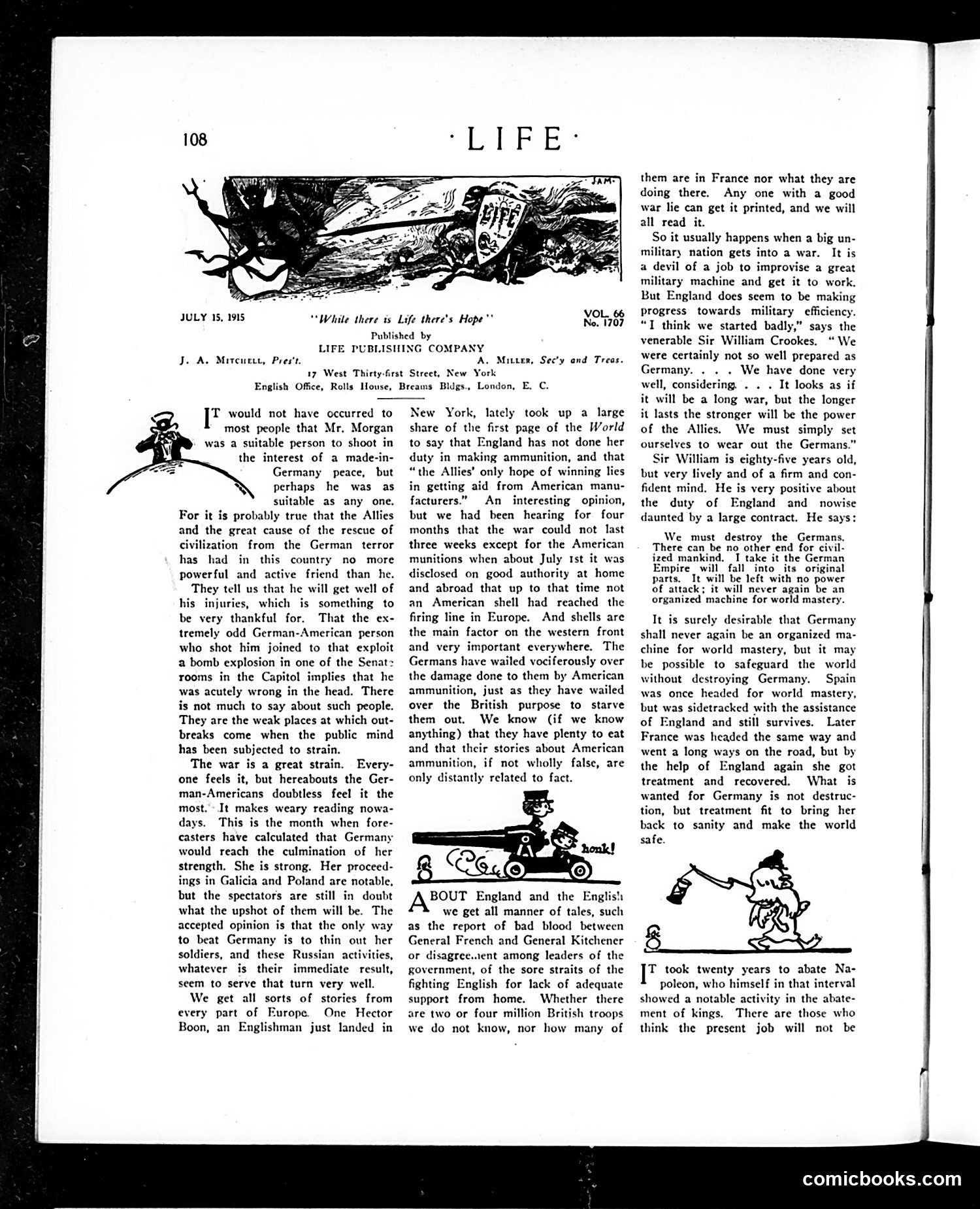
This editorial page addresses recent violence and wartime strain in America during WWI. The text references an attack on **J.P. Morgan**, the prominent banker and Allied supporter, by an unnamed German-American assailant who also planted a bomb in the Capitol. Life treats this as symptomatic of public anxiety rather than a serious political act. The main satirical targets are: 1. **Exaggerated war claims**—Life debunks British and German propaganda about American ammunition's impact and German food shortages, noting both sides make inflated claims for public consumption. 2. **English unpreparedness**—The magazine cites Sir William Crookes admitting Britain "started badly" militarily compared to Germany, contradicting official optimism. The cartoon (appears to show military equipment or machinery) likely illustrates the difficulty of rapidly industrializing for war. The satire emphasizes how total war strains civilian populations and generates misinformation.
📄 Transcribed text from this page (OCR, searchable)
Machine-transcribed from the original scan — historical spelling and the odd misread are preserved.
JULY 15, 1915 “While there is Life there's Hope™* Published by LIFE PUBLISHING COMPANY A. Mutter, Sec’y and Treas. 17 West Thirty-first Street, New York English Office, Rolls House, Brean J. A. Mitcuett, Pres’t. T would not have occurred to most people that Mr. Morgan was a suitable person to shoot in the interest of a made-in- Germany peace, but perhaps he was as suitable as any one. For it is probably true that the Allies and the great cause of the rescue of civilization from the German terror has had in this country no more powerful and active friend than he. They tell us that he will get well of his injuries, which is something to be very thankful for. That the ex- tremely odd German-American person who shot him joined to that exploit a bomb explosion in one of the Senat> rooms in the Capitol implies that he was acutely wrong in the head. There is not much to say about such people. They are the weak places at which out- breaks come when the public mind has been subjected to strain. The war is a great strain. Every- one feels it, but hereabouts the Ger- man-Americans doubtless feel it the most. It makes weary reading now: days. This is the month when fore- casters have calculated that Germany would reach the culmination of her strength. She is strong. Her proceed- ings in Galicia and Poland are notable, but the spectators are still in doubt what the upshot of them will be. The accepted opinion is that the only way to beat Germany is to thin out her soldiers, and these Russian activities, whatever is their immediate result, seem to serve that turn very well. We get all sorts of stories from every part of Europe. One Hector Boon, an Englishman just landed in Bldgs, London, E. C. New York, lately took up a large share of the first page of the World to say that England has not done her duty in making ammunition, and that “the Allies’ only hope of winning lies in getting aid from American manu- facturers.”. An_ interesting opinion, but we had been hearing for four months that the war could not last three weeks except for the American munitions when about July 1st it was disclosed on good authority at home and abroad that up to that time not an American shell had reached the firing line in Europe. And shells are the main factor on the western front and very important everywhere, The Germans have wailed vociferously over the damage done to them by American ammunition, just as they have wailed over the British purpose to starve them out. We know (if we know anything) that they have plenty to eat and that their stories about American ammunition, if not wholly false, are only distantly related to fact. BOUT England and the English we get all manner of tales, such as the report of bad blood between General French and General Kitchener or disagree..ent among leaders of the government, of the sore straits of the fighting English for lack of adequate support from home. Whether there are two or four million British troops we do not know, nor how many of them are in France nor what they are doing there. Any one with a good war lie can get it printed, and we will all read it. So it usually happens when a big un- military nation gets into a war. It is a devil of a job to improvise a great military machine and get it to work. But England does seem to be making progress towards military efficiency. “IT think we started badly,” says the venerable Sir William Crookes. “We were certainly not so well prepared as Germany. . . . We have done very well, considering. . . . It looks as if it will be a long war, but the longer it lasts the stronger will be the power of the Allies, We must simply set ourselves to wear out the Germans.” Sir William is eighty-five years old, but very lively and of a firm and con- fident mind. He is very positive about the duty of England and nowise daunted by a large contract. He says: We must destroy the Germans. There can be no other end for civil- ized mankind, I take it the German Empire will fall into its original parts. It will be left with no power of attack; it will never again be an organized machine for world mastery. It is surely desirable that Germany shall never again be an organized ma- chine for world mastery, but it may be possible to safeguard the world without destroying Germany. Spain was once headed for world mastery, but was sidetracked with the assistance of England and still survives. Later France was headed the same way and went a long ways on the road, but by the help of England again she got treatment and recovered. What is wanted for Germany is not destruc- tion, but treatment fit to bring her back to sanity and make the world I" took twenty years to abate Na- poleon, who himself in that interval showed a notable activity in the abate- ment of kings, There are those who think the present job will not be comicbooks.com