
Life, 1915-07-15 · page 21 of 48
Life — July 15, 1915 — page 21: what you’re looking at
What you’re looking at
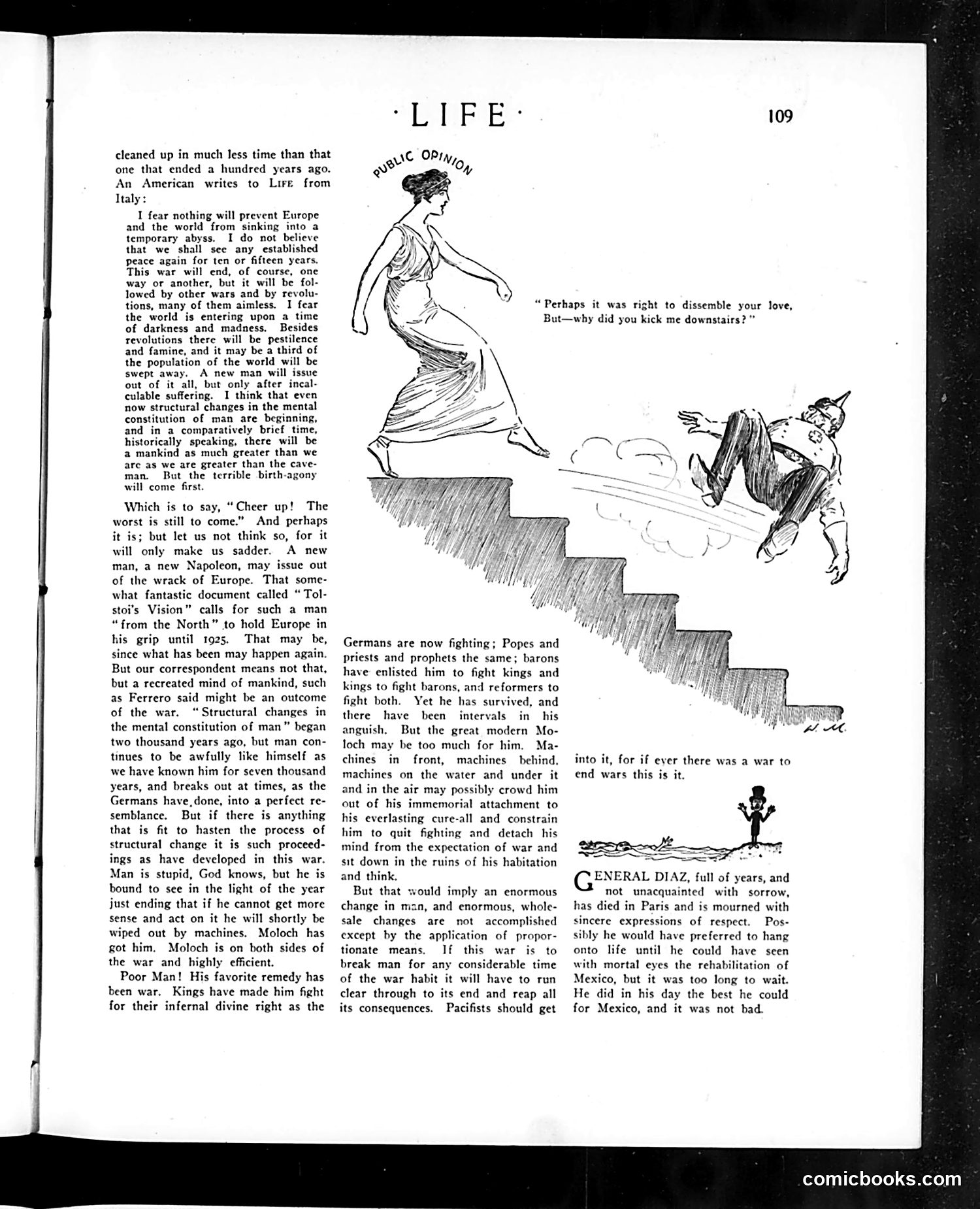
This page contains two distinct editorial pieces from WWI-era Life magazine: **Main Editorial Essay:** A pessimistic letter from an American correspondent in Italy predicts Europe faces 15+ years of war, revolution, famine, and social collapse before humanity undergoes "structural change" and produces a "new man." The essay sardonically notes that while this sounds bleak ("the worst is still to come"), mankind must endure this suffering to evolve beyond its war-making nature. It references Tolstoy's prophecy of a Napoleon-like figure emerging "from the North" by 1925, and argues that only catastrophic machine warfare will finally force humanity to abandon its ancient habit of warfare. **Political Cartoon:** Depicts "Public Opinion" (personified as a woman) kicking a small, demon-like figure down stairs, accompanying a domestic dispute caption. This satirizes public sentiment during WWI—blaming war itself rather than human actors for conflict. **Brief Obituary:** Notes General Díaz's death in Paris, suggesting he would have preferred continued life over military involvement. The page reflects deep wartime anxiety about civilization's future.
📄 Transcribed text from this page (OCR, searchable)
Machine-transcribed from the original scan — historical spelling and the odd misread are preserved.
cleaned up in much less time than that one that ended a hundred years ago. An American writes to Lire from Italy: I fear nothing will prevent Europe and the world from sinking into a temporary abyss. I do not believe that we shall see any established peace again for ten or fifteen years. This war will end, of course, one way or another, but it will be fol- lowed by other wars and by revolu- tions, many of them aimless. I fear the world is entering upon a time of darkness and madness. Besides revolutions there will be pestilence and famine, and it may be a third of the population of the world will be swept away. A new man will issue out of it all, but only after incal- culable suffering. I think that even now structural changes in the mental constitution of man are beginning, and in a comparatively bricf time, historically speaking, there will be a mankind as much greater than we are as we are greater than the cave- man. But the terrible birth-agony will come first. Which is to say, “Cheer up! The worst is still to come.” And perhaps it is; but let us not think so, for it will only make us sadder. A new man, a new Napoleon, may issue out of the wrack of Europe. That some- what fantastic document called “ Tol- stoi’s Vision” calls for such a man “from the North” to hold Europe in grip until 1925. That may be, since what has been may happen again. But our correspondent means not that, but a recreated mind of mankind, such as Ferrero said might be an outcome of the war. “Structural changes in the mental constitution of man” began two thousand years ago, but man con- tinues to be awfully like himself as we have known him for seven thousand years, and breaks out at times, as the Germans have,done, into a perfect re- semblance. But if there is anything that is fit to hasten the process of structural change it is such proceed- ings as have developed in this war. Man is stupid, God knows, but he is bound to see in the light of the year just ending that if he cannot get more sense and act on it he will shortly be wiped out by machines. Moloch has got him. Moloch is on both sides of the war and highly efficient. Poor Man! His favorite remedy has been war. Kings have made him fight for their infernal divine right as the “Perhaps it was right to dissemble your love, But—why did you kick me downstairs?” Germans are now fighting; Popes and priests and prophets the same; barons have enlisted him to fight kings and kings to fight barons, and reformers to fight both. Yet he has survived, and there have been intervals in his anguish, But the great modern Mo- loch may he too much for him. Ma- chines in front, machines behind, machines on the water and under it and in the air may possibly crowd him out of his immemorial attachment to his everlasting cure-all and constrain him to quit fighting and detach his mind from the expectation of war and sit down in the ruins of his habitation and think. But that would imply an enormous change in man, and enormous, whole- sale changes are not accomplished except by the application of propor- tionate means. If this war is to break man for any considerable time of the war habit it will have to run clear through to its end and reap all its consequences. Pacifists should get into it, for if ever there was a war to end wars this is it. ENERAL DIAZ, full of years, and not unacquainted with sorrow, has died in Paris and is mourned with sincere expressions of respect. Pos- sibly he would have preferred to hang onto life until he could have seen with mortal eyes the rehabilitation of Mexico, but it was too long to wait. He did in his day the best he could for Mexico, and it was not bad. comicbooks.com