
Life, 1915-07-15 · page 30 of 48
Life — July 15, 1915 — page 30: what you’re looking at
What you’re looking at
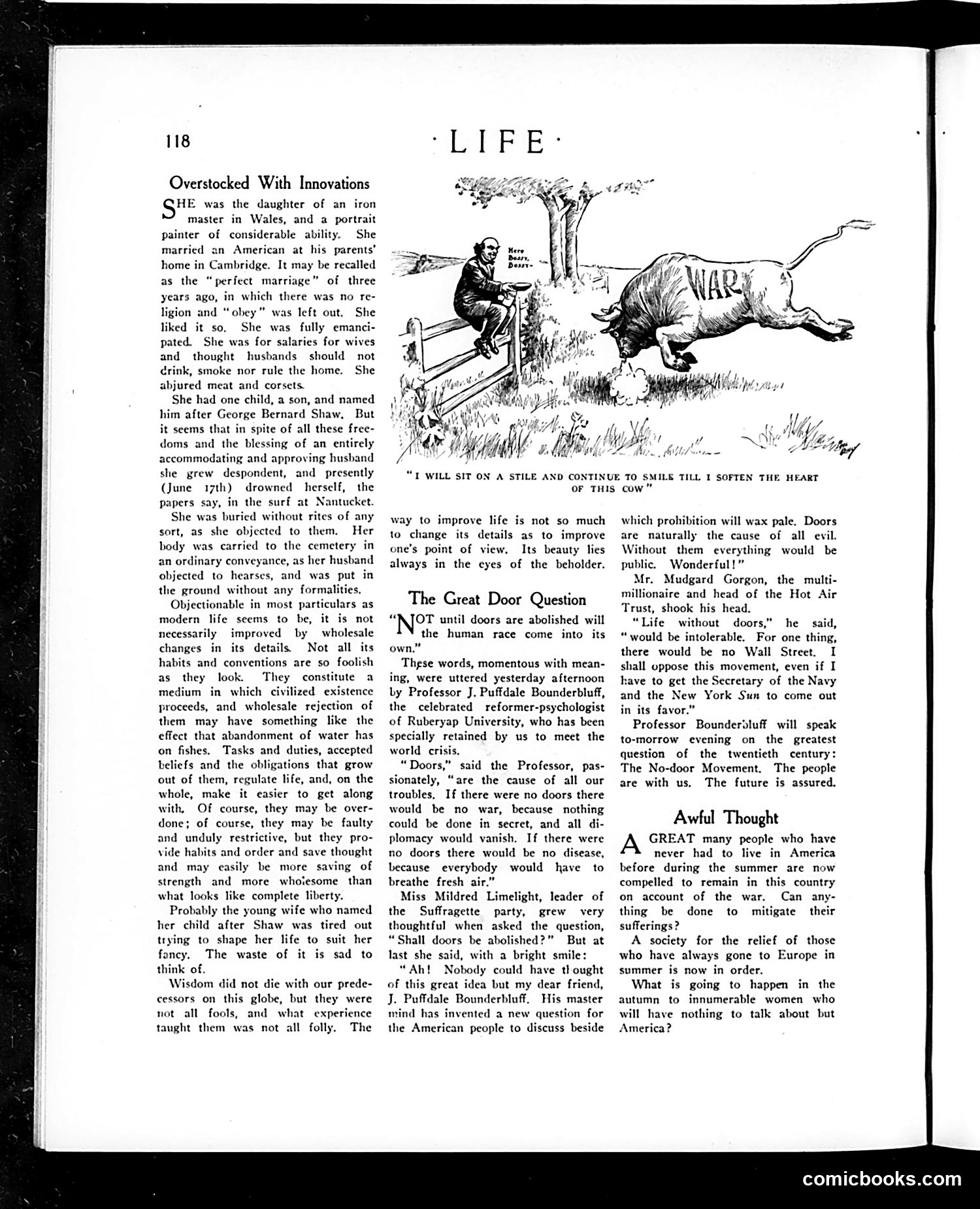
This page contains two satirical pieces mocking progressive reform movements of the early 20th century. **"Overstocked With Innovations"** tells of a Welsh woman who embraced radical modernism—rejecting religion, marriage conventions, meat, corsets, and traditional funeral rites. She drowned herself despite (or because of) her freedoms. The piece sarcastically argues that wholesale rejection of established social customs, while well-intentioned, can be destructive. Life suggests that traditional practices, though imperfect, provide necessary structure for civilized life. **"The Great Door Question"** satirizes intellectual reformers and suffragettes by having a fictitious "Professor Puffdale Bounderbluff" propose abolishing doors as the solution to war, disease, and secrecy. The suffragette leader and a millionaire head humorously endorse this absurd idea. The cartoon (showing a man sitting on a stile trying to "soften the heart" of a cow) reinforces the mockery of overambitious social engineering schemes that ignore practical reality.
📄 Transcribed text from this page (OCR, searchable)
Machine-transcribed from the original scan — historical spelling and the odd misread are preserved.
118 Overstocked With Innovations GHE was the daughter of an iron master in Wales, and a portrait painter of considerable ability. She married an American at his parents’ home in Cambridge. It may be recalled as the “perfect marriage” of three ago, in which there was no re- ion and “ oly was left out. She liked it so, She was fully emanci- pated. She was for salaries for wives and thought husbands should not ¢rink, smoke nor rule the home. She abjured meat and corsets. She had one child, a son, and named him after George Bernard Shaw, But it seems that in spite of all these free- doms and the blessing of an entirely accommodating and approving husband she grew despondent, and presently (june 17th) drowned herself, the papers say, in the surf at Nantucket. She was buried without rites of any sort, as she objected to them. Her body was carried to the cemetery in an ordinary conveyance, as her husband objected to hearses, and was put in the ground without any formalities, Objectionable in most particulars as modern life seems to be, it is not necessarily improved by wholesale changes in its details Not all its habits and conventions are so foolish as they look. They constitute a medium in which civilized existence proceeds, and wholesale rejection of them may have something like the effect that abandonment of water has on fishes. Tasks and duties, accepted beliefs and the obligations that grow out of them, regulate life, and, on the whole, make it easier to get along with, Of course, they may be over- done; of course, they may be faulty and unduly restrictive, but they pro- vide habits and order and save thought and may easily be more saving of strength and more whoiesome than what looks like complete liberty. Probably the young wife who named her child after Shaw was tired out trying to shape her life to suit her fancy. The waste of it is sad to think of. Wisdom did not die with our prede- cessors on this globe, but they were not all fools, and what experience taught them was not all folly. The “TI WILL SIT ON A STILE AND CONTINUE TO SMILE TILL I SOFTEN THE HEART OF THIS Cow” way to improve life is not so much to change its details as to improve one’s point of view. Its beauty. lies always in the eyes of the beholder. The Great Door Question “AJOT until doors are abolished will the human race come into its own,” Thgse words, momentous with mean- ing, were uttered yesterday afternoon Ly Professor J. Puffdale Bounderbluff, the celebrated reformer-psychologist of Ruberyap University, who has been specially retained by us to meet the world crisis. “Doors,” said the Professor, pas- sionately, “are the cause of all our troubles, If there were no doors there would be no war, because nothing could be done in secret, and all di- plomacy would vanish. If there were no doors there would be no disease, because everybody would have to breathe fresh air.” Miss Mildred Limelight, leader of the Suffragette party, grew very thoughtful when asked the question, “Shall doors be abolished?” But at last she said, with a bright smile: “Ah! Nobody could have thought of this great idea but my dear friend, J. Puffdale Bounderbluff, His master mind has invented a new question for the American people to discuss beside which prohibition will wax pale, Doors are naturally the cause of all evil. Without them everything would be public. Wonderful!” Mr. Mudgard Gorgon, the multi- millionaire and head of the Hot Air Trust, shook his head. “Life without doors,” he said, “would be intolerable. For one thing, there would be no Wall Street. I shall oppose this movement, even if I have to get the Secretary of the Navy and the New York Sun to come out in its favor.” Professor Bounderoluff will speak to-morrow evening on the greatest question of the twentieth century: The No-door Movement. The people are with us. The future is assured. Awful Thought GREAT many people who have never had to live in America A before during the summer are now compelled to remain in this country Can any- their on account of the war. thing be done to mitigate sufferings? A society for the relief of those who have always gone to rope in summer is now in order. What is going to happen in the autumn to innumerable women who will have nothing to talk about but America? comicbooks.com