
A complete issue · 48 pages · 1915
Life — June 10, 1915
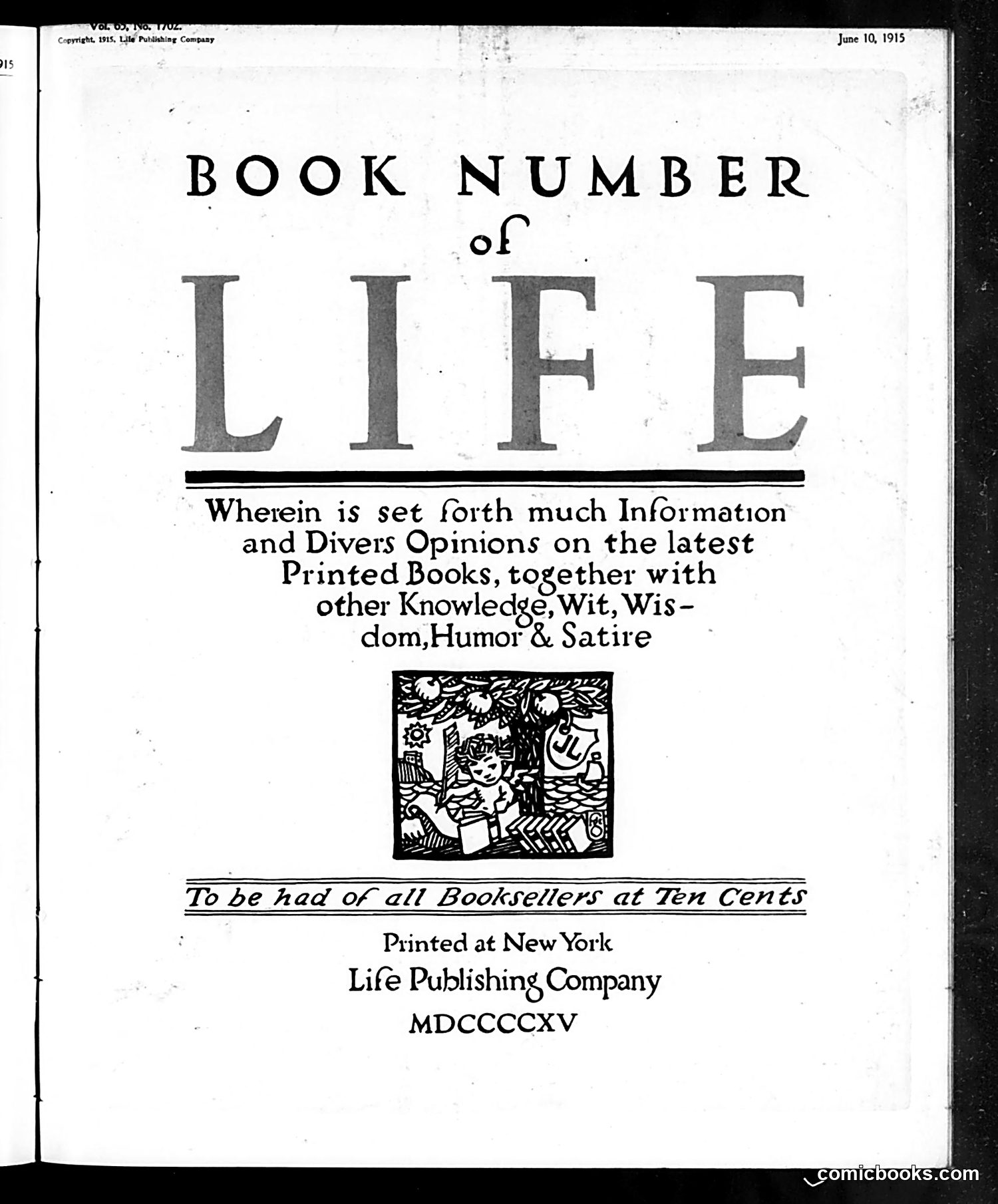
This is a title page for "Book Number of Life," a satirical magazine published by Life Publishing Company. The page advertises the issue's contents: "Information and Divers Opinions on the latest Printed Books, together with other Knowledge, Wit, Wisdom, Humor & Satire." The small woodcut illustration depicts a cherub or putto (classical child figure) surrounded by books and writing implements—typical iconography representing learning and literature. The playful image reinforces the magazine's tone of intellectual humor. At ten cents, this was an affordable periodical aimed at educated readers interested in book reviews and social commentary. The date (June 10, 1915) places this during World War I, when Life magazine was known for witty commentary on contemporary events and culture.
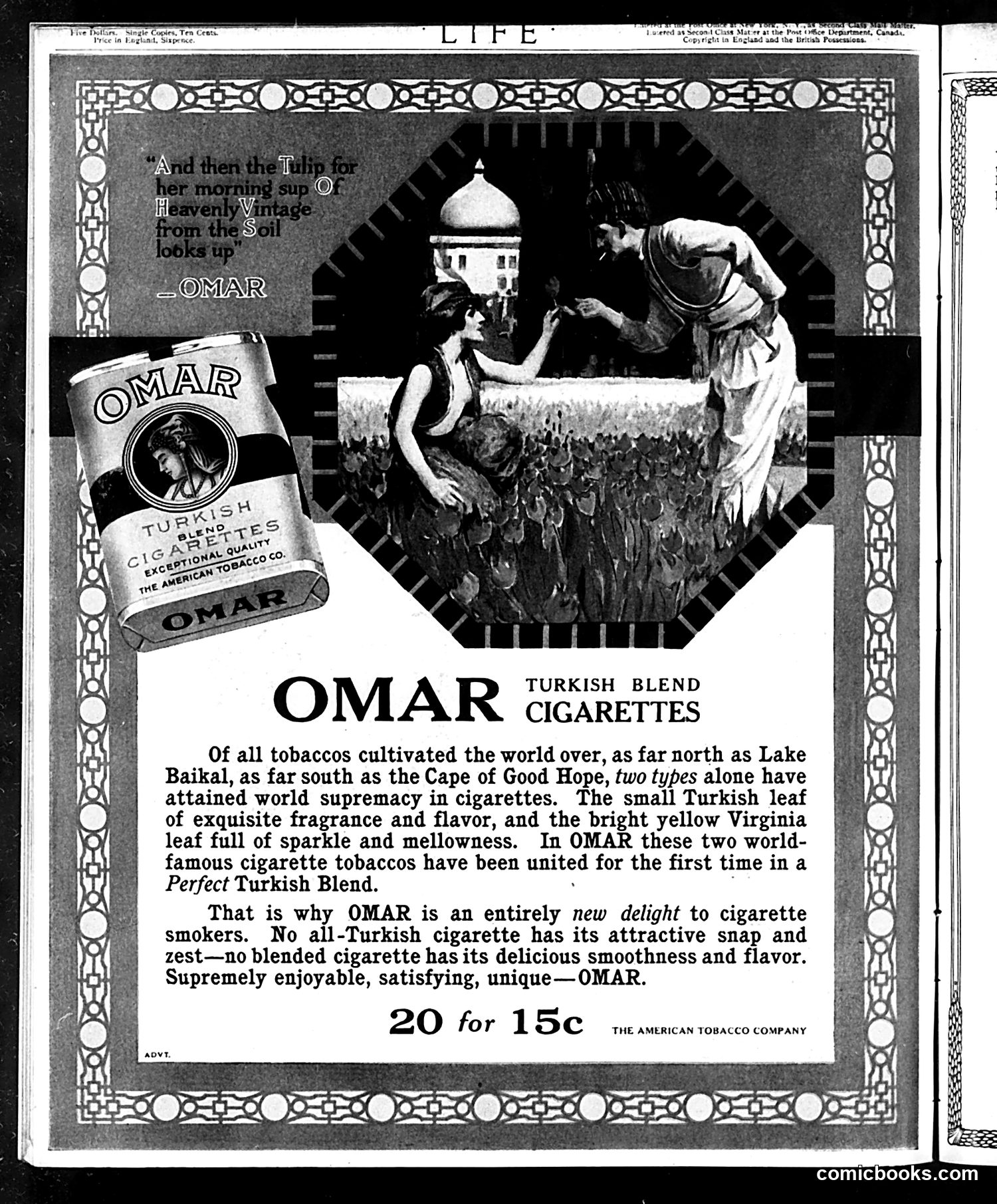
This page is primarily a **cigarette advertisement**, not political satire. It promotes Omar Turkish Blend cigarettes made by The American Tobacco Company. The advertisement features an Orientalist scene depicting two figures in what appears to be a Middle Eastern setting with a domed building. The imagery is designed to evoke exotic Turkish heritage to market the product's "Turkish blend" composition. The ad's copy emphasizes the blend combines Turkish and Virginia leaf tobacco, claiming superiority over all-Turkish or all-Virginia cigarettes alone. The price point—"20 for 15c"—appears competitive for the era. The decorative Art Deco border and Omar brand imagery reflect early 20th-century design and marketing conventions. This is commercial advertising rather than social or political commentary.
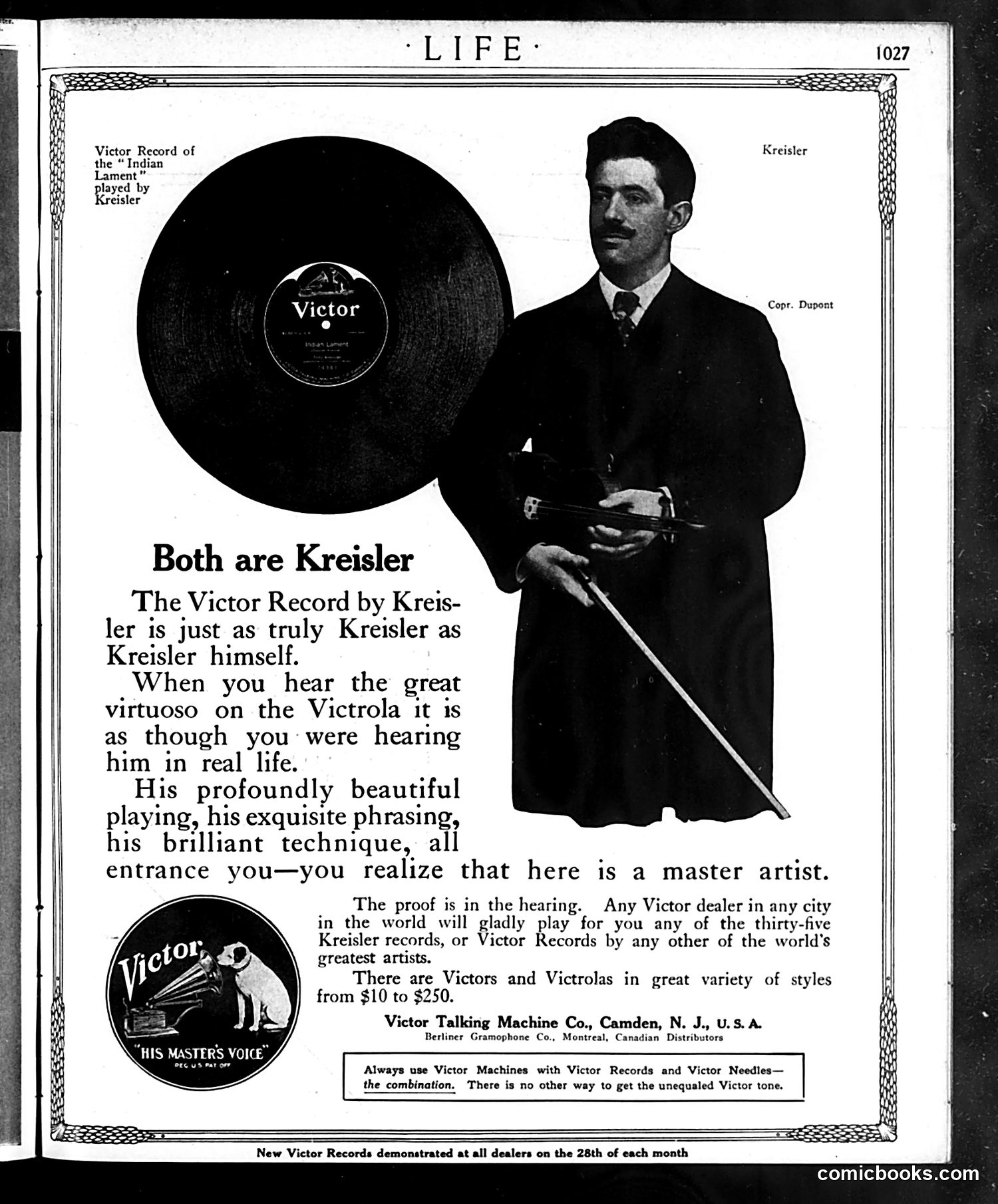
This is **not satire or a political cartoon**—it's a **straightforward advertisement** for Victor Talking Machine Company (the predecessor to RCA Victor). The page promotes Victor Records featuring **Fritz Kreisler**, a renowned violinist of the era. The central image shows Kreisler holding a violin next to a large Victor record labeled "Indian Lament." The ad's message is that Kreisler's recorded performance captures his artistry so faithfully that "when you hear the great virtuoso on the Victrola it is as though you were hearing him in real life." This was a major selling point for early phonograph technology—the claim that recorded music could authentically reproduce a live performance. The "His Master's Voice" logo appears at bottom left, Victor's famous trademark featuring a dog listening to a phonograph.
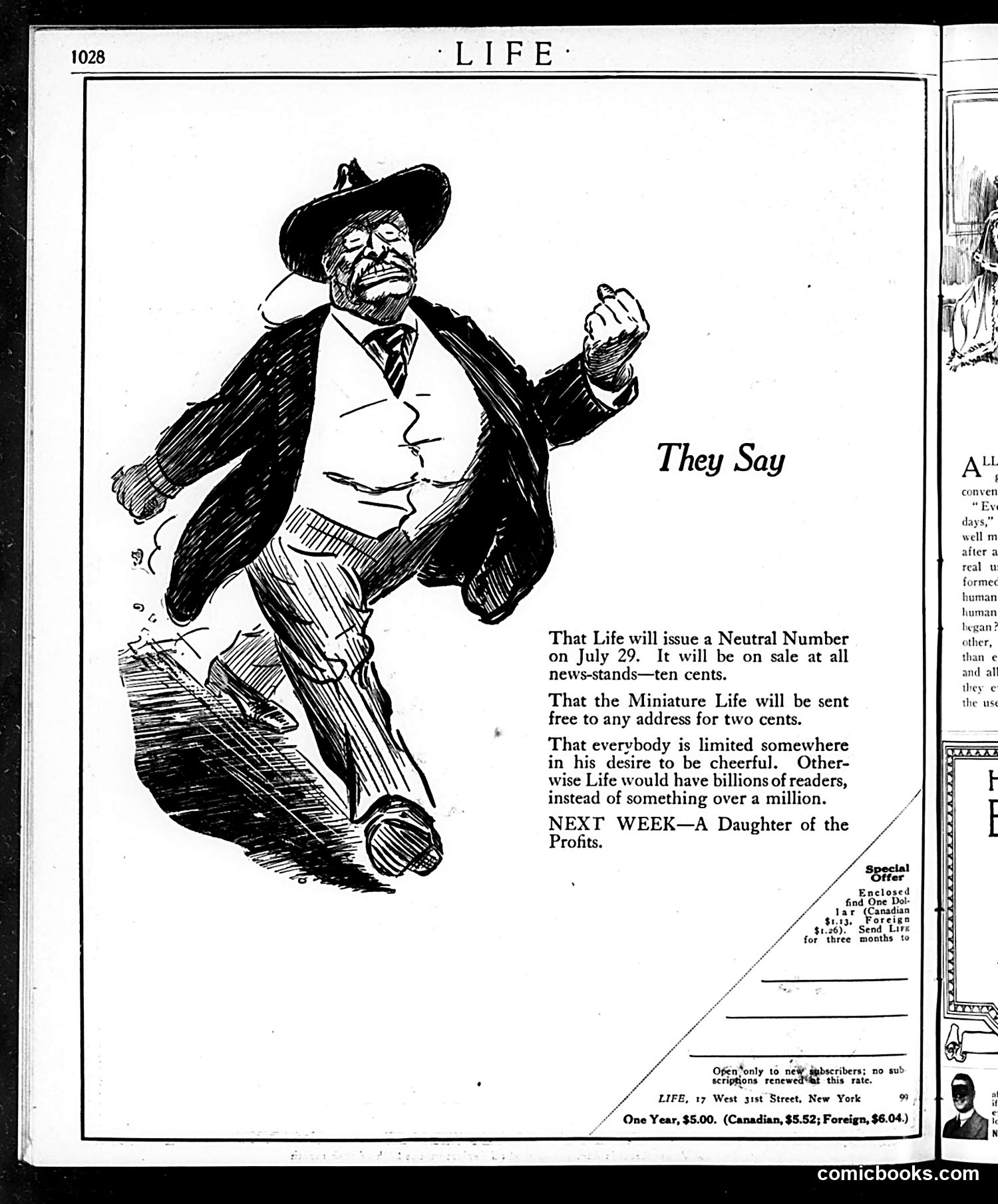
This is primarily a **house advertisement** for Life magazine itself, not political commentary. The cartoon depicts an exuberant man in a cowboy hat and formal wear, seemingly dancing or celebrating with abandonment—his coat flailing, one shoe flying off. The text humorously claims Life will issue a "Neutral Number" on July 29 for ten cents, and notes that Life must limit cheerfulness "otherwise Life would have billions of readers, instead of something over a million." The cartoon illustrates this concept: the figure's unrestrained joy represents what unlimited cheerfulness might look like. The joke suggests Life's editorial approach includes deliberate restraint to maintain readership—a self-aware, tongue-in-cheek jab at the magazine's own humor and moderation.
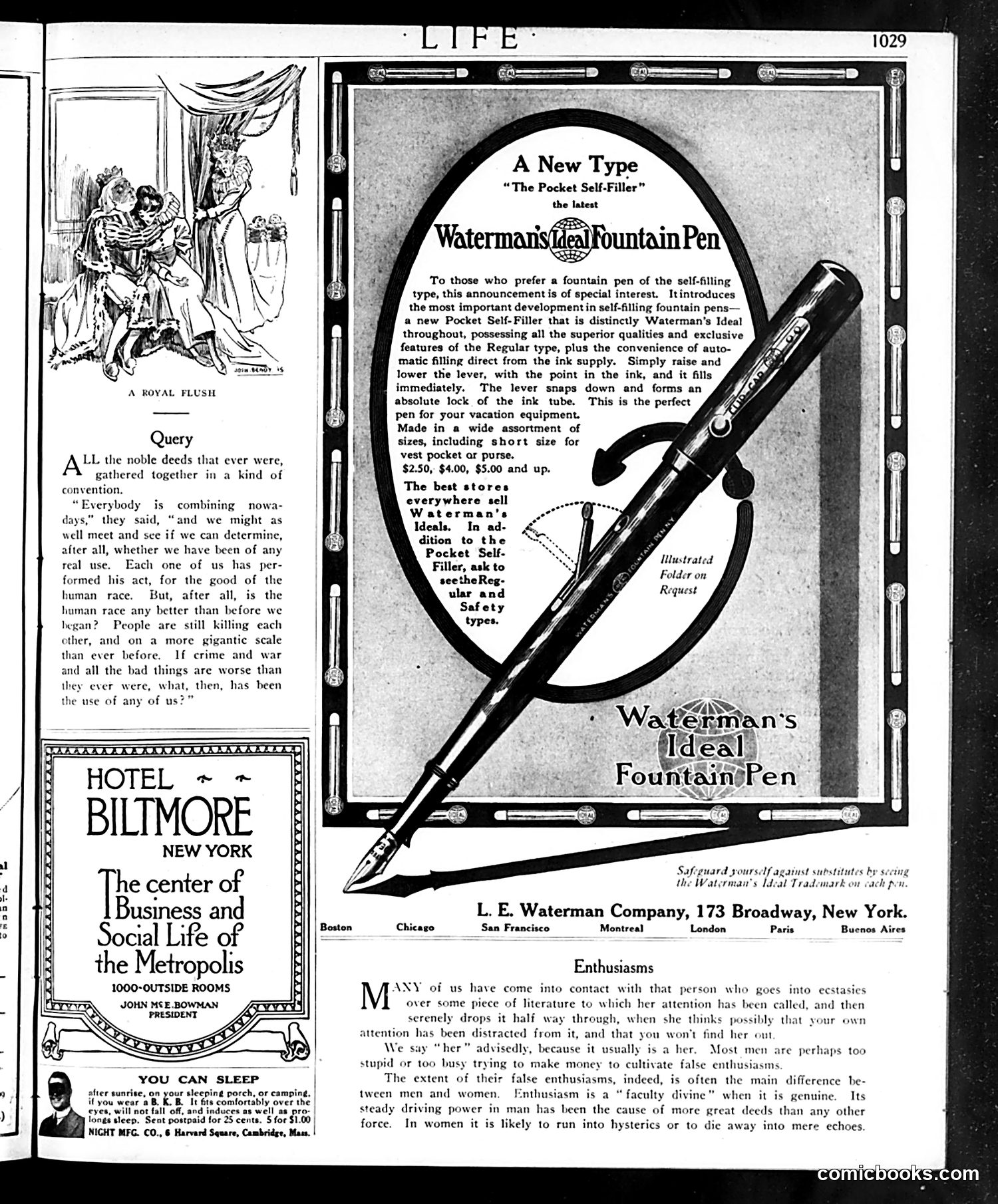
This page is primarily **advertising**, not satire. The dominant right-side content advertises Waterman's Ideal Fountain Pen, emphasizing its new "Pocket Self-Filler" model as ideal for vacation travel, available in multiple sizes and prices ($2.50-$5.00). The left side contains two unrelated items: 1. **"A Royal Flush"** — a small cartoon sketch (artist credited as "LIFE" artist) depicting an elaborate court scene, likely satirizing aristocratic excess or pretense. 2. **"Query"** — a philosophical text questioning whether human achievement justifies continued violence and warfare, arguing that crime and war may be worse uses of human capacity than ever before. 3. **Hotel Biltmore advertisement** marketing New York's premier business and social venue. The page represents typical Life magazine mixed content: advertising, light social commentary, and philosophical musing.
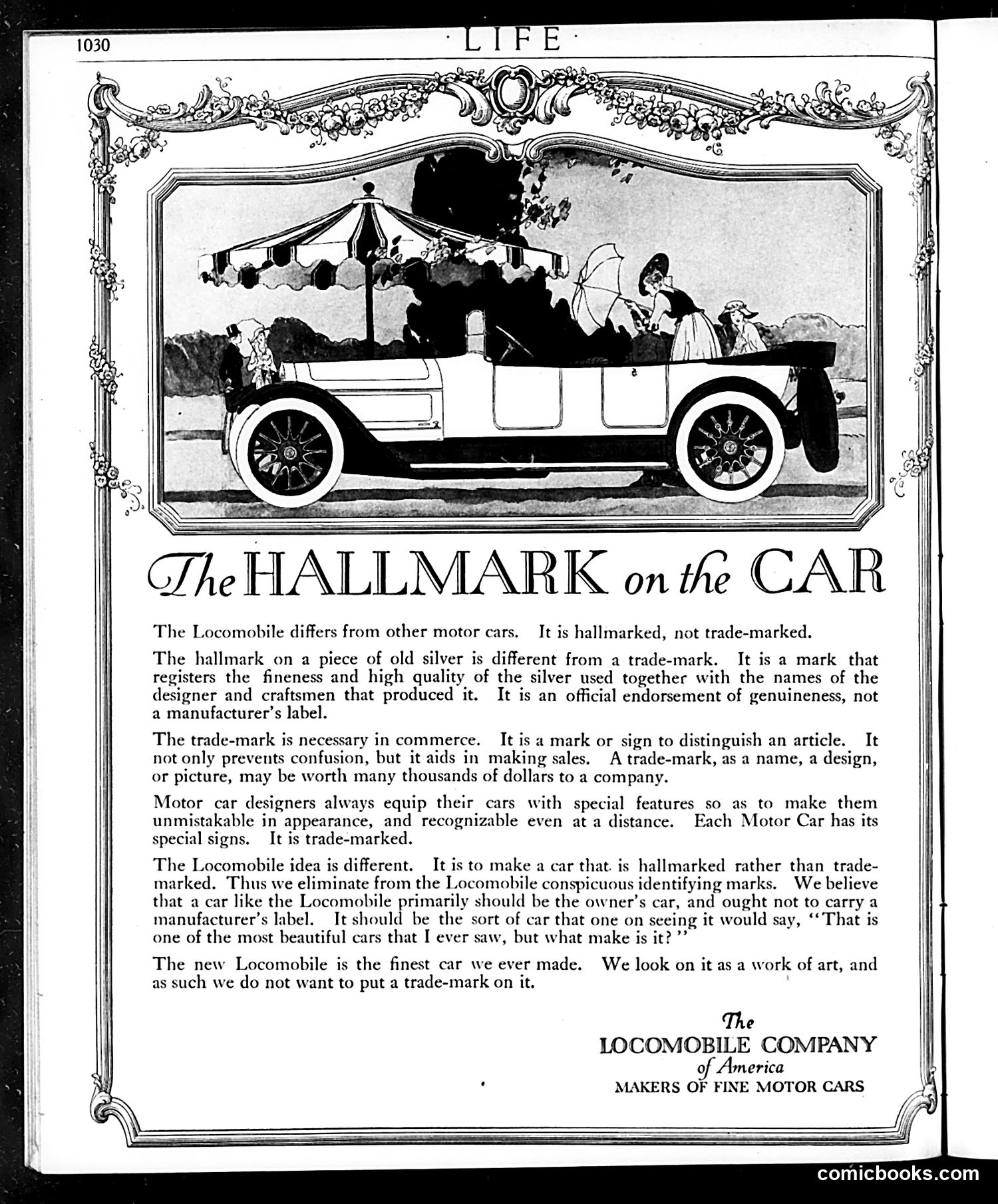
This is primarily a **Locomobile automobile advertisement** from Life magazine, not political satire. The ad contrasts hallmarks (official quality endorsements, like those on silver) with trade-marks (commercial brand labels). The Locomobile Company argues their car deserves a "hallmark"—signifying fine craftsmanship and artistry—rather than a manufacturer's trade-mark, which they associate with mass-market commerce. The illustration shows an elegant open-air automobile with well-dressed passengers and a decorative parasol, emphasizing luxury positioning. **Key appeal**: The company positions their vehicle as fine art deserving authentication of quality, not mere commercial goods requiring a brand label. This reflects early 1900s luxury-car marketing emphasizing craftsmanship over mass production.
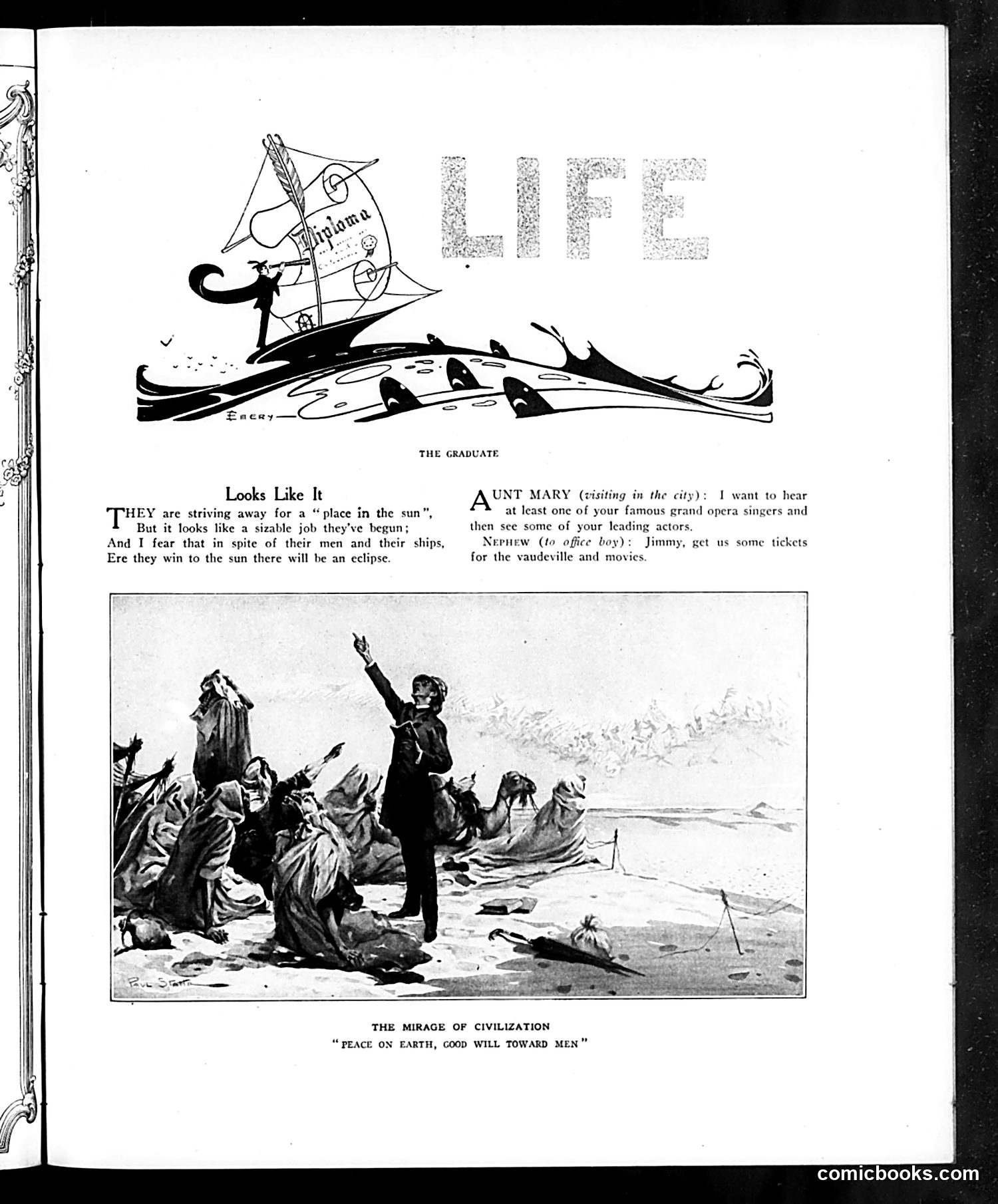
This page from *Life* magazine contains two distinct pieces: **"Looks Like It"** (poem, upper left): A satirical verse mocking ambitious people pursuing success ("a place in the sun"), suggesting their aspirations will end in failure or conflict ("eclipse"). **"The Mirage of Civilization"** (illustration, lower half): Shows a figure in formal dress gesturing toward a crowd of ragged, desperate people on barren ground. The caption—"Peace on Earth, Good Will Toward Men"—employs bitter irony: the elegant speaker's promise of civilization and peace contrasts starkly with the suffering masses depicted below. This appears to critique empty rhetoric about progress and humanitarian ideals when confronted with actual human misery and inequality. Both pieces reflect early 20th-century skepticism toward grand promises of social advancement.
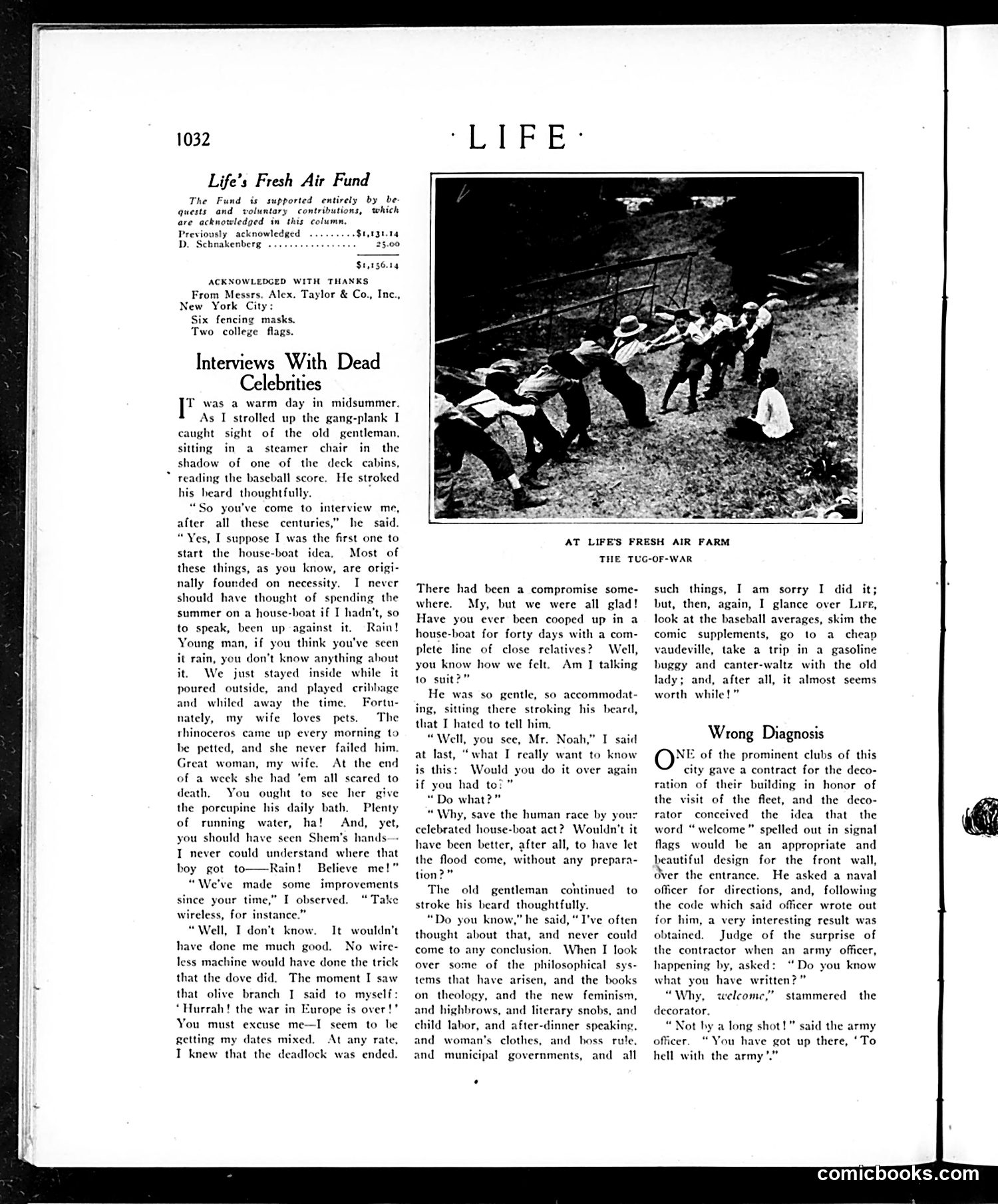
This page contains a satirical article titled "Interviews With Dead Celebrities," imagining a conversation with a deceased gentleman about life and regret. The unnamed figure reflects on starting the "house-boat idea" and expresses remorse about various life choices—particularly spending summers on houseboats instead of more meaningful pursuits. The accompanying photograph shows people at "Life's Fresh Air Farm" engaged in a "tug-of-war," illustrating Life magazine's charitable Fresh Air Fund, which provided outdoor recreation for underprivileged city residents. The satire appears to contrast idle wealthy leisure activities (houseboats) with Life's philanthropic mission of providing accessible fresh air and recreation to those who couldn't otherwise afford it. The "dead celebrity" serves as a cautionary figure about misplaced priorities.
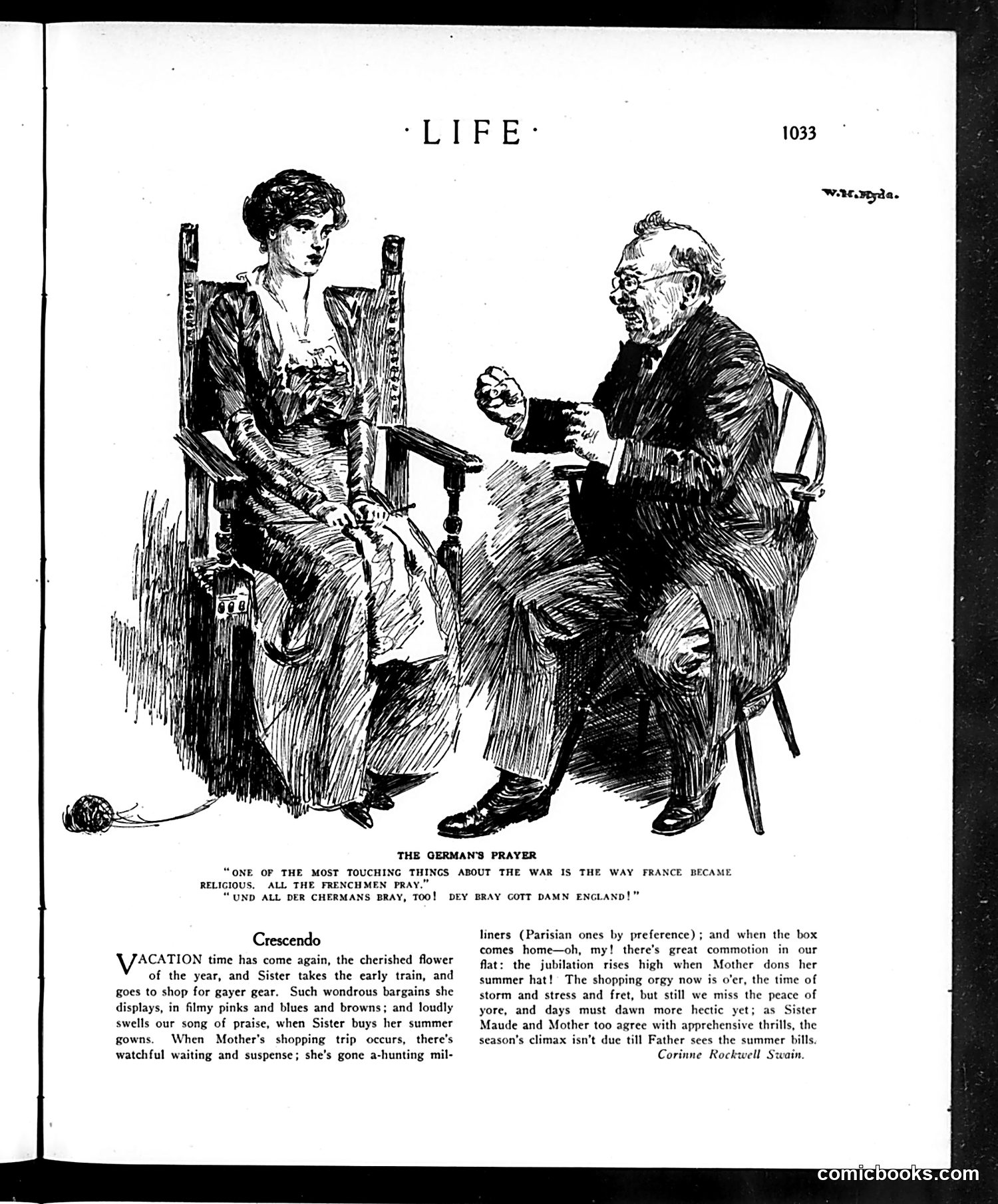
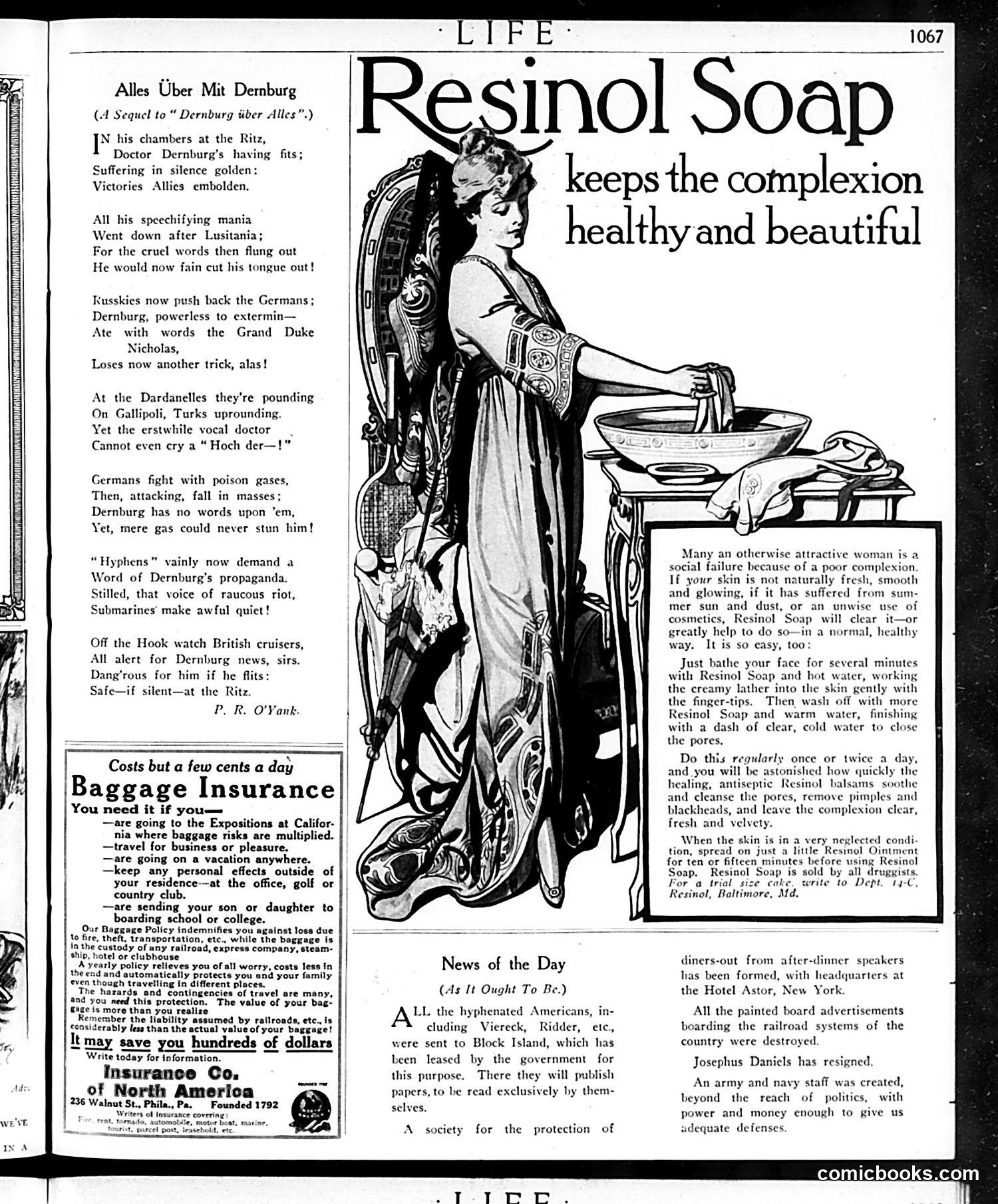
This Life magazine cartoon satirizes German religiosity during World War I. It depicts an elderly German man (identifiable by context as representing Germany or German culture) in prayer, with a woman listening. The caption quotes him praying in German dialect: "Und all der Chermans bray, too! Dey bray Gott damn England!" The satire mocks German claims of piety while simultaneously cursing England—suggesting hypocrisy in German wartime rhetoric that combined religious devotion with militant aggression. The subtitle notes this represents "one of the most touching things about the war," referring ironically to France becoming religious during conflict. The cartoon reflects American anti-German sentiment during WWI, portraying Germans as crude and contradictory in their patriotic fervor.
This is an editorial essay by Edward S. Marlin titled "The Magazine," not primarily a political cartoon page. The silhouette illustrations lining the margins appear to be decorative vignettes of magazine office life and readers. The essay satirizes magazine publishing's tension between efficiency and quality. Marlin criticizes magazines run purely by office machinery and administrative systems, arguing they lose human touch and editorial judgment. He contrasts this with "ambitious" writers and editors who understand that magazines need human intuition, not just mechanization. He mocks the competitive race among publishers to maximize circulation and profit through mass production techniques, suggesting this compromises editorial integrity. The piece advocates for magazines retaining human editorial vision rather than becoming mere manufactured products. The silhouettes humorously illustrate various magazine workplace scenarios mentioned in the text.
This page consists entirely of editorial commentary about magazine publishing—no political cartoons or caricatures are present. The decorative illustrations along the margins show silhouettes of people reading or lounging with magazines, serving as visual breaks in the text. The satire targets magazine editors and their challenges: maintaining circulation while staying financially solvent, balancing entertainment with substance, and managing writers' egos. The text criticizes editors who seek self-aggrandizement rather than serving readers, and discusses tension between editorial quality and commercial viability. The piece advocates for magazines that entertain thoughtful readers over those targeting "people who don't think," while acknowledging the business realities of magazine publishing—aiming at audiences interested in sports and entertainment to achieve financial sustainability.
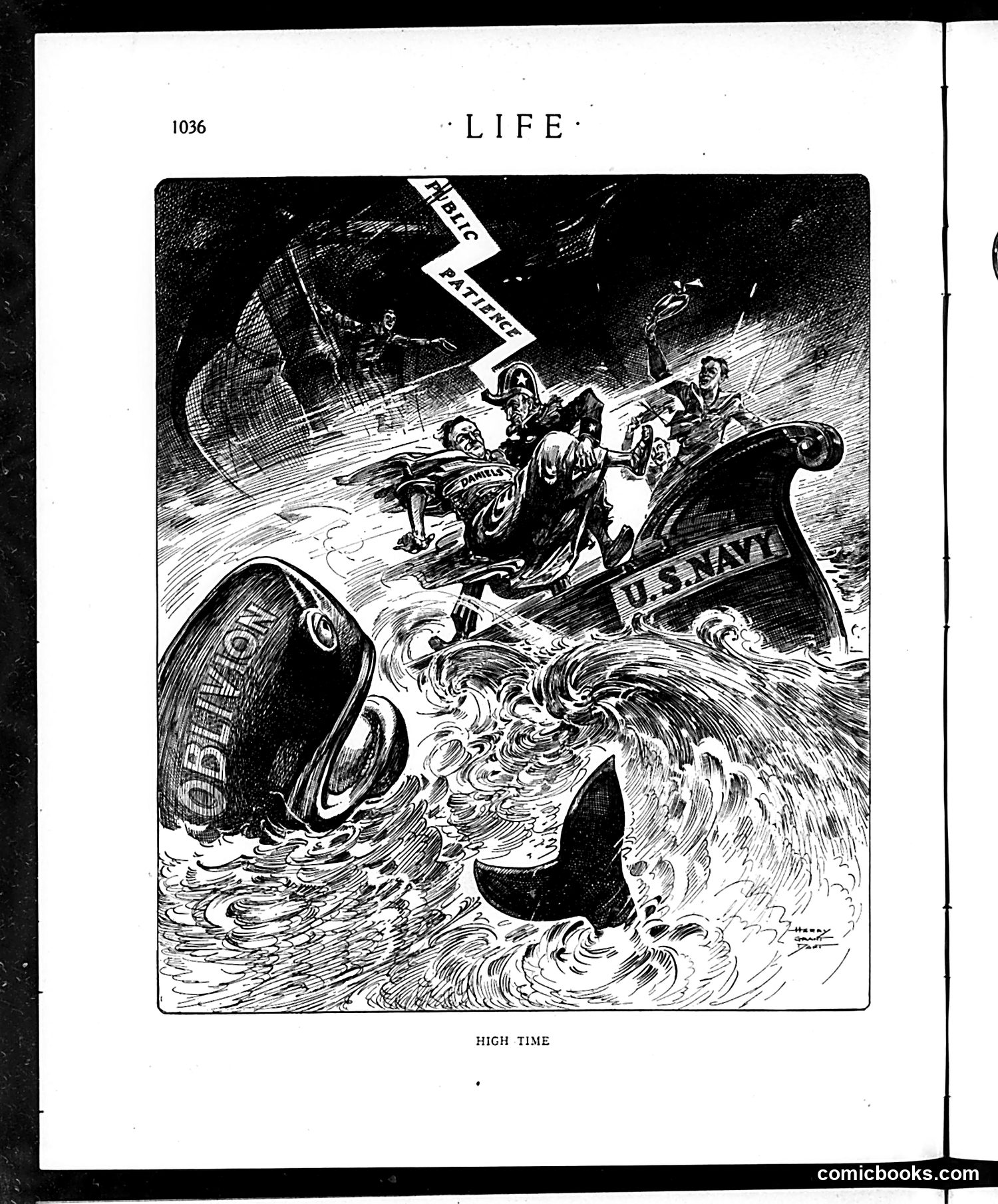
This cartoon depicts a dramatic maritime disaster with clear political messaging. A U.S. Navy vessel labeled "U.S. NAVY" is sinking amid turbulent waves, while sailors struggle in lifeboats. Above, a lightning bolt labeled "AMERICAN PATRIOTISM" strikes downward—suggesting internal conflict rather than external enemy attack. The satire critiques American naval preparedness or leadership during what appears to be a crisis period. The "high time" caption suggests urgency or that a reckoning has arrived. Given the dramatic, allegorical style typical of early 20th-century *Life* magazine, this likely comments on military readiness, leadership failures, or political divisions threatening national defense. The patriotism lightning bolt hitting rather than protecting the Navy suggests ironic commentary on misplaced or destructive nationalism.
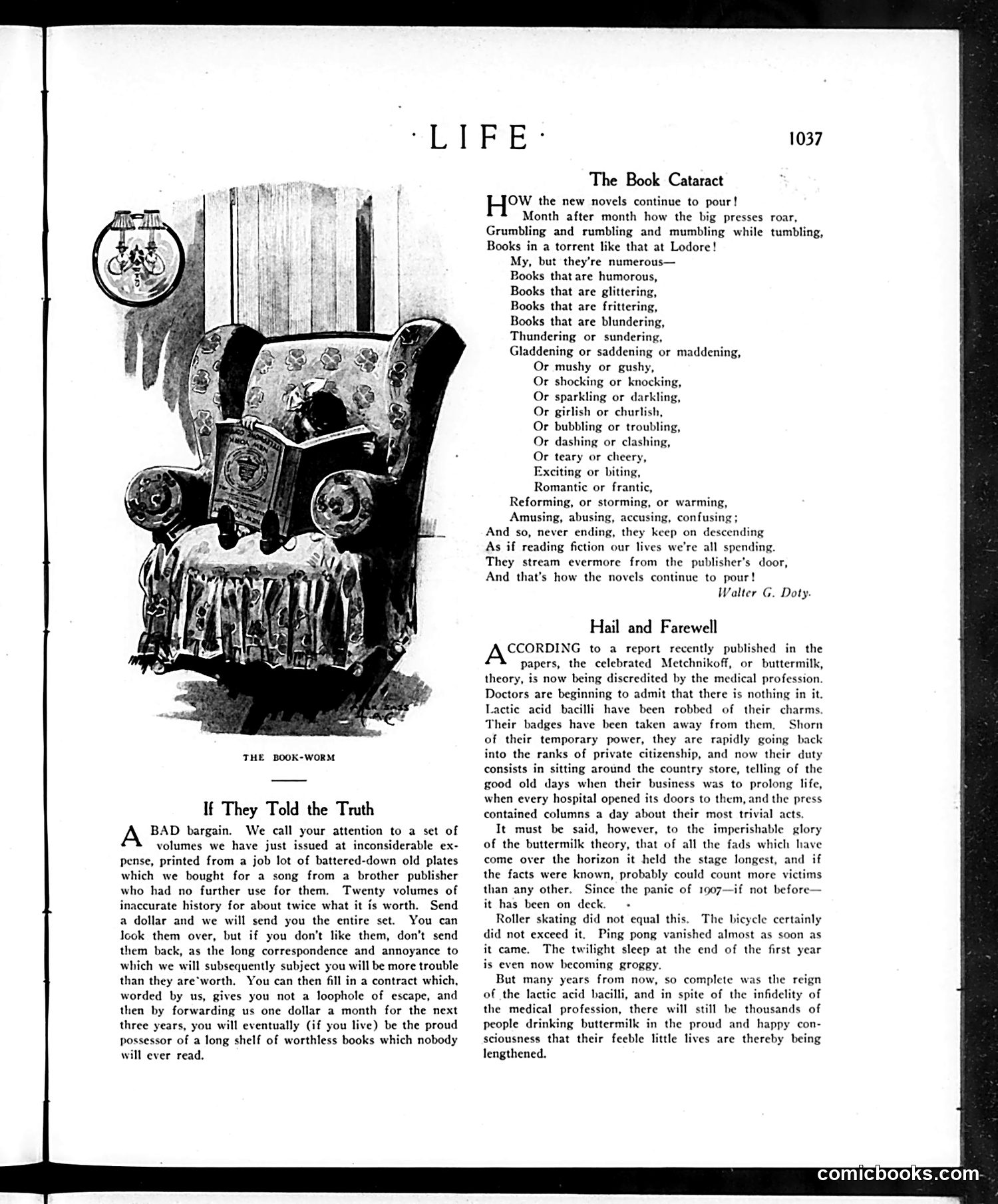
This satirical illustration depicts an armchair reader so absorbed in books that they've become a grotesque hybrid—part human, part furniture. The figure is literally merged with an ornate chair, complete with decorative wheels and upholstered fabric, suggesting someone who has become permanently sedentary from excessive reading. The accompanying poem by Walter G. Doty mocks the endless flood of newly published novels pouring into the market. It humorously catalogs their quality as "humorous," "glittering," "thundering," and "frantic"—satirizing publishers' aggressive marketing and readers' compulsive consumption despite questionable literary merit. The cartoon critiques both the publishing industry's prolific output and readers' passive, almost addictive relationship with mass-produced fiction. It's a commentary on early 20th-century consumer culture and mass entertainment.
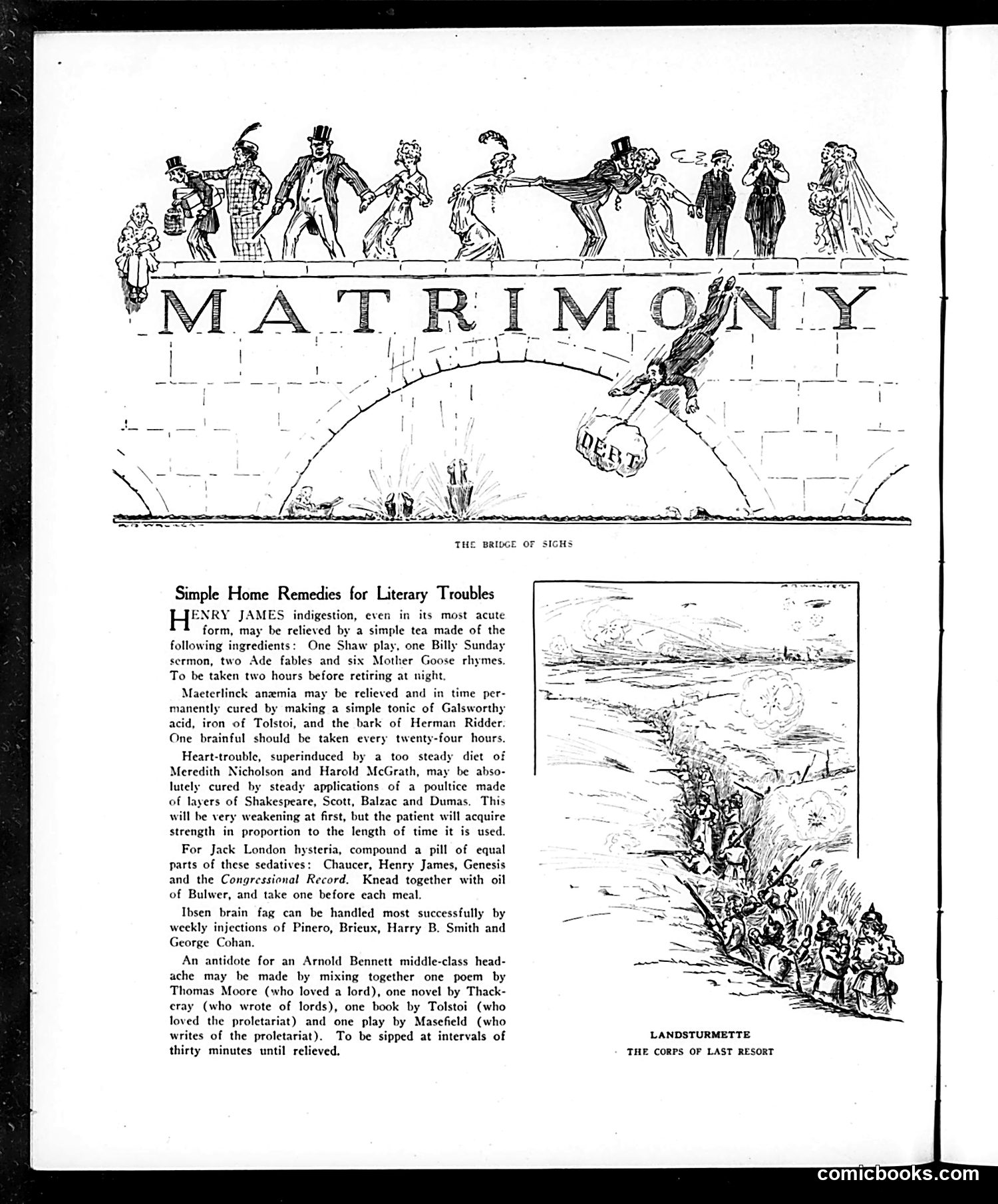
This page satirizes literary ailments with humorous "remedies." The top cartoon, "The Bridge of Sighs," depicts various literary figures crossing an arch labeled "DEBT," with a demon dropping a weight marked "DEBT" below. This mocks authors struggling with financial difficulties—a common problem for writers. The text below, "Simple Home Remedies for Literary Troubles," parodies medical advice by prescribing absurd cures for famous authors' problems: Henry James's indigestion requires Shaw and Billy Sunday; Jack London's hysteria needs equal parts Chesterton, Henry James, and the Congressional Record. The satire targets both the authors' well-known struggles and contemporary literary criticism, suggesting that writers' personal and professional difficulties were public knowledge and fodder for humor in this American satirical magazine.
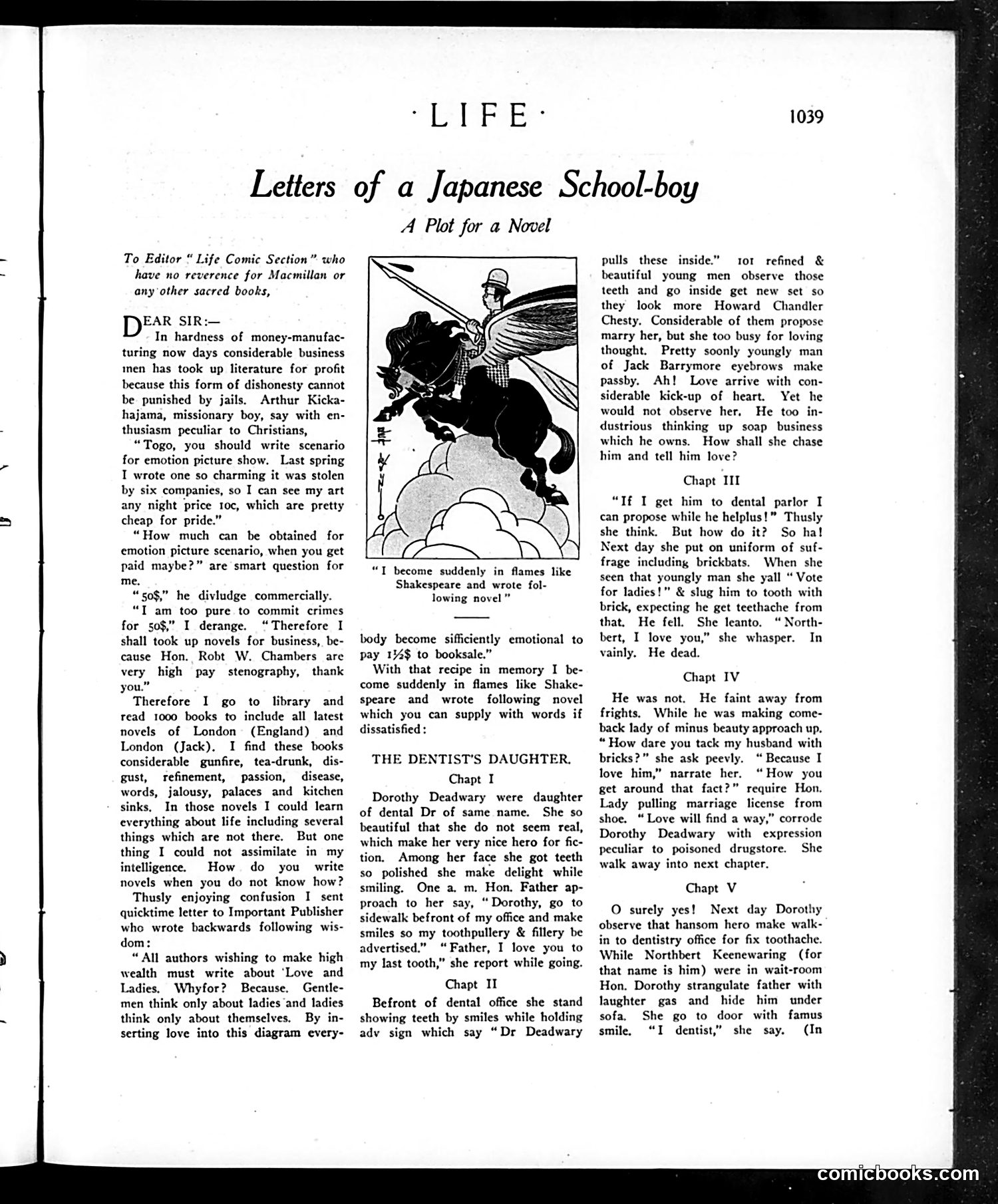
This piece satirizes the commercialization of literature and formulaic novel-writing in early 20th-century America. A Japanese character writes to *Life*'s editor, reporting advice from a publisher: insert "Love and Ladies" into any story to guarantee sales, since men will buy anything about women. The satire mocks both publishers' cynicism and writers' willingness to produce sentimental drivel for profit. The accompanying mock-novel excerpt—"The Dentist's Daughter"—deliberately demonstrates this formula's absurdity with overwrought melodrama, broken English, and ridiculous plot turns (a woman attacks a man with bricks to get him to dental work; he dies of shock). The "Japanese school-boy" framing device, common in *Life*, allows the author to critique American literary standards through an outsider's bemused perspective, highlighting how transparently mercenary the publishing industry had become.
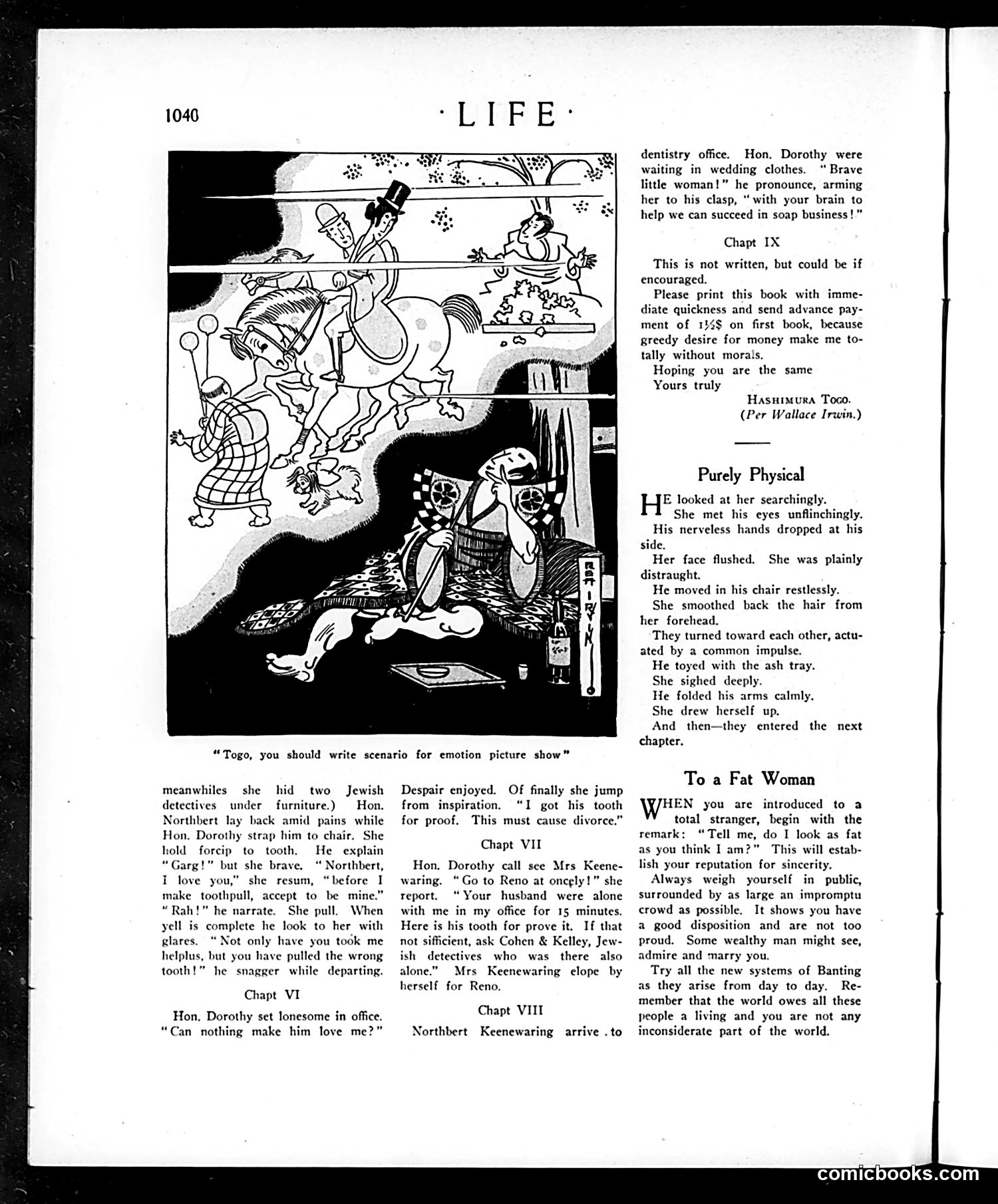
This page contains satirical humor typical of early-20th-century Life magazine. The main cartoon depicts a melodramatic serial narrative (styled as chapters) about "Hon. Dorothy" and "Northbert Keenewaring." The plot parodies overwrought silent-film scenarios: Dorothy extracts Northbert's tooth to use as false "proof" of infidelity, forcing his wife to flee to Reno (then famous for quick divorces). The satire mocks both sensational divorce plots and broken English narration, likely parodying foreign film scenarios or poorly-written pulp fiction. The cartoonist (credited to Wallace Irwin via "Hashimura Togo") ridicules the absurdity of melodramatic storytelling where trivial events become "evidence" of moral transgression. Below are brief satirical advice pieces ("Purely Physical" and "To a Fat Woman") offering tongue-in-cheek social commentary on romantic conventions and body image—typical of Life's light, sarcastic tone.
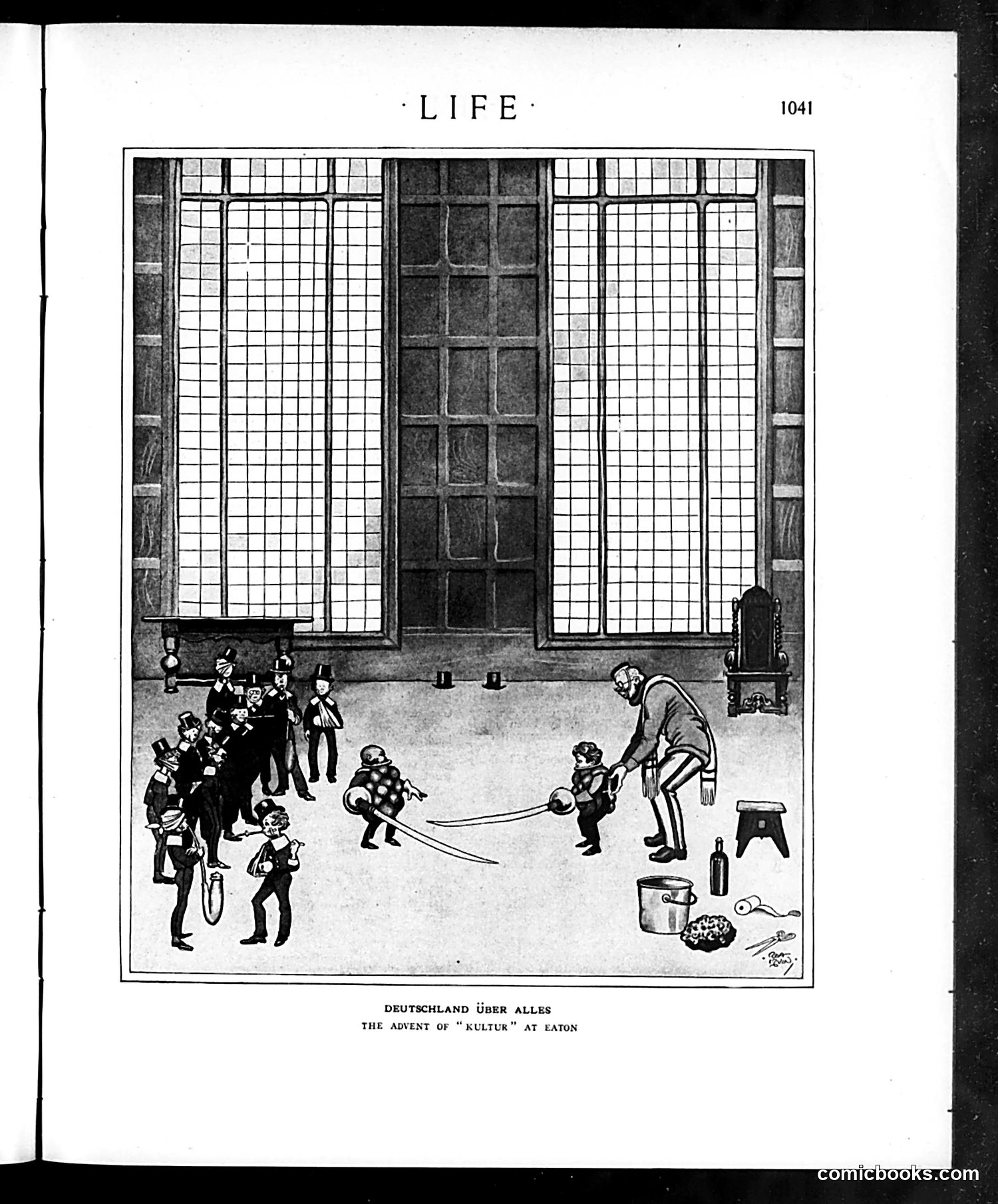
This is a satirical cartoon titled "Deutschland Über Alles: The Advent of 'Kultur' at Eaton," published in Life magazine (page 1041). The image depicts a gymnasium or large institutional space where children play while an adult supervises. The caption's reference to "Deutschland Über Alles" (Germany Above All) and "Kultur" suggests this is commentary on German educational or cultural practices being introduced at Eaton (likely Eaton School, a prestigious British institution). The satire appears to criticize the adoption of German methods or ideology in British education. The children's activities—playing with rope, various toys and implements visible in the foreground—seem designed to show either militaristic training or overly regimented physical culture being imposed on youth. The cartoon likely reflects early-20th-century tensions between British and German cultural influence, or anxieties about foreign educational philosophies affecting British institutions.
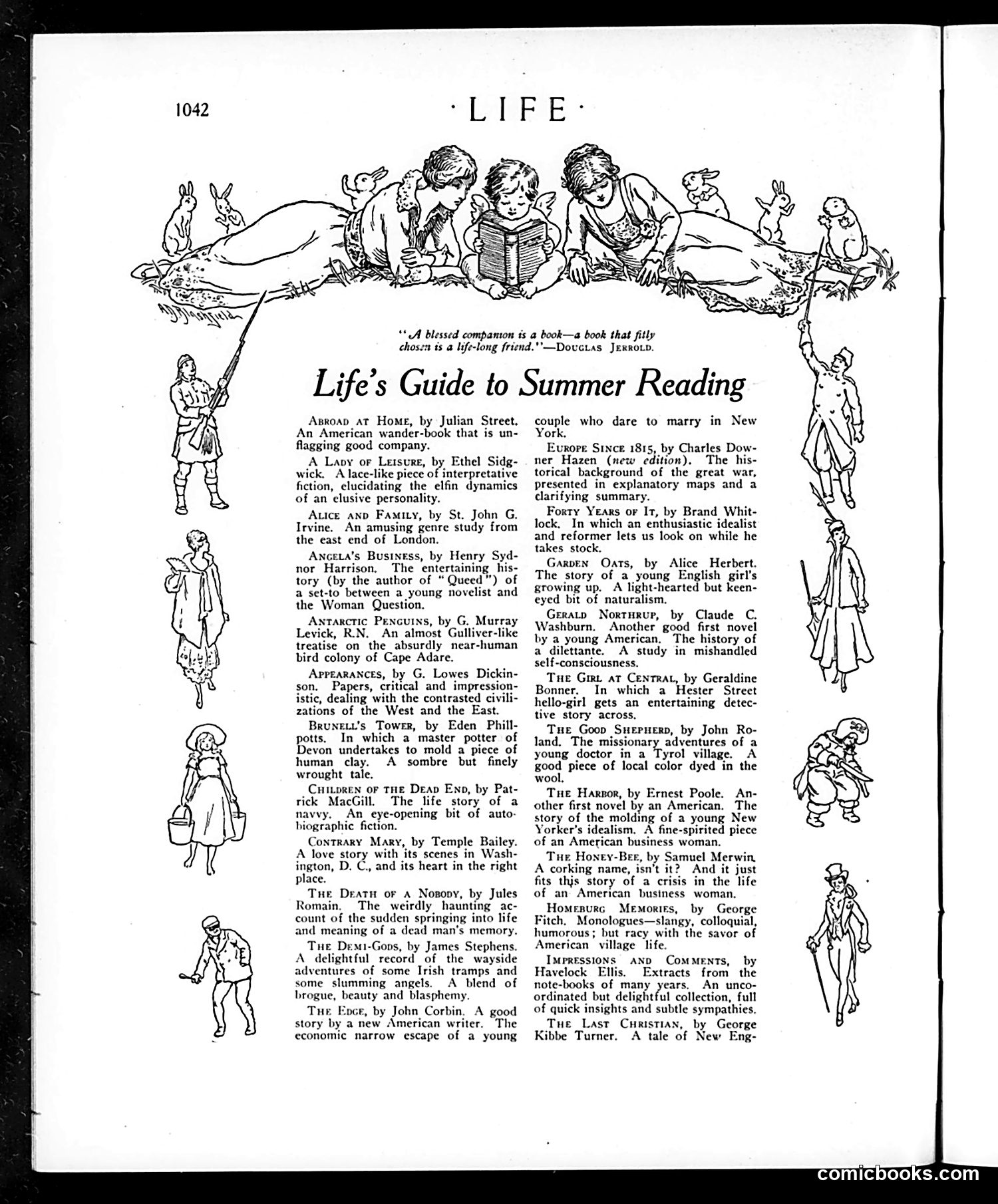
This is a **book recommendation list**, not a political cartoon. The page presents approximately 25 summer reading suggestions from Life magazine, with decorative illustrations of figures reading and children playing along the margins. The recommendations range across genres—romance (*Contrary Mary*), adventure (*Antarctic Penguins*), social commentary (*Children of the Dead End*), and historical analysis (*Europe Since 1815*). Several are explicitly identified as "first novels by American" authors, reflecting early 20th-century literary culture. The epigraph attributes a quote to "Douglas Jerrold" about books as lifelong companions, framing reading as serious intellectual companionship. The ornamental border illustrations suggest summer leisure activities—appropriate for the season's reading guide. This is primarily **editorial content promoting contemporary literature** rather than satire or political commentary.
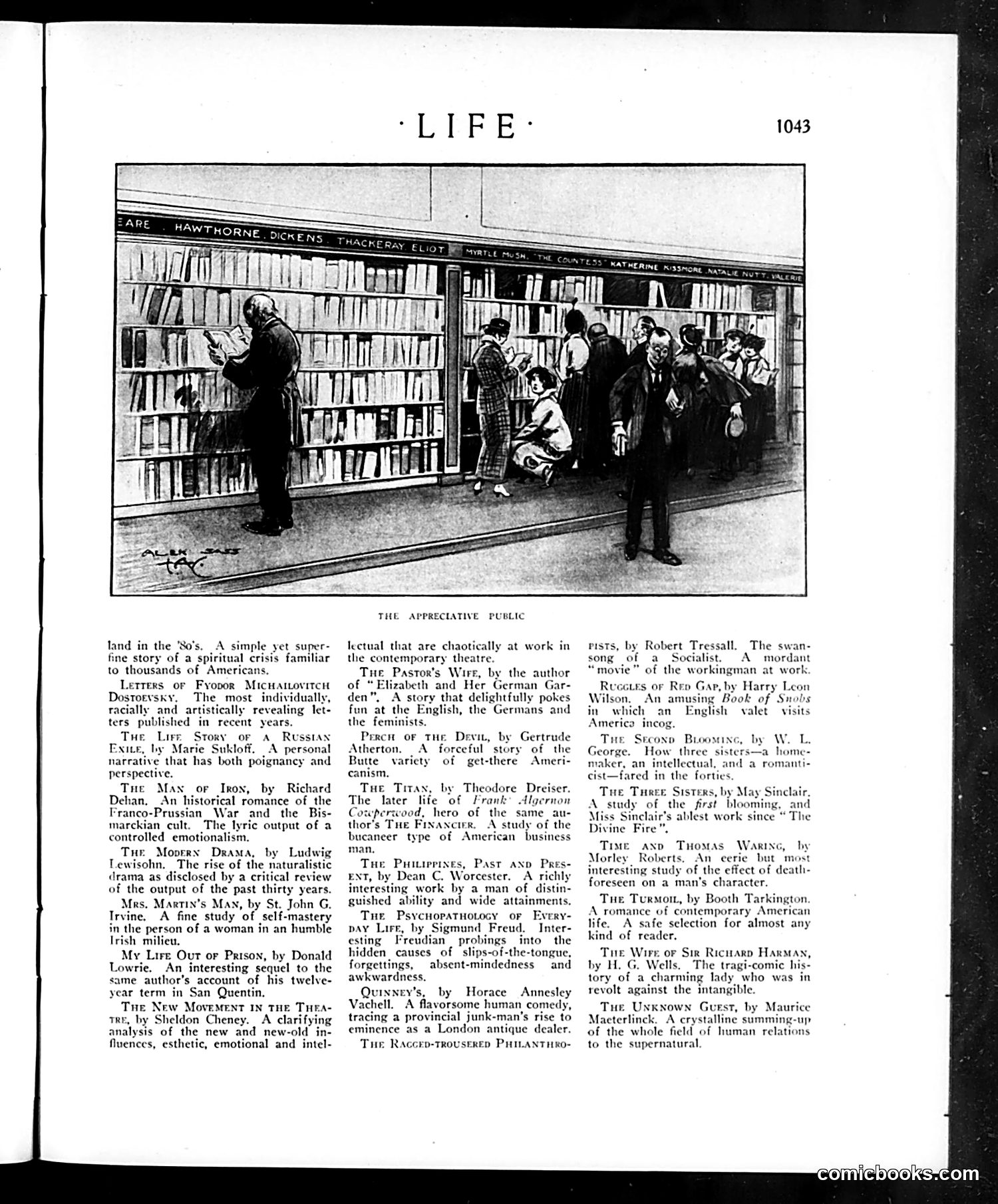
This page from *Life* magazine is primarily a **book review section**, not a political cartoon. The illustration at top shows a bookstore window display with customers browsing—a scene titled "The Appreciative Public." The satirical point appears gentle: the image depicts ordinary people (working-class and middle-class) examining serious literary works displayed in a shop window. The reviews below list intellectually demanding books—Dostoevsky's letters, Freud's psychology, Theodore Dreiser's naturalistic novels, and works on drama and philosophy. The humor likely lies in the **contrast between "appreciative public" and actual public taste**—suggesting that while these weighty, difficult works are on display, most people remain indifferent or confused by them. The window-shopping scene may gently mock both the pretensions of serious literature and the gap between high culture and popular interest.
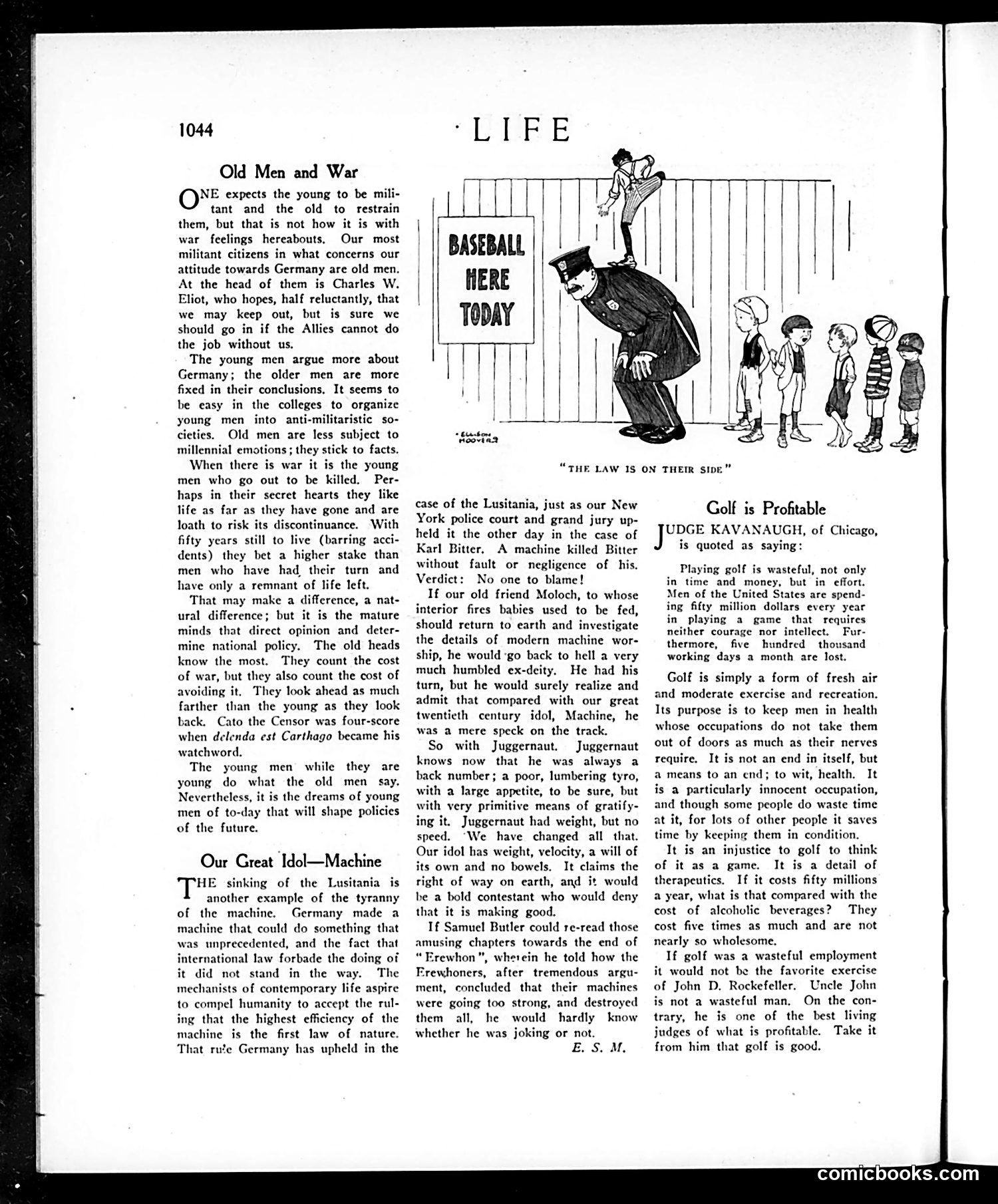
## "Old Men and War" This essay criticizes elderly American leaders—particularly Charles W. Eliot—for pushing military intervention against Germany while young men would bear the combat casualties. The author argues that older men, having lived most of their lives, more easily commit younger men to death, whereas youth naturally hesitate to risk their remaining decades. The reference to Cato's "delenda est Carthago" (Carthage must be destroyed) suggests this warmongering is ancient folly repeated. This was written during WWI debates over American neutrality. ## "The Law Is on Their Side" (Cartoon) The illustration shows a uniformed officer or authority figure towering over children, captioned about "the law." This likely references the recent sinking of the Lusitania (1915) or the Karl Bitter case—instances where mechanical/industrial accidents killed people without legal accountability, illustrating how modern society shields machines from moral responsibility. ## "Golf is Profitable" A brief satire on Judge Kavanaugh's claim that golf wastes time and money while men could be more productively employed—ironic commentary on American leisure priorities.
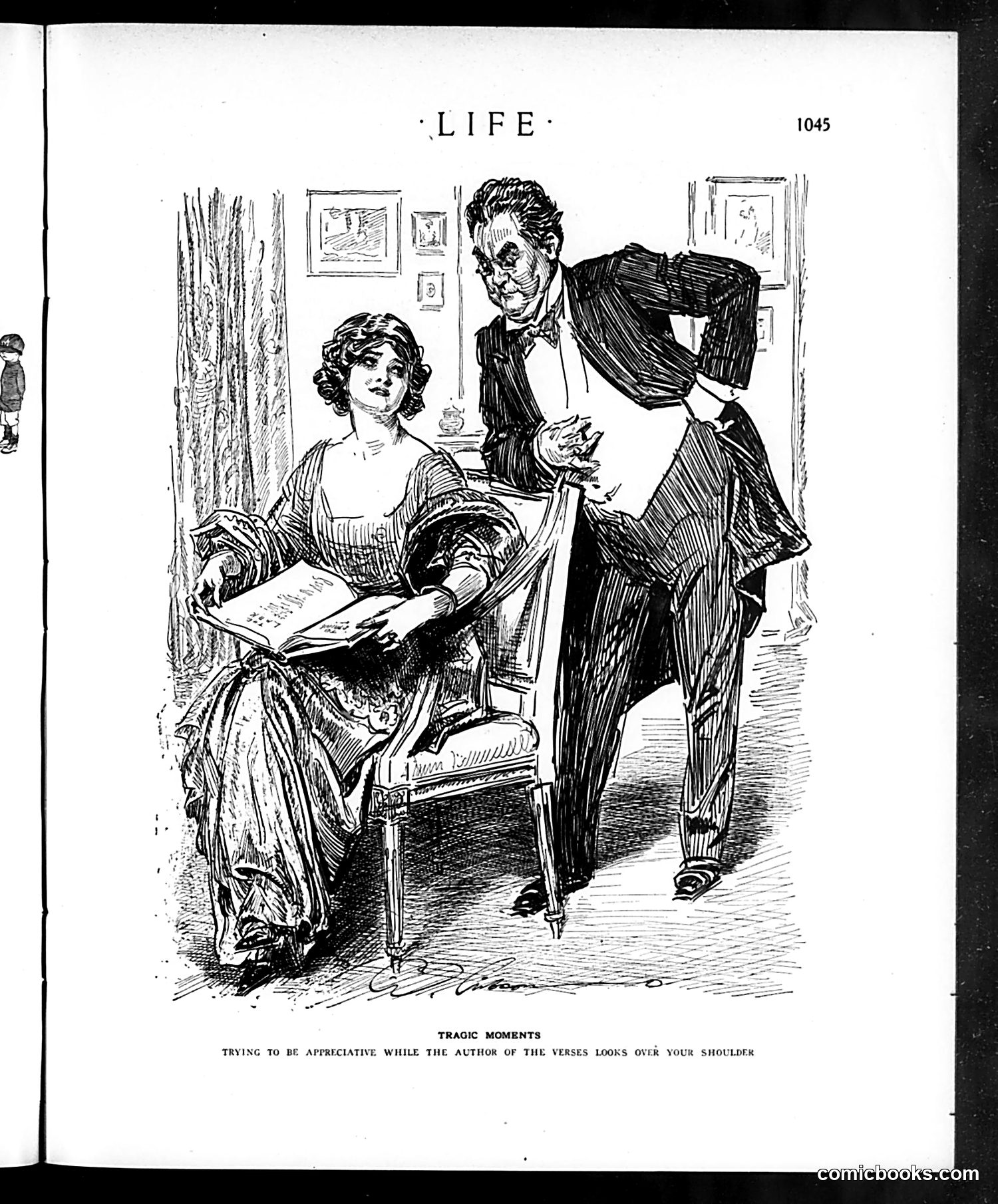
This cartoon depicts a common social awkwardness: a woman sitting and reading verses (poetry) while a man—presumably the author—stands beside her watching her reaction. The caption identifies this as a "tragic moment." The satire targets the difficult etiquette of receiving creative work from someone present. The woman must pretend to enjoy the verses while being scrutinized, unable to express genuine disinterest or criticism. Her forced smile and the man's expectant posture capture the tension between honesty and politeness. This reflects early 20th-century social conventions where rejecting someone's artistic efforts—especially from an acquaintance or suitor—was considered rude. The joke is about the awkward performance both parties must maintain in such situations.
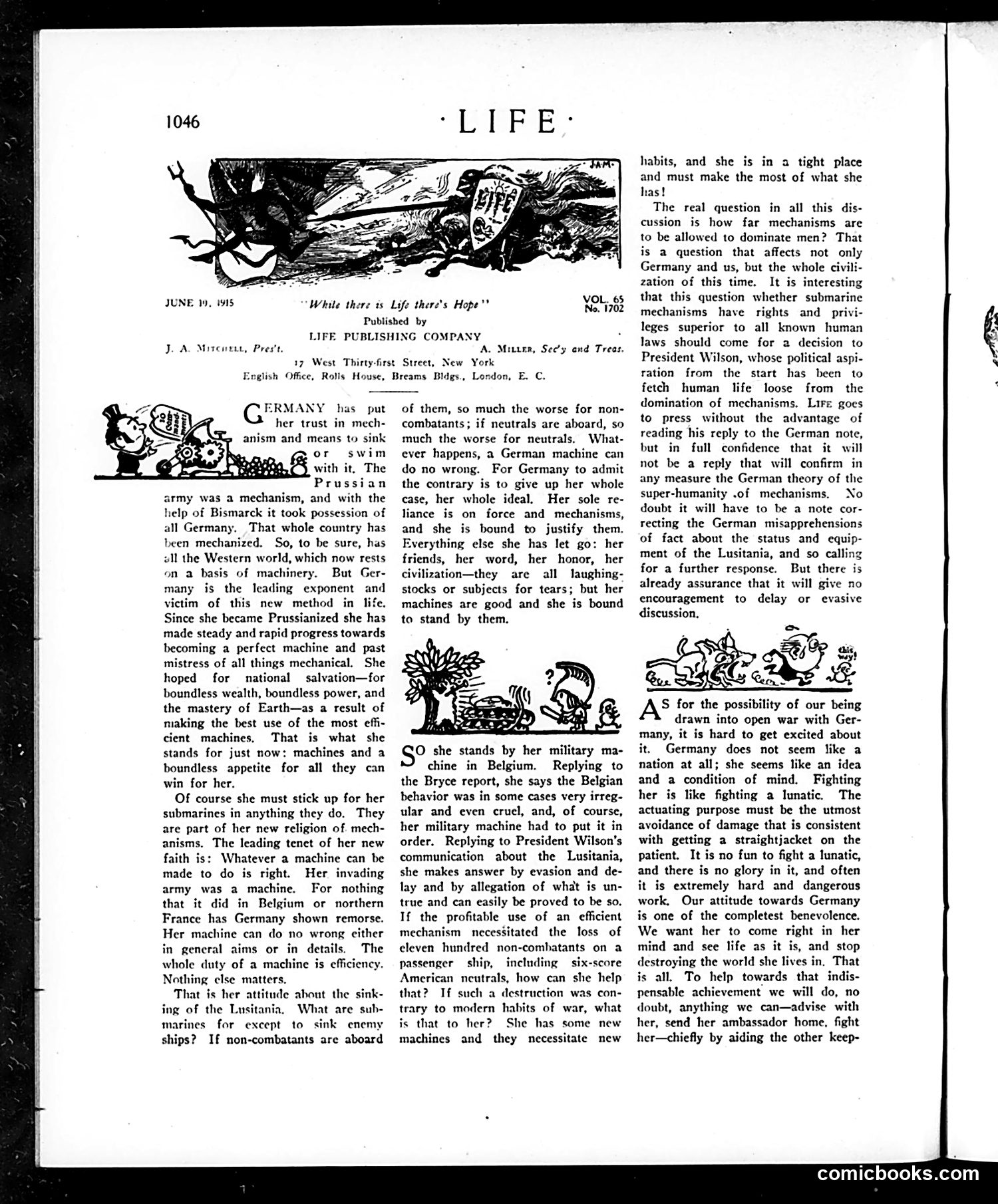
This editorial cartoon and accompanying text satirize Germany's justification for unrestricted submarine warfare, particularly the sinking of the Lusitania (May 1915, which killed American civilians). The cartoon depicts **Death personified**, likely representing the consequences of mechanized warfare. The text argues that Germany has become enslaved to "mechanism"—military machines—to the point where efficiency justifies any atrocity. Germany claims submarines merely fulfill their function; sinking civilian ships is acceptable because machines serve no moral purpose beyond efficiency. The author mocks this logic: if the mechanism "necessitated" killing 1,100 non-combatants (including American neutrals), Germany accepts this as inevitable. The satire highlights the tragic irony that President Wilson—philosophically opposed to machines dominating human life—must now decide whether international law supersedes German mechanical "necessity." The piece condemns Germany's abandonment of honor, civilization, and human values in favor of pure mechanistic morality.
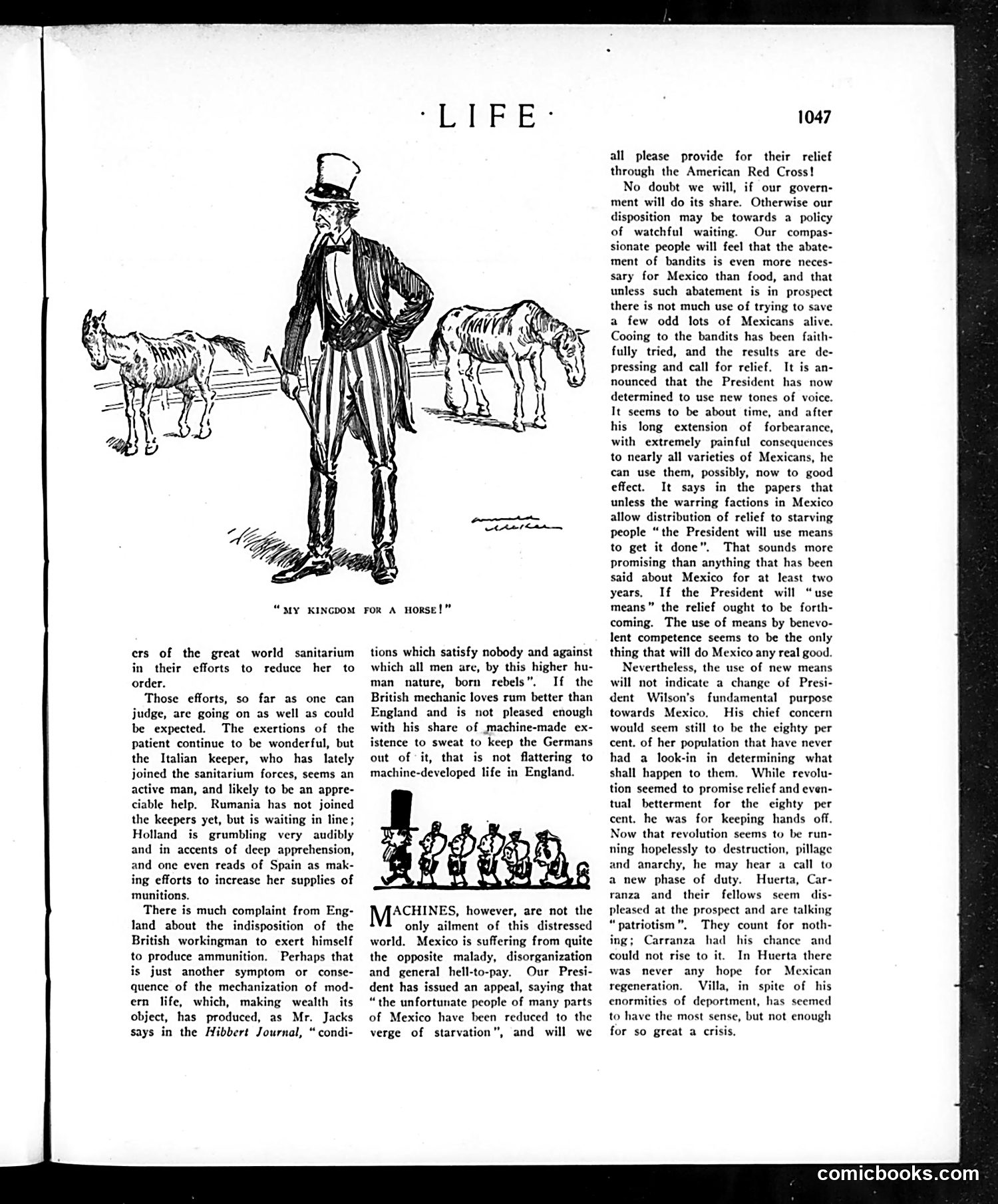
The cartoon depicts Uncle Sam (identified by his top hat and characteristic appearance) standing between two starving, emaciated donkeys, captioned "MY KINGDOM FOR A HORSE!" This is a Shakespeare reference (Richard III) suggesting desperation. The accompanying text satirizes President Wilson's foreign policy toward Mexico during the Mexican Revolution. The article criticizes Wilson's previous "watchful waiting" policy as ineffective, mocking his recent appeal for Red Cross relief while Mexican factions continue fighting. The donkeys likely represent Mexico or Mexican suffering under revolutionary chaos. The cartoon suggests Wilson finally recognizes he must take action—though the satire questions whether he will genuinely intervene or merely use new rhetoric while maintaining passivity. The broader context involves Wilson's struggle with Mexican instability, bandit violence, and humanitarian crisis. The magazine ridicules both the revolutionaries (Huerta, Carranza) and Wilson's hesitant diplomacy, suggesting stronger intervention is needed to protect ordinary Mexicans from continued devastation.
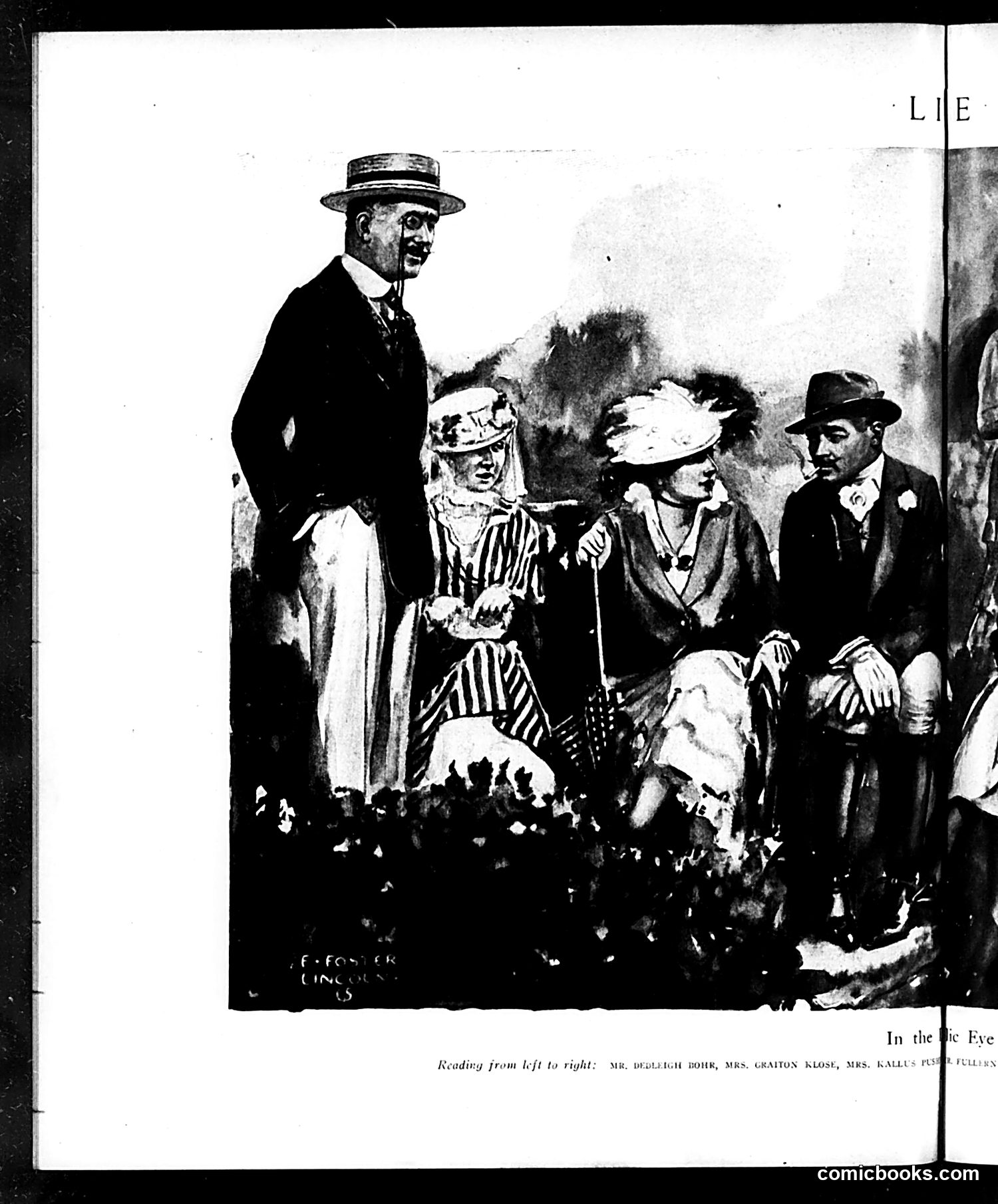
This appears to be a satirical illustration showing a well-dressed man standing prominently while addressing or observing several seated figures in period clothing (appearing early 20th century). The caption identifies figures as "Mr. Wedleigh Bour, Mrs. Graiton Klose, Mrs. Kallus" and others. Without the full article text or publication date visible, the specific satire is unclear. However, the composition suggests social commentary—possibly mocking upper-class pretension, a public speaking scene, or political figures of the era. The formal dress and theatrical staging suggests this ridicules either societal affectation or a specific newsworthy event involving these named individuals. The illustration style and magazine context indicate this is satirical commentary on contemporary society or personalities, but the exact target requires additional context.
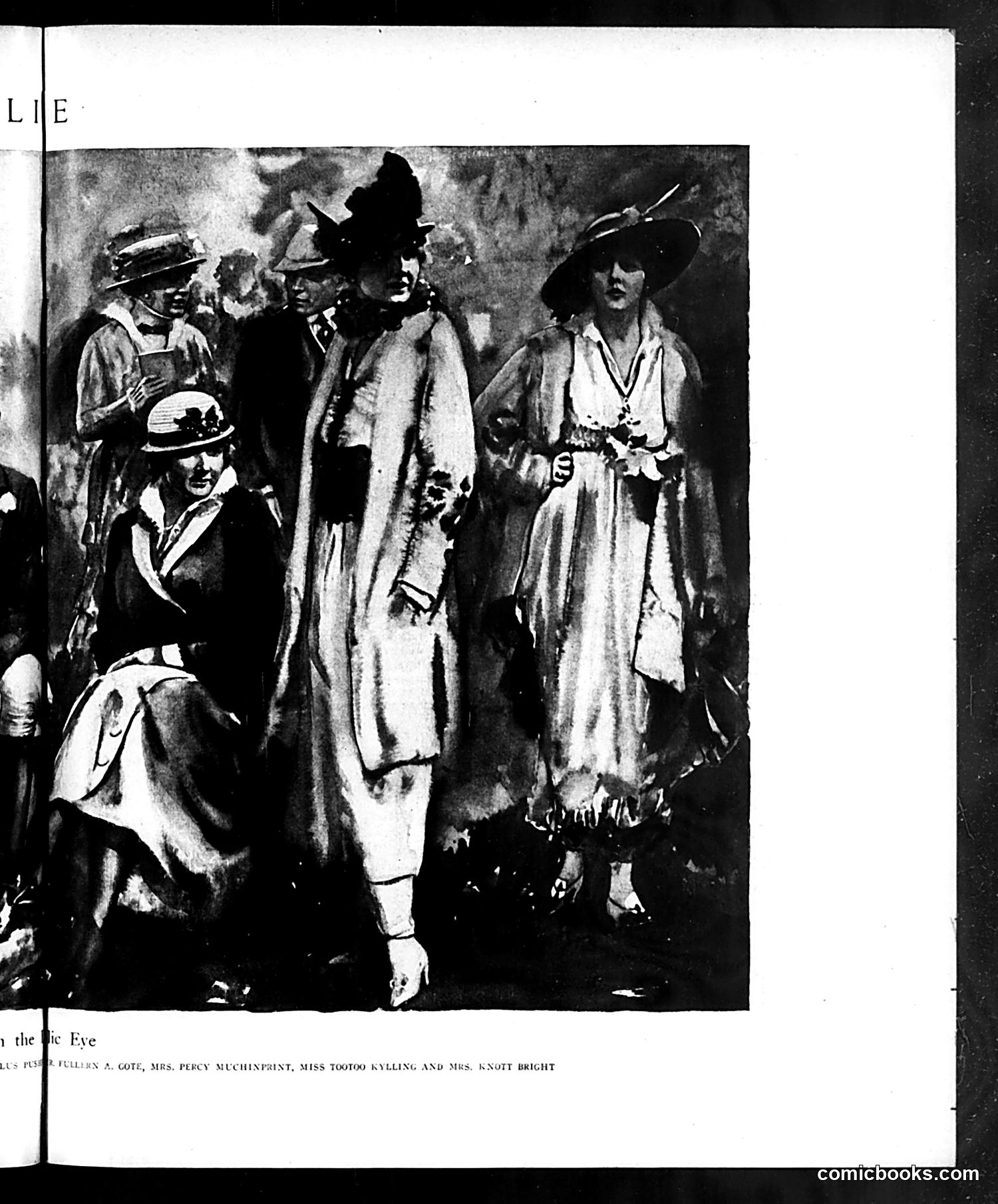
This appears to be a photograph caption from *Life* magazine featuring several women in period costume (likely 1920s-1930s based on the hats and dress styles). The caption lists names that are clearly **satirical pseudonyms**: "Fuller A. Gote" (Fuller's goat), "Mrs. Percy Muchinprint" (much in print), "Miss Tootoo Kyling" (too too killing), and "Mrs. Knott Bright" (not bright). The humor derives from these punning names describing the women's social pretensions or characteristics—suggesting they are society figures or celebrities whose names are jokingly "corrected" to mock their vanity, superficiality, or media obsession. This was typical *Life* magazine satire targeting wealthy or famous women of the era.
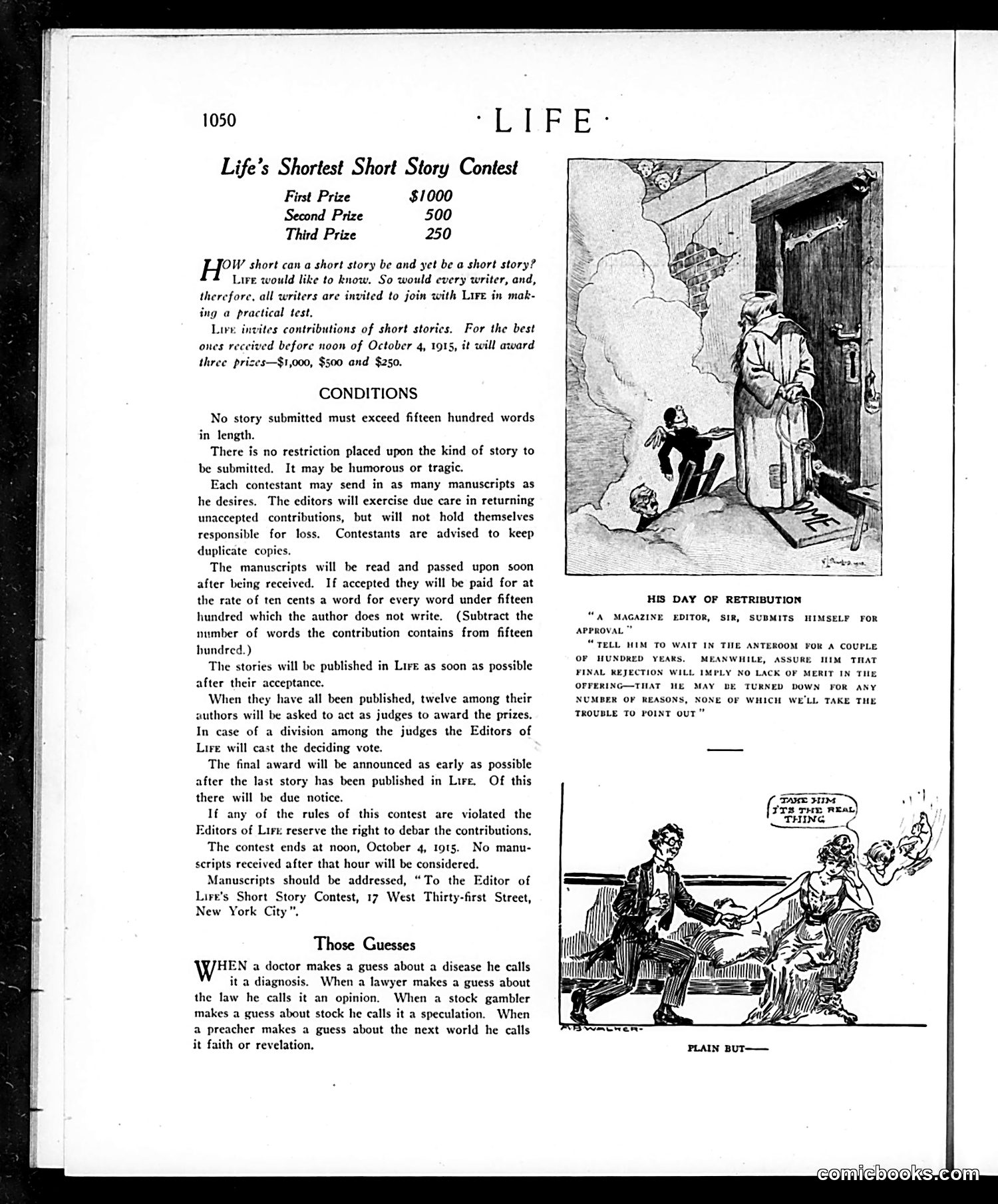
This page announces **Life's Shortest Short Story Contest**, offering $1,000 for the winning entry—a practical test of how brief fiction can be while remaining a "short story." The contest deadline is October 4, 1915, with stories limited to 1,500 words. The cartoons mock professional pretension: **"His Day of Retribution"** depicts a **magazine editor** (likely representing the magazine itself) being submitted for "approval" to what appears to be a heavenly or judgment authority. The editor is told to wait "a couple of hundred years" for rejection—satirizing editors' notorious habit of rejecting writers' work. The joke inverts power: now *the editor* experiences the humiliation writers endure. **"Plain But—"** shows a couple discussing whether something is "the real thing," likely mocking sentimental romance or advertising claims about authenticity. The section "Those Guesses" is philosophical satire: it notes how professionals rebrand guesses with fancy terminology (diagnosis, opinion, speculation, faith) to sound authoritative—a critique of professional pretension common in Life magazine's satirical tradition.
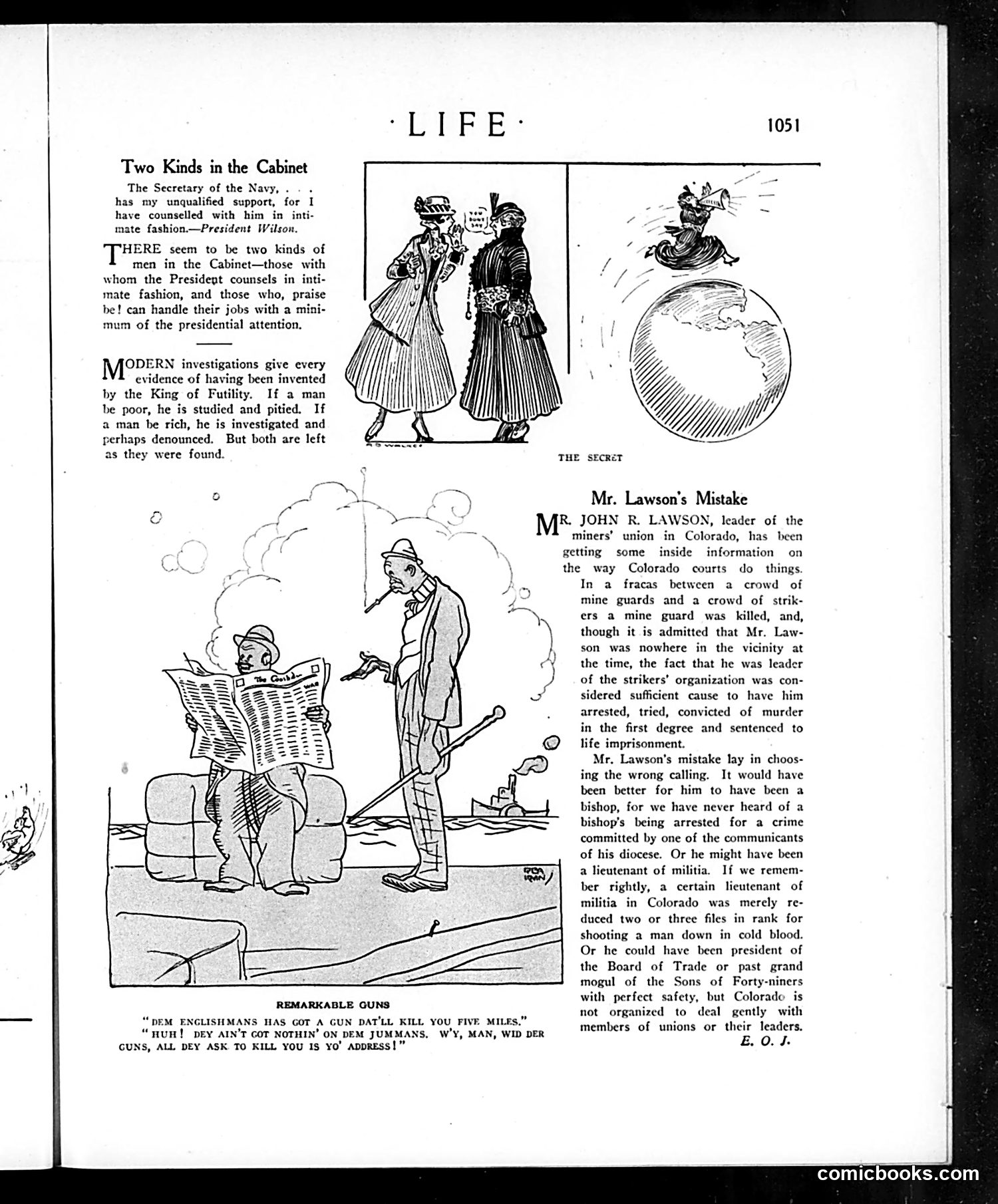
This page contains two satirical pieces critiquing American institutions: **"Two Kinds in the Cabinet"** mocks President Wilson's selective attention to cabinet members, suggesting he overly "counsels" some while neglecting others. The cartoon shows two women discussing this favoritism. **"Mr. Lawson's Mistake"** is the main commentary. John R. Lawson, a Colorado miners' union leader, was convicted of murder and sentenced to life imprisonment despite being absent when a mine guard was killed—his crime was leading the strikers' organization. The author sarcastically argues Lawson's "mistake" was choosing labor organizing rather than a safer profession like bishop or militia officer, positions whose members escape legal consequences for similar or worse offenses. This critiques Colorado's judicial system as systematically hostile to union members while protecting the wealthy and powerful. **"Remarkable Guns"** is a separate cartoon depicting exaggerated boasts about weapons' killing ranges, likely referencing WWI propaganda. The page attacks class inequality and labor injustice in early 20th-century America.
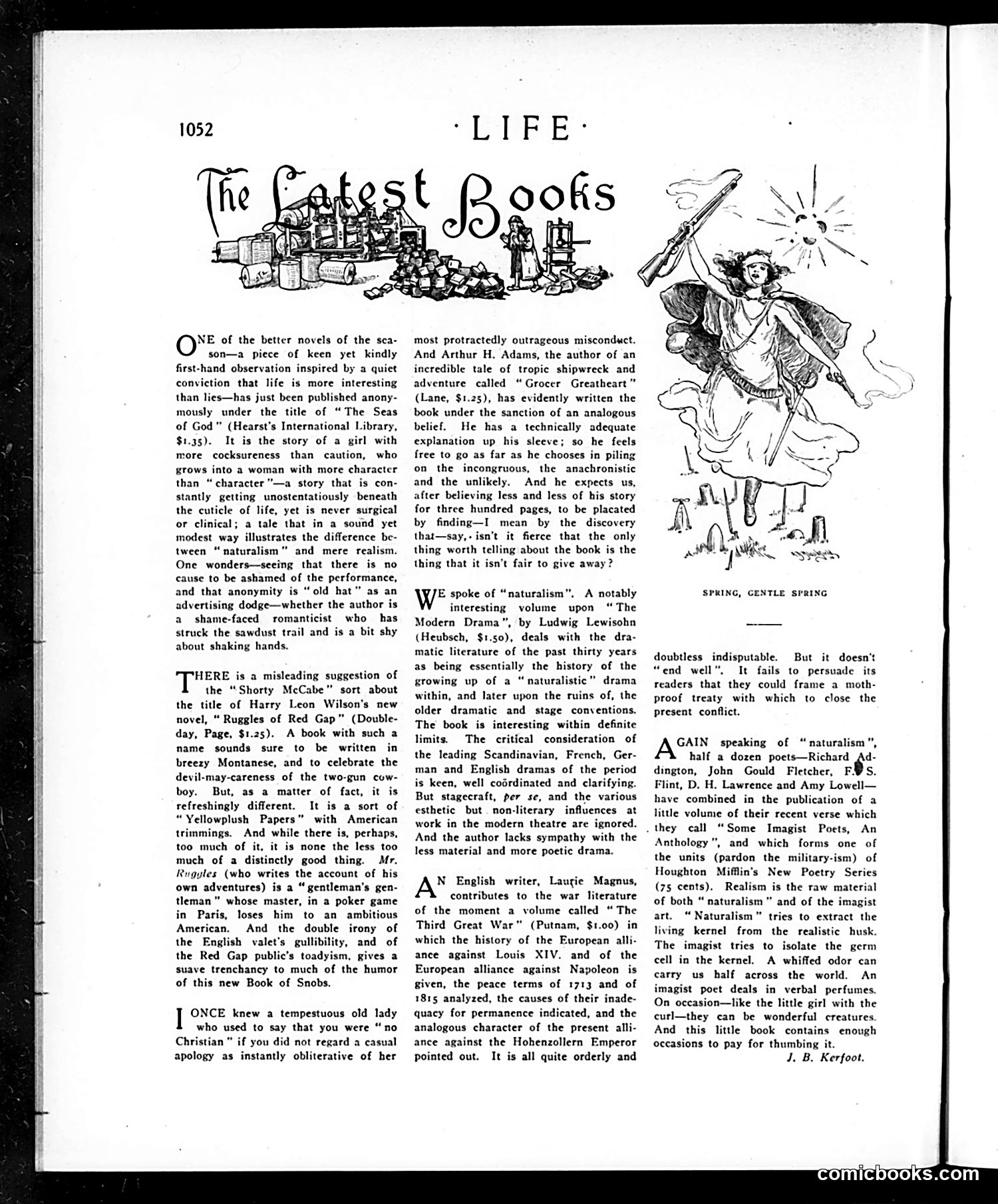
This is a straightforward literary review section, not political satire. The page discusses four recent novels and books: 1. **"The Seas of God"** — praised for keen observation, published anonymously, which the reviewer finds curious given its quality 2. **"Ruggles of Red Gap"** by Harry Leon Wilson — a satirical novel about an English valet ("gentleman's gentleman") who loses a poker game in Paris and becomes servant to an American, allowing the author to mock both English snobbery and American social pretension 3. **"Grocer Greatheart"** by Arthur H. Adams — criticized as an implausible tropical adventure that expects readers to accept an unsatisfying explanation 4. **"The Modern Drama"** by Ludwig Lewisohn — an academic study of naturalistic drama's rise over thirty years, praised for critical analysis but faulted for ignoring stagecraft and poetic drama The small illustration shows a cherub or allegorical figure labeled "SPRING, GENTLE SPRING" — a decorative seasonal element unrelated to the book reviews.
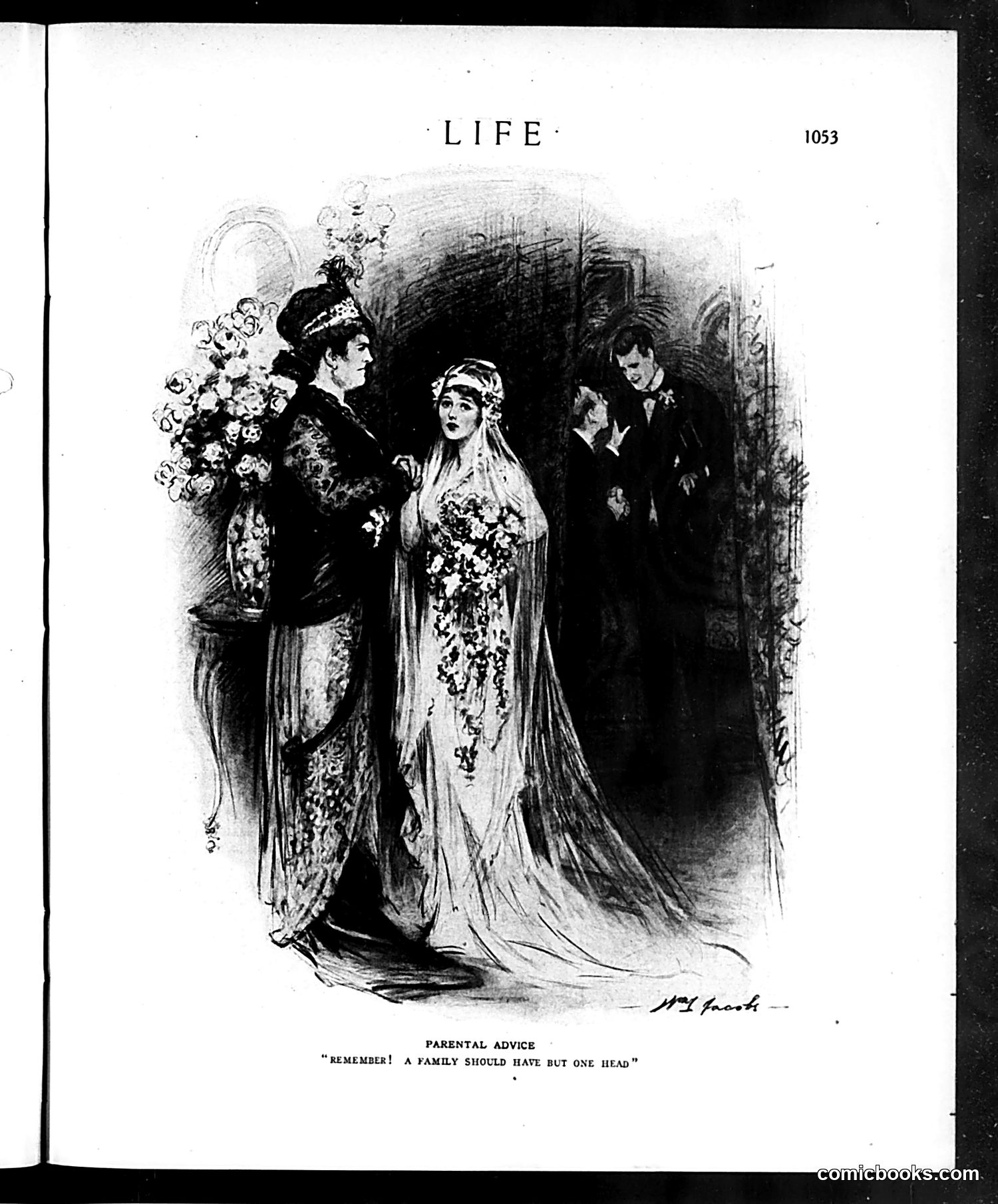
This satirical cartoon depicts a wedding scene where a bride in white stands with her groom, while older figures (likely parents or in-laws) offer unsolicited advice. The caption's joke—"A family should have but one head"—is a play on marital power dynamics. The satire targets newlyweds receiving traditional parental wisdom about household hierarchy, likely suggesting the husband should be the sole authority figure. However, the visual composition, with multiple authority figures crowding the scene, ironically undermines this message by showing how many voices actually compete for control. This reflects early-20th-century anxieties about marriage, family structure, and the tension between traditional patriarchal authority and the reality of familial influence from multiple generations.
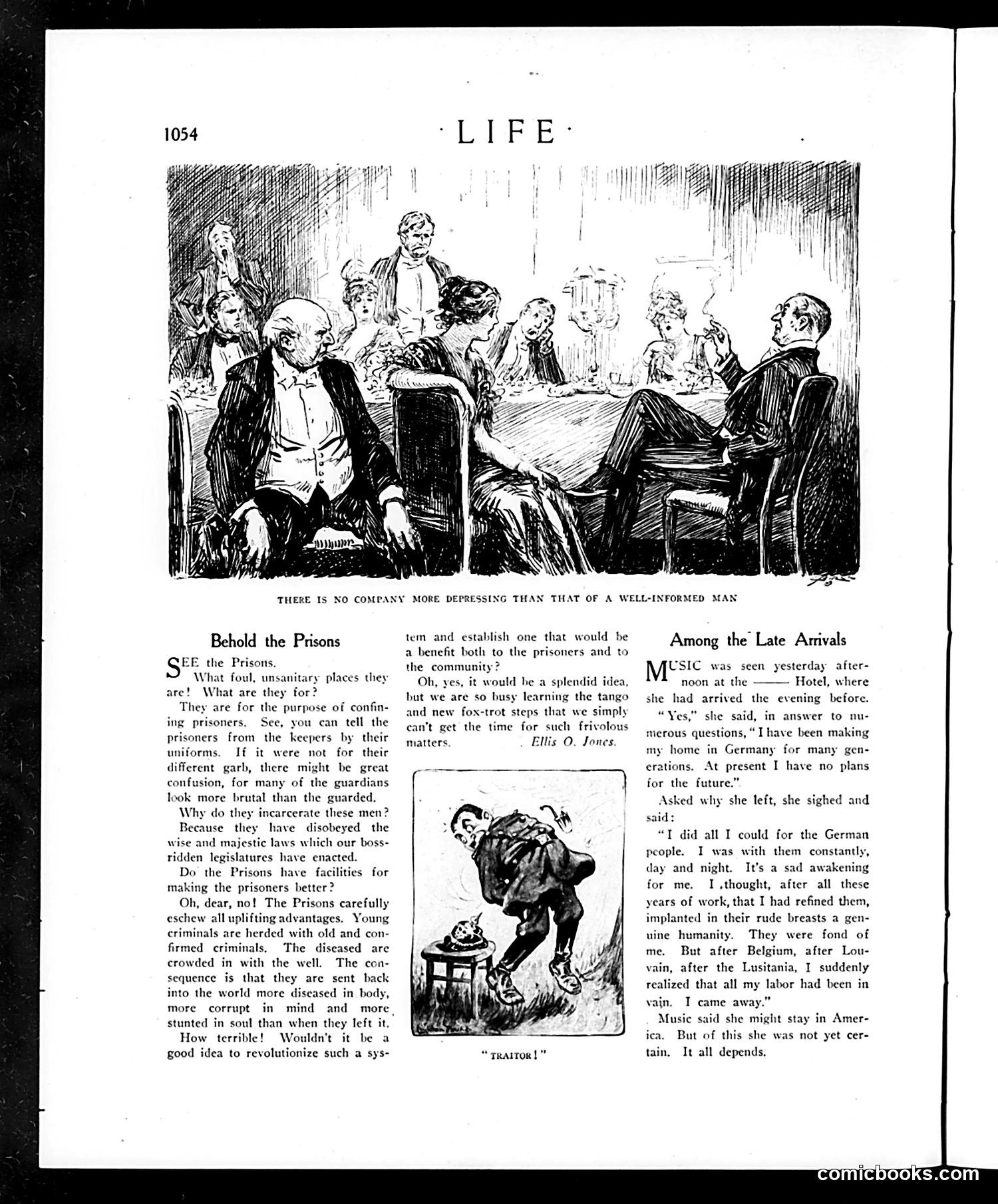
This 1915 *Life* magazine page contains two separate satirical pieces: **"Behold the Prisons"** critiques the American penal system as deliberately corrupting rather than rehabilitative. The author sarcastically notes prisons mix hardened criminals with first-time offenders and diseased with healthy inmates—intentionally worsening prisoners. The joke: Americans are too busy learning the tango to reform this system. The accompanying illustration labeled "TRAITOR!" depicts prisoner abuse. **"Among the Late Arrivals"** personifies "Music" as a German woman who emigrated to America, disillusioned after WWI. She claims she tried to civilize Germans through culture, but their conduct—Belgium's invasion, Louvain's destruction, the *Lusitania* sinking—proved hopeless. The satire mocks German claims of cultural superiority while indicting wartime atrocities. Music's uncertainty about staying reflects skepticism about German-American loyalty during the war. Both pieces critique institutional failure and enemy barbarism respectively.
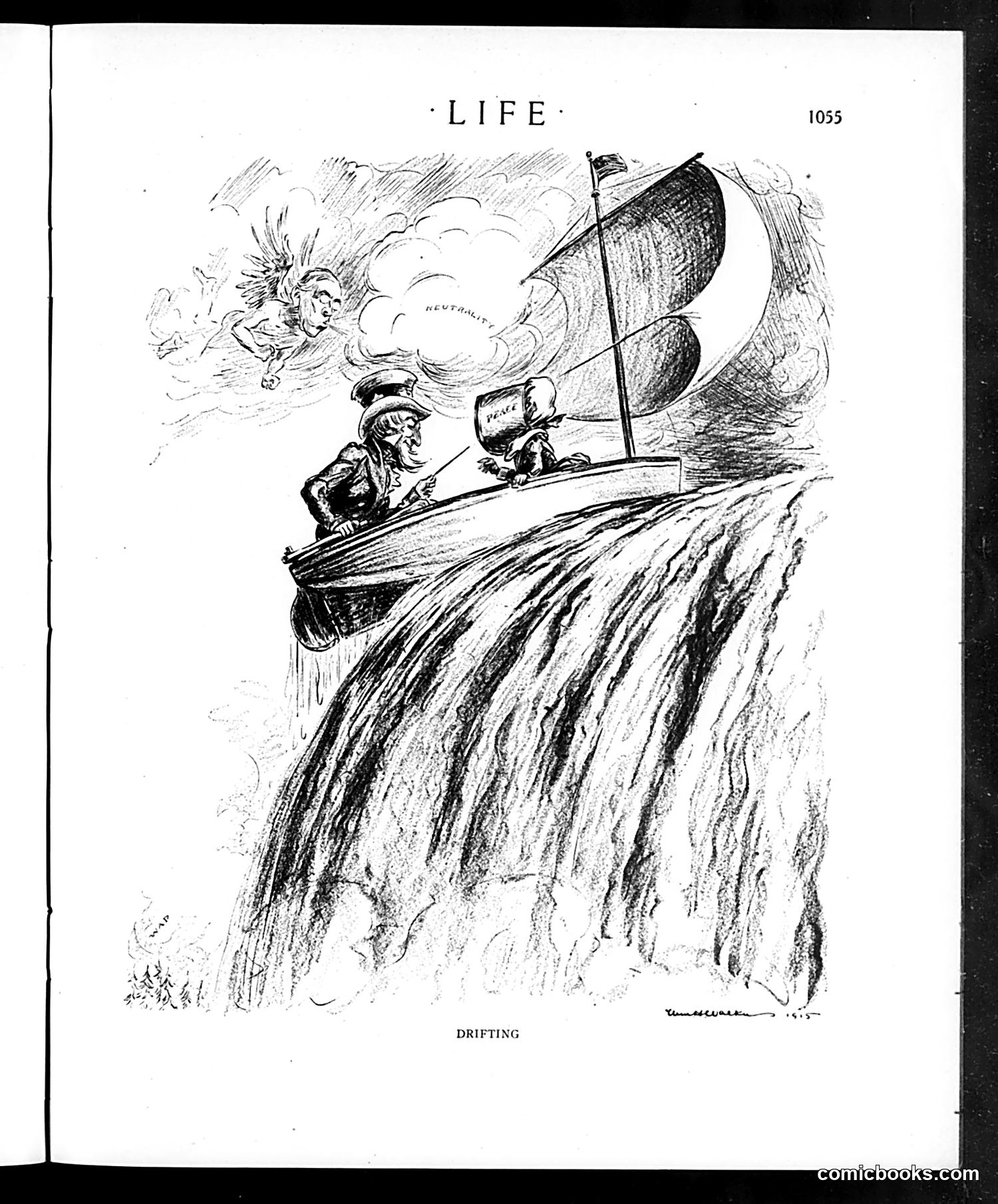
This political cartoon depicts two figures in a small boat going over a waterfall, labeled "DRIFTING." The composition suggests they're helplessly swept toward disaster. The cartoon likely satirizes political or economic leadership during a period of crisis—the figures appear to be caricatured politicians or leaders, with one wearing a top hat (suggesting authority or establishment). The "drifting" metaphor criticizes passive or ineffective governance; rather than steering the nation deliberately, leaders are portrayed as passive passengers headed toward catastrophe. The cherub-like figure blowing in the upper left may represent fate or circumstance. Without additional context about the publication date, I cannot identify the specific figures or which crisis this references, though the style suggests early-to-mid 20th century American politics.
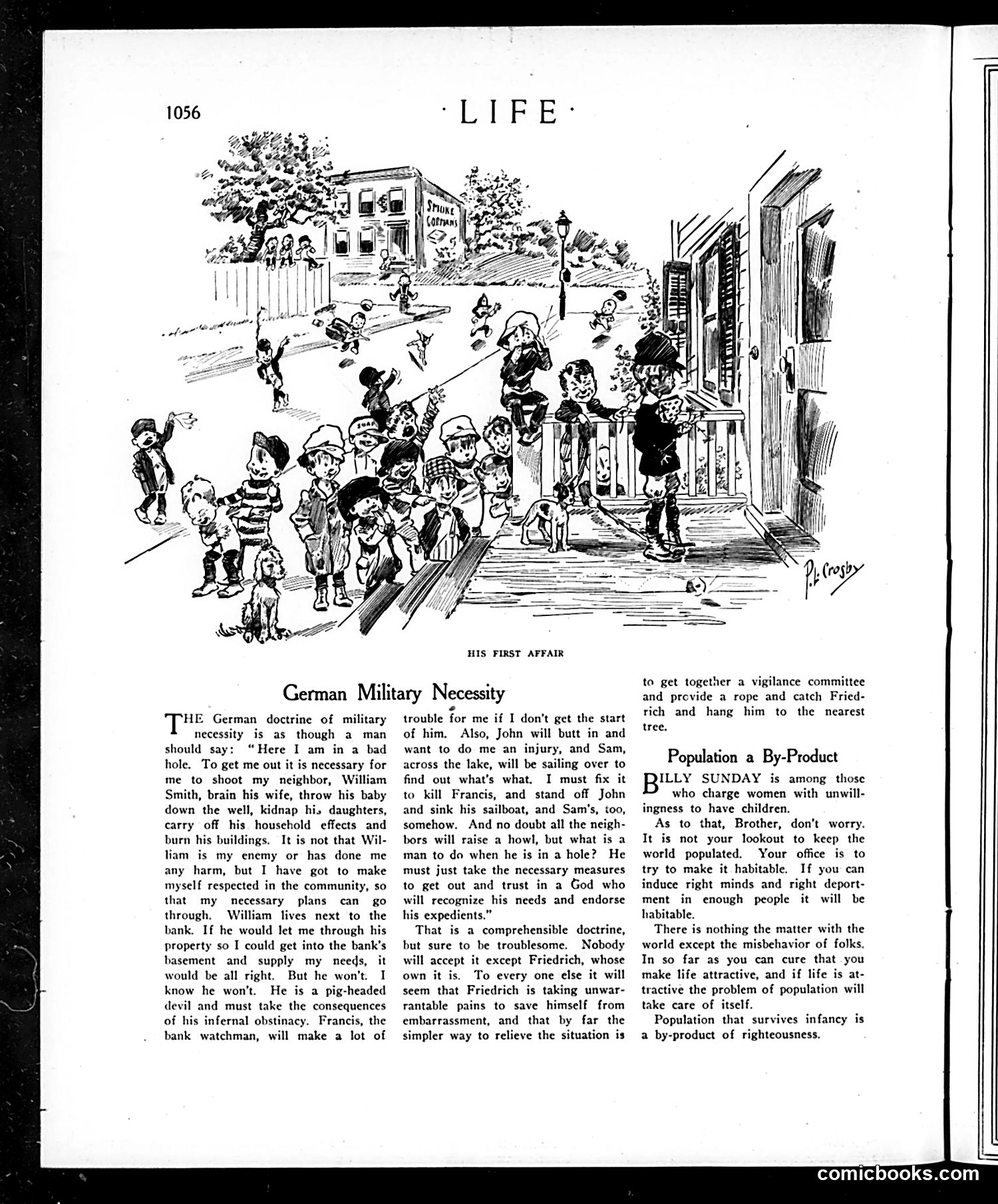
**"His First Affair"** is a political cartoon critiquing German military doctrine during World War I. The illustration shows children playing, while the accompanying text uses an extended metaphor: a man justifies committing atrocities against his neighbor William Smith as "military necessity" to solve his own problems—shooting him, drowning his baby, burning his buildings. The satire equates Germany's invasion of neutral Belgium and other aggressive actions to a criminal's self-serving rationalization. The text concludes that such logic is indefensible; any civilized society would respond by hanging this "Friedrich" (clearly representing Germany/Kaiser Friedrich Wilhelm). The second article, **"Population a By-Product,"** addresses evangelist Billy Sunday's criticism of women avoiding childbearing. Life's counter-argument: population growth naturally follows when society becomes morally upright and habitable—it's not women's duty to reproduce in an unattractive world. The piece advocates social improvement over moral blame. Both pieces reflect Progressive-era American magazine satire using sharp wit to critique militarism and religious moralizing.
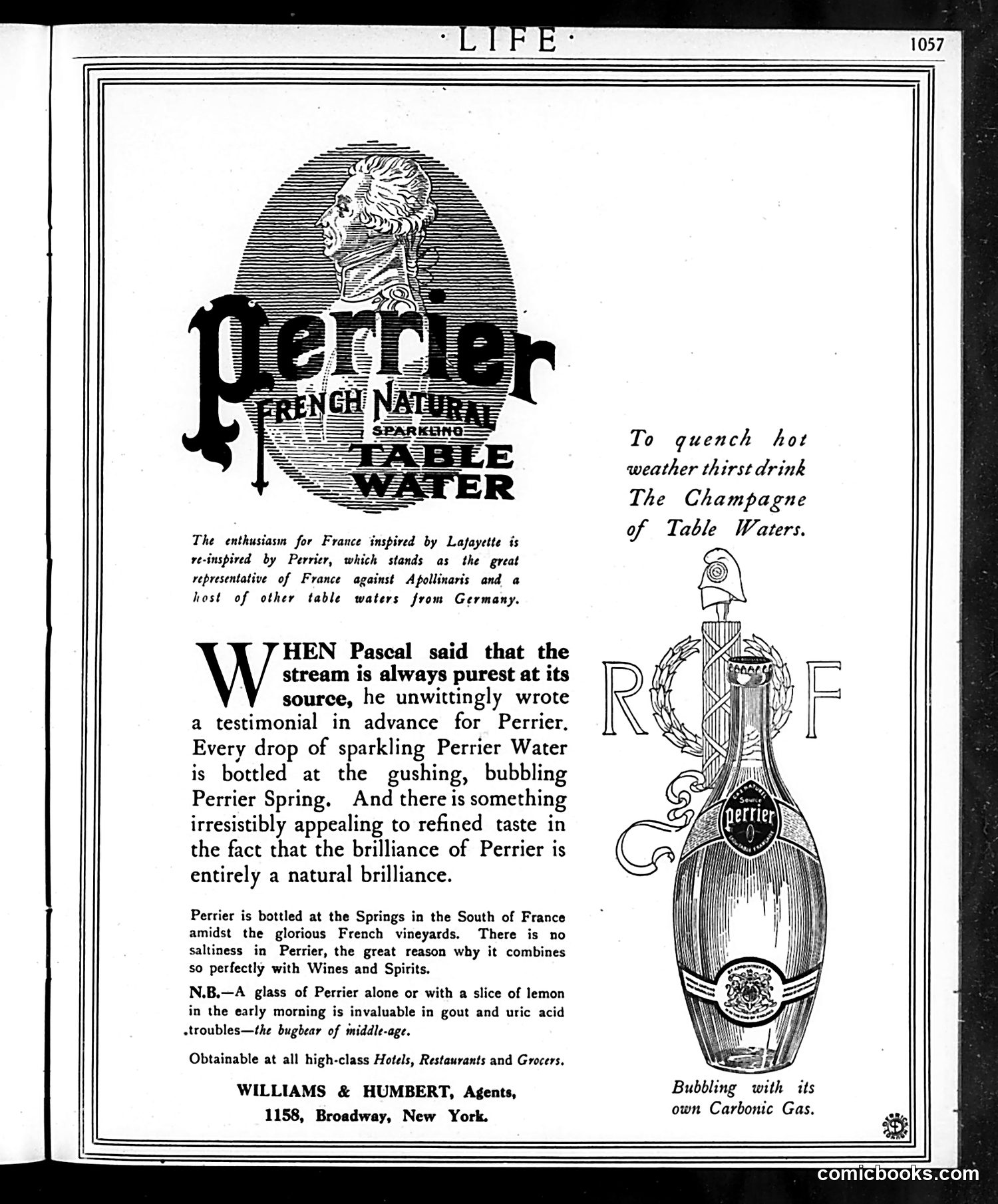
This is primarily a **product advertisement**, not political satire. However, it contains nationalist messaging relevant to its historical context. The ad promotes Perrier sparkling water by positioning it as a French alternative to German table waters like Apollinaris. The text explicitly invokes **Lafayette**—the French Revolutionary hero—to create patriotic appeal, suggesting that choosing Perrier is choosing France over Germany. The illustrated bottle features a French military figure (appears to be a Napoleonic-era soldier based on the uniform and bicorne hat), reinforcing French national pride and superiority. The copy uses pseudo-scientific language (referencing Pascal, purity "at the source," natural carbonation) to legitimize health claims—typical of early 20th-century advertising before FDA regulations. The note about gout and "uric acid troubles" reflects period concerns about digestive ailments among the "middle-age" affluent class who could afford imported luxury goods. This advertisement conflates consumer choice with national loyalty during a period of Franco-German tension.
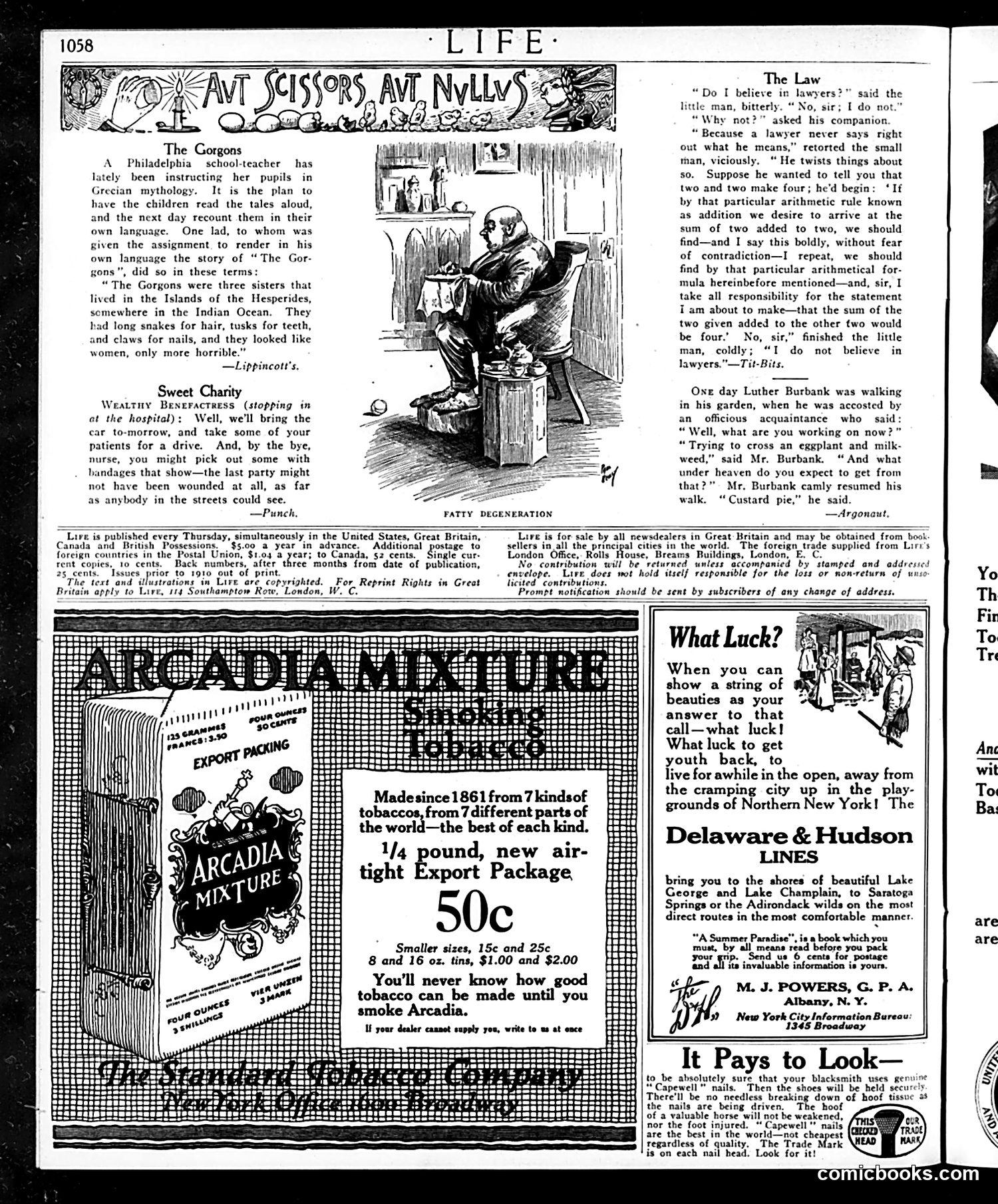
This cartoon depicts a well-dressed man hunched over a desk, appearing to engage in dishonest legal work. The title "PATTY DEGENERATION" suggests moral or professional decline. The accompanying text column titled "The Law" features a dialogue where a small man questions whether lawyers truly believe in their profession. His companion responds cynically, explaining how lawyers manipulate arithmetic and logic to win cases—using technical arguments to obscure truth rather than serve justice. The cartoon illustrates this critique: the lawyer appears consumed by paperwork and dubious practices, embodying the satirical complaint that lawyers prioritize winning cases over ethical conduct. This reflects early 20th-century skepticism about the legal profession's integrity and methods.
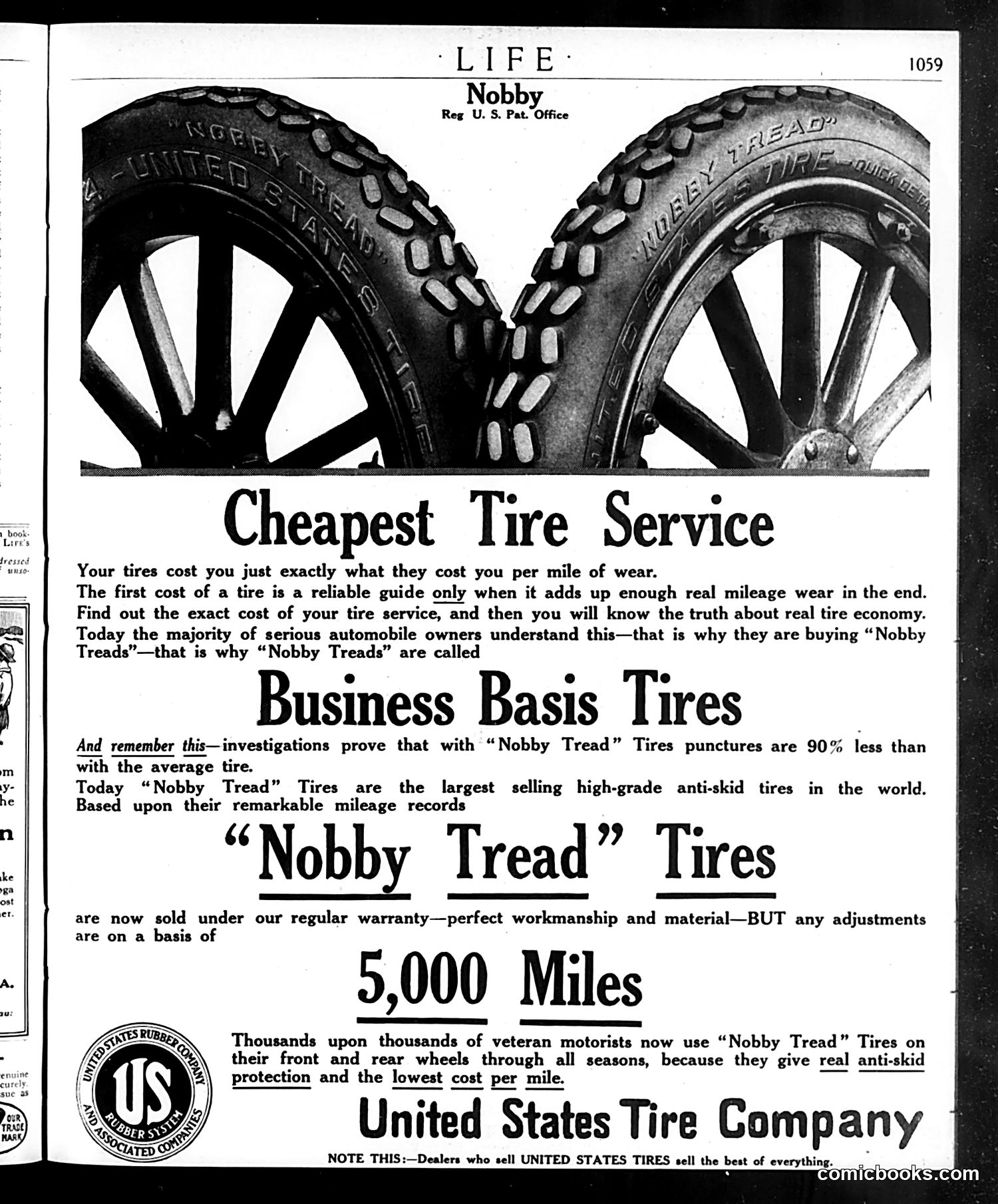
This is a **tire advertisement**, not a political cartoon. It promotes "Nobby Tread" tires made by the United States Tire Company. The page uses two tire photographs to visually demonstrate the product's tread pattern. The advertisement's main argument is economic: tire value should be measured by cost-per-mile of actual wear, not initial purchase price. It claims "Nobby Tread" tires deliver superior mileage and durability, with 90% fewer punctures than competitors. The ad targets "serious automobile owners" as a rational consumer base who understand "business basis" purchasing—a marketing strategy emphasizing reliability and long-term savings. The emphasis on "anti-skid" protection reflects early automotive safety concerns. The U.S. Rubber Company seal at bottom suggests official endorsement, adding credibility. This represents typical early 20th-century product advertising focused on durability claims and consumer education rather than modern marketing approaches.
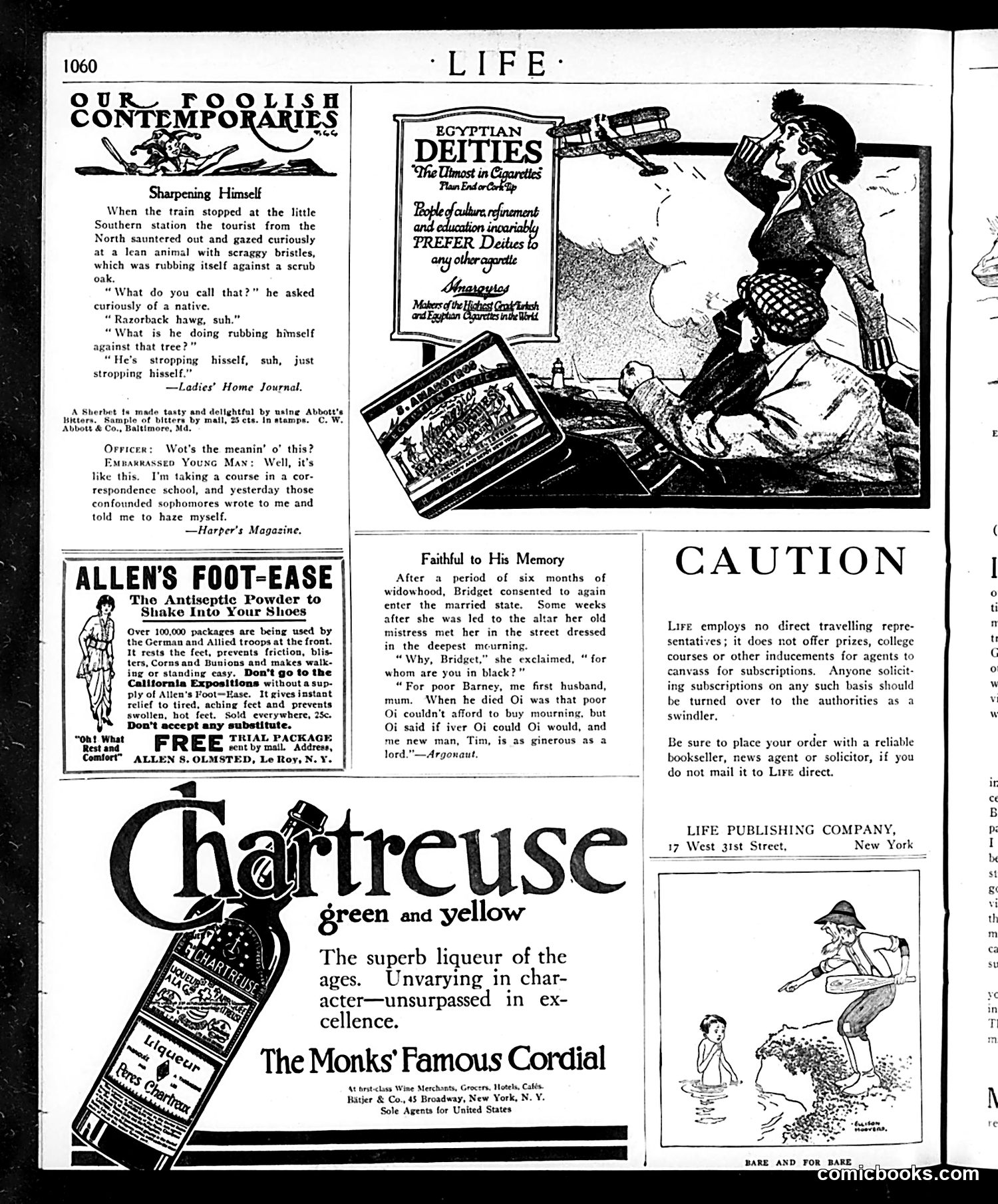
This page collects humorous anecdotes and advertisements typical of Life magazine's satirical content. **"Our Foolish Contemporaries"** presents brief jokes mocking various social types: - **"Sharpening Himself"**: A Northern tourist mistakes a Southern farmer's description of a pig "stropping himself" (sharpening bristles on a tree) for actual self-improvement—satirizing rural dialect and Northern condescension toward the South. - **"Faithful to His Memory"**: An Irish servant woman (Bridget) remarries quickly but claims to mourn her first husband, finally able to afford proper mourning clothes only through her new husband's generosity—mocking working-class hypocrisy and Irish stereotypes. - **Officer anecdote**: Plays on hazing traditions at correspondence schools, joking about a confused student instructed to "haze himself." The **"Egyptian Deities"** advertisement (top right) appears to promote cigarettes using exotic imagery—common marketing of the era. The page also advertises period products (Allen's Foot-Ease powder, Chartreuse liqueur) and includes a **caution box** warning readers against Life subscription fraud schemes.
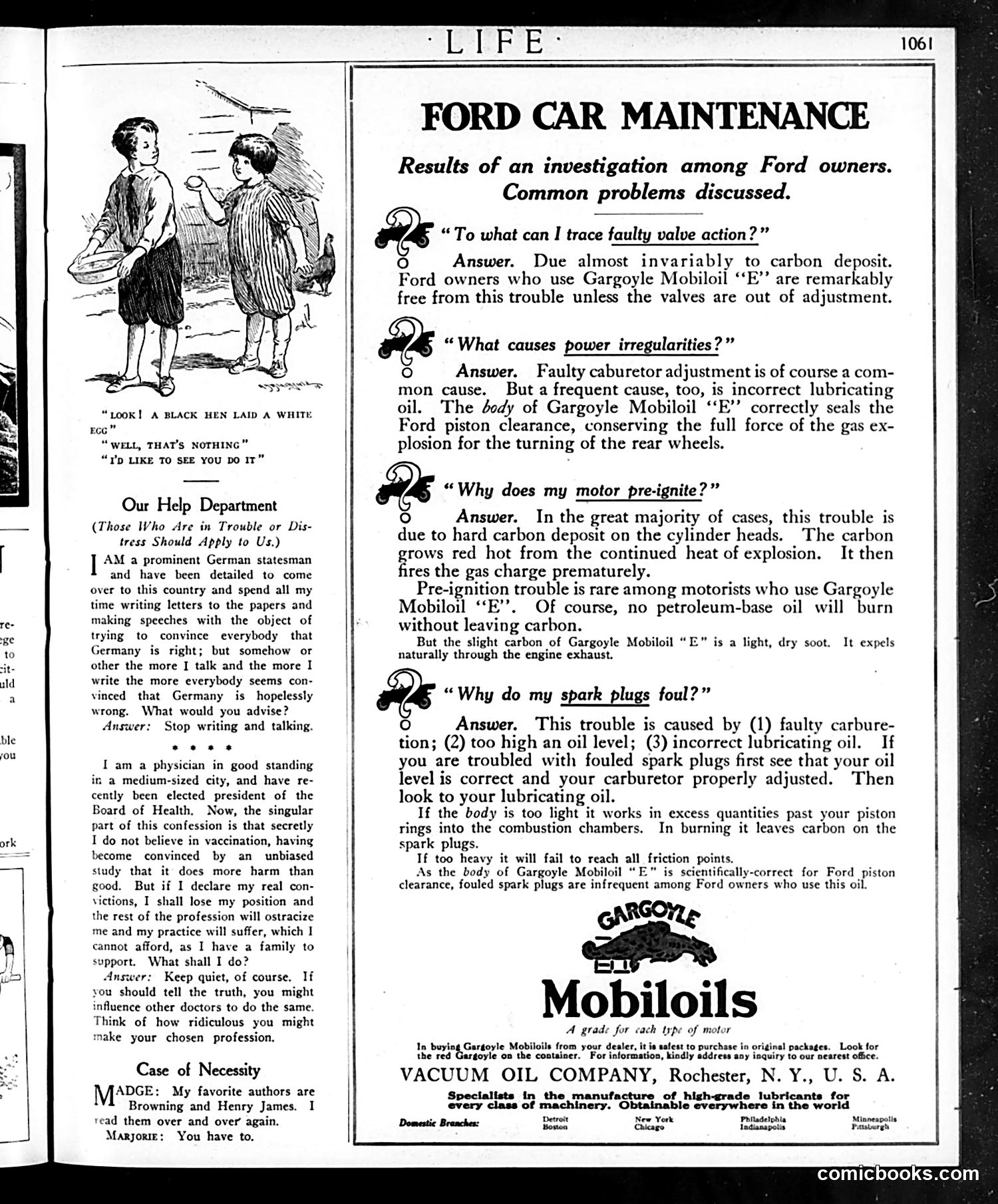
The cartoon at top-left presents a simple joke: a child reports a black hen laid a white egg; the other child asks the first to repeat the trick. It's satirizing the absurdity of demanding the impossible—a gentle, family-oriented humor typical of early 20th-century magazines. The "Help Department" section is Life's signature satirical advice column. Key entries include: 1. **A German statesman's problem**: Dark commentary on World War I-era German propaganda efforts in America. The advice—"stop writing and talking"—mocks Germany's failing public relations campaign. 2. **The doctor's vaccination dilemma**: Critique of professional cowardice. The sarcastic "answer" exposes how institutions suppress truth to maintain reputation. 3. **Madge's literary preference**: A brief joke about rereading boring authors. The remainder is a full-page **Gargoyle Mobiloils advertisement**, disguised as Ford maintenance advice. This hybrid advertisement-editorial format was common in Life, blending commercial content with editorial voice for credibility.
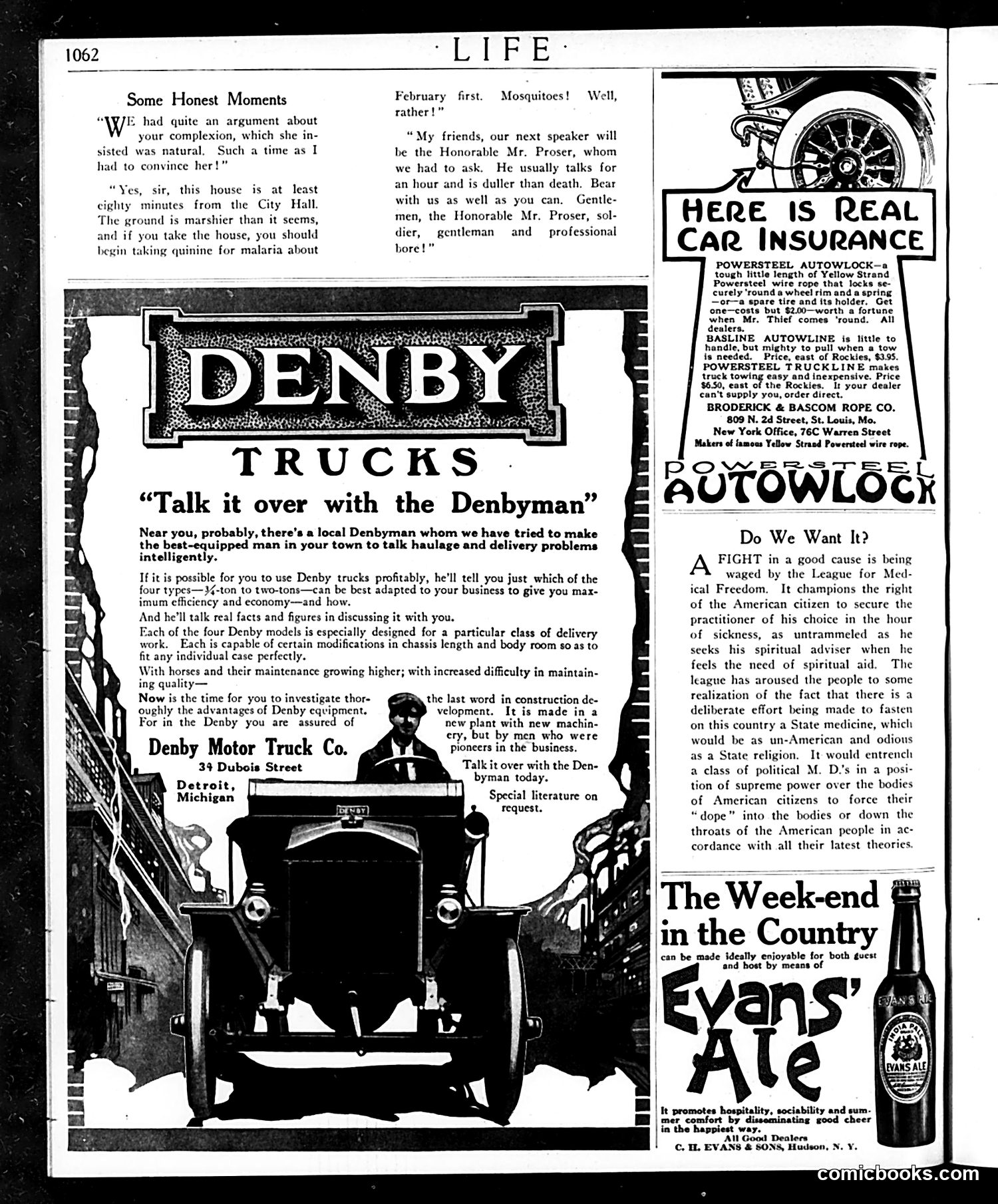
This page is primarily **advertising**, with brief humorous editorial content. The "Some Honest Moments" column presents short satirical dialogues mocking social pretense—a man defending his complexion as natural, someone warning about malaria near City Hall, and introducing a tedious speaker ("duller than death"). These are lightweight social observations typical of Life's era. The major content is a **Denby Trucks advertisement** featuring the slogan "Talk it over with the Denbyman," positioning local truck salesmen as knowledgeable business advisors. The right column contains ads for automotive safety products (Powersteel Autolock, rope products) and an editorial titled "Do We Want It?" opposing state-mandated medicine, framing it as un-American and threatening individual choice—reflecting 1920s libertarian skepticism toward government healthcare. It also promotes Evans' Ale. The page reflects period concerns: commercial truck adoption, medical freedom debates, and leisure consumption (country weekends).
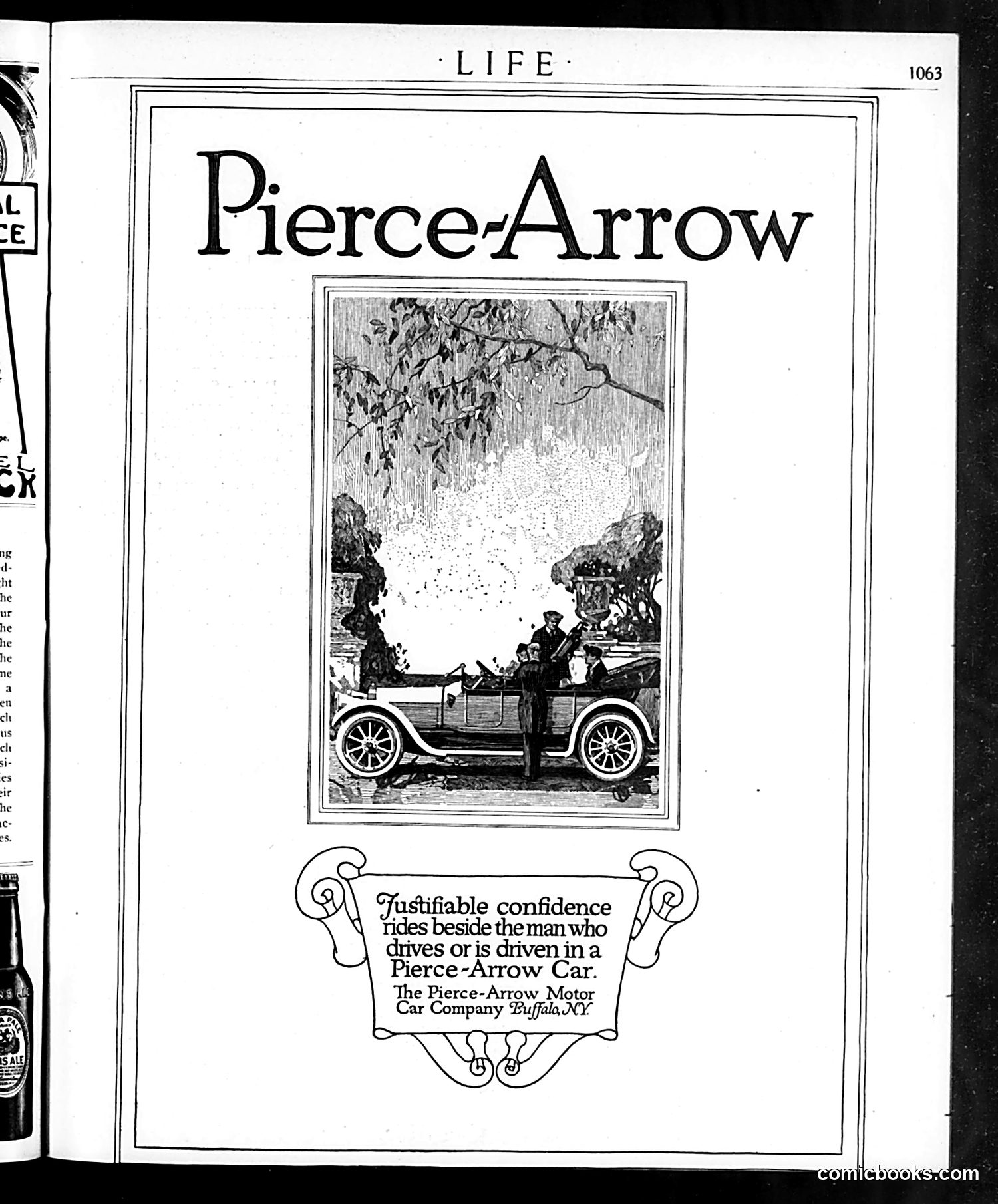
This is a full-page advertisement for Pierce-Arrow automobiles from Life magazine. The headline claims "Justifiable confidence rides beside the man who drives or is driven in a Pierce-Arrow Car." The illustration shows a well-dressed couple in an open-air Pierce-Arrow vehicle, parked in what appears to be an elegant public space with ornamental urns and willow trees. The image emphasizes luxury and social status—the car and its occupants project refinement and trustworthiness. This is straightforward advertising rather than satire or political commentary. It appeals to early automotive consumers' desires for prestige and reliability, positioning Pierce-Arrow (manufactured in Buffalo, NY) as a status symbol associated with "justifiable confidence" in both the vehicle's quality and the owner's social standing.
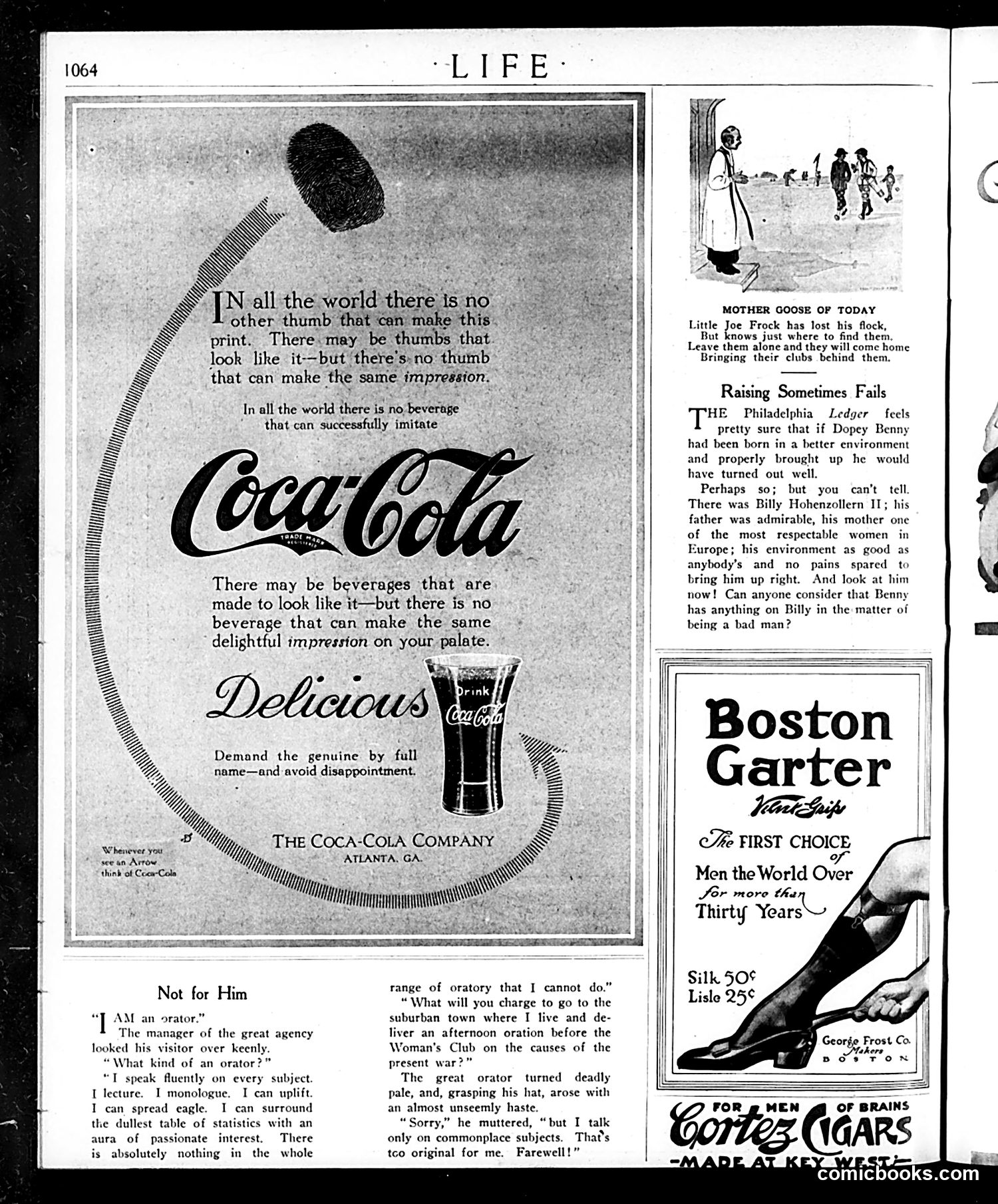
This page contains three distinct pieces: **Coca-Cola Advertisement** (left): A full-page ad emphasizing Coca-Cola's uniqueness and inimitability—no competitor can replicate its "impression" or taste. The thumbprint imagery suggests authenticity and singularity. **"Mother Goose of Today"** (top right): A satirical poem about "Little Joe Frock" and his "flock," with clubs "behind them." This appears to reference organized labor or union activities ("clubs"), playing on the nursery rhyme format for social commentary about contemporary movements. **"Raising Sometimes Fails"** (middle right): A comparison between "Dopey Benny" (appears to reference a criminal or public figure) and "Billy Hohenzollern II" (Kaiser Wilhelm II of Germany). The satire argues that good upbringing cannot prevent someone from becoming a "bad man"—a pointed critique suggesting heredity or character trumps environment, using the German Kaiser as proof of this maxim. **"Not for Him"** (bottom): A brief comic about an orator who refuses to speak on the causes of "the present war"—likely World War I. He claims he only discusses "commonplace subjects," satirizing speakers who avoid controversial contemporary topics.
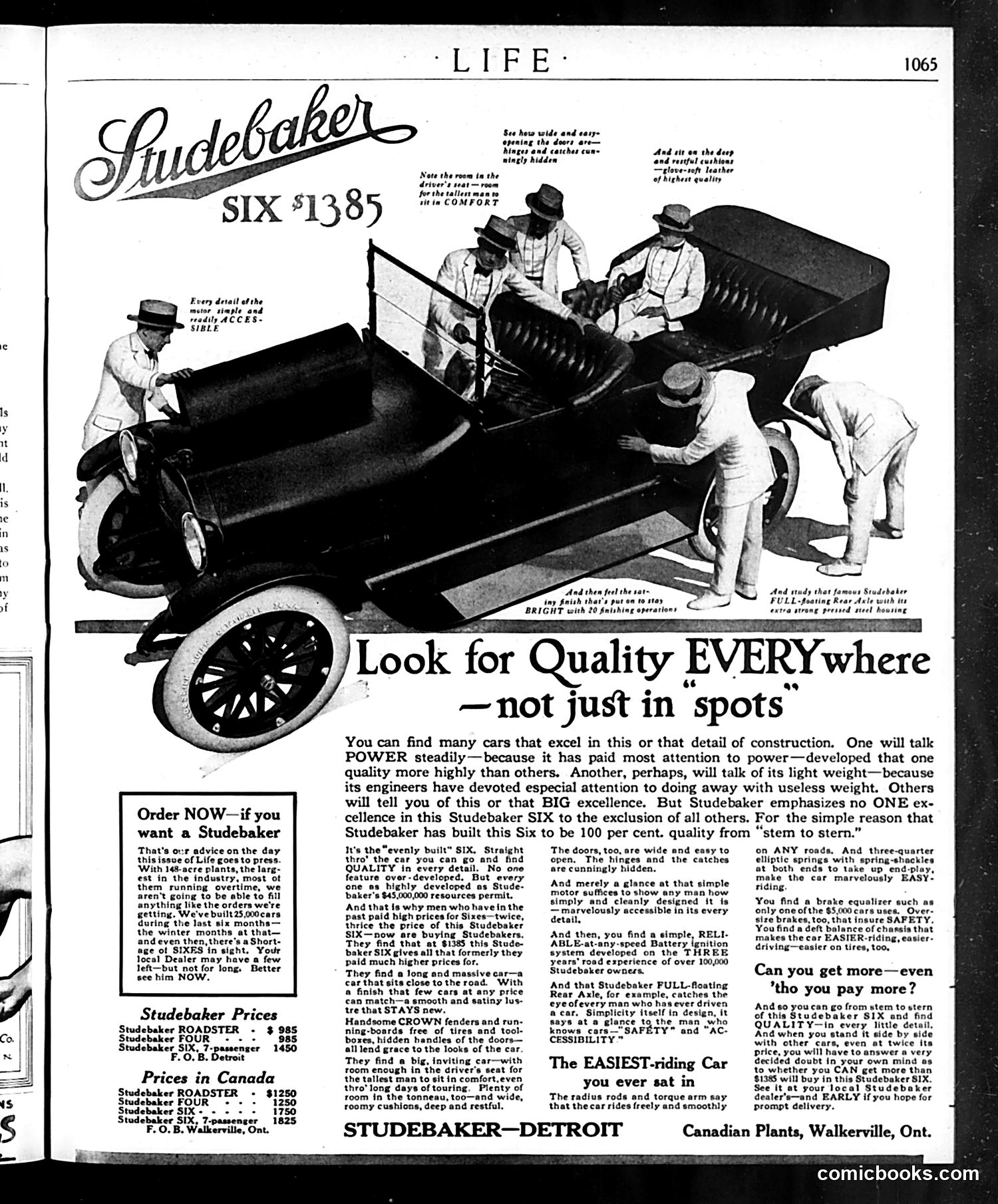
This is a Studebaker automobile advertisement disguised as editorial content. The image shows mechanics and salesmen inspecting a Studebaker Six automobile, presenting it as a thoroughly quality-built vehicle. The advertisement's central claim—"Look for Quality EVERYWHERE—not just in 'spots'"—responds to competitor advertising of the era, which typically highlighted one exceptional feature. Studebaker counters that its Six is comprehensively well-made across all components: engine, brakes, suspension, body, doors, and electrical systems. The context: Post-World War I Americans were buying cars eagerly, and manufacturers competed aggressively on value. At $1,385, the Six undercuts competitors charging significantly more for comparable quality. The ad emphasizes Studebaker's manufacturing capacity ("148-acre plants") and production volume (25,000 cars in six months) to suggest both efficiency and reliability. The "order NOW" box conveys artificial scarcity to motivate immediate purchase—a marketing tactic as old as advertising itself.
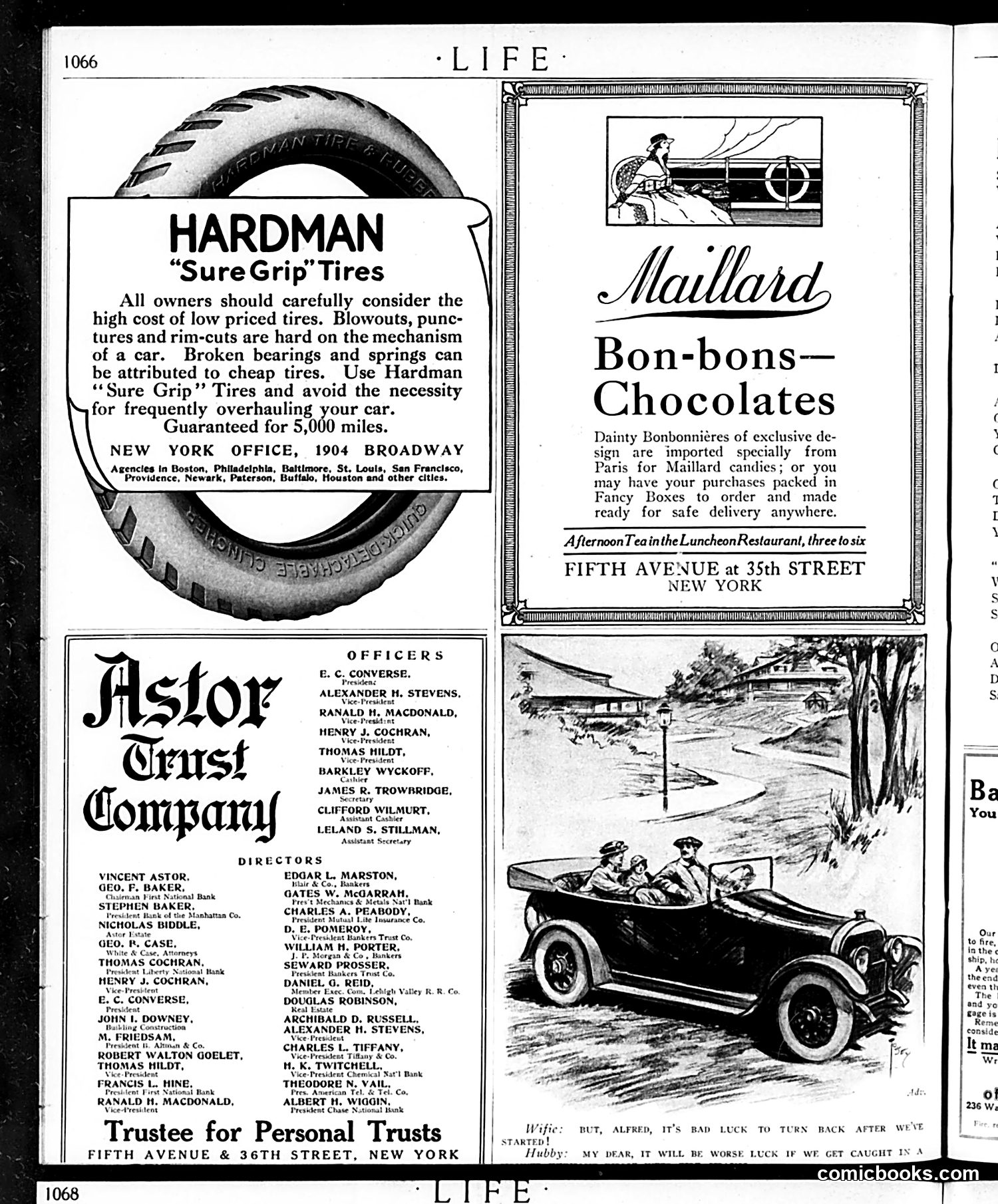
This page is primarily advertising and corporate information, not political satire. The content includes: **Advertisements:** Hardman "Sure Grip" tires (emphasizing durability over cheap alternatives), Maillard chocolates (imported French bonbons), and what appears to be an Astor Trust Company corporate listing. **The only cartoon** shows a couple in an early automobile, with dialogue: "Wife: BUT, ALFRED, IT'S BAD LUCK TO TURN BACK AFTER WE'VE STARTED. Hubby: MY DEAR, IT WILL BE WORSE LUCK IF WE GET CAUGHT IN A—" (text cuts off). This appears to be a domestic humor joke about superstition versus practical concerns during a car ride, likely referencing getting caught in bad weather or traffic. The page is essentially a period advertisement section with one modest comic strip segment, not satirical commentary.
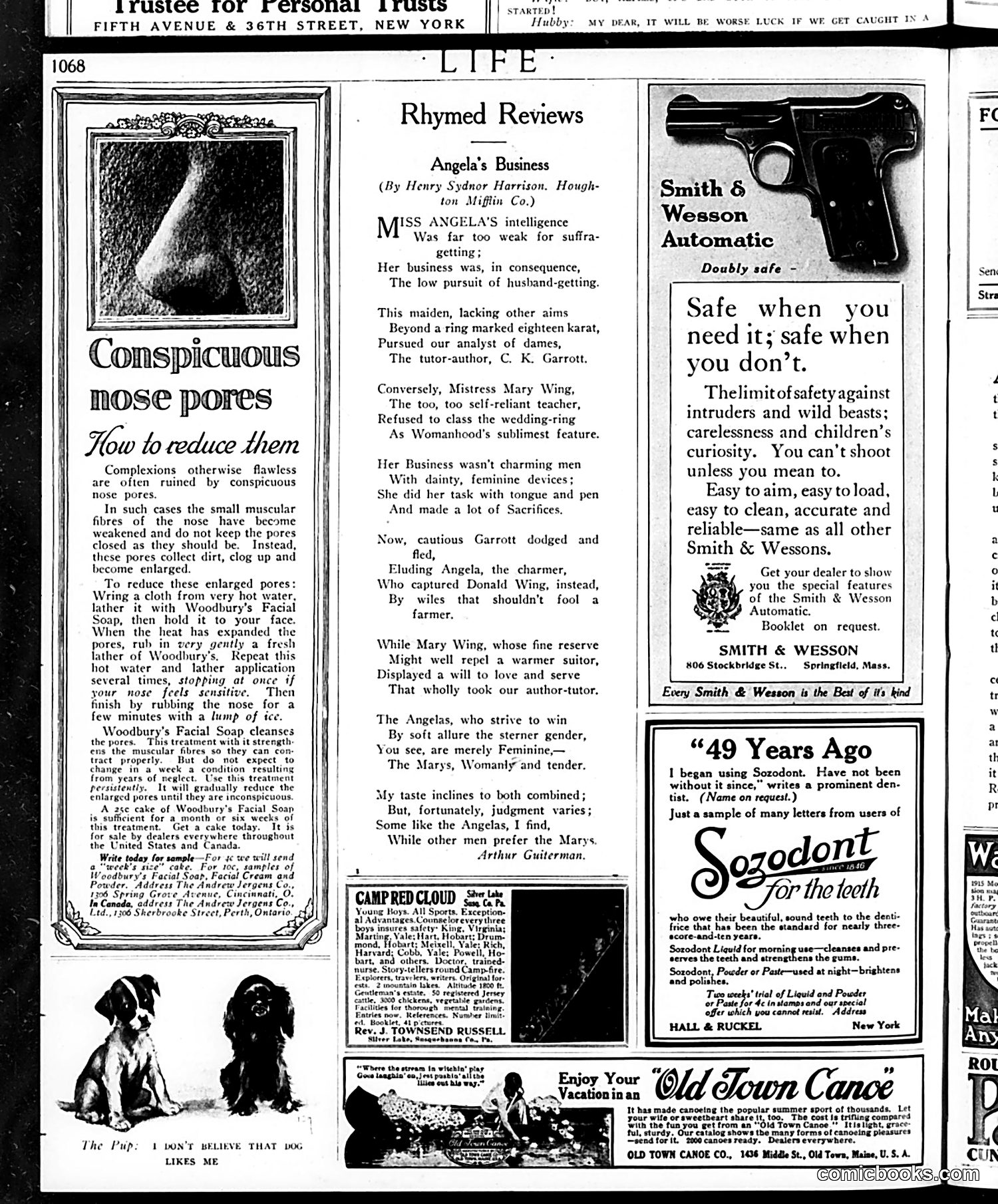
This page is primarily **advertising and literary content** rather than political satire. **Main Contents:** 1. **"Conspicuous Nose Pores"** advertisement for Woodbury's Facial Soap—a beauty product pitch with detailed instructions for reducing enlarged pores. 2. **"Rhymed Reviews"** by Arthur Guiterman reviewing Henry Sydnor Harrison's novel *Angela's Business*. The poem contrasts two female types: Angela (pursuing marriage through charm and physical allure) versus Mary Wing (self-reliant, intellectual). Guiterman playfully suggests both approaches have merit, though he prefers a combination. 3. **Product advertisements** for Smith & Wesson revolvers and Sozodont toothpaste. 4. **A cartoon** at bottom left showing a man and woman with a dog, captioned "I Don't Believe That Dog Likes Me," appearing to be a domestic humor sketch. The page reflects early 20th-century gender attitudes—contrasting "feminine" woman-chasing with "womanly" self-sufficiency—but contains no overt political satire.
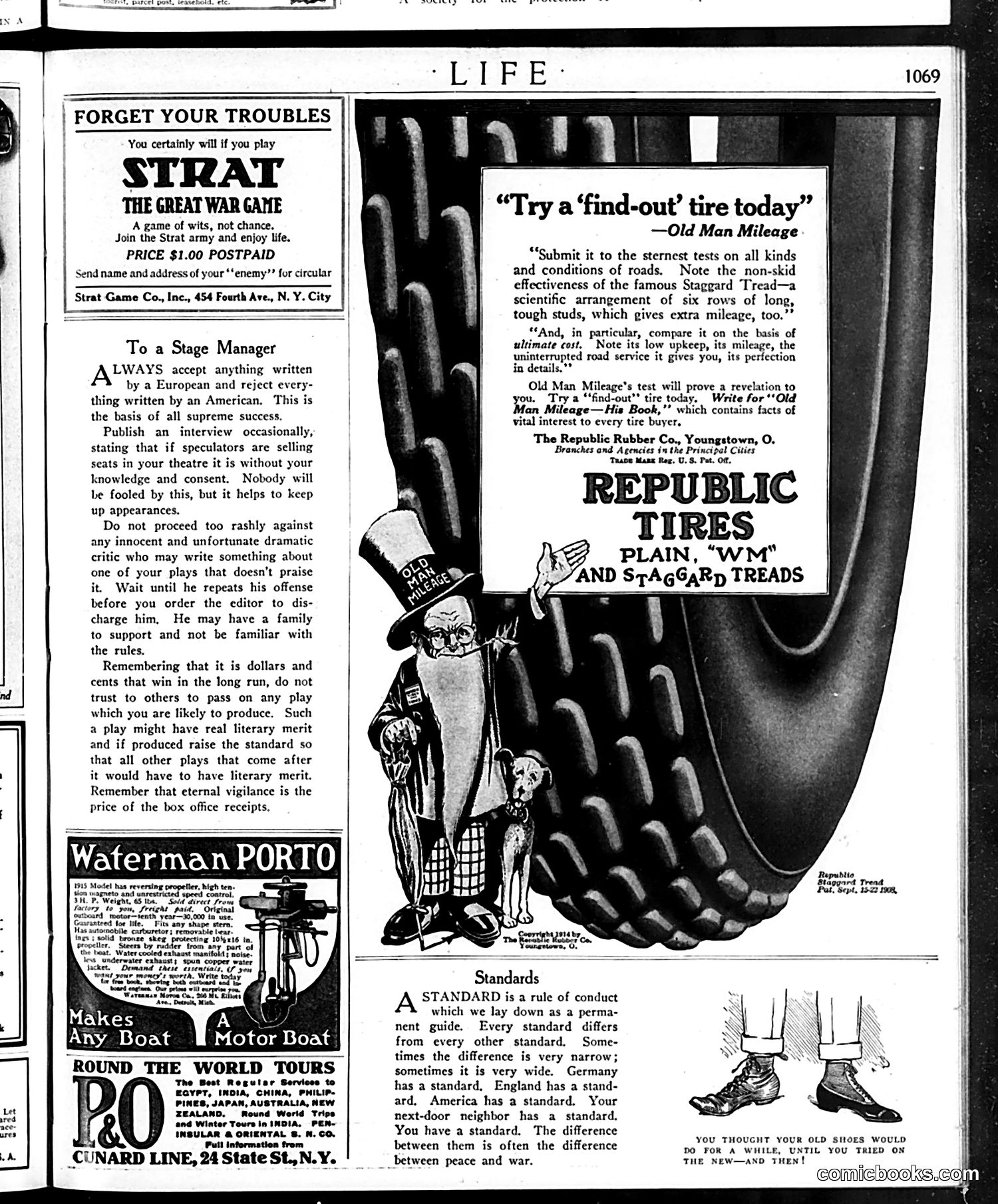
This is primarily an **advertising page** with minimal editorial content. The main elements are: **Advertisements:** - *Strat* board game ("The Great War Game")—a war-themed game capitalizing on WWI interest - *Republic Tires* featuring "Old Man Mileage," a folksy character endorsing tire durability - *Waterman Porto* pen for motorboats - *P&O Cunard Line* world cruise tours - Shoe advertisement (bottom right) **Editorial Content:** A brief satirical advice column "To a Stage Manager" mocking theatrical producers. It sarcastically recommends accepting European plays over American ones, manipulating critics, and prioritizing profit over artistic merit—critiquing what the author saw as theater industry corruption. **The "Standards" Essay:** A short philosophical piece observing that different nations and individuals have different moral/conduct standards, and these differences sometimes cause conflict. **Context for modern readers:** The page reflects 1910s-20s consumer culture, wartime entertainment, and theater industry practices of that era.
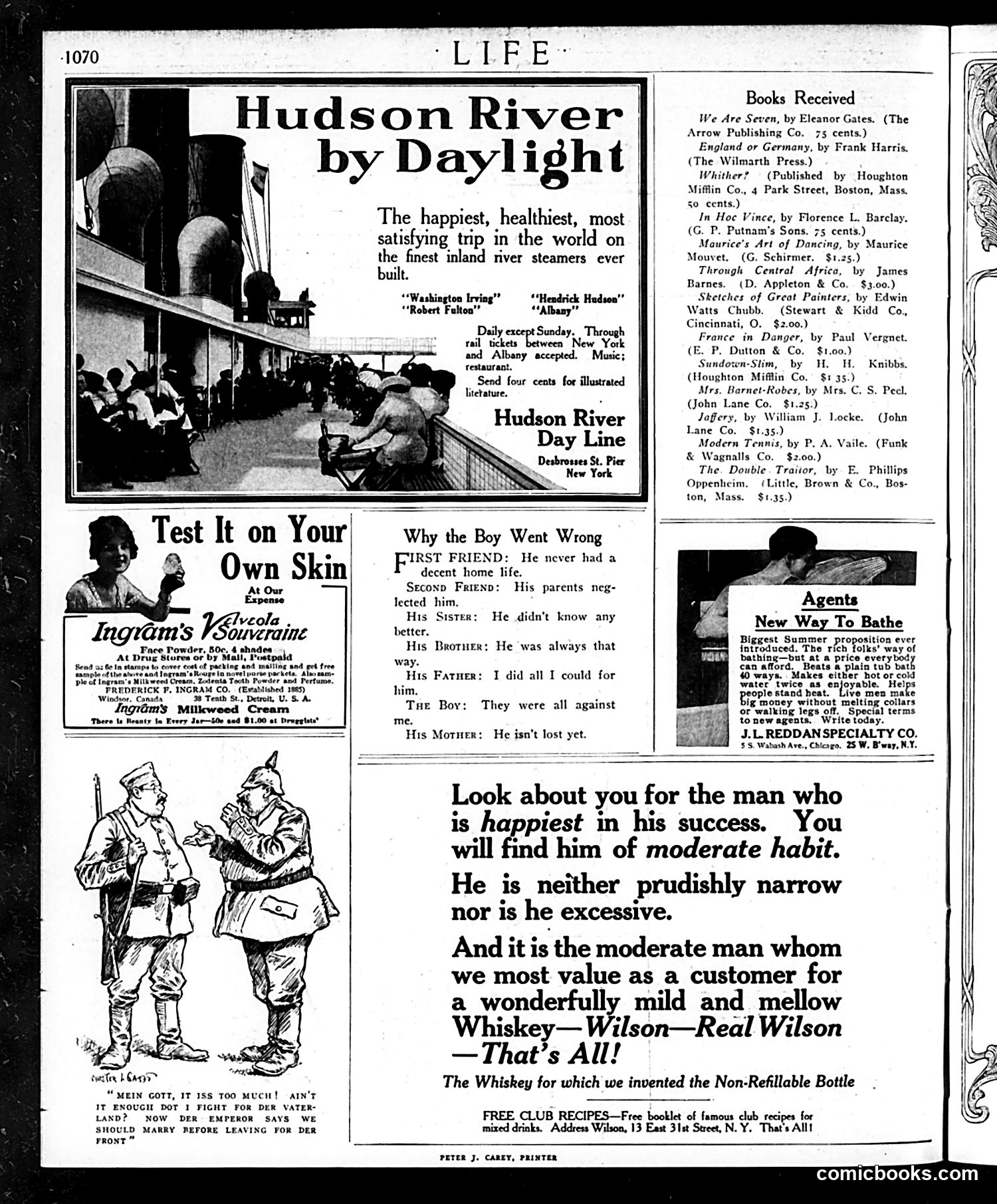
This page is primarily **advertising and book reviews**, with one notable political cartoon. The main cartoon (bottom left) depicts two German military officers in conversation. One says: "Mein Gott, it iss too much! Ain't it enough dot I fight for my emperor, now he says we should marry before leaving for der front." **Context**: This references World War I (likely 1914-1918), mocking German military culture and duty. The exaggerated accent and the absurdity of the Emperor mandating marriage as a wartime requirement satirize German authoritarianism and militarism. The joke targets the extreme obedience expected in the German military hierarchy. The remainder of the page consists of: - **Hudson River Day Line advertisement** (top) - **Ingram's beauty product ads** - **Wilson Whiskey advertisement** promoting "moderate habit" and the "Non-Refillable Bottle" - **Books Received section** listing contemporary publications - **Agentes bathing product ad** The page reflects early 20th-century advertising alongside wartime political commentary.
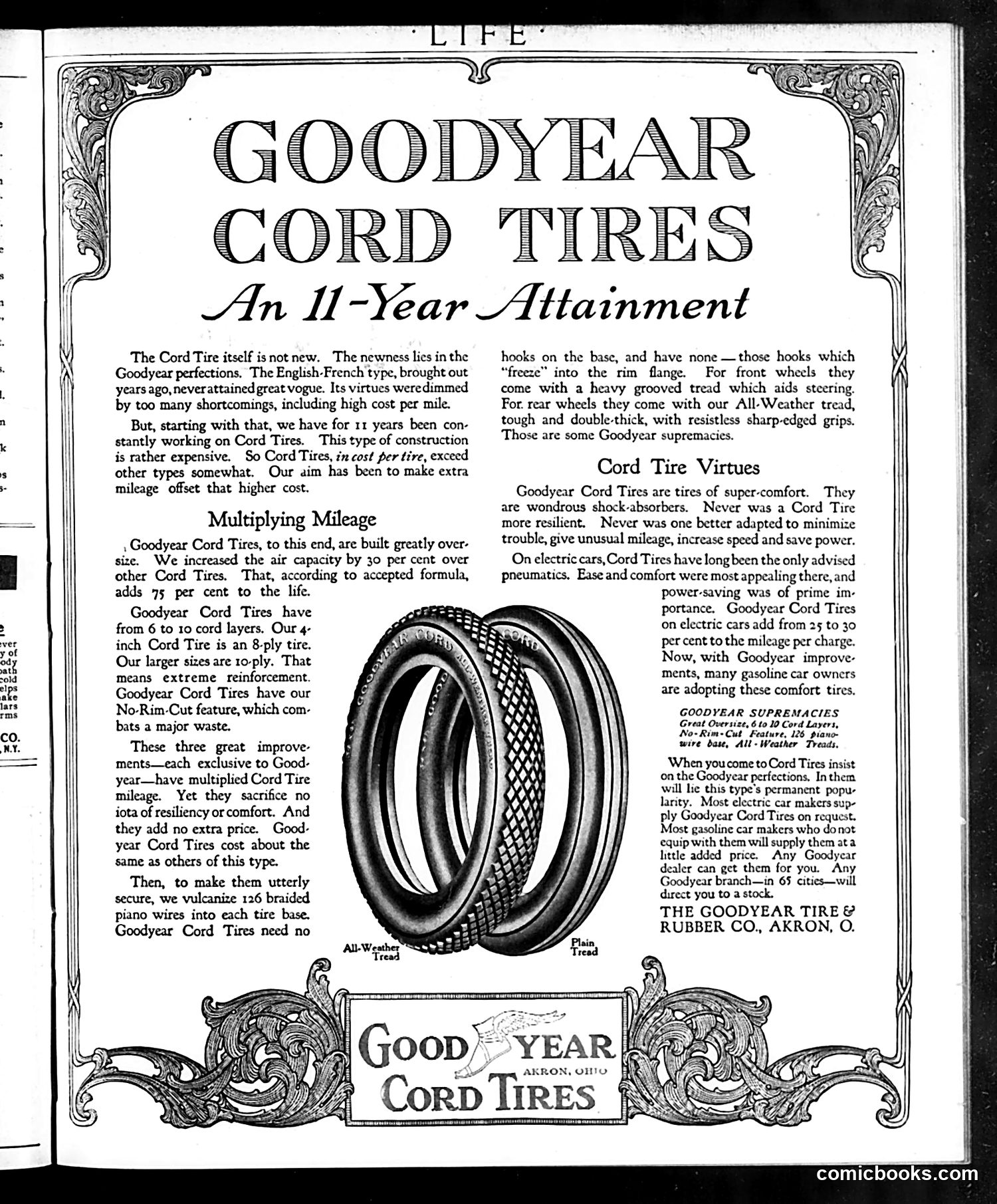
This is a **full-page advertisement**, not a political cartoon or satire. It promotes Goodyear's cord tire technology, marketed as an "11-Year Attainment"—representing over a decade of development refinement. The ad emphasizes technical superiority: cord tires use multiple layers (6-10 cord layers, up to 8-ply construction), increased air capacity, and 126 braided piano wires for reinforcement. These features allegedly increase tire lifespan by 75% while maintaining comfort and shock absorption. Notable selling points include special appeal to **electric car owners** (gaining 25-30% more mileage per charge) and advantages over earlier cord tire designs. The ad addresses cost concerns—while cord tires cost more initially, promised durability justifies the higher price. The centered tire illustration and ornate border reflect the magazine's early-20th-century design aesthetic. This is straightforward product marketing, not editorial commentary.
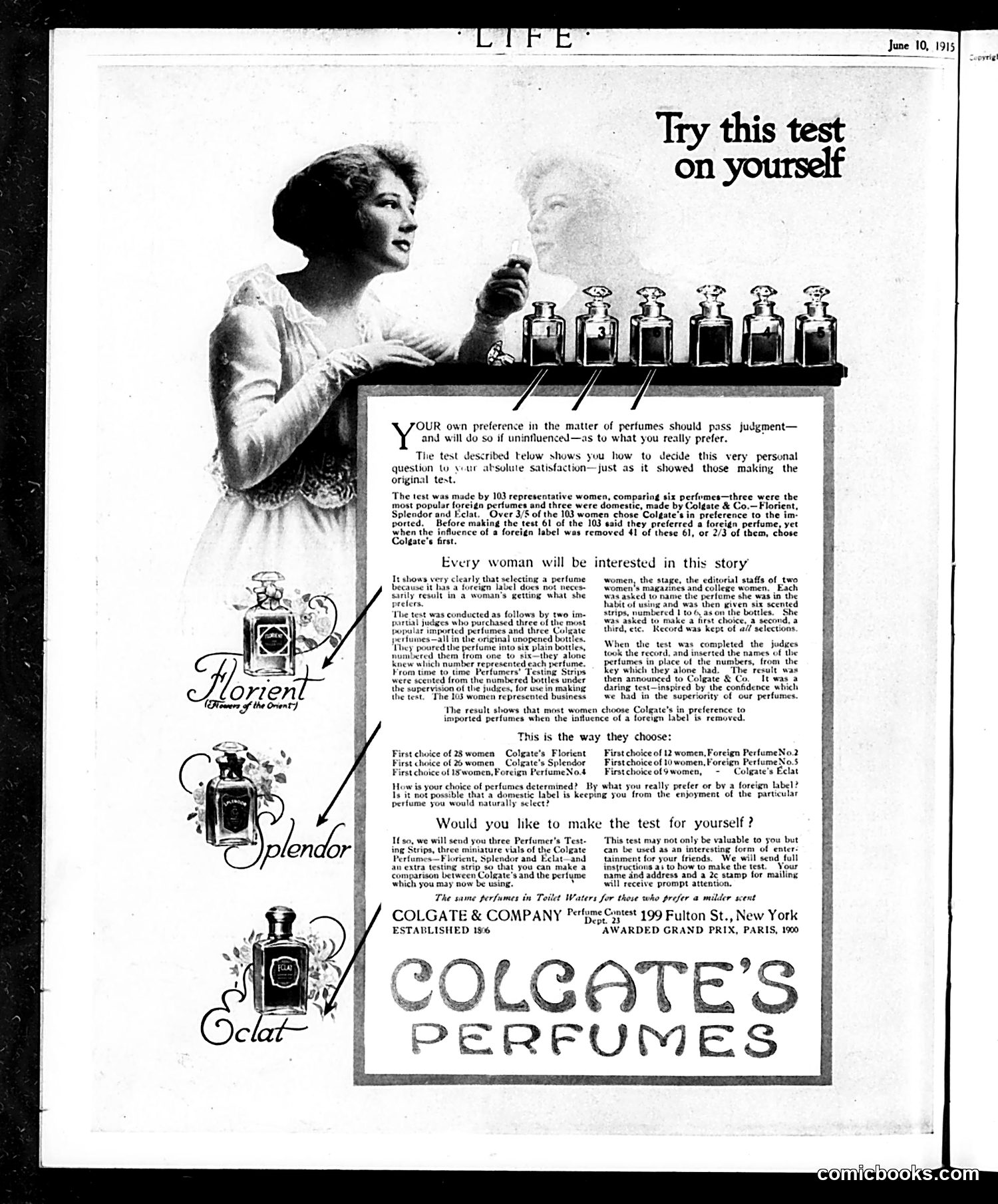
This page is primarily a **perfume advertisement**, not a political cartoon. However, it contains an implicit social satire about consumer psychology and nationalism. The ad describes a test where 103 women compared three Colgate domestic perfumes against three imported French ones—blindly, without labels. The results showed that despite 61 women claiming to prefer foreign perfumes initially, two-thirds switched to Colgate's when brand identity was hidden. **The satire:** The ad mocks consumer preference based on prestige rather than actual quality. It exposes how the "foreign label" influences judgment—a critique of American consumers' blind trust in European superiority. By removing the influence of brand mystique, Colgate demonstrates that domestic American products could match or exceed imported ones. This reflects early 20th-century anxieties about American manufacturing competitiveness and consumer susceptibility to marketing psychology—a surprisingly modern advertising critique for 1915.