
Life, 1915-06-10 · page 22 of 48
Life — June 10, 1915 — page 22: what you’re looking at
What you’re looking at
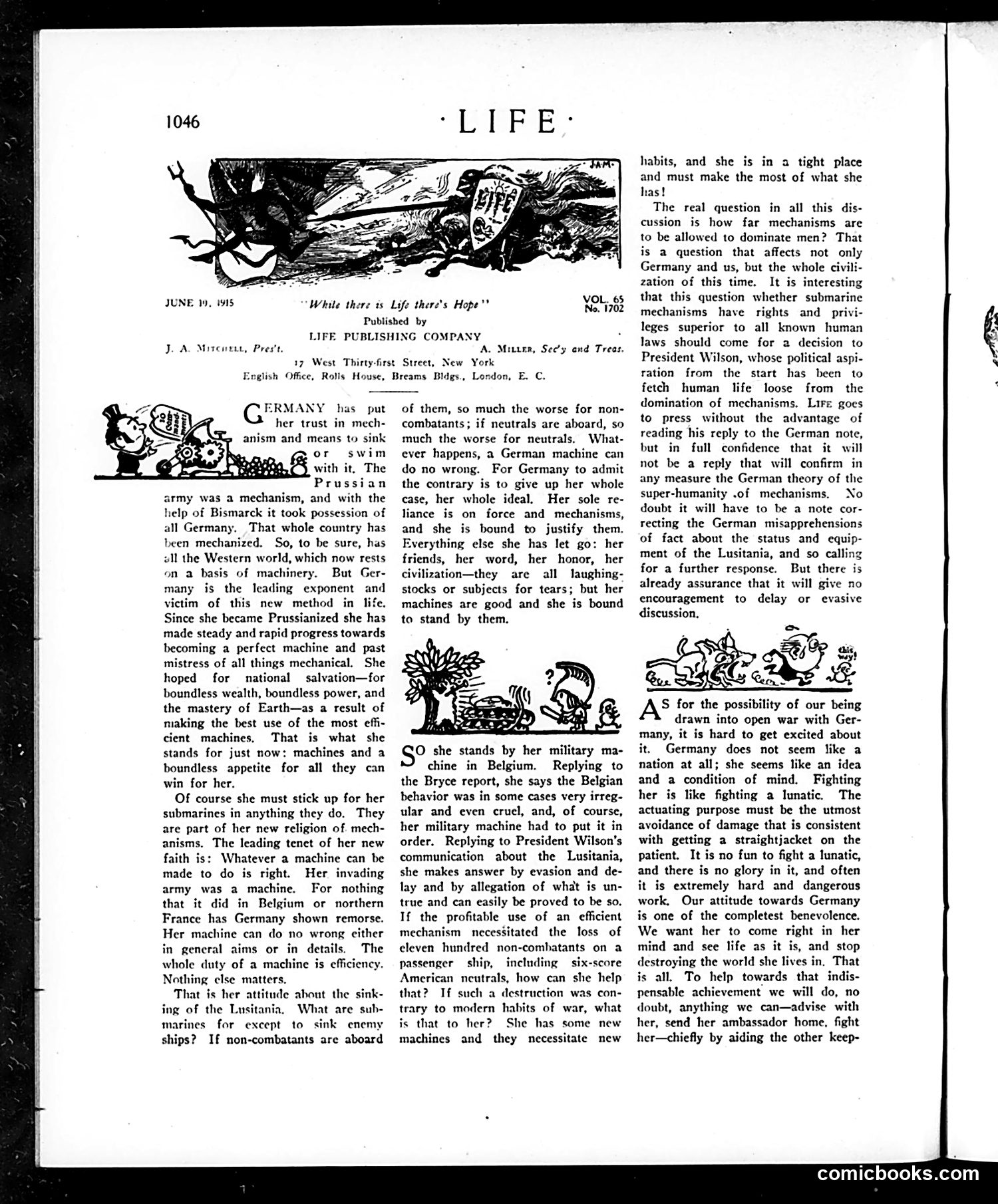
This editorial cartoon and accompanying text satirize Germany's justification for unrestricted submarine warfare, particularly the sinking of the Lusitania (May 1915, which killed American civilians). The cartoon depicts **Death personified**, likely representing the consequences of mechanized warfare. The text argues that Germany has become enslaved to "mechanism"—military machines—to the point where efficiency justifies any atrocity. Germany claims submarines merely fulfill their function; sinking civilian ships is acceptable because machines serve no moral purpose beyond efficiency. The author mocks this logic: if the mechanism "necessitated" killing 1,100 non-combatants (including American neutrals), Germany accepts this as inevitable. The satire highlights the tragic irony that President Wilson—philosophically opposed to machines dominating human life—must now decide whether international law supersedes German mechanical "necessity." The piece condemns Germany's abandonment of honor, civilization, and human values in favor of pure mechanistic morality.
📄 Transcribed text from this page (OCR, searchable)
Machine-transcribed from the original scan — historical spelling and the odd misread are preserved.
JUNE 19, W915, While there is Life there's Hope" Published by LIFE J. A. Mircunat, Pres't, PUBLISHING COMPANY A. Mitinr, Sec’y and Treas. 17 West Thirty-first Street, New York English Office, Rolls House, Breams Bldgs., London, E. C. MANY has put her trust in mech- anism and means to sink or swim with it, The Prussian army was a mechanism, and with the help of Bismarck it took possession of all Germany. That whole country has been mechanized. So, to be sure, has wll the Western world, which now rests on a basis of machinery. But Ger- many is the leading exponent and victim of this new method in life. Since she became Prussianized she has made steady and rapid progress towards becoming a perfect machine and past mistress of all things mechanical. She hoped for national salvation—for boundless wealth, boundless power, and the mastery of Earth—as a result of niaking the best use of the most effi- cient machines, That is what she stands for just now: machines and a boundless appetite for all they can win for her. Of course she must stick up for her submarines in anything they do. They are part of her new religion of. mech- anisms. The leading tenet of her new faith is: Whatever a machine can be made to do is right. Her invading army was a machine. For nothing that it did in Belgium or northern France has Germany shown remorse. Her machine can do no wrong either in general aims or in details. The whole duty of a machine is efficiency. Nothing clse matters. That is her attitude about the sink- ing of the Lus What are sub- marines for except to sink enemy ships? If non-combatants are aboard of them, so much the worse for non- combatants; if neutrals are aboard, so much the worse for neutrals, What- ever happens, a German machine can do no wrong. For Germany to admit the contrary is to give up her whole case, her whole ideal, Her sole re- liance is on force and mechanisms, and she is bound to justify them. Everything else she has let go: her friends, her word, her honor, her civilization—they are all laughing- stocks or subjects for tears; but her machines are good and she is bound to stand by them. O she stands by her military ma- chine in Belgium. Replying to the Bryce report, she says the Belgian behavior was in some cases very irreg- ular and even cruel, and, of course, her military machine had to put it in order. Replying to President Wilson's communication about the Lusitania, she makes answer by evasion and de- lay and by allegation of what is un- true and can easily be proved to be so. If the profitable use of an efficient mechanism necessitated the loss of eleven hundred non-combatants on a passenger ship, including six-score American neutrals, how can she help that? If such a destruction was con- trary to modern habits of war, what is that to her? She has some new machines and they necessitate new habits, and she is in a tight place and must make the most of what she has! The real question in all this dis- cussion is how far mechanisms are to be allowed to dominate men? That is a question that affects not only Germany and us, but the whole civili- zation of this time. It is interesting that this question whether submarine mechanisms have rights and_privi- leges superior to all known human laws should come for a decision to President Wilson, whose political aspi- ration from the start has been to fetch human life loose from the domination of mechanisms. Lire gocs to press without the advantage of reading his reply to the German note, but in full confidence that it will not be a reply that will confirm in any measure the German theory of the super-humanity .of mechanisms. No doubt it will have to be a note cor- recting the German misapprehensions of fact about the status and equip- ment of the Lusitania, and so calling for a further response. But there is already assurance that it will give no encouragement to delay or evasive discussion, AS for the possibility of our being drawn into open war with Ger- many, it is hard to get excited about it. Germany does not seem like a nation at all; she seems like an idea and a condition of mind. Fighting her is like fighting a lunatic. The actuating purpose must be the utmost avoidance of damage that is consistent with getting a straightjacket on the patient. It is no fun to fight a lunatic, and there is no glory in it, and often it is extremely hard and dangerous work, Our attitude towards Germany is one of the completest benevolence. We want her to come right in her mind and see life as it is, and stop destroying the world she lives in, That is all. To help towards that indis- pensable achievement we will do, no doubt, anything we can—advise with her, send her ambassador home, fight her—chiefly by aiding the other keep- comicbooks.com