
Life, 1915-06-10 · page 18 of 48
Life — June 10, 1915 — page 18: what you’re looking at
What you’re looking at
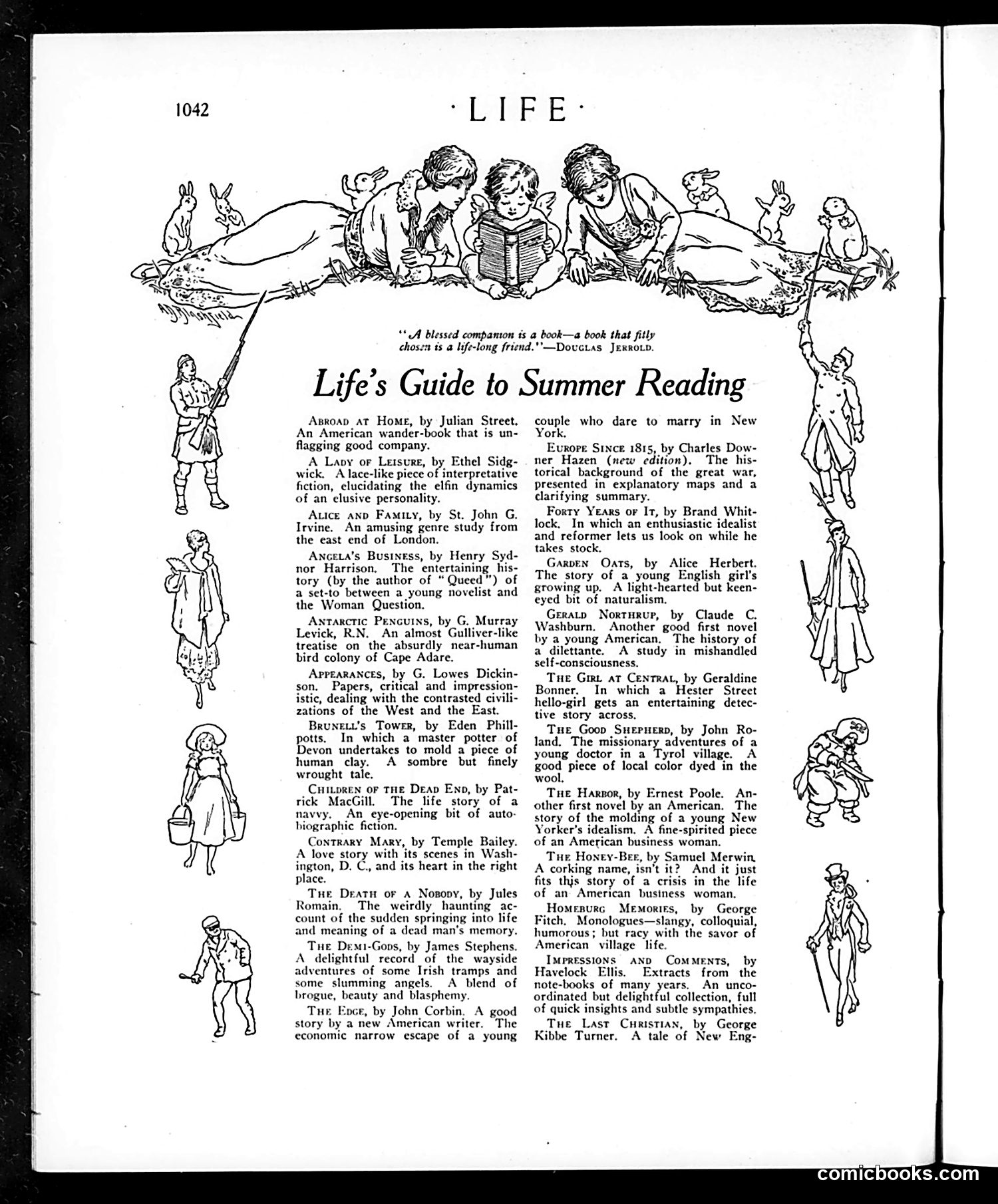
This is a **book recommendation list**, not a political cartoon. The page presents approximately 25 summer reading suggestions from Life magazine, with decorative illustrations of figures reading and children playing along the margins. The recommendations range across genres—romance (*Contrary Mary*), adventure (*Antarctic Penguins*), social commentary (*Children of the Dead End*), and historical analysis (*Europe Since 1815*). Several are explicitly identified as "first novels by American" authors, reflecting early 20th-century literary culture. The epigraph attributes a quote to "Douglas Jerrold" about books as lifelong companions, framing reading as serious intellectual companionship. The ornamental border illustrations suggest summer leisure activities—appropriate for the season's reading guide. This is primarily **editorial content promoting contemporary literature** rather than satire or political commentary.
📄 Transcribed text from this page (OCR, searchable)
Machine-transcribed from the original scan — historical spelling and the odd misread are preserved.
“A blessed companion is a book—a book that fitly chosen is a life-long friend.""—Dovetas. Jexnor. Life’s Guide to Summer Reading Asroap at Home, by Julian Street. An American wander-book that is un- flagging good company. A Lavy or Letsure, by Ethel Sidg- wick. A lace-like piece of interpretative fiction, elucidating the elfin dynamics of an’elusive personality. Atice ano Famity, by St. John G. Irvine. An amusing genre study from the east end of London. Anceta’s Busis » by Henry Syd- nor Harrison. The entertaining his- tory (by the author of “Queed”) of a set-to between a young novelist and the Woman Question. Antarctic Pencuins, by G. Murray Levick, RN. An almost Gulliver-like treatise on the absurdly near-human bird colony of Cape Adare. Appearances, by G. Lowes Dickin- son. Papers, critical and impression- istic, dealing with the contrasted civili- zations of the West and the East. Brunett’s Tower, by Eden Phill- potts. In which a master potter of Devon undertakes to mold a piece of human clay. A sombre but finely wrought tale. Cuitpren or THE Deap Enp, by Pat- rick MacGill. The life story of a navvy, An eye-opening bit of auto- biographic fiction. Contrary Mary, by Temple Bailey. A love story with its scenes in Wash- ington, D. C., and its heart in the right place. Tue Deatn oF A Nonopy, by Jules Romain, The weirdly haunting ac- count of the sudden springing into life and meaning of a dead man’s memory. Tue Demi-Gons, by James Stephens. A. delightful record of the wayside adventures of some Irish tramps and some slumming angels. A blend of brogue, beauty and blasphemy. Tue Ence, by John Corbin, A good story by a new American writer. The economic narrow escape of a young couple who dare to marry in New York. Europe Since 1815, by Charles Dow- ner Hazen (new edition), The his- torical background of the great war, presented in explanatory maps and a darifying summary. Forty Years or It, by Brand Whit- lock. In which an enthusiastic idealist and reformer lets us look on while he takes stock. Garven Oats, by Alice Herbert. The story of a young English girl's growing up. A light-hearted but keen- eyed bit of naturalism. Grratp Norturur, by Claude C. Washburn, Another good first novel by a young American, The history of a dilettante. A study in mishandled self-consciousness. Tue Girt at Centrat, by Geraldine Bonner. In which a Hester Street hello-girl gets an entertaining detec- tive story across, Tue _Goop Suepuerp, by John Ro- land, The missionary adventures of a young doctor in a Tyrol village. A good piece of local color dyed in the wool, Tne Harnor, by Ernest Poole, An- other first novel by an American. The story of the molding of a young New Yorker’s idealism. A fine-spirited piece of an American business woman. Tue Honey-Bee, by Samuel Merwin, A corking name, isn’t it? And it just fits thjs story of a crisis in the life of an American business woman. Homenurc Memories, by George Fitch, Monologues—slangy, colloquial, humorous; but racy with the savor of American village life. IMpressIONS AND CoMMENTS, by Havelock Ellis. Extracts from the note-books of many pare An unco- ordinated but delightful collection, full of quick insights and subtle sympathies, Tue Last Curistian, by George Kibbe Turner. A tale of New Eng- comicbooks.com