
Life, 1915-06-10 · page 30 of 48
Life — June 10, 1915 — page 30: what you’re looking at
What you’re looking at
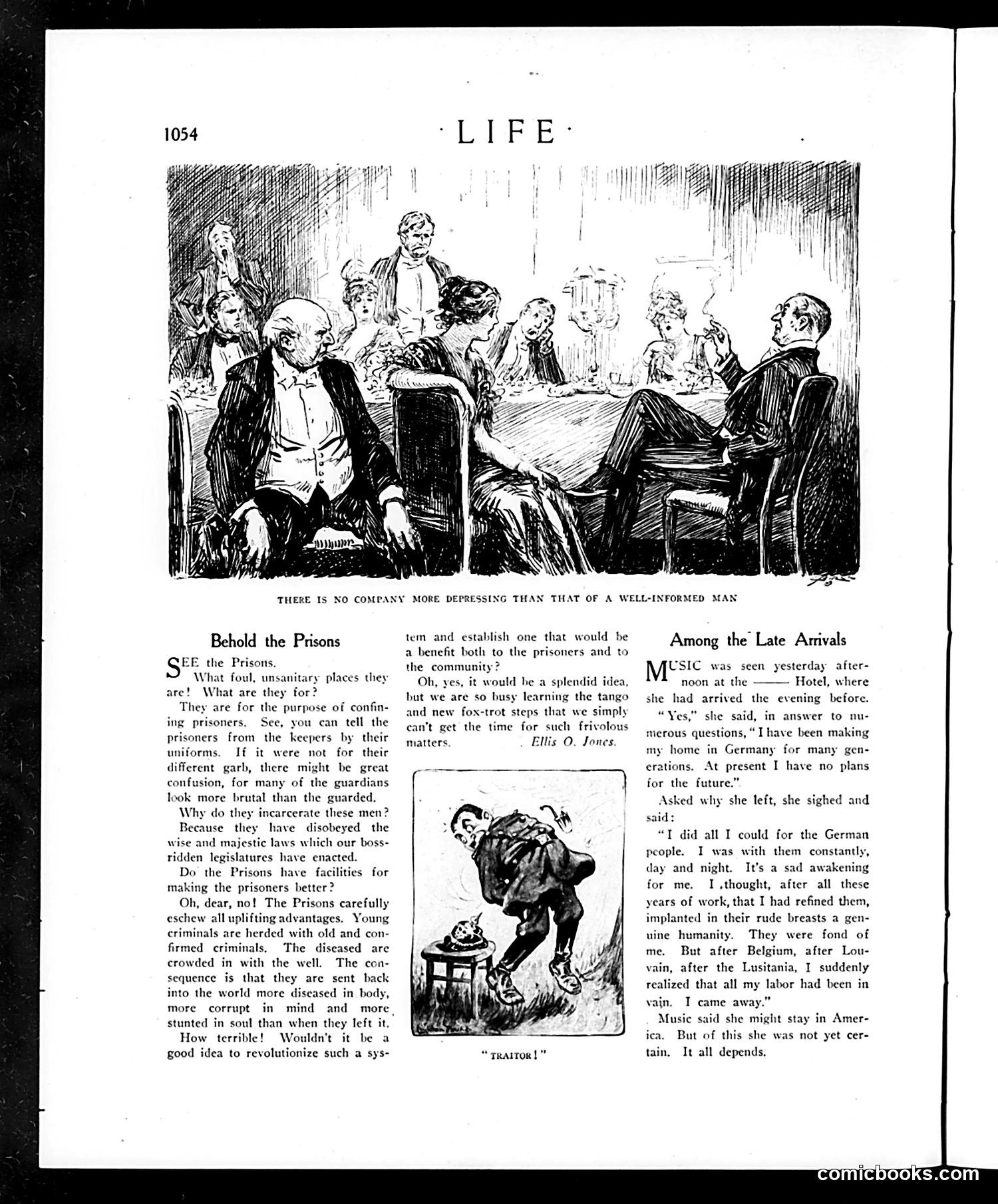
This 1915 *Life* magazine page contains two separate satirical pieces: **"Behold the Prisons"** critiques the American penal system as deliberately corrupting rather than rehabilitative. The author sarcastically notes prisons mix hardened criminals with first-time offenders and diseased with healthy inmates—intentionally worsening prisoners. The joke: Americans are too busy learning the tango to reform this system. The accompanying illustration labeled "TRAITOR!" depicts prisoner abuse. **"Among the Late Arrivals"** personifies "Music" as a German woman who emigrated to America, disillusioned after WWI. She claims she tried to civilize Germans through culture, but their conduct—Belgium's invasion, Louvain's destruction, the *Lusitania* sinking—proved hopeless. The satire mocks German claims of cultural superiority while indicting wartime atrocities. Music's uncertainty about staying reflects skepticism about German-American loyalty during the war. Both pieces critique institutional failure and enemy barbarism respectively.
📄 Transcribed text from this page (OCR, searchable)
Machine-transcribed from the original scan — historical spelling and the odd misread are preserved.
THERE IS NO COMPANY MORE DEPRESSING THAN THAT OF A WELL-INFORMED MAN Behold the Prisons EE the Prisons. What foul, unsanitary places they are! What are they for? They are for the purpose of confin- ing prisoners, See, you can tell the prisoners from the keepers by their uniforms. If it were not for their different garb, there might be great confusion, for many of the guardians look more brutal than the guarded. Why do they incarcerate these men? Because they have disobeyed the wise and majestic laws which our boss- ridden legislatures have enacted. Do the Prisons have facilities for making the prisoners better? Oh, dear, no! The Prisons carefully eschew all uplifting advantages. Young criminals are herded with old and con- firmed criminals, The diseased are crowded in with the well. The con- sequence is that they are sent back into the world more diseased in body, more corrupt in mind and stunted in soul than when they left it. How terrible! Wouldn't it be a good idea to revolutionize such a sys- more | tem and establish one that would be a benefit both to the prisoners and to the community? Oh, yes, it would he a splendid idea, but we are so busy learning the tango and new fox-trot steps that we simply can’t get the time for such frivolous matters. Ellis O. Jones. “TRAITOR 1" Among the Late Arrivals M SIC was seen yesterday after- noon at the Hotel, where she had arrived the evening before. “Yes,” she said, in answer to nu- merous questions, “Ihave been making my home in Germany for many gen- erations. At present I have no plans for the future.” Asked why she left, she sighed and said: “T did all I could for the German people. I was with them constantly, day and night. It’s a sad awakening for me. I .thought, after all these years of work, that I had refined them, implanted in their rude breasts a gen- uine humanity. They were fond of me. But after Belgium, after Lou- vain, after the Lusitania, I suddenly realized that all my labor had been in vain. T came away.” Music said she might stay in Amer- ica. But of this she was not yet cer- tain. It all depends,