
Life, 1915-06-10 · page 19 of 48
Life — June 10, 1915 — page 19: what you’re looking at
What you’re looking at
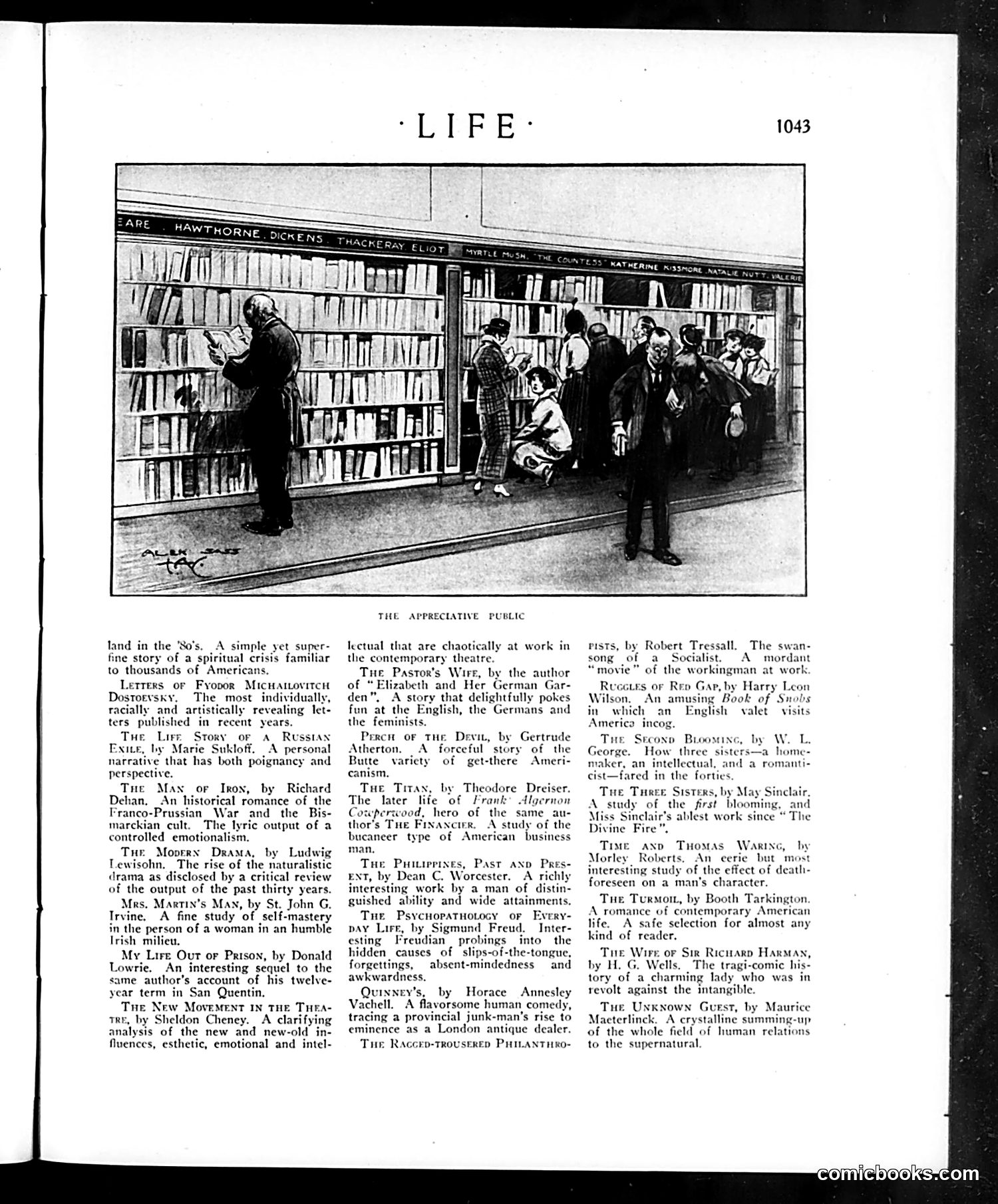
This page from *Life* magazine is primarily a **book review section**, not a political cartoon. The illustration at top shows a bookstore window display with customers browsing—a scene titled "The Appreciative Public." The satirical point appears gentle: the image depicts ordinary people (working-class and middle-class) examining serious literary works displayed in a shop window. The reviews below list intellectually demanding books—Dostoevsky's letters, Freud's psychology, Theodore Dreiser's naturalistic novels, and works on drama and philosophy. The humor likely lies in the **contrast between "appreciative public" and actual public taste**—suggesting that while these weighty, difficult works are on display, most people remain indifferent or confused by them. The window-shopping scene may gently mock both the pretensions of serious literature and the gap between high culture and popular interest.
📄 Transcribed text from this page (OCR, searchable)
Machine-transcribed from the original scan — historical spelling and the odd misread are preserved.
land in the ‘So's. fine story of a spiritual crisis familiar to thousands of Americans. Letrers or Fyonor Micuattovitcu Dostoevsky, The most individually racially and artistically revealing let- ters published in recent years. Tue Lire Story or a Russian Exite, by Marie Sukloff. A personal narrative that has both poignancy and perspective. Tne Manx or Trox, by Richard Dehan, An historical romance of the Franco-Prussian War and the Bis- marckian cult. The lyric output of a controlled emotionalism. Tur Mopern Drama, by Ludwig Lewisohn. The rise of the naturalistic drama as disclosed by a critical review of the output of the past thirty years. Mrs. Martin’s Man, by St. John G. Irvine, A fine study of self-mastery in the person of a woman in an humble Irish milieu. My Lire Out or Prison, by Donald Lowrie. An interesting sequel to the same author’s account of his twelve- year term in San Quentin. Tne New Movement In THE THEA- tre, by Sheldon Cheney. A clarifying analysis of the new and new-old in- Nuences, esthetic, emotional and intel- THE APPRECIATIVE PUBLIC lectual that are chaotically at work in the contemporary theatr Tue Pastor's Wire, by the author zabeth and Her German Gar- A story that delightfully pokes fun at the English, the Germans and the feminists. Percn or tHe Devit, by Gertrude Atherton, A forceful story of the Butte variety of get-there Ameri- canism. Tue Titax, by Theodore Dreiser. The later life of Frank’ Algernon Cowperwood, hero of the same_au- thor’s Tue Financier. A study of the bucaneer type of American business man, Tue Puiiprixes, Past axp Pres- ENT, by Dean C. Worcester. A richly interesting work by a man of distin- guished ability and wide attainments. Tue Psycnoratnotocy or Every- pay Lire, by Sigmund Freud. Inter- esting Freudian probings into the hidden causes of slips-of-the-tongue, forgettings, absent-mindedness and awkwardness Quiyney’s, by Horace Annesley Vachell. A flavorsome human comedy, tracing a provincial junk-man’s rise to eminence as a London antique dealer. Tur, Raccro-Trousexey PHIANTiKo- The swan- mordant nat work. pists, by Robert Tressall. song of a Socialist. A “movie” of the workingr Rvccots or Rev Gar, by Harry Leon Wilson, An amusing Book of Snobs in which an English valet visits America ince Tue Stcoxp Bioosixe, by W. L. Seorge. How three sisters—a home- aker, an intellectual, and a romanti- cist—fared in the forties. Tue Turee Sisters, by May Sinclair, A. study of the first bloomin; Miss Sinclair's ablest work sin Divine Fire”. Time axp Tuomas Morley Roberts, An eerie but t interesting study of the effect of death- foreseen on a man’s character. Tue Turmow, by Booth Tarkin; A romance of contemporary Ame: life. A safe selection for almost any kind of reader, Tne Wire oF Six Ricus by H. G. Wells, The tragi-comic his- tory of a charming lady who was in revolt against the intangible. Tue Unknown Guest, by Maurice Maeterlinck. A crystalline summing-up of the whole field of human relations to the supernatural. Warixe, by pb Harman,