
Life, 1915-06-10 · page 20 of 48
Life — June 10, 1915 — page 20: what you’re looking at
What you’re looking at
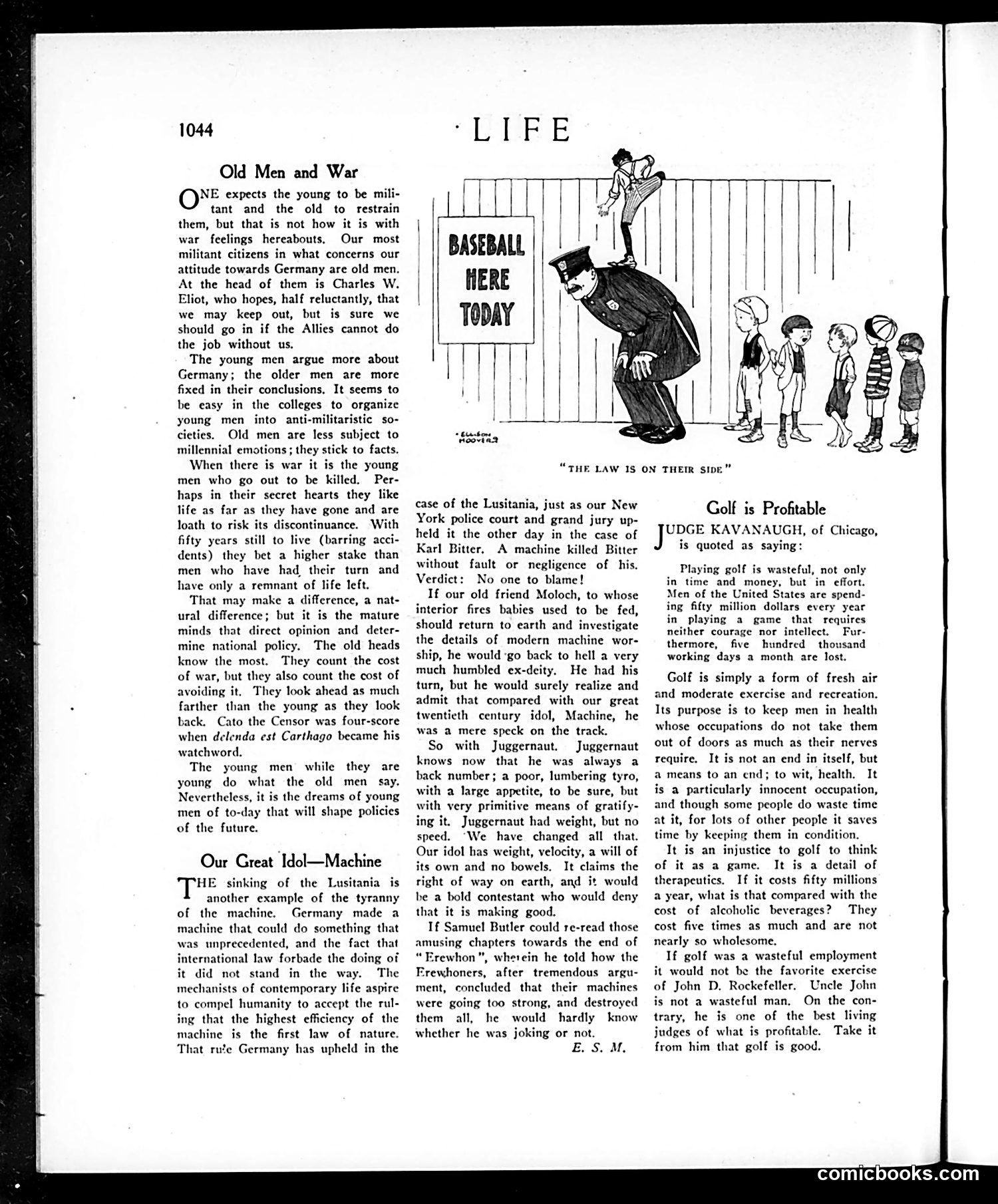
## "Old Men and War" This essay criticizes elderly American leaders—particularly Charles W. Eliot—for pushing military intervention against Germany while young men would bear the combat casualties. The author argues that older men, having lived most of their lives, more easily commit younger men to death, whereas youth naturally hesitate to risk their remaining decades. The reference to Cato's "delenda est Carthago" (Carthage must be destroyed) suggests this warmongering is ancient folly repeated. This was written during WWI debates over American neutrality. ## "The Law Is on Their Side" (Cartoon) The illustration shows a uniformed officer or authority figure towering over children, captioned about "the law." This likely references the recent sinking of the Lusitania (1915) or the Karl Bitter case—instances where mechanical/industrial accidents killed people without legal accountability, illustrating how modern society shields machines from moral responsibility. ## "Golf is Profitable" A brief satire on Judge Kavanaugh's claim that golf wastes time and money while men could be more productively employed—ironic commentary on American leisure priorities.
📄 Transcribed text from this page (OCR, searchable)
Machine-transcribed from the original scan — historical spelling and the odd misread are preserved.
1044 Old Men and War ONE expects the young to be mili- tant and the old to restrain them, but that is not how it is with war feelings hereabouts, Our most militant citizens in what concerns our attitude towards Germany are old men. At the head of them is Charles W. Eliot, who hopes, half reluctantly, that we may keep out, but is sure we should go in if the Allies cannot do the job without us. The young men argue more about Germany; the older men are more fixed in their conclusions. It seems to be easy in the colleges to organize young men into anti-militaristic so- cieties. Old men are less subject to millennial emotions ; they stick to facts. When there is war it is the young men who go out to be killed. Per- haps in their secret hearts they like life as far as they have gone and are loath to risk its discontinuance. With fifty years still to live (barring acci- dents) they bet a higher stake than men who have had their turn and have only a remnant of life left. That may make a difference, a nat- ural difference; but it is the mature ds that direct opinion and deter- mine national policy, The old heads know the most. They count the cost of war, but they also count the cost of avoiding it, They look ahead as much farther than the young as they look back. Cato the Censor was four-score when delenda est Carthago became his watchword. The young men while they are young do what the old men say. Nevertheless, it is the dreams of young men of to-day that will shape policies of the future. Our Great Idol—Machine HE sinking of the Lusitania is another example of the tyranny of the machine. Germany made a machine that could do something that was unprecedented, and the fact that international law forbade the doing of it did not stand in the way. The mechanists of contemporary life aspire to compel humanity to accept the rul- ing that the highest efficiency of the machine is the first law of nature. That rute Germany has upheld in the “THE LAW IS ON THEIR SIDE” case of the Lusitania, just as our New York police court and grand jury up- held it the other day in the case of Karl Bitter, A machine killed Bitter without fault or negligence of his. Verdict: No one to blame! If our old friend Moloch, to whose interior fires babies used to be fed, should return to earth and investigate the details of modern machine wor- ship, he would -go back to hell a very much humbled ex-deity, He had his turn, but he would surely realize and admit that compared with our great twentieth century idol, Machine, he was a mere speck on the track. So with Juggernaut. Juggernaut knows now that he was always a back number; a poor, lumbering tyro, with a large appetite, to be sure, but with very primitive means of gratify- ing it. Juggernaut had weight, but no speed. “We have changed all that. Our idol has weight, velocity, a will of its own and no bowels, It claims the right of way on earth, and it would be a bold contestant who would deny that it is making good. If Samuel Butler could re-read those amusing chapters towards the end of “Erewhon", wherein he told how the Erewhoners, after tremendous argu- ment, concluded that their machines were going too strong, and destroyed them all, he would hardly know whether he was joking or not. ELS. M. Golf is Profitable UDGE KAVANAUGH, of Chicago, is quoted as saying: Playing golf is wasteful, not only in time and money, but in effort. Men of the United States are spend- ing fifty million dollars every year in playing a game that requires neither courage nor intellect. Fur- thermore, five hundred thousand working days a month are lost. Golf is simply a form of fresh air and moderate exercise and recreation. Its purpose is to keep men in health whose occupations do not take them out of doors as much as their nerves require. It is not an end in itself, but a means to an end; to wit, health, It is a particularly innocent occupation, and though some people do waste time at it, for lots of other people it saves time by keeping them in condition. It is an injustice to golf to think of it as a game. It is a detail of therapeutics. If it costs fifty millions a year, what is that compared with the cost of alcoholic beverages? They cost five times as much and are not nearly so wholesome. If golf was a wasteful employment it would not be the favorite exercise of John D. Rockefeller. Uncle John is not a wasteful man, On the con- trary, he is one of the best living judges of what is profitable. Take it from him that golf is good. comicbooks.com