
Life, 1915-06-10 · page 28 of 48
Life — June 10, 1915 — page 28: what you’re looking at
What you’re looking at
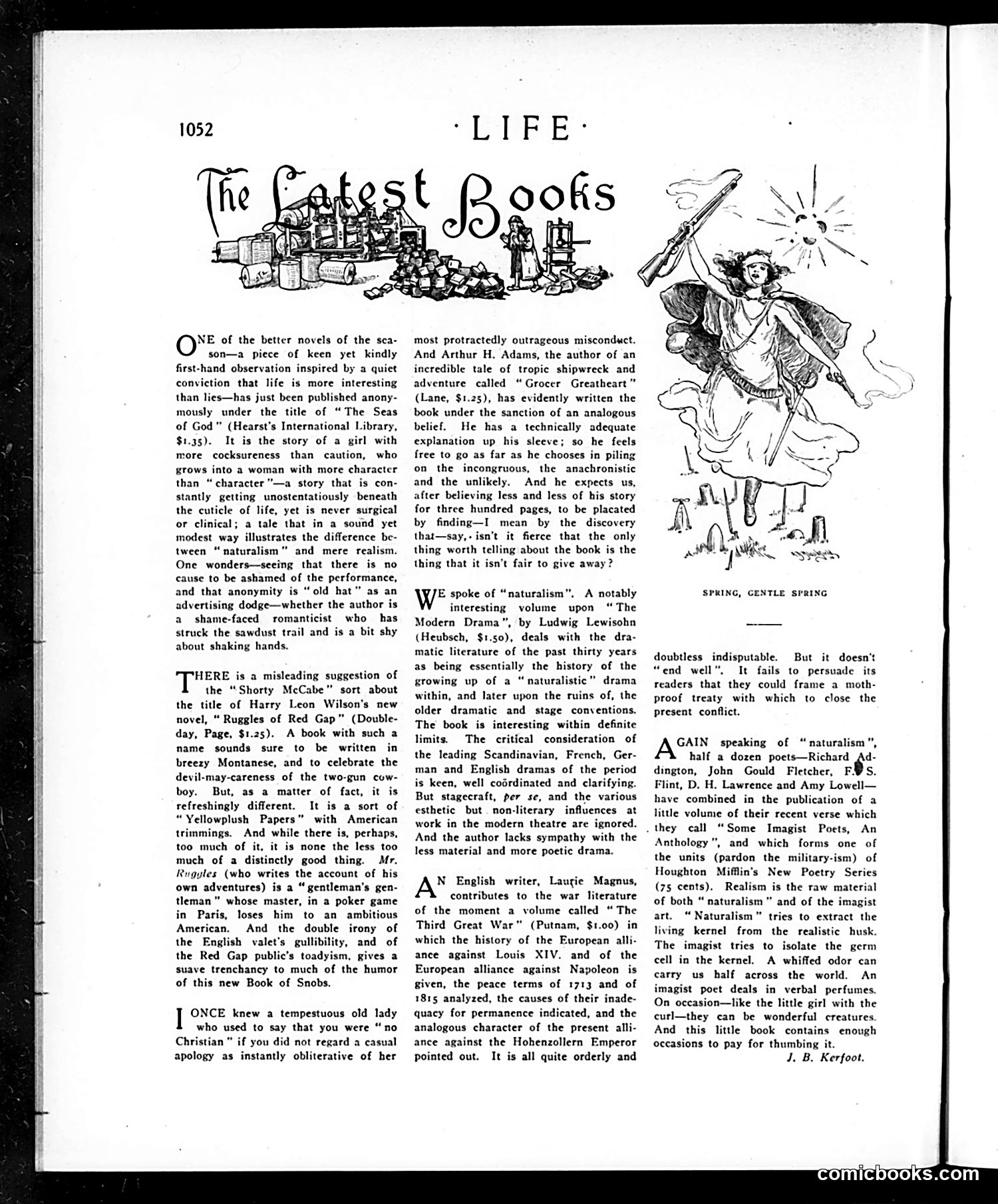
This is a straightforward literary review section, not political satire. The page discusses four recent novels and books: 1. **"The Seas of God"** — praised for keen observation, published anonymously, which the reviewer finds curious given its quality 2. **"Ruggles of Red Gap"** by Harry Leon Wilson — a satirical novel about an English valet ("gentleman's gentleman") who loses a poker game in Paris and becomes servant to an American, allowing the author to mock both English snobbery and American social pretension 3. **"Grocer Greatheart"** by Arthur H. Adams — criticized as an implausible tropical adventure that expects readers to accept an unsatisfying explanation 4. **"The Modern Drama"** by Ludwig Lewisohn — an academic study of naturalistic drama's rise over thirty years, praised for critical analysis but faulted for ignoring stagecraft and poetic drama The small illustration shows a cherub or allegorical figure labeled "SPRING, GENTLE SPRING" — a decorative seasonal element unrelated to the book reviews.
📄 Transcribed text from this page (OCR, searchable)
Machine-transcribed from the original scan — historical spelling and the odd misread are preserved.
NE of the better novels of the sca- son—a piece of keen yet kindly first-hand observation inspired by a quiet conviction that life is more interesting than lies—has just been published anony- mously under the title of “The Seas of God” (Hearst's International Library, $1.35). It is the story of a girl with more cocksureness than caution, who grows into a woman with more character than “character”—a story that is con- stantly getting unostentatiously beneath the cuticle of life, yet is never surgical or clinical; a tale that in a sound yet modest way illustrates the difference be- tween “naturalism” and mere realism. One wonders—seeing that there is no cause to be ashamed of the performance, and that anonymity is “old hat” as an advertising dodge—whether the author is a shame-faced romanticist who has struck the sawdust trail and is a bit shy about shaking hands. HERE is a misleading suggestion of the “Shorty McCabe” sort about the title of Harry Leon Wilson’s new novel, “ Ruggles of Red Gap” (Double- day, Page, $1.25). A book with such a name sounds sure to be written in breezy Montanese, and to celebrate the devil-may-careness of the two-gun cow- boy. But, as a matter of fact, it is refreshingly different. It is a sort of “Yellowplush Papers” with American trimmings. And while there is, perhaps, too much of it, it is none the less too much of a distinctly good thing. Mr. Rugyles (who writes the account of his own adventures) is a “gentleman's gen- tleman” whose master, in a poker game in Paris, loses him to an ambitious American, And the double irony of the English valet’s gullibility, and of the Red Gap public’s toadyism, gives a suave trenchancy to much of the humor of this new Book of Snobs. ONCE knew a tempestuous old lady who used to say that you were “no Christian” if you did not regard a casual apology as instantly obliterative of her most protractedly outrageous misconduct. And Arthur H. Adams, the author of an incredible tale of tropic shipwreck and adventure called “Grocer Greatheart” (Lane, $1.25), has evidently written the book under the sanction of an analogous belief. He has a technically adequate explanation up his sleeve; so he feels free to go as far as he chooses in piling on the incongruous, the anachronistic and the unlikely. And he expects us, after believing less and less of his story for three hundred pages, to be placated by finding—I mean by the discovery that—say,- isn’t it fierce that the only thing worth telling about the book is the thing that it isn’t fair to give away? E spoke of “naturalism”. A notably interesting volume upon “The Modern Drama”, by Ludwig Lewisohn (Heubsch, $1.50), deals with the dra- matic literature of the past thirty years as being essentially the history of the growing up of a “naturalistic” drama within, and later upon the ruins of, the older dramatic and stage conventions. The book is interesting within definite limits. The critical consideration of the leading Scandinavian, French, Ger- man and English dramas of the period is keen, well codrdinated and clarifying. But stagecraft, per se, and the various esthetic but. non-literary influences at work in the modern theatre are ignored. And the author lacks sympathy with the less material and more poetic drama. AS English writer, Laurie Magnus, contributes to the war literature of the moment a volume called “ The Third Great War" (Putnam, $1.00) in which the history of the European alli- ance against Louis XIV. and of the European alliance against Napoleon is given, the peace terms of 1713 and of 1815 analyzed, the causes of their inade- quacy for permanence indicated, and the analogous character of the present alli- ance against the Hohenzollern Emperor pointed out. It is all quite orderly and ( all SSS SPRING, GENTLE sre’ doubtless indisputable. But it doesn’t “end well”. It fails to persuade its readers that they could frame a moth- proof treaty with which to close the Present conflict. GAIN speaking of “naturalism”, half a dozen poets—Richard és dington, John Gould Fletcher, FS. Flint, D, H. Lawrence and Amy Lowell— have combined in the publication of a little volume of their recent verse which they call “Some Imagist Poets, An Anthology", and which forms one of the units (pardon the military-ism) of Houghton Mifflin's New Poetry Series (75 cents). Realism is the raw material of both “ naturalism” and of the imagist art. “Naturalism” tries to extract the living kernel from the realistic husk. The imagist tries to isolate the germ cell in the kernel. A whiffed odor can carry us half across the world. An imagist poet deals in verbal perfumes. On occasion—like the little girl with the curl—they can be wonderful creatures. And this little book contains enough occasions to pay for thumbing it. J. B. Kerfoot.