
Life, 1915-06-10 · page 23 of 48
Life — June 10, 1915 — page 23: what you’re looking at
What you’re looking at
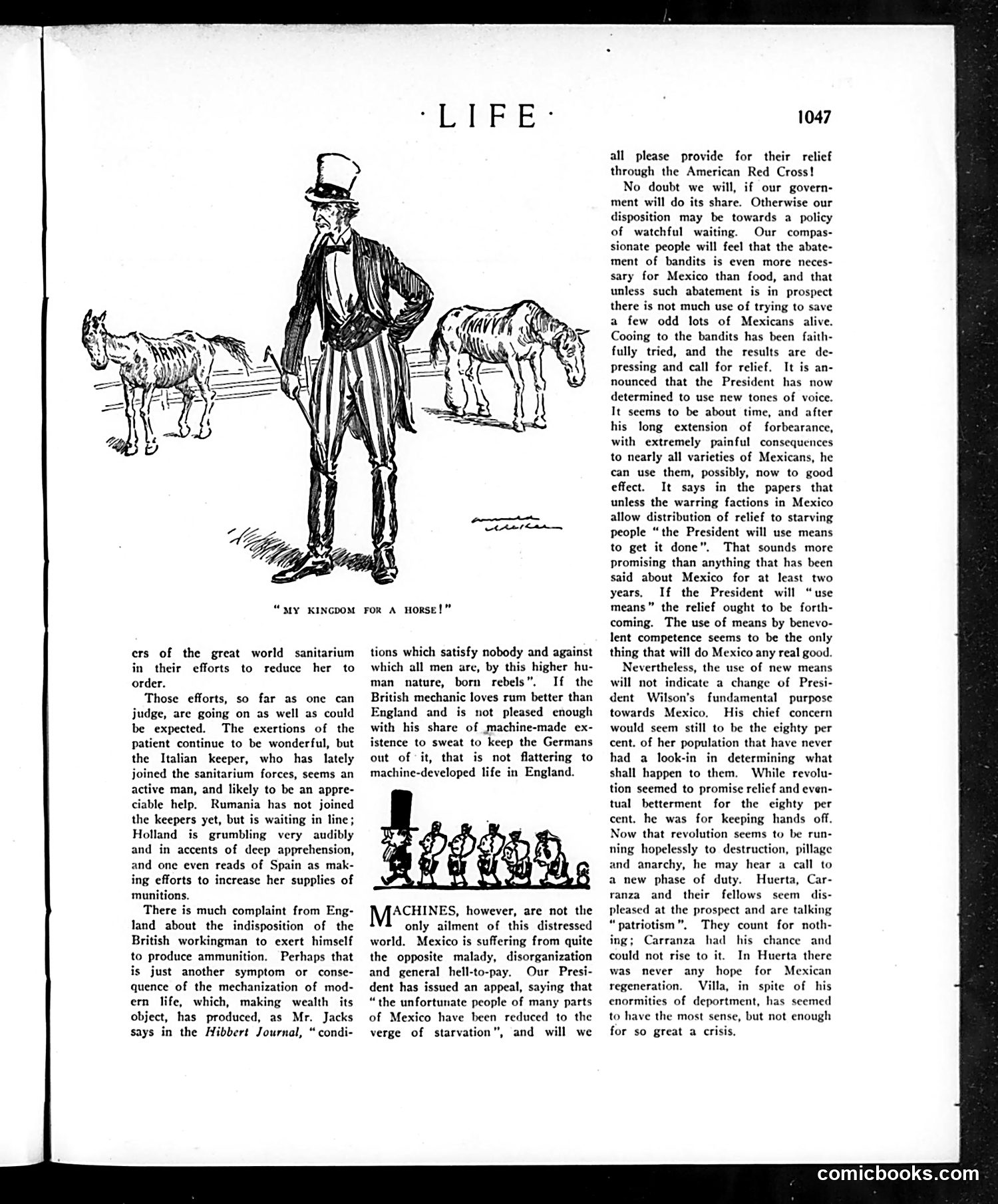
The cartoon depicts Uncle Sam (identified by his top hat and characteristic appearance) standing between two starving, emaciated donkeys, captioned "MY KINGDOM FOR A HORSE!" This is a Shakespeare reference (Richard III) suggesting desperation. The accompanying text satirizes President Wilson's foreign policy toward Mexico during the Mexican Revolution. The article criticizes Wilson's previous "watchful waiting" policy as ineffective, mocking his recent appeal for Red Cross relief while Mexican factions continue fighting. The donkeys likely represent Mexico or Mexican suffering under revolutionary chaos. The cartoon suggests Wilson finally recognizes he must take action—though the satire questions whether he will genuinely intervene or merely use new rhetoric while maintaining passivity. The broader context involves Wilson's struggle with Mexican instability, bandit violence, and humanitarian crisis. The magazine ridicules both the revolutionaries (Huerta, Carranza) and Wilson's hesitant diplomacy, suggesting stronger intervention is needed to protect ordinary Mexicans from continued devastation.
📄 Transcribed text from this page (OCR, searchable)
Machine-transcribed from the original scan — historical spelling and the odd misread are preserved.
“MY KINGDOM FoR A Horse!” ers of the great world sanitarium in their efforts to reduce her to order. Those efforts, so far as one can judge, are going on as well as could be expected. The exertions of the patient continue to be wonderful, but the Italian keeper, who has lately joined the sanitarium forces, seems an active man, and likely to be an appre- ciable help. Rumania has not joined the keepers yet, but is waiting in line; Holland is grumbling very audibly and in accents of deep apprehension, and one even reads of Spain as mak- ing efforts to increase her supplies of munitions. There is much complaint from Eng- land about the indisposition of the British workingman to exert himself to produce ammunition. Perhaps that is just another symptom or conse- quence of the mechanization of mod- ern life, which, making wealth its object, has produced, as Mr. Jacks says in the Hibbert Journal, “condi- tions which satisfy nobody and against which all men are, by this higher hu- man nature, born rebels”. If the British mechanic loves rum better than England and is not pleased enough with his share of machine-made ex- istence to sweat to keep the Germans out of it, that is not flattering to machine-developed life in England. ACHINES, however, are not the only ailment of this distressed world. Mexico is suffering from quite the opposite malady, disorganization and general hell-to-pay. Our Presi- dent has issued an appeal, saying that “the unfortunate people of many parts of Mexico have been reduced to the verge of starvation”, and will we 1047 all please provide for their relief through the American Red Cross! No doubt we will, if our govern- ment will do its share. Otherwise our disposition may be towards a policy of watchful waiting. Our compas- sionate people will feel that the abate- ment of bandits is even more neces- sary for Mexico than food, and that unless such abatement is in prospect there is not much use of trying to save a few odd lots of Mexicans alive. Cooing to the bandits has been faith- fully tried, and the results are de- pressing and call for relief. It is an- nounced that the President has now determined to use new tones of voice. It seems to be about time, and after his long extension of forbearance, with extremely painful consequences to nearly all varieties of Mexicans, he can use them, possibly, now to good effect. It says in the papers that unless the warring factions in Mexico allow distribution of relief to starving people “the President will use means to get it done”. That sounds more Promising than anything that has been said about Mexico for at least two years, If the President will “use means” the relief ought to be forth- coming. The use of means by benevo- lent competence seems to be the only thing that will do Mexico any real good. Nevertheless, the use of new means will not indicate a change of Presi- dent Wilson's fundamental purpose towards Mexico. His chief concern would seem still to be the eighty per cent. of her population that have never had a look-in in determining what shall happen to them. While revolu- tion seemed to promise relief and even- tual betterment for the eighty per cent. he was for keeping hands off. Now that revolution seems to be run- ning hopelessly to destruction, pillage and anarchy, he may hear a call to a new phase of duty. Huerta, Car- ranza and their fellows seem dis- pleased at the prospect and are talking “patriotism”. They count for noth- ing; Carranza had his chance and could not rise to it. In Huerta there was never any hope for Mexican regeneration. Villa, in spite of his enormities of deportment, has seemed to have the most sense, but not enough for so great a crisis, comicbooks.com