
A complete issue · 44 pages · 1915
Life — May 27, 1915
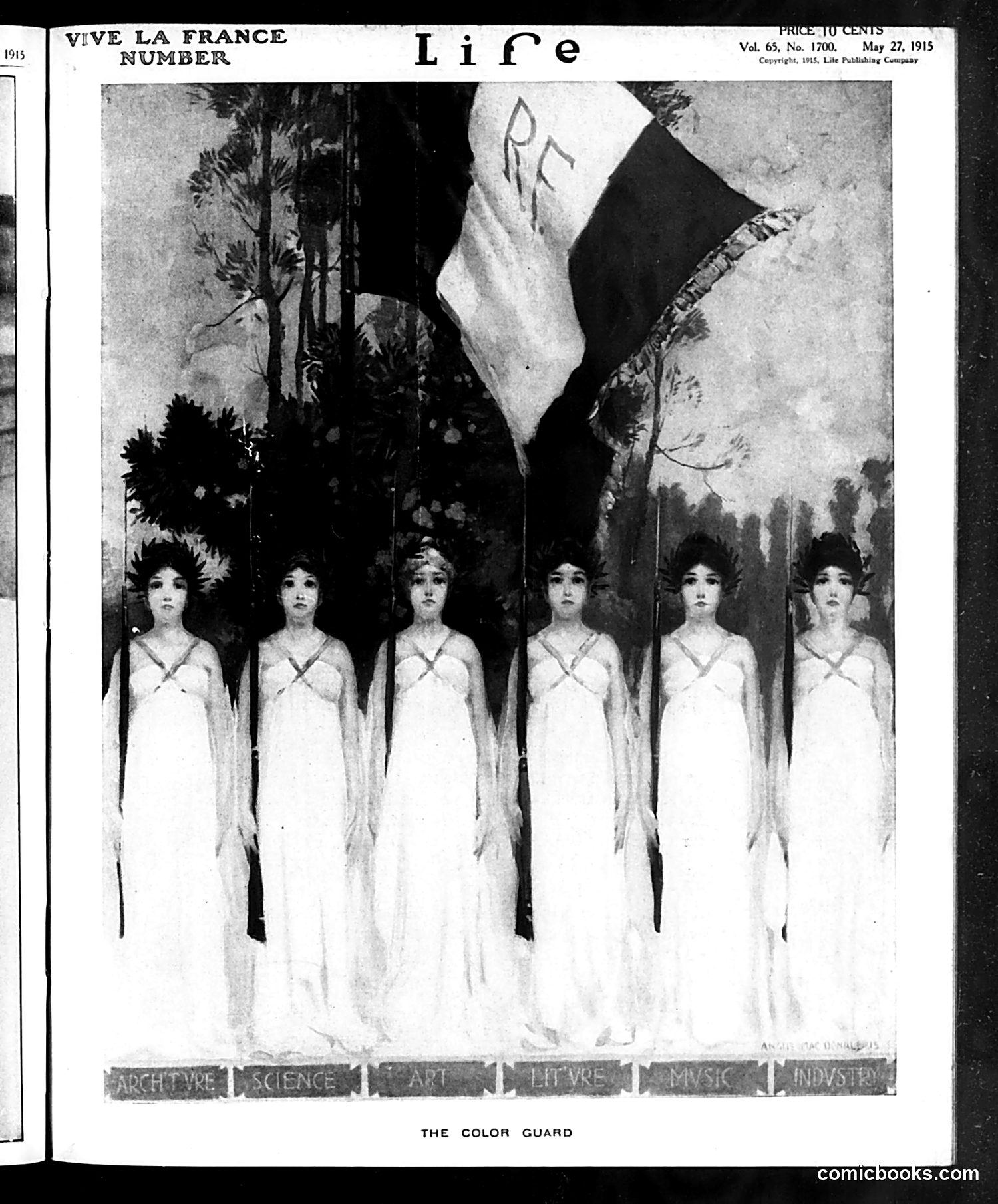
This May 1915 *Life* magazine cover presents an allegorical image titled "The Color Guard." Six identically-posed women in white classical dresses stand beneath the French flag (marked "RF" for République Française), holding standards labeled: Architecture, Science, Art, Literature, Music, and Industry. The satire celebrates French cultural and intellectual achievement during World War I. By personifying France's greatest contributions as noble female figures protecting the national flag, the illustration makes patriotic propaganda. The composition suggests these cultural pillars represent what France fights to preserve. Published while America remained neutral, this likely aimed to cultivate American sympathy for France—presenting the nation not merely as a military combatant but as a guardian of Western civilization's highest achievements.
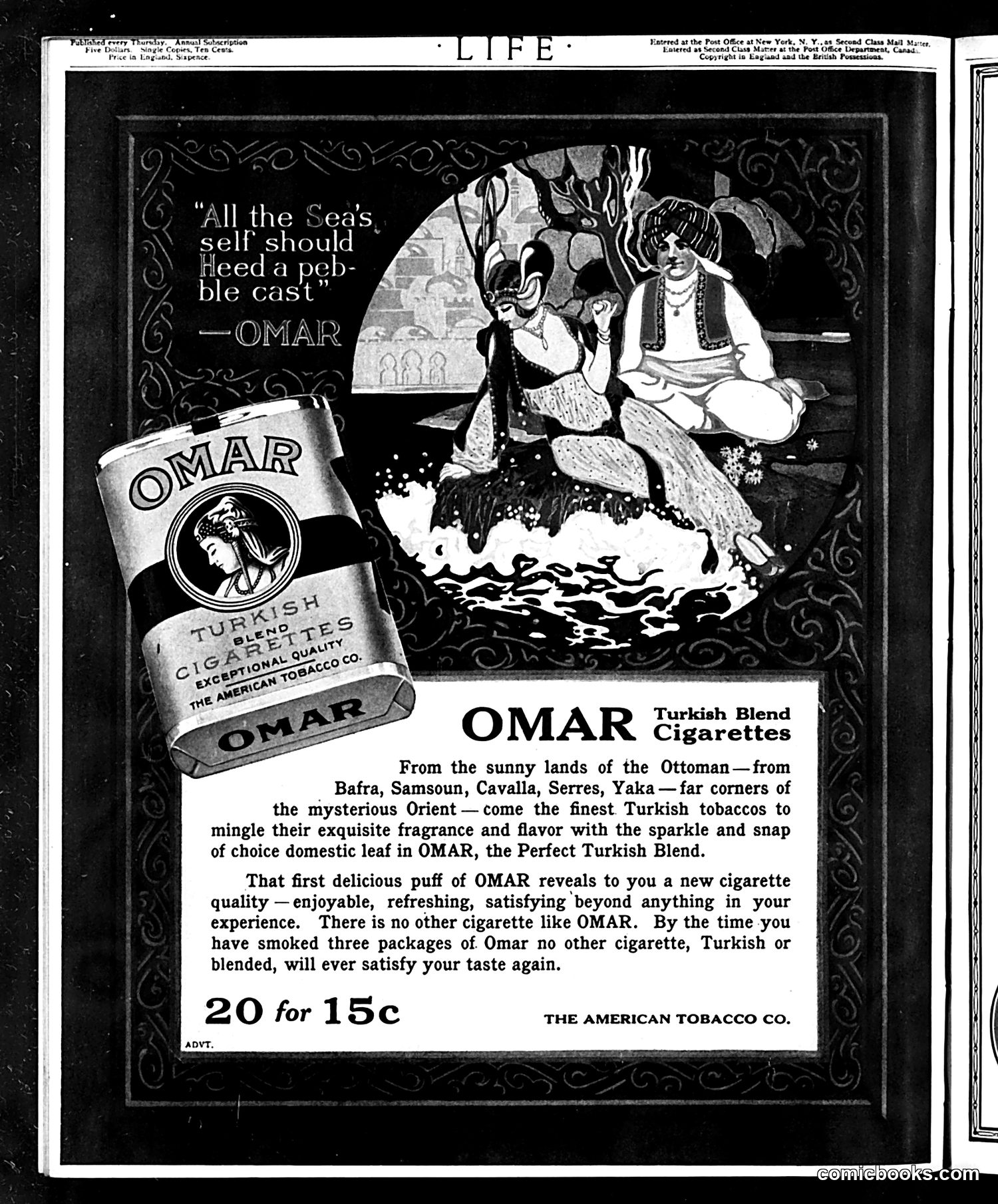
This page is primarily a **cigarette advertisement** for Omar Turkish Blend Cigarettes by The American Tobacco Company, not political satire. The illustration depicts an **Orientalist fantasy scene**: two women in harem-style costumes in an exotic setting, reflecting early 20th-century Western stereotypes about the Ottoman Empire and "the Orient." The quote attributed to "Omar" ("All the Sea's self should heed a pebble cast") appears to invoke exotic/poetic authority to market the product. The ad emphasizes the cigarettes' Turkish origin, listing Ottoman regions (Bafra, Samsoun, Cavalla, Serres, Yaka) to suggest authenticity and quality. The price point—"20 for 15c"—indicates this was an affordable mass-market product. This represents **Orientalism as marketing**: exotic imagery used to make a domestic American product seem sophisticated and desirable to consumers.
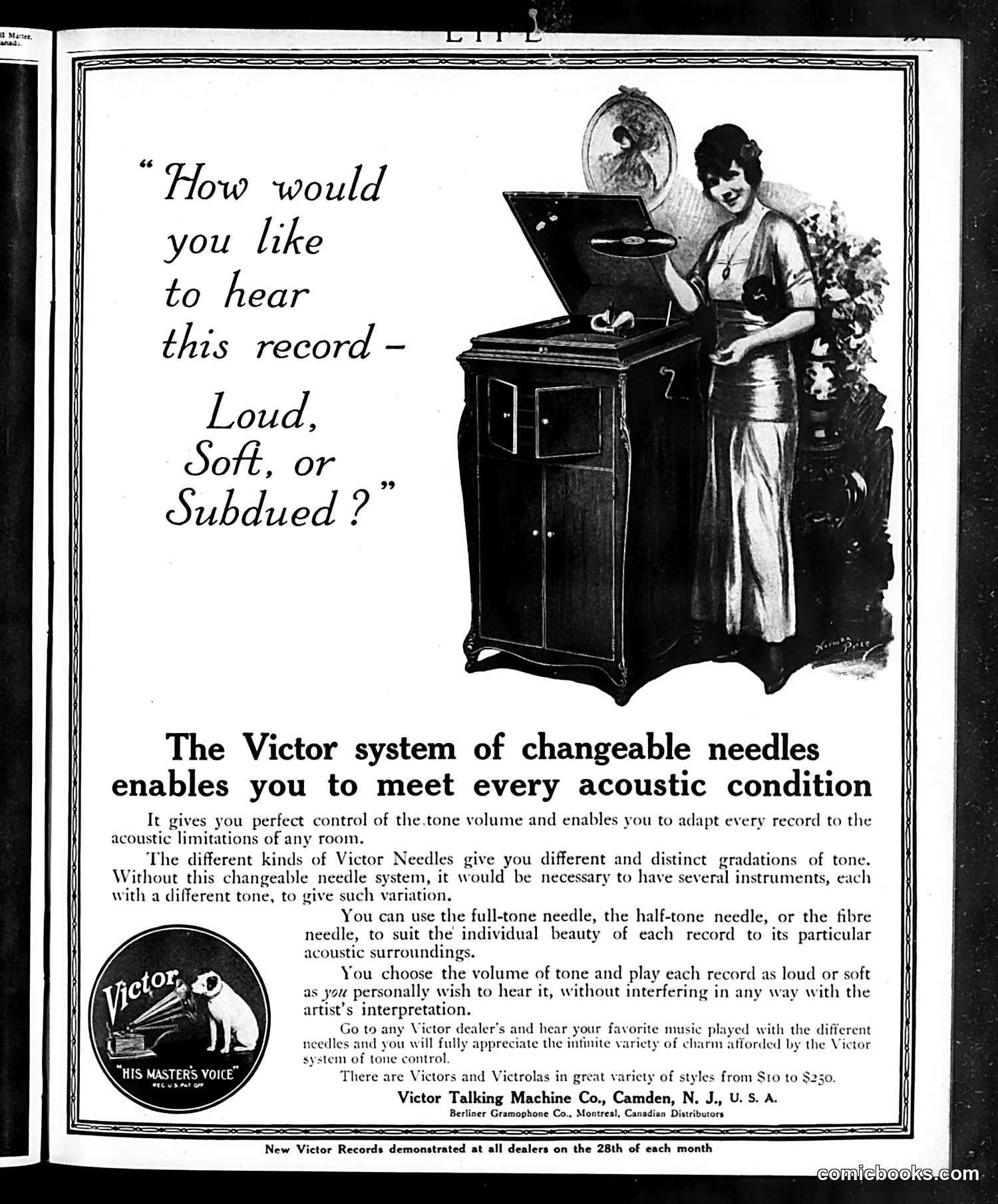
This is actually **not satire or political cartoon**—it's a straightforward advertisement for Victor phonographs and records, likely from the 1920s. The ad features a woman operating a Victor gramophone, promoting their "changeable needle system." The marketing pitch emphasizes consumer control: buyers could adjust volume and tone quality by selecting different needle types (full-tone, half-tone, or fibre needle), adapting records to different room acoustics and personal preferences. The "His Master's Voice" logo appears at bottom left—Victor's famous trademark featuring a dog listening to a gramophone. This represents early audio technology marketing, emphasizing technological sophistication and user customization as luxury features. Prices ranged $10–$250, indicating a premium product for middle-to-upper class consumers.
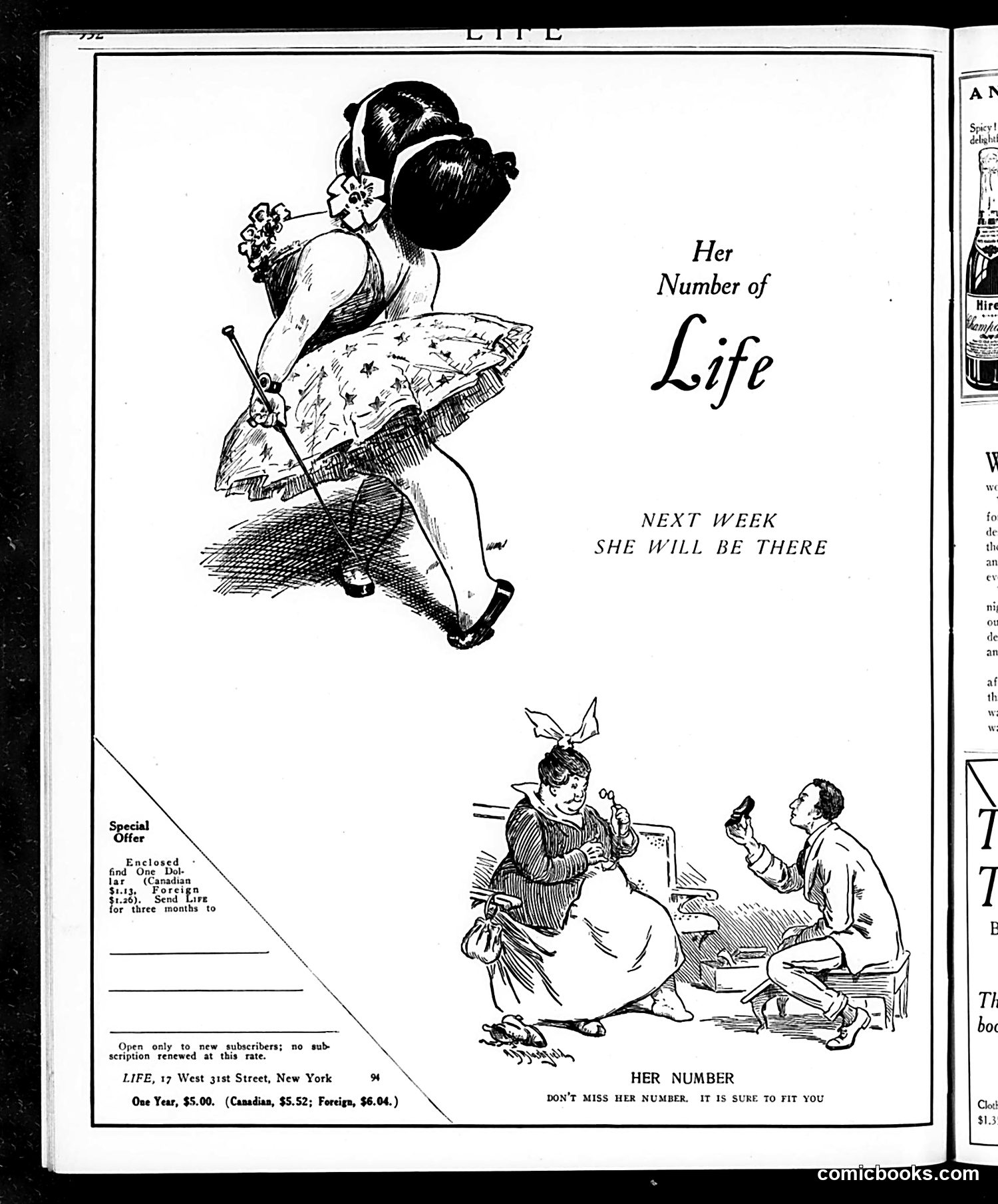
This page is primarily **advertising** for Life magazine subscriptions, not political satire. The top illustration depicts an exaggerated female figure in a star-patterned skirt, promoting "Her Number of Life" with text promising "Next week she will be there." The bottom cartoon shows two figures (appears to be a woman and man) in domestic interaction, captioned "Her Number - Don't Miss Her Number. It is sure to fit you." The advertisements use suggestive imagery and double entendre typical of early 20th-century humor magazines. The "special offer" promotes a one-dollar subscription (or 52 cents Canadian, 60 cents foreign). The overall tone relies on flirtation and mild innuendo to market the magazine to male readers.
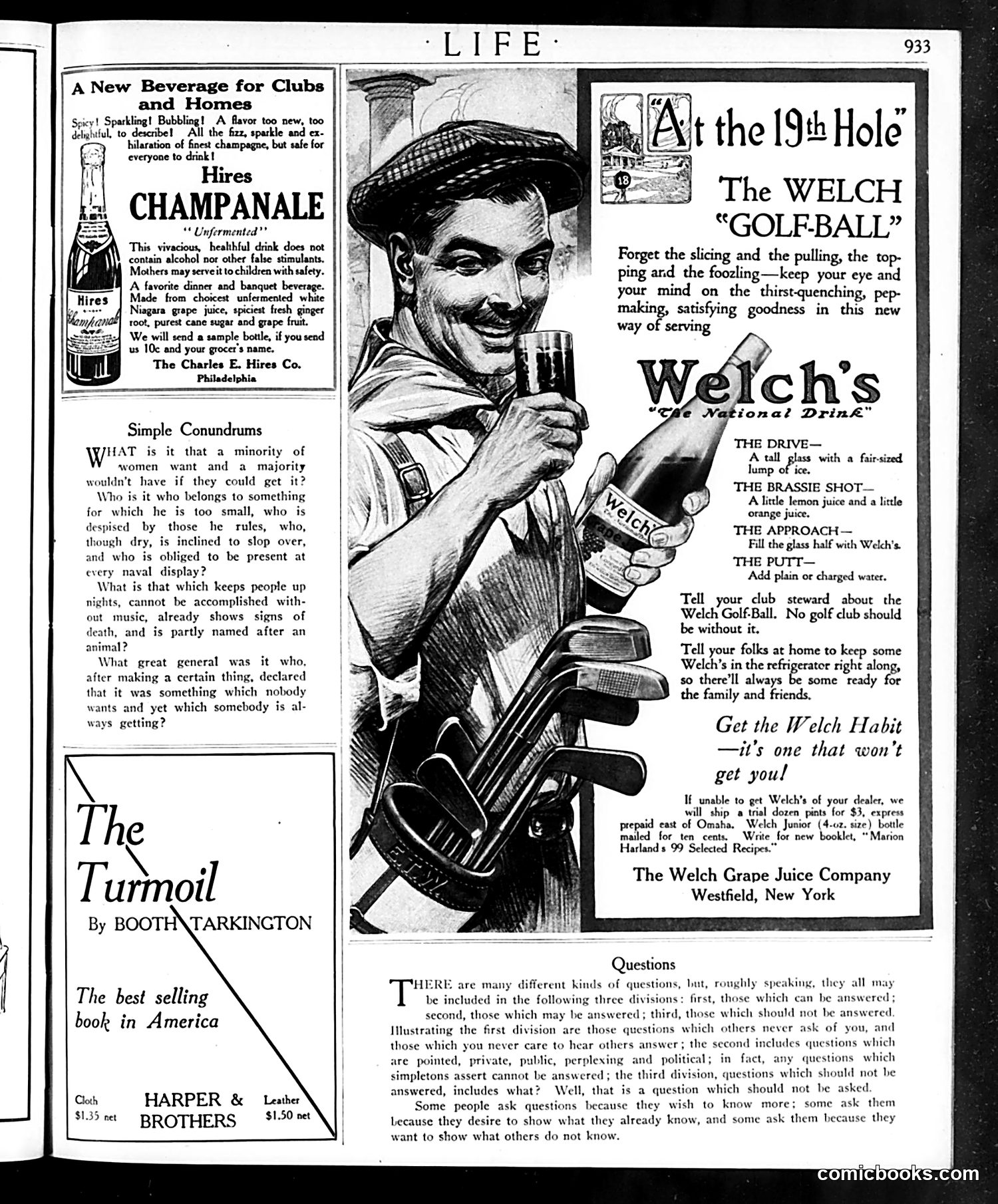
This page is primarily **advertising**, not political satire. The main content includes: 1. **Hires Champanale** - an alcohol-free beverage ad 2. **Welch's Golf-Ball** - a grape juice drink marketed for golf clubs, with creative serving suggestions ("The Drive," "The Approach," "The Putt") 3. **"Simple Conundrums"** - a brief humor section with riddles about minority preferences and naval display 4. **The Turmoil** - advertising Booth Tarkington's bestselling book The central illustration depicts a golfer enthusiastically holding bottles of Welch's juice. The page reflects early 20th-century leisure culture and marketing strategies targeting clubs and home entertainers. There is **no political cartoon or satire** present—this is a straightforward commercial publication page.
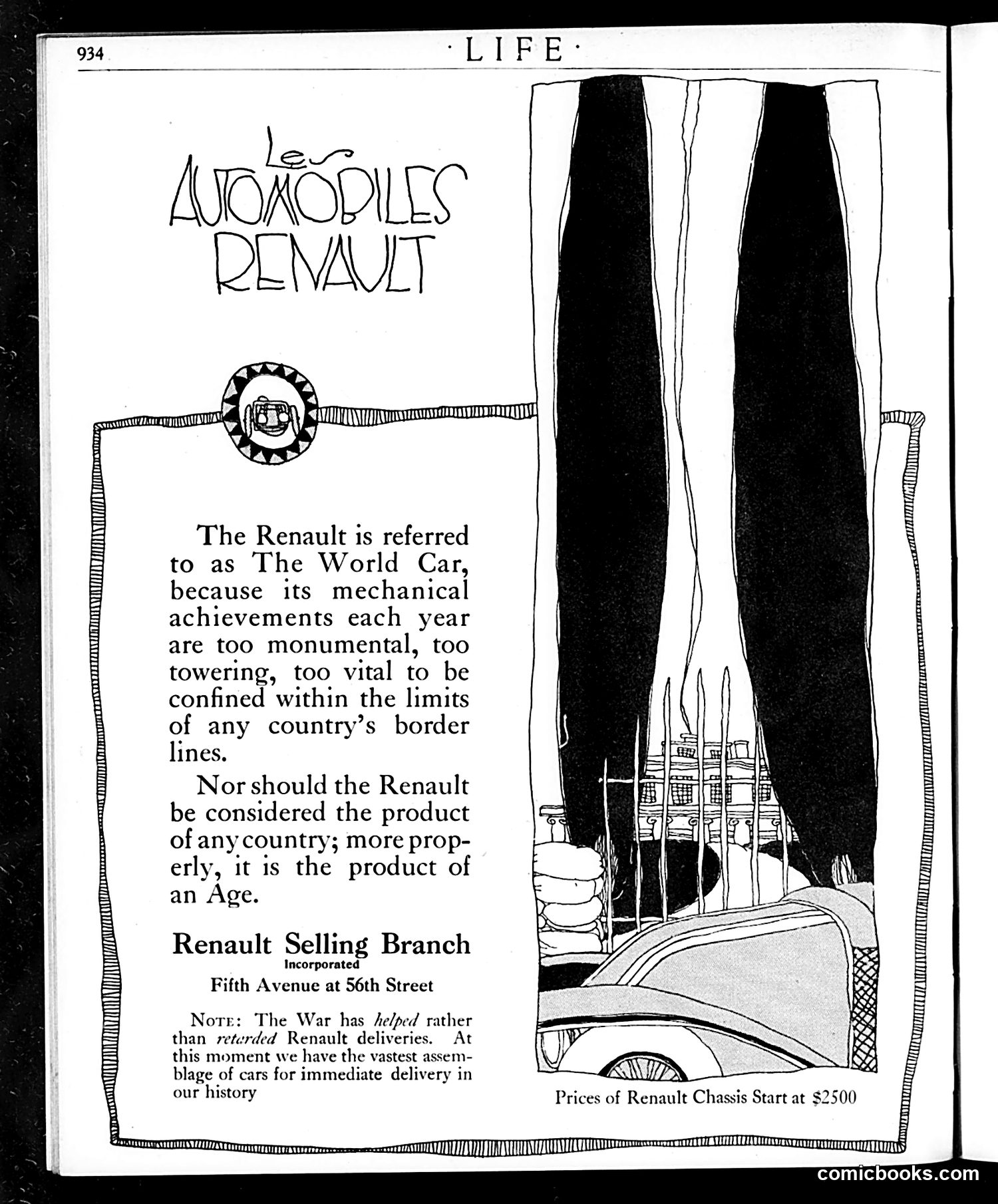
This is primarily a **Renault automobile advertisement** from Life magazine (page 934). The image shows a stylized art deco illustration of a sleek Renault car dwarfed between two enormous legs/feet, emphasizing the car's small size relative to human scale—a visual metaphor for the vehicle's significance. The text makes grandiose claims about Renault as "The World Car," asserting its mechanical innovations transcend national boundaries and represent an "Age" rather than any single country's product. Notably, a footnote references "The War" (likely WWI), claiming it has "*helped* rather than *retarded* Renault deliveries," boasting of "the vastest assemblage of cars for immediate delivery in our history." The advertisement costs $2,500 for a Renault chassis. This appears to be post-WWI promotional material emphasizing industrial prowess and international prestige.
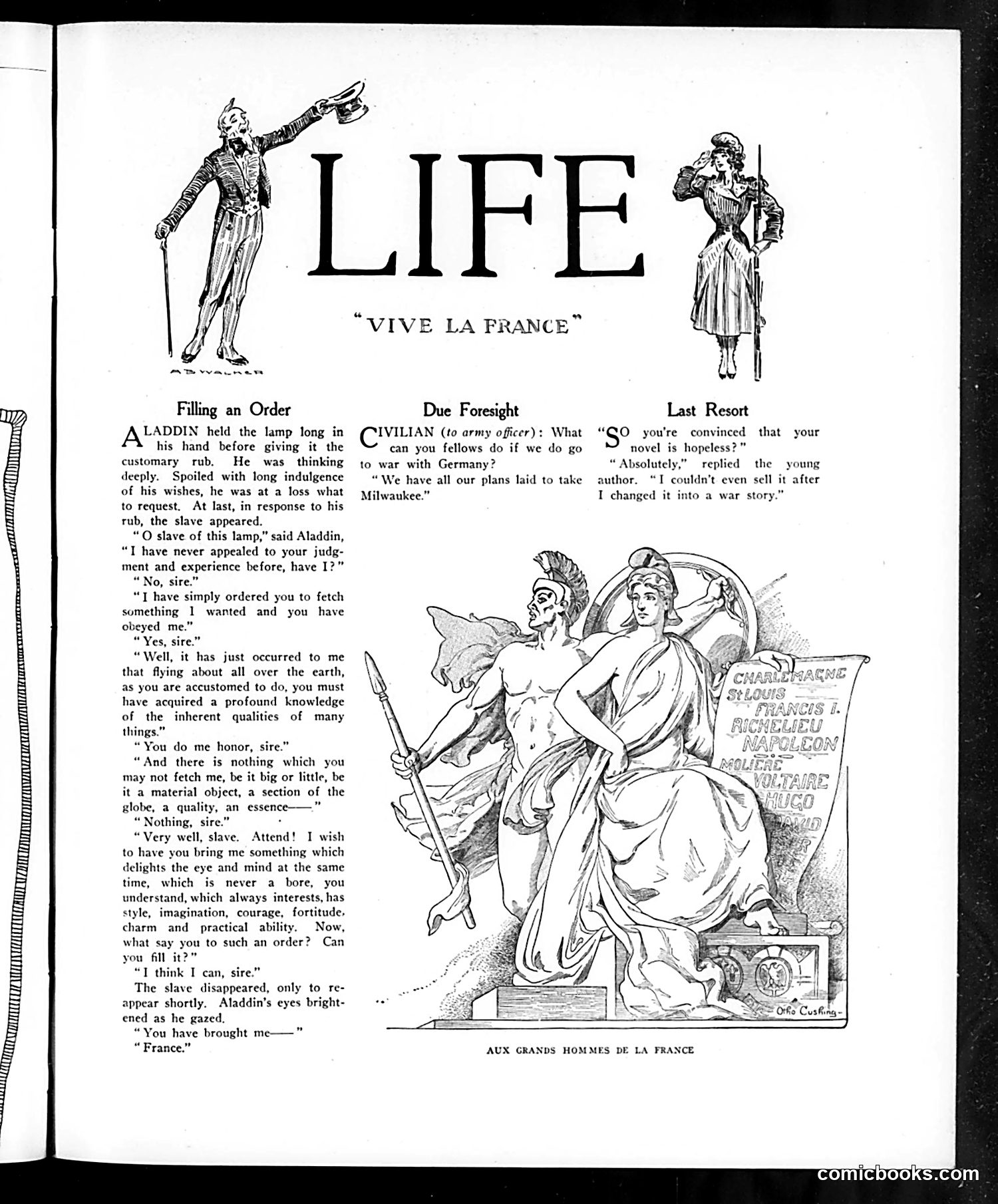
This page from *Life* magazine presents a satirical dialogue titled "Filling an Order" featuring Aladdin and a slave. The narrative mocks wartime literary adaptation: a civilian asks Aladdin for something that "delights the eye and mind" while possessing "style, imagination, courage, fortitude, charm and practical ability." Aladdin promptly delivers "France"—represented in the classical allegorical illustration below. The satire targets authors who hastily rewrite novels as war stories for commercial success. The young author in "Last Resort" admits changing his hopeless novel into a war story to sell it. The page ridicules both the demand for patriotic content and authors' opportunistic compliance, suggesting France itself becomes a commodity product rather than genuine artistic subject matter.
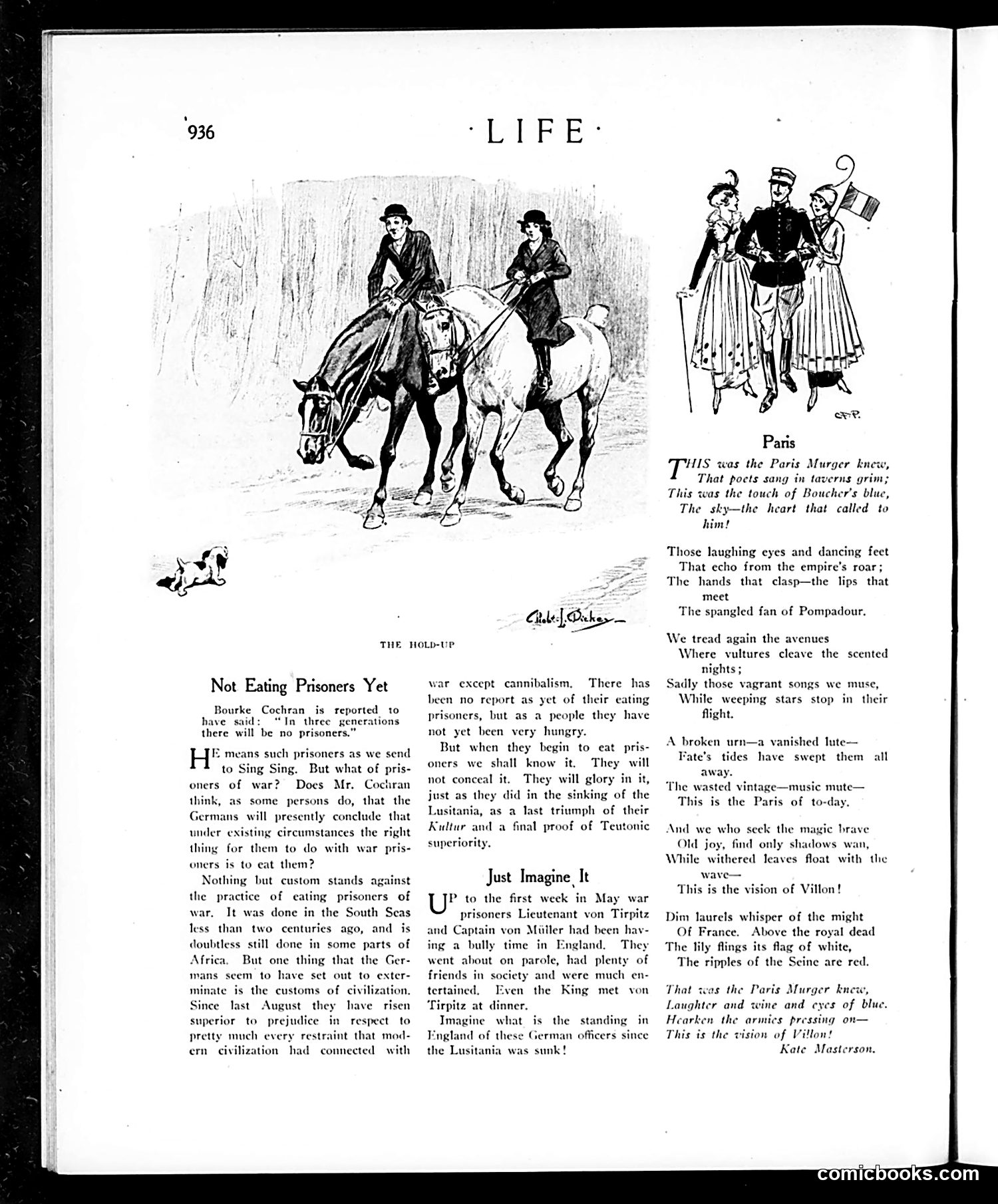
This Life magazine page from 1936 addresses World War I atrocities and prisoner treatment. The article "Not Eating Prisoners Yet" responds to claims by Bourke Cochran that Germans won't eat prisoners, satirizing this as an absurdly low bar for "civilization." The piece argues that Germans have only recently abandoned practices like cannibalism in the South Seas, and that restraint in prisoner treatment shouldn't warrant praise. The cartoon "The Hold-Up" (lower left) depicts a mounted soldier confronting a pedestrian—likely satirizing German militarism or wartime coercion. The poem "Paris" on the right, by Kate Masterson, nostalgically evokes pre-war Paris's cultural glory while lamenting its current state, evoking loss and decline during wartime.
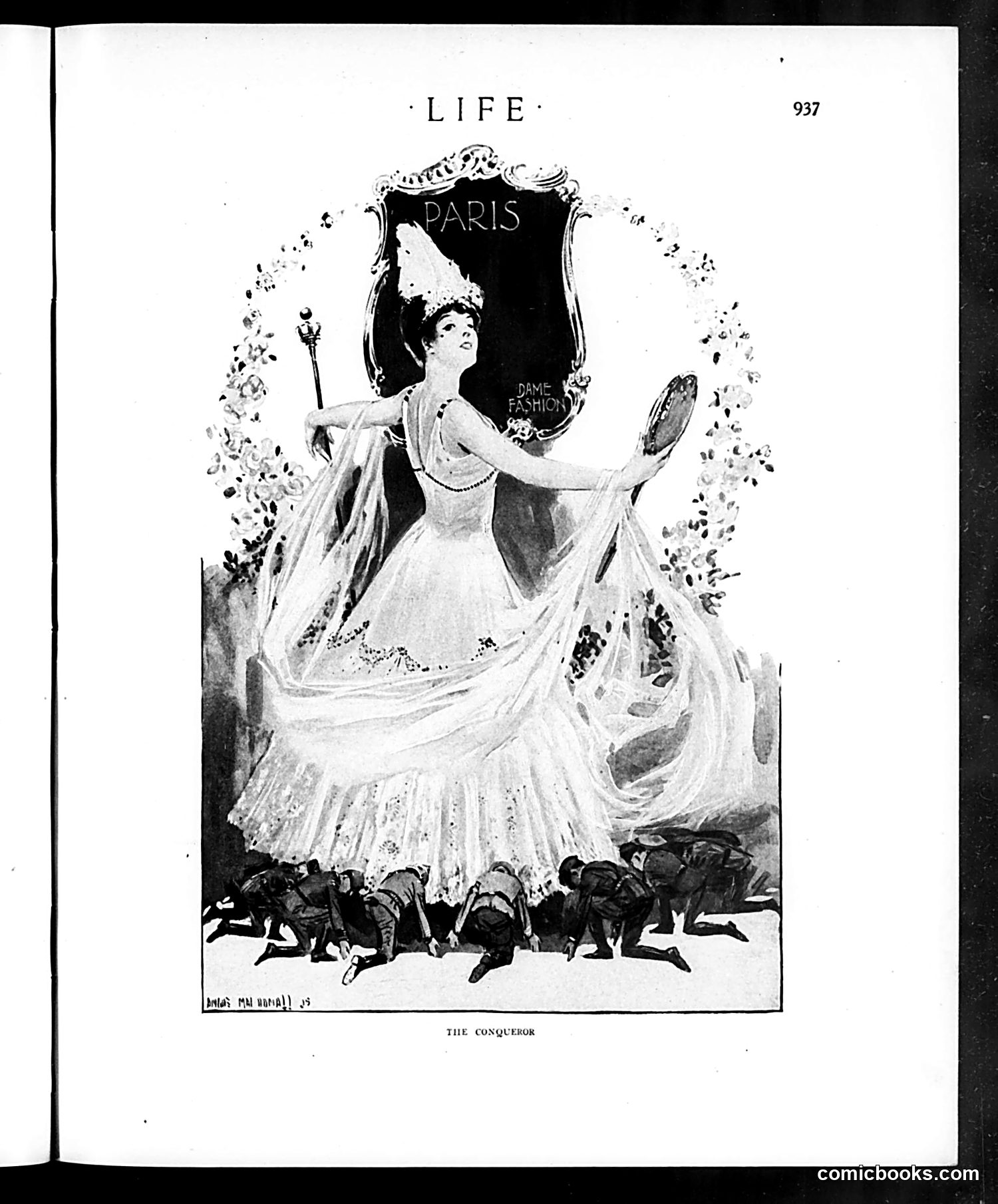
This illustration from Life magazine (page 937) depicts a woman in an elaborate white gown with flowing drapery, holding a hand mirror and a scepter-like object. Above her is a ornate mirror frame labeled "PARIS" and "DAME FASHION." The satire concerns fashion's dominance, particularly Parisian fashion trends. The woman represents Fashion personified as a conquering figure literally standing atop what appear to be conquered subjects or victims at the base of the image. The title "The Conqueror" ironically suggests fashion's power over society and individuals. This reflects early 20th-century commentary on how fashion—especially dictates from Paris—dominated women's choices and social life, treating followers as subjects under fashion's rule rather than autonomous agents.
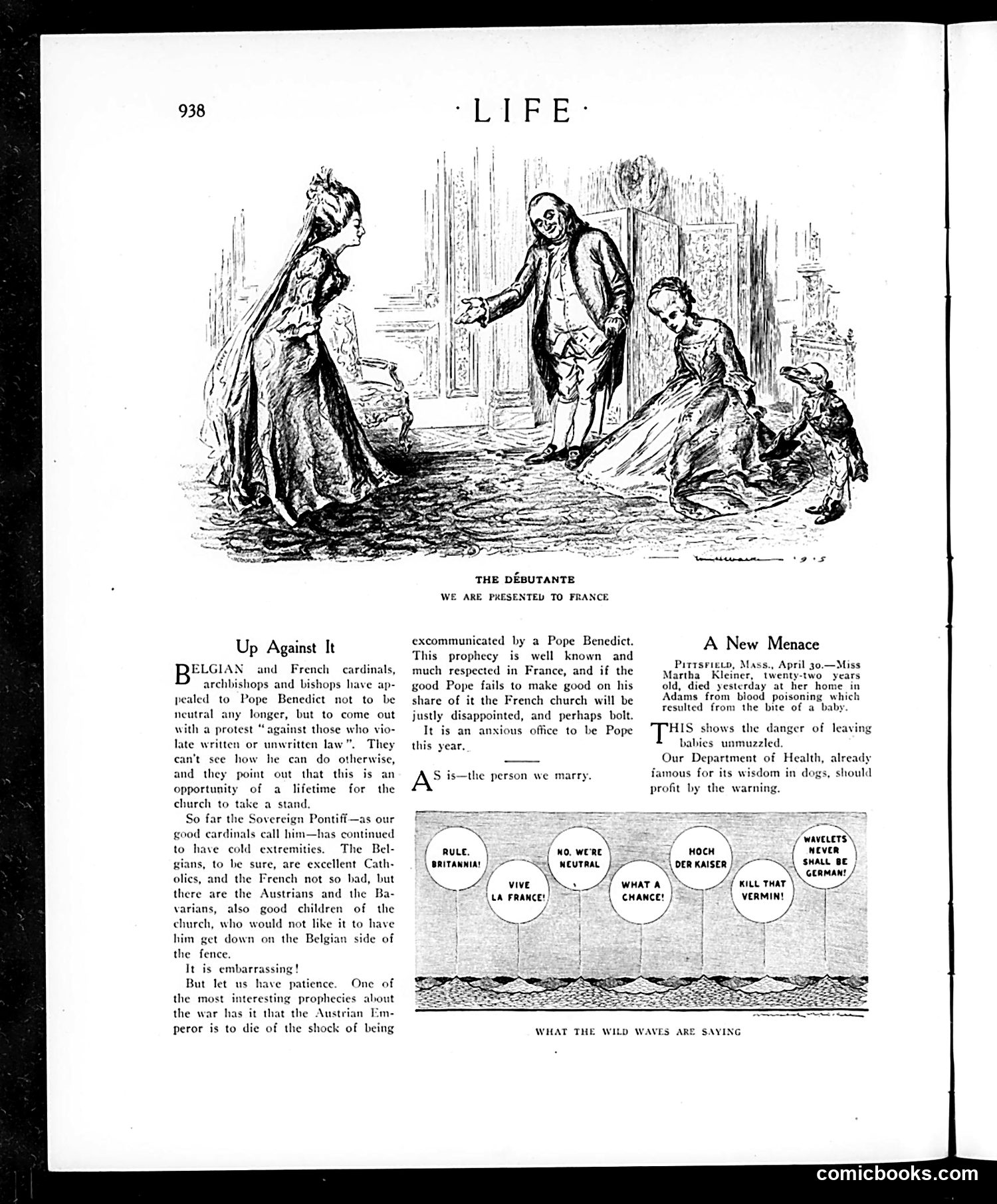
**Top Illustration:** "The Débutante We Are Presented to France" depicts a formal social scene, likely satirizing Franco-Belgian diplomatic relations during WWI. A woman in elaborate dress is presented while others gesture dramatically. **"Up Against It" (left column):** Criticizes Belgian and French cardinals for protesting to Pope Benedict XIV about remaining neutral during the war. The piece argues the church should take a stand rather than hide behind neutrality. **"A New Menace" (right column):** Reports a baby death from a dog bite, warning against leaving babies unattended. This is straightforward health advisory satire. **Bottom cartoon:** "What the Wild Waves Are Saying" shows propaganda messages in speech bubbles—military slogans reflecting wartime rhetoric and posturing between nations.
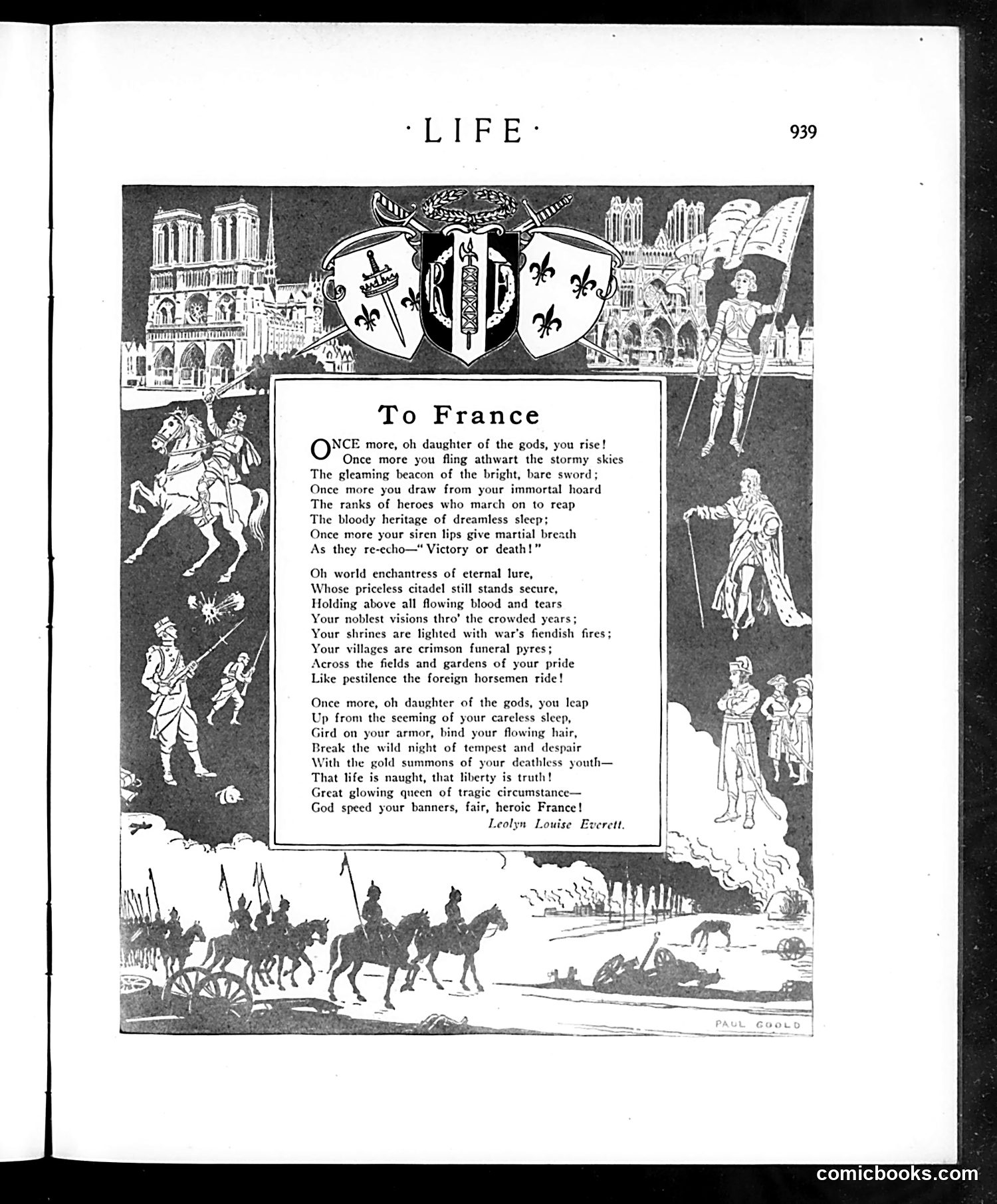
This page features a patriotic poem by Leolyn Louise Everett titled "To France," surrounded by elaborate decorative illustrations. The poem is a call to action addressed to France as a female figure ("daughter of the gods"), exhorting her to rise up in battle against her enemies during what appears to be World War I. The illustrated border depicts military scenes: mounted cavalry soldiers at the bottom, medieval and classical warriors on the sides, architectural landmarks (possibly Notre-Dame), and heraldic shields with fleur-de-lis symbols at the top. The imagery invokes France's historical military glory and cultural heritage to inspire patriotic fervor. This represents typical American wartime propaganda encouraging support for the Allied cause.
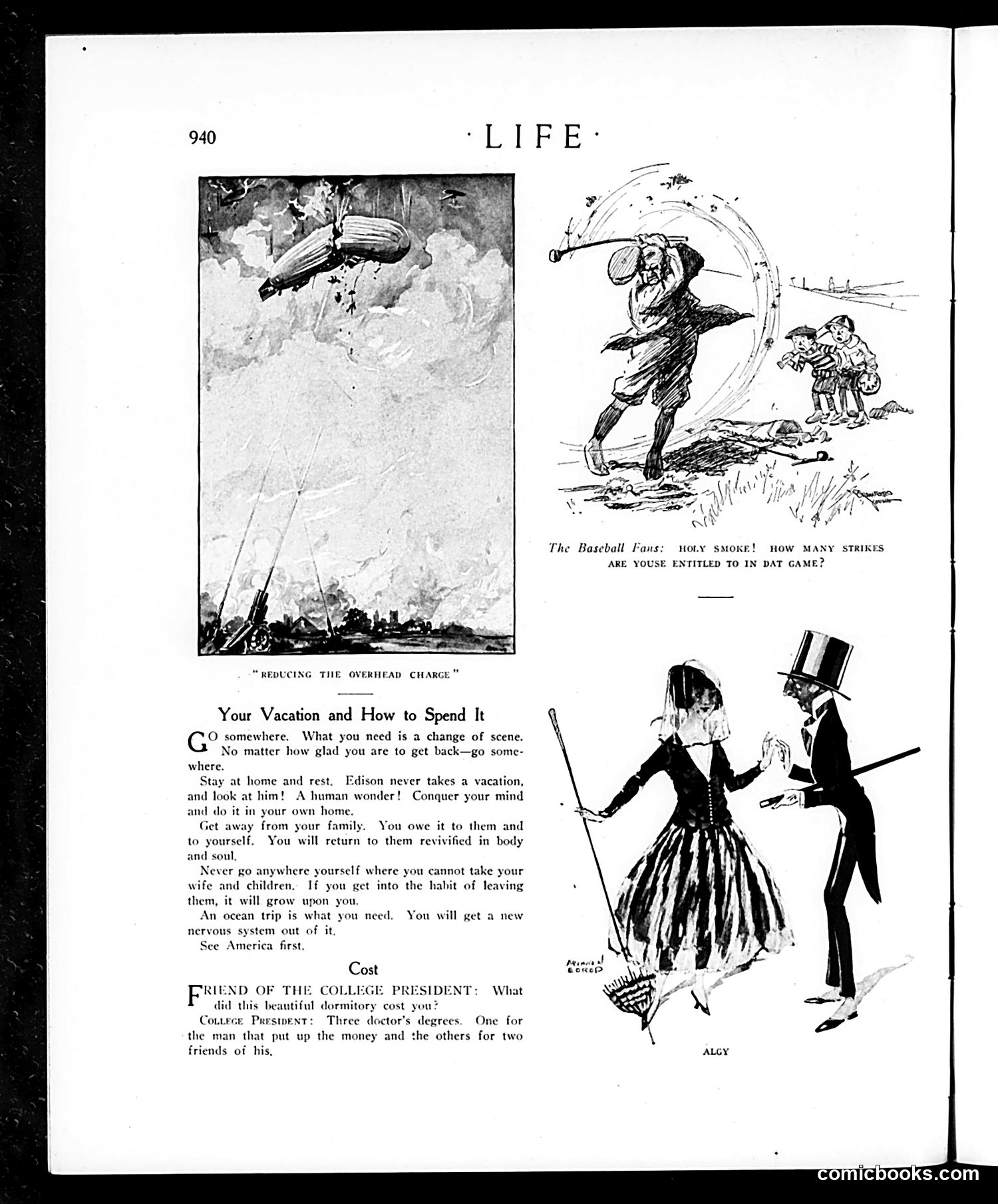
This page contains three separate pieces of satirical humor: 1. **"Reducing the Overhead Charge"** (left): An aerial photograph showing what appears to be a zeppelin or airship being deflated/shot down, satirizing military or technological excess. 2. **"The Baseball Fans"** (top right): A cartoon mocking baseball spectators' obsession with rules, depicting a man with a megaphone asking children about strike counts—poking fun at fans who focus excessively on technical details rather than enjoying the game. 3. **"Your Vacation and How to Spend It"** (center): Advice advocating domestic tourism and family vacations at home, promoting "See America first"—likely reflecting early 20th-century American isolationism or nationalist sentiment. 4. **"Cost"** (bottom): A joke about a college president's expensive dormitory, with the punchline implying three honorary degrees were given to hide the actual cost. The bottom illustration appears to be a separate, unrelated social comedy sketch.
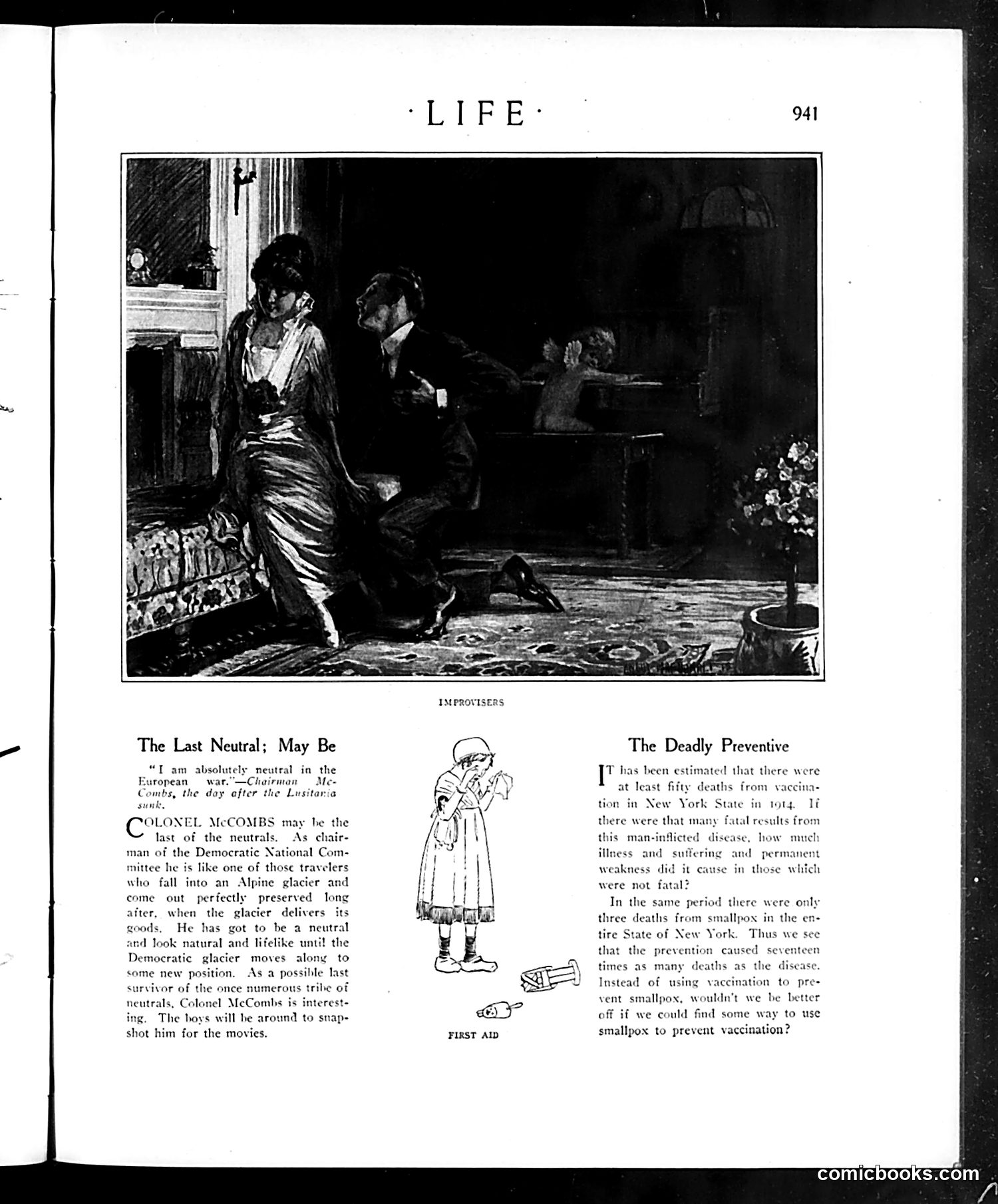
This page contains two distinct articles with illustrations: **"The Last Neutral; May Be"** discusses Colonel McCombs, described as possibly "the last of the neutrals" regarding the European war. The text suggests he maintains neutrality while others take sides, and notes he's being photographed for film purposes. **"The Deadly Preventive"** addresses a public health controversy: vaccination against smallpox in New York State caused approximately fifty deaths, while the disease itself caused only three deaths during the same period. The article questions whether vaccination prevention is worthwhile compared to the disease risk it poses. The small illustration labeled "First Aid" depicts a nurse or medical figure. The page reflects early-20th-century medical and wartime debates, questioning both military neutrality and vaccination safety practices.
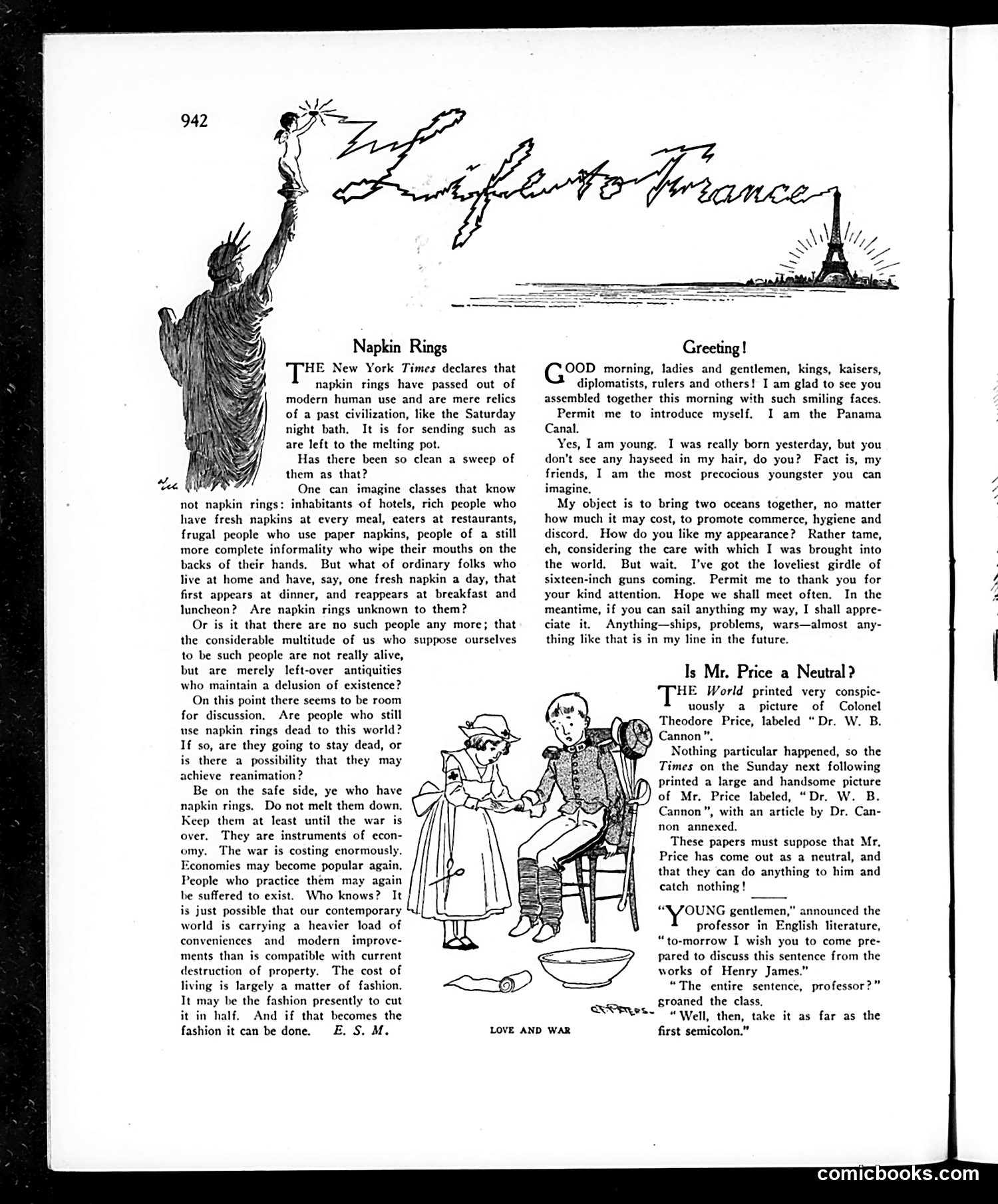
This page contains three distinct pieces satirizing World War I-era social customs and attitudes: 1. **"Napkin Rings"** (left): Critiques the New York Times' declaration that napkin rings are obsolete relics. The author sarcastically defends napkin rings as practical for ordinary people living in homes and flats, arguing their continued use makes economic sense during wartime, when frugality should become fashionable again. 2. **"Greeting!"** (top right): A personified Panama Canal addresses assembled dignitaries with pride about connecting two oceans, then boasts of possessing "sixteen-inch guns"—military hardware reflecting WWI's militarization of previously civilian infrastructure. 3. **"Is Mr. Price a Neutral?"** (bottom right): Questions whether a newspaper figure (Colonel Theodore Price) maintains neutrality, referencing the contemporary debate over American neutrality before entering WWI.
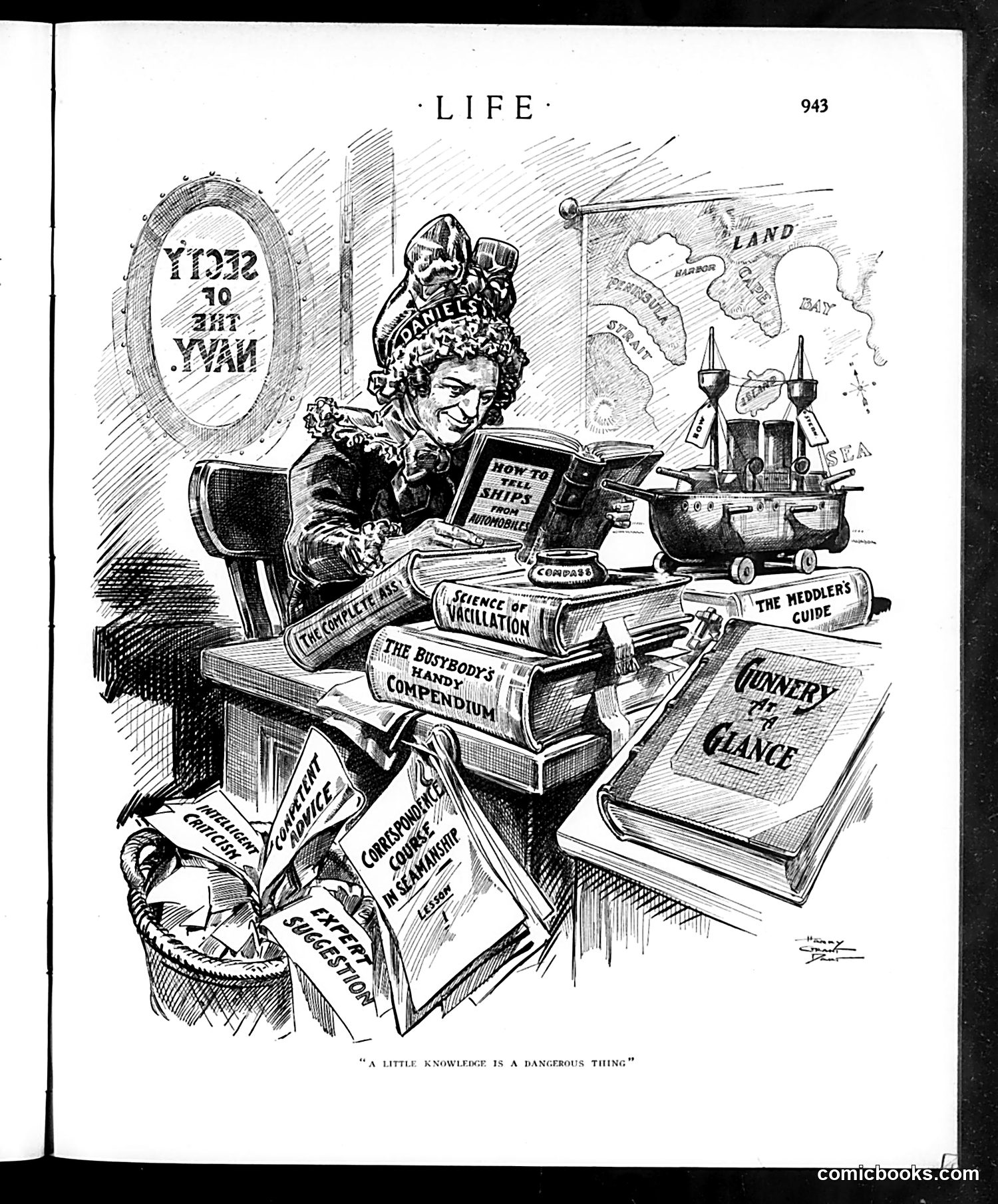
This satirical illustration depicts a woman surrounded by numerous self-help and practical instruction books, including titles visible as "How to Sell Ships," "Science of Vaccination," "The Meddler's Guide," "Gunnery at a Glance," and "Cookery." She reads intently while toy ships and navigation instruments clutter her desk, suggesting she's dabbling superficially in diverse, complex subjects. The cartoon satirizes amateur expertise and overconfidence. The caption—quoting Alexander Pope—mocks people who acquire scattered, surface-level knowledge from how-to books and popular manuals, then presume to offer opinions or advice on serious matters (navigation, medicine, military science) they don't genuinely understand. This reflects early 20th-century anxieties about mass-produced instructional literature enabling unqualified commentary.
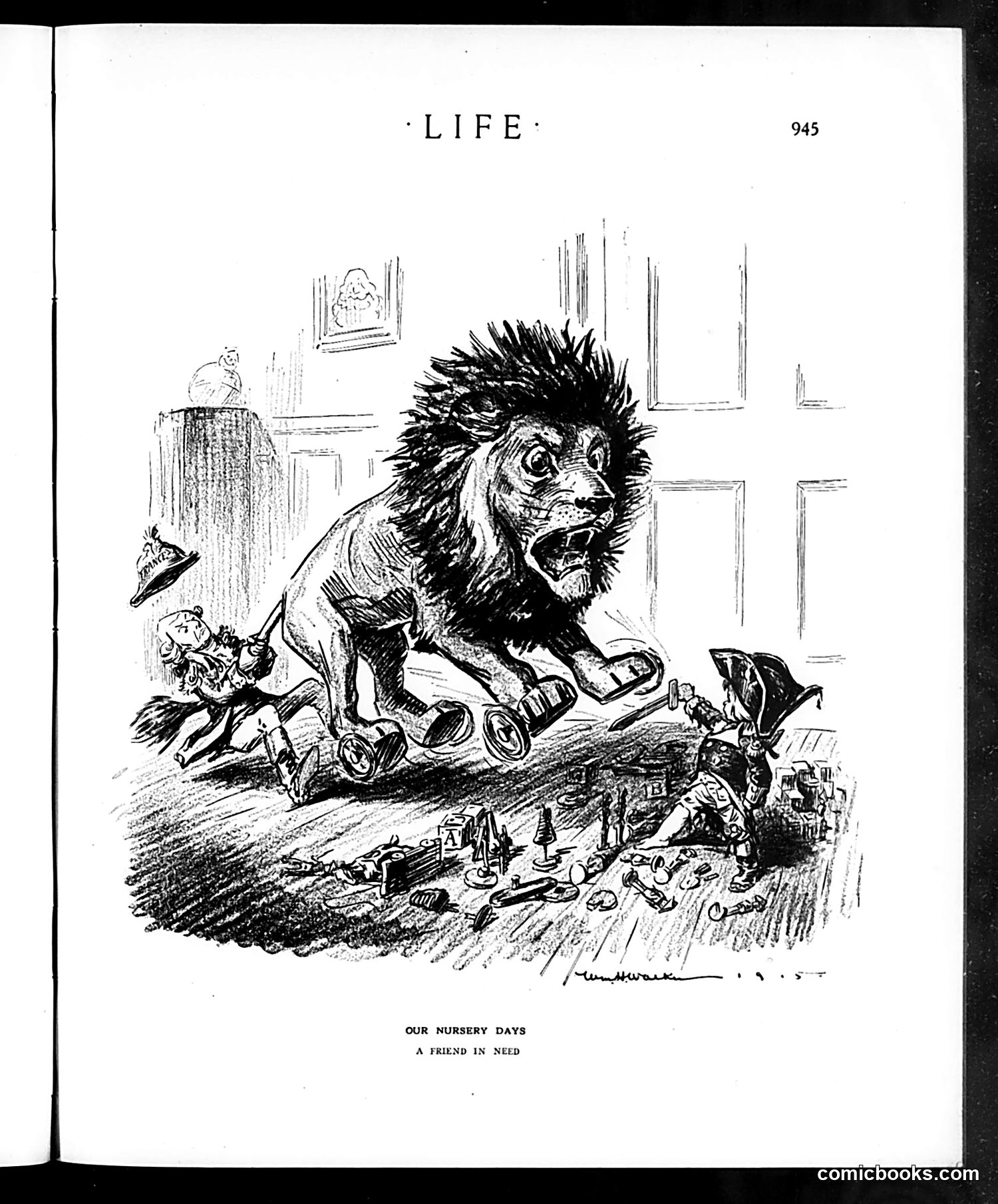
This is a satirical cartoon titled "Our Nursery Days: A Friend in Need." The image depicts a large lion wearing what appears to be a harness or cart, surrounded by small human figures (children or adults depicted small) playing with toys on the floor. The satire likely comments on **power dynamics and dependency**—a massive, dangerous predator (the lion) is harnessed and controlled by much smaller humans, suggesting either: the fragility of such control, the absurdity of attempting to domesticate the untamable, or commentary on how the powerful can be exploited or constrained by the seemingly powerless. Without additional context about the specific historical moment this *Life* magazine issue was published, the precise political or social target remains unclear, though the surreal juxtaposition of scale and control is the evident joke.
This page announces Life magazine's literary contest challenging writers to create the shortest possible short story while maintaining narrative integrity. The contest offered $1,000, $500, and $250 prizes. The satirical twist: authors were paid ten cents per word they *didn't* write (up to 1,500 words). A 100-word story earned $140; a 1,499-word story earned only ten cents. This inverted payment structure mocked both verbose writing and commercial incentives in publishing. The second section, "The Royal Road," appears to be a separate satirical poem mocking political/business success through cynicism rather than merit—referencing "the Colonel" succeeding by being "chummy with the bosses." It advocates abandonment of principles for pragmatism, satirizing corruption in American institutions and politics of the era.
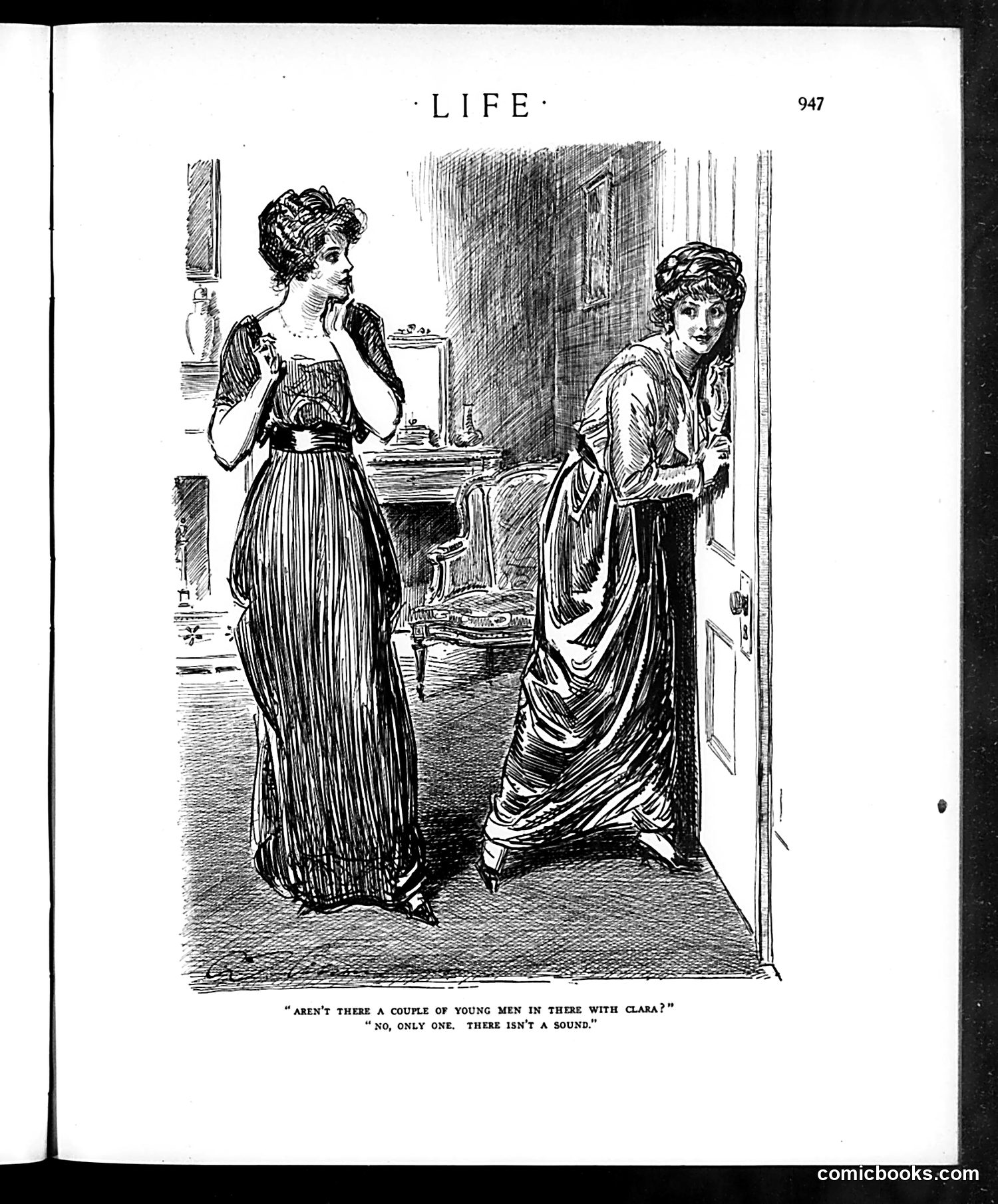
This is a domestic humor cartoon depicting two women in what appears to be a bedroom or private chamber. One woman stands outside, asking if there are young men visiting "Clara" inside. The other responds that there's only one man present, and notably, "there isn't a sound." The joke relies on the implication that a young unmarried woman entertaining a gentleman caller alone—especially in silence—was socially scandalous by early 20th-century standards. The humor derives from the suggestive double meaning: the absence of conversation implies improper conduct rather than innocent socializing. This reflects period anxieties about unchaperoned courtship and women's behavior.
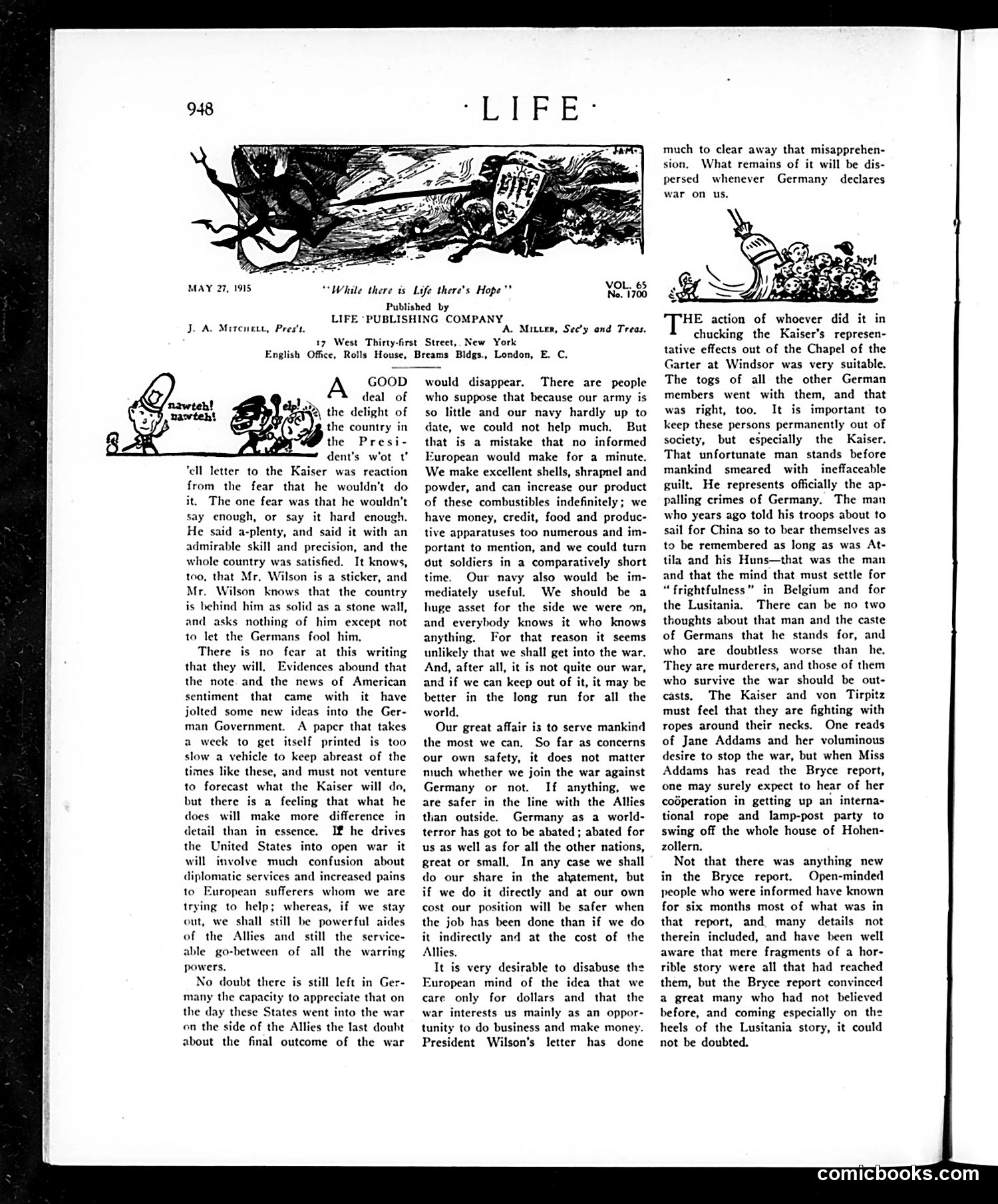
This page discusses President Wilson's recent diplomatic note to Germany (likely regarding the *Lusitania* sinking on May 7, 1915). The small cartoon at top-left shows caricatured figures representing the American public's approval of Wilson's stern letter to "the Kaiser." The editorial praises Wilson for speaking forcefully enough to satisfy the country, arguing that America's industrial and financial capacity makes it a crucial potential ally to the Allies. It disputes European assumptions that the U.S. cares only about profit, claiming Wilson's letter dispels this misconception. The text suggests war remains unlikely but possible, and argues that if America eventually joins the Allies directly, Germany's defeat becomes certain. The piece frames American intervention as both a moral service to mankind and strategically wise for U.S. long-term security.
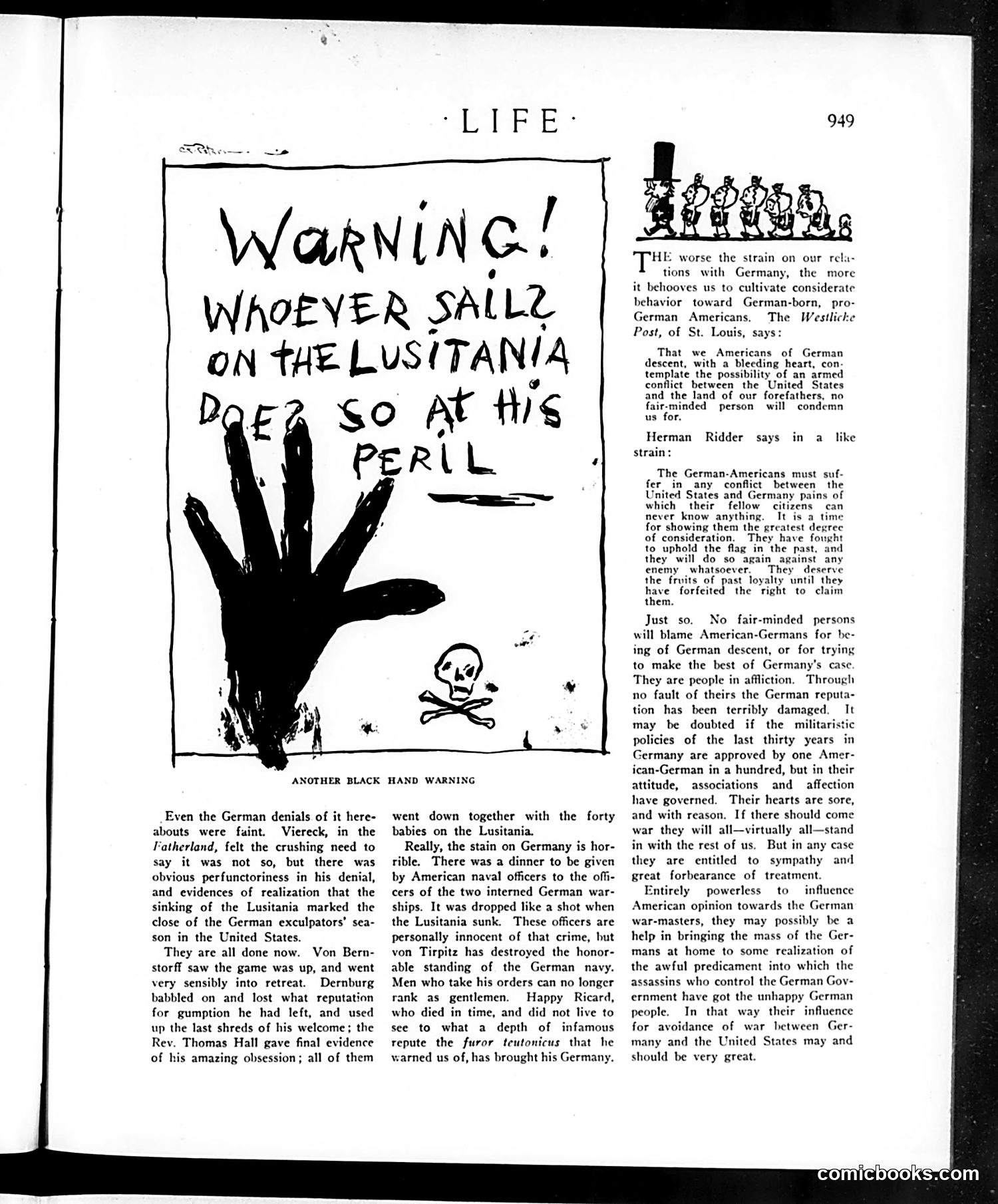
This 1915 *Life* magazine page addresses the sinking of the RMS Lusitania by a German U-boat (May 1915), which killed nearly 1,200 people including 128 Americans. The cartoon's "Black Hand Warning" depicts a skeletal hand emerging from the Lusitania's sinking, referencing the "Black Hand"—a symbol of German intimidation and threat. The warning caption sarcastically mocks German threats. The text acknowledges Germany's diplomatic damage but argues for compassion toward German-Americans, who faced suspicion and hostility. The magazine quotes German-American leaders defending their loyalty to the U.S. while sympathizing with Germany's plight, arguing they deserve fair treatment despite the crisis. The overall message: while condemning Germany's actions, Americans should distinguish between the German government and German-American citizens, treating the latter with consideration during this dangerous diplomatic moment.
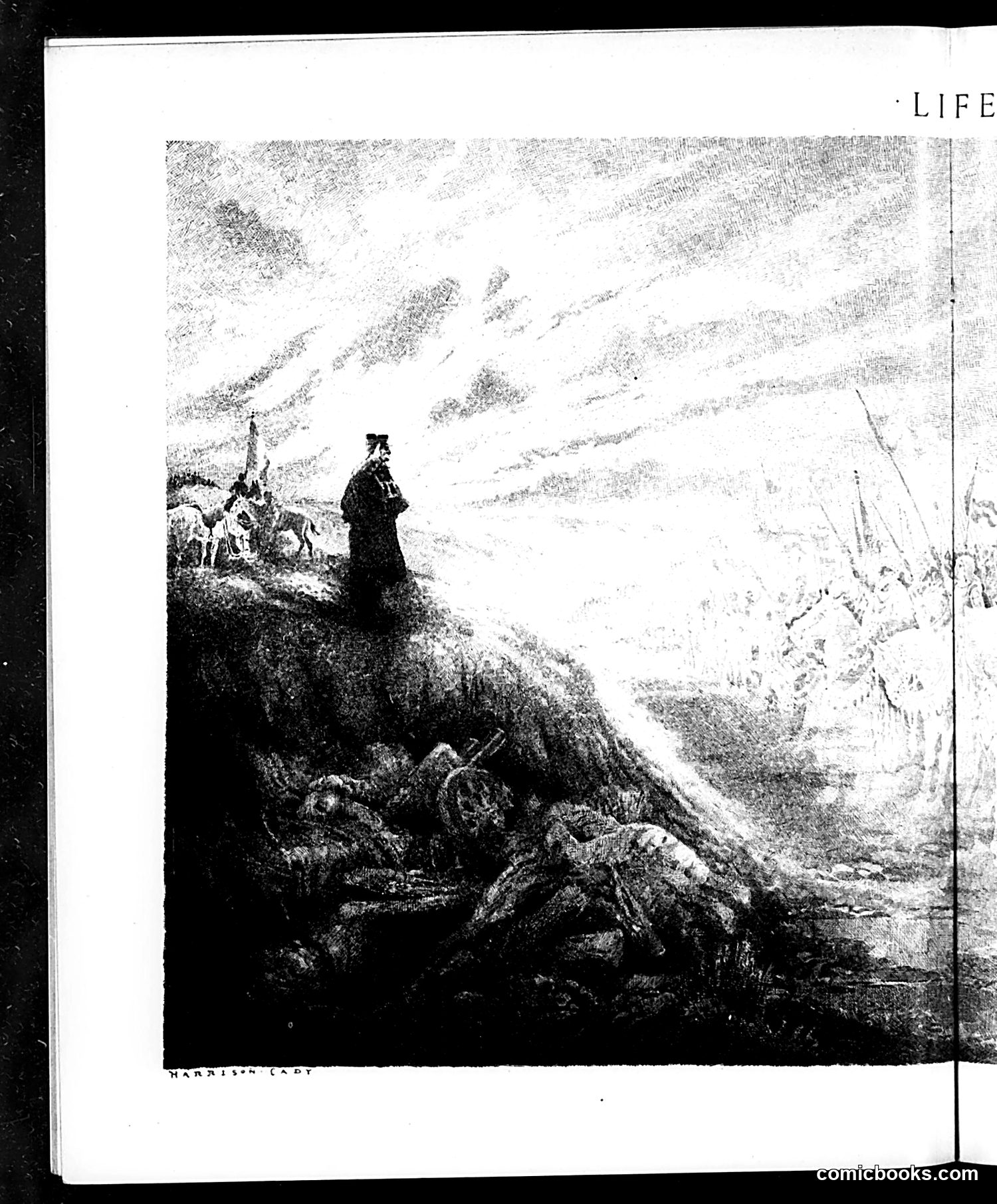
This page shows a romantic engraving titled "Marriage Cape" depicting a figure in dark clothing standing on a rocky outcrop overlooking a dramatic seascape. The style suggests 19th-century sentimental or literary imagery rather than political satire. Without additional context or clearer OCR text, the specific satirical intent is unclear. The caption "Marriage Cape" may reference a geographical location or be a metaphorical title. The solitary figure gazing seaward could represent romantic idealization, longing, or—given Life's satirical nature—possibly mock the sentimental Victorian attitudes toward romance and marriage. Without visible text explaining the cartoon's point, I cannot confidently identify what social or political commentary it intended.
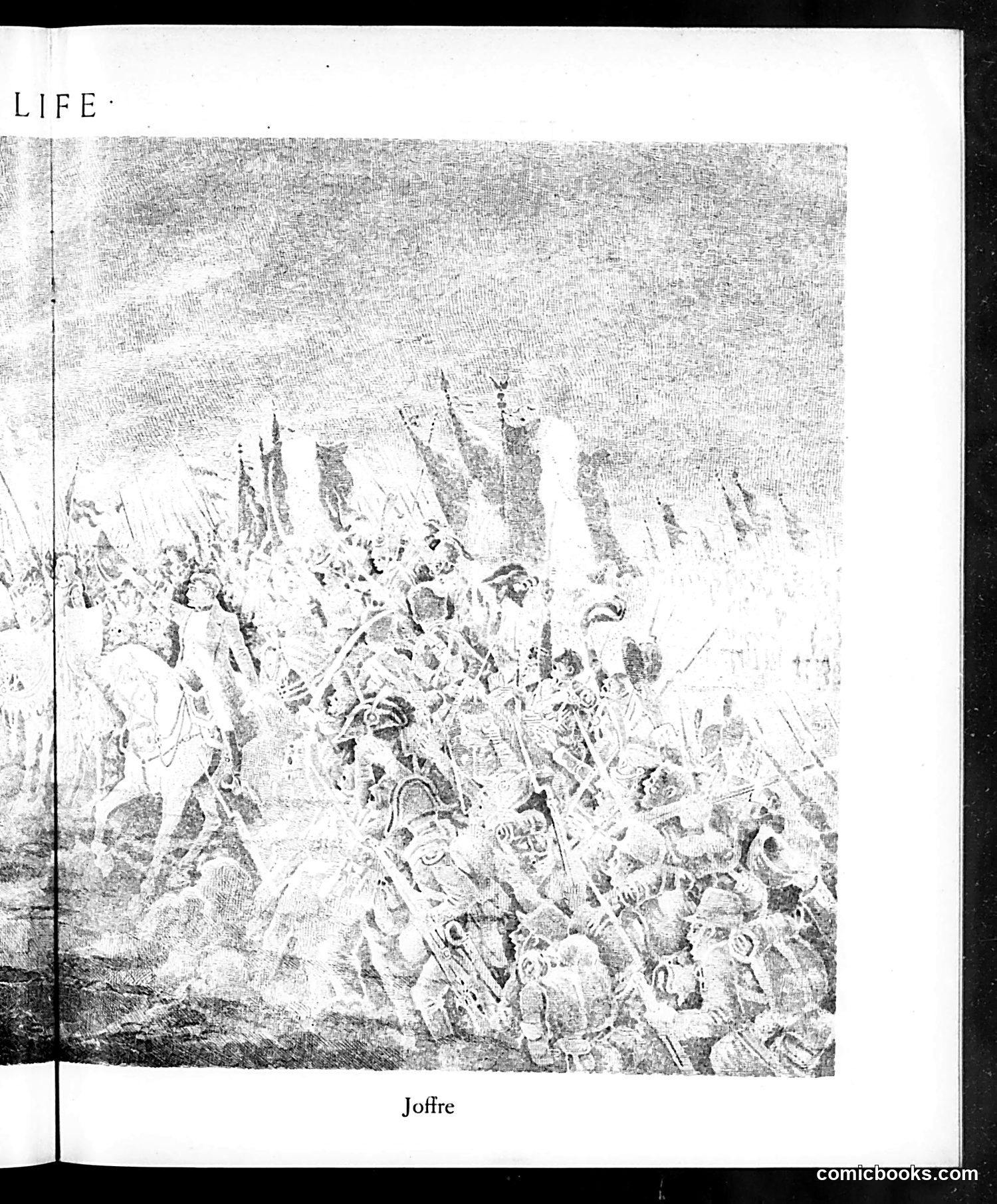
This appears to be a satirical cartoon from Life magazine depicting **Marshal Joseph Joffre**, the French military commander during World War I. The image shows a chaotic battle scene with numerous soldiers, flags, and military action. The cartoon likely comments on Joffre's military strategy or leadership during WWI—possibly satirizing either his tactical decisions or the massive scale of casualties in the conflict. The dense, crowded composition emphasizes the chaos and carnage of modern warfare. Without the full article text or date, the specific critique is unclear, but Life magazine frequently used such illustrations to comment on military leadership and wartime decisions. The style and subject matter suggest this dates from the WWI era or its immediate aftermath.
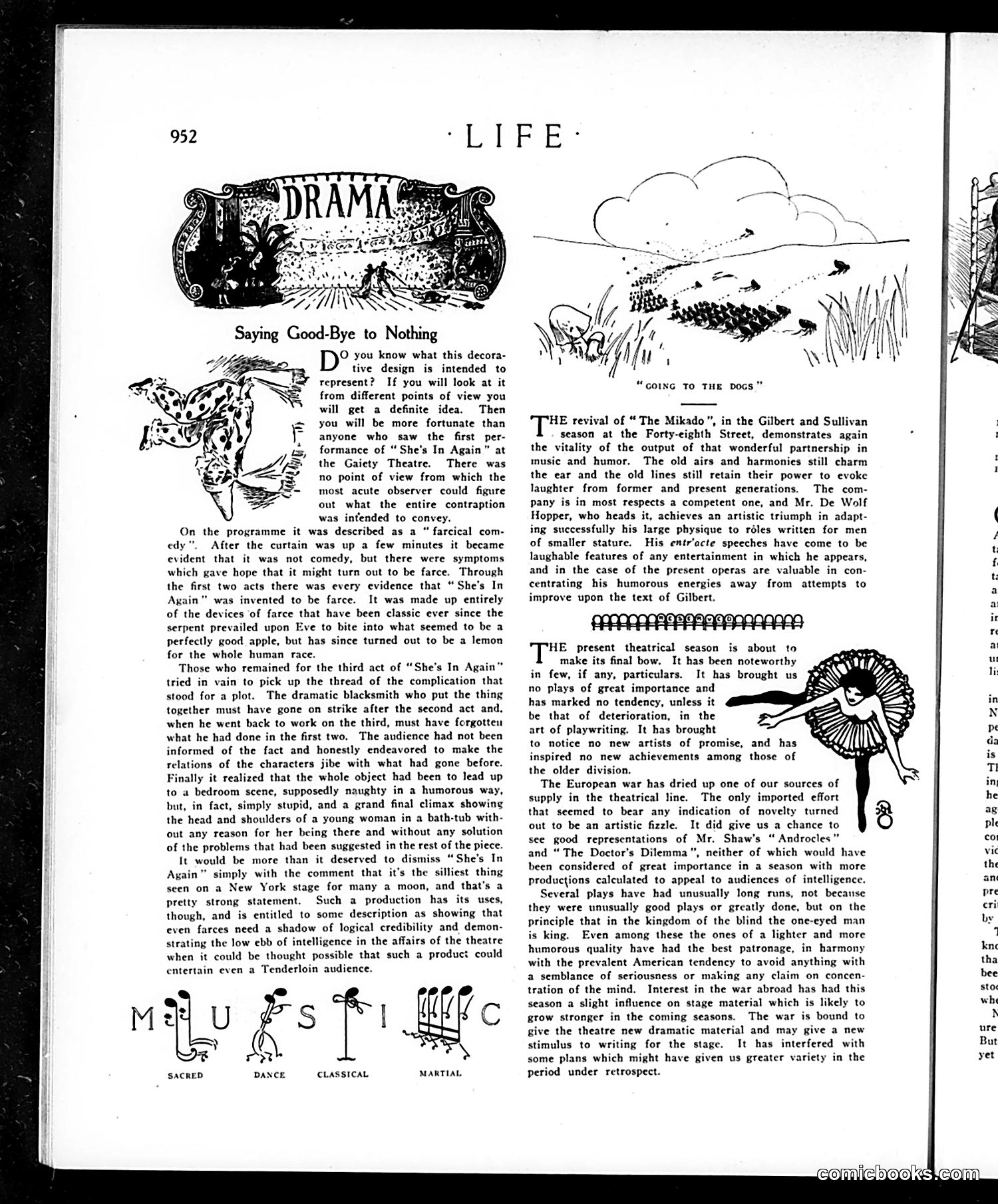
This page contains theater reviews from an American satirical magazine. The main content critiques Broadway productions: **"Saying Good-Bye to Nothing"** savagely reviews a farce called *"She's In Again"* at the Gaiety Theatre. The critic argues it's incoherent—the plot collapses after act two, and the finale (a woman in a bathtub) makes no sense. The decorative design at top symbolizes this meaninglessness; viewed from different angles, it represents nothing coherent, mirroring the play's failure. **"Going to the Dogs"** discusses a Gilbert and Sullivan revival of *"The Mikado"*, praising the music's timelessness but noting star De Wolf Hopper's comedic speeches are so entertaining they distract from Gilbert's actual text—a backhanded compliment suggesting the production needs saving from its source material. The final section observes the theatrical season ending with no significant new plays or promising artists, indicating artistic decline. This reflects post-WWI American theater struggling to find direction.
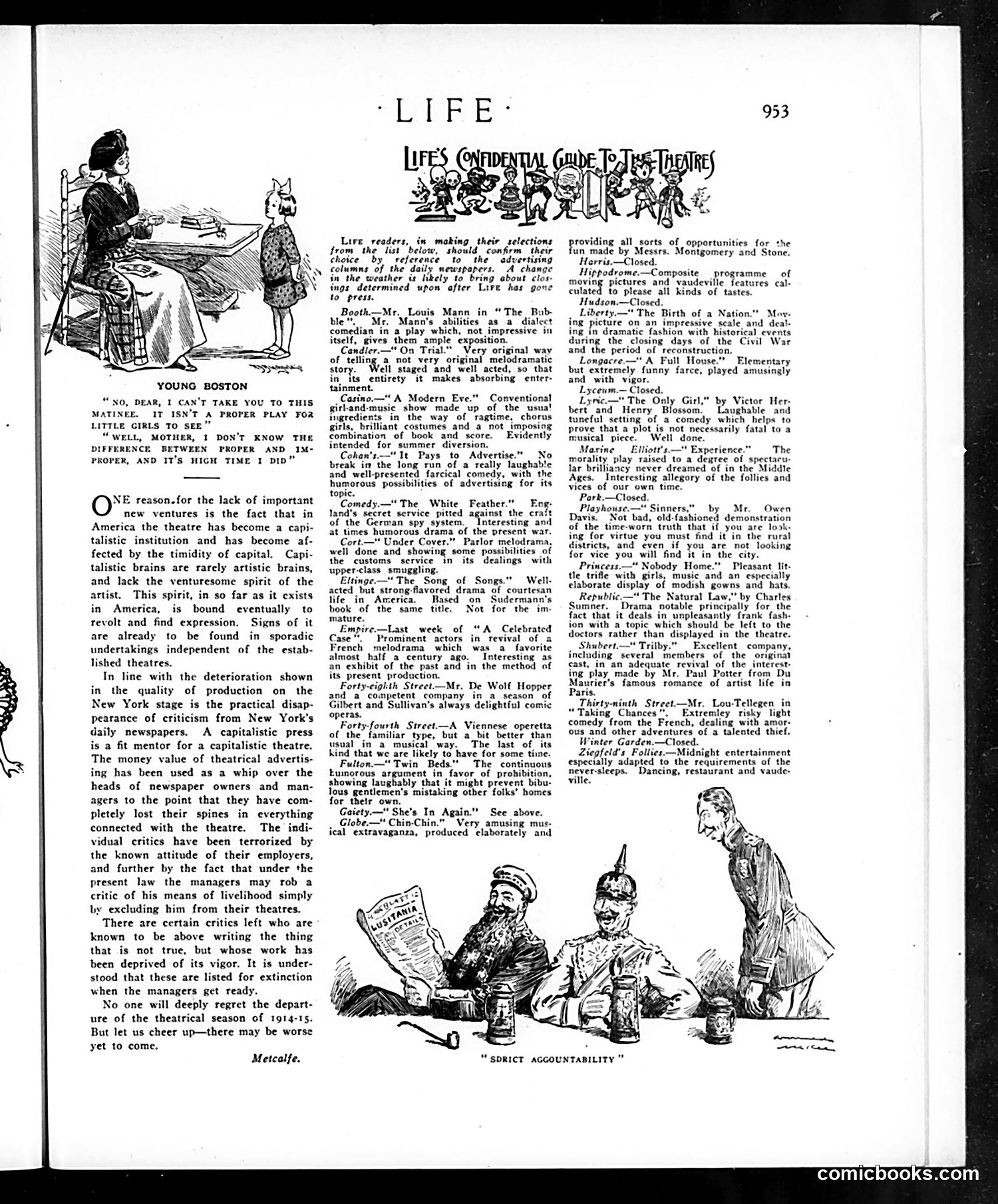
This page combines theater criticism with pointed satire about American theatrical capitalism. The top cartoon shows a Boston mother refusing to take her daughter to a "proper" matinee—a joke about censorship and propriety in theater. The main article criticizes how capitalistic interests have corrupted American theater. The author (Metcalfe) argues that profit-driven owners lack artistic vision, that newspapers suppress honest theater criticism because advertising revenue from theaters matters more than journalistic integrity, and that critics face intimidation or exclusion from theaters if they write unfavorably. The theater listings below satirize this corruption: they humorously note that readers should confirm show selections against newspaper ads, since closings may occur after Life's publication—implying the very advertising influence the article just condemned. The bottom cartoon labeled "Strict Accountability" (artist unclear) appears to mock military or governmental oversight, though its connection to the theater content is uncertain.
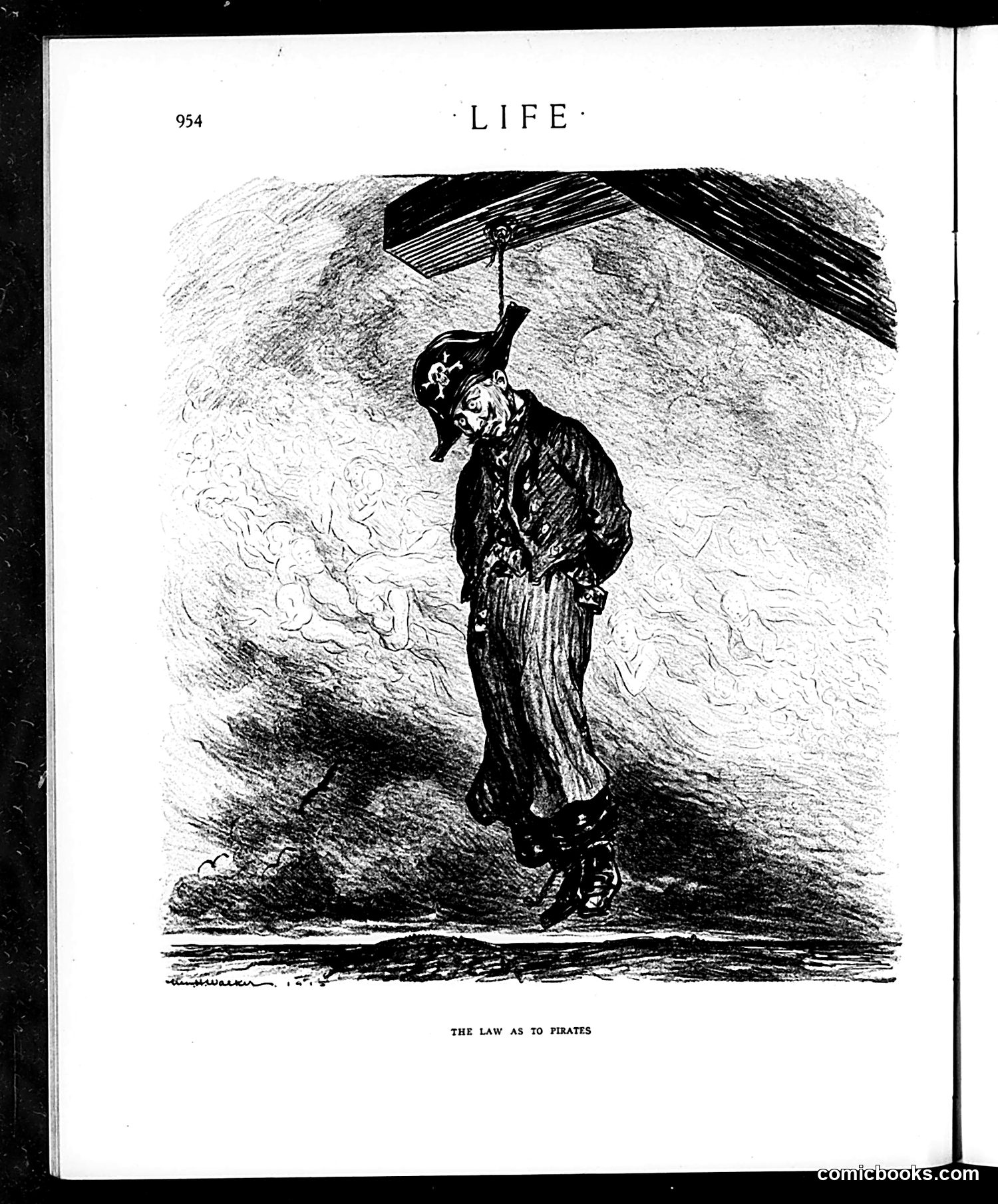
This satirical cartoon depicts a figure dressed as a pirate or vagabond standing in the rain holding an umbrella, looking bedraggled and distressed. The caption "THE LAW AS TO PIRATES" suggests commentary on how laws treat pirates or criminal elements. The exact satirical target is unclear from the image alone, but the figure's shabby appearance and vulnerable stance—contrasted with the dignified title "The Law"—likely mocks either how laws inadequately punish piracy, or how laws treat marginalized/criminal populations with contempt. The rainy, desolate setting emphasizes the subject's miserable condition. Without additional context about the publication date or political climate, the specific target remains uncertain.
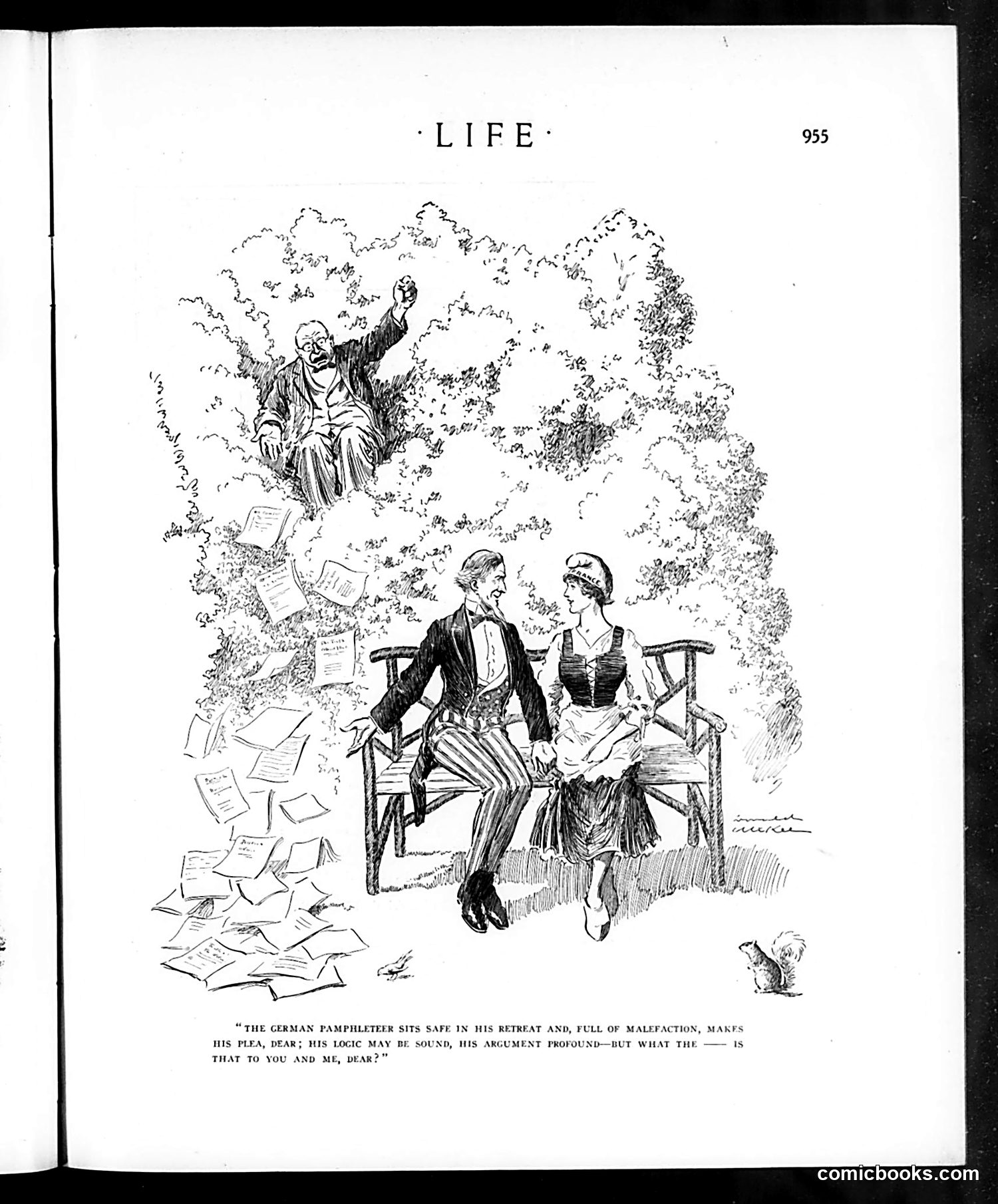
This WWI-era cartoon satirizes German propaganda efforts. A couple sits in an idyllic pastoral setting while a figure above (representing a "German pamphleteer") gestures dramatically amid scattered papers—likely propaganda leaflets. The satire targets the disconnect between abstract political arguments and ordinary people's lived reality. The man's quoted dialogue dismisses the pamphleteer's "sound logic" and "profound argument," suggesting that clever German propaganda, no matter how intellectually rigorous, is irrelevant to average citizens concerned with simple domestic happiness. The cartoon reflects American attitudes toward German wartime psychological operations—that propaganda, however well-crafted, cannot sway people focused on personal relationships and everyday life. It's a commentary on the limits of rhetorical persuasion against basic human priorities.
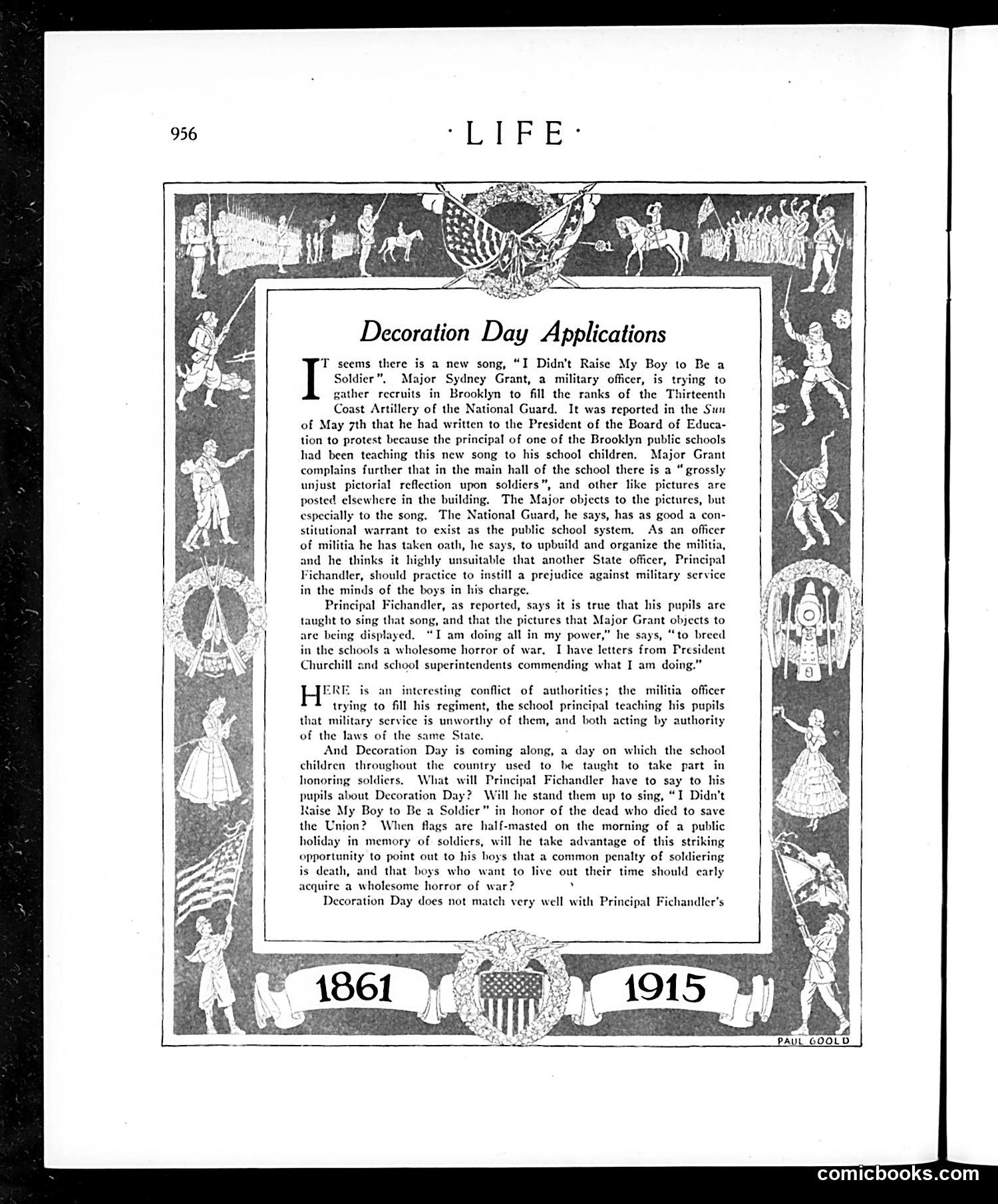
This article satirizes a conflict between militarism and pacifism in early 1915 America. Major Sydney Grant, a National Guard recruiter, protests that Brooklyn Principal Fichandler is teaching schoolchildren the anti-war song "I Didn't Raise My Boy to Be a Soldier" and displaying anti-military artwork. The satire highlights the contradiction: both men claim state authority, yet pursue opposite goals—Grant seeks military recruitment while Fichandler teaches "wholesome horror of war." The piece mocks this impasse by asking how Fichandler will handle the approaching Decoration Day (Memorial Day), when patriotic commemoration of fallen soldiers traditionally occurs. The article's tone suggests the author finds Fichandler's pacifism absurd when measured against honoring the war dead, implying the school principal's anti-military stance conflicts with basic patriotic duty.
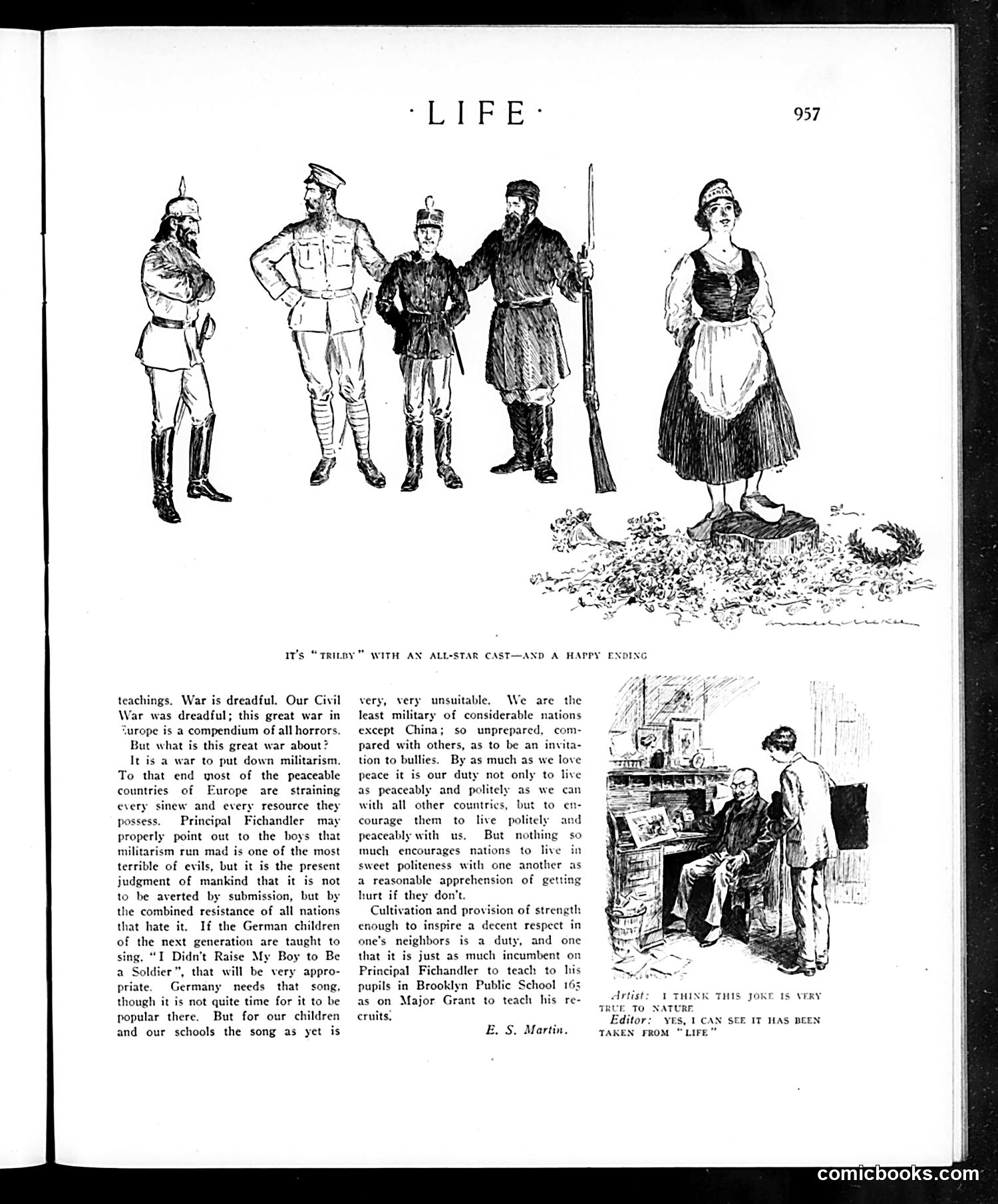
The top illustration titled "It's 'Trilby' with an All-Star Cast—and a Happy Ending" depicts five figures in military and civilian dress, likely representing European powers and nations during World War I. The cartoon satirizes the conflict as a theatrical production featuring various combatants. The accompanying text by E.S. Martin responds to Principal Fichandler's apparent pacifist teaching, arguing against the song "I Didn't Raise My Boy to Be a Soldier." Martin contends that America, being unprepared militarily, needs military strength to deter aggression from other nations. He argues that cultivation of defensive capability—not pacifism—protects peace, and that this duty applies equally to educators and military officers. The lower illustration shows a joke about Life magazine, with the editor crediting the artist's work as material "taken from Life," a self-referential gag about the magazine's own content. The page reflects WWI-era debate about American preparedness and isolationism versus military readiness.
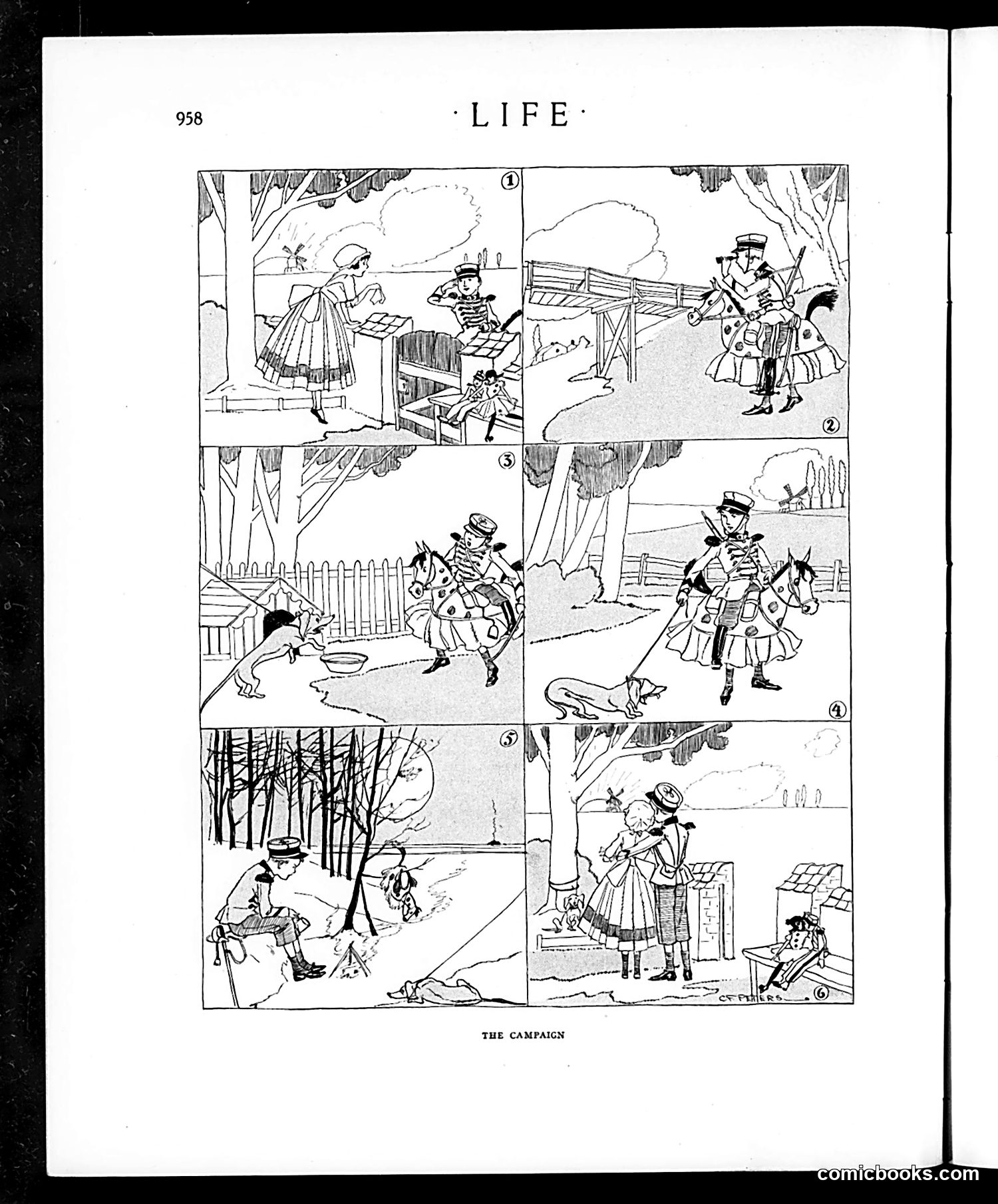
This six-panel comic strip titled "The Campaign" depicts a satirical sequence about political campaigning. The narrative appears to show a candidate (dressed formally with a hat) moving through various rural and suburban scenes, interacting with voters and citizens. The progression suggests the typical rituals of seeking political support—shaking hands, visiting homes and neighborhoods, and performing public appearances. The humor likely derives from exaggerating the performative nature of campaigning: the candidate's somewhat artificial interactions with ordinary people in domestic settings. The strip satirizes how politicians "campaign" by meeting constituents, suggesting the repetitive, theater-like quality of electoral politics. Without clearer OCR text or visible dates, the specific election or candidate referenced remains unclear.
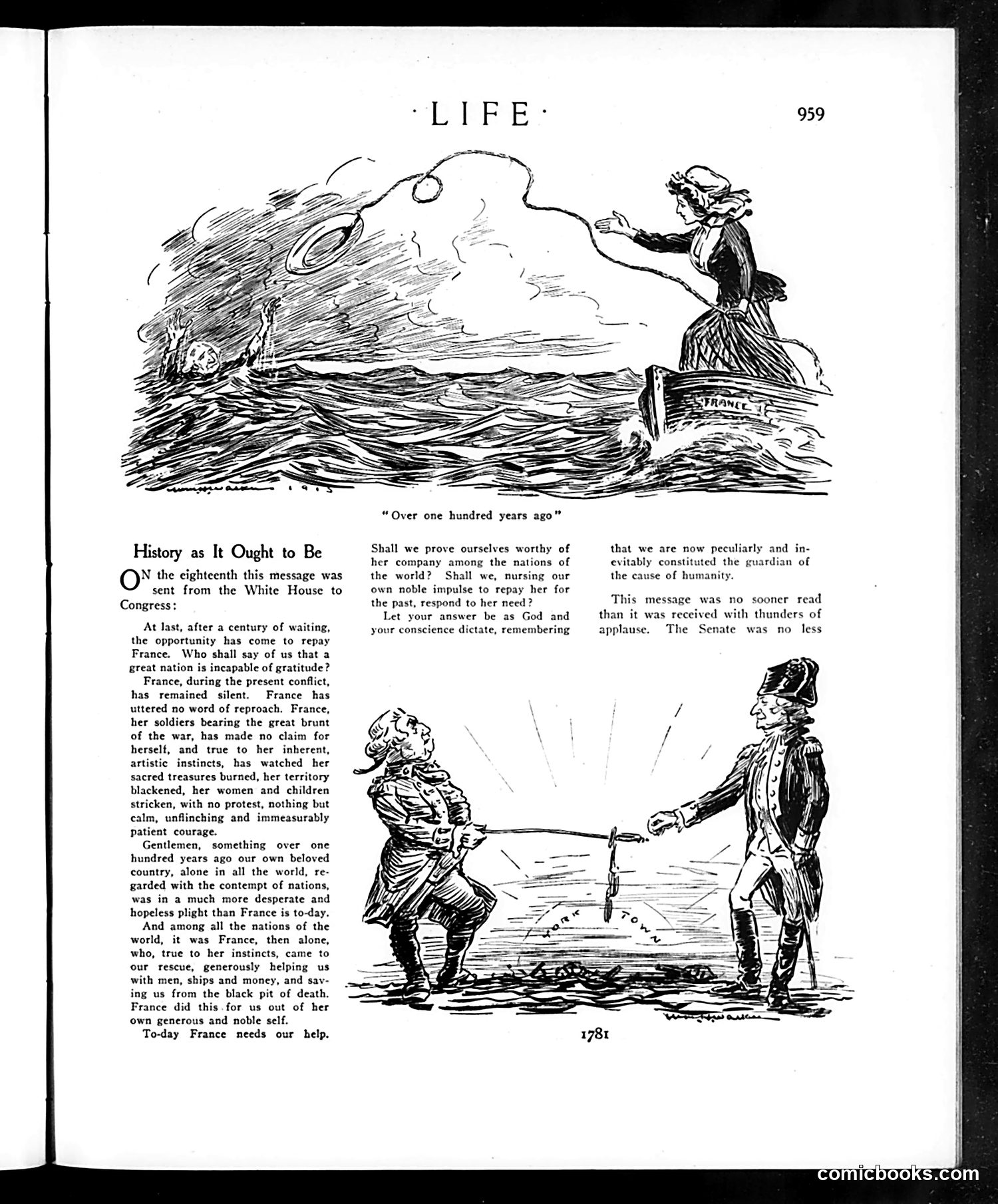
This 1918 Life magazine page satirizes American reluctance to aid France during World War I. The top cartoon shows a woman (representing France) drowning, reaching desperately for help. The bottom illustration depicts two military figures shaking hands, labeled "1781"—referencing the American Revolution when France saved the newborn United States. The accompanying text is a mock presidential message invoking historical debt: America owes France repayment for aid received "over one hundred years ago." The satire's point is clear—despite France's current suffering and past generosity, Congress hesitated to provide military support. By contrasting 1781 with the present moment, Life's cartoonists argue America should reciprocate, framing aid not as charity but as moral obligation and gratitude. The theatrical tone mocks both political rhetoric and American foot-dragging on intervention.
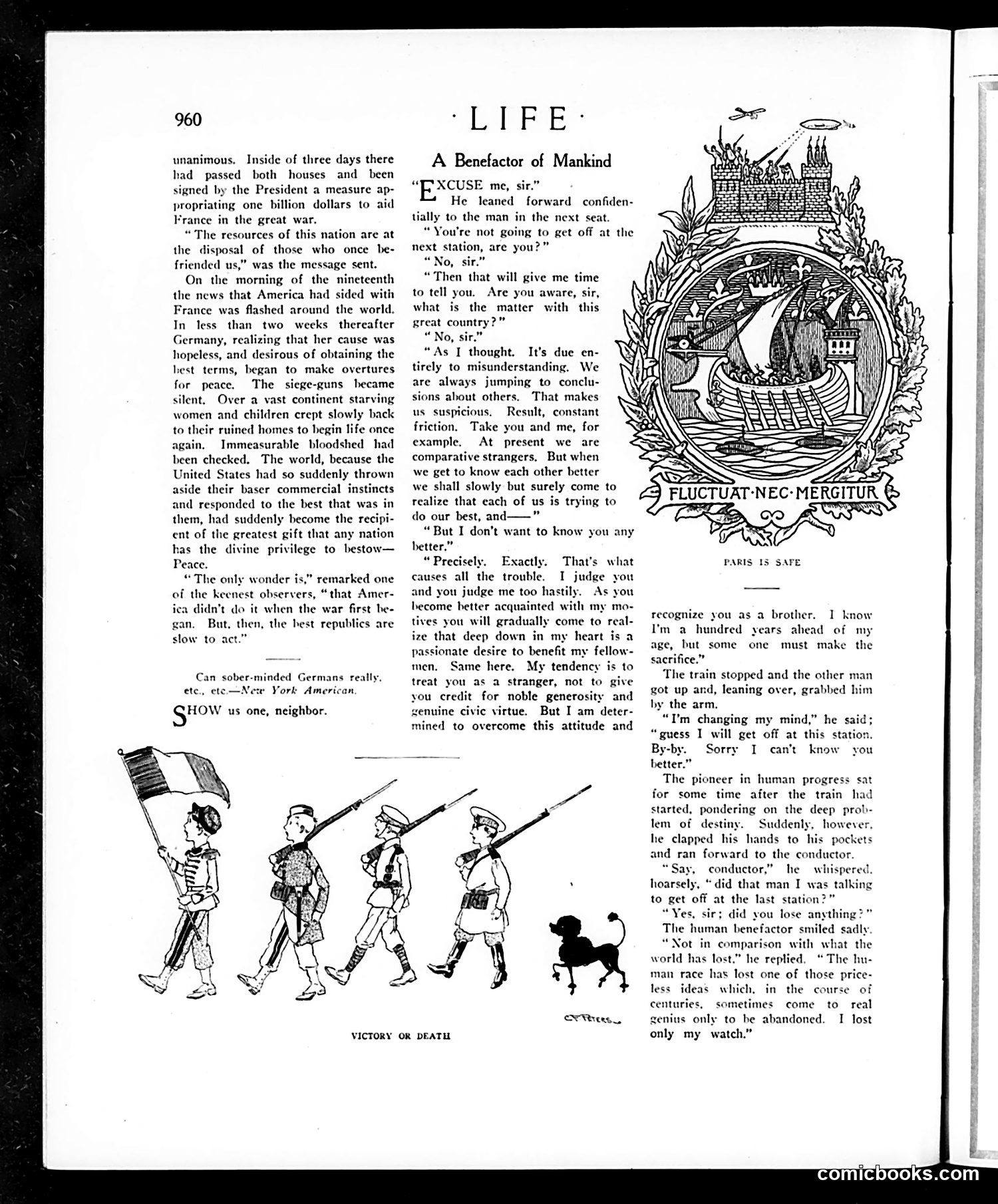
This page from *Life* magazine (appears to be post-WWI era, given references to America aiding France and Germany suing for peace) contains two distinct satirical pieces: **Left cartoon ("Victory or Death"):** Shows four German soldiers in succession, presumably depicting Germany's progression from fighting to surrendering. The caption mocks German militarism's collapse. **Main story ("A Benefactor of Mankind"):** A longer satirical narrative about a self-righteous man on a train who buttonholes a stranger with sanctimonious philosophizing about human brotherhood, mutual understanding, and overcoming prejudice—all while subtly patronizing his captive audience. The punchline reveals this "benefactor" is a hypocrite: after preaching noble ideals, he gets robbed by the very man he was lecturing, then mourns losing his watch more than "humanity" lost the man's priceless ideas. **The satire:** Mocks American self-congratulation about entering WWI as moral crusade, and skewers the type of insufferable moral pontificator who uses grand rhetoric to mask either naivety or self-interest. The theft suggests the "benefactor's" actual worth matches his hollow moralizing.
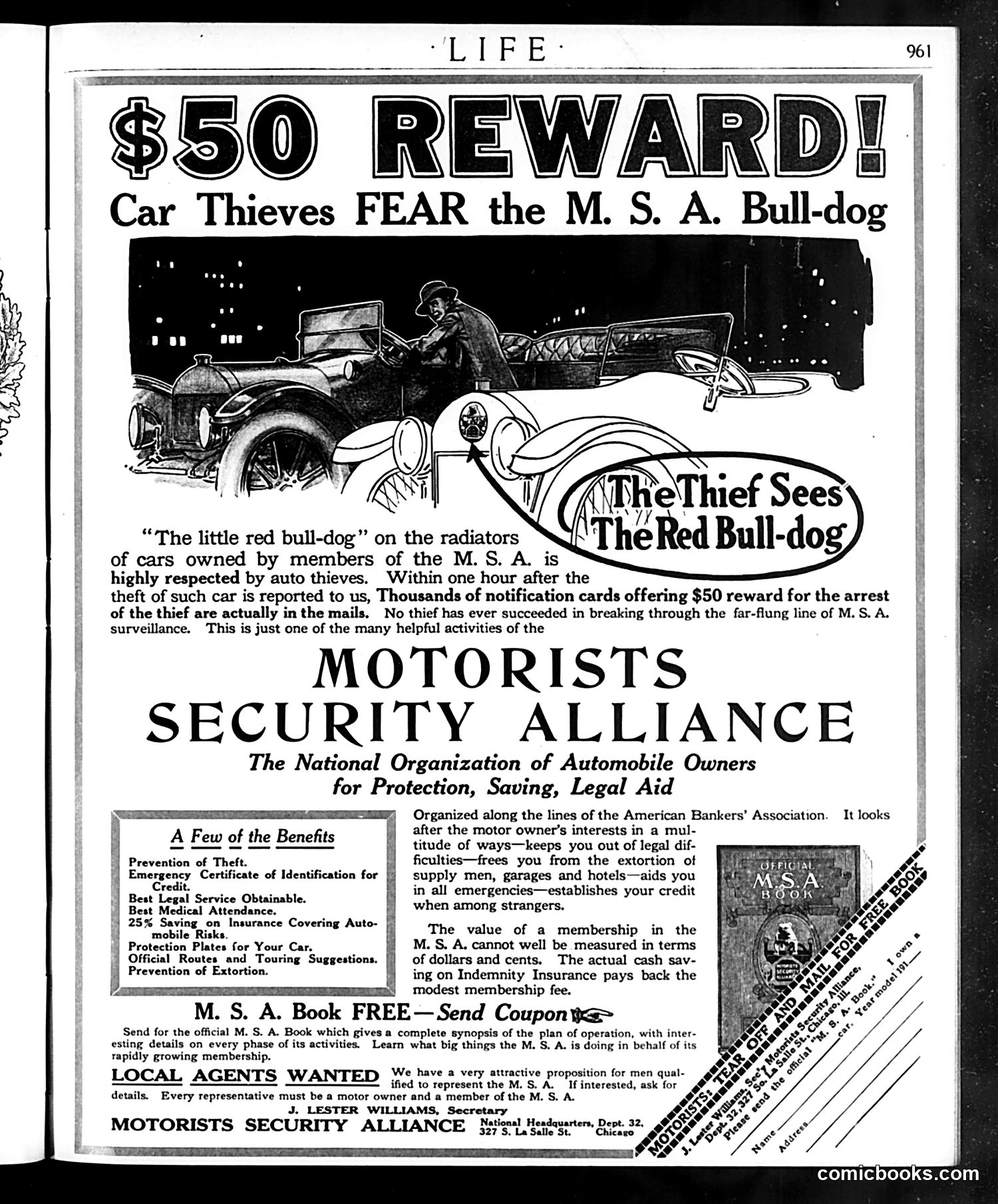
This is a **period advertisement**, not a satirical cartoon. It promotes the Motorists Security Alliance (M.S.A.), a membership organization for automobile owners, circa early 1900s. The "Red Bull-dog" emblem appearing on member car radiators supposedly deterred car thieves through fear of the organization's rapid $50-reward notification system. The advertisement claims no thief has ever successfully stolen from an M.S.A. member car. The organization positioned itself as protection against multiple threats: theft, legal difficulties, extortion by mechanics/garages, and credit issues when traveling. Membership benefits included legal aid, medical attendance, and insurance discounts. The page recruits local agents, requiring them to be motor owners and M.S.A. members themselves. The organization modeled itself on the American Bankers' Association structure. This reflects early automotive-era concerns: car theft was common, motorist networks were nascent, and insurance/legal protections were underdeveloped. The advertisement targets middle-class car owners seeking security and community status.
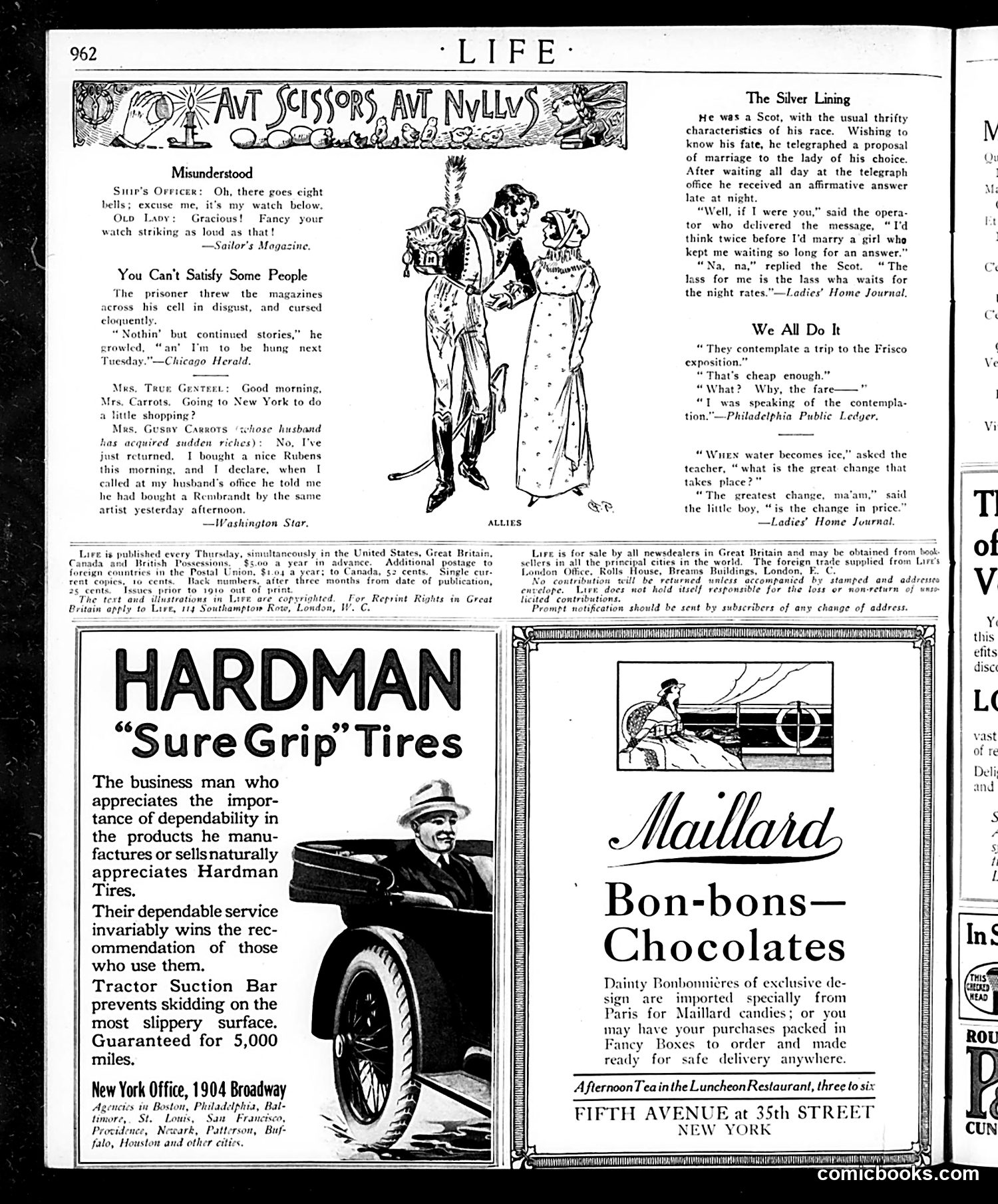
This page contains three brief satirical jokes typical of early 1900s American humor, plus period advertisements. **The Cartoons/Jokes:** 1. "Misunderstood" — A naval officer excuses himself from conversation, citing his "watch below" (nautical duty). The humor relies on the lady mishearing this as his pocket watch being loud. 2. "You Can't Satisfy Some People" — A death-row prisoner complains about receiving only serialized stories in magazines, despite his imminent execution Tuesday. The joke is that even facing death, people find trivial things to grumble about. 3. "Mrs. True Genteel" — A newly wealthy woman's husband competes with her in art purchases (Rubens, Rembrandt), satirizing nouveau-riche excess and one-upmanship among the newly rich. The page also contains era-appropriate advertisements for Hardman tires, Maillard chocolates, and brief humorous anecdotes about a thrifty Scot and a child's economics joke about ice prices. This is straightforward period humor reflecting early 20th-century social attitudes and concerns.
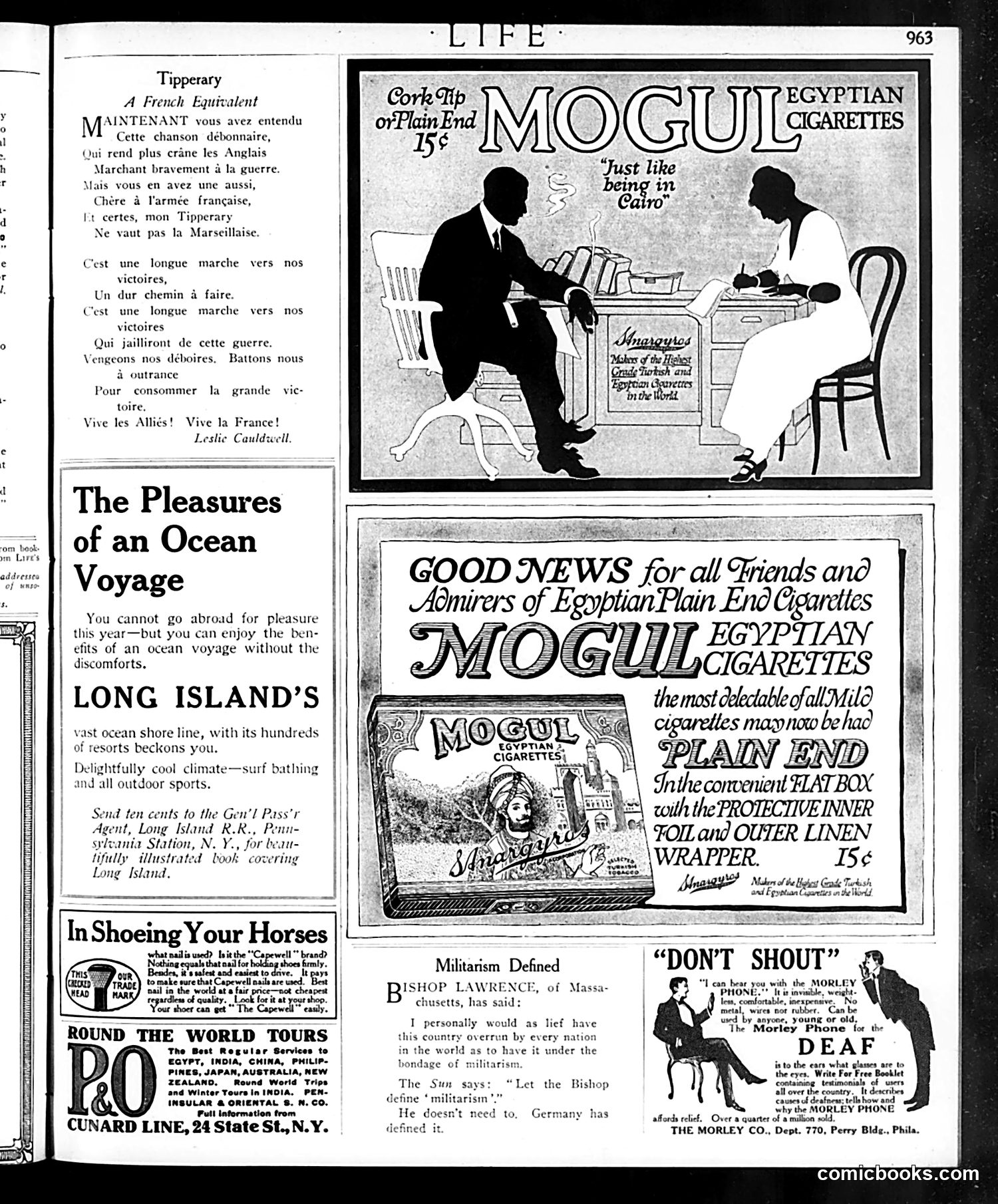
This page mixes wartime content with advertising typical of circa 1915-1918. **Top Section:** A French patriotic poem responds to the popular British WWI song "It's a Long Way to Tipperary," offering a French equivalent celebrating Allied victory and French military resolve. **Cigarette Advertisements:** Mogul Egyptian Cigarettes dominate the right side, using casual imagery of two men at a café table ("Just like being in Cairo") to market their product at 15 cents. This reflects pre-health-warning era advertising normalcy. **"Militarism Defined":** A brief editorial comment references Bishop Lawrence of Massachusetts opposing militarism. The Sun newspaper sarcastically responds that Germany has already "defined" militarism through its actions—a pointed reference to German aggression in WWI, suggesting Germany's conduct (rather than any explicit ideology) exemplifies what militarism means. **Surrounding Ads:** Travel tours, ocean voyage promotions, and horse-shoeing products fill remaining space—standard magazine filler. The page reflects American WWI-era sentiment and pre-modern advertising standards.
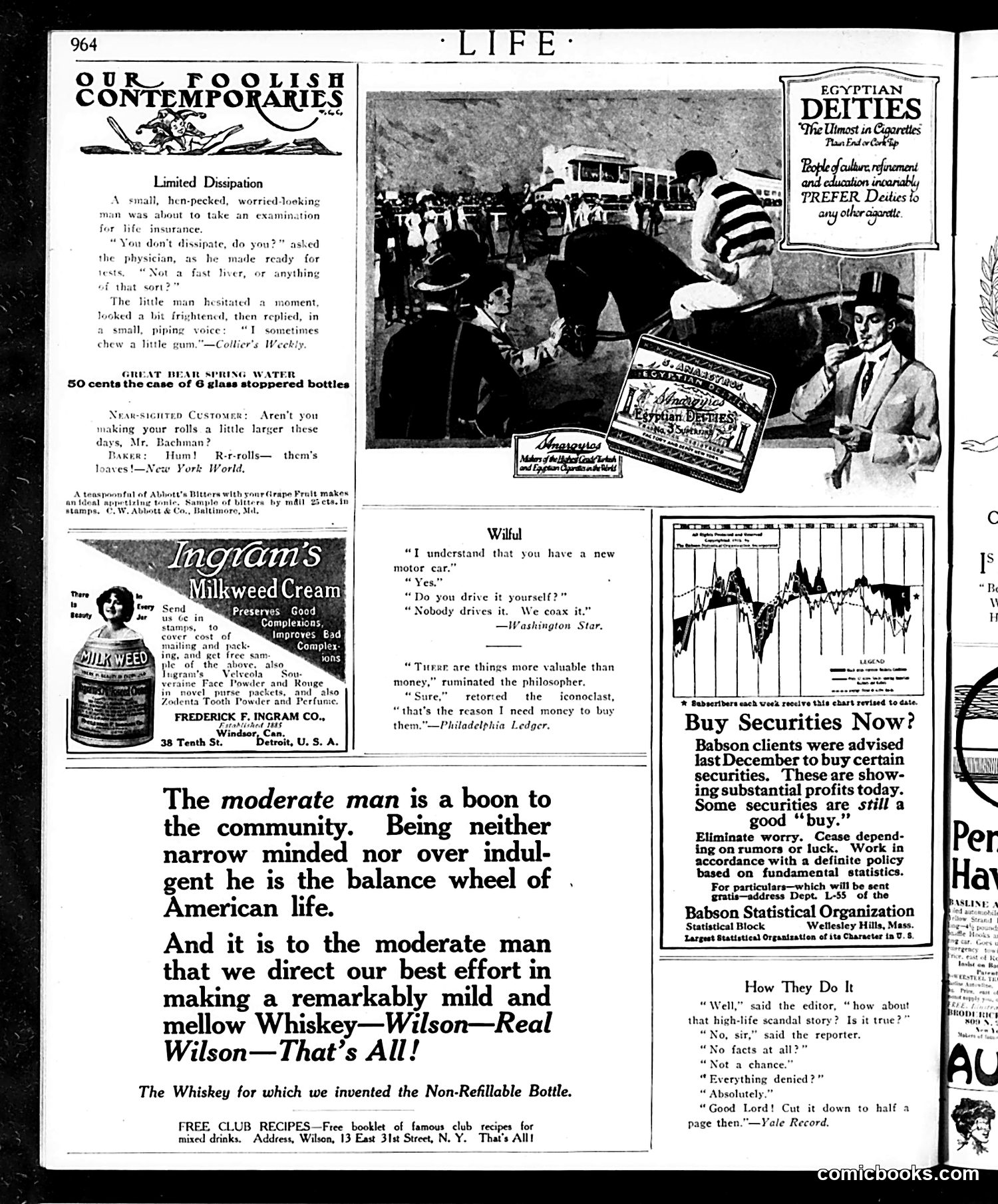
This page contains multiple short humorous items rather than unified political cartoons. **"Limited Dissipation"** jokes about a nervous man taking a life insurance exam—the physician asks if he's a "fast liver," and the man's anxious reply suggests he's hen-pecked and worrisome, implying his modest lifestyle makes him low-risk insurance. **The motor car joke** satirizes the new automobile technology: a man claims "nobody drives it. We coax it"—mocking early cars' unreliability and difficulty of operation. **The philosopher dialogue** contrasts idealism with materialism: when a philosopher claims intangible things matter more than money, the pragmatist responds you need money to *buy* those things anyway. **"The moderate man" section** is actually advertising for Wilson Whiskey, dressed up as social philosophy—claiming moderation is virtuous while promoting alcohol. **"How They Do It"** mocks sensationalist journalism: an editor publishes a scandal story he knows is completely false, based purely on entertainment value. The page is primarily advertising dressed as humor and social commentary—typical of early-20th-century Life magazine's format.
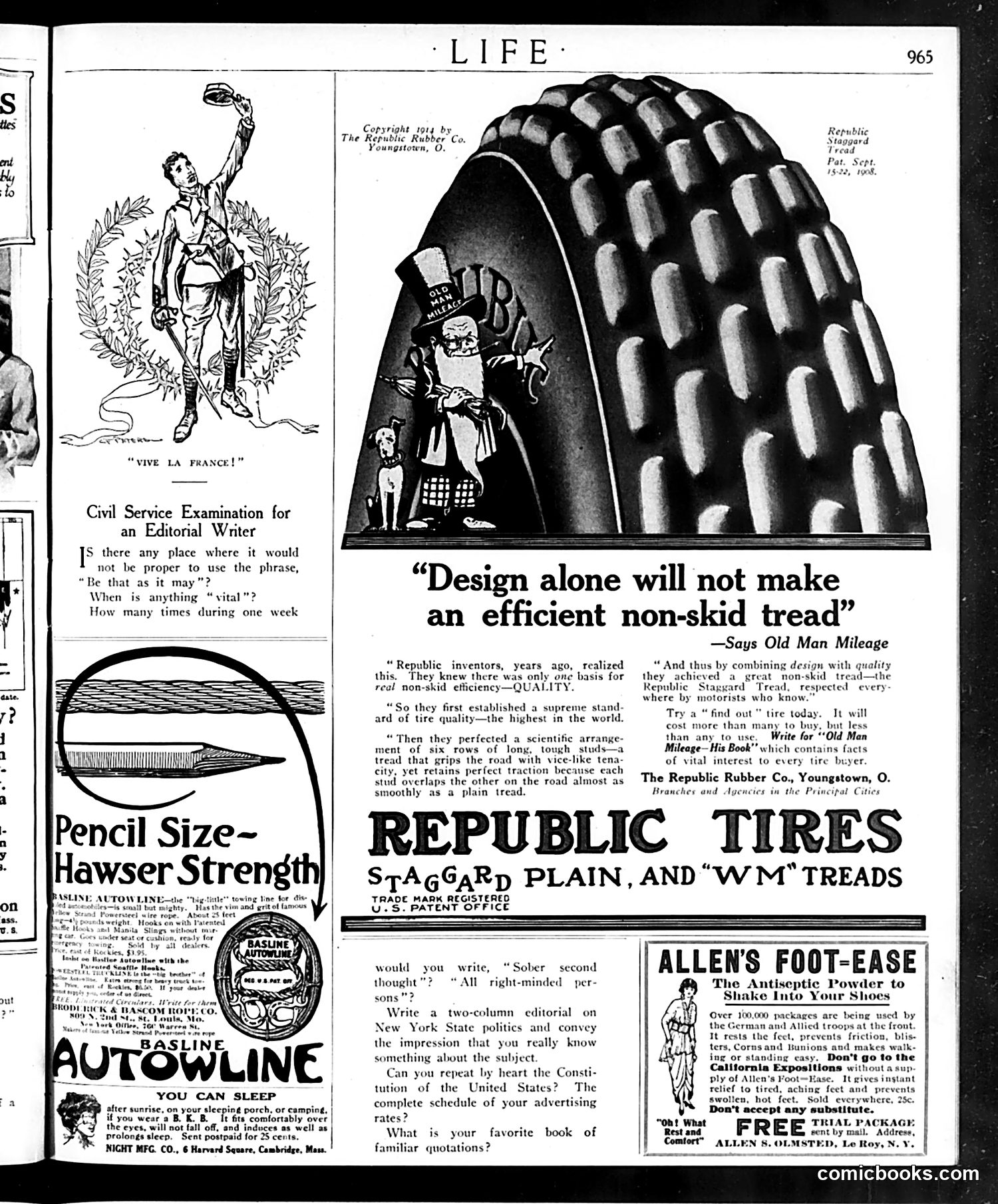
This page contains a satirical examination titled "Civil Service Examination for an Editorial Writer"—mocking the formulaic writing of newspaper editorialists. The questions mock clichéd editorial phrases: "Be that as it may," overuse of the word "vital," and reliance on memorized quotations from familiar books rather than original thought. The satire targets editorial writers of 1914 as intellectually lazy, suggesting they succeed through formula and memorization rather than genuine knowledge or analysis. Questions like "Can you repeat by heart the Constitution?" imply editors don't truly understand political subjects they write about. The page also contains period advertisements (Republic Tires, Basline Autoline, Allen's Foot-Ease) and a left-hand cartoon showing a figure holding up a laurel wreath with "Vive la France!"—likely reflecting American sentiment during World War I. The overall message: newspaper editorial writing had become a mechanical exercise in clichés rather than genuine journalism.
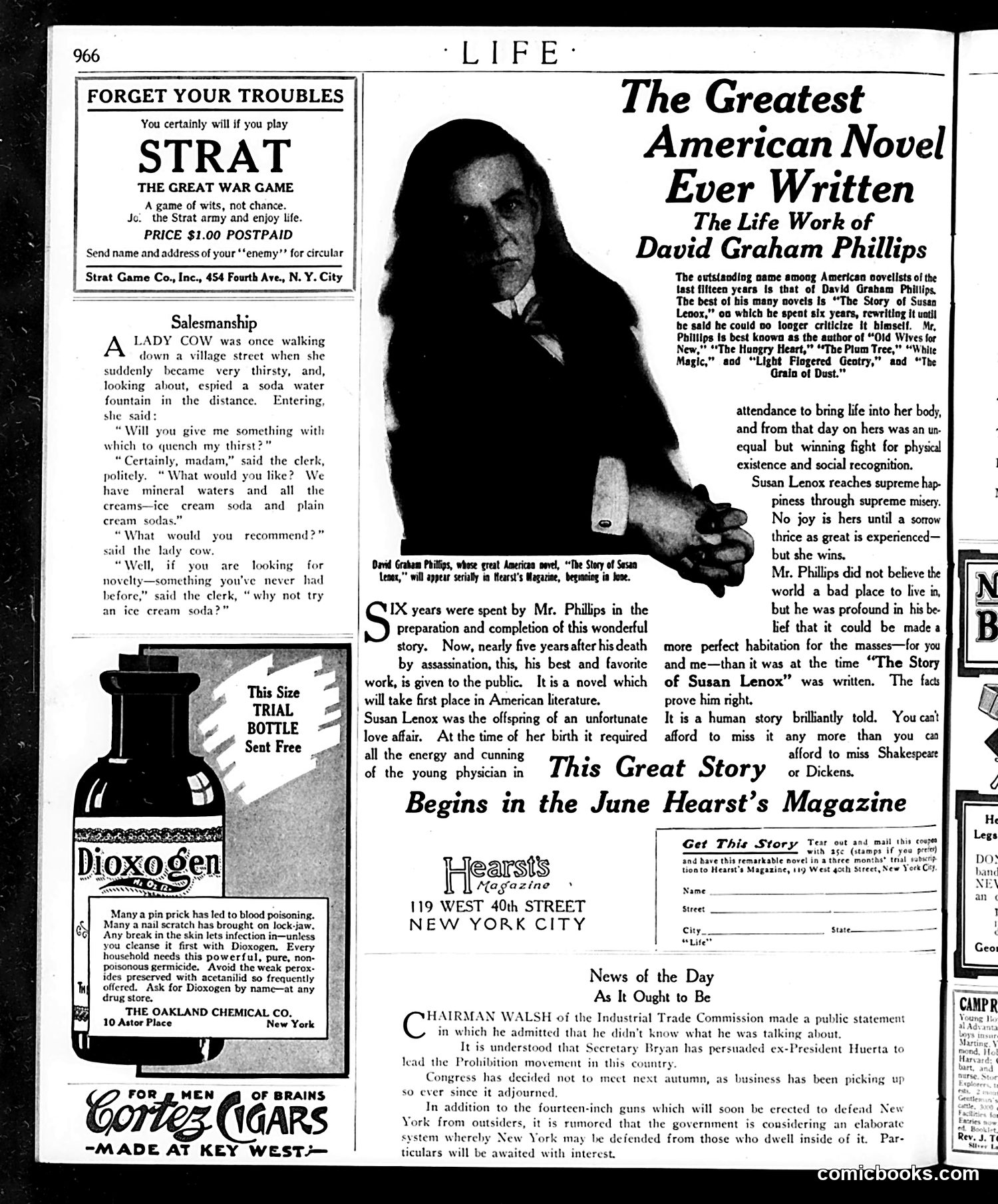
This page contains primarily **advertisements and promotional content** rather than political cartoons. The main feature is an advertisement for David Graham Phillips's novel *"The Story of Susan Lenox,"* serializing in Hearst's Magazine. The accompanying biographical text emphasizes Phillips spent six years writing this work about an illegitimate woman's struggle for "physical existence and social recognition," portraying it as a great American novel addressing social reform. The page also includes: - **"Strat" game advertisement**: A WWI-themed board game marketed as entertainment to forget troubles - **"Lady Cow" anecdote**: A gentle humor piece about salesmanship (a clerk recommends ice cream soda to a cow) - **Product ads**: Dioxogen (antiseptic) and Cortez cigars The Phillips promotion reflects early 20th-century literary culture and serialized fiction's popularity. No clear political satire or caricature is evident on this page.
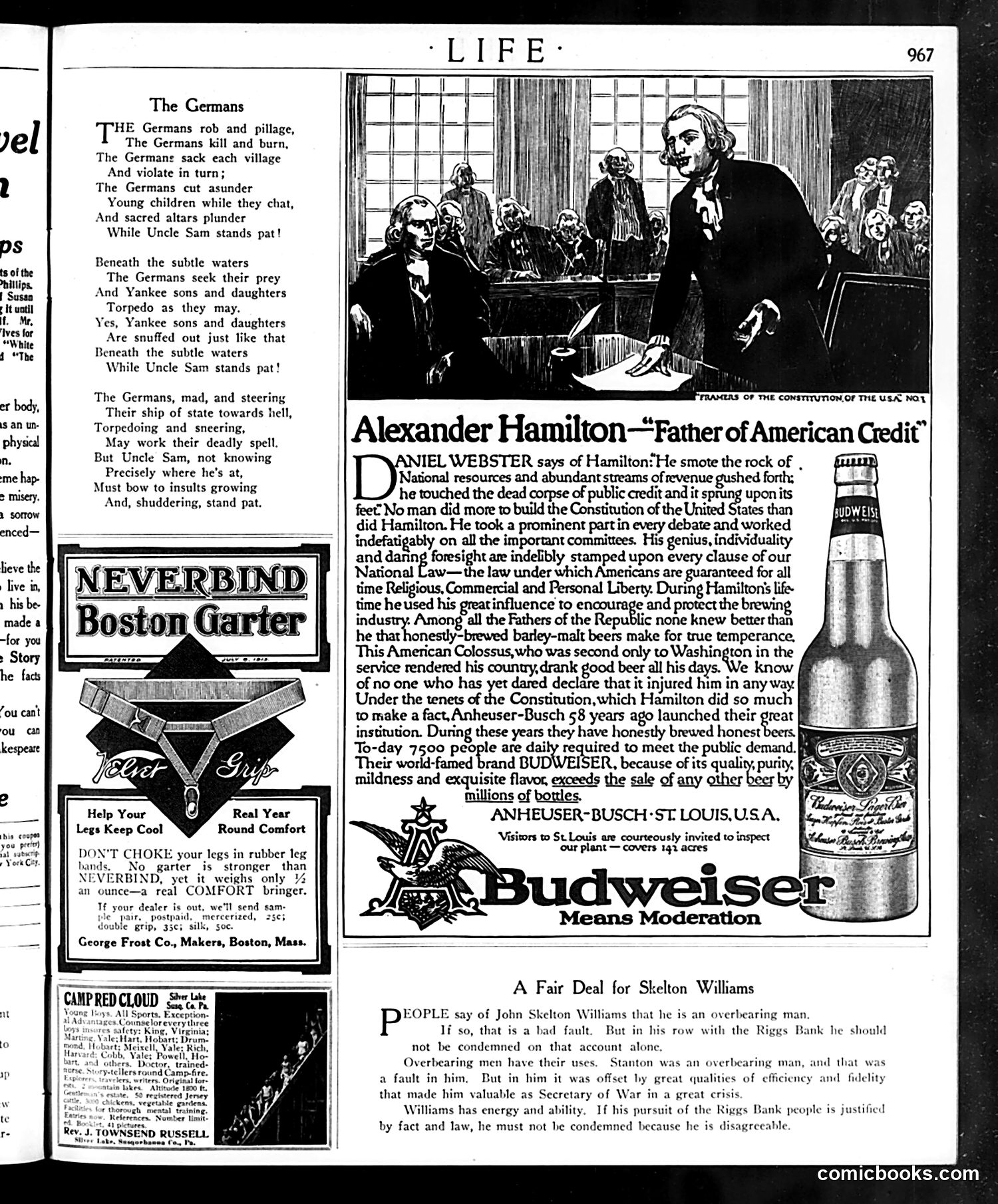
**"The Germans" Poem:** This is WWI-era propaganda criticizing American neutrality. The verse accuses Germany of atrocities (killing children, sinking ships with American victims) while America—represented as "Uncle Sam"—passively "stands pat." The poem urges U.S. intervention, suggesting neutrality is complicity. This reflects pre-1917 American debate over entering the war. **Alexander Hamilton Advertisement:** Anheuser-Busch exploits Hamilton's Founding Father status to legitimize beer drinking. The ad claims Hamilton encouraged "honestly-brewed barley-malt beers" for temperance, implying beer consumption is patriotic and constitutional. This is transparently self-serving corporate propaganda, using historical authority to sell alcohol. **"Fair Deal for Skelton Williams" Item:** A brief defense of John Skelton Williams (likely a Federal Reserve official), acknowledging his "overbearing" personality but arguing his aggressive tactics served the public good, particularly regarding the Riggs Bank controversy. **Context:** This 1917 *Life* magazine page blends war propaganda, commercial advertising, and political defense—typical of the era's editorial mix.
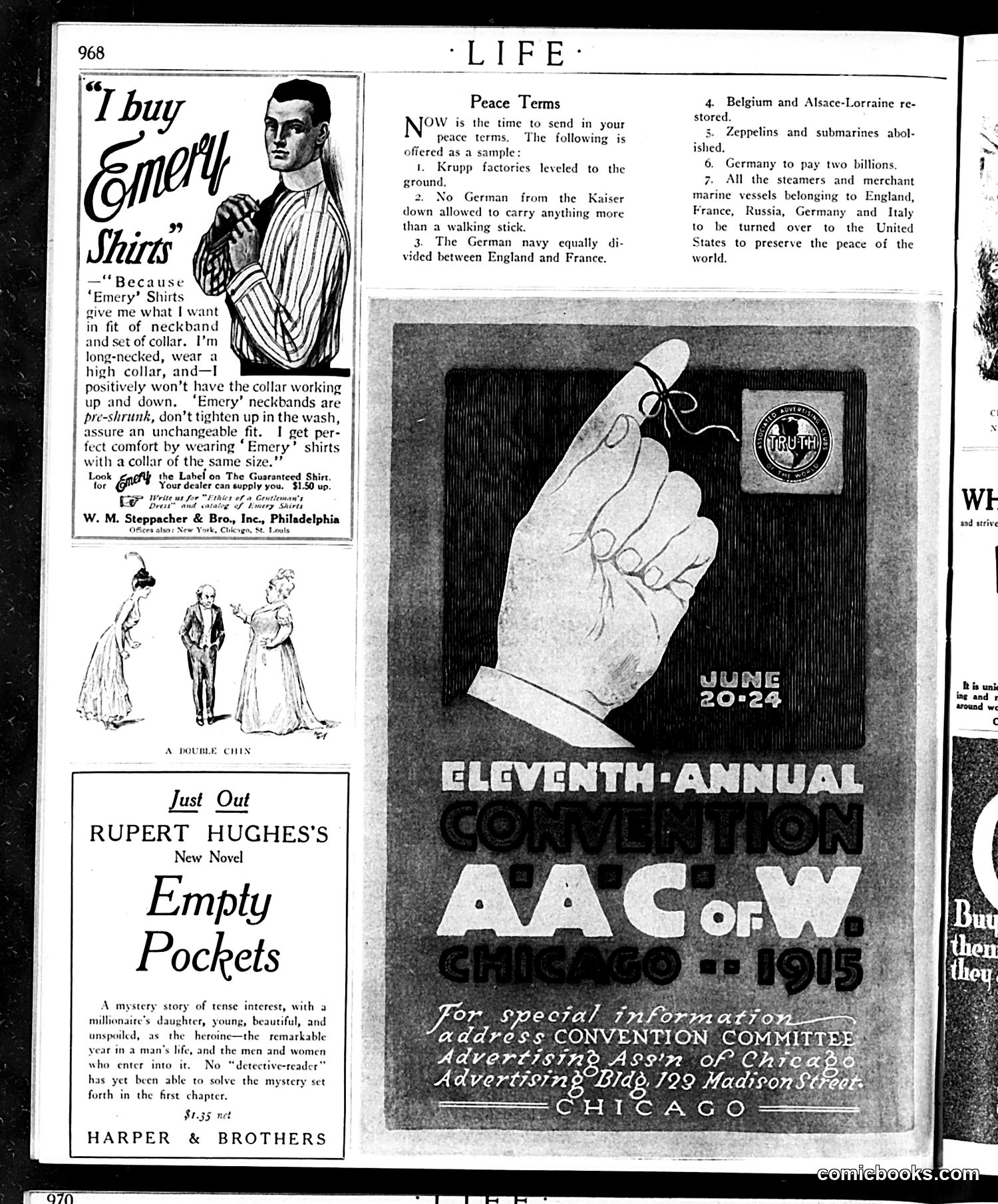
This page mixes advertisements with political satire typical of Life magazine during World War I (the "Peace Terms" section dates this to around 1918). **The "Peace Terms" section** is satirical commentary on potential German war reparations. It mockingly proposes harsh punitive measures: destroying Krupp munitions factories, stripping Germans of weapons, dividing the German navy between Britain and France, restoring Belgian/Alsace-Lorraine territories, abolishing submarines and zeppelins (weapons that terrorized civilians), imposing a two-billion-mark indemnity, and transferring German merchant vessels to the U.S. These proposals reflect American public sentiment toward defeated Germany—combining practical military disarmament with economic punishment and territorial loss. The satirical tone suggests the author finds these demands (however severe) justified given German aggression. **Other content** includes standard period advertising (Emery Shirts, emphasizing quality neckbands for long-necked men) and a book advertisement for Rupert Hughes's mystery novel *Empty Pockets*. The "Double Chin" illustration remains unexplained on this fragment.
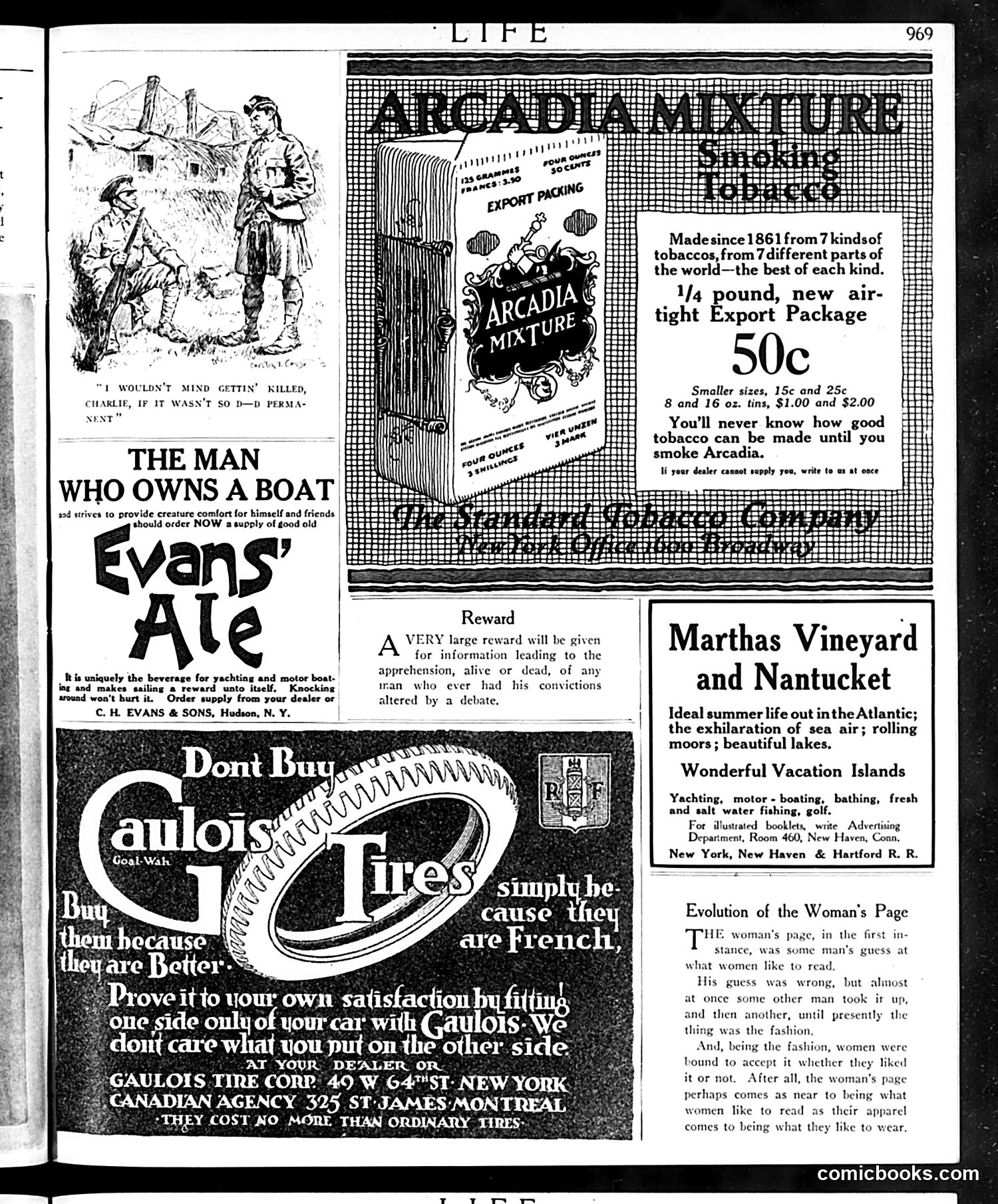
This page is primarily **advertising** with one small cartoon at top left. The cartoon depicts two soldiers in what appears to be a WWI trench setting. One says to the other: "I wouldn't mind gettin' killed, Charlie, if it wasn't so d—d permanent." This is **dark war humor**—gallows comedy about the finality of death in combat. The joke relies on the soldier's absurd understatement, treating death as merely an inconvenience rather than the ultimate consequence. The advertisements reflect early 20th-century consumer goods: Evans' Ale for boat owners, Arcadia tobacco mixture, Gaulois tires (French brand), and Martha's Vineyard vacation packages. A brief essay on "Evolution of the Woman's Page" notes that women's magazines historically reflected male assumptions about what women wanted to read, until women themselves began determining content—paralleling how women's fashion evolved from male-dictated to female-chosen preferences. The page captures a moment when WWI was fresh enough for satirical treatment and consumer culture was expanding.
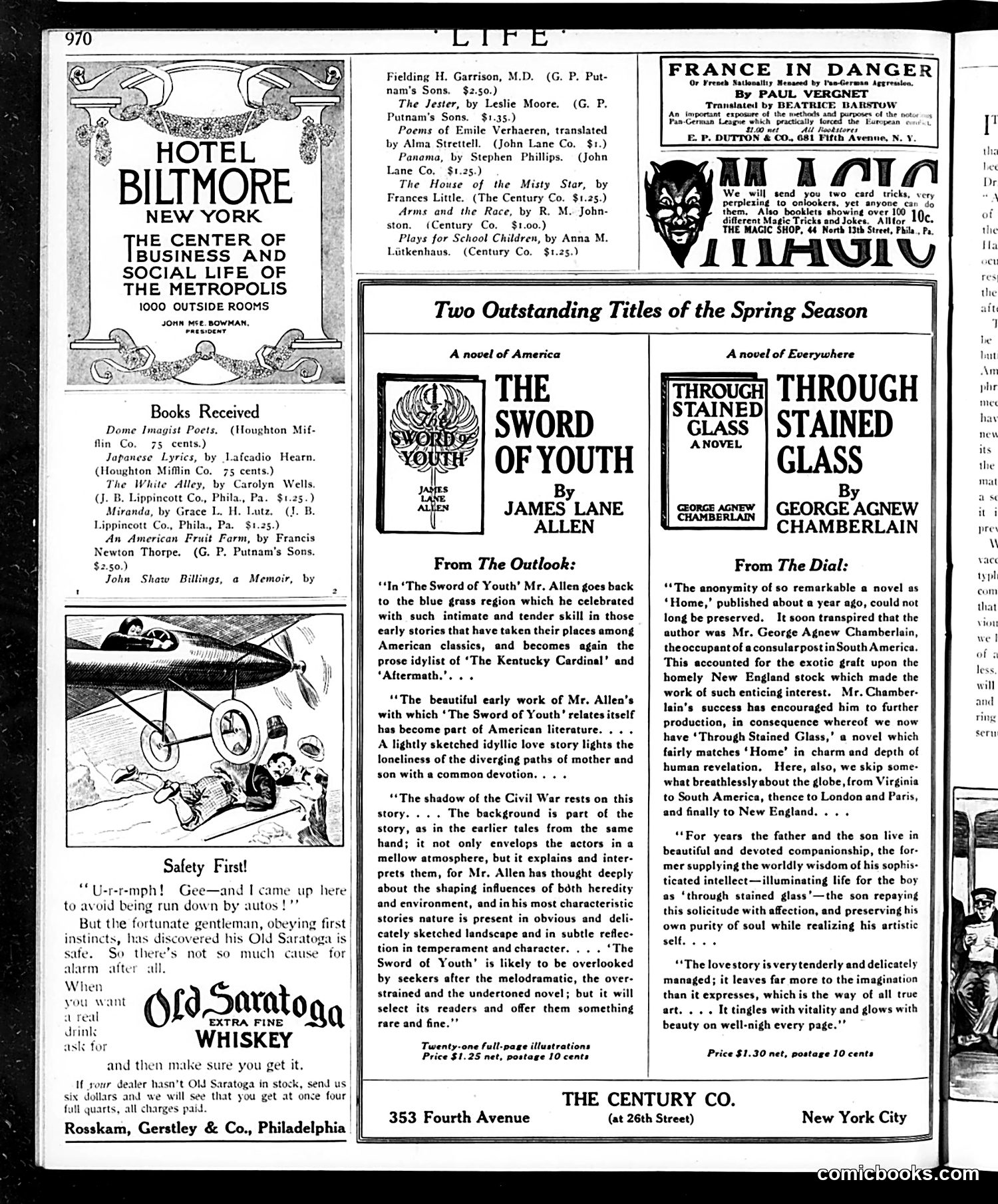
This page is primarily **advertising and book reviews**, not political satire. The main content includes: 1. **Hotel Biltmore advertisement** (top left) - promoting New York's premier business hotel 2. **"Safety First" cartoon** (center-left) - depicts a man fleeing automobiles, seeking refuge in a bar for Old Saratoga whiskey. The joke references the early 1900s "Safety First" movement, a genuine public concern about automobile dangers. The irony: he escapes traffic danger only to consume alcohol, which poses its own risks. This reflects contemporary anxieties about new technology. 3. **Book reviews and advertisements** - promoting spring publications including novels by James Lane Allen and George Agnew Chamberlain, plus a book on French military preparedness titled "France in Danger." 4. **Magic shop advertisement** (right side) - promoting card tricks and magic instruction booklets The page reflects early-20th-century concerns: automobile safety, literature, and (subtly) European military tensions.
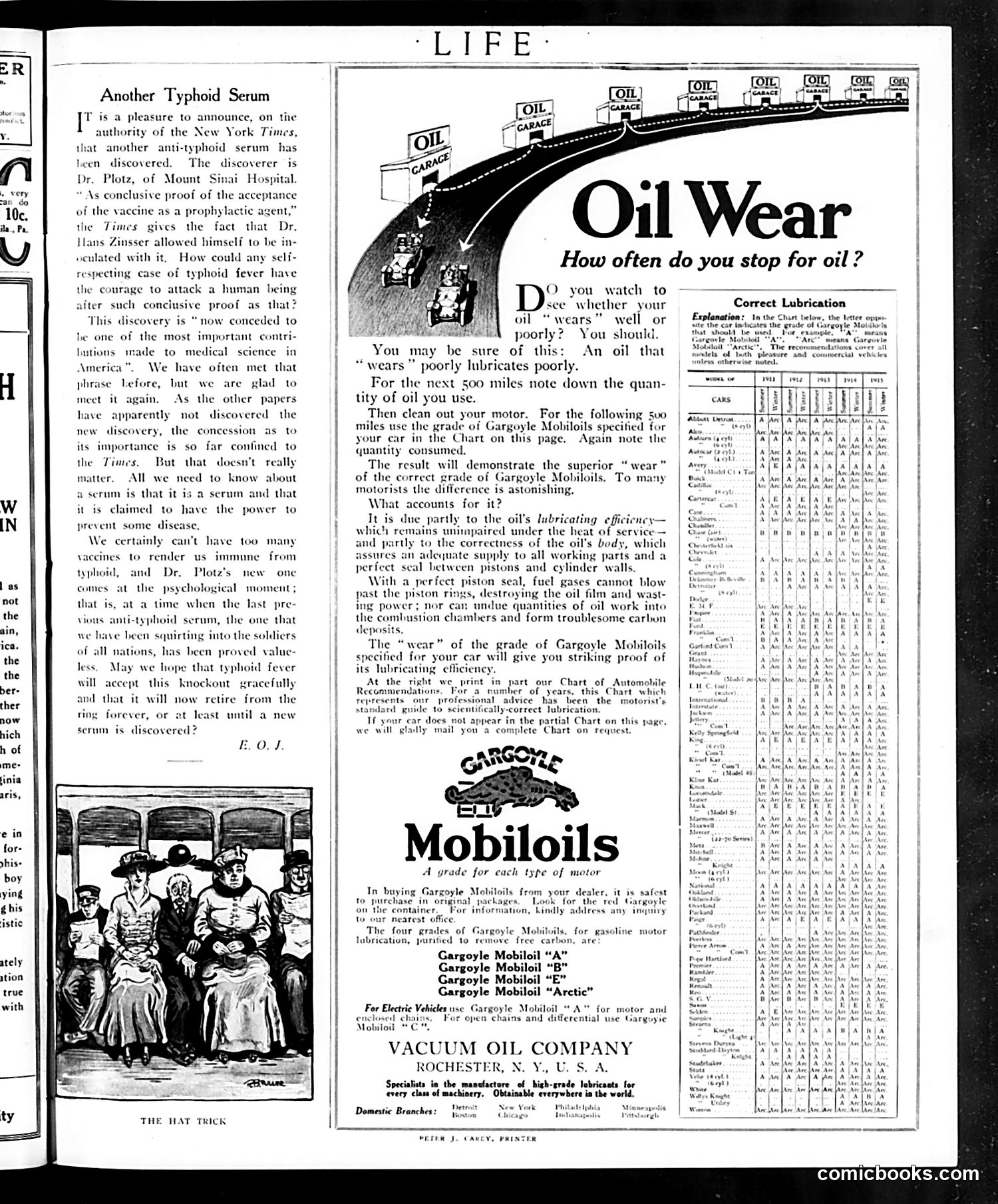
This page contains two distinct elements: **Left side - Editorial satire:** A brief satirical piece mocking the announcement of yet another anti-typhoid serum by Dr. Plotz. The satire's point: Life magazine is skeptical of constant claims of medical "breakthroughs." The joke relies on the absurdity that the New York Times validated the serum simply because Dr. Hans Zinsser allowed himself to be inoculated—as if typhoid fever would be too "polite" to attack someone with such prestigious endorsement. The piece sarcastically suggests that previous typhoid serums given to soldiers have proven worthless, so this latest miracle cure will likely join them. **Right side - Advertisement:** A full-page ad for Gargoyle Mobiloils motor oil, featuring a chart recommending specific oil grades for different car models and an explanation of how proper oil "wear" prevents engine damage. **Context:** The page juxtaposes medical skepticism against corporate advertising, typical of Life's satirical approach to American institutions and consumer culture in the early 20th century.
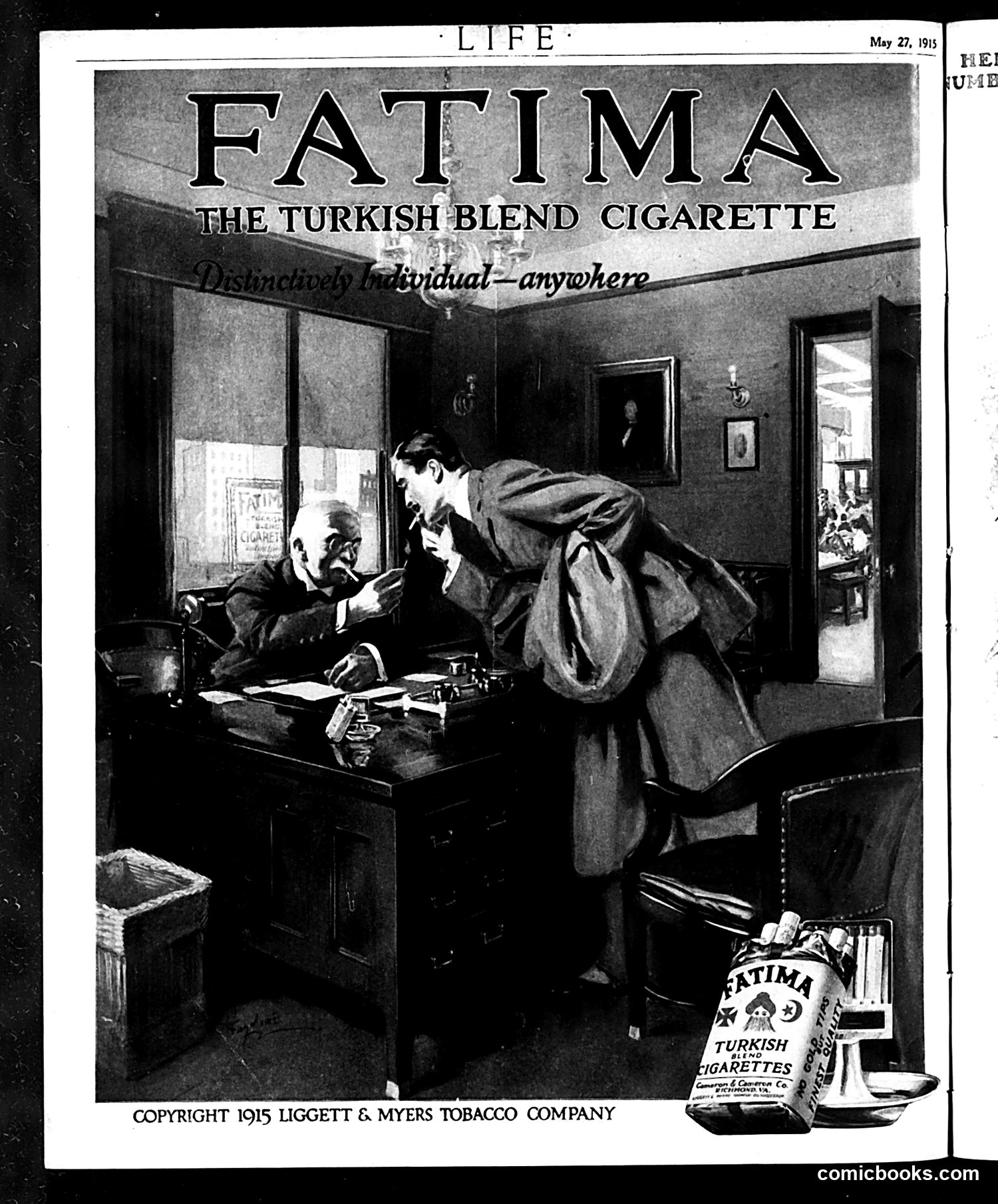
This is a full-page advertisement for Fatima cigarettes, not political satire. The image shows an office scene where a well-dressed man leans toward a seated older man at a desk, apparently conducting business or making a pitch. The tagline claims the cigarettes are "Distinctively individual—anywhere," suggesting they're appropriate for any social or professional setting. The advertisement relies on aspirational imagery—professional men in a respectable office environment—to position the product as sophisticated and refined. This represents early 20th-century tobacco marketing, when cigarettes were actively promoted without health warnings. The Fatima brand name itself references Turkish tobacco, then associated with exotic quality and premium status.