
Life, 1915-05-27 · page 28 of 44
Life — May 27, 1915 — page 28: what you’re looking at
What you’re looking at
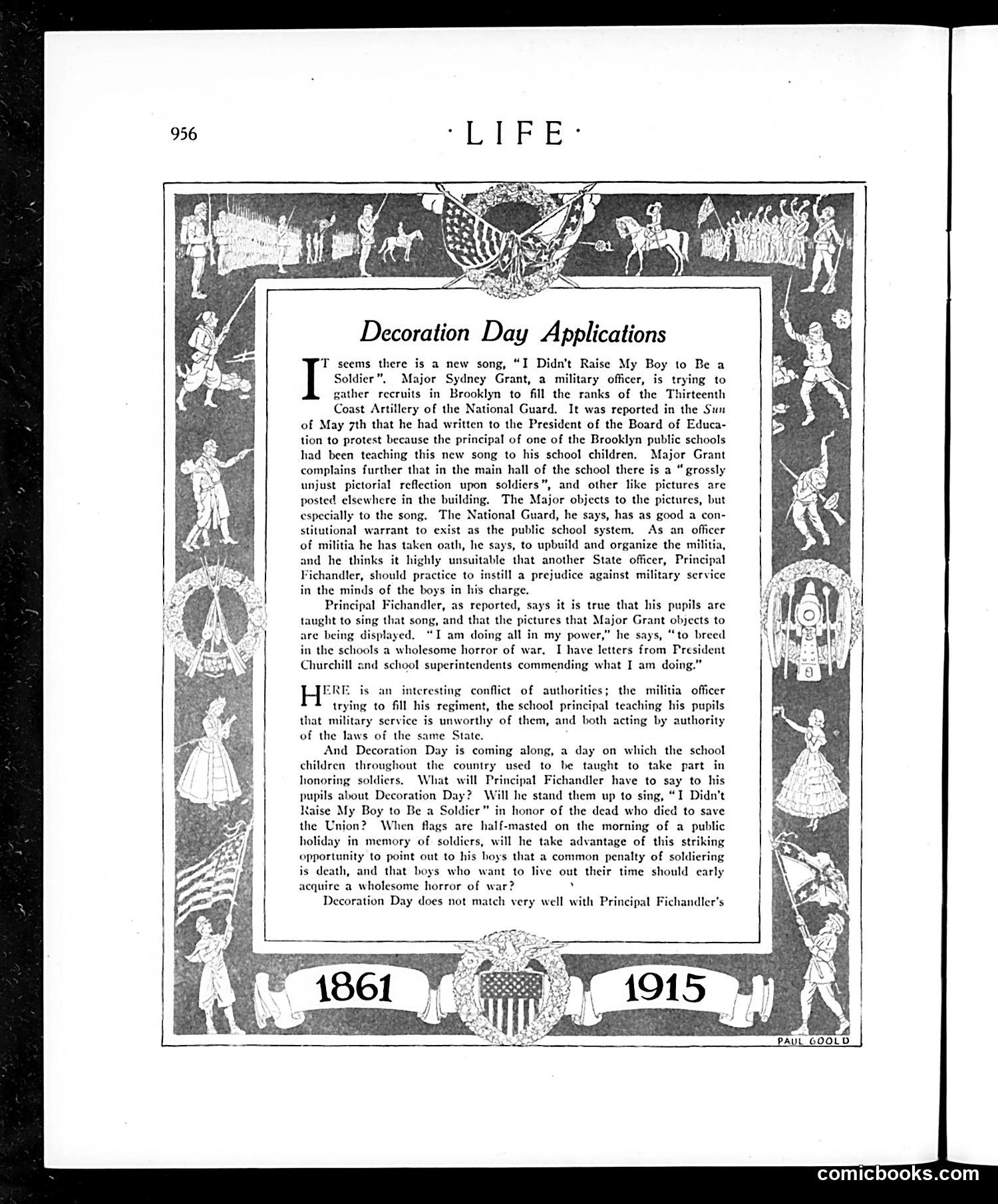
This article satirizes a conflict between militarism and pacifism in early 1915 America. Major Sydney Grant, a National Guard recruiter, protests that Brooklyn Principal Fichandler is teaching schoolchildren the anti-war song "I Didn't Raise My Boy to Be a Soldier" and displaying anti-military artwork. The satire highlights the contradiction: both men claim state authority, yet pursue opposite goals—Grant seeks military recruitment while Fichandler teaches "wholesome horror of war." The piece mocks this impasse by asking how Fichandler will handle the approaching Decoration Day (Memorial Day), when patriotic commemoration of fallen soldiers traditionally occurs. The article's tone suggests the author finds Fichandler's pacifism absurd when measured against honoring the war dead, implying the school principal's anti-military stance conflicts with basic patriotic duty.
📄 Transcribed text from this page (OCR, searchable)
Machine-transcribed from the original scan — historical spelling and the odd misread are preserved.
Decoration Day Applications T seems there is a new song, “I Didn't Raise My Boy to Be a I Soldier”. Major Sydney Grant, a military officer, is trying to gather recruits in Brooklyn to fill the ranks of the Thirteenth Coast Artillery of the National Guard. It was reported in the Sun of May 7th that he had written to the President of the Board of Educa- tion to protest because the principal of one of the Brooklyn public schools had been teaching this new song to his school children. Major Grant complains further that in the main hall of the school there is a “grossly unjust pictorial reflection upon soldiers”, and other like pictures are posted elsewhere in the building. The Major objects to the pictures, but especially to the song. The National Guard, he says, has as good a con- stitutional warrant to exist as the public school system. As an officer of militia he has taken oath, he says, to upbuild and organize the militia, and he thinks it highly unsuitable that another State officer, Principal Fichandler, should practice to instill a prejudice against military service in the minds of the boys in his charge. Principal Fichandler, as reported, says it is true that his pupils are taught to sing that song, and that the pictures that Major Grant objects to are being displayed. “I am doing all in my power,” he says, “to breed in the schools a wholesome horror of war, I have letters from President Churchill and school superintendents commending what I am doing.” H is an interesting conflict of authorities; the militia officer trying to fill his regiment, the school principal teaching his pupils that military service is unworthy of them, and both acting by authority of the laws of the same State. And Decoration Day is coming along, a day on which the school children throughout the country used to be taught to take part in honoring soldiers, What will Principal Fichandler have to say to his pupils about Decoration Day? Will he stand them up to sing, “I Didn't Raise My Boy to Be a Soldier” in honor of the dead who died to save the Union? When flags are half-masted on the morning of a public holiday in memory of soldiers, will he take advantage of this striking opportunity to point out to his boys that a common penalty of soldiering is death, and that boys who want to live out their time should early acquire a wholesome horror of war? , Decoration Day does not match very well with Principal Fichandler’s PAUL GOOLD comicbooks.com