
Life, 1915-05-27 · page 32 of 44
Life — May 27, 1915 — page 32: what you’re looking at
What you’re looking at
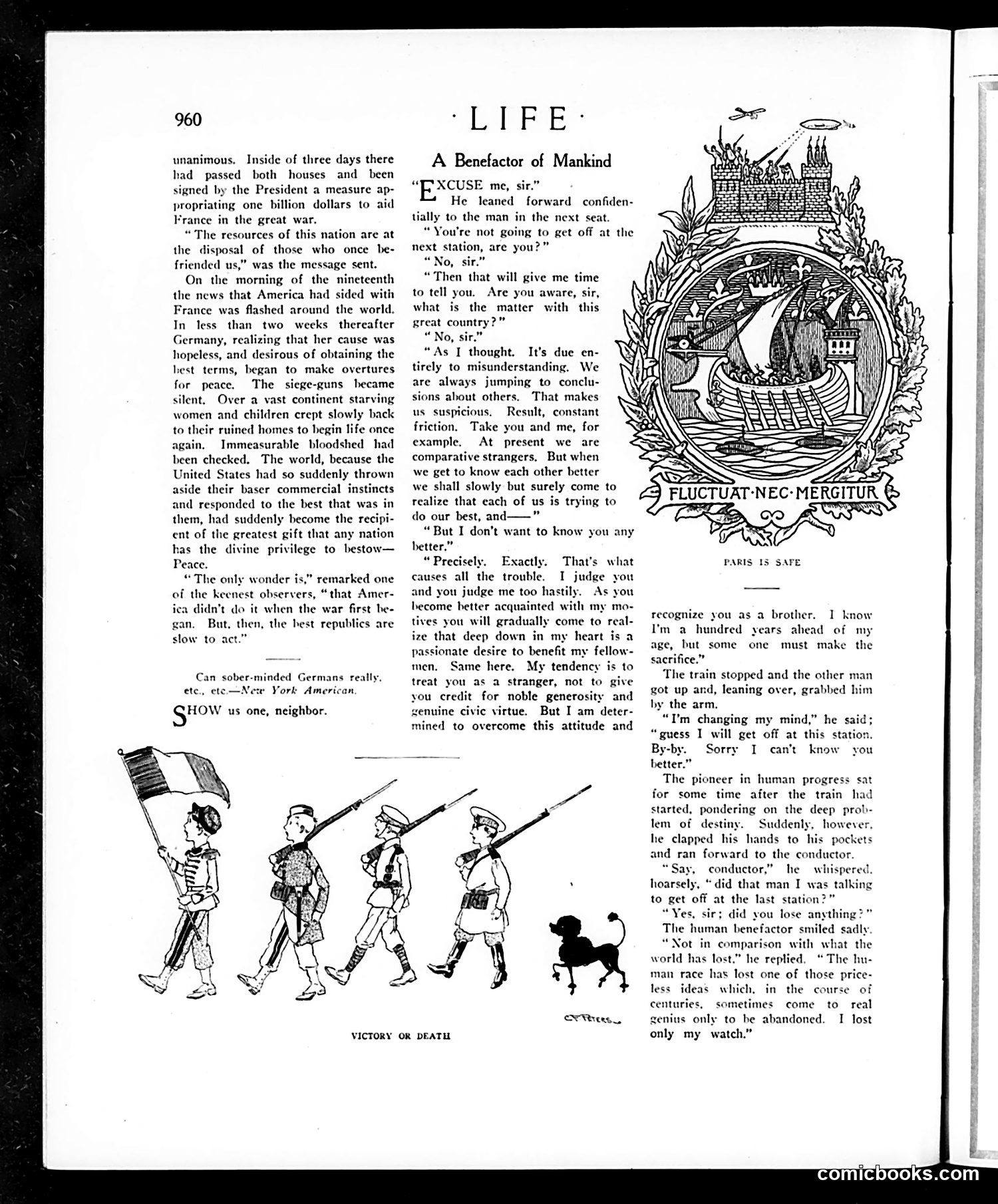
This page from *Life* magazine (appears to be post-WWI era, given references to America aiding France and Germany suing for peace) contains two distinct satirical pieces: **Left cartoon ("Victory or Death"):** Shows four German soldiers in succession, presumably depicting Germany's progression from fighting to surrendering. The caption mocks German militarism's collapse. **Main story ("A Benefactor of Mankind"):** A longer satirical narrative about a self-righteous man on a train who buttonholes a stranger with sanctimonious philosophizing about human brotherhood, mutual understanding, and overcoming prejudice—all while subtly patronizing his captive audience. The punchline reveals this "benefactor" is a hypocrite: after preaching noble ideals, he gets robbed by the very man he was lecturing, then mourns losing his watch more than "humanity" lost the man's priceless ideas. **The satire:** Mocks American self-congratulation about entering WWI as moral crusade, and skewers the type of insufferable moral pontificator who uses grand rhetoric to mask either naivety or self-interest. The theft suggests the "benefactor's" actual worth matches his hollow moralizing.
📄 Transcribed text from this page (OCR, searchable)
Machine-transcribed from the original scan — historical spelling and the odd misread are preserved.
960 unanimous. Inside of three days there had passed both houses and been signed by the President a measure ap- propriating one billion dollars to aid France in the great war, “The resources of this nation are at the disposal of those who once be- friended us,” was the message sent. On the morning of the nineteenth the news that America had sided with France was flashed around the world. In less than two weeks thereafter Germany, realizing that her cause was hopeless, and desirous of obtaining the hest terms, began to make overtures for peace. The siege-guns became silent. Over a vast continent starving women and children crept slowly back to their ruined homes to hegin life once again, Immeasurable bloodshed had been checked. The world, because the United States had so suddenly thrown aside their baser commercial instincts and responded to the best that was in them, had suddenly become the recipi- ent of the greatest gift that any nation has the divine privilege to bestow— Peace. “The only wonder is,” remarked one of the keenest observers, “that Amer- ica didn’t do it when the war first he- gan. But, then, the best republics are slow to act.” Can sober-minded Germans really, ete, ete: York American. SHOW aus one, neighbor. oO) (al al a A Benefactor of Mankind “EXCUSE me, sir.” He leaned forward confiden- tially to the man in the next seat. “You're not going to get off at the next station, are you?” “No, sir.” “Then that will give me time to tell you. Are you aware, sir, what is the matter with this great country?” “No, sir.” “As I thought. It’s due en- tirely to misunderstanding. We are always jumping to conclu- sions about others. That makes us suspicious. Result, constant friction. Take you and me, for example, At present we are comparative strangers, But when we get to know each other better we shall slowly but surely come to realize that each of us is trying to do our best, and——” “But I don’t want to know you any better.” “Precisely, Exactly. That's what causes all the trouble. I judge you and you judge me too hastily. As you become better acquainted with my mo- tives you will gradually come to real- ize that deep down in my heart is a passionate desire to benefit my fellow- men, Same here. My tendency is to treat you as a stranger, not to give you credit for noble generosity and genuine civic virtue. But I am deter- mined to overcome this attitude and VICTORY OR DEATH PARIS 15 SAFE recognize you as a brother. I know I'm a hundred years ahead of my age, but some one must make the sacrifice.” The train stopped and the other man got up and, leaning over, grabbed him by the arm. “I'm changing my mind,” he said; “guess I will get off at this station. y: Sorry I can’t know you The pioneer in human progress sat for some time after the train had started, pondering on the deep prob- lem of destiny. Suddenly, however, he clapped his hands to his pockets and ran forward to the conductor. “Say, conductor,” he whisper hoarsely, “did that man I was talking to get off at the last station “Yes, sir: did you lose anything?” The human benefactor smiled sadly. “Not in comparison with what the world has lost.” he replied, “The hu- man race has lost one of those price- less ideas which, in the course of centuries, sometimes come to real genius only to be abandoned. I lost only my watch.” E comicbooks.com