
Life, 1915-05-27 · page 25 of 44
Life — May 27, 1915 — page 25: what you’re looking at
What you’re looking at
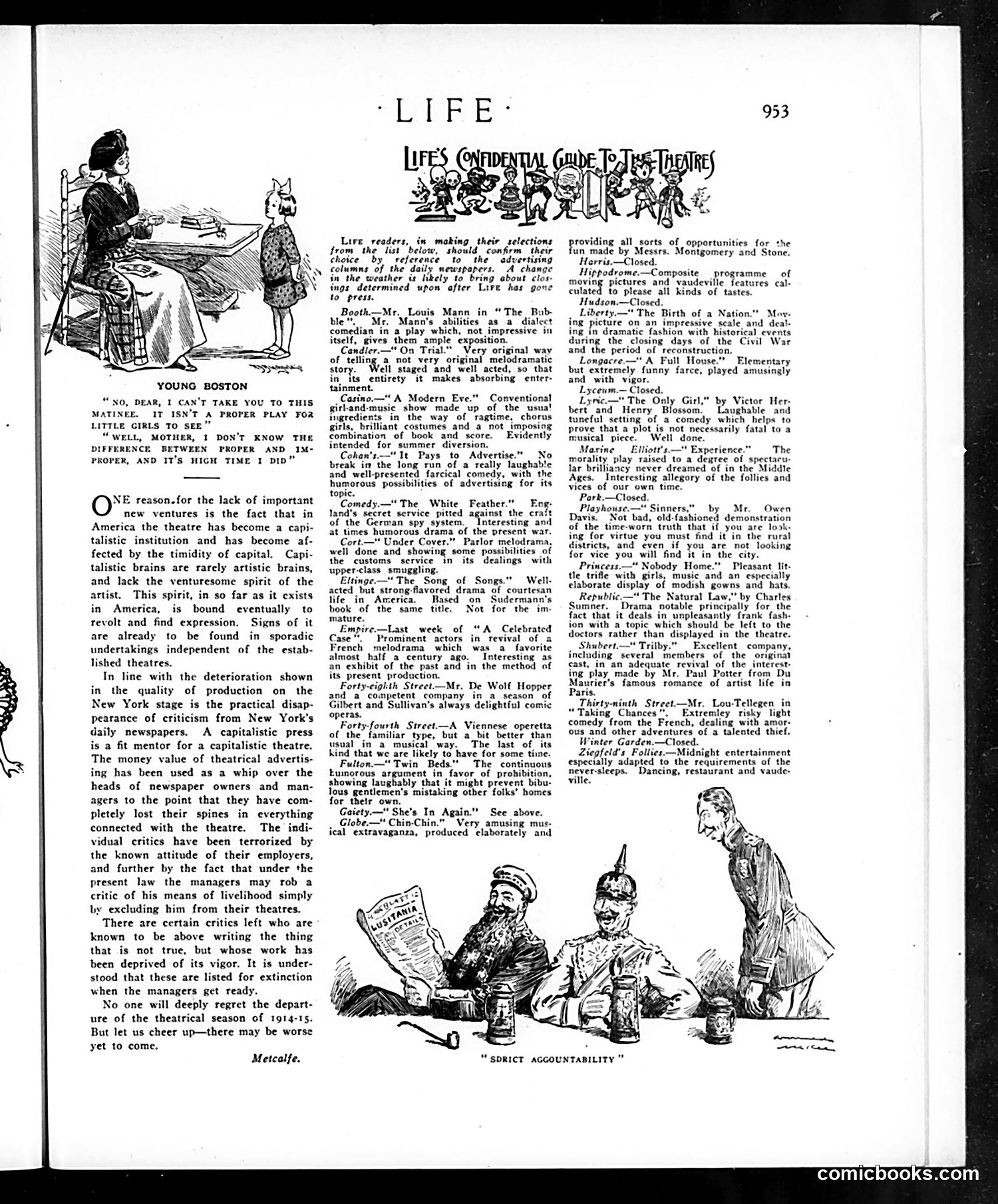
This page combines theater criticism with pointed satire about American theatrical capitalism. The top cartoon shows a Boston mother refusing to take her daughter to a "proper" matinee—a joke about censorship and propriety in theater. The main article criticizes how capitalistic interests have corrupted American theater. The author (Metcalfe) argues that profit-driven owners lack artistic vision, that newspapers suppress honest theater criticism because advertising revenue from theaters matters more than journalistic integrity, and that critics face intimidation or exclusion from theaters if they write unfavorably. The theater listings below satirize this corruption: they humorously note that readers should confirm show selections against newspaper ads, since closings may occur after Life's publication—implying the very advertising influence the article just condemned. The bottom cartoon labeled "Strict Accountability" (artist unclear) appears to mock military or governmental oversight, though its connection to the theater content is uncertain.
📄 Transcribed text from this page (OCR, searchable)
Machine-transcribed from the original scan — historical spelling and the odd misread are preserved.
YOUNG BOSTON 0, DEAR, 1 CAN'T TAKE YOU To THIS MATINEE. IT ISN'T A PROPER PLAY FOR LITTLE GIRLS TO SEE” WELL, MOTHER, I DON'T KNOW THE DIFFERENCE BETWEEN PROPER AND 1M- PROPER, AND IT’S HIGH TIME 1 DID” E reason.for the lack of important new ventures is the fact that in America the theatre has become a capi- talistic institution and has become af- fected by the timidity of capital. Capi- talistic brains are rarely artistic brains, and lack the venturesome spirit of the artist. This spirit, in so far as it exists in America, is bound eventually to revolt and find expression. Signs of it are already to be found in sporadic undertakings independent of the estab- lished theatres. In line with the deterioration shown in the quality of production on the New York stage is the practical disap- pearance of criticism from New York's daily newspapers. A capitalistic press is a fit mentor for a capitalistic theatr The money value of theatrical advertis- ing has been used as a whip over the heads of newspaper owners and man- agers to the point that they have com- pletely lost their spines in everything connected with the theatre. The indi- vidual critics have been terrorized by the known attitude of their employers, and further by the fact that under the present law the managers may rob a critic of his means of livelihood simply by excluding him from their theatres. There are certain critics left who are known to be above writing the thing that is not true, but whose work has been deprived of its vigor. It is under- stood that these are listed for extinction when the managers get ready. No one will deeply regret the depart- ure of the theatrical season of 1914-15. But let us cheer up—there may be worse yet to come. Metcalfe. Lire readers, in making their selections from the list ‘below, should confirm their choice by reference to the advertising columns of the daily newspapers. A change in the weather is likely to bring about clos- ings determined upon after Live has gone to press. Booth—Mr. Louis Mann in “ The ble". “Mr. Mann's abilities as a dialect comedian in a play which, not impressive in itself, gives them ample exposition. Candler.—" On Trial.” Very original way of telling a not very original melodramatic story. Well staged and well acted, so that in its entirety it makes absorbing enter- tainment. Casino.—" A Modern Eve.” Conventional irland-music show made up of the usual redients in the way of ragtime, chorus girls, brilliant costumes and a not imposing combination of book and score. Evidently intended for summer diversion. Cohan’s.—“"It_ Pays to Advertise break im the long run of a really laughable and well-presented farcical comedy, with the humorous possibilities of advertising for its topic. Comedy.—" The White Feather." Eng: land's secret service pitted against the craft of the German spy system. Interesting and at times humorous drama of the present war. Cort.—" Under Cover." Parlor melodrama, well done and showing some possibilities of the customs service in its dealings with upper-class smuggling. Eltinge.—" The Song of Songs." Well- acted but strong-avored drama of courtesan life in America. Based on Sudermann's hook of the same title, Not for the im- mature, Empire—Last_ week of “A Celebrated Case”. Prominent actors in revival of a French melodrama which was a favorite almost half a century ago. Interesting as an exhibit of the past and in the method of its_present production. Forty-eiglith Street.—Mr, De Wolf Hopper and a competent company in a season of Gilbert and Sullivan's always delightful comic operas. Forty-fourth Street.—A Viennese operetta of the familiar type, but a bit better than usual in a musical ‘way. The last of its kind that we are likely to have for some time. Fulton.—" Twin Beds." The continuous tumorous argument in favor of prohibition, showing laughably that it might prevent bibu- lous gentlemen's mistaking other folks’ homes for thelr own. Gaiety.— She's In Again.” See above. _ Globe.— Chin-Chin.” Very amusing mus- ical extravaganza, produced elaborately and roviding all sorts of opportunities for the un made by Messrs. Montgomery and Stone. Herris.—Closed. Hippodrome.—Composite programme of moving pictures and vaudeville features cal- culated to please all kinds of tastes. Hudson.—Closed. __Liberty.—" The Birth of a Nation." Mov. ing picture on an impressive scale and deal- ing in dramatic fashion with historical events during the closing days of the Civil War and the period of reconstruction. Longacre—" A Full House.” Elementary but extremely funny farce, played amusingly and with vigor. Lyceum.— Closed. Lyric.—" The Only Girl," by Victor Her- bert. and Henry Blossom: Laughable and tuneful setting of a comedy which helps to prove that a plot is not necessarily fatal to a musical piece. Well done. Maxine Eltiott’s—" Experience.” The morality play raised to a degree of spectacu- lar brilliancy never dreamed of in the Middle Ages. Interesting allegory of the follies and vices of our own time. Park.—Closed. Playhouse.—" Sinners," by Mr. Owen Davis. Not bad, old-fashioned demonstration of the time-worn truth that if you are look: ing for virtue you must find it in the rural districts, and even if you are not looking for vice you will find it in the city. Princess.—" Nobody Home.” Pleasant lit. tle trifle with girls, music and an especially elaborate display of modish gowns and hats. Republic.—" The Natural Law,” by Charles Sumner. Drama notable principally for the fact that it deals in unpleasantly frank fash- ion with a topic which should be left to the doctors rather than displayed in the theatre. _ Shubert.— Trilby.” Excellent. company, including several members of the originat cast, in an adequate revival of the interest: ing ‘play, made by Mr. Paul Potter from Du Maurier's famous romance of artist life in Paris Thirty-ninth Street—Mr. Lou-Tellegen in “Taking Chances”. | Extremiey risky light comedy from the French, dealing with amor- ous and other adventures of a talented thief. Winter Garden,—Closed. Ziegfeld’s Follies—Midnight entertainment especially adapted to the requirements of the neversleeps. “Dancing, restaurant and vaue- ville. “SDRICT AGGOUNTABILITY ” comicbooks.com