
Life, 1915-05-27 · page 18 of 44
Life — May 27, 1915 — page 18: what you’re looking at
What you’re looking at
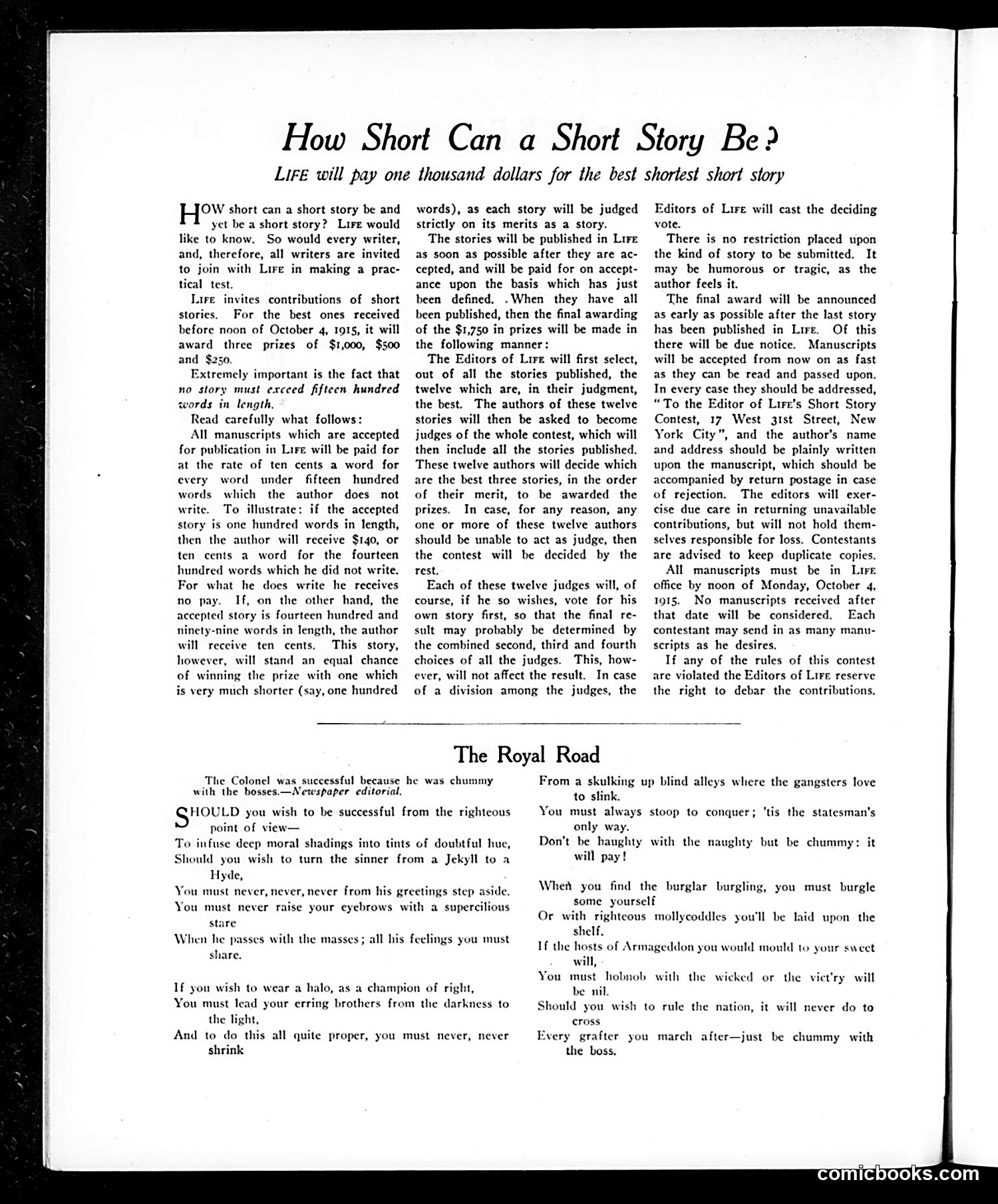
This page announces Life magazine's literary contest challenging writers to create the shortest possible short story while maintaining narrative integrity. The contest offered $1,000, $500, and $250 prizes. The satirical twist: authors were paid ten cents per word they *didn't* write (up to 1,500 words). A 100-word story earned $140; a 1,499-word story earned only ten cents. This inverted payment structure mocked both verbose writing and commercial incentives in publishing. The second section, "The Royal Road," appears to be a separate satirical poem mocking political/business success through cynicism rather than merit—referencing "the Colonel" succeeding by being "chummy with the bosses." It advocates abandonment of principles for pragmatism, satirizing corruption in American institutions and politics of the era.
📄 Transcribed text from this page (OCR, searchable)
Machine-transcribed from the original scan — historical spelling and the odd misread are preserved.
How Short Can a Short Story Be? LiFe will pay one thousand dollars for the best shortest short story OW short can a short story be and yet be a short story? Lire would like to know. So would every writer, and, therefore, all writers are invited to join with Lire in making a prac- tical test. Lire invites contributions of short stories. For the best ones received before noon of October 4, 1915, it will award three prizes of $1,000, $500 and $250. Extremely important is the fact that no story must exceed fifteen hundred words in length, Read carefully what follows: All manuscripts which are accepted for publication in Lire will be paid for at the rate of ten cents a word for every word under fifteen hundred words which the author does not write. To illustrate: if the accepted story is one hundred words in length, then the author will receive $140, or ten cents a word for the fourteen hundred words which he did not write. For what he does write he receives no pay. If, on the other hand, the accepted story is fourteen hundred and ninety-nine words in length, the author will receive ten cents, This story, however, will stand an equal chance of winning the prize with one which is very much shorter (say, one hundred words), as each story will be judged strictly on its merits as a story. The stories will be published in Lire as soon as possible after they are ac- cepted, and will be paid for on accept- ance upon the basis which has just been defined. .When they have all been published, then the final awarding of the $1,750 in prizes will be made in the following manner: The Editors of Lire will first select, out of all the stories published, the twelve which are, in their judgment, the best. The authors of these twelve stories will then be asked to become judges of the whole contest, which will then include all the stories published. These twelve authors will decide which are the best three stories, in the order of their merit, to be awarded the prizes. In case, for any reason, any one or more of these twelve authors should be unable to act as judge, then the contest will be decided by the rest. Each of these twelve judges will, of course, if he so wishes, vote for his own story first, so that the final re- sult may probably be determined by the combined second, third and fourth choices of all the judges. This, how- ever, will not affect the result. In case of a division among the judges, the The Colonel was successful because he was chummy with the bosses.—Newspaper editorial. The Royal Road to slink. You must aly Editors of Lire will cast the deciding vote. There is no restriction placed upon the kind of story to be submitted. It may be humorous or tragic, as the author feels it. The final award will be announced as early as possible after the last story has been published in Lire. Of this there will be due notice. Manuscripts will be accepted from now on as fast as they can be read and passed upon. In every case they should be addressed, “To the Editor of Lire’s Short Story Contest, 17 West jist Street, New York City”, and the author's name and address should be plainly written upon the manuscript, which should be accompanied by return postage in case of rejection. The editors will exer- cise due care in returning unavailable contributions, but will not hold them- selves responsible for loss. Contestants are advised to keep duplicate copies. All manuscripts must be in Lire office by noon of Monday, October 4, 1915. No manuscripts received after that date will be considered. Each contestant may send in as many manu- scripts as he desires. If any of the rules of this contest are violated the Editors of Lire reserve the right to debar the contributions, From a skulking up blind alleys where the gangsters love GHOUED you wish to be successful from the righteous point of view— To infuse deep moral shadings into tints of doubtful hue, Should you wish to turn the sinner from a Jekyll to a Hyde, You must never, never, never from his greetings step aside. You must never raise your eyebrows with a supercilious stare When he passes with the masses; all his feelings you must share. If you wish to wear a halo, as a champion of right, You must lead your erring brothers from the darkness to the light, And to do this all quite proper, you must never, never shrink YS stoop to conquer; ‘tis the statesman’s only way. Don't be haughty with the naughty but be chummy: it will pay! When you find the burglar burgling, you must burgle some yourself Or with righteous mollycoddles you'll be laid upon the shelf. If the hosts of Armageddon you would mould to your sweet will, You must hobnob with the wicked or the viet'ry will be nil. Should you wish to rule the nation, it will never do to cross I y grafter you march after—just be chummy with the boss, comicbooks.com