
Life, 1915-05-27 · page 8 of 44
Life — May 27, 1915 — page 8: what you’re looking at
What you’re looking at
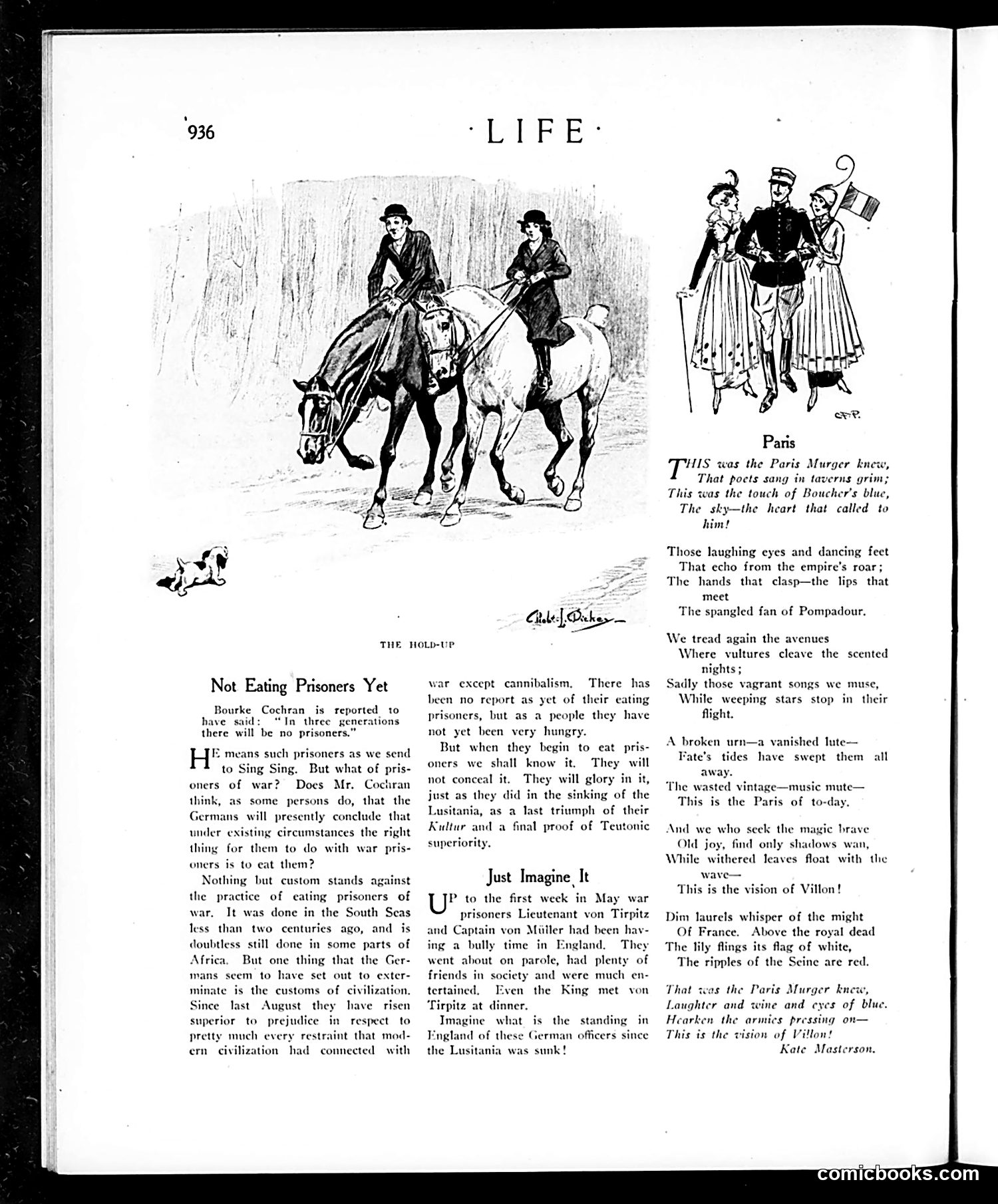
This Life magazine page from 1936 addresses World War I atrocities and prisoner treatment. The article "Not Eating Prisoners Yet" responds to claims by Bourke Cochran that Germans won't eat prisoners, satirizing this as an absurdly low bar for "civilization." The piece argues that Germans have only recently abandoned practices like cannibalism in the South Seas, and that restraint in prisoner treatment shouldn't warrant praise. The cartoon "The Hold-Up" (lower left) depicts a mounted soldier confronting a pedestrian—likely satirizing German militarism or wartime coercion. The poem "Paris" on the right, by Kate Masterson, nostalgically evokes pre-war Paris's cultural glory while lamenting its current state, evoking loss and decline during wartime.
📄 Transcribed text from this page (OCR, searchable)
Machine-transcribed from the original scan — historical spelling and the odd misread are preserved.
THE HOLD-UP Not Eating Prisoners Yet Bourke Cochran is reported to have said: “In three generations there will be no prisoners.” H" means such prisoners as we send to Sing Sing. But what of pris- oners of war? Does Mr. Cochran think, as some persons do, that the Germans will presently conclude that under existing circumstances the right thing for them to do with war pris- oners is to eat them? Nothing but custom stands against the practice of eating prisoners of war. It was done in the South Scas less than two centuries ago, and is doubtless still done in some parts of Africa, But one thing that the Ger- mans scem to have set out to exter- minate is the customs of civilization, Since last August they have risen superior to prejudice in respect to pretty much every restraint that mod- ern civilization had connected with war except cannibalism, There has leen no report as yet of their eating prisoners, but as a people they have not yet been very hungry. But when they begin to eat pris- I know it. They will not conceal it. They will glory in it, just as they did in the sinking of the Lusitania, as a last triumph of their Kultur and a final proof of Teutonic superiority. oners we sl Just Imagine | It U > to the first week in M. prisoners Lieutenant von Tirpitz and Captain von Miiller had been hav- ing a bully time in England. They went about on parole, had plenty of friends in society and were much en- tertained. Even the King met von ‘Tirpitz at dinner. Imagine what is standing in England of these German officers since the Lusitania was sunk! the HIS was the Paris Murger knew, That poets sang in taverns grim; This was the touch of Boucher’s blue, The sky—the heart that called to him! Those laughing eyes and dancing feet That echo from the empire's roar; The hands that clasp—the lips that meet The spangled fan of Pompadour, We tread again the avenues Where vultures cleave the scented nights; Sadly those vagrant songs we muse, While weeping stars stop in their flight. A broken urn—a vanished lute— Fate's tides have swept them all away. ‘The wasted vintage—music mute— This is the Paris of to-day, And we who seek the magic brave Old joy, find only shadows wan, While withered leaves float with the wave— This is the vision of Villon! Dim laurels whisper of the might Of France. Above the royal dead The lily flings its flag of white, The ripples of the Seine are red. That was the Paris Murger kne Laughter and wine and ¢} Hearken the armies pressing on— This is the vision of Villon! Kate Masterson. comicbooks.com