
Life, 1915-05-27 · page 24 of 44
Life — May 27, 1915 — page 24: what you’re looking at
What you’re looking at
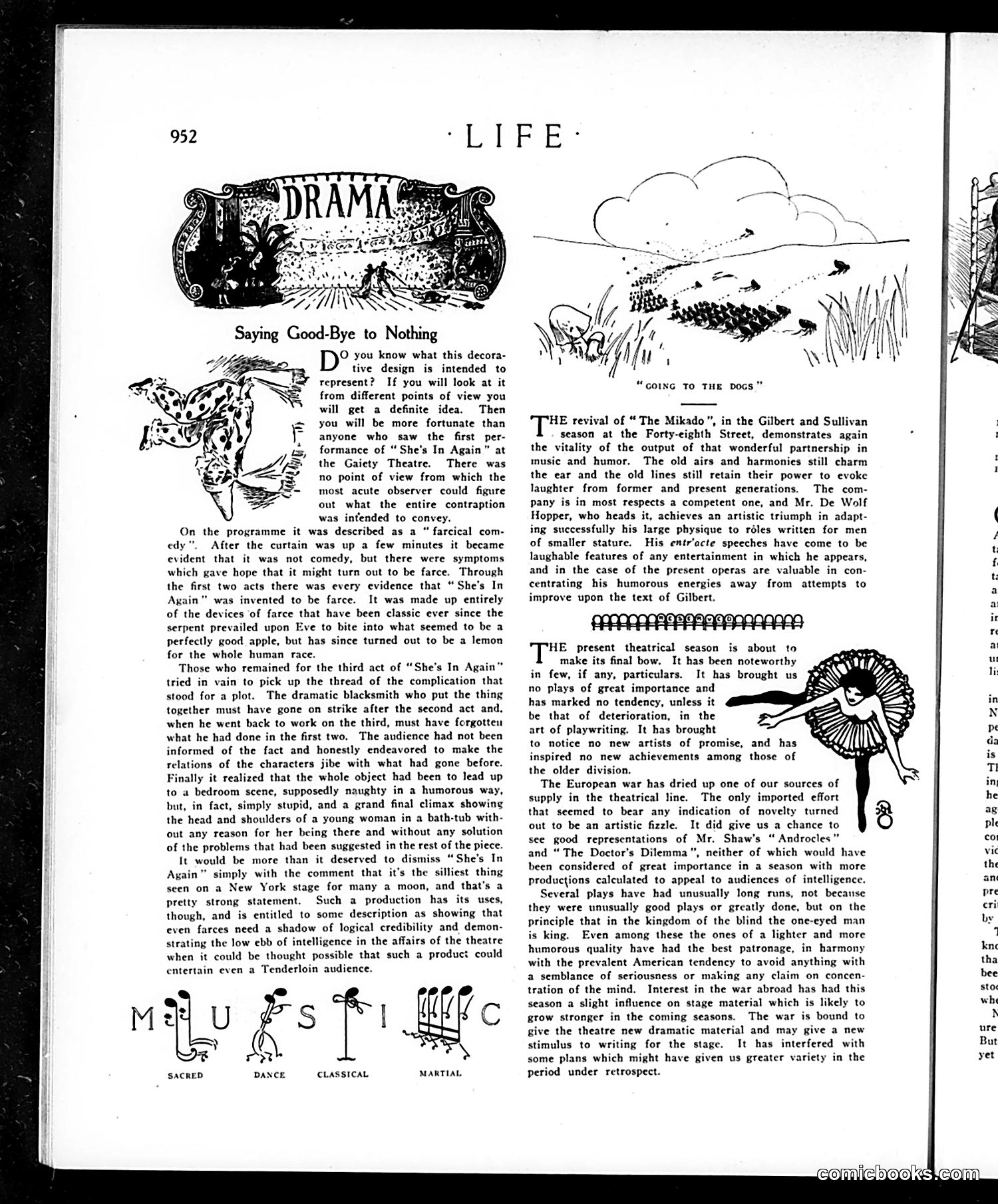
This page contains theater reviews from an American satirical magazine. The main content critiques Broadway productions: **"Saying Good-Bye to Nothing"** savagely reviews a farce called *"She's In Again"* at the Gaiety Theatre. The critic argues it's incoherent—the plot collapses after act two, and the finale (a woman in a bathtub) makes no sense. The decorative design at top symbolizes this meaninglessness; viewed from different angles, it represents nothing coherent, mirroring the play's failure. **"Going to the Dogs"** discusses a Gilbert and Sullivan revival of *"The Mikado"*, praising the music's timelessness but noting star De Wolf Hopper's comedic speeches are so entertaining they distract from Gilbert's actual text—a backhanded compliment suggesting the production needs saving from its source material. The final section observes the theatrical season ending with no significant new plays or promising artists, indicating artistic decline. This reflects post-WWI American theater struggling to find direction.
📄 Transcribed text from this page (OCR, searchable)
Machine-transcribed from the original scan — historical spelling and the odd misread are preserved.
Saying Good-Bye to Nothing O you know what this decora- tive design is intended to represent? If you will look at it from different points of view you will get a definite idea. Then you will be more fortunate than anyone who saw the first per- formance of “She's In Again” at the Gaiety Theatre. There was no point of view from which the most acute observer could figure out what the entire contraption was intended to convey. On the programme it was described as a “ farcical com- edy"”, After the curtain was up a few minutes it became evident that it was not comedy, but there were symptoms which gave hope that it might turn out to be farce. Through the first two acts there was every evidence that “She's In Again” was invented to be farce. It was made up entirely of the devices of farce that have been classic ever since the serpent prevailed upon Eve to bite into what seemed to be a perfectly good apple, but has since turned out to be a lemon for the whole human race. Those who remained for the third act of “She's In Again” tried in vain to pick up the thread of the complication that stood for a plot. The dramatic blacksmith who put the thing together must have gone on strike after the second act and, when he went back to work on the third, must have forgotten what he had done in the first two. The audience had not been informed of the fact and honestly endeavored to make the relations of the characters jibe with what had gone before. Finally it realized that the whole object had been to lead up to a bedroom scene, supposedly naughty in a humorous way, but, in fact, simply stupid, and a grand final climax showing the head and shoulders of a young woman in a bath-tub with- out any reason for her being there and without any solution of the problems that had been suggested in the rest of the piece. It would be more than it deserved to d “She's In Again” simply with the comment that it’s the silliest thing seen on a New York stage for many a moon, and that’s a pretty strong statement. Such a production has its uses, though, and is entitled to some description as showing that even farces need a shadow of logical credibility and demon- strating the low ebb of intelligence in the affairs of the theatre when it could be thought possible that such a product could entertain even a Tenderloin audience. DANCE CLASSICAL MARTIAL SACRED “GOING To THE Docs” 'HE revival of “ The Mikado”, in the Gilbert and Sullivan season at the Forty-eighth Street, demonstrates again the vitality of the output of that wonderful partnership in music and humor. The old airs and harmonies still charm the ear and the old lines still retain their power to evoke laughter from former and present generations. The com- pany is in most respects a competent one, and Mr. De Wolf Hopper, who heads it, achieves an artistic triumph in adapt- ing successfully his large physique to réles written for men of smaller stature. His entr’acte speeches have come to be laughable features of any entertainment in which he appears, and in the case of the present operas are valuable in con- centrating his humorous energies away from attempts to improve upon the text of Gilbert. 'HE present theatrical season is about to make its final bow. It has been noteworthy in few, if any, particulars. It has brought us no plays of great importance and has marked no tendency, unless it be that of deterioration, in the art of playwriting. It has brought to notice no new artists of promise, and has inspired no new achievements among those of the older division. The European war has dried up one of our sources of supply in the theatrical line. The only imported effort that seemed to bear any indication of novelty turned out to be an artistic fizzle. It did give us a chance to see good representations of Mr. Shaw's “ Androcles” and “ The Doctor's Dilemma”, neither of which would have been considered of great importance in a season with more productions calculated to appeal to audiences of intelligence. Several plays have had unusually long runs, not because they were unusually good plays or greatly done, but on the principle that in the kingdom of the blind the one-eyed man is king. Even among these the ones of a lighter and more humorous quality have had the best patronage, in harmony with the prevalent American tendency to avoid anything with a semblance of seriousness or making any claim on concen- tration of the mind. Interest in the war abroad has had this season a slight influence on stage material which is likely to grow stronger in the coming seasons. The war is bound to give the theatre new dramatic material and may give a new stimulus to writing for the stage. It has interfered with some plans which might have given us greater variety in the period under retrospect.