
Life, 1915-05-27 · page 14 of 44
Life — May 27, 1915 — page 14: what you’re looking at
What you’re looking at
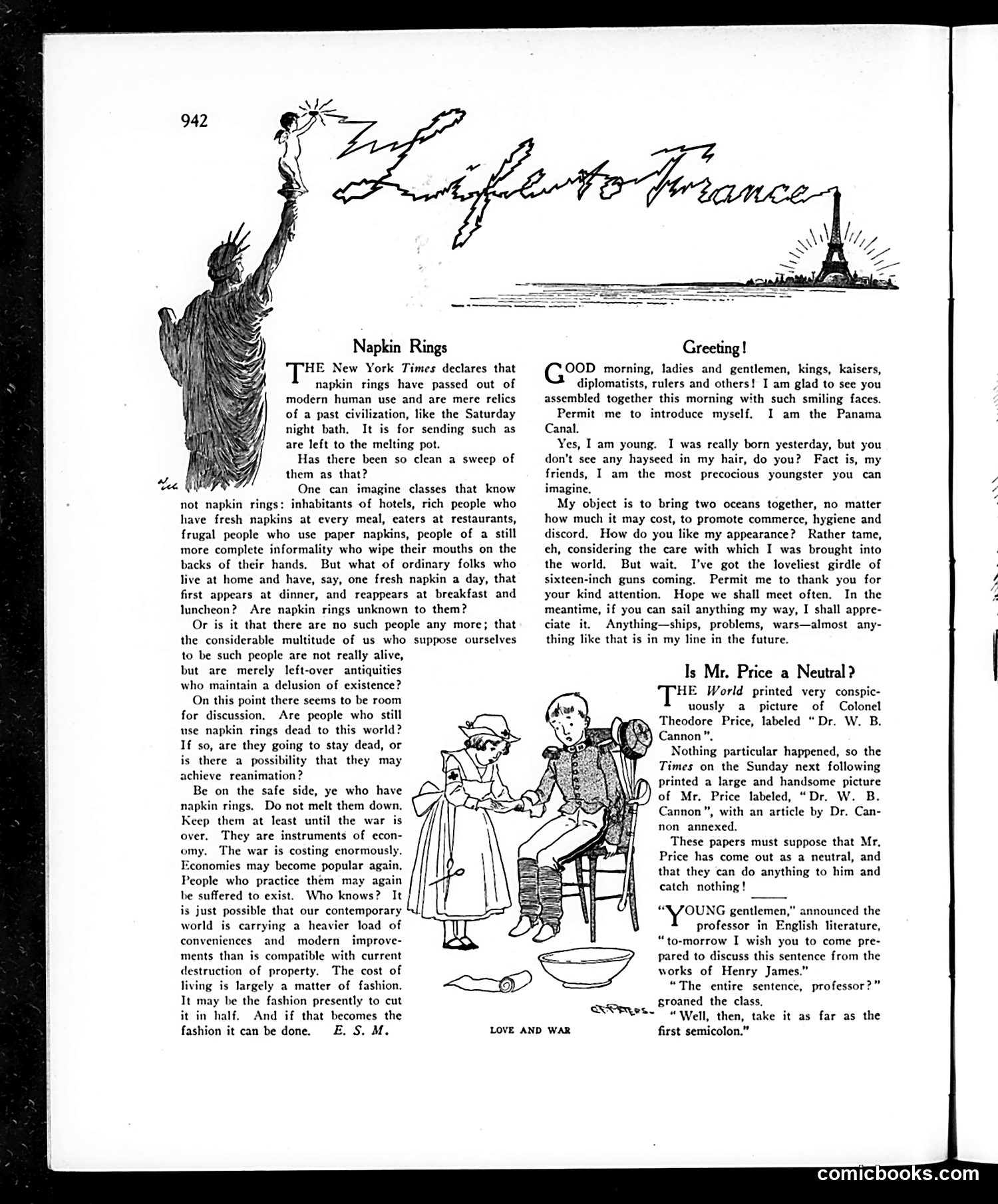
This page contains three distinct pieces satirizing World War I-era social customs and attitudes: 1. **"Napkin Rings"** (left): Critiques the New York Times' declaration that napkin rings are obsolete relics. The author sarcastically defends napkin rings as practical for ordinary people living in homes and flats, arguing their continued use makes economic sense during wartime, when frugality should become fashionable again. 2. **"Greeting!"** (top right): A personified Panama Canal addresses assembled dignitaries with pride about connecting two oceans, then boasts of possessing "sixteen-inch guns"—military hardware reflecting WWI's militarization of previously civilian infrastructure. 3. **"Is Mr. Price a Neutral?"** (bottom right): Questions whether a newspaper figure (Colonel Theodore Price) maintains neutrality, referencing the contemporary debate over American neutrality before entering WWI.
📄 Transcribed text from this page (OCR, searchable)
Machine-transcribed from the original scan — historical spelling and the odd misread are preserved.
Napkin Rings HE New York Times declares that napkin rings have passed out of modern human use and are mere relics of a past civilization, like the Saturday night bath, It is for sending such as are left to the melting pot. Has there been so clean a sweep of them as that? One can imagine classes that know not napkin rings: inhabitants of hotels, rich people who have fresh napkins at every meal, eaters at restaurants, frugal people who use paper napkins, people of a still more complete informality who wipe their mouths on the backs of their hands. But what of ordinary folks who live at home and have, say, one fresh napkin a day, that first appears at dinner, and reappears at breakfast and luncheon? Are napkin rings unknown to them? Or is it that there are no such people any more; that the considerable multitude of us who suppose ourselves to be such people are not really alive, but are merely left-over antiquities who maintain a delusion of existence? On this point there seems to be room for discussion. Are people who still use napkin rings dead to this world? If so, are they going to stay dead, or is there a possibility that they may achieve reanimation? Be on the safe side, ye who have napkin rings. Do not melt them down, Keep them at least until the war is over. They are instruments of econ- omy. The war is costing enormously. Economies may become popular again, People who practice them may again he suffered to exist. Who knows? It is just possible that our contemporary world is carrying a heavier load of conveniences and modern improve- ments than is compatible with current ruction of property. The cost of living is largely a matter of fashion. It may be the fashion presently to cut it in half. And if that becomes the fashion it can be done. E. S. M. LOVE AND WAR Go morning, ladies and gentlemen, kings, kaisers, diplomatists, rulers and others! I am glad to see you assembled together this morning with such smiling faces. Permit me to introduce myself. I am the Panama Canal. Yes, I am young. I was really born yesterday, but you don’t see any hayseed in my hair, do you? Fact is, my friends, I am the most precocious youngster you can imagine. My object is to bring two oceans together, no matter how much it may cost, to promote commerce, hygiene and discord. How do you like my appearance? Rather tame, ch, considering the care with which I was brought into the world. But wait. I’ve got the loveliest girdle of sixteen-inch guns coming, Permit me to thank you for your kind attention. Hope we shall meet often. In the meantime, if you can sail anything my way, I shall appre- ciate it. Anything—ships, problems, wars—almost any- thing like that is in my line in the future. Is Mr. Price a Neutral? 'HE World printed very conspic- uously a picture of Colonel Theodore Price, labeled “Dr. W. B. Cannon”, Nothing particular happened, so the Times on the Sunday next following printed a large and handsome picture of Mr. Price labeled, “Dr. W. B. Cannon”, with an article by Dr. Can- non annexed. These papers must suppose that Mr, Price has come out as a neutral, and that they can do anything to him and catch nothing! “SVOUNG gentlemen,” announced the professor in English literature, “to-morrow I wish you to come pre- pared to discuss this sentence from the works of Henry James.” “The entire sentence, professor?” ; groaned the class, SNPeEL. Well, then, take it as far as the first semicolon.” comicbooks.com es eee