
Life, 1915-05-27 · page 20 of 44
Life — May 27, 1915 — page 20: what you’re looking at
What you’re looking at
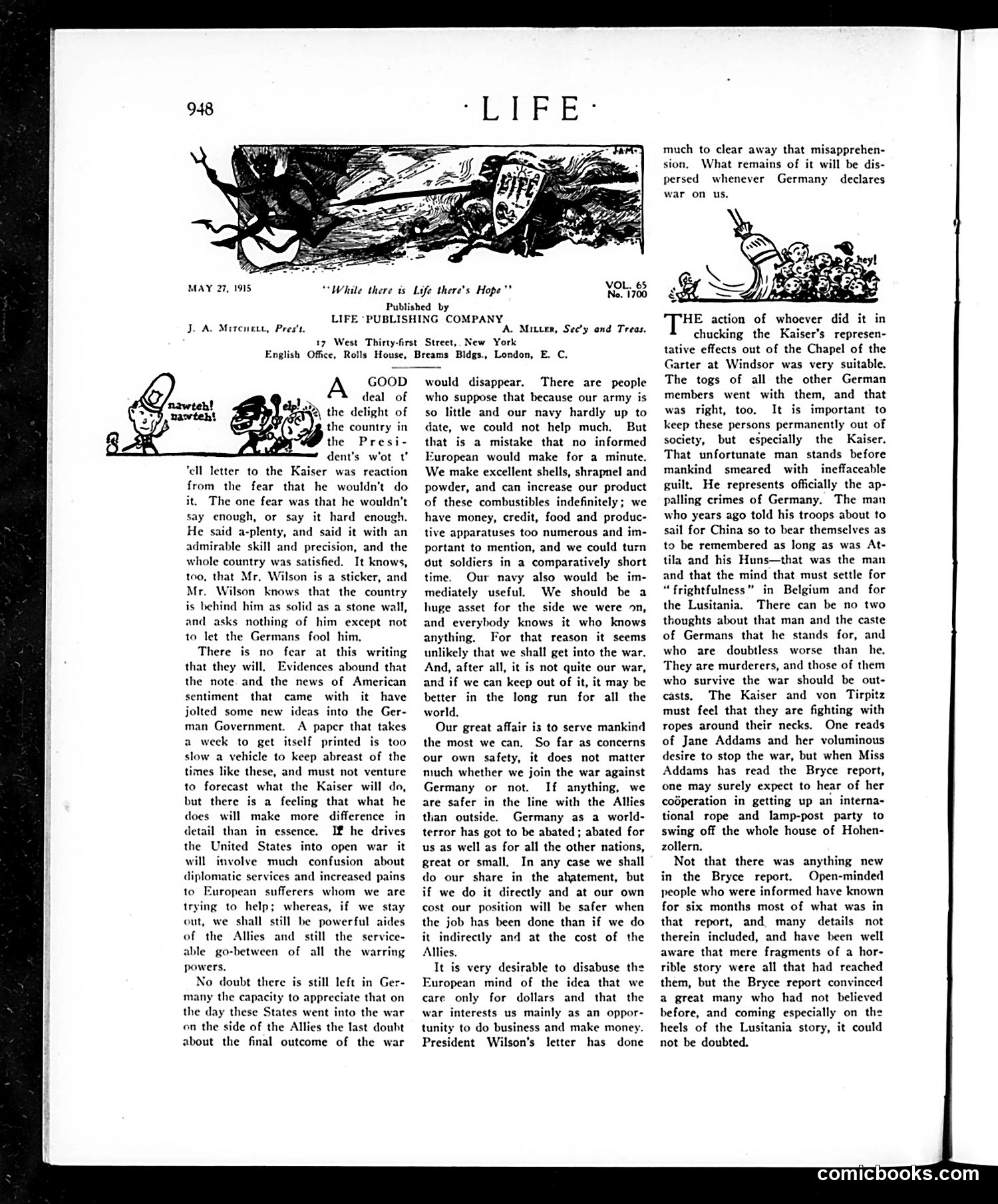
This page discusses President Wilson's recent diplomatic note to Germany (likely regarding the *Lusitania* sinking on May 7, 1915). The small cartoon at top-left shows caricatured figures representing the American public's approval of Wilson's stern letter to "the Kaiser." The editorial praises Wilson for speaking forcefully enough to satisfy the country, arguing that America's industrial and financial capacity makes it a crucial potential ally to the Allies. It disputes European assumptions that the U.S. cares only about profit, claiming Wilson's letter dispels this misconception. The text suggests war remains unlikely but possible, and argues that if America eventually joins the Allies directly, Germany's defeat becomes certain. The piece frames American intervention as both a moral service to mankind and strategically wise for U.S. long-term security.
📄 Transcribed text from this page (OCR, searchable)
Machine-transcribed from the original scan — historical spelling and the odd misread are preserved.
MAY 27, 1915 “While there is Life there's Hope" Published by LIFE ‘PUBLISHING COMPANY J. A. Mirenent, Pres’t, A. Minter, Sec’y and Treas. 17 West Thirty-first. Street, New York English Office, Rolls House, Breams Bldgs., London, E. C. GOOD deal of 2 the delight of the country in the Presi- dent's w'ot ‘ell letter to the Kaiser was reaction from the fear that he wouldn't do it. The one fear was that he wouldn’t say enough, or say it hard enough. He said a-plenty, and said it with an admirable skill and precision, and the whole country was satisfied. It knows, too, that Mr, Wilson is a sticker, and Mr. Wilson knows that the country is hehind him as solid as a stone wall, and asks nothing of him except not to let the Germans fool him. There is no fear at this writing that they will, Evidences abound that the note and the news of American sentiment that came with it have jolted some new ideas into the Ger- man Government. A paper that takes a week to get itself printed is too slow a vehicle to keep abreast of the times like these, and must not venture to forecast what the Kaiser will do, but there is a feeling that what he does will make more difference in detail than in essence. If he drives the United States into open war it will involve much confusion about diplomatic services and increased pains to European sufferers whom we are trying to help; whereas, if we stay out, we shall still be powerful aides of the Allies and still the service- able go-between of all the warring powers. No doubt there is still left in Ger- many the capacity to appreciate that on the day these States went into the war on the side of the Allies the last doubt about the final outcome of the war would disappear. There are people who suppose that because our army is so little and our navy hardly up to date, we could not help much. But that is a mistake that no informed European would make for a minute. We make excellent shells, shrapnel and powder, and can increase our product of these combustibles indefinitely; we have money, credit, food and produc- tive apparatuses too numerous and im- portant to mention, and we could turn out soldiers in a comparatively short time. Our navy also would be im- mediately useful. We should be a huge asset for the side we were on, and everybody knows it who knows anything. For that reason it seems unlikely that we shall get into the war. And, after all, it is not quite our war, and if we can keep out of it, it may be better in the long run for all the world, Our great affair is to serve mankind the most we can, So far as concerns our own safety, it does not matter much whether we join the war against Germany or not. If anything, we are safer in the line with the Allies than outside. Germany as a world- terror has got to be abated; abated for us as well as for all the other nations, great or small. In any case we shall do our share in the abatement, but if we do it directly and at our own cost our position will be safer when the job has been done than if we do it indirectly and at the cost of the Allies. It is very desirable to disabuse the European mind of the idea that we care only for dollars and that the war interests us mainly as an oppor- tunity to do business and make money. President Wilson's letter has done much to clear away that misapprehen- sion, What remains of it will be dis- persed whenever Germany declares war on us. 'HE action of whoever did it in chucking the Kaiser’s represen- tative effects out of the Chapel of the Garter at Windsor was very suitable. The togs of all the other German members went with them, and that was right, too. It is important to keep these persons permanently out of society, but especially the Kaiser. That unfortunate man stands before mankind smeared with ineffaceable guilt. He represents officially the ap- palling crimes of Germany, The man who years ago told his troops about to sail for China so to bear themselves as to be remembered as long as was At- tila and his Huns—that was the man and that the mind that must settle for “frightfulness” in Belgium and for the Lusitania. There can be no two thoughts about that man and the caste of Germans that he stands for, and who are doubtless worse than he, They are murderers, and those of them who survive the war should be out- casts. The Kaiser and von Tirpitz must feel that they are fighting with ropes around their necks. One reads of Jane Addams and her voluminous desire to stop the war, but when Miss Addams has read the Bryce report, one may surely expect to hear of her codperation in getting up an interna- tional rope and lamp-post party to swing off the whole house of Hohen- zollern. Not that there was anything new in the Bryce report. Open-minded people who were informed have known for six months most of what was in that report, and many details not therein included, and have been well aware that mere fragments of a hor- rible story were all that had reached them, but the Bryce report convinced a great many who had not believed before, and coming especially on the heels of the Lusitania story, it could not be doubted. comicbooks.com