
A complete issue · 44 pages · 1915
Life — February 25, 1915
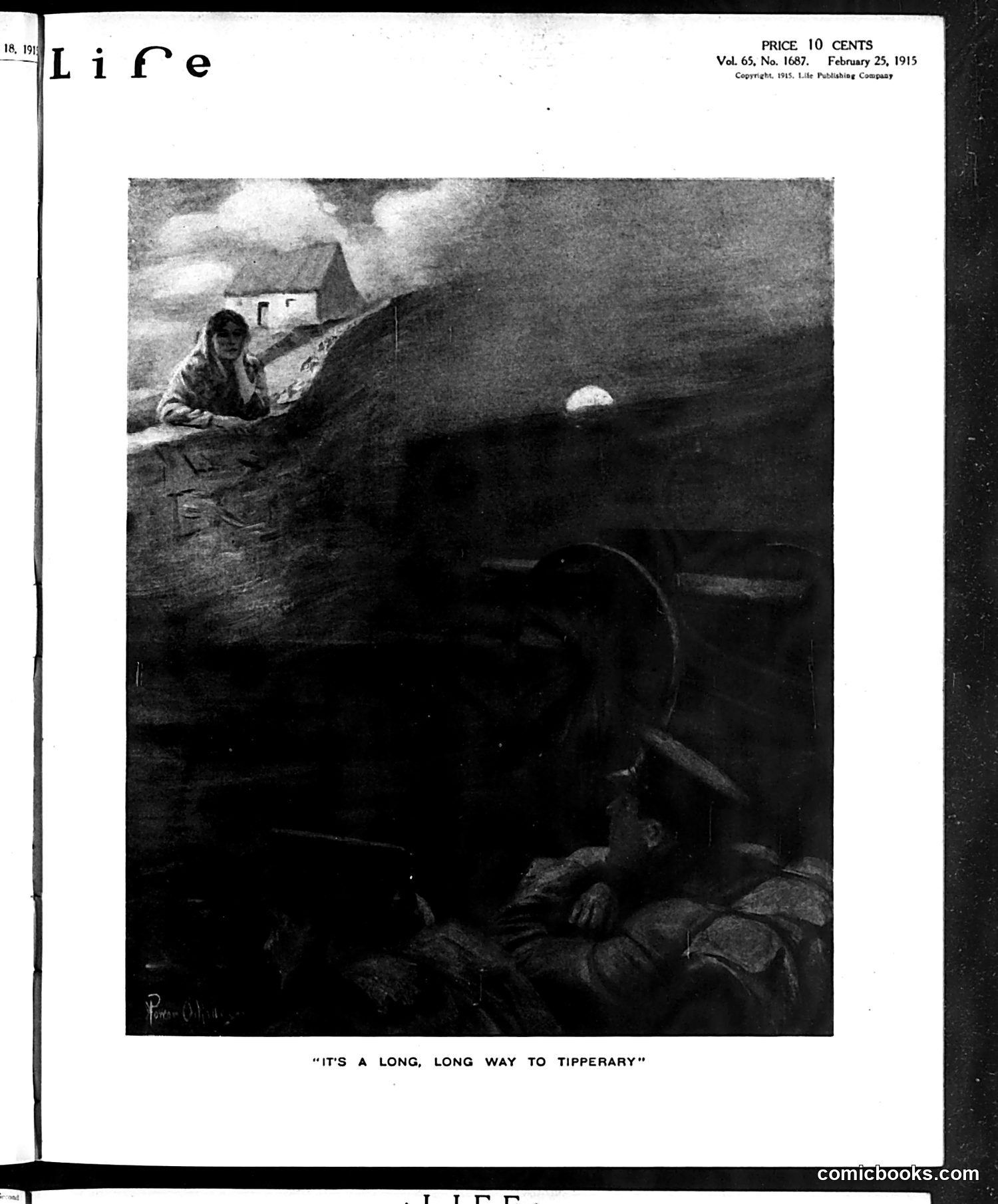
This 1915 *Life* magazine illustration references the popular World War I song "It's a Long, Long Way to Tipperary" (1912), which became an anthem for British soldiers. The image depicts soldiers in a trench or fortification, with one figure looking toward a distant church or building, evoking homesickness and the vast distance from home. The satire appears to comment on the soldiers' longing for Tipperary (Ireland), using the song title to highlight the contrast between the harsh realities of trench warfare and nostalgic memories of home. Published while America was still neutral but increasingly aware of the brutal Western Front, the cartoon likely expressed sympathetic commentary on soldiers' endurance during the protracted conflict.
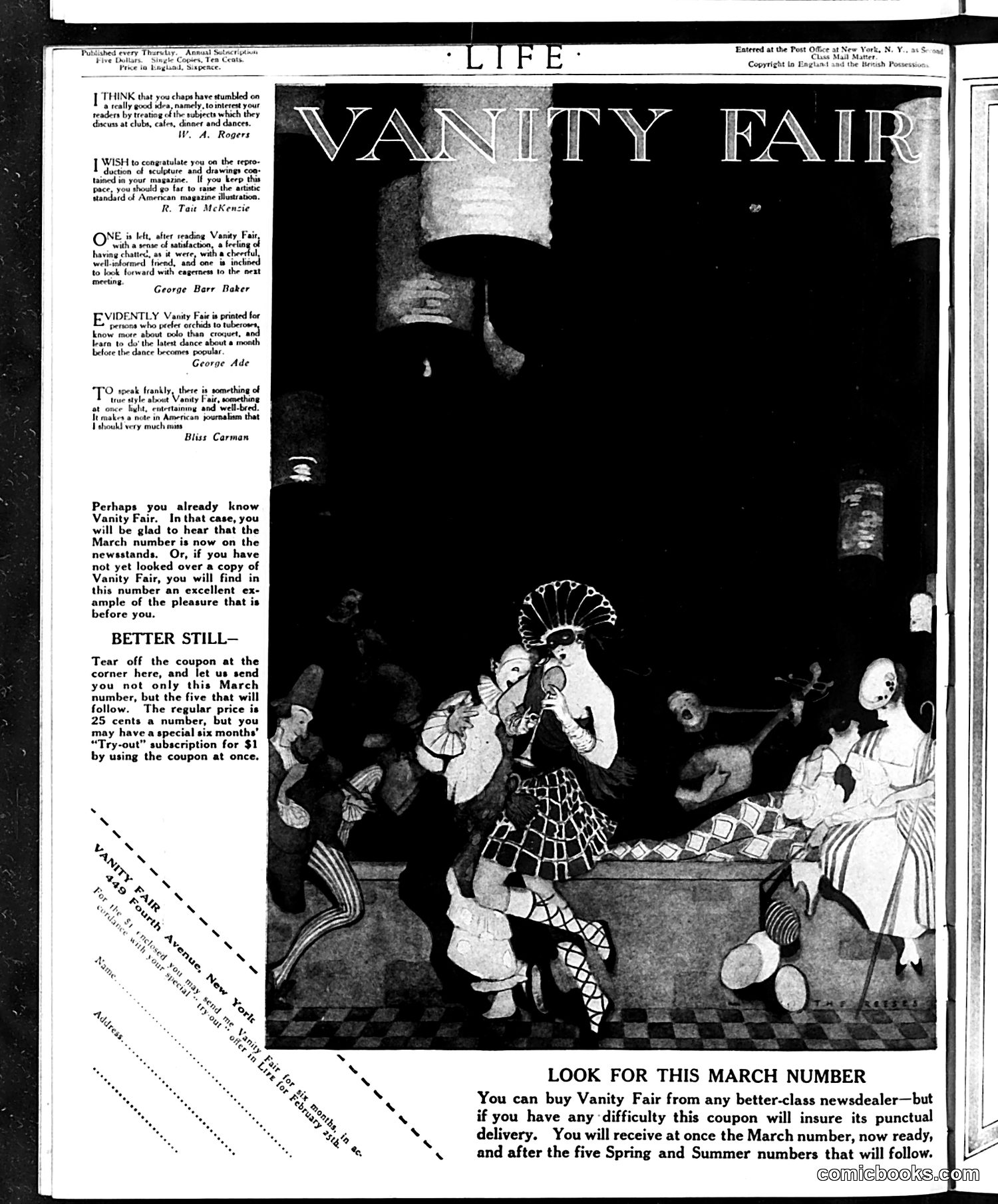
This page is primarily **advertising for Vanity Fair magazine**, not political satire. The left side contains endorsements from public figures (H. Van McKenzie, George Barr Baker, George Ade, Bliss Carman) praising Vanity Fair's quality and entertainment value. These quotes emphasize the magazine's appeal to readers seeking sophisticated, current content about "the latest dance" and fashionable topics. The main illustration shows a **1920s social scene** — a woman in elaborate period costume with a large feathered hat entertaining guests at what appears to be a card game or social gathering. This image exemplifies the magazine's focus: documenting contemporary leisure, fashion, and high-society entertainment. The bottom section urges readers to purchase the March issue from newsstands or use the attached coupon for a discounted subscription. This is purely commercial promotion.
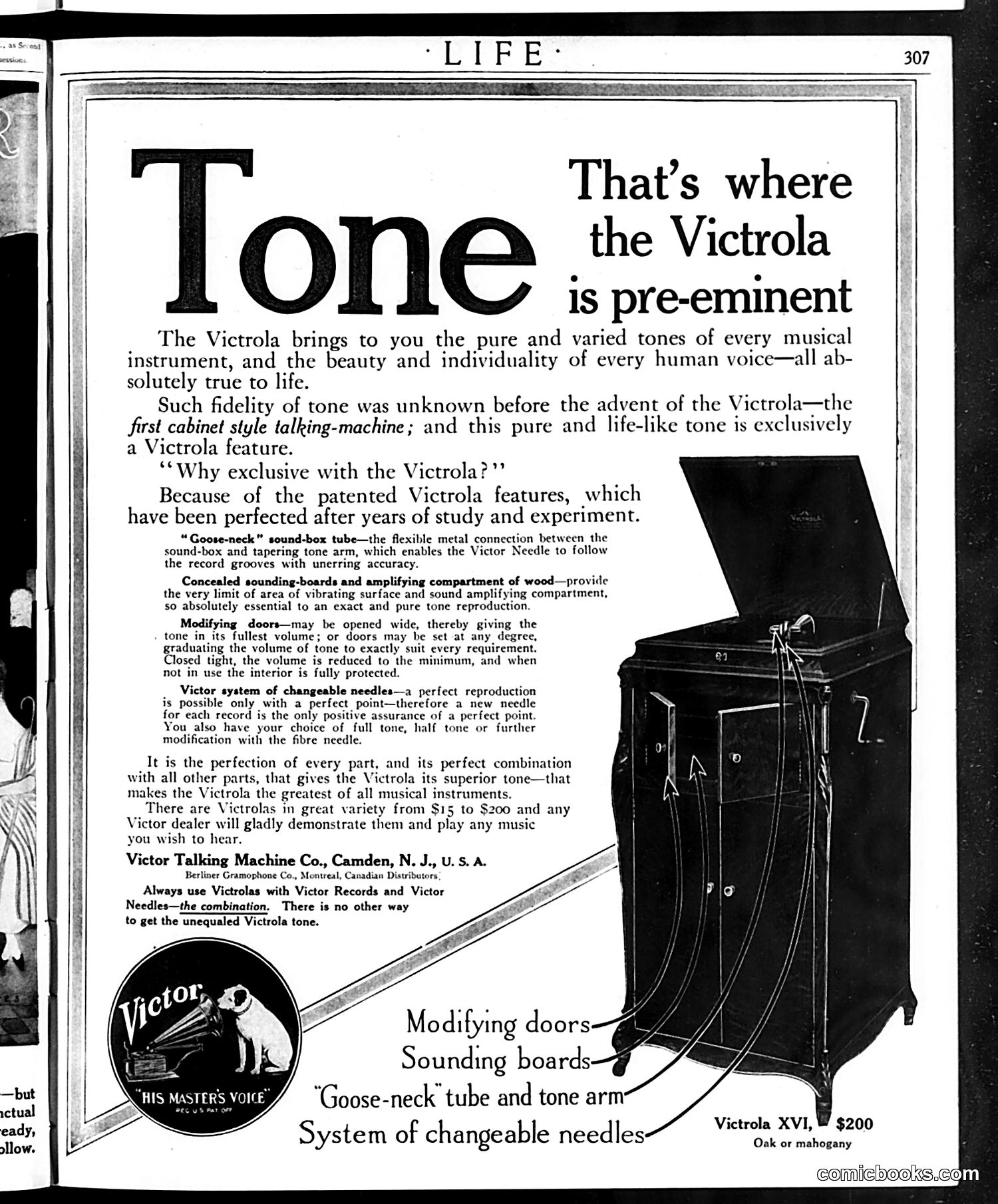
This is **not a cartoon or satirical content** — it's a straightforward **product advertisement** for the Victrola, a cabinet-style phonograph manufactured by Victor Talking Machine Co. in Camden, New Jersey. The ad emphasizes the Victrola's superior sound quality, claiming it reproduces "the pure and varied tones of every musical instrument" with fidelity "unknown before." It highlights patented features like the "goose-neck" sound-box tube, concealed sounding boards, and modifiable doors for volume control. The "His Master's Voice" Victor logo appears at bottom. The page includes a technical diagram of the Victrola XVI model priced at $200 in oak or mahogany. This represents early 20th-century consumer marketing for what was cutting-edge audio technology.
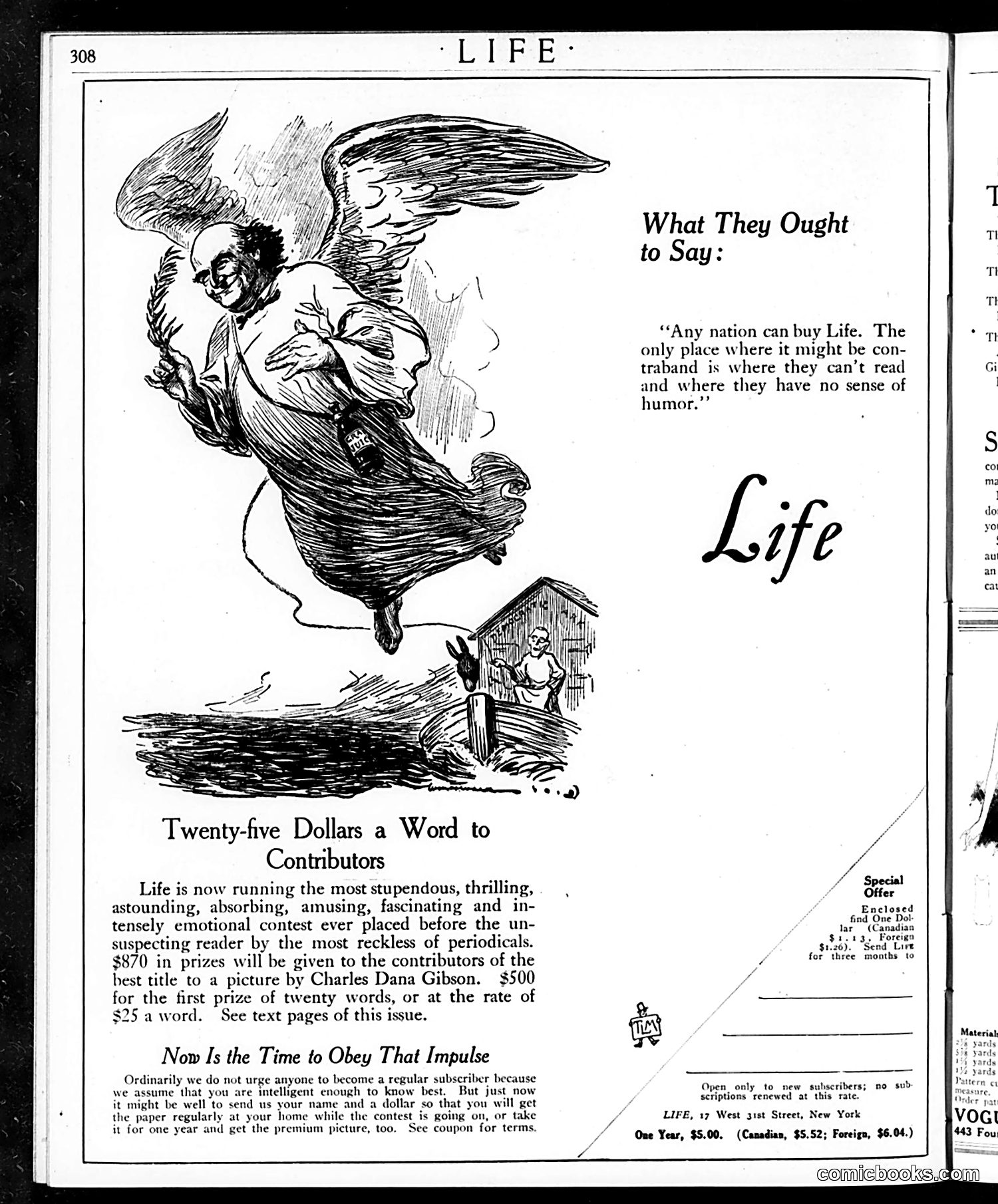
This page is primarily an **advertisement for Life magazine's writing contest**, not political satire. The winged figure carrying a man appears to be an allegorical representation of inspiration or fortune, depicted in a classical style. The contest offers **$870 in prizes** ($500 for first place at $25 per word) for the best title to accompany a Charles Dana Gibson illustration. Gibson was Life's famous illustrator known for the "Gibson Girl." The quoted text at top—about nations being able to buy Life except where people can't read or lack humor—is self-promotional copy positioning Life as witty and intelligent. The small illustration below shows a modest cabin, likely meant to represent everyday American life as subject matter for the contest. This is essentially a **classified advertising page**, not editorial content with political meaning.
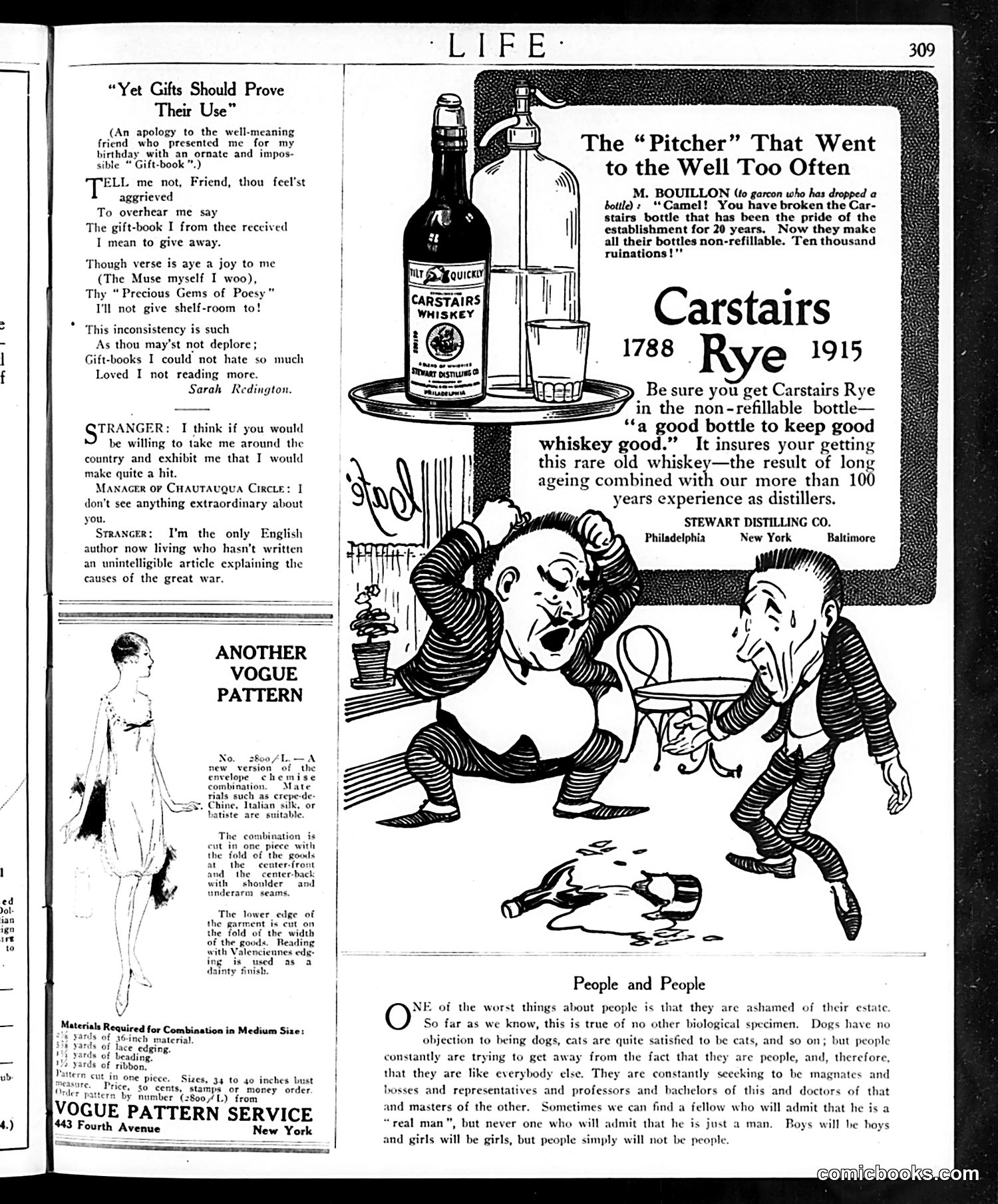
This Life magazine page (309) mixes poetry, fashion, and advertising. The main cartoon depicts a slapstick scene of two exaggerated figures reacting with shock and alarm to a broken bottle on the floor. The image appears to be satirizing carelessness or domestic mishaps. The adjacent Carstairs Rye whiskey advertisement uses this chaos humorously—the broken bottle serves as dark comedy promoting their "non-refillable bottle" as superior to competitors' traditional bottles. The tagline suggests their product won't break like rivals', turning a disaster into a sales pitch. Below, "People and People" is a humorous essay mocking human pretension and social climbing, contrasting people's desire to be like others while denying they're "just" people. It's gentle social satire typical of Life's satirical approach to human nature and class anxiety.
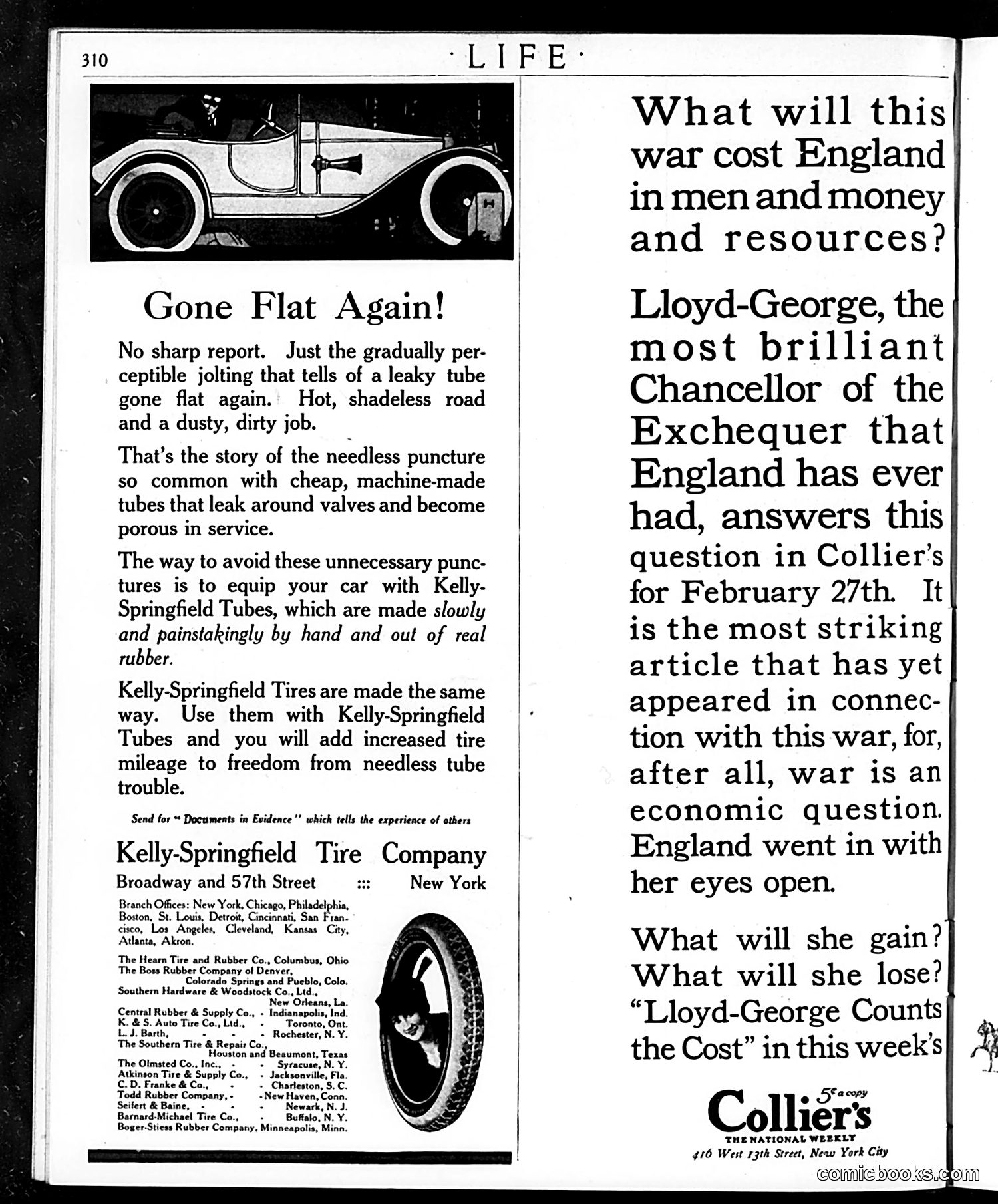
This page contains two distinct advertisements rather than political satire. **Left side:** A Kelly-Springfield Tire Company ad addressing a common automotive problem—flat tires caused by faulty inner tubes. The ad promises their tires and tubes, made from "real rubber," will reduce punctures and increase mileage reliability. **Right side:** A Collier's magazine advertisement referencing World War I. It promotes an upcoming article by Lloyd George (British Chancellor of the Exchequer) analyzing the war's economic costs to England—what the nation would gain and lose. The ad frames this as timely analysis of the war as fundamentally an "economic question." Both advertisements target readers' practical concerns: car maintenance and wartime economic anxieties. Neither contains editorial cartoons or political caricature.
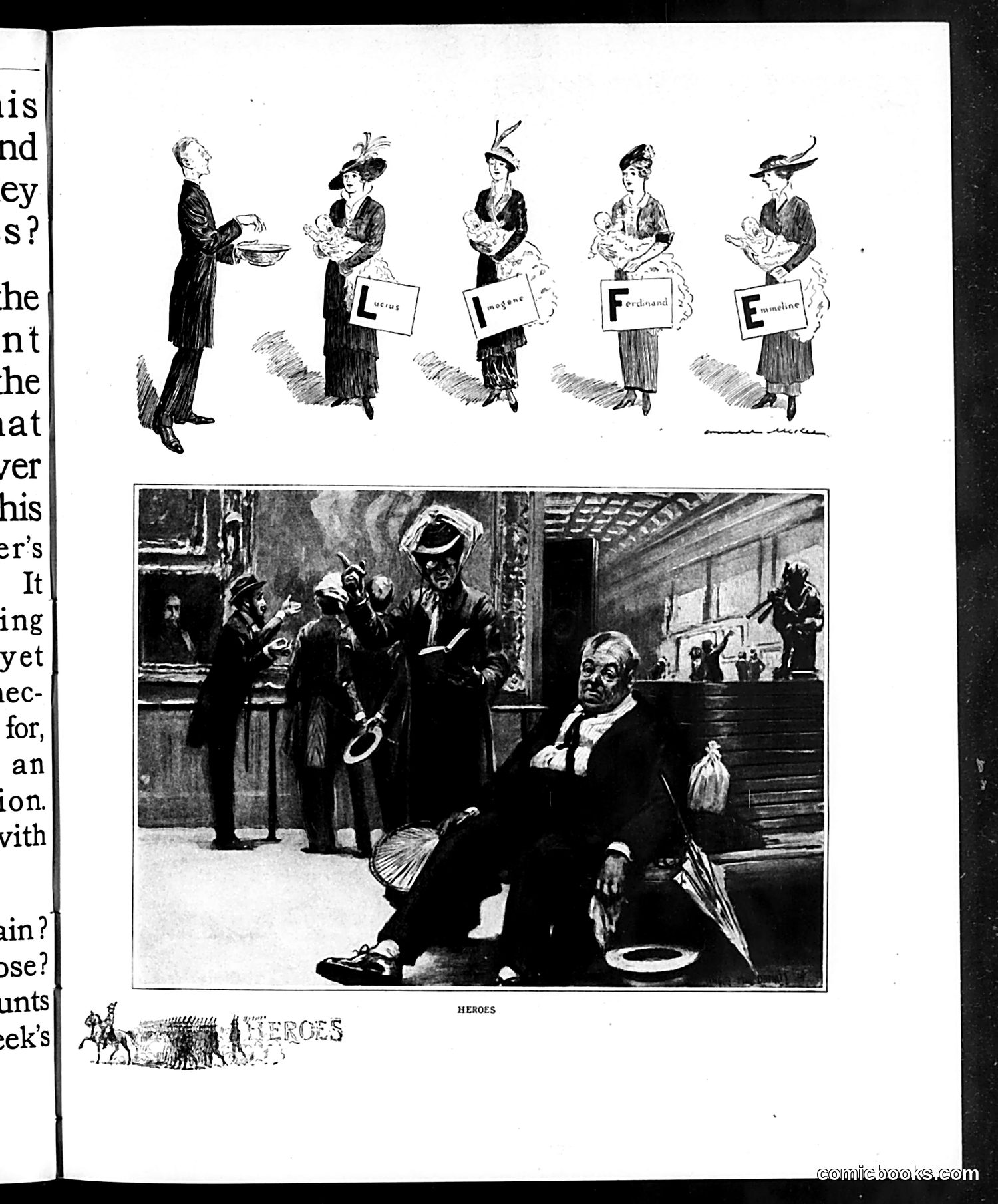
The top cartoon shows a man presenting decorative items to five women, each holding a label. The visible labels read "L[unclear]," "D[unclear]," "F[unclear]," and "E[unclear]" — likely representing different nations or regions, suggested by their period dress and elaborate hats. The bottom illustration, titled "HEROES," depicts a formal interior scene where well-dressed military or government officials stand conferring while an older gentleman sits alone in the foreground, appearing marginalized or ignored. Without clearer OCR text or additional context, the precise political references remain uncertain. This appears to satirize diplomatic dealings, possibly gift-giving between nations or the sidelining of a particular leader or faction during international negotiations. The contrast between the active officials and the isolated seated figure suggests commentary on power dynamics or exclusion from decision-making.
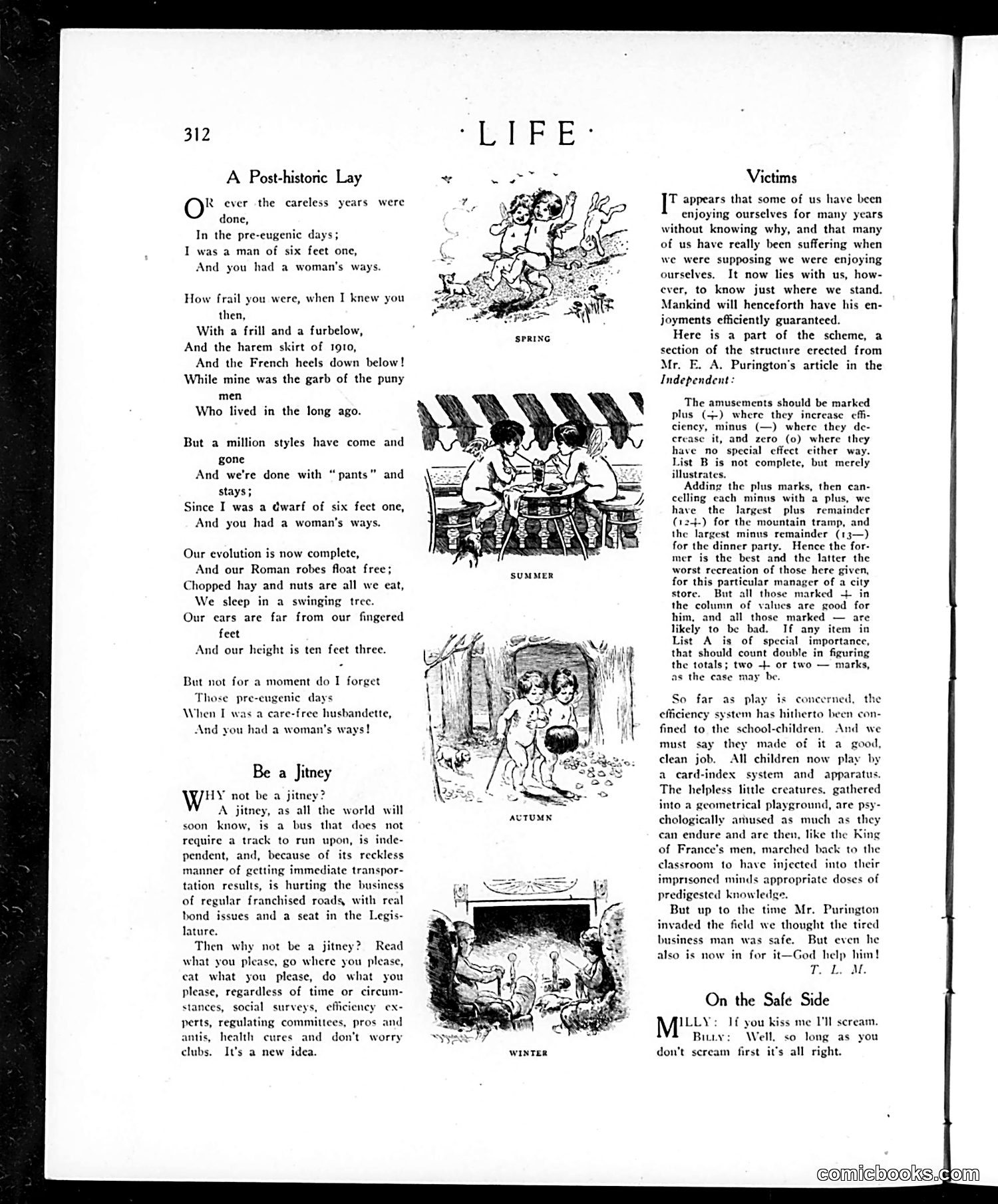
This page contains literary and humorous content rather than political cartoons. "A Post-historic Lay" is a poem describing evolutionary changes—humans have evolved from six-foot beings to smaller creatures living in trees, eating "chopped hay and nuts," with ears "far from our fingered feet." The four seasonal illustrations (Spring, Summer, Autumn, Winter) appear to depict children at play in increasingly primitive or simplified conditions, satirizing modern civilization's "progress." "Be a Jitney" proposes an alternative transportation system—independent vehicles operating on flexible routes rather than fixed tracks, suggesting this as a novel solution to urban transit problems. "Victims" and "On the Sale Side" discuss children's games and amusements, apparently commentary on modern recreational systems. The satire targets evolutionary theory and contemporary social organization.
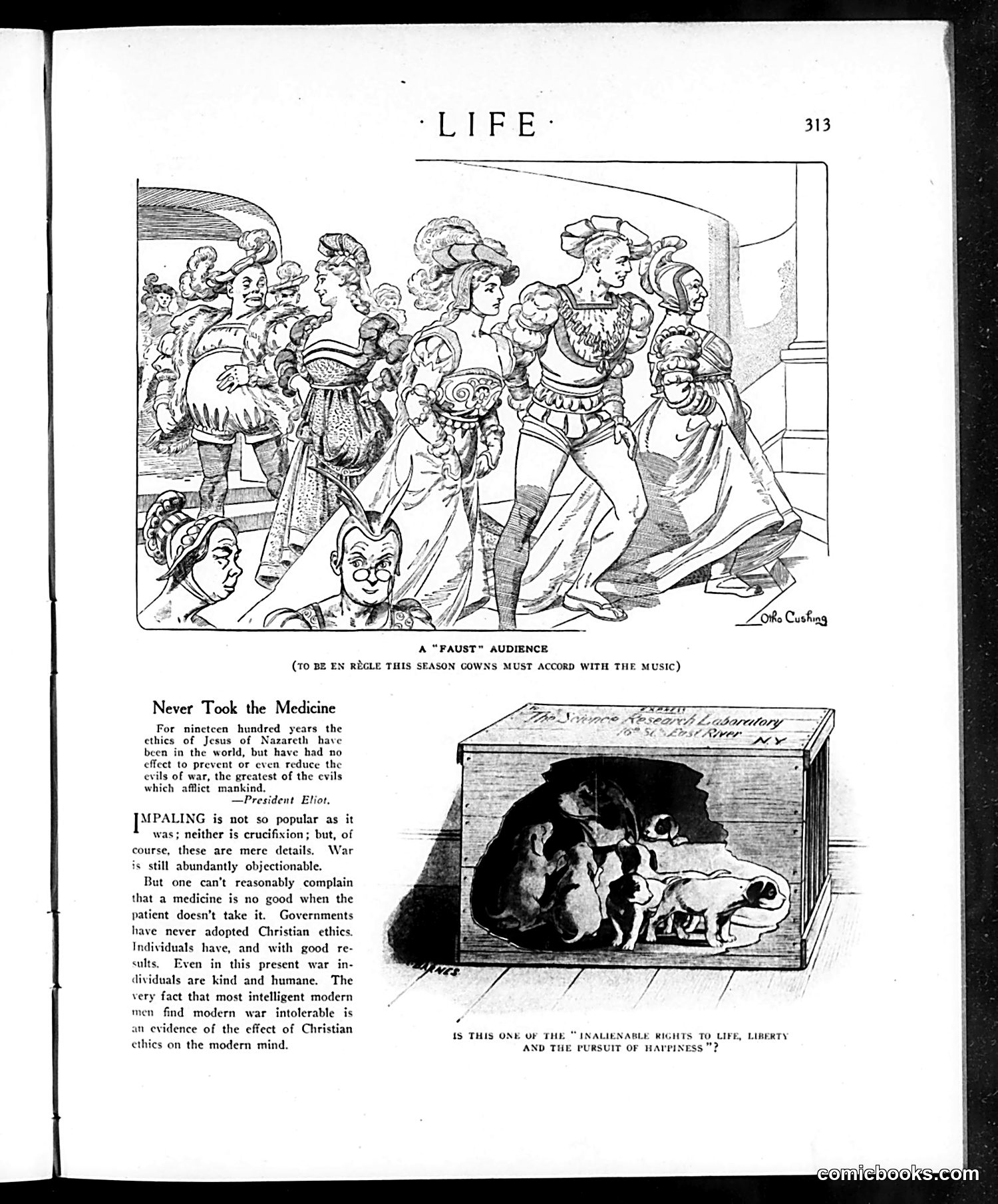
The top illustration labeled "A 'Faust' Audience" depicts an elaborate Renaissance or operatic court scene with elaborately dressed nobles and courtiers, suggesting a theatrical production. The caption notes these "season gowns must accord with the music," implying satire about pretentious operatic audiences obsessed with fashion conformity. The lower section, "Never Took the Medicine," argues against pacifism during wartime. The text critiques Christian ethics as ineffective against war, claiming governments reasonably reject pacifist medicine since "the patient doesn't take it." The accompanying illustration (unclear in detail) appears to reinforce this anti-pacifist stance, questioning whether disarmament represents genuine "liberty" and "pursuit of happiness." The page satirizes both elite cultural pretension and idealistic pacifism.
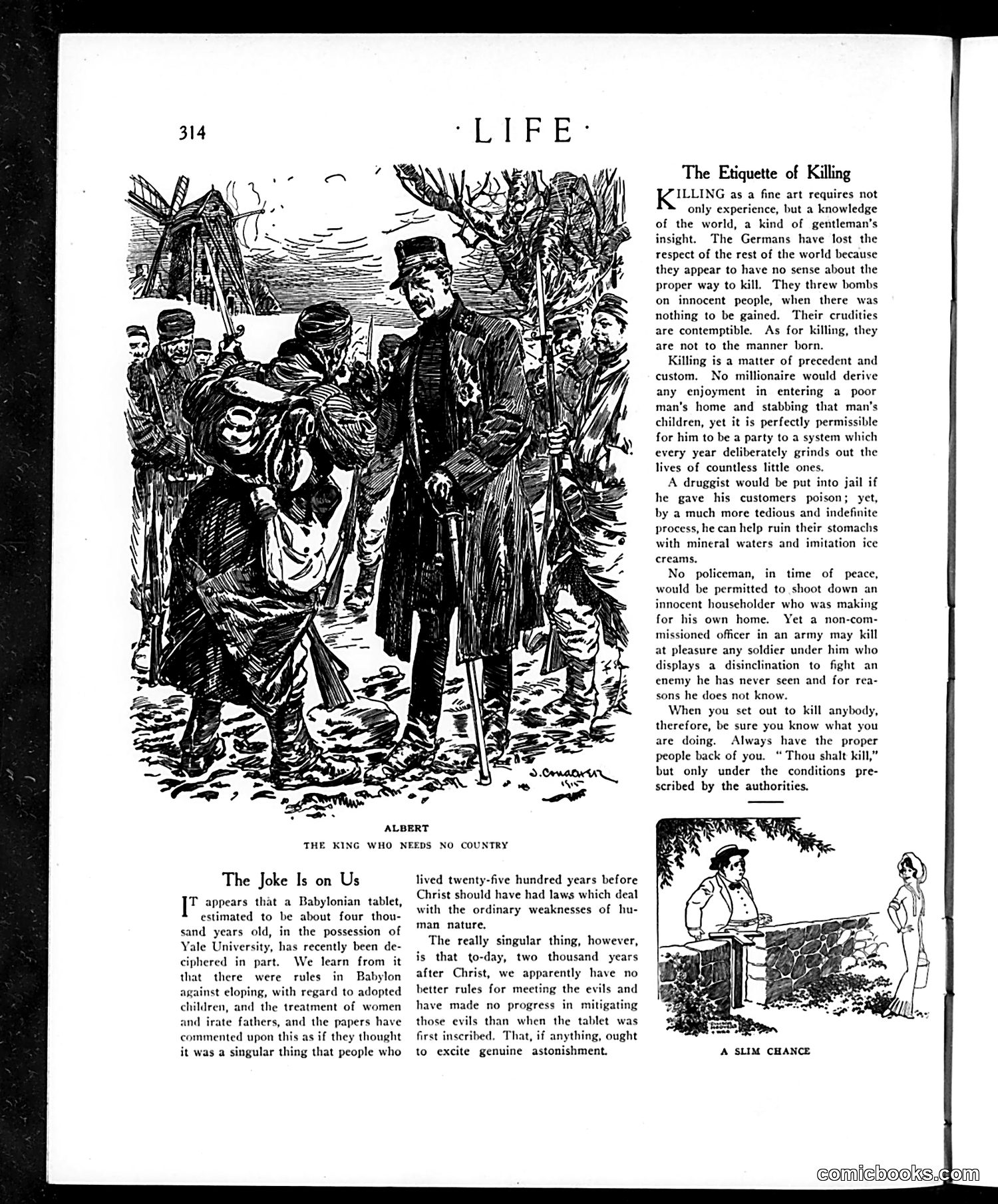
This page contains satirical commentary on warfare and morality. **"Albert: The King Who Needs No Country"** depicts what appears to be a military figure (likely German, given the caption's reference to "Germans" in the text) surrounded by soldiers and civilians in a war-torn landscape. The accompanying essay titled "The Etiquette of Killing" sarcastically critiques the hypocrisy of civilization's rules of conduct. It argues that while civilians face legal consequences for murder, military officers can kill with impunity—a privilege the text treats as morally indefensible. **"The Joke Is on Us"** references a Babylonian tablet, suggesting ancient societies had better moral codes than modern ones regarding treatment of the weak and women. The smaller cartoon "A Slim Chance" appears unrelated social commentary. The overall message criticizes military exemption from civilian moral standards as fundamentally unjust.
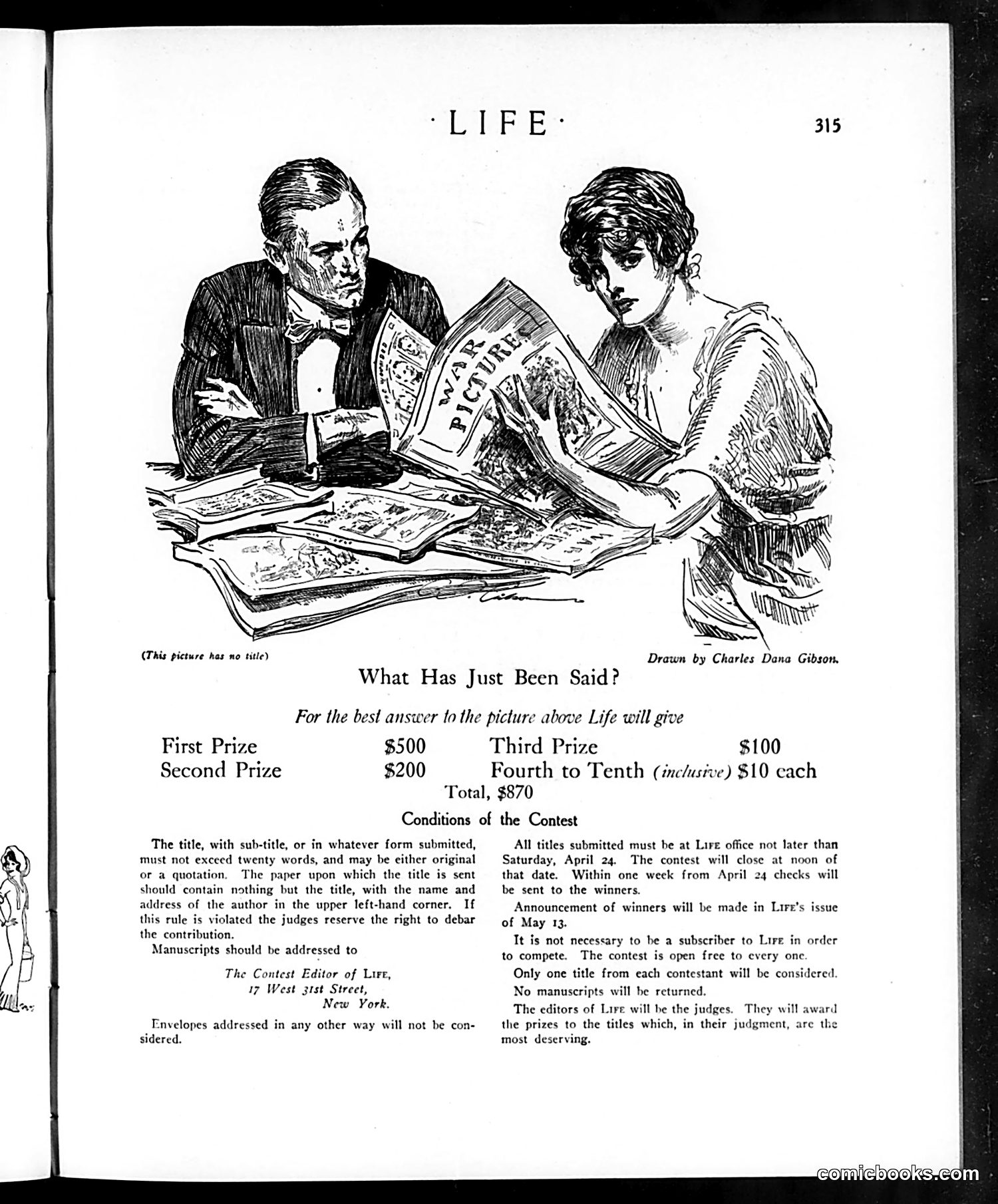
This page features a contest announced by *Life* magazine, with an illustration by Charles Dana Gibson (the famous "Gibson Girl" artist). The drawing shows a well-dressed man and woman examining picture books and magazines together at a table. The contest asks readers to submit titles for this untitled illustration, with prizes totaling $870. The satire likely plays on domestic or social dynamics of the era—the couple's body language and their focused attention on illustrated material suggests commentary on shared leisure activities, courtship, or the influence of popular media on social interaction. Without additional context, the specific social critique remains unclear, though the prominent display of books/magazines implies the content's relevance to public taste or behavior.
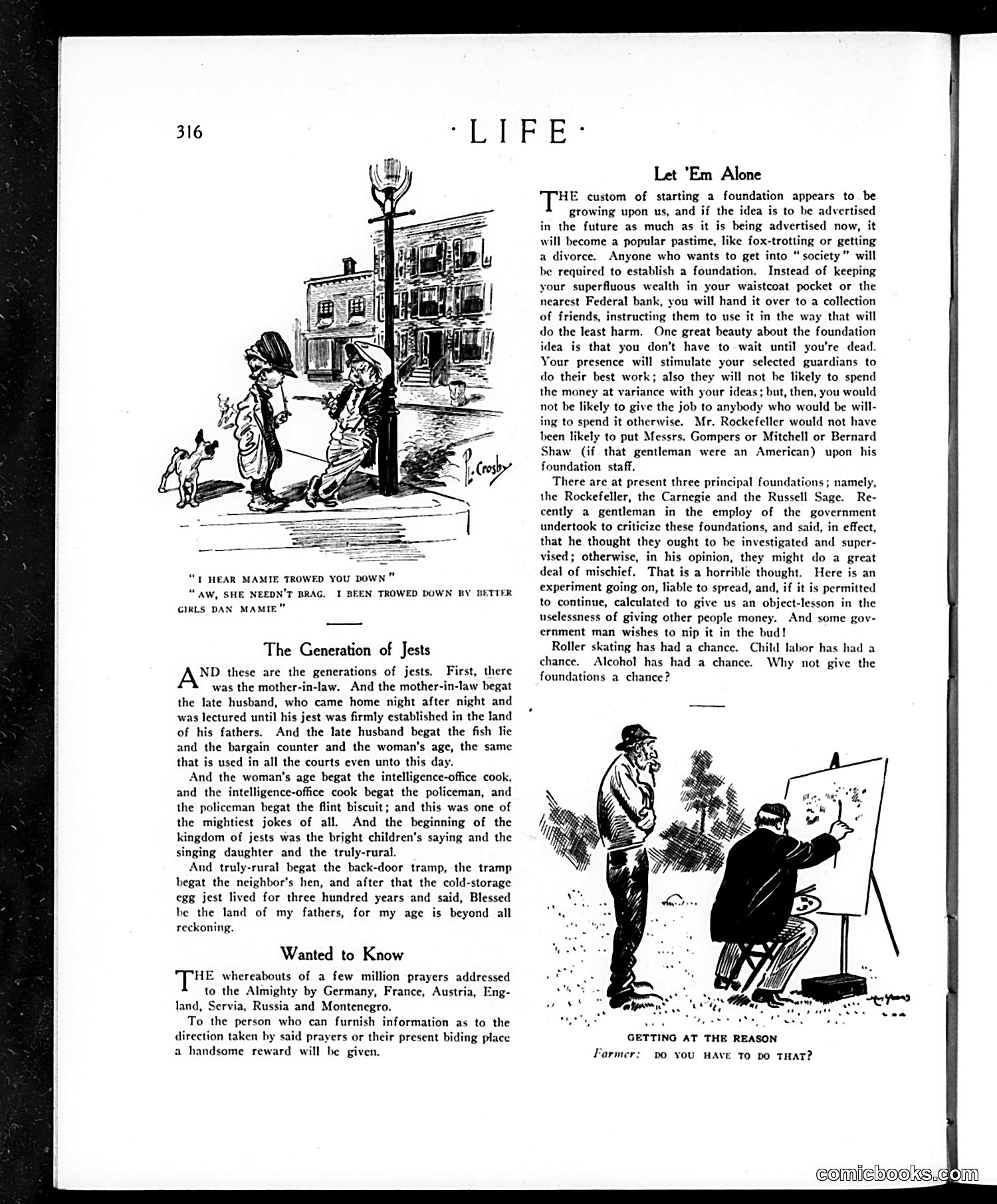
The page contains three distinct pieces of satire: 1. **"Let 'Em Alone"** (top): A cartoon and essay mocking the trend of wealthy philanthropists establishing foundations. The satire argues that foundation-giving has become a status symbol—a requirement for "society"—and criticizes both the practice and government oversight of these institutions. It sarcastically suggests foundations might do "a great deal of mischief" if unsupervised. 2. **"The Generation of Jests"** (middle): A humorous piece about domestic quarrels and verbal sparring between spouses, using mock-biblical language to satirize trivial marital disputes. 3. **"Getting at the Reason"** (bottom): A cartoon showing an artist/painter with a model, captioned with a farmer's bewildered question about the purpose of posing—poking fun at artistic pretension and rural incomprehension of modern art. The overall tone is gently mocking of wealth, social conventions, and artistic pretense.
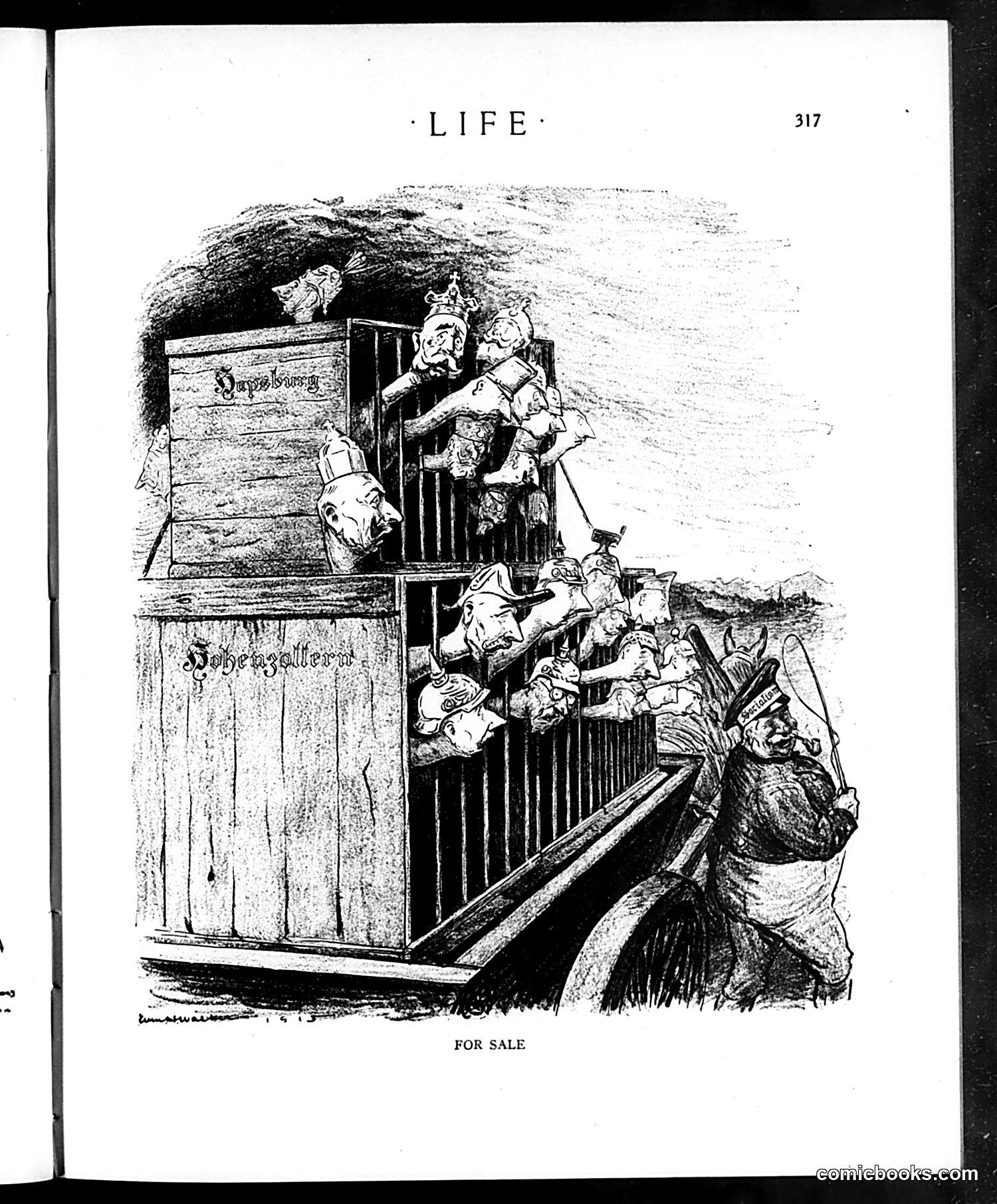
This cartoon depicts a wooden structure labeled "Scheggeller's" with anthropomorphic animal figures (appearing to be pigs or similar creatures) crowded inside and around it. A figure on the right, dressed as a butcher or dealer, appears to be conducting a sale or auction of these animals. The satirical point seems to be social commentary on commodification and exploitation—the animals are literally "for sale" in what appears to be a cramped, inhumane container. The title and setup suggest criticism of exploitative labor practices, possibly sweatshop conditions or unethical business practices of the era. Without additional context about "Scheggeller's" specifically, the precise target remains unclear, but the cartoon critiques treating beings as mere merchandise.
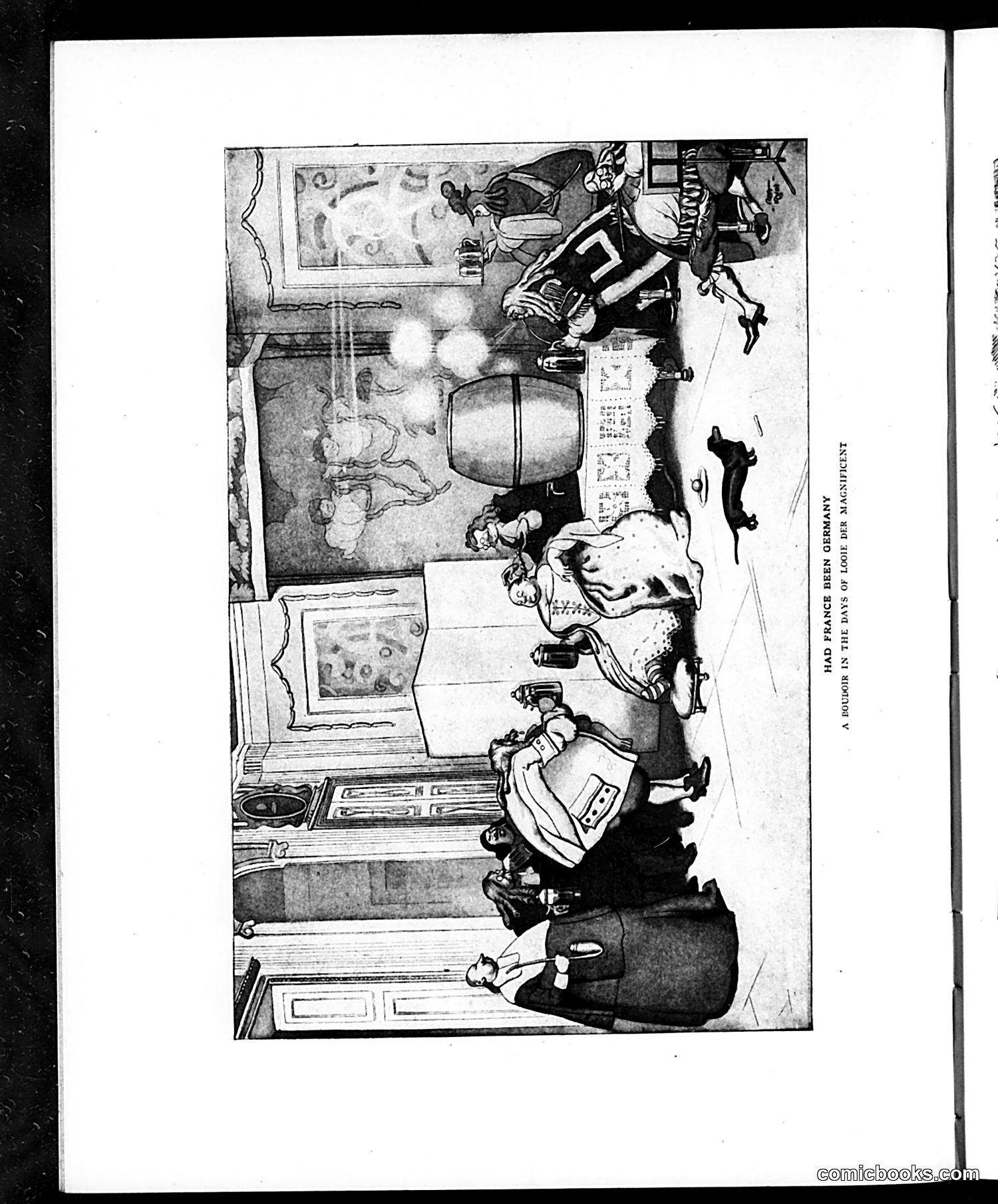
The caption reads "BAD FARCE IN GERMANY — A RUMOR IN THE DAYS OF LONG FINE MEASUREMENT" This appears to be a political cartoon satirizing German affairs, shown rotated 90 degrees. The image depicts what seems to be a domestic or governmental scene with multiple figures in what looks like an interior space. Based on the caption's reference to "bad farce" and "Germany," this likely critiques some absurd or ridiculous aspect of German politics or society during the period Life magazine was published. However, without being able to clearly identify the specific figures or read all details in the rotated image, I cannot definitively state which German political event or figures this targets. The "long fine measurement" phrase suggests measurement or standards of some kind were involved in the contemporary controversy being mocked.
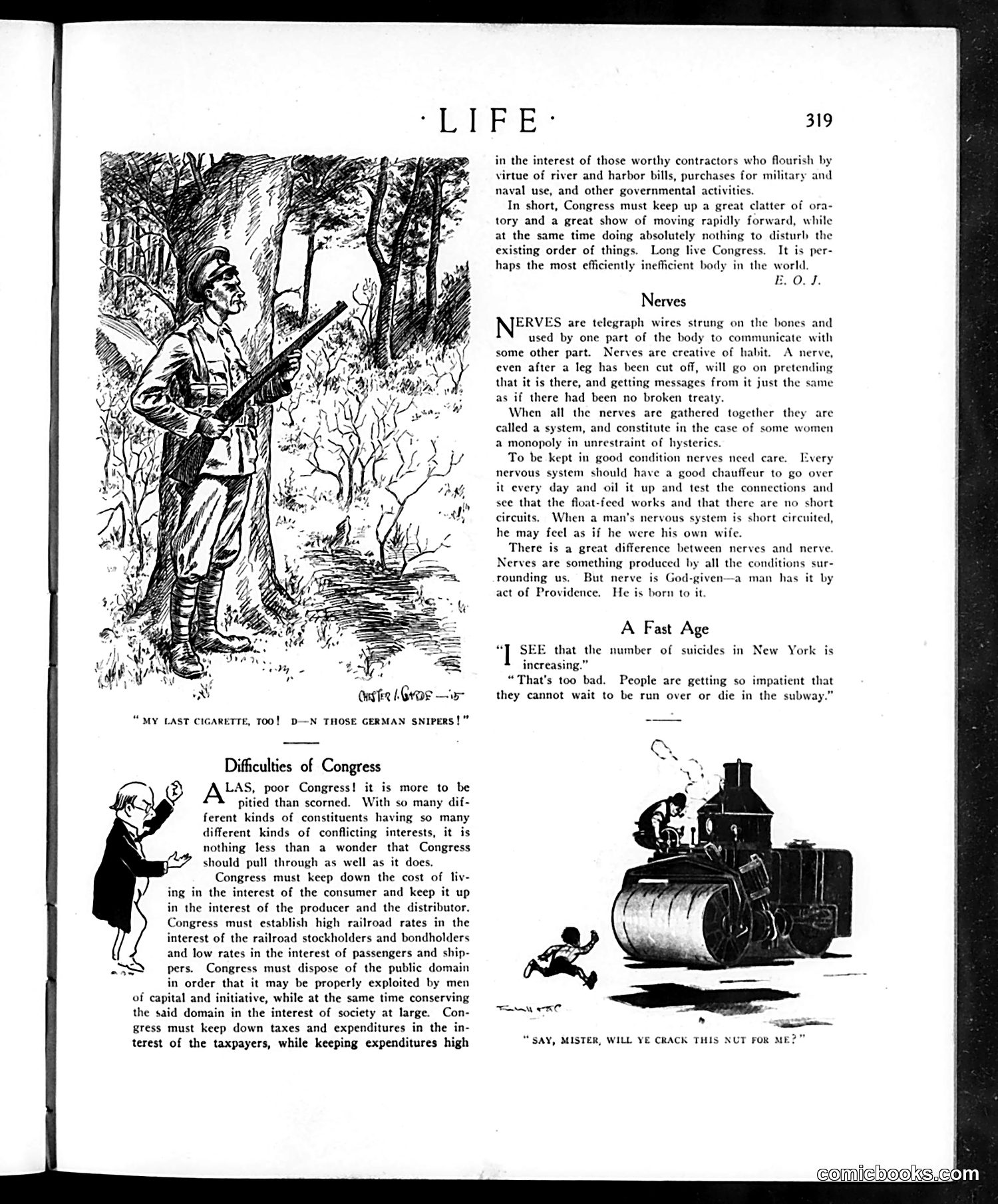
This 1915 Life magazine page contains satirical commentary on American institutions. **"Difficulties of Congress"** mocks Congress's impossible mandate to satisfy contradictory interests simultaneously—keeping living costs low for consumers while high for producers, establishing both high and low railroad rates depending on whose interests are served. The satire argues Congress is "efficiently inefficient," maintaining the appearance of action while preserving the status quo. **The WWI cartoon** (top left) depicts a soldier in a trench saying "My last cigarette, too! D—n those German snipers!"—darkly humorous commentary on combat conditions during World War I. **"A Fast Age"** section satirizes modern impatience, with a dialogue suggesting New Yorkers are so desperate they can't even wait for accidents—they commit suicide instead. The train cartoon below illustrates this commentary on urban pace and desperation. The "Nerves" section is a humorous faux-scientific explanation of the nervous system, comparing it to mechanical systems requiring maintenance.
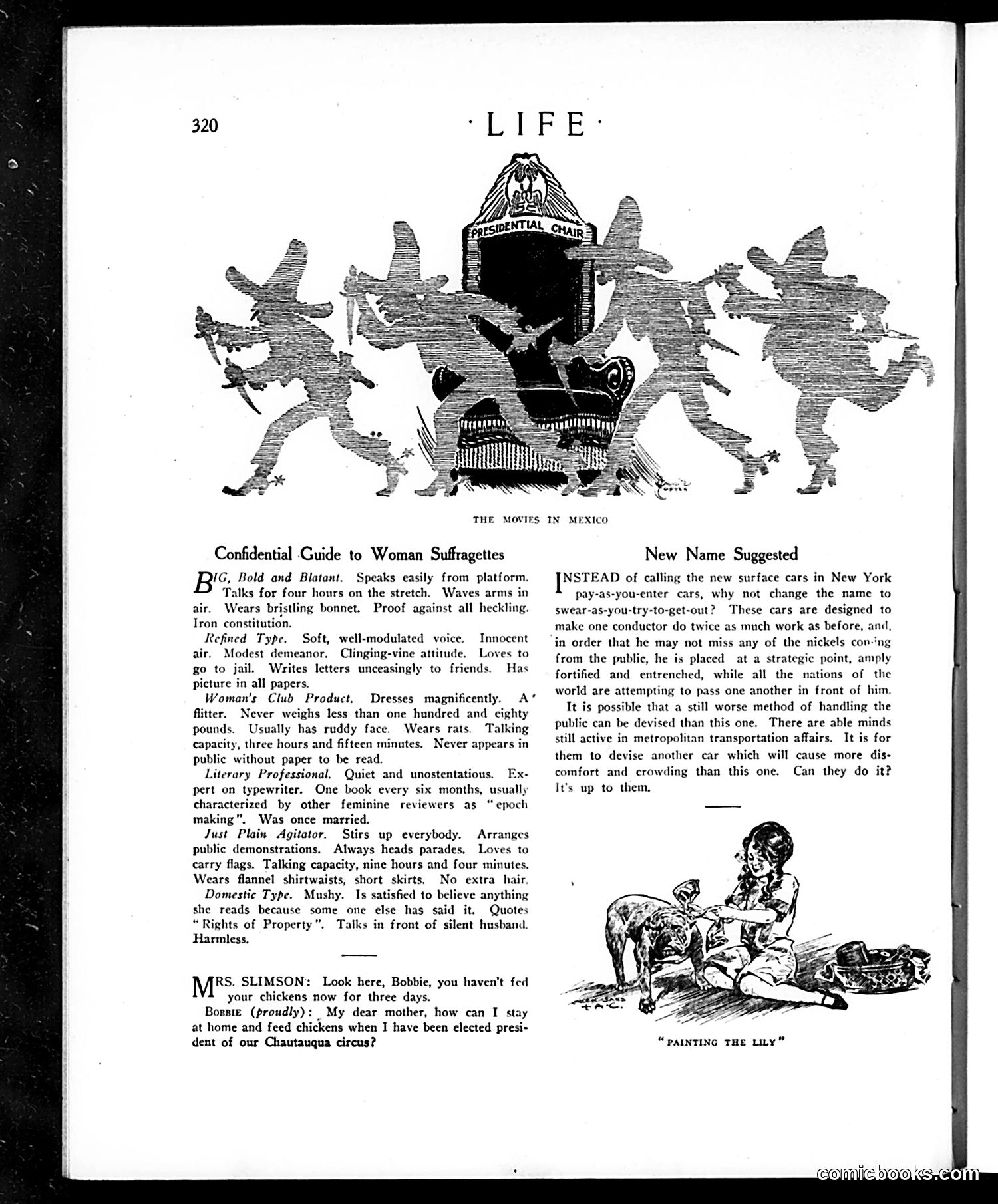
This page contains two separate satirical pieces mocking women suffragettes and modern urban inconvenience. **"Confidential Guide to Woman Suffragettes"** (top section) stereotypes female activists into six caricatured types—from the loudmouthed "Bold and Blatant" suffragette to the passive "Domestic Type" who merely parrots others' opinions. The satire dismisses women's political activism by reducing suffragists to shallow personality types rather than serious advocates. The accompanying illustration shows cartoonish figures dancing around a "Presidential Chair," mocking their aspirations to political power. **"New Name Suggested"** (right) sarcastically proposes renaming New York's new pay-as-you-enter streetcars "swear-as-you-try-to-get-out cars," critiquing their design as deliberately uncomfortable and crowded to maximize conductor revenue collection. It's an ironic jab at transit companies prioritizing profit over passenger comfort. The page reflects early 20th-century attitudes: dismissive humor toward women's suffrage and cynical commentary on corporate indifference to public welfare.
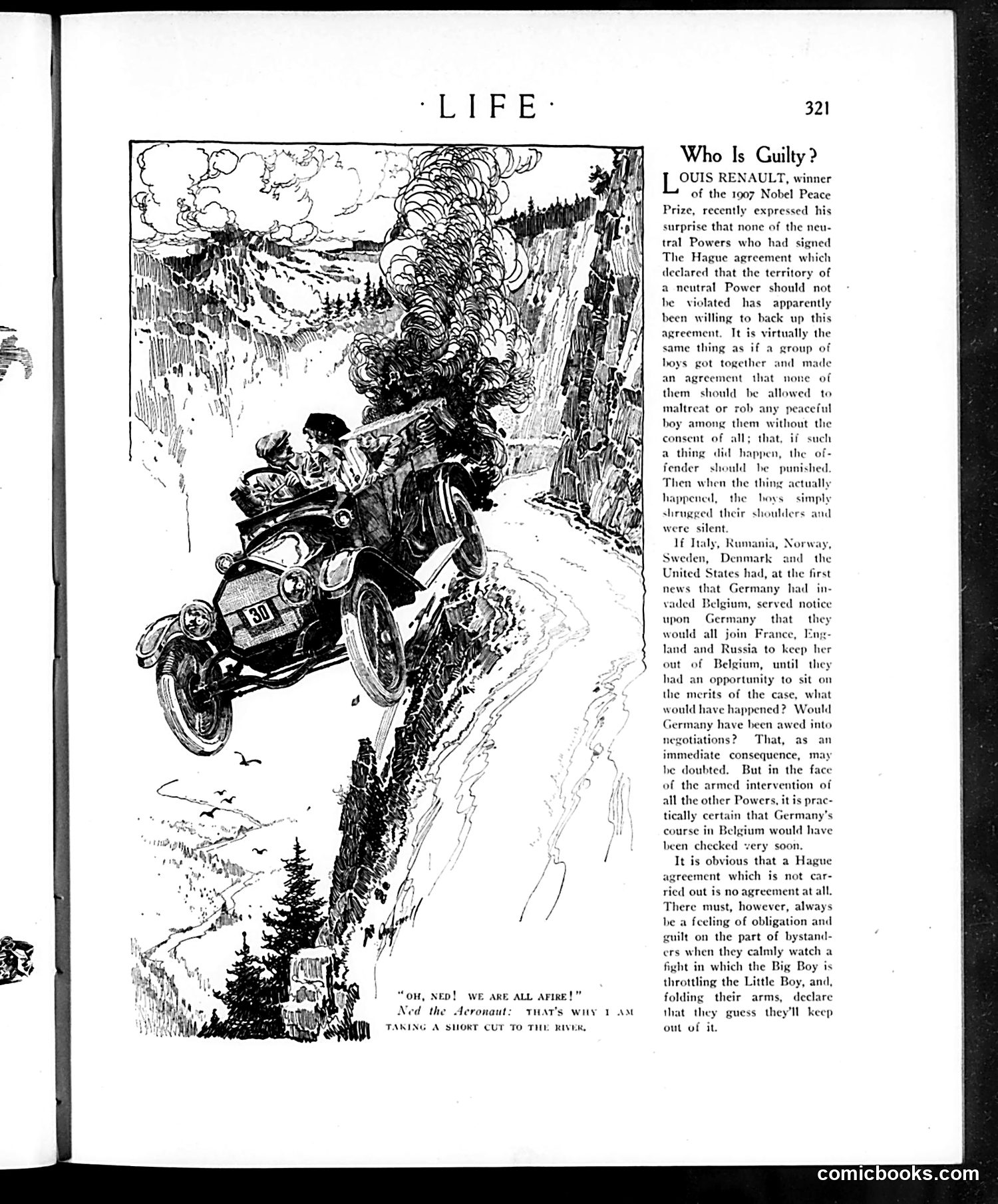
This page critiques neutral powers' failure to enforce the Hague agreement after Germany invaded Belgium in WWI. The illustration shows a motorcycle careening dangerously off a cliff while a passenger cries "We are all afire!"—the "aeronaut" taking a shortcut to escape. This metaphor represents neutral nations (Italy, Rumania, Norway, Sweden, Denmark, the U.S.) who signed the Hague treaty promising to jointly protect neutral territory, yet did nothing when Germany violated Belgian neutrality. The text, attributed to Nobel Peace Prize winner Louis Renault, compares the situation to boys making a pact against bullying, then passively watching one boy throttle another. The satire's point: an unenforced agreement is meaningless, and neutral bystanders bear guilt for their inaction. The cartoon mocks their cowardly "shortcut"—avoiding intervention—as reckless and ultimately self-destructive.
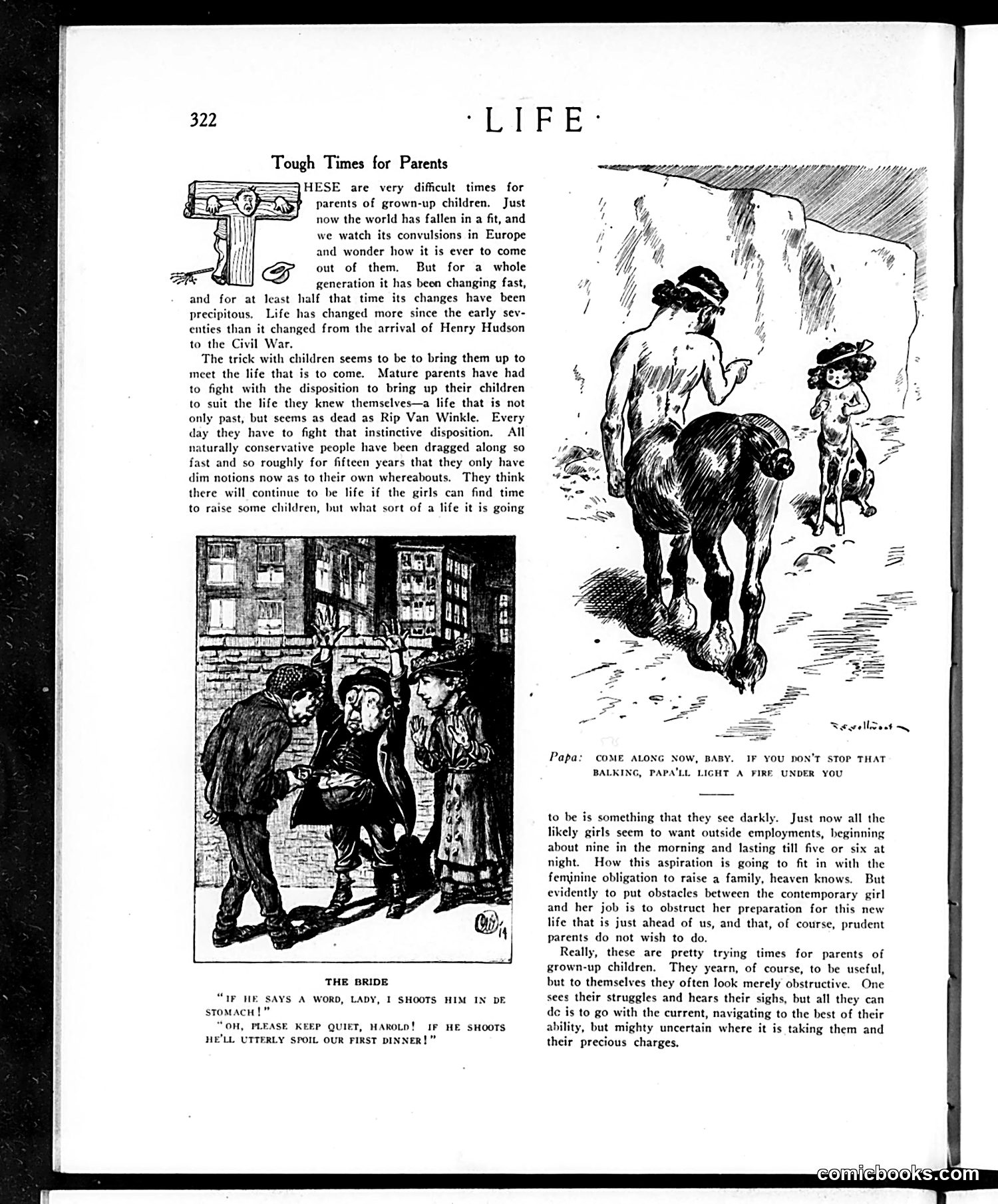
This page addresses early 20th-century generational conflict. The editorial argues that rapid social change since the 1870s has made parents' traditional values obsolete—comparing modern transformation to the entire span from Henry Hudson to the Civil War. The central tension: young women (particularly daughters) now want employment outside the home, conflicting with traditional expectations that they prepare for family life. Parents struggle because the world they knew no longer applies, yet they cannot confidently guide children toward an uncertain future. The cartoons illustrate this friction. The top drawing shows a father threatening corporal punishment ("light a fire under you") to a child—depicting outdated parental authority. "The Bride" cartoon satirizes newlyweds so concerned with propriety they won't even react to violence, suggesting rigid social conventions persisting despite changing times. The satire targets conservative parents caught between old values and new realities, unable to help because they don't understand the emerging world themselves.
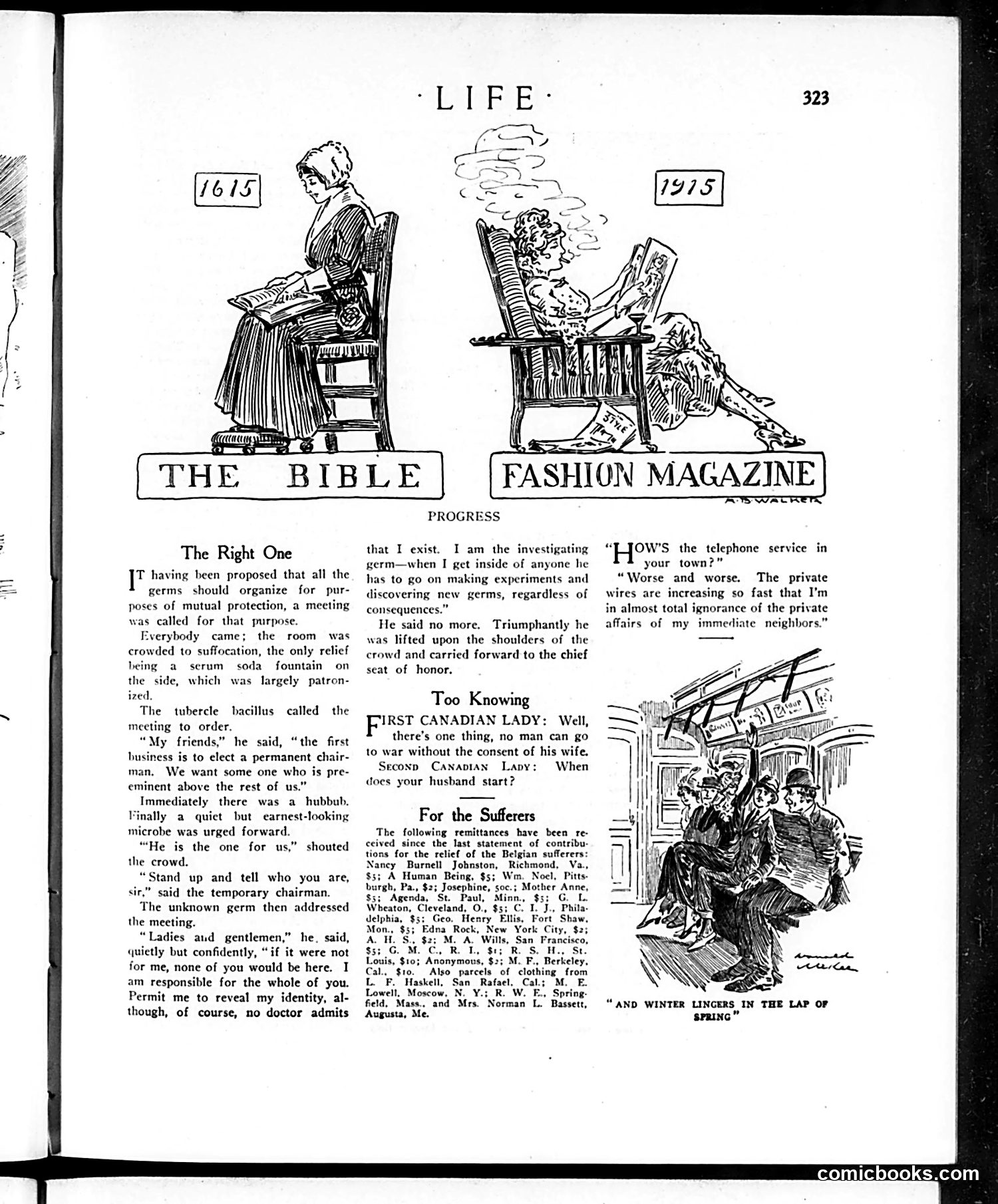
**Top Cartoon: "The Right One"** This is satirical commentary on disease research. Personified germs hold a meeting to elect a leader. They choose a modest microbe who reveals himself as the "investigating germ"—the one that forces doctors to conduct experiments and discover new pathogens. The joke: this germ is celebrated because his very existence drives medical progress through necessity. It's satire on how scientific advancement often happens reactively, in response to problems rather than prevention. **"Too Knowing"** Two Canadian women discuss going to war (likely WWI context, given the 1915 date). One claims "no man can go to war without his wife's consent," and the other asks when her husband leaves—implying she's eager to send him off. The satire mocks women's claimed domestic authority while suggesting they'll readily sacrifice their husbands to war. **Bottom Right: "And Winter Lingers in the Lap of Spring"** An illustration showing people crowded together indoors, captioned with a quote about winter persisting into spring—likely commentary on weather or seasonal transition.
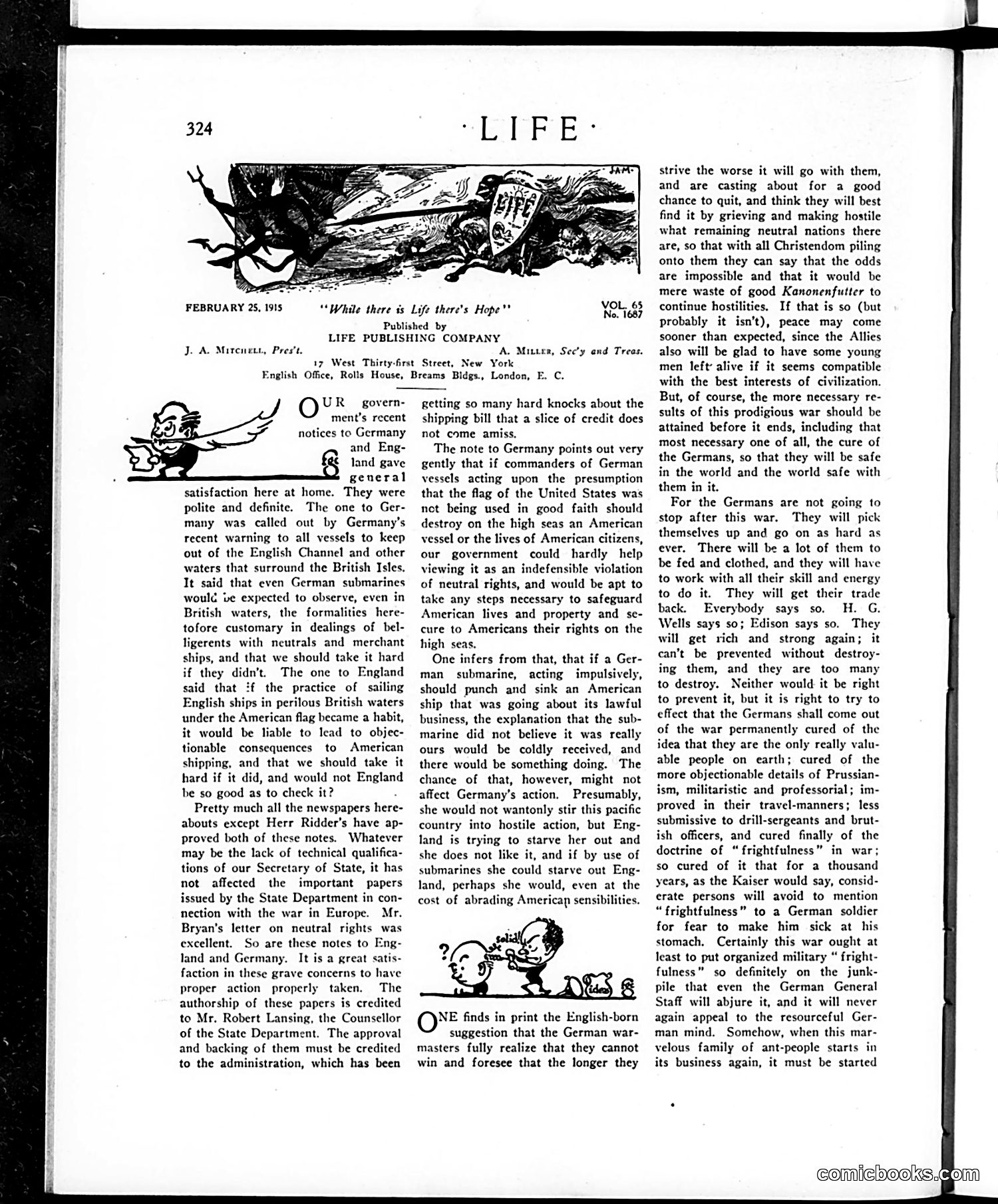
This *Life* magazine page discusses U.S. diplomatic notes to Germany and Britain regarding submarine warfare and neutral shipping rights during World War I. **The cartoons** (visible but small) appear to depict political figures or allegorical representations related to these diplomatic tensions, though specific identities are unclear from the image quality. **The main article** praises Secretary of State William Jennings Bryan and counselor Robert Lansing for issuing firm but polite warnings to both belligerents: Germany must respect American vessels and lives, and Britain shouldn't misuse the American flag. **The satire** targets Germany's submarine threat and the suggestion (printed elsewhere) that German commanders might provoke America into the war, calculating they'll lose anyway and prefer to blame impossible odds rather than admit defeat. The term "Kanonenfutter" (cannon fodder) sarcastically references Germany's willingness to sacrifice soldiers. The piece reflects American anxiety about remaining neutral while both European powers threatened American interests.
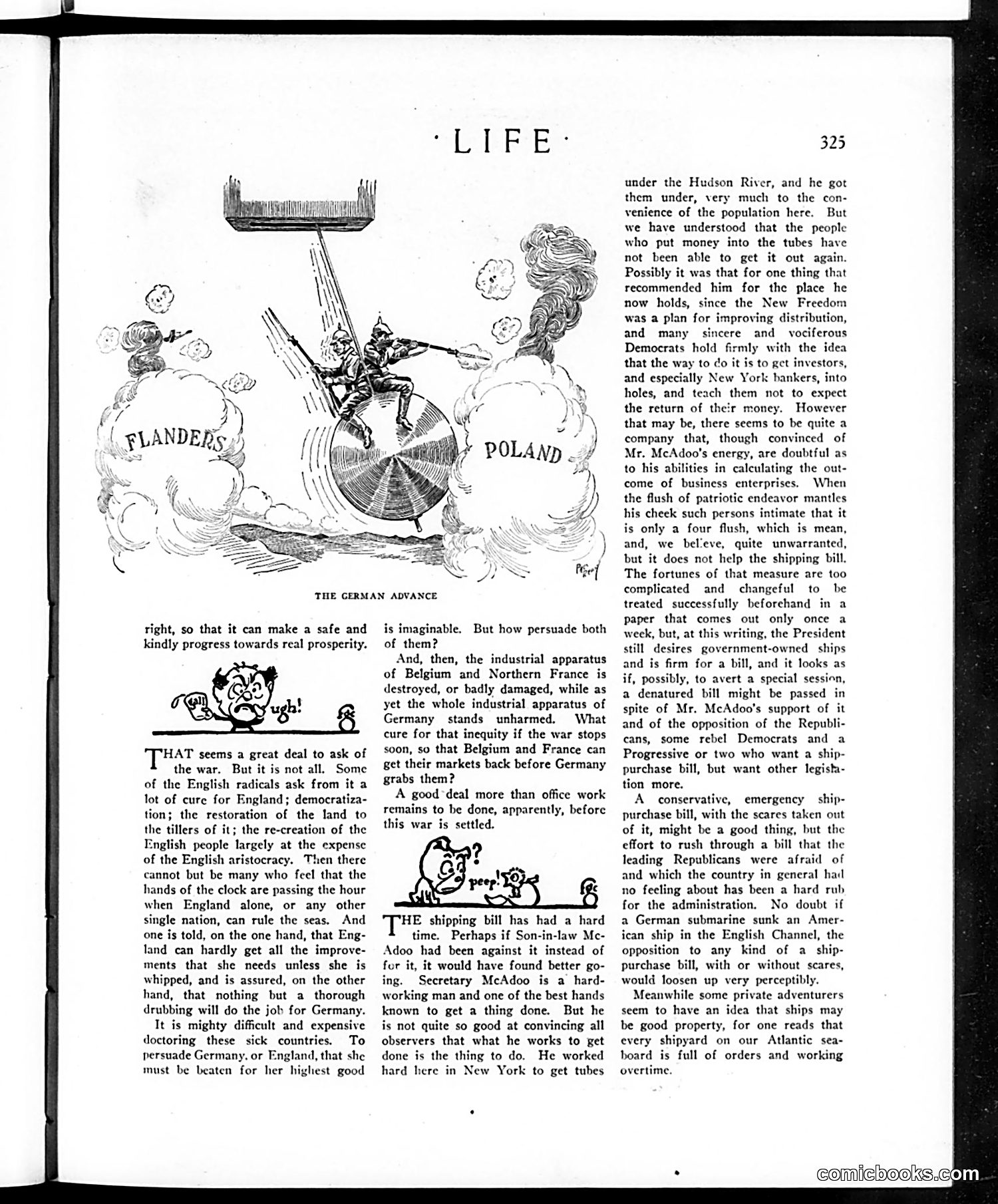
This page critiques Secretary of the Treasury William McAdoo (identified as "Son-in-law McAdoo," referring to his marriage to President Wilson's daughter). **The main cartoon** depicts a figure straddling bubbles labeled "Flanders" and "Poland," representing the WWI conflict's geographic devastation. The satire contrasts Belgium and Northern France's destroyed industrial capacity with Germany's intact apparatus—questioning how peace could be just. **The text criticism** focuses on McAdoo's advocacy for a government-owned shipping bill. Life mocks his inability to convince observers his initiatives will succeed, citing his previous Hudson River tube project where investors never recovered their money. The magazine suggests McAdoo's "New Freedom" philosophy—deliberately putting bankers "into holes"—makes people skeptical of his business judgment, regardless of his work ethic. The piece reflects broader Progressive-era skepticism about shipping legislation and government economic intervention during the early WWI period.
I can see this is a page from *Life* magazine oriented sideways, but the image quality and rotation make it difficult to read the specific text or clearly identify the cartoon content and figures. The page appears to contain advertisements and possibly cartoon illustrations, but I cannot reliably make out the details well enough to explain the satire, identify specific figures, or describe political/social references with confidence. To provide accurate historical context as requested, I would need either a clearer image or the page oriented correctly for reading. I cannot responsibly guess at identities or meanings without being able to see the content clearly.
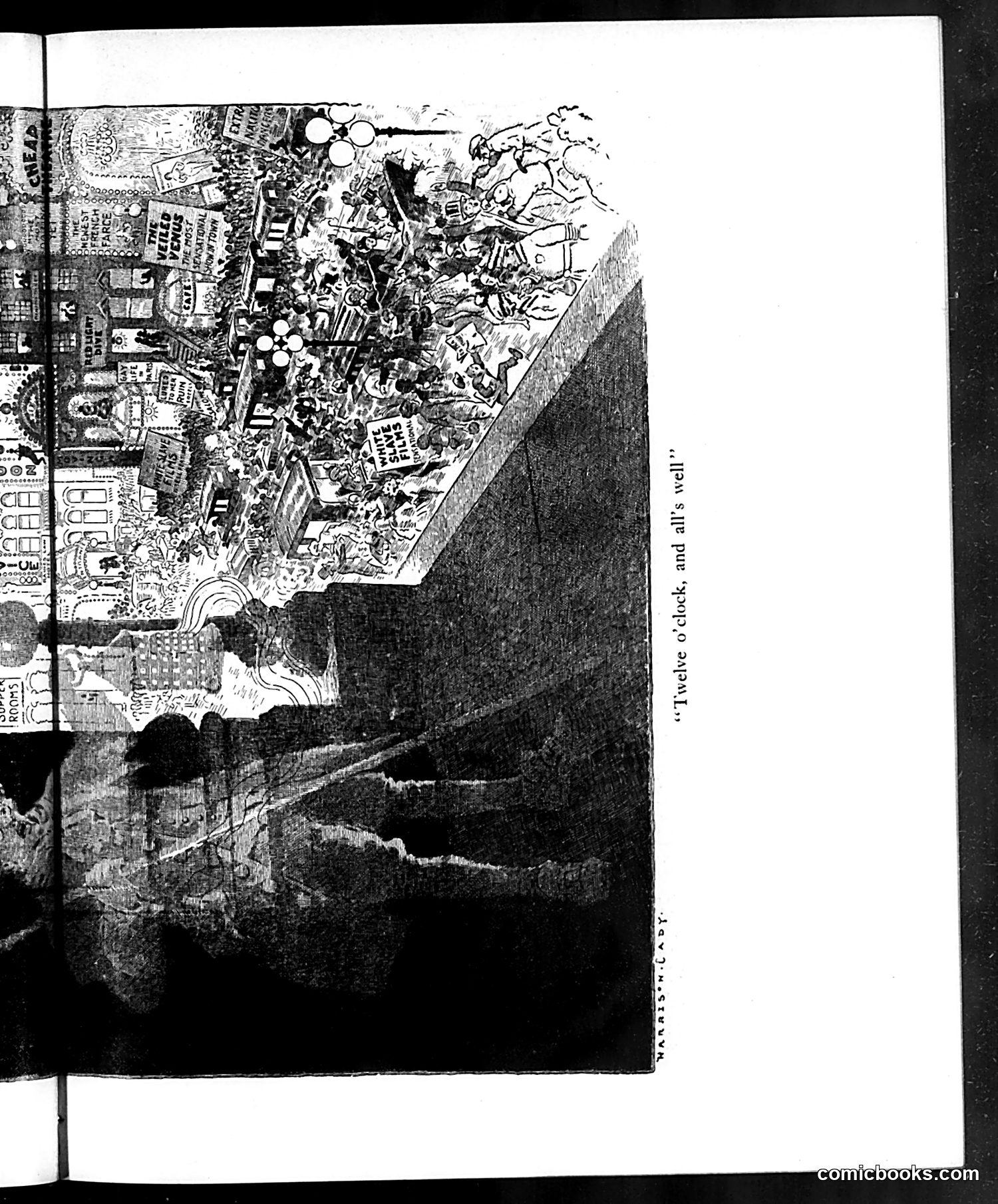
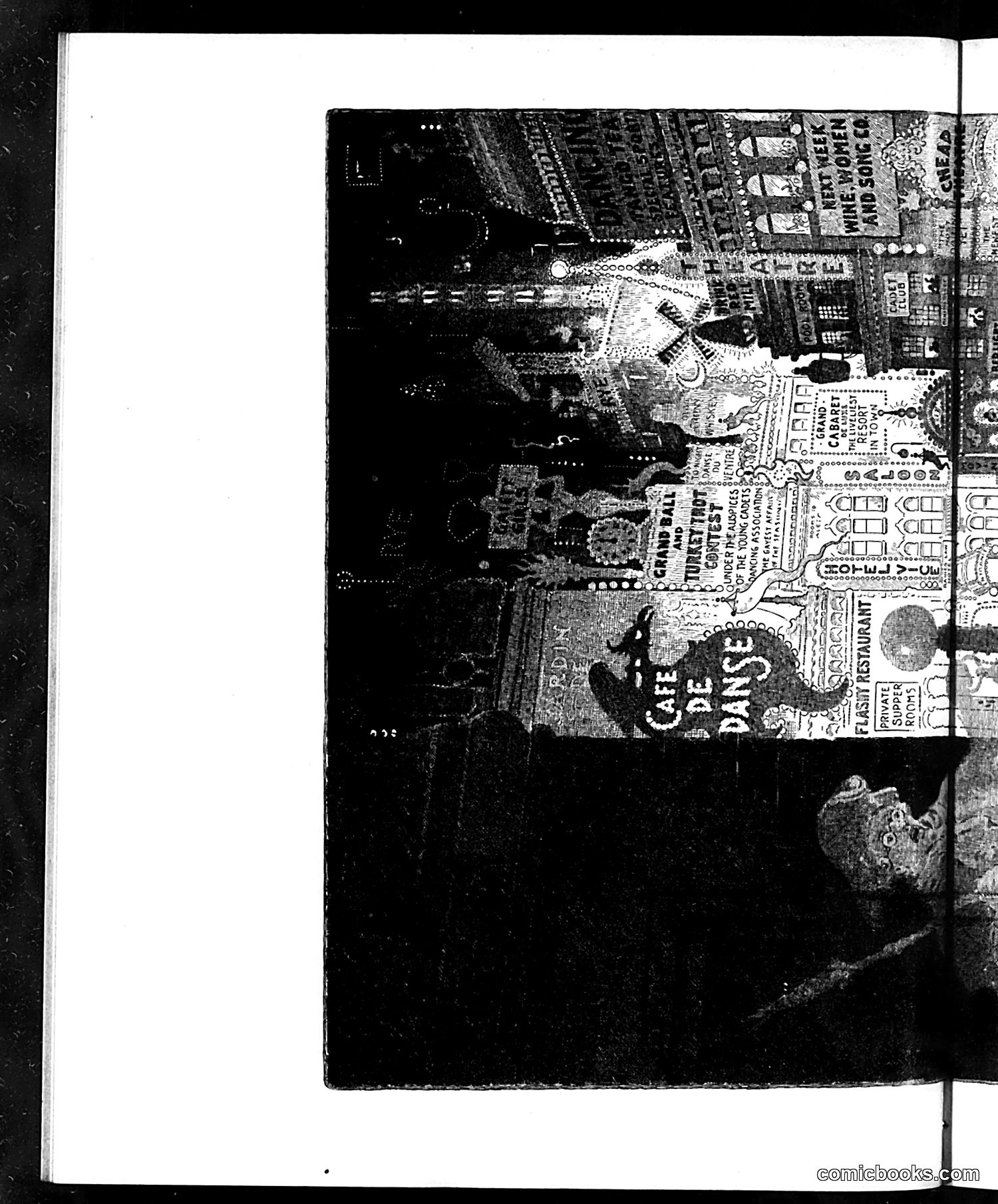
This page appears to be rotated 90 degrees, making full interpretation difficult. The caption reads "Twelve o'clock, and it's well," suggesting a time-based joke or reference. The illustration shows a densely packed, chaotic scene with multiple figures and detailed linework characteristic of early-to-mid 20th century satirical comics. Various signs and text elements are scattered throughout, though most are illegible at this resolution. Without clearer visibility of specific caricatures or readable text bubbles, I cannot confidently identify the political figures or specific event being satirized. The style and composition suggest social or political commentary typical of *Life* magazine's satirical approach, but determining the precise subject and targets requires more legible source material than currently visible.
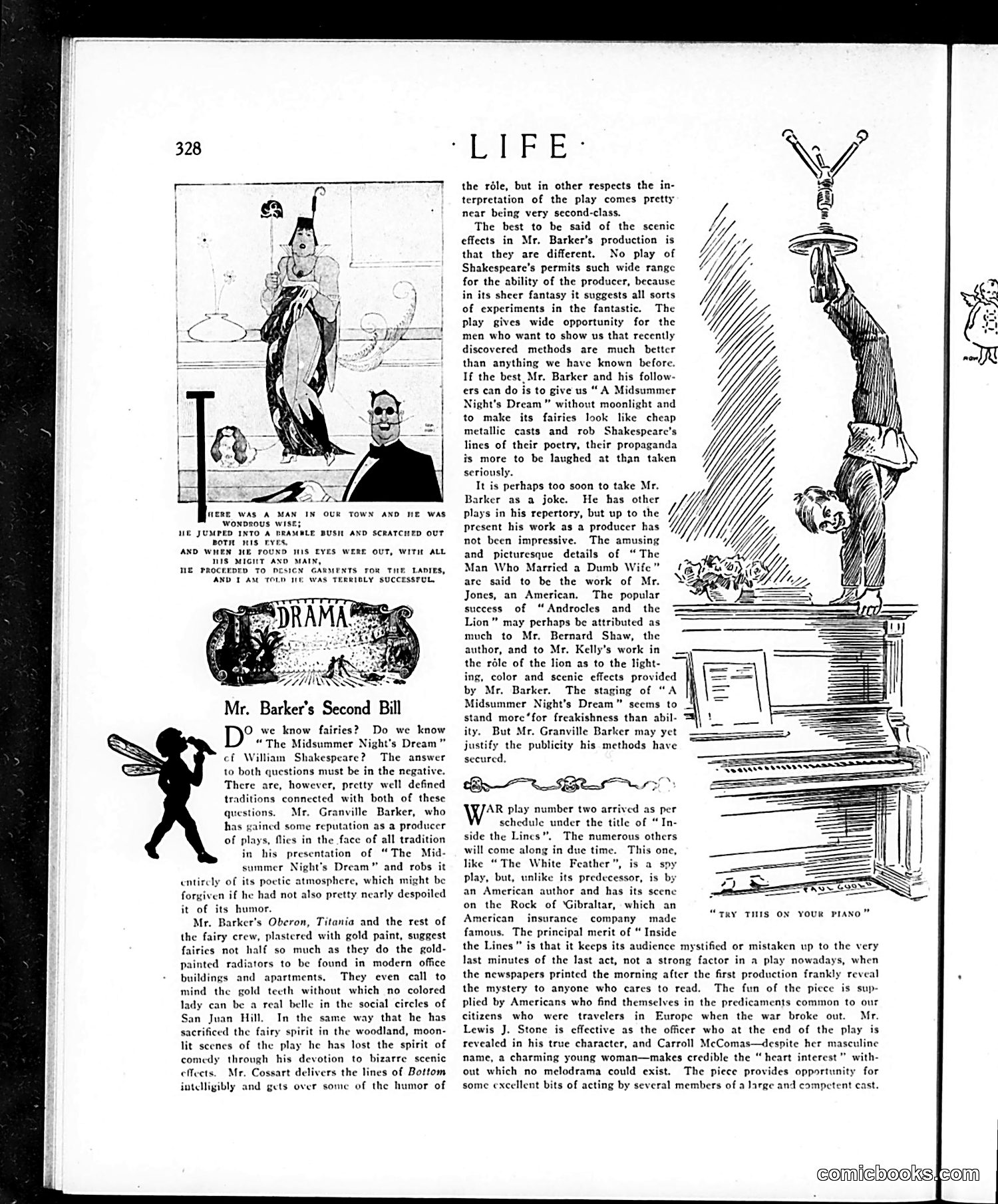
This page satirizes producer Granville Barker's unconventional staging of Shakespeare's *A Midsummer Night's Dream*. The reviewer mocks Barker's avant-garde approach, particularly his decision to abandon romantic tradition by depicting fairies as gold-painted figures resembling "gold-painted radiators" in modern office buildings—or offensive comparisons to gold teeth seen in certain communities. The criticism argues Barker's experimental scenic design, while permitted by Shakespeare's fantastical scope, sacrifices the play's poetic atmosphere and comedy. The reviewer suggests Barker receives undue credit; successes in his other productions (*Androcles and the Lion*, *The Man Who Married a Dumb Wife*) likely result from the authors, actors, or other collaborators rather than Barker's direction. The illustration (left) depicts a costumed fairy figure, likely mocking the gold-paint aesthetic being criticized. The page's overall tone dismisses modernist theater experimentation as pretentious "freakishness" over genuine ability.
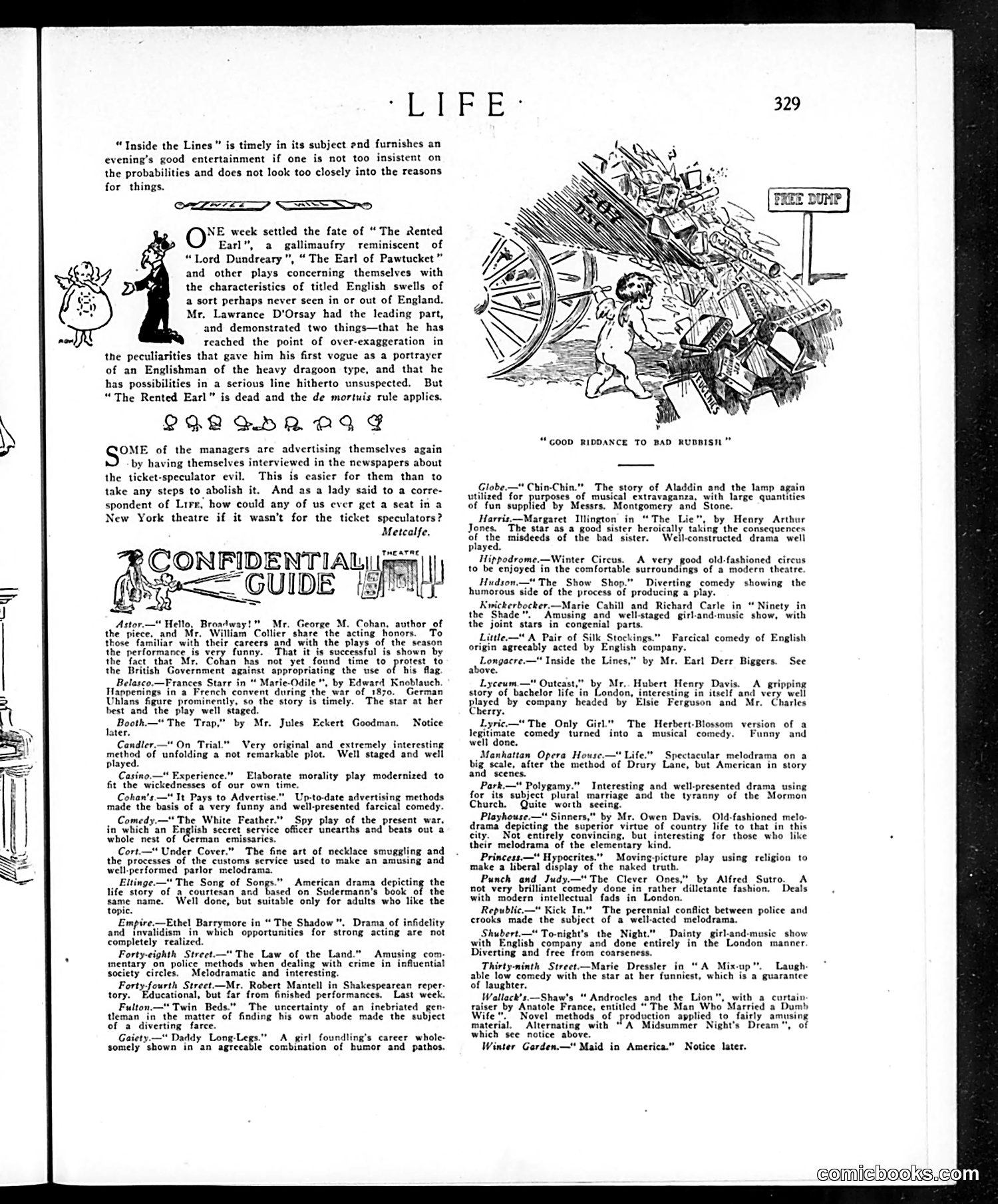
This page contains theater reviews from Life magazine's "Confidential Guide" section, critiquing Broadway productions. The small cartoon at top left shows a portly gentleman in formal dress—likely representing a theater patron or impresario. The main content satirizes theater managers who publicly claim to fight ticket scalpers while doing nothing substantive. The text includes a pointed quote from a woman noting the hypocrisy: managers couldn't fill theaters without scalpers, so their public protests are merely self-serving publicity stunts. The reviews themselves catalog current Broadway shows, mixing praise with pointed criticism of acting styles and subject matter. References to "spy plays of the present war" and German antagonists reflect WWI-era anxieties. The tone is sophisticated, assuming readers know theater conventions and current events.
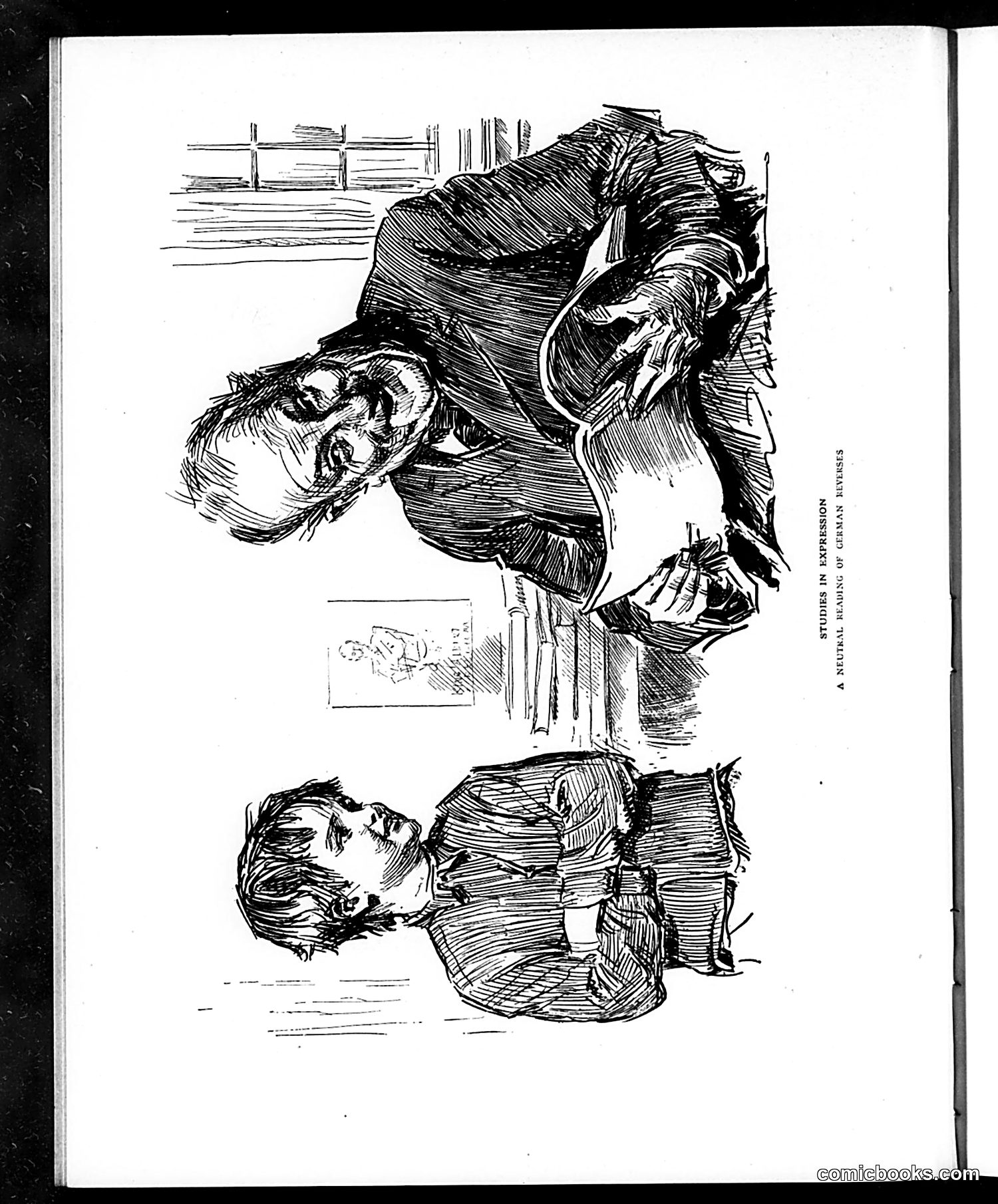
This page presents two ink sketch portraits oriented upside-down relative to the page's text. The caption indicates these are studies examining facial expressions in the context of German culture or character. The sketches show detailed character studies rendered in cross-hatching technique typical of late 19th/early 20th-century satirical illustration. Without clearer context or dates visible, I cannot definitively identify the specific individuals depicted or confirm the exact satirical point. The "natural reading" caption suggests the cartoonist is examining how to interpret German physiognomy or expressions, possibly as social commentary on German character traits—a common theme in American satirical magazines of that era. The artistic focus appears anthropological rather than addressing a specific political event.
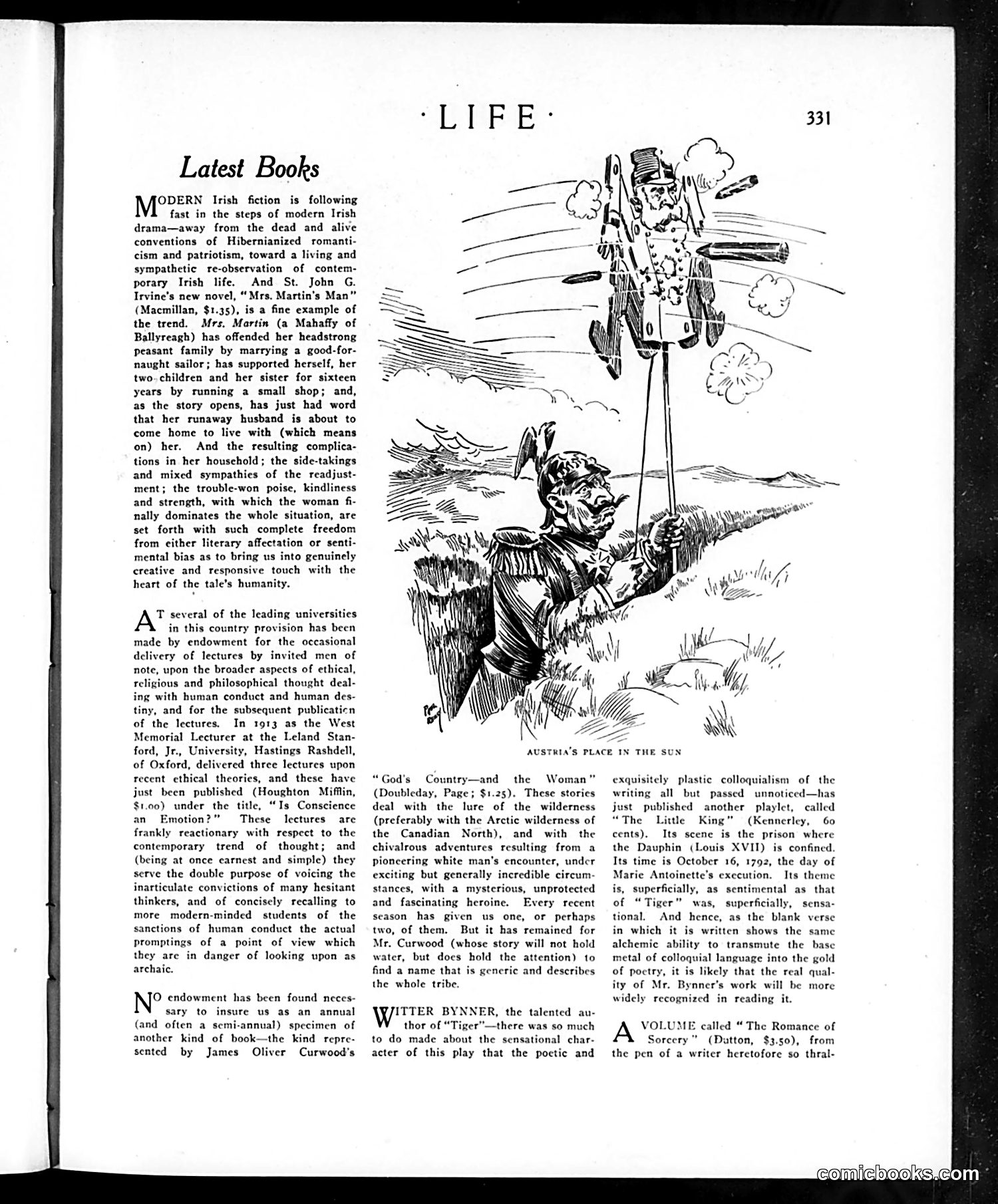
This cartoon depicts a figure (likely representing Austria-Hungary) being shot down from the sky during World War I. The illustration shows a military officer or soldier falling from an aircraft or flying machine that's under fire, with explosions and clouds surrounding the scene. The caption "Austria's Place in the Sun" is satirical irony—a reference to imperialist ambitions. The phrase mocks Austria-Hungary's imperial pretensions by literally depicting its downfall. Given this is from *Life* magazine during the WWI era, the cartoon likely comments on Austria-Hungary's military failures or declining power in the war, particularly after early defeats on the Eastern Front. The soldier plummeting to earth symbolizes the empire's collapse from its position of power.
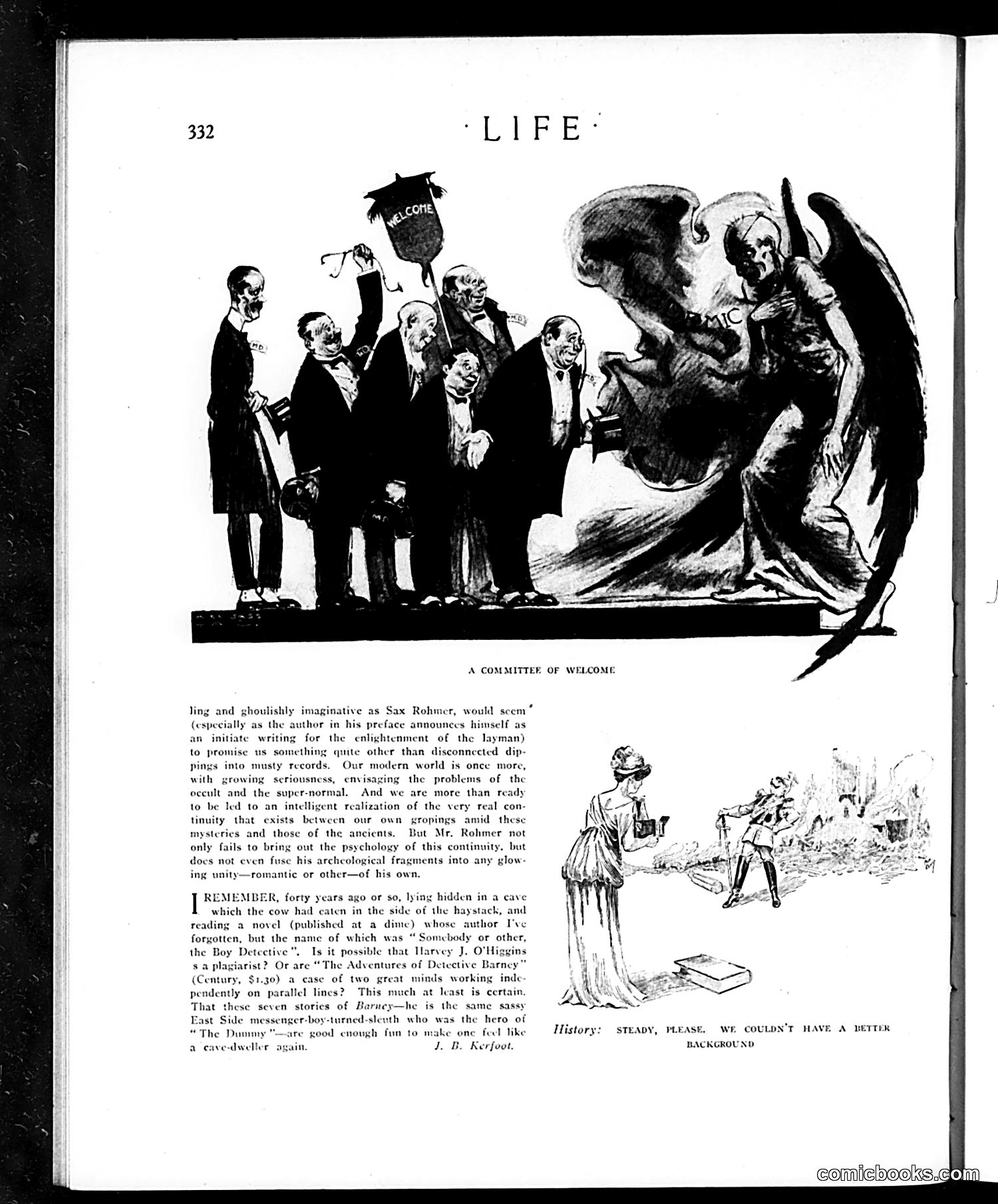
The top cartoon depicts welcoming dignitaries greeting demonic or supernatural figures—likely satirizing public enthusiasm for occult literature and spiritualism. The illustration mocks the fashionable fascination with the "super-normal" mentioned in the text below. The review criticizes author Sax Rohmer for failing to deliver on the promise of connecting ancient mysteries to modern occultism in an intellectually coherent way. The text laments that Rohmer merely presents disconnected historical fragments without psychological or thematic unity. The lower cartoon shows a woman and man in what appears to be a cave setting, captioned "STEADY, PLEASE, WE COULDN'T HAVE A BETTER BACKGROUND"—humorously suggesting that primitive/ancient settings have romantic appeal. The page concludes with a book review of "The Adventures of Detective Barney," questioning whether it plagiarizes an earlier dime-novel detective story, while admitting the new version is entertaining enough.
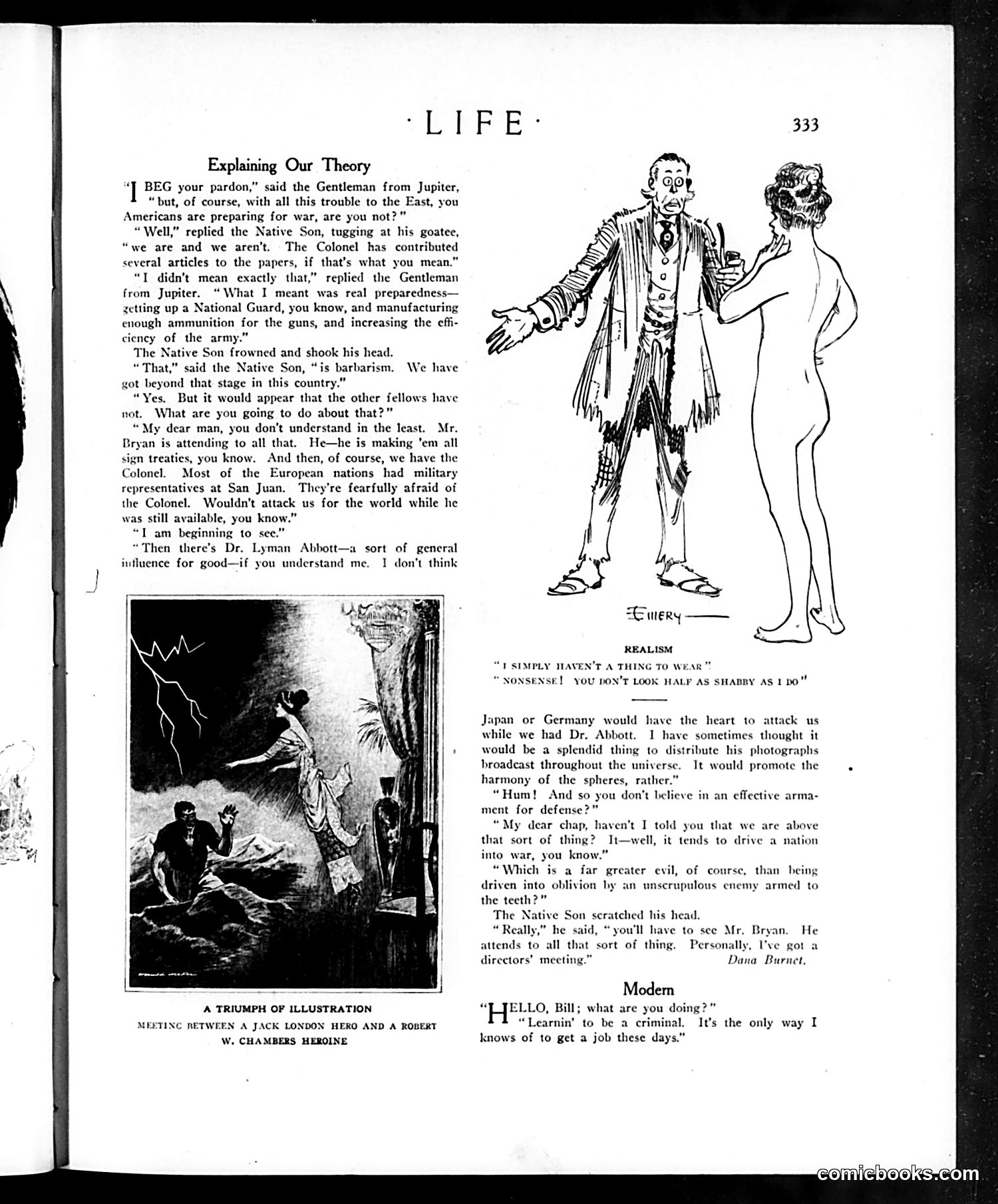
This satirical piece mocks American pacifism and idealistic disarmament arguments circa 1910s. A visiting alien ("Gentleman from Jupiter") questions an American ("Native Son") about military preparedness amid international tensions ("trouble to the East"—likely referencing Asian conflicts). The satire targets American reliance on *rhetoric over action*: the Native Son claims preparedness consists merely of newspaper articles by "the Colonel" (possibly Theodore Roosevelt), treaties signed by William Jennings Bryan, and the moral influence of Dr. Lyman Abbott—not actual weapons or armies. The joke exposes the naïveté of believing that reputation, pacifism, and good intentions provide real defense against armed enemies like Japan or Germany. The secondary cartoon contrasts literary idealism: a Jack London-style hero meets a Robert W. Chambers heroine, mocking sentimental fiction's disconnection from gritty reality. The "Modern" dialogue at bottom further satirizes this gap—a character turned criminal because legitimate employment was unavailable.
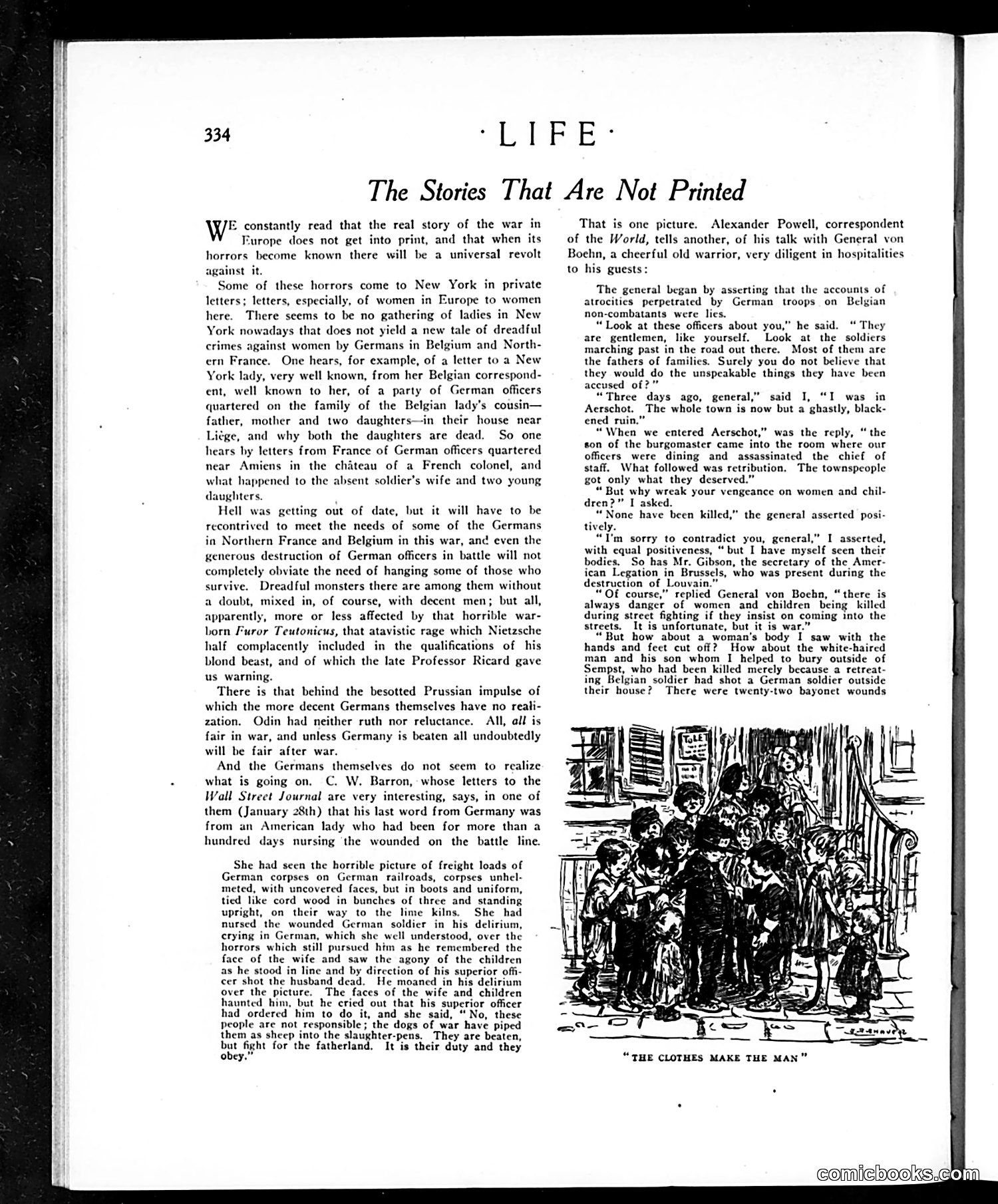
This Life magazine article (circa WWI era) addresses atrocity rumors from German-occupied Belgium and France circulating in New York society through private letters. The piece presents two contrasting accounts: one from a American nurse describing a traumatized German soldier who committed war crimes under orders, and another from correspondent Alexander Powell quoting General von Boehn dismissing atrocity allegations as fabrications. The accompanying illustration labeled "THE CLOTHES MAKE THE MAN" appears to satirize German officer conduct—showing what seems to be soldiers or officers in a domestic setting, likely depicting the very abuses discussed in the text. The article critiques both German denial of war crimes and the dehumanizing effect of military command ("the dogs of war have piped them as sheep into the slaughter-pens"), suggesting systemic brutality rather than individual moral failure. The satire targets German leadership's refusal to acknowledge documented horrors.
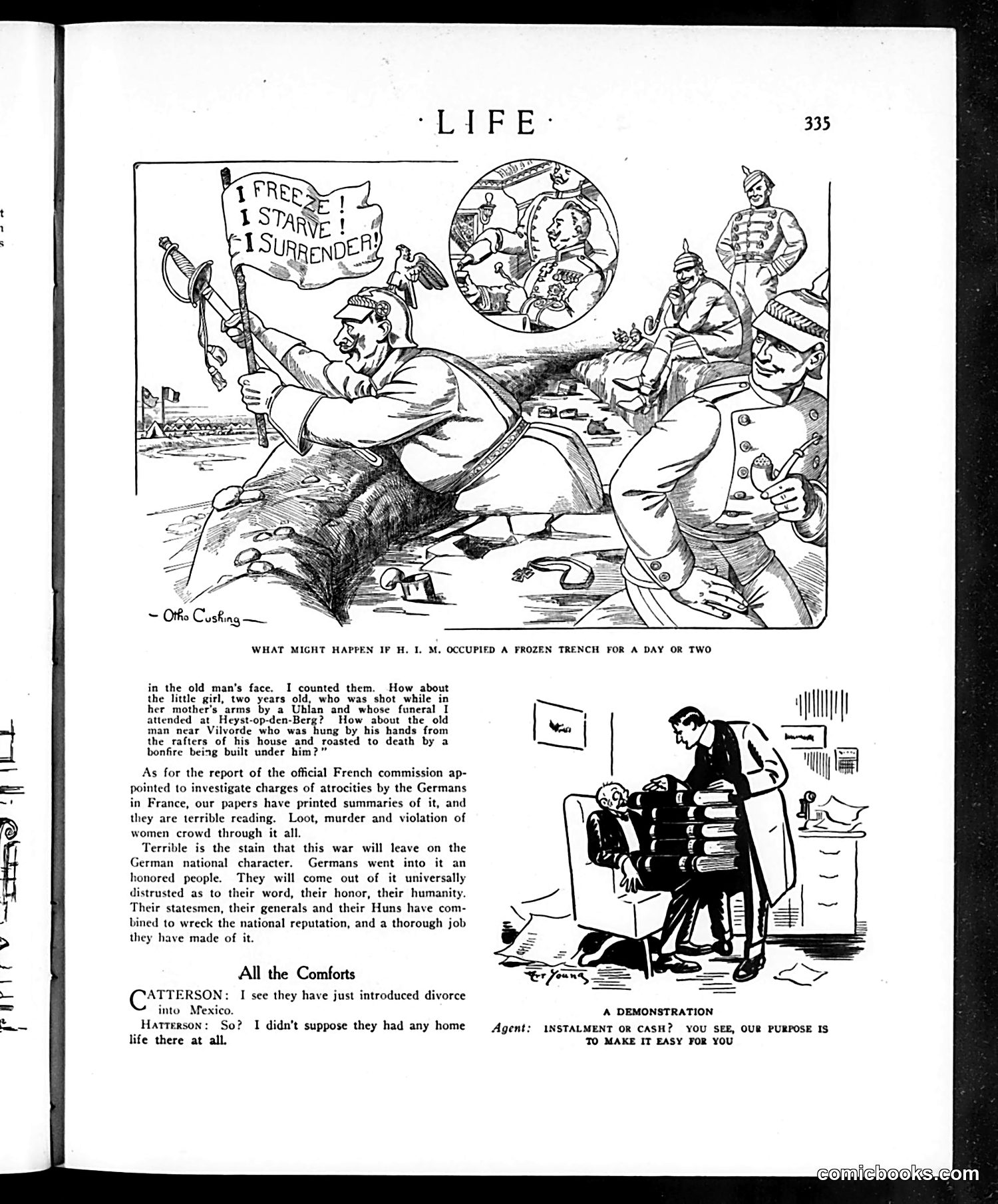
The top cartoon depicts "H.I.M." (His Imperial Majesty, the German Kaiser) experiencing a frozen trench, holding a flag reading "I FREE! I STARVE! I SURRENDER!" The circular inset shows him imagining comfortable domestic life. This satirizes the contrast between the Kaiser's presumed luxury and soldiers' horrific battlefield conditions. The accompanying text documents alleged German atrocities in France—killings of civilians, including children and the elderly—referencing a French commission's investigation. The satire's point: the Kaiser, insulated from war's brutality, would lose his honor and Germany's international reputation through such atrocities. The lower cartoon is unrelated domestic humor about divorce and installment buying in Mexico. This page, likely from WWI-era Life magazine, uses satire to criticize German military conduct and leadership's disconnection from suffering soldiers face.
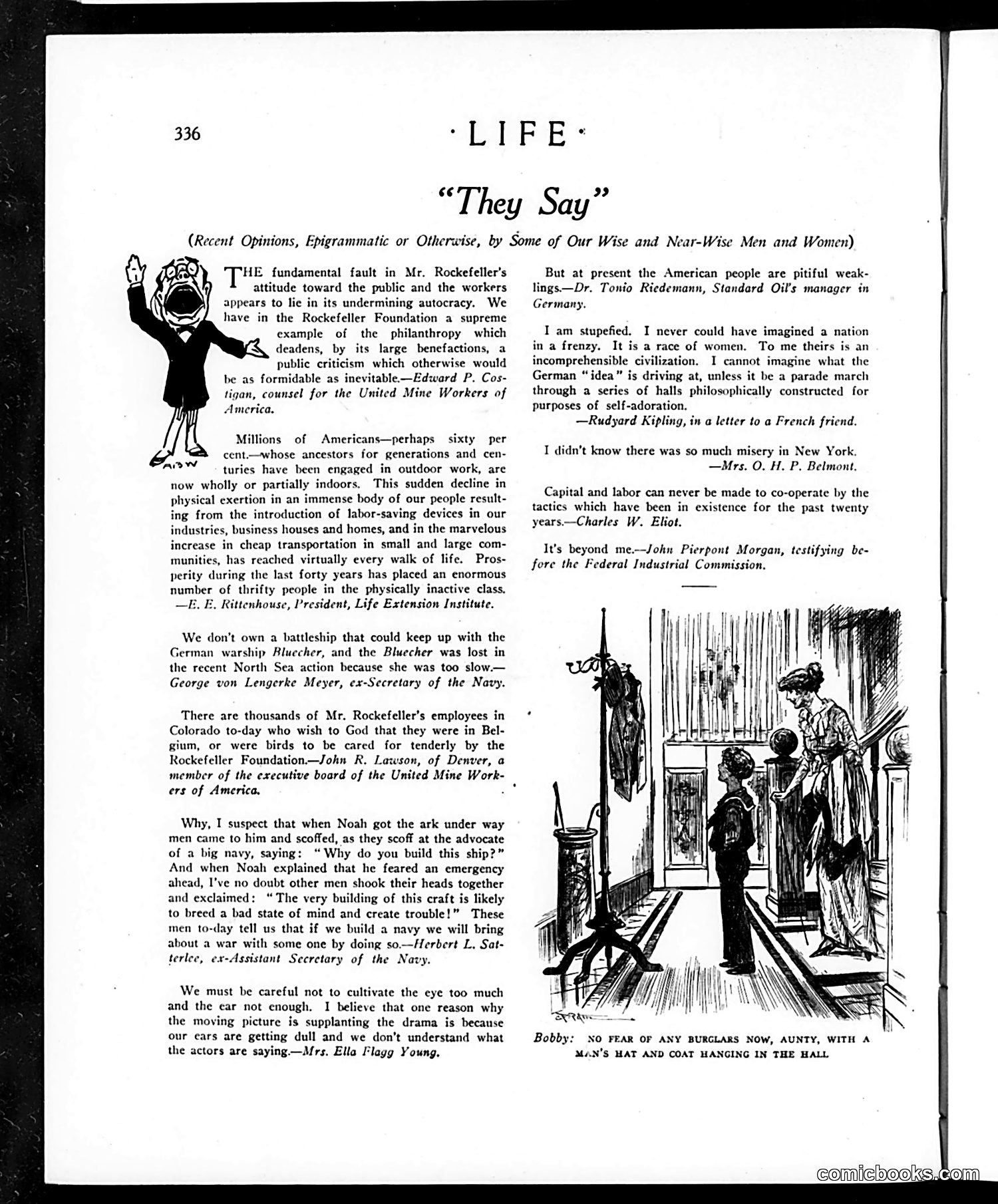
This page collects satirical quotes from prominent figures of the era (circa 1910s), each followed by the speaker's name and credential. The commentary critiques major social issues: **Key targets:** - **Rockefeller Foundation**: Edward Costigan argues Rockefeller's philanthropy silences legitimate public criticism of labor practices - **Labor conditions**: John Lawson sarcastically suggests Rockefeller's Colorado mine workers envy Belgian refugees, implying poor treatment - **Military readiness**: Naval weakness is defended against critics - **Americanism**: German observers (Standard Oil's Riedemann, Rudyard Kipling) mock Americans as weak and unable to understand German "civilization" **The cartoon** (lower right) depicts a burglar deterrent: a man's hat and coat hanging in a hallway creates the *appearance* of a male occupant, protecting vulnerable women—satirizing how appearances substitute for actual security. The page's satire mocks both establishment figures (Rockefeller, Morgan) and foreign critics, while highlighting labor unrest and social inequality.
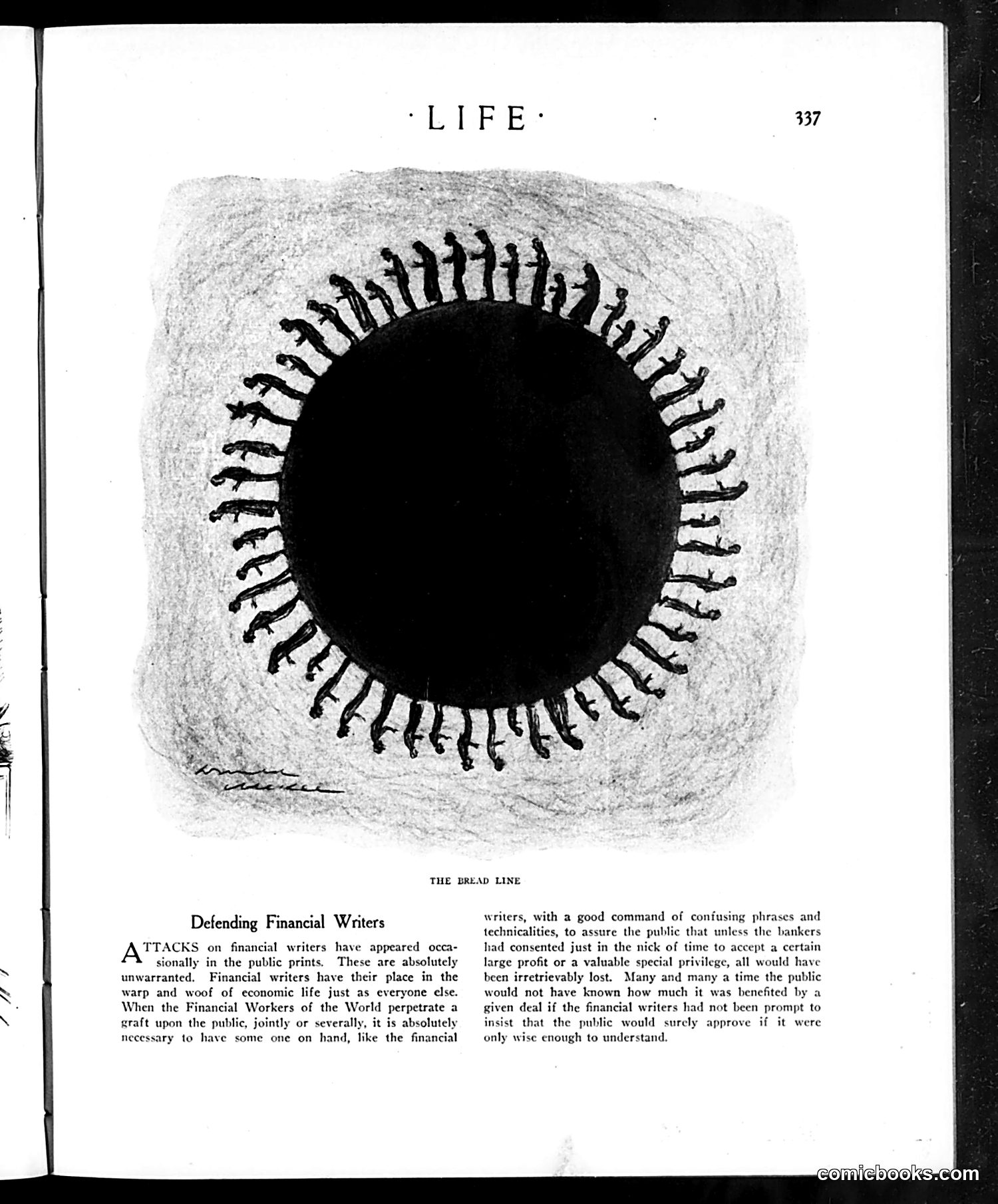
This is satirical defense of financial writers, presented ironically. The article mock-defends writers who use "confusing phrases and technicalities" to convince the public that banking deals benefiting bankers were actually in the public interest. The satire targets how financial writers obscure reality: they convince people that lucrative banker "profits" and "special privileges" represent public benefits. The piece sarcastically suggests the public should be grateful for writers' opacity—implying readers *wouldn't* approve if they actually understood these transactions clearly. The circular image with radiating lines (labeled "The Bread Line") likely visualizes this circularity of financial jargon obscuring exploitation. The satire critiques complicit financial journalism and banking interests working together to mislead the public during an era of economic inequality and financial manipulation.
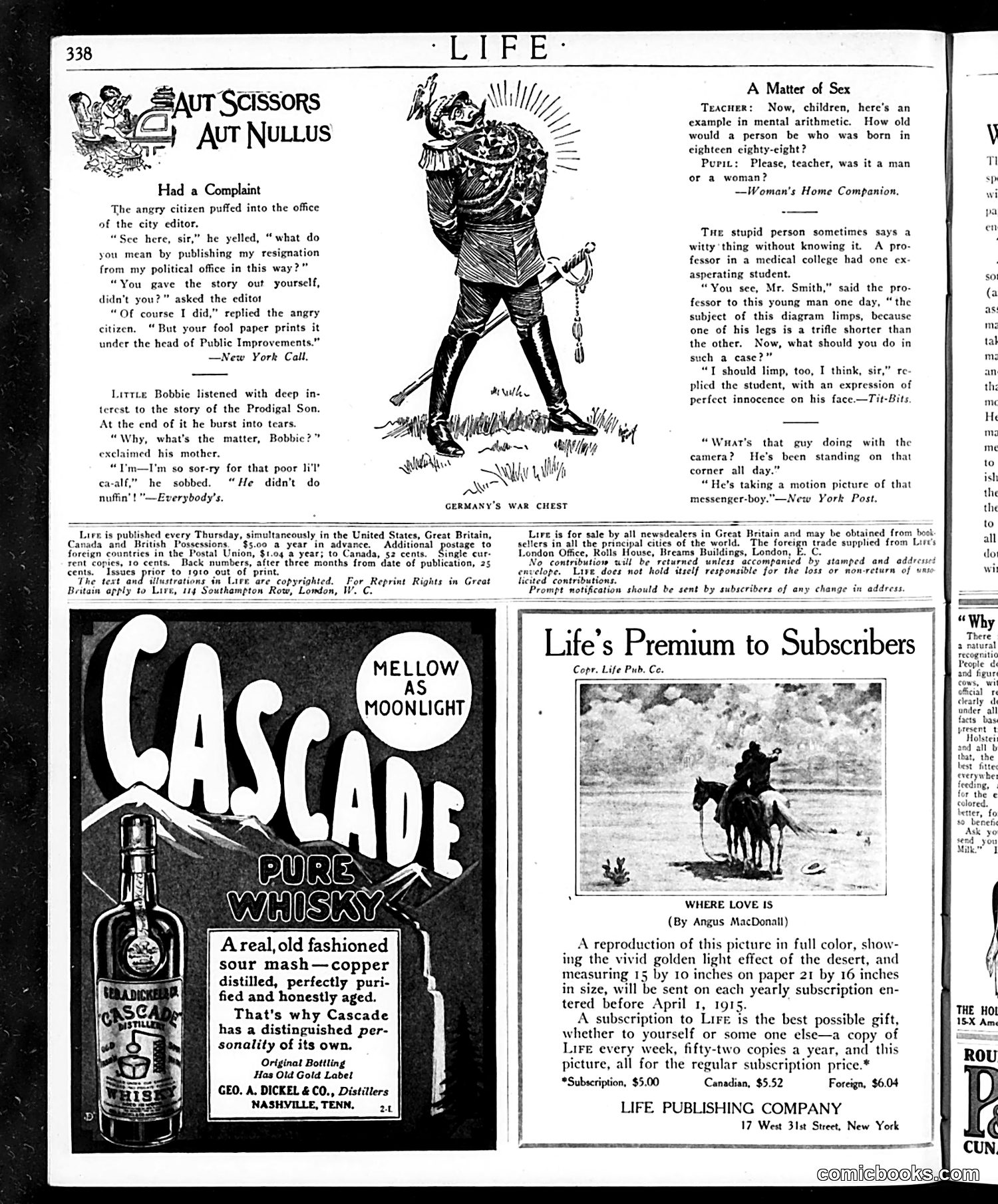
This page contains multiple satirical jokes typical of early 20th-century American humor magazines: **"Had a Complaint"** mocks a politician who leaked his own resignation story, then complained when the newspaper labeled it under "Public Improvements"—suggesting his departure *was* an improvement for the city. **"Germany's War Chest"** shows a caricatured German soldier (identifiable by the spiked helmet) holding a large money bag, likely referencing wartime military spending during WWI (the page dates to around 1915). The remaining items are brief humor snippets: a child mishearing the parable of the Prodigal Son, a gender-based math joke, and an anecdote about a medical student's accidentally witty response. The page also contains period advertisements (Cascade Whisky) and a subscription premium offering a desert landscape painting by Angus MacDonald to new subscribers—typical magazine marketing of the era.
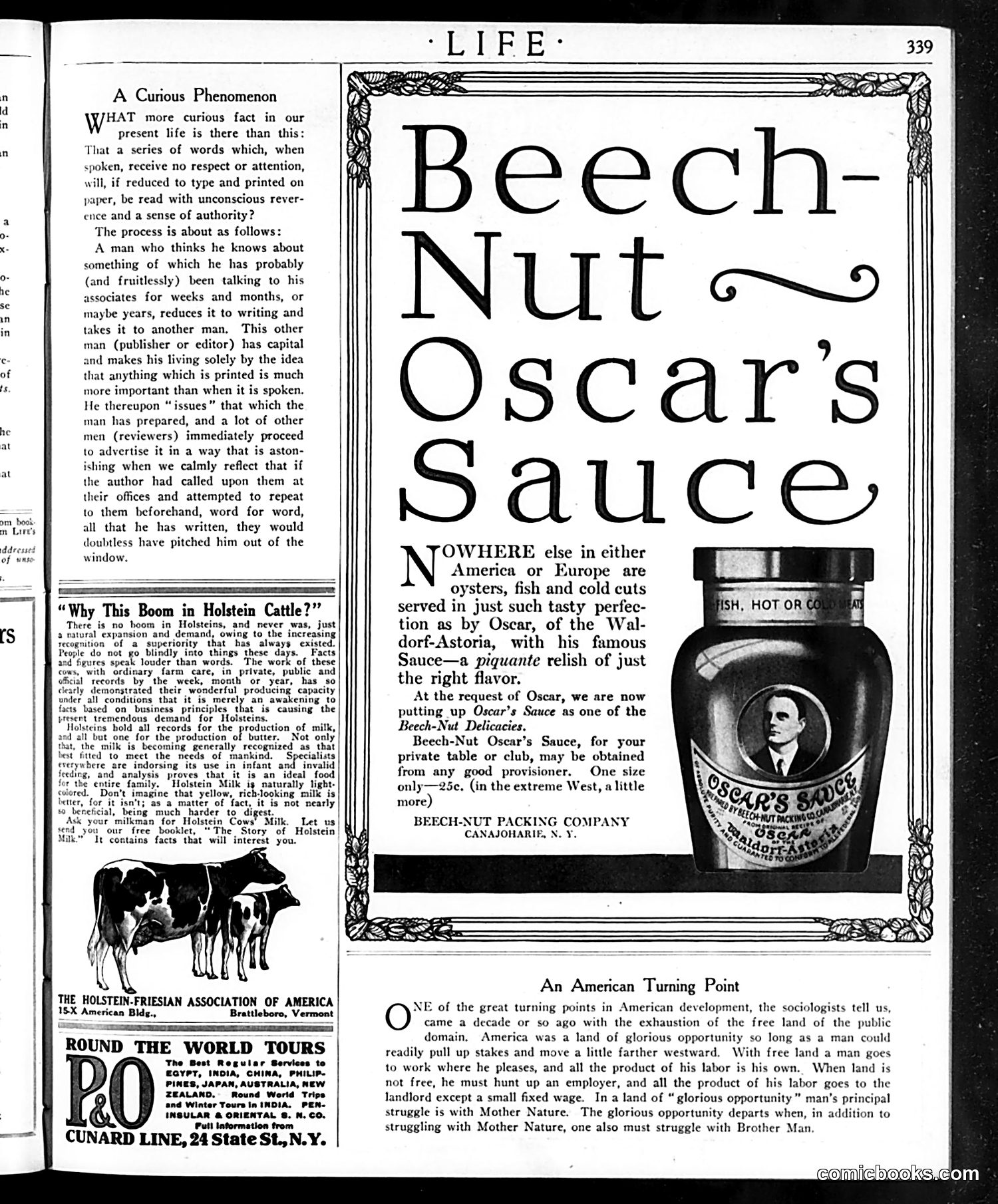
This page contains **editorial commentary and advertisements** rather than political cartoons. The lead essay, "A Curious Phenomenon," satirizes the authority granted to printed words versus spoken ones. The author notes that ideas spoken casually receive no respect, yet when printed and published, the same ideas gain unwarranted credibility—reviewers will promote what they'd dismiss if told verbally. The other content is straightforward advertising: Holstein cattle breeders promote milk production superiority through "facts and figures"; Cunard Line advertises world tours; Beech-Nut promotes "Oscar's Sauce" (attributed to Oscar of the Waldorf-Astoria hotel); and an essay discusses America's "turning point" following exhaustion of free western land. The satire targets **public gullibility toward print media**—a timely concern about how typography confers false authority on mediocre ideas.
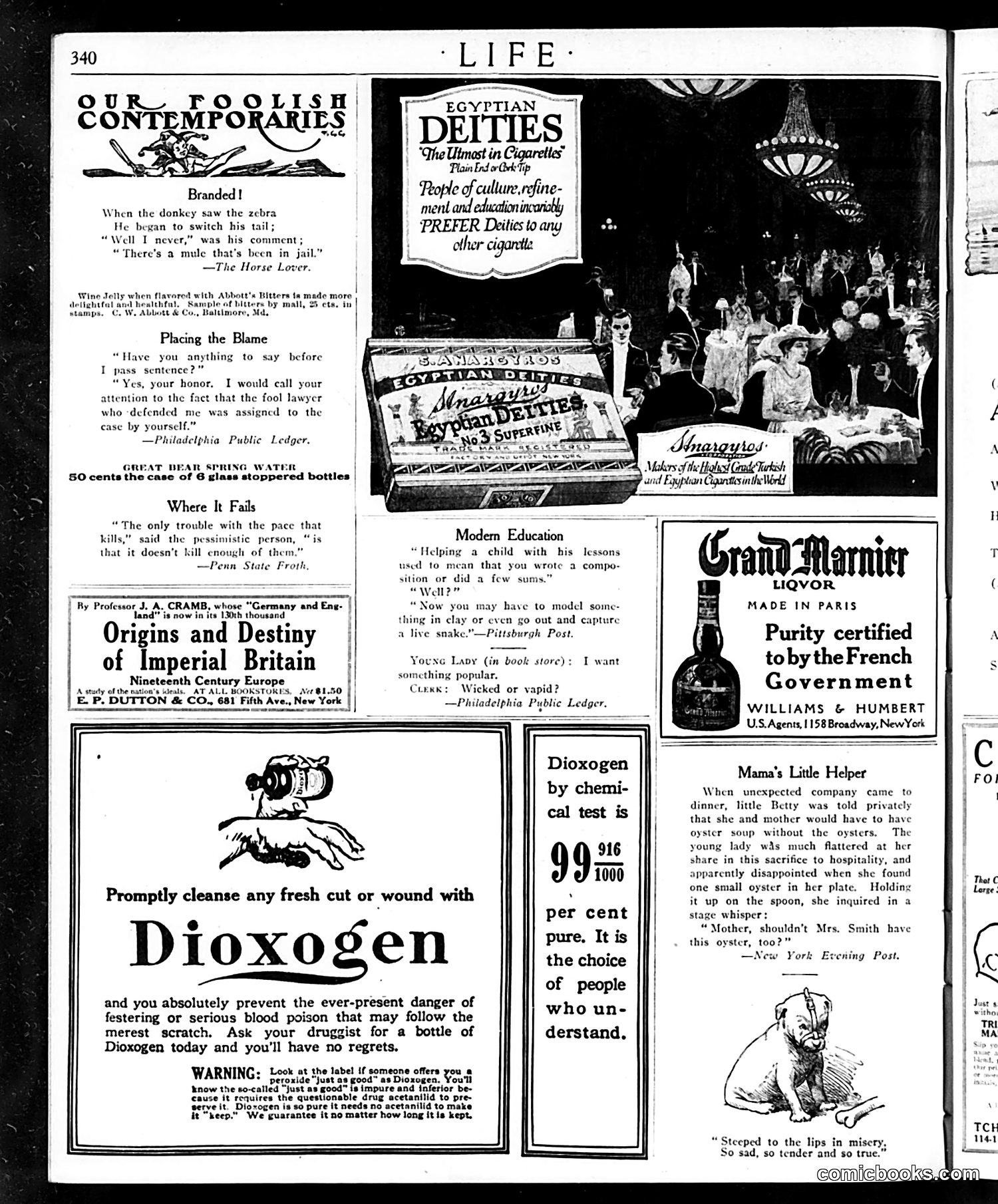
This page is primarily **advertising with interspersed humorous anecdotes**, typical of Life's format during this era. The jokes mock contemporary social situations: a donkey mistaking a zebra for a disgraced mule; a defendant blaming his court-appointed lawyer; a pessimist criticizing traffic safety measures; and modern education's shift toward hands-on learning (modeling clay, capturing snakes) versus traditional composition-writing. One anecdote satirizes middle-class pretension: a mother tells her daughter they'll have oyster soup "without the oysters" for economy, but the child innocently exposes the fiction by pointing out a single oyster and asking if the guest should have it too. The advertisements include patent medicines (Dioxogen antiseptic, Abbott's Bitters), cigarettes, liquor, and a book on imperial Britain—reflecting early 20th-century consumer culture. The content reflects prevailing attitudes toward education, propriety, and modern anxieties about disease prevention.
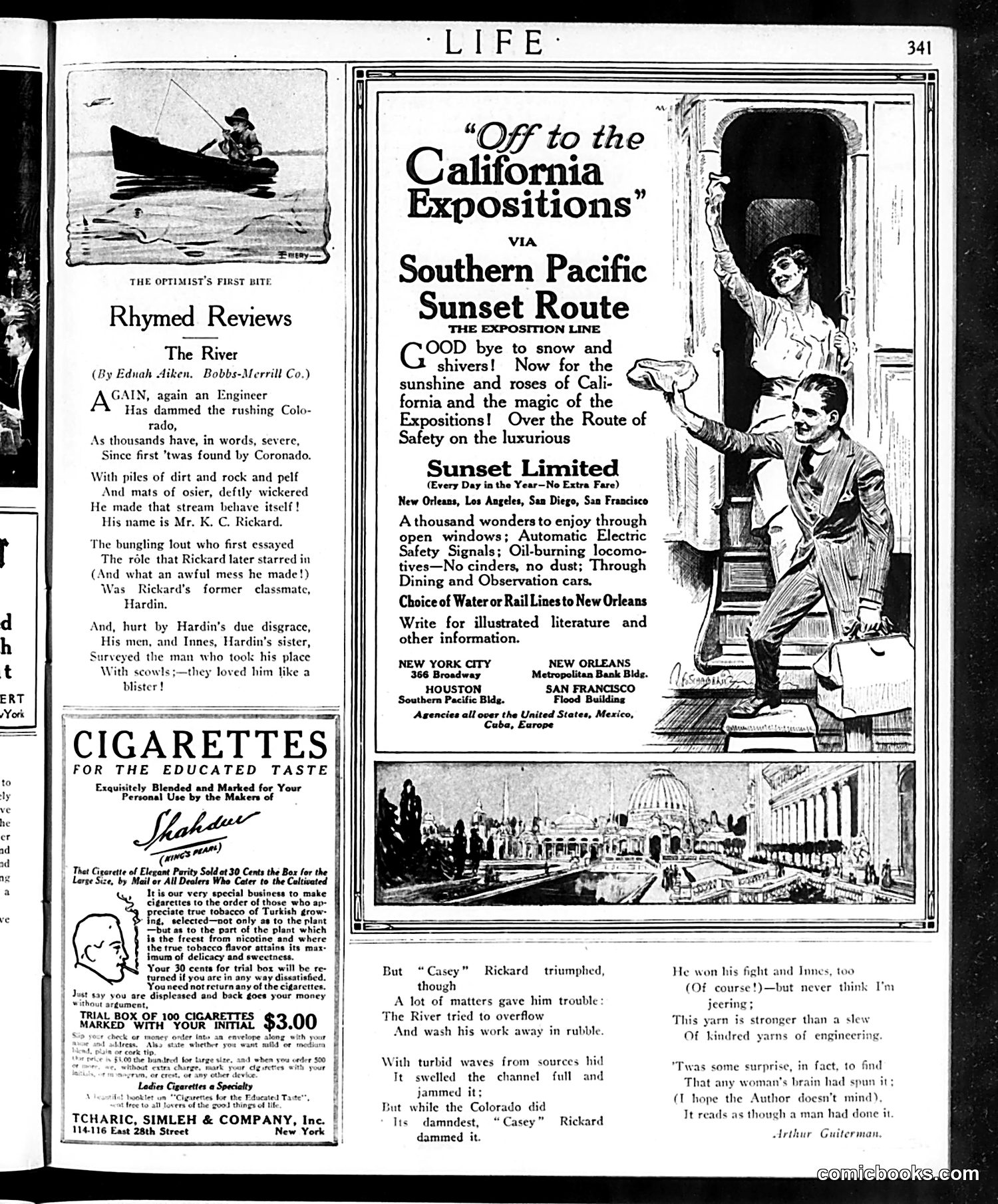
This page combines literary criticism with period advertising. The left side reviews "The River," a novel by Ednah Aiken about engineer K.C. Rickard who successfully dams the Colorado River—a feat his predecessor Hardin failed at. The review, written in verse, celebrates Rickard's triumph over both the river and personal obstacles (Hardin's resentful staff and sister). The satire is gentle: the final lines joke that the novel reads so competently it seems a man must have written it, despite Aiken being a woman author—a backhanded compliment reflecting early 20th-century gender biases about technical writing. The right side features a Southern Pacific railroad advertisement promoting the "Sunset Limited" train to California Expositions (likely the 1915 Panama-Pacific Exposition), emphasizing modern safety features and comfort. Both reflect era-typical American optimism about engineering prowess and westward expansion.
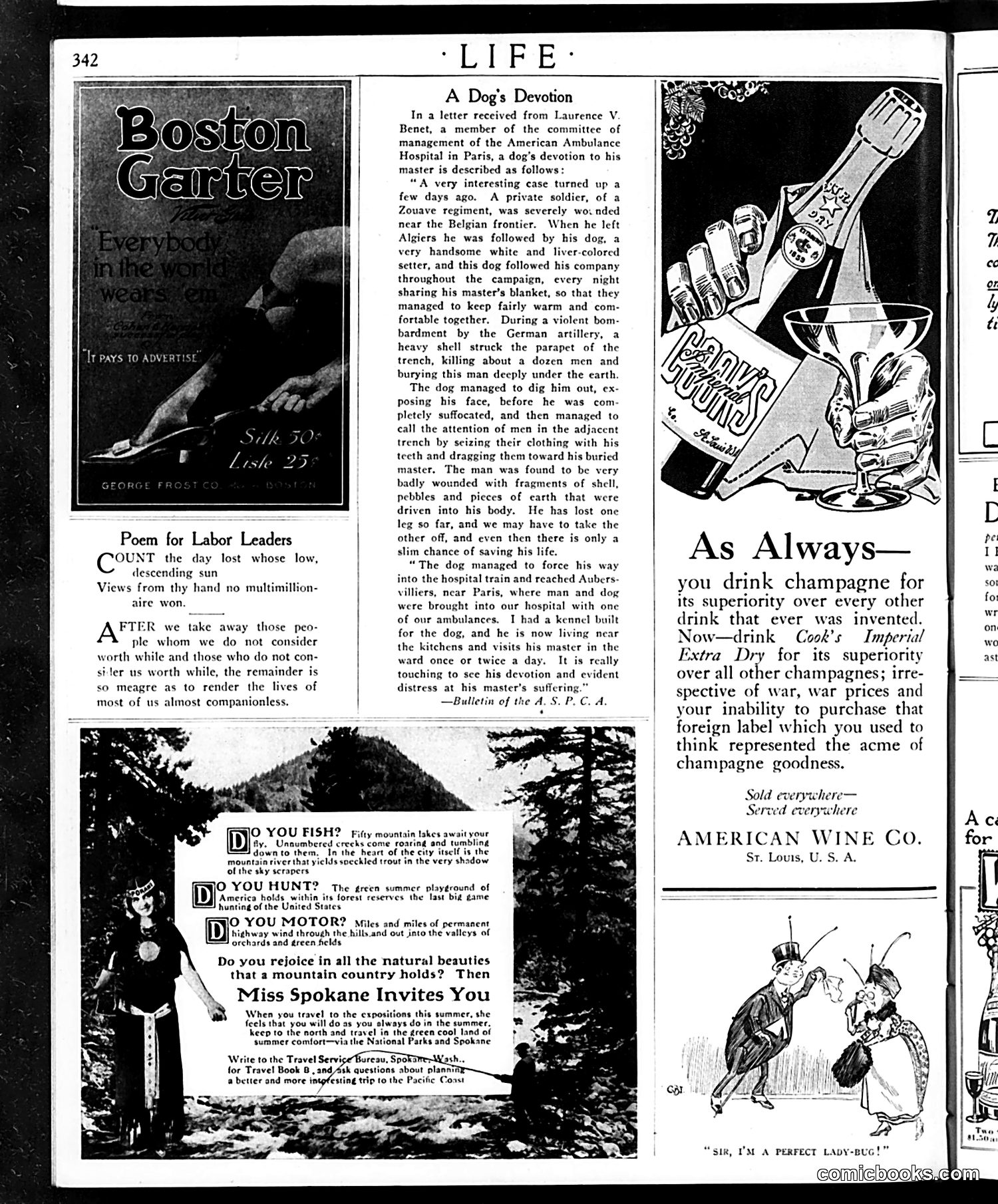
This page mixes earnest wartime content with advertising. The main article, "A Dog's Devotion," reprints a letter describing a French soldier's setter that dug him from artillery rubble during WWI combat, then alerted nearby troops to save him. The dog now visits the wounded soldier in a Paris hospital. This touching anecdote illustrates animal loyalty and was likely intended to boost morale during the war. The "Poem for Labor Leaders" addresses class divisions, arguing that excluding "unworthy" people leaves society impoverished of human connection—subtle social commentary on inequality. The advertisements—Cook's champagne (emphasizing American-made quality despite wartime foreign-import restrictions) and Spokane tourism—represent typical Life magazine revenue. The cartoon at bottom shows a couple with the caption "SIR, I'M A PERFECT LADY-BUG!" suggesting a flirtatious double entendre about insect references and feminine propriety, common humor of the era.
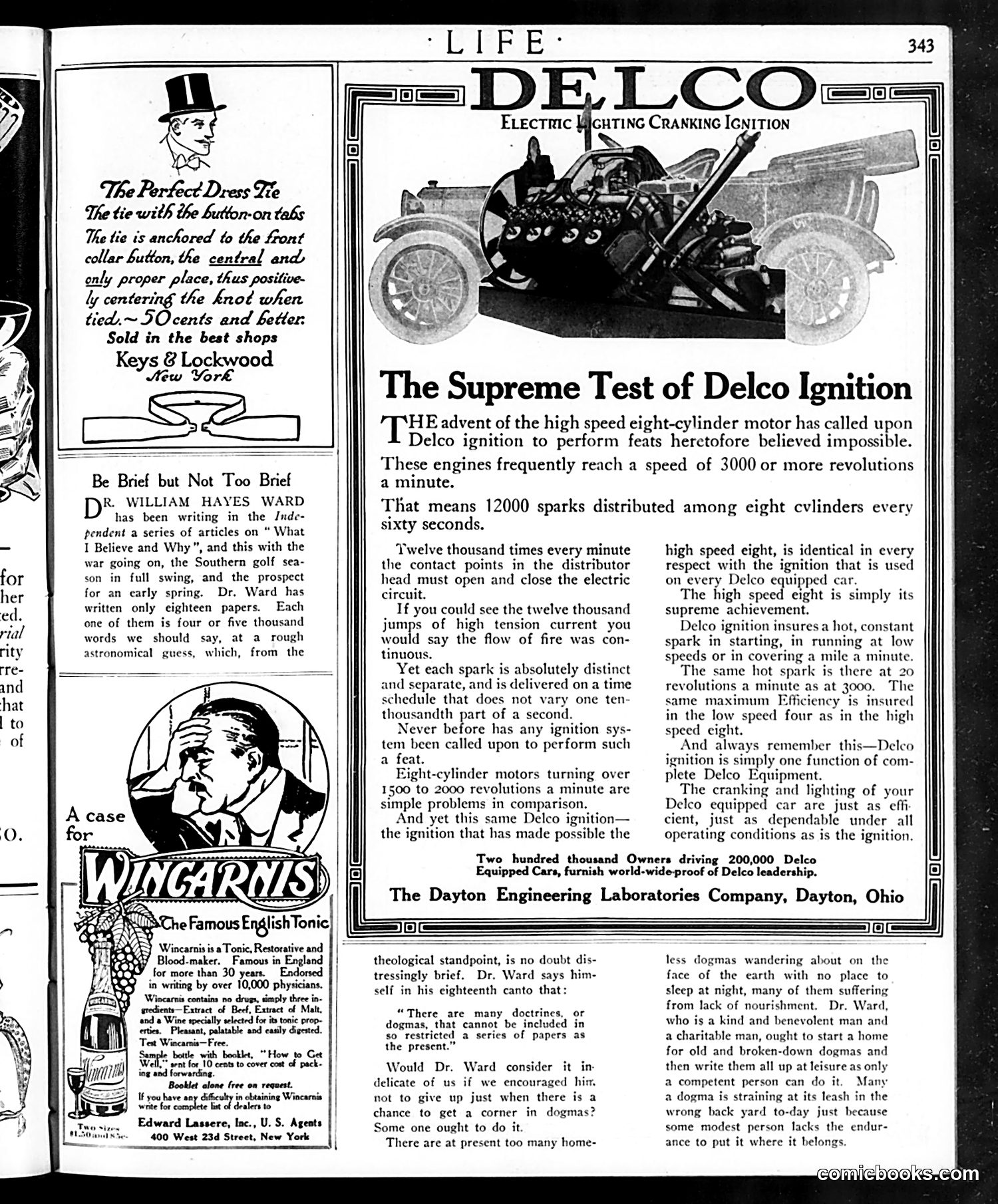
This page is primarily **advertising**, not political satire. It contains three ads: 1. **"The Perfect Dress Tie"** (top left): A men's fashion ad for a tie with button-on tabs, sold by Keys & Lockwood of New York—a practical solution to keep neckties centered and neat. 2. **"Wincarnis"** (bottom left): An endorsement for a tonic drink marketed as a "restorative and blood-maker," claiming backing from 10,000 physicians. This reflects early 20th-century patent medicine advertising, now recognized as dubious. 3. **"Delco Ignition"** (right, dominally): A technical advertisement for automotive ignition systems, emphasizing Delco's reliability for high-speed eight-cylinder engines (then cutting-edge technology). The ad boasts 200,000 satisfied owners. The page also includes a brief editorial note ("Be Brief but Not Too Brief") about theologian Dr. William Hayes Ward's prolific writing—a gentle jab at his verbosity, not political commentary. The satire is minimal; this is primarily a commercial page reflecting 1920s consumer products and technology.
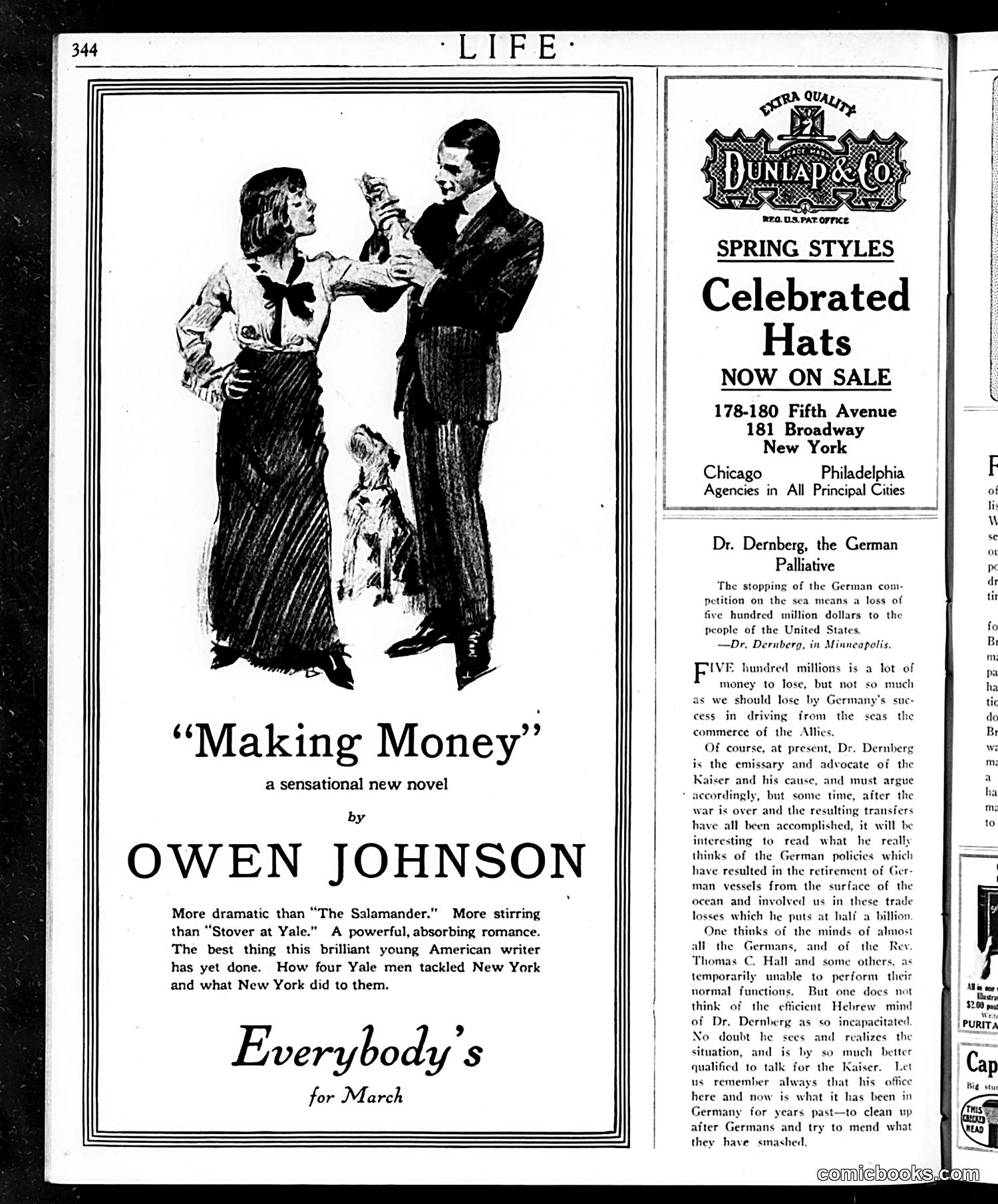
This page mixes advertising with political commentary about World War I. The main satirical content attacks **Dr. Dernberg**, identified as a German emissary and advocate for the Kaiser. The text presents his argument that Germany's loss of sea commerce costs America $500 million—then refutes it, arguing the real cost is Germany's disruption of Allied trade (valued at "half a billion"). The commentary suggests Dernberg is either deluded or deliberately misleading about Germany's culpability. The piece subtly mocks his competence: while acknowledging his intelligence, it implies his "normal functions" are compromised by loyalty to German interests. The final barb suggests his actual mission is simply German propaganda—"to clean up after Germans and try to mend what they have smashed." This reflects America's pre-1917 neutrality debates, when German diplomatic efforts to influence American opinion were active and controversial. The left side advertises Owen Johnson's novel "Making Money."
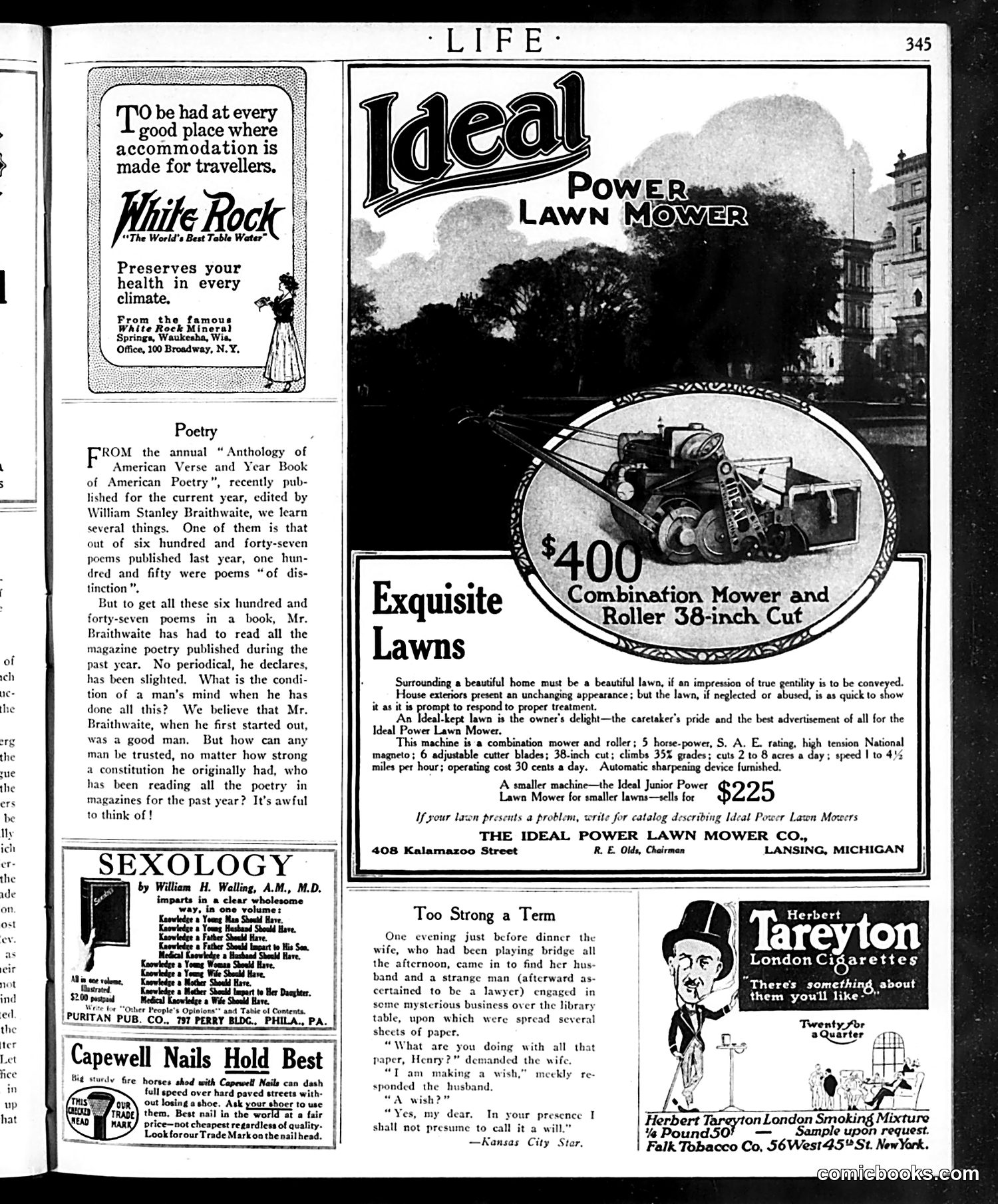
This page is primarily **advertising and miscellaneous content** rather than satirical cartoons. The main notable item is a brief humorous anecdote titled "Too Strong a Term," which uses wordplay: a husband tells his wife he's "making a wish" rather than a "will" because he wouldn't presume to call it a will in her presence—implying she might not respect his wishes or that his desires carry little weight with her. The joke reflects period gender dynamics about marital authority. The page also includes an editorial comment on "Poetry" criticizing editor William Stanley Braithwaite for having read all American magazine poetry from the past year to compile an anthology, suggesting this exhausting task must have damaged his mental condition. The bulk of the page consists of product advertisements: White Rock Mineral Springs water, Capewell Nails, Ideal Power Lawn Mower ($400), Sexology book, and Herbert Tareyton cigarettes. These ads reveal period consumer products and marketing approaches targeting homeowners and leisure activities. No identifiable political figures or satire appear on this page.
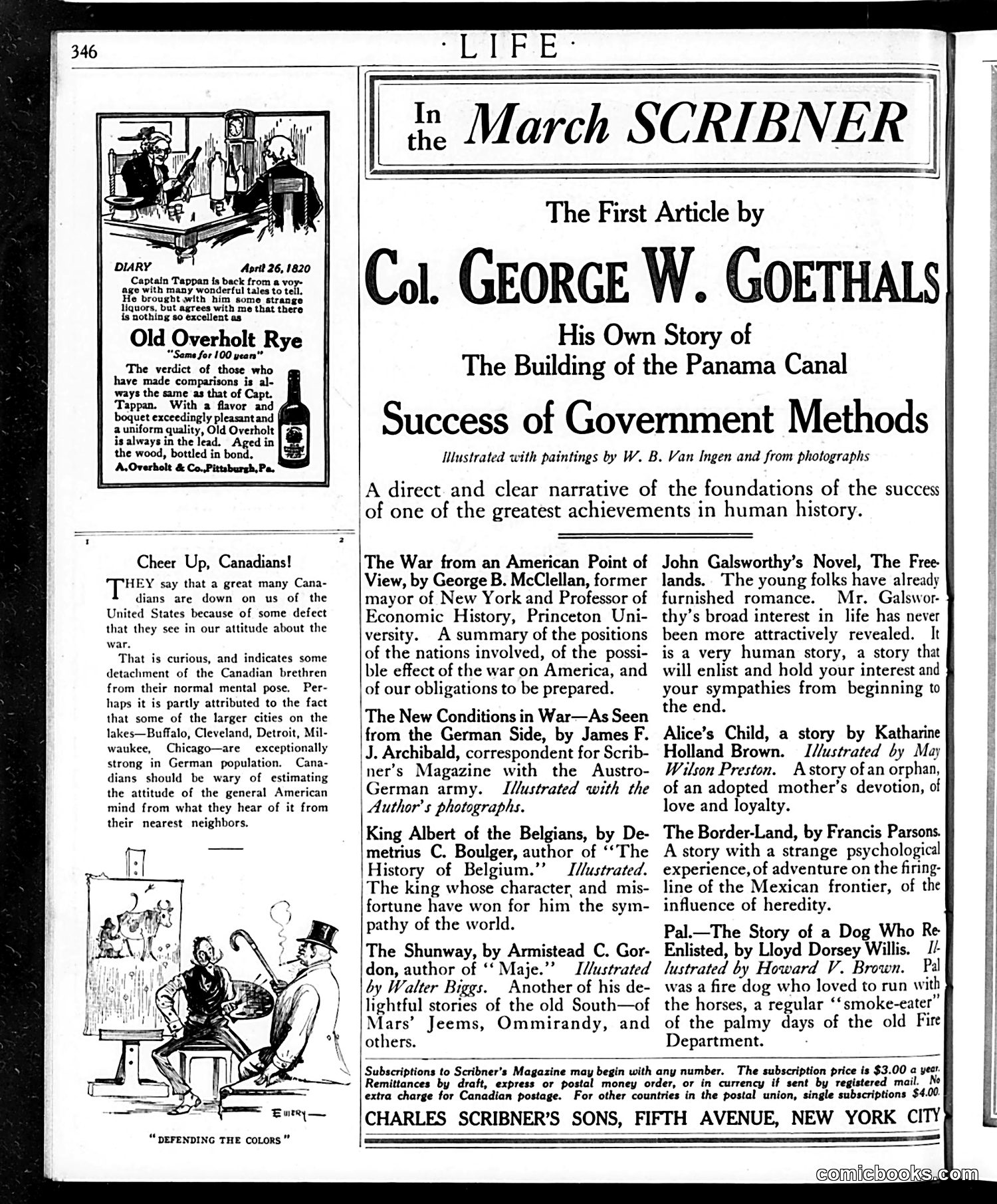
This is primarily an advertising and promotional page for the March *Scribner* magazine and Old Overholt Rye whiskey, not a political cartoon page. The small sketch labeled "DEFENDING THE COLORS" (lower left) appears to show a patriotic military scene, likely referencing American military service, though details are unclear. The main text includes an editorial titled "Cheer Up, Canadians!" expressing concern about Canadian-American relations. It suggests some Canadians resent American attitudes toward World War I, and speculates this resentment stems partly from German-immigrant populations in border cities (Buffalo, Cleveland, Detroit, Milwaukee). The editor advises Canadians not to judge American sentiment based on these German-influenced regions. The page is otherwise devoted to advertising the upcoming *Scribner's* issue, featuring articles by military figures like General Goethals on the Panama Canal and correspondent Archibald on the German war effort—timely topics in 1915.
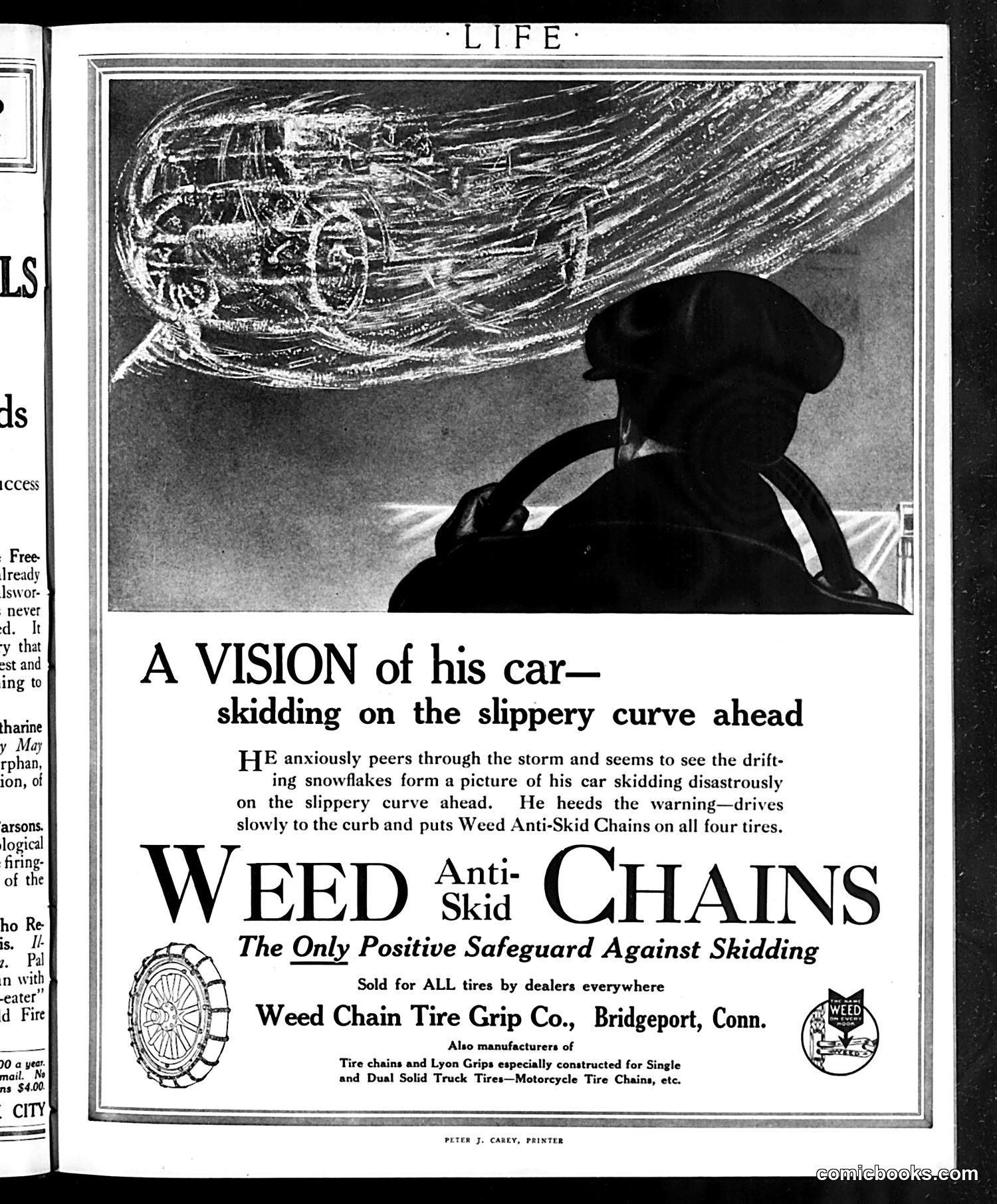
This is primarily a **vintage advertisement**, not political satire. It promotes Weed Anti-Skid Chains, tire chains designed for winter driving safety. The "cartoon" depicts a driver's anxious vision during a snowstorm: he imagines his car skidding dangerously on a slippery curve ahead. Rather than satirizing anything, the ad uses this dramatic scenario to sell its product—the chains supposedly prevent such disasters. **Context for modern readers:** This reflects early-20th-century winter driving hazards before modern tire technology, salt roads, or widespread snow removal. Tire chains were genuinely necessary safety equipment, not optional accessories. The ad's appeal to fear and responsible driving ("He heeds the warning") was a standard sales technique of that era. The silhouetted driver peering anxiously through the storm is meant to trigger recognition and concern in contemporary readers who faced similar winter driving dangers.
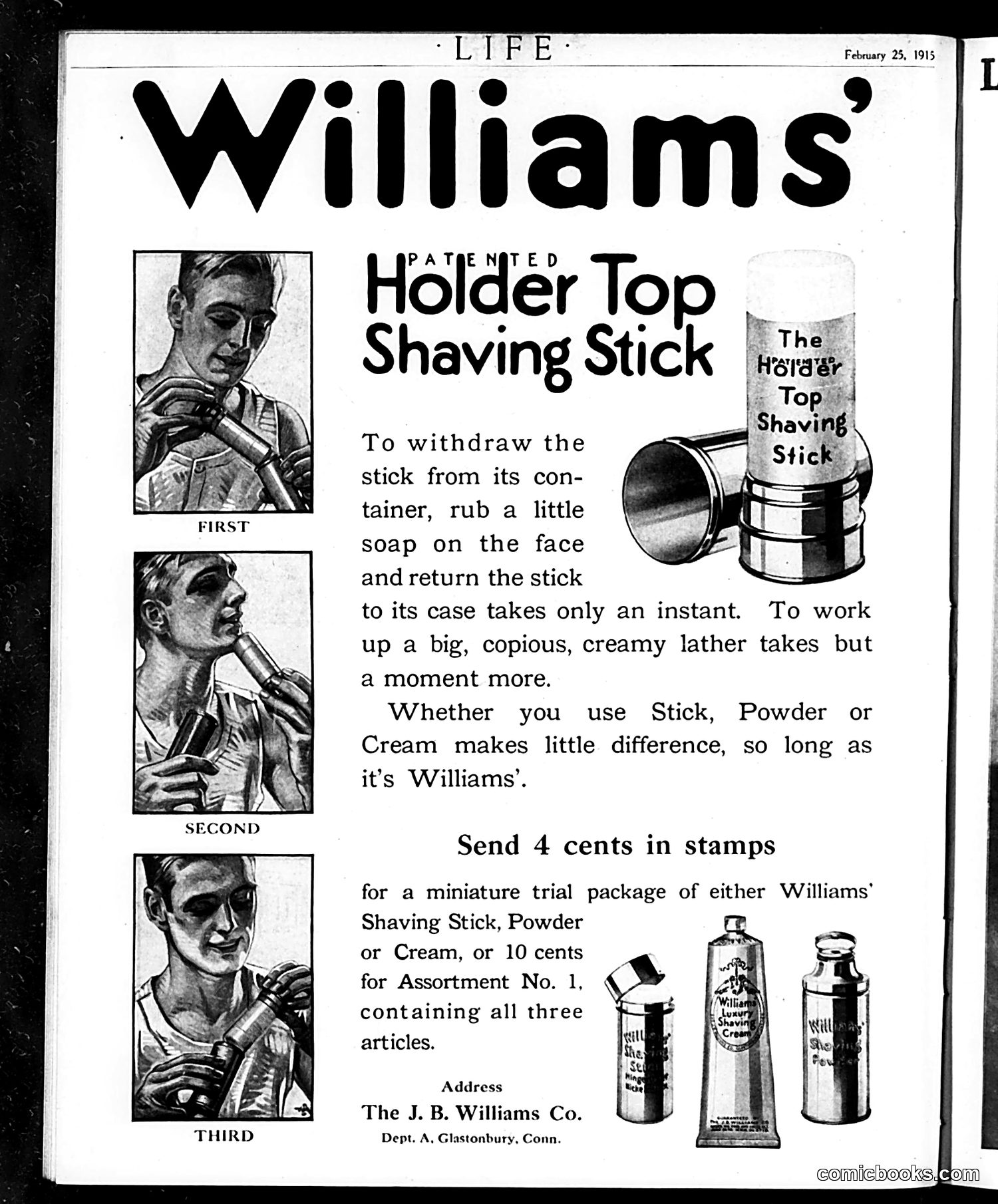
This is **not a cartoon or satire**—it's a straightforward product advertisement for Williams' shaving products, published in the satirical magazine *Life*. The page shows three sequential illustrations demonstrating how to use the "Holder Top Shaving Stick": a man first applies soap to his face, then removes the stick from its container, and finally uses it to create lather. The advertisement emphasizes convenience—the product supposedly requires only moments to use. The ad promotes three product formats (Stick, Powder, or Cream) and offers trial packages for 4-10 cents in stamps. The company address is listed as Glastonbury, Connecticut. There is no political message or satire here—this is typical early 20th-century advertising that happened to appear in *Life*, which published both humor and commercial content.