
Life, 1915-02-25 · page 24 of 44
Life — February 25, 1915 — page 24: what you’re looking at
What you’re looking at
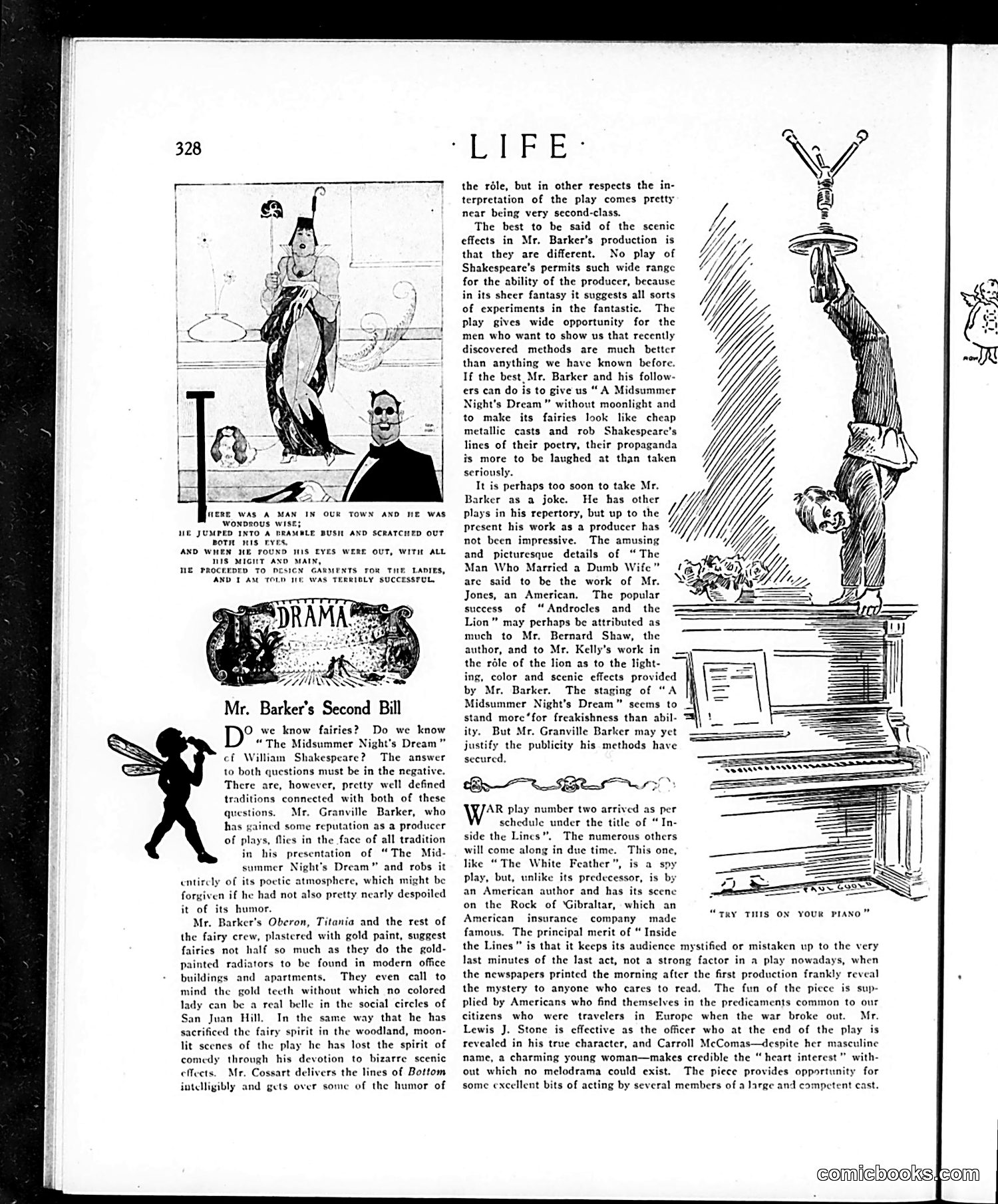
This page satirizes producer Granville Barker's unconventional staging of Shakespeare's *A Midsummer Night's Dream*. The reviewer mocks Barker's avant-garde approach, particularly his decision to abandon romantic tradition by depicting fairies as gold-painted figures resembling "gold-painted radiators" in modern office buildings—or offensive comparisons to gold teeth seen in certain communities. The criticism argues Barker's experimental scenic design, while permitted by Shakespeare's fantastical scope, sacrifices the play's poetic atmosphere and comedy. The reviewer suggests Barker receives undue credit; successes in his other productions (*Androcles and the Lion*, *The Man Who Married a Dumb Wife*) likely result from the authors, actors, or other collaborators rather than Barker's direction. The illustration (left) depicts a costumed fairy figure, likely mocking the gold-paint aesthetic being criticized. The page's overall tone dismisses modernist theater experimentation as pretentious "freakishness" over genuine ability.
📄 Transcribed text from this page (OCR, searchable)
Machine-transcribed from the original scan — historical spelling and the odd misread are preserved.
MIS MIGHT AND MAIN, NE PROCEEDED TO DESIGN GARMENTS TOR THE LADIES, AND TAM TOLD IIe WAS TERRIOLY SUCCESSFUL, Mr. Barker’s Second Bill O we know fairies? “The Midsummer Night's Dream” Do we know cf William Shakespeare? The answer to both questions must be in the negative. There are, however, pretty well defined traditions connected with both of these Mr. Granville Barker, who has gained some reputation as a producer of plays, flies in the face of all tradition in his presentation of “The Mid- immer Night’s Dream” and robs it entircly of its poetic atmosphere, which might be forgiven if he had not also pretty nearly despoiled it of its humor. Mr. Barker's Oberon, Titania and the rest of the fairy crew, plastered with gold paint, suggest fairies not half so much as they do the gold- painted radiators to be found in modern office buildings and apartments, They even call to mind the gold teeth without which no colored lady can be a real belle in the social circles of Juan Hill, In the same way that he has sacrificed the fairy spirit in the woodland, moon- lit scenes of the play he has lost the spirit of comedy through his devotion to bizarre scenic effects. Mr. Cossart delivers the lines of Bottom iutelligibly and gets over some of the humor of the réle, but in other respects the in- terpretation of the play comes pretty near being very second-class. The best to be said of the scenic effects in Mr. Barker’s production is that they are different. No play of Shakespeare’s permits such wide range for the ability of the producer, because in its sheer fantasy it suggests all sorts of experiments in the fantastic. The play gives wide opportunity for the men who want to show us that recently discovered methods are much better than anything we have known before. If the best. Mr. Barker and his follow- ers can do is to give us “ A Midsummer Night’s Dream” without moonlight and to make its fairies look like cheap metallic casts and rob Shakespeare's lines of their poctry, their propaganda is more to be laughed at than taken seriously. It is perhaps too soon to take Mr. Barker as a joke. He has other plays in his repertory, but up to the present his work as a producer has not been impressive. The amusing and picturesque details of “The Man Who Married a Dumb Wife” are said to be the work of Mr. Jones, an American. The popular success of “Androcles and the Lion” may perhaps be attributed as much to Mr. Bernard Shaw, the author, and to Mr. Kelly's work in the réle of the lion as to the light- ing, color and scenic effects provided by Mr. Barker. The staging of “A Midsummer Night's Dream” seems to stand more‘for freakishness than abil- ity. But Mr. Granville Barker may yet justify the publicity his methods have secured. we play number two arrived as per schedule under the title of “In- side the Lincs”. The numerous others will come along in due time. This one, like “The White Feather”, is a spy play, but, unlike its predecessor, is by an American author and has its scene on the Rock of Gibraltar, which an American insurance company made famous. The principal merit of “ Inside TRY THIS ON YOUR PIANO” the Lines” is that it keeps its audience mystified or mistaken up to the very last minutes of the last act, not a strong factor in a play nowadays, when the newspapers printed the morning after the first production frankly reveal the mystery to anyone who cares to read. The fun of the picce is sup- plied by Americans who find themselves in the predicaments common to our citizens who were travelers in Europe when the war broke out. Mr. Lewis J. Stone is effective as the officer who at the end of the play is revealed in his true character, and Carroll McComas—despite her masculine name, a charming young woman—makes credible the “heart interest" with- out which no melodrama could exist. The piece provides opportunity for some excellent bits of acting by several members of a Jarge and competent cast.