
Life, 1915-02-25 · page 15 of 44
Life — February 25, 1915 — page 15: what you’re looking at
What you’re looking at
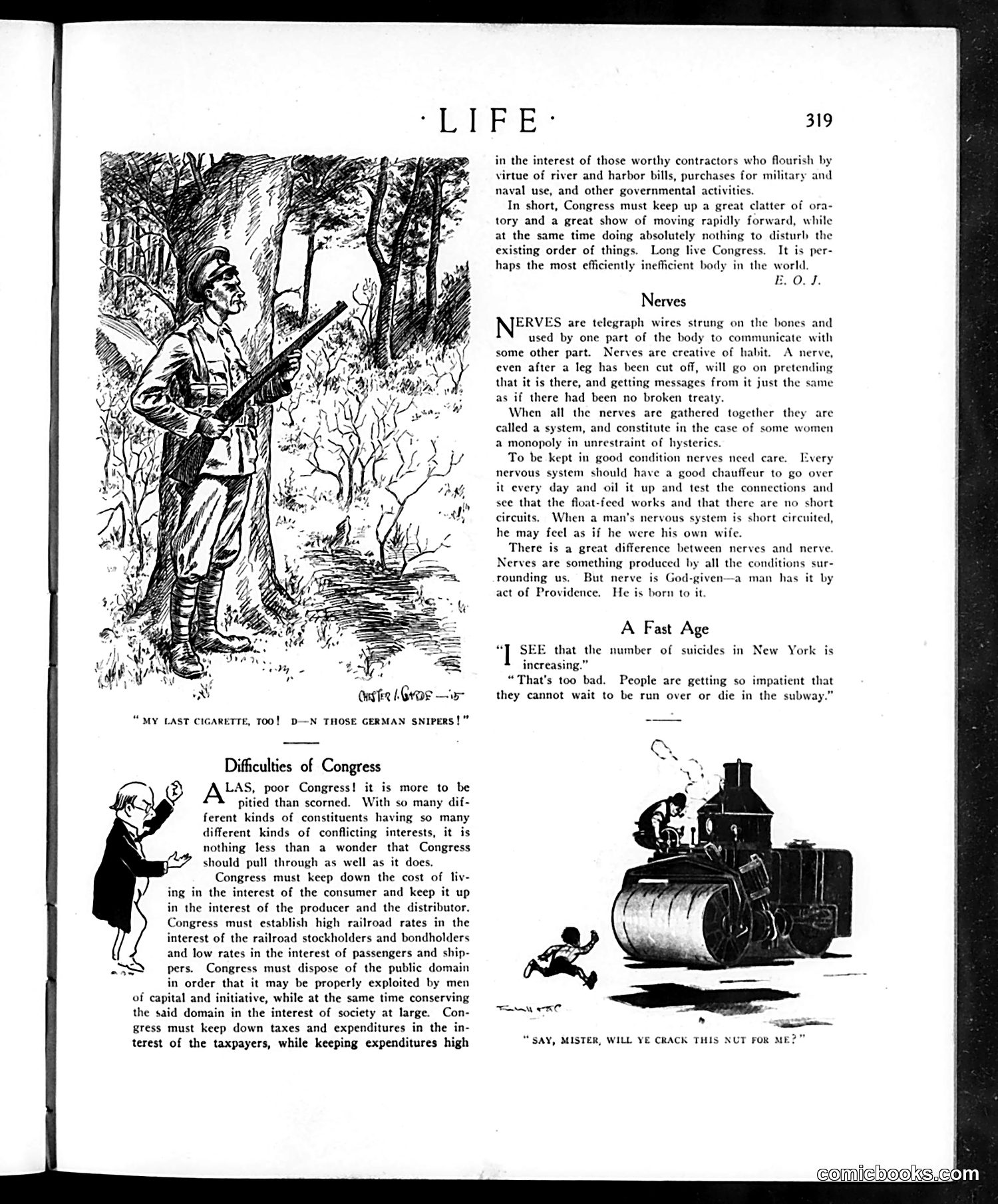
This 1915 Life magazine page contains satirical commentary on American institutions. **"Difficulties of Congress"** mocks Congress's impossible mandate to satisfy contradictory interests simultaneously—keeping living costs low for consumers while high for producers, establishing both high and low railroad rates depending on whose interests are served. The satire argues Congress is "efficiently inefficient," maintaining the appearance of action while preserving the status quo. **The WWI cartoon** (top left) depicts a soldier in a trench saying "My last cigarette, too! D—n those German snipers!"—darkly humorous commentary on combat conditions during World War I. **"A Fast Age"** section satirizes modern impatience, with a dialogue suggesting New Yorkers are so desperate they can't even wait for accidents—they commit suicide instead. The train cartoon below illustrates this commentary on urban pace and desperation. The "Nerves" section is a humorous faux-scientific explanation of the nervous system, comparing it to mechanical systems requiring maintenance.
📄 Transcribed text from this page (OCR, searchable)
Machine-transcribed from the original scan — historical spelling and the odd misread are preserved.
“ERPE* Shih R\ Cugtee roe —o- “MY LAST CIGARETTE, TOO! D—N THOSE GERMAN SNIPERS!” Difficulties of Congress Al's. poor Congress! it is more to be pitied than scorned. With so many dif- ferent kinds of constituents having so many different kinds of conflicting interests, it is nothing less than a wonder that Congress should pull through as well as it does, Congress must keep down the cost of liv- ing in the interest of the consumer and keep it up in the interest of the producer and the distributor, Congress must establish high railroad rates in the interest of the railroad stockholders and bondholders and low rates in the interest of passengers and ship- -sS> pers. Congress must dispose of the public domain in order that it may be properly exploited by men of capital and initiative, while at the same time conserving the said domain in the interest of society at large. Con- gress must keep down taxes and expenditures in the in- terest of the taxpayers, while keeping expenditures high 319 in the interest of those worthy contractors who flourish by virtue of river and harbor bills, purchases for military and naval use, and other governmental activ In short, Congress must keep up a great clatter of ora- tory and a great show of moving rapidly forward, while at the same time doing absolutely nothing to disturb the existing order of things. Long live Congress. It is per- haps the most efficiently inefficient body in the world. E. 0.2, Nerves ERVES are telegraph wires strung on the bones and used by one part of the body to communicate with some other part. Nerves are creative of habit. A nerve, even after a leg has been cut off, will go on pretending that it is there, and getting messages from it just the same as if there had been no broken treaty. When all the nerves are gathered together they are called a system, and constitute in the case of some women a monopoly in unrestraint of hysterics. To be kept in good condition nerves need care. Every nervous system should have a good chauffeur to go over it every day and oil it up and test the connections and see that the float-feed works and that there are no short circuits, When a man’s nervous system is short circuited, he may feel as if he were his own wife. There is a great difference between nerves and nerve. Nerves are something produced by all the conditions sur- rounding us. But nerve is God-given—a man has it by act of Providence. He is born to it. A Fast Age “T SEE that the number of suicides in New York is increasing.” “That's too bad. People are getting so impatient that they cannot wait to be run over or die in the subway.” “SAY, MISTER, WILL YE CRACK THIS NUT FOR ME