
Life, 1915-02-25 · page 32 of 44
Life — February 25, 1915 — page 32: what you’re looking at
What you’re looking at
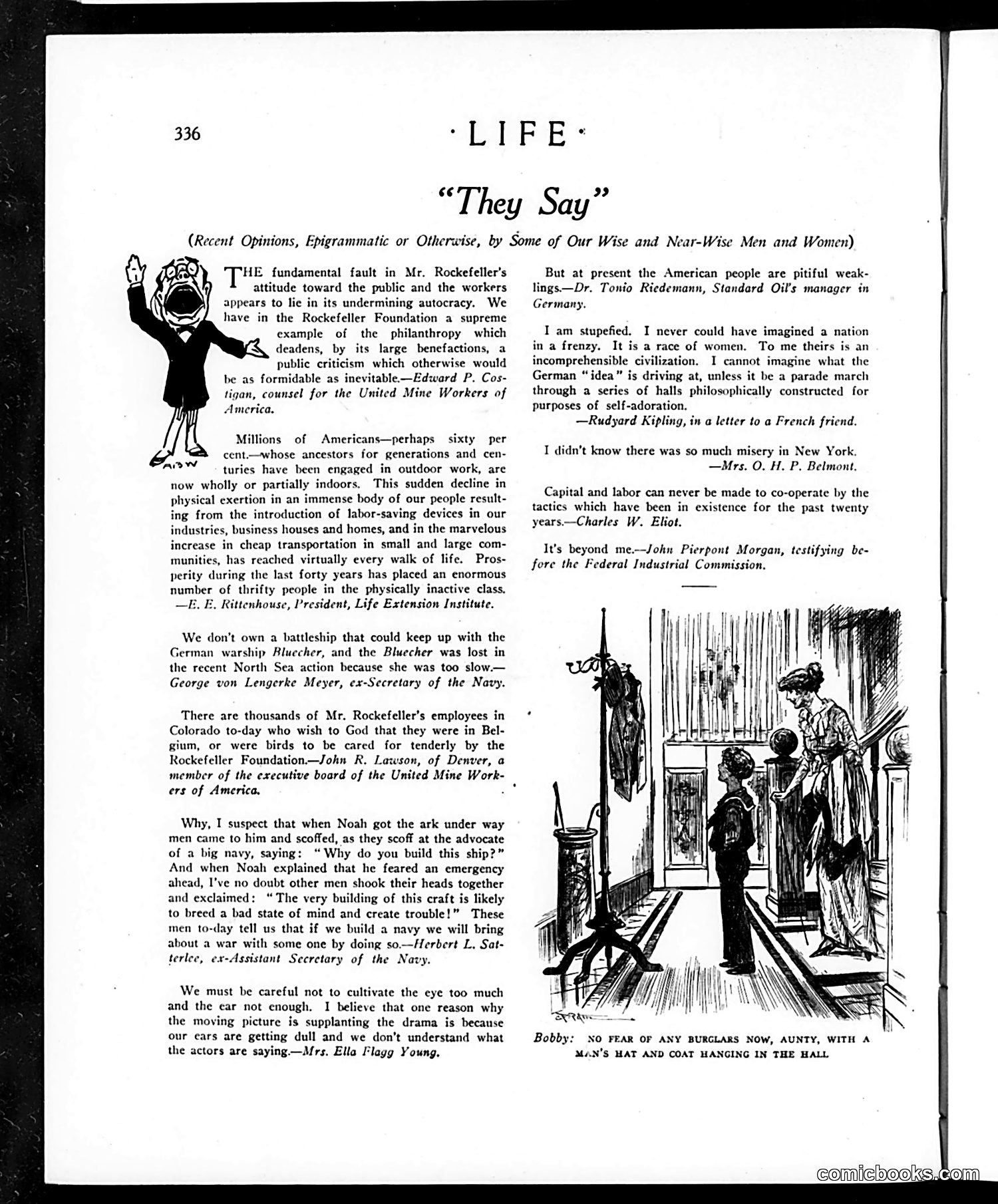
This page collects satirical quotes from prominent figures of the era (circa 1910s), each followed by the speaker's name and credential. The commentary critiques major social issues: **Key targets:** - **Rockefeller Foundation**: Edward Costigan argues Rockefeller's philanthropy silences legitimate public criticism of labor practices - **Labor conditions**: John Lawson sarcastically suggests Rockefeller's Colorado mine workers envy Belgian refugees, implying poor treatment - **Military readiness**: Naval weakness is defended against critics - **Americanism**: German observers (Standard Oil's Riedemann, Rudyard Kipling) mock Americans as weak and unable to understand German "civilization" **The cartoon** (lower right) depicts a burglar deterrent: a man's hat and coat hanging in a hallway creates the *appearance* of a male occupant, protecting vulnerable women—satirizing how appearances substitute for actual security. The page's satire mocks both establishment figures (Rockefeller, Morgan) and foreign critics, while highlighting labor unrest and social inequality.
📄 Transcribed text from this page (OCR, searchable)
Machine-transcribed from the original scan — historical spelling and the odd misread are preserved.
“aL BEESE, © “They Say” (Recent Opinions, Epigrammatic or Otherwise, by Some of Our Wise and Near-Wise Men and Women) HE fundamental fault in Mr. Rockefeller’s attitude toward the public and the workers appears to lic in its undermining autocracy. We have in the Rockefeller Foundation a supreme example of the philanthropy which deadens, by its large benefactions, a public criticism which otherwise would be as formidable as inevitable—Edward P. Cos- tigan, counsel for the United Mine Workers of America. Millions of Americans—perhaps sixty per cent.—whose ancestors for generations and cen- turies have been engaged in outdoor work, are now wholly or partially indoors. This sudden decline in physical exertion in an immense body of our people result- ing from the introduction of labor-saving devices in our industries, business houses and homes, and in the marvelous increase in cheap transportation in small and large com- munities, has reached virtually every walk of life. Pros- perity during the last forty years has placed an enormous number of thrifty people in the physically inactive class. —E. E, Rittenhouse, President, Life Extension Institute. We don’t own a battleship that could keep up with the German warship Bluecher, and the Bluecher was lost in the recent North Sea action because she was too slow.— George von Lengerke Meyer, ex-Secretary of the Navy. There are thousands of Mr. Rockefeller’s employees in Colorado to-day who wish to God that they were in Bel- gium, or were birds to be cared for tenderly by the Rockefeller Foundation—John R. Lawson, of Denver, a member of the executive board of the United Mine Work- ers of America, : Why, I suspect that when Noah got the ark under way men came to him and scoffed, as they scoff at the advocate of a big navy, saying: “Why do you build this ship?” And when Noah explained that he feared an emergency ahead, I've no doubt other men shook their heads together and exclaimed: “The very building of this craft is likely to breed a bad state of mind and create trouble!” These men to-day tell us that if we build a navy we will bring about a war with some one by doing so.—Herbert L, Sat- terlee, ex-Assistant Secretary of the Ye We must be careful not to cultivate the eye too much and the car not enough. I believe that one reason why the moving picture is supplanting the drama is because our cars are getting dull and we don’t understand what the actors are saying —Mrs. Ella Flagg Young. But at present the American people are pitiful weak- lings—Dr. Tonio Riedemann, Standard Oil's manager in Germany. I am stupefied. I never could have imagined a nation in a frenzy. It is a race of women. To me theirs is an incomprehensible civilization, I cannot imagine what the German “idea” is driving at, unless it be a parade march through a series of halls philosophically constructed for purposes of self-adoration. —Rudyard Kipling, in a letter to a French friend. I didn’t know there was so much misery in New York. —Mrs. O. H. P. Belmont, Capital and labor can never be made to co-operate by the tactics which have been in existence for the past twenty years.—Charles W. Eliot. It’s beyond me—John Pierpont Morgan, testifying be- fore the Federal Industrial Commission. Bobby: No FEAR OF ANY BURGLARS NOW, AUNTY, WITH A MAN'S HAT AND COAT HANGING IN THE HALL