
Life, 1915-02-25 · page 10 of 44
Life — February 25, 1915 — page 10: what you’re looking at
What you’re looking at
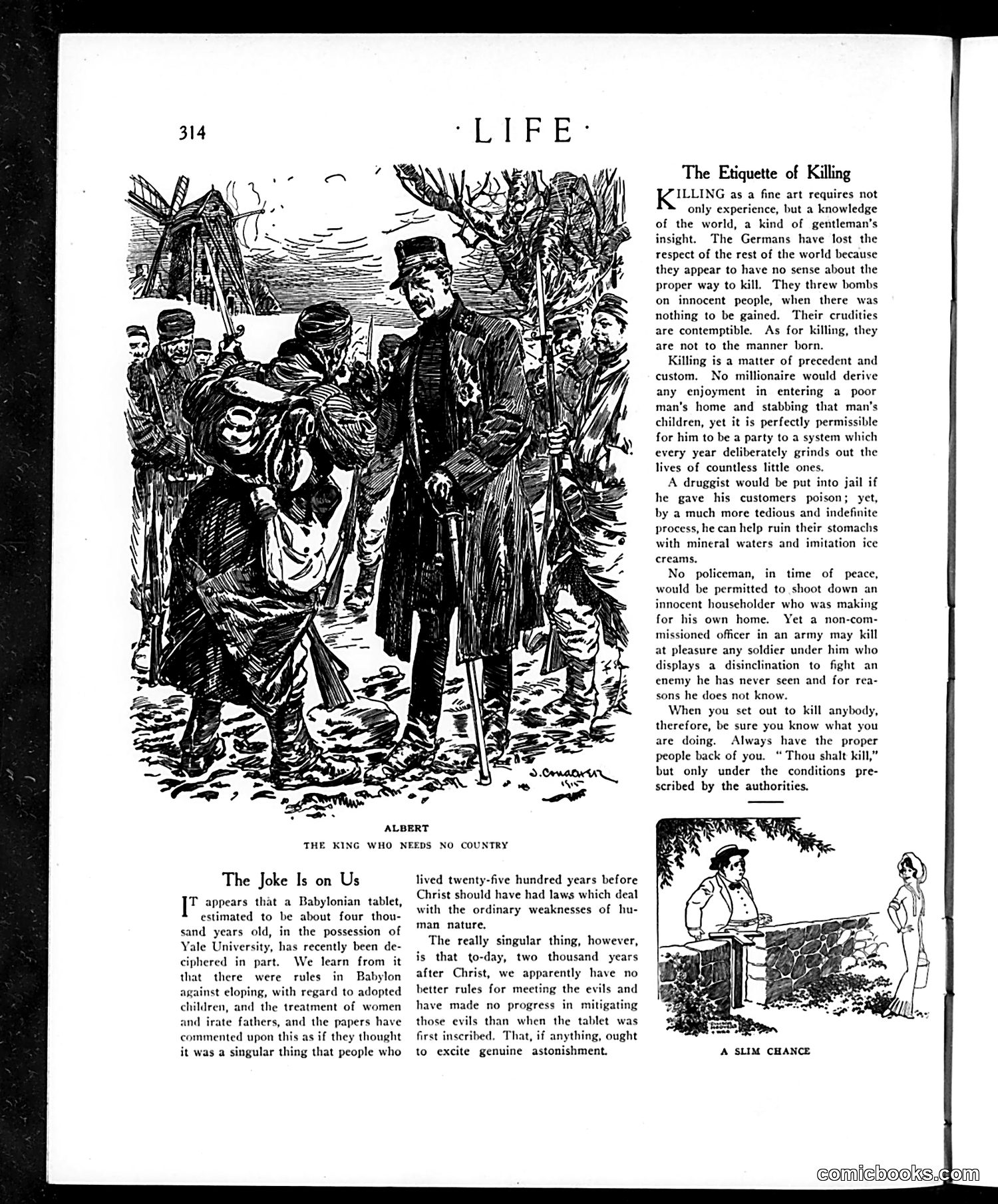
This page contains satirical commentary on warfare and morality. **"Albert: The King Who Needs No Country"** depicts what appears to be a military figure (likely German, given the caption's reference to "Germans" in the text) surrounded by soldiers and civilians in a war-torn landscape. The accompanying essay titled "The Etiquette of Killing" sarcastically critiques the hypocrisy of civilization's rules of conduct. It argues that while civilians face legal consequences for murder, military officers can kill with impunity—a privilege the text treats as morally indefensible. **"The Joke Is on Us"** references a Babylonian tablet, suggesting ancient societies had better moral codes than modern ones regarding treatment of the weak and women. The smaller cartoon "A Slim Chance" appears unrelated social commentary. The overall message criticizes military exemption from civilian moral standards as fundamentally unjust.
📄 Transcribed text from this page (OCR, searchable)
Machine-transcribed from the original scan — historical spelling and the odd misread are preserved.
ALBERT THE KING WHO NEEDS NO COUNTRY The Joke Is on Us T appears that a Babylonian tablet, estimated to be about four thou- sand years old, in the possession of Yale University, has recently been de- ciphered in part. We learn from it that there were rules in Babylon inst eloping, with regard to adopted children, and the treatment of women and irate fathers, and the papers have commented upon this as if they thought it was a singular thing that people who lived twenty-five hundred years before Christ should have had laws which deal with the ordinary weaknesses of hu- man nature. The really singular thing, however, is that to-day, two thousand years after Christ, we apparently have no better rules for meeting the evils and have made no progress in mitigati those evils than when the tablet was first inscribed. That, if anything, ought to excite genuine astonishment. The Etiquette of Killing ILLING as a fine art requires not only experience, but a knowledge of the world, a kind of gentleman's insight. The Germans have lost the respect of the rest of the world because they appear to have no sense about the proper way to kill. They threw bombs on innocent people, when there was nothing to be gained. Their crudities are contemptible. As for killing, they are not to the manner born. Killing is a matter of precedent and custom. No millionaire would derive any enjoyment in entering a poor man’s home and stabbing that man’s children, yet it is perfectly permissible for him to be a party to a system which every year deliberately grinds out the lives of countless little ones. A druggist would be put into jail if he gave his customers poison; yet, by a much more tedious and indefinite process, he can help ruin their stomachs with mineral waters and imitation ice creams. No policeman, in time of peace, would be permitted to shoot down an innocent householder who was making for his own home. Yet a non-com- missioned officer in an army may kill at pleasure any soldier under him who displays a disinclination to fight an enemy he has never seen and for rea- sons he does not know. When you set out to kill anybody, therefore, be sure you know what you are doing. Always have the proper people back of you. “Thou shalt kill,” but only under the conditions pre- scribed by the authorities, A SLIM CHANCE comichooks.qom