
Life, 1915-02-25 · page 27 of 44
Life — February 25, 1915 — page 27: what you’re looking at
What you’re looking at
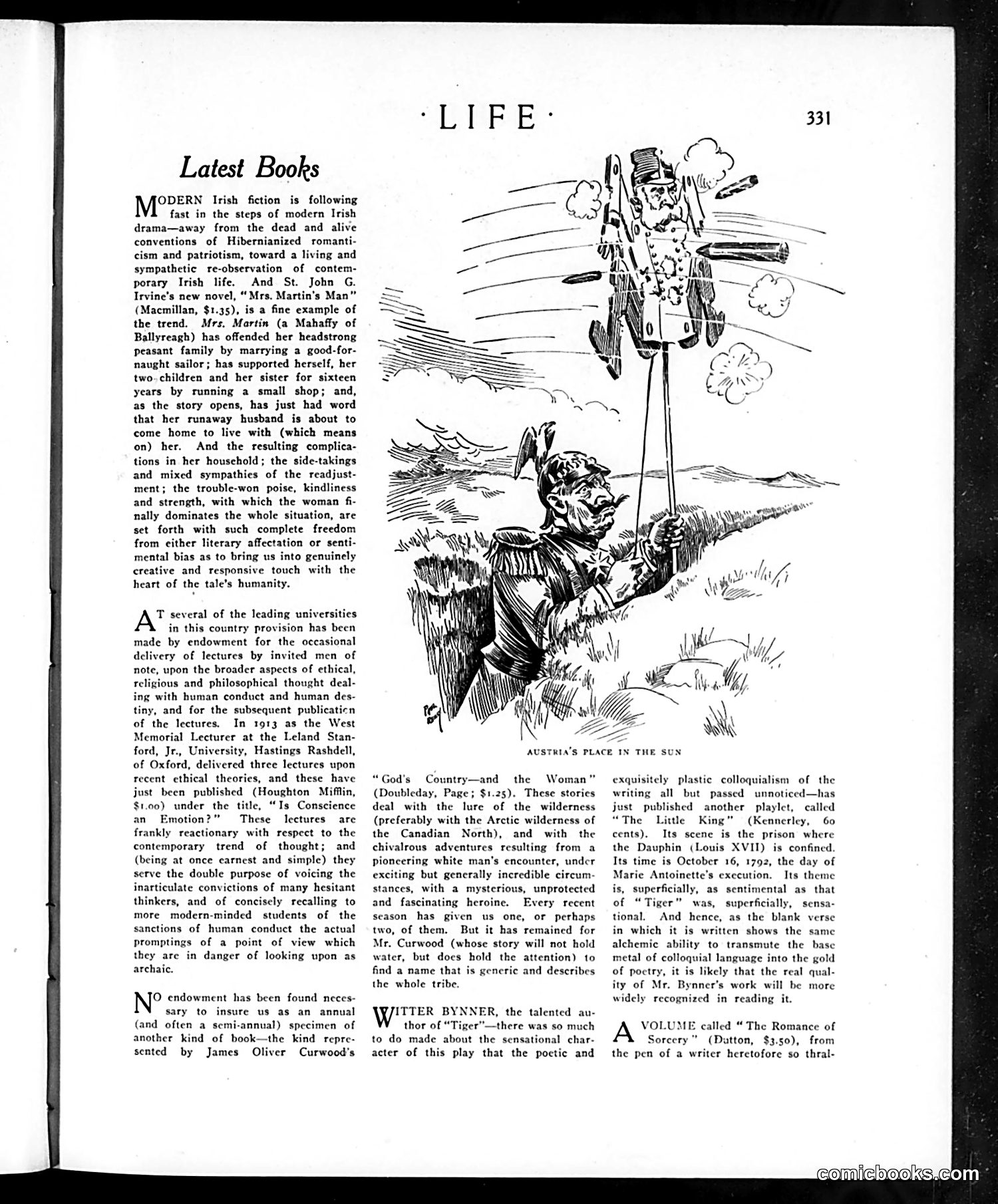
This cartoon depicts a figure (likely representing Austria-Hungary) being shot down from the sky during World War I. The illustration shows a military officer or soldier falling from an aircraft or flying machine that's under fire, with explosions and clouds surrounding the scene. The caption "Austria's Place in the Sun" is satirical irony—a reference to imperialist ambitions. The phrase mocks Austria-Hungary's imperial pretensions by literally depicting its downfall. Given this is from *Life* magazine during the WWI era, the cartoon likely comments on Austria-Hungary's military failures or declining power in the war, particularly after early defeats on the Eastern Front. The soldier plummeting to earth symbolizes the empire's collapse from its position of power.
📄 Transcribed text from this page (OCR, searchable)
Machine-transcribed from the original scan — historical spelling and the odd misread are preserved.
Latest Books ODERN Irish fiction is following fast in the steps of modern Irish drama—away from the dead and aliv conventions of Hibernianized romanti- cism and patriotism, toward a living and sympathetic re-observation of contem- porary Irish life. And St. John G. Irvine’s new novel, “Mrs. Martin's Man” (Macmillan, $1.35), is a fine example of the trend. Mrs, Martin (a Mahaffy of Ballyreagh) has offended her headstrong peasant family by marrying a good-for- naught sailor; has supported herself, her two-children and her sister for sixteen years by running a small shop; and, as the story opens, has just had word that her runaway husband is about to come home to live with (which means on) her. And the resulting complica- tions in her household; the side-takings and mixed sympathies of the readjust- ment; the trouble-won poise, kindliness and strength, with which the woman fi- nally dominates the whole situation, are set forth with such complete freedom from either literary affectation or senti- mental bias as to bring us into genuinely creative and responsive touch with the heart of the tale’s humanity. T several of the leading universities in this country provision has been made by endowment for the occasional delivery of lectures by invited men of note, upon the broader aspects of ethical, religious and philosophical thought deal- ing with human conduct and human des- tiny, and for the subsequent publicaticn of the lectures. In 1913 as the West Memorial Lecturer at the Leland Stan- ford, Jr., University, Hastings Rashdell, of Oxford, delivered three lectures upon recent ethical theories, and these have just been published (Houghton Mifflin, $1.00) under the title, “Is Conscience an Emotion?” These lectures are frankly reactionary with respect to the contemporary trend of thought; and (being at once earnest and simple) they serve the double purpose of voicing the inarticulate convictions of many hesitant thinkers, and of concisely recalling to more modern-minded students of the sanctions of human conduct the actual promptings of a point of view which they are in danger of looking upon as archaic. 'O endowment has been found neces- sary to insure us as an annual (and often a semi-annual) specimen of another kind of book—the kind repre- sented by James Oliver Curwood's tt a Za AUSTRIA'S PLACE IN THE SUN “God's Country—and the Woman" (Doubleday, Page; $1.25). These stories deal with the lure of the wilderness (preferably with the Arctic wilderness of the Canadian North), and with the chivalrous adventures resulting from a pioncering white man’s encounter, under exciting but generally incredible circum- stances, with a mysterious, unprotected and fascinating heroine. Every recent season has given us one, or perhaps two, of them, But it has remained for Mr. Curwood (whose story will not hold water, but does hold the attention) to find a name that is generic and describes the whole tribe. ITTER BYNNER, the talented au- thor of “Tiger”—there was so much to do made about the sensational char- acter of this play that the poctic and exquisitely plastic colloquialism of the writing all but passed unnoticed—has just published another playlet, called “The Little King" (Kennerley, 60 cents), Its scene is the prison where the Dauphin (Louis XVII) is confined. Its time is October 16, 1792, the day of Marie Antoinette’s execution. Its theme is, superficially, as sentimental as that of “Tiger” was, superficially, sensa- tional. And hence, as the blank verse in which it is written shows the same alchemic ability to transmute the base metal of colloquial language into the gold of poctry, it is likely that the real qual- ity of Mr. Bynner’s work will be more widely recognized in reading it. VOLUME called “ The Romance of Sorcery (Dutton, $3.50), from the pen of a writer heretofore so thral-