
Life, 1915-02-25 · page 33 of 44
Life — February 25, 1915 — page 33: what you’re looking at
What you’re looking at
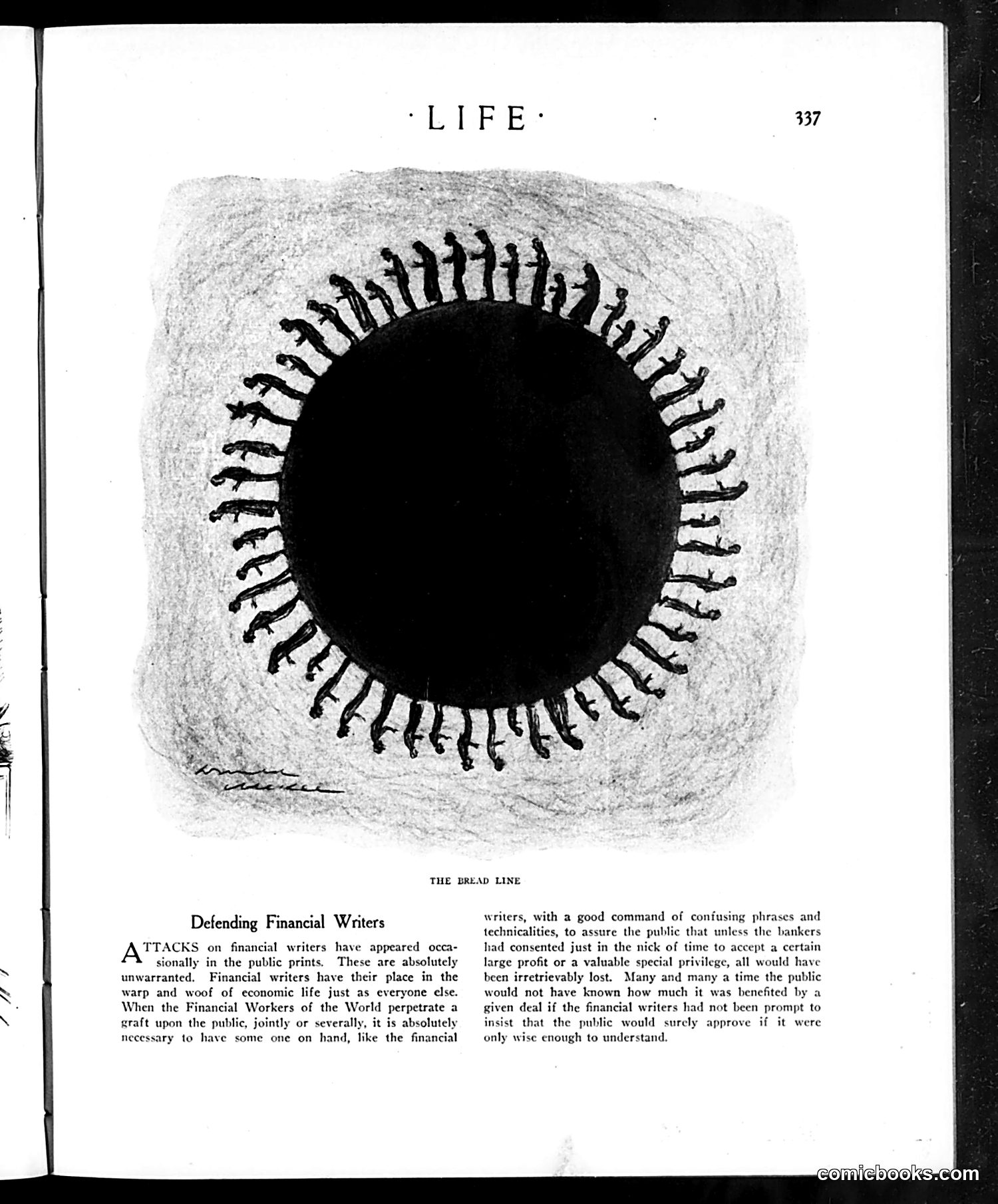
This is satirical defense of financial writers, presented ironically. The article mock-defends writers who use "confusing phrases and technicalities" to convince the public that banking deals benefiting bankers were actually in the public interest. The satire targets how financial writers obscure reality: they convince people that lucrative banker "profits" and "special privileges" represent public benefits. The piece sarcastically suggests the public should be grateful for writers' opacity—implying readers *wouldn't* approve if they actually understood these transactions clearly. The circular image with radiating lines (labeled "The Bread Line") likely visualizes this circularity of financial jargon obscuring exploitation. The satire critiques complicit financial journalism and banking interests working together to mislead the public during an era of economic inequality and financial manipulation.
📄 Transcribed text from this page (OCR, searchable)
Machine-transcribed from the original scan — historical spelling and the odd misread are preserved.
THE BREAD LI Defending Financial Writers fTACKS sionally in the public prints. on financial writers have appeared occa- These are absolutely unwarranted, Financial writers have their place in the warp and woof of economic life just as everyone else. When the Financial Workers of the World perpetrate a graft upon the public, jointly or severally, it is absolutely necessary to have some one on hand, like the financial writers, with a good command of confusing phrases and technicalities, to assure the public tl unless the bankers had consented just in the nick of time to accept a certain large profit or a valuable special privilege, all would have been irretrievably lost. Many and many a time the public would not have known how much it was benefited by a given deal if the financial writers had not been prompt to insist that the public would surely only wise enough to understand. approve if it were