
Life, 1915-02-25 · page 20 of 44
Life — February 25, 1915 — page 20: what you’re looking at
What you’re looking at
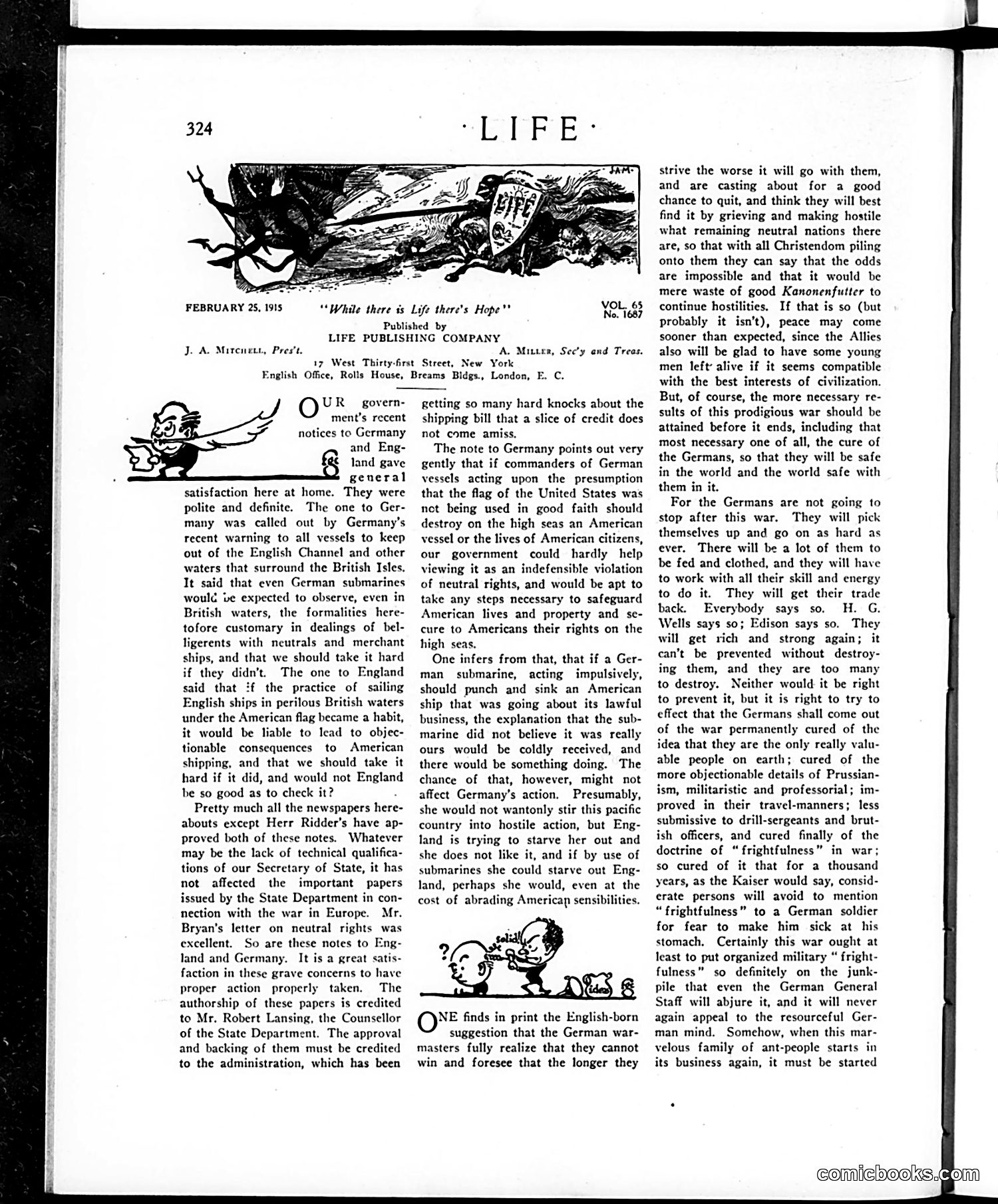
This *Life* magazine page discusses U.S. diplomatic notes to Germany and Britain regarding submarine warfare and neutral shipping rights during World War I. **The cartoons** (visible but small) appear to depict political figures or allegorical representations related to these diplomatic tensions, though specific identities are unclear from the image quality. **The main article** praises Secretary of State William Jennings Bryan and counselor Robert Lansing for issuing firm but polite warnings to both belligerents: Germany must respect American vessels and lives, and Britain shouldn't misuse the American flag. **The satire** targets Germany's submarine threat and the suggestion (printed elsewhere) that German commanders might provoke America into the war, calculating they'll lose anyway and prefer to blame impossible odds rather than admit defeat. The term "Kanonenfutter" (cannon fodder) sarcastically references Germany's willingness to sacrifice soldiers. The piece reflects American anxiety about remaining neutral while both European powers threatened American interests.
📄 Transcribed text from this page (OCR, searchable)
Machine-transcribed from the original scan — historical spelling and the odd misread are preserved.
FEBRUARY 25, 1915 “Whale there is Life there's Hope"* No. 1687 Published by LIFE PUBLISHING COMPANY J. A. Mircnett, Pres't. A. Mitre, Sec’y end Treas. 17 West Thirty-first Street, New York English Office, Rolls House, Breams Bidgs., London, E. C. UR govern- ment’s recent notices to Germany a and Eng- land gave general satisfaction here at home. They were polite and definite. The one to Ger- many was called out by Germany’s recent warning to all vessels to keep out of the English Channel and other waters that surround the British Isles. It said that even German submarines would ve expected to observe, even in British waters, the formalities here- tofore customary in dealings of bel- ligerents with neutrals and merchant ships, and that we should take it hard if they didn’t. The one to England said that if the practice of sailing English ships in perilous British waters under the American flag became a habit, it would be liable to lead to objec- tionable consequences to American shipping, and that we should take it hard if it did, and would not England be so good as to check it? . Pretty much all the newspapers here- abouts except Herr Ridder’s have ap- proved both of these notes. Whatever may be the lack of technical qualifica- tions of our Secretary of State, it has not affected the important papers issued by the State Department in con- nection with the war in Europe. Mr. Bryan's letter on neutral rights was excellent. So are these notes to Eng- land and Germany. It is a great satis- faction in these grave concerns to have proper action properly taken. The authorship of these papers is credited to Mr. Robert Lansing, the Counsellor of the State Department. The approval and backing of them must be credited to the administration, which has been Sf getting so many hard knocks about the shipping bill that a slice of credit does not come amiss, The note to Germany points out very gently that if commanders of German vessels acting upon the presumption that the flag of the United States was not being used in good faith should destroy on the high seas an American vessel or the lives of American citizens, our government could hardly help viewing it as an indefensible violation of neutral rights, and would be apt to take any steps necessary to safeguard American lives and property and se- cure to Americans their rights on the high seas. One infers from that, that if a Ger- man submarine, acting impulsively, should punch and sink an American ship that was going about its lawful business, the explanation that the sub- marine did not believe it was really ours would be coldly received, and there would be something doing. The chance of that, however, might not affect Germany’s action. Presumably, she would not wantonly stir this pacific country into hostile action, but Eng- land is trying to starve her out and she does not like it, and if by use of submarines she could starve out Eng- land, perhaps she would, even at the cost of abrading American sensibilities. E finds in print the English-born suggestion that the German war- masters fully realize that they cannot win and foresee that the longer they strive the worse it will go with them, and are casting about for a good chance to quit, and think they will best find it by grieving and making hostile what remaining neutral nations there are, so that with all Christendom piling onto them they can say that the odds are impossible and that it would be mere waste of good Kanonenfutter to continue hostilities, If that is so (but probably it isn’t), peace may come sooner than expected, since the Allies also will be glad to have some young men left’ alive if it seems compatible with the best interests of civilization. But, of course, the more necessary re- sults of this prodigious war should be attained before it ends, including that most necessary one of all, the cure of the Germans, so that they will be safe in the world and the world safe with them in it. For the Germans are not going to stop after this war. They will pick themselves up and go on as hard as ever. There will be a lot of them to be fed and clothed, and they will have to work with all their skill and energy to do it. They will get their trade back. Everybody says so. H. G. Wells says so; Edison says so. They will get rich and strong again; it can’t be prevented without destroy- ing them, and they are too many to destroy. Neither would it be right to prevent it, but it is right to try to effect that the Germans shall come out of the war permanently cured of the idea that they are the only really valu- able people on earth; cured of the more objectionable details of Prussian- ism, militaristic and professorial; im- proved in their travel-manners; less submissive to drill-sergeants and brut- ish officers, and cured finally of the doctrine of “frightfulness” in war; so cured of it that for a thousand years, as the Kaiser would say, consid- erate persons will avoid to mention “ frightfulness” to a German soldier for fear to make him sick at his stomach. Certainly this war ought at least to put organized military “ fright- fulness” so definitely on the junk- pile that even the German General Staff will abjure it, and it will never again appeal to the resourceful Ger- man mind. Somehow, when this mar- velous family of ant-people starts in its business again, it must be started comichooks.com