
Life, 1915-02-25 · page 30 of 44
Life — February 25, 1915 — page 30: what you’re looking at
What you’re looking at
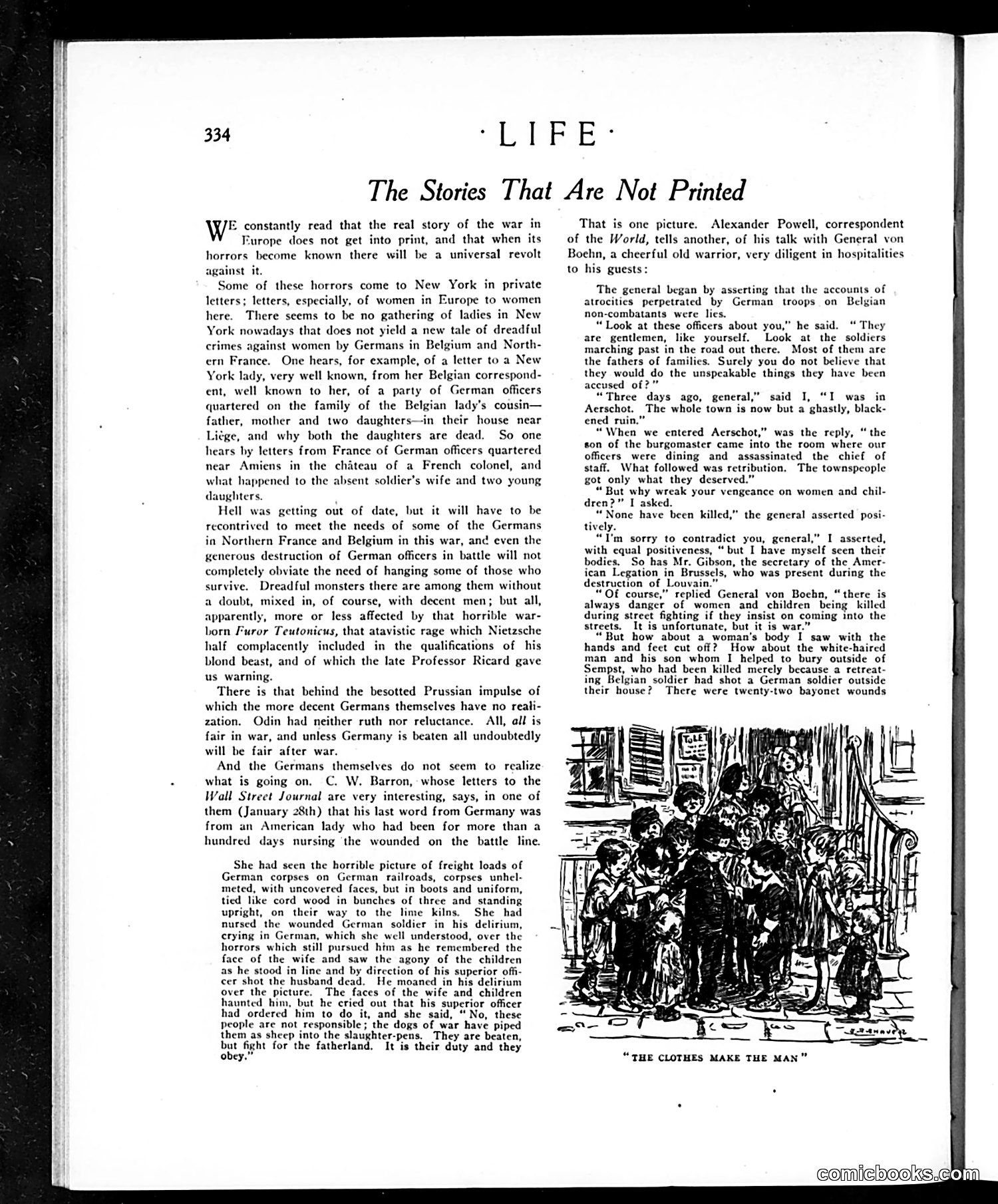
This Life magazine article (circa WWI era) addresses atrocity rumors from German-occupied Belgium and France circulating in New York society through private letters. The piece presents two contrasting accounts: one from a American nurse describing a traumatized German soldier who committed war crimes under orders, and another from correspondent Alexander Powell quoting General von Boehn dismissing atrocity allegations as fabrications. The accompanying illustration labeled "THE CLOTHES MAKE THE MAN" appears to satirize German officer conduct—showing what seems to be soldiers or officers in a domestic setting, likely depicting the very abuses discussed in the text. The article critiques both German denial of war crimes and the dehumanizing effect of military command ("the dogs of war have piped them as sheep into the slaughter-pens"), suggesting systemic brutality rather than individual moral failure. The satire targets German leadership's refusal to acknowledge documented horrors.
📄 Transcribed text from this page (OCR, searchable)
Machine-transcribed from the original scan — historical spelling and the odd misread are preserved.
*LIFE-> The Stories That Are Not Printed W* constantly read that the real story of the war in Europe does not get into print, and that when its horrors become known there will be a universal revolt against it. Some of these horrors come to New York in private letters; letters, especially, of women in Europe to women here. There seems to be no gathering of ladies in New York nowadays that does not yield a new tale of dreadful crimes against women by Germans in Belgium and North- ern France. One hears, for example, of a letter to a New York lady, very well known, from her Belgian correspond- ent, well known to her, of a party of German officers quartered on the family of the Belgian lady's cousin— father, mother and two daughters—in their house near Liége, and why both the daughters are dead. So one hears by letters from France of German officers quartered near Amiens in the chateau of a French colonel, and what happened to the absent soldier’s wife and two young daughters. Hell was getting out of date, but it will have to be recontrived to meet the needs of some of the Germans in Northern France and Belgium in this war, and even the generous destruction of German officers in battle will not completely obviate the need of hanging some of those who survive. Dreadful monsters there are among them without a doubt, mixed in, of course, with decent men; but all, apparently, more or less affected by that horrible war- horn Furor Teutonicus, that atavistic rage which Nietzsche half complacently included in the qualifications of his blond beast, and of which the late Professor Ricard gave us warning. There is that behind the besotted Prussian impulse of which the more decent Germans themselves have no reali- zation. Odin had neither ruth nor reluctance. All, all is fair in war, and unless Germany is beaten all undoubtedly will be fair after war. And the Germans themselves do not seem to realize what is going on. C. W. Barron, whose letters to the Wall Street Journal are very interesting, says, in one of them (January 28th) that his last word from Germany was from an American lady who had been for more than a hundred days nursing the wounded on the battle line. She had seen the horrible picture of freight loads of German corpses on German railroads, corpses unhel- meted, with uncovered faces, but in boots and uniform, tied like cord wood in bunches of three and standing upright, on their way to the lime kilns. She had nursed the wounded German soldier in his delirium, crying in German, which she well understood, over the horrors which still pursued him as he remembered the face of the wife and saw the agony of the children as he stood in line and by direction of his superior offi- cer shot the husband dead. He moaned in his delirium over the picture. The faces of the wife and children haunted him, but he cried out that his superior officer had ordered him to do it, and she said, “No, these people are not responsible; the dogs of war have piped them as sheep into the slaughter-pens. They are beaten, but fight for the fatherland, It is their duty and they obey. That is one picture. Alexander Powell, correspondent of the World, tells another, of his talk with General von Boehn, a cheerful old warrior, very diligent in hospitalities to his guests: The general began by asserting that the accounts of atrocities perpetrated by German troops on Belgian non-combatants were lies. “Look at these officers about you,” he said. “ They are gentlemen, like yourself. Look at the soldiers marching past in the road out there. Most of them are the fathers of families. Surely you do not believe that they would do the unspeakable things they have been accused of ?” “Three days ago, general,” said I, “I was in Aerschot. The whole town is now but a ghastly, black- ened ruit “When we entered Aerschot,” was the reply, “the son of the burgomaster came into the room where our officers were dining and assassinated the chief of staff. What followed was retribution. The townspeople got only what they deserved.” “But why wreak your vengeance on women and chil- dren?” I asked. “None have been killed,” the general asserted posi- tively. “I'm sorry to contradict you, general,” I asserted, with equal positiveness, “but I have myself seen their bodies. So has Mr. Gibson, the secretary of the Amer- ican Legation in Brussels, who was present during the destruction of Louvain.” “Of course,” replied General von Bochn, “there is always danger of women and children being killed during street fighting if they insist on coming into the streets. It is unfortunate, but it is war.” “But how about a woman's body I saw with the hands and feet cut off? How about the white-haired man and his son whom I helped to bury outside of Sempst, who had been killed merely because a retreat- ing Belgian soldier had shot a German soldier outside their house? There were twenty-two bayonet wounds “THE CLOTHES MAKE THE MAN” comichooks.celm