
A complete issue · 44 pages · 1915
Life — February 18, 1915
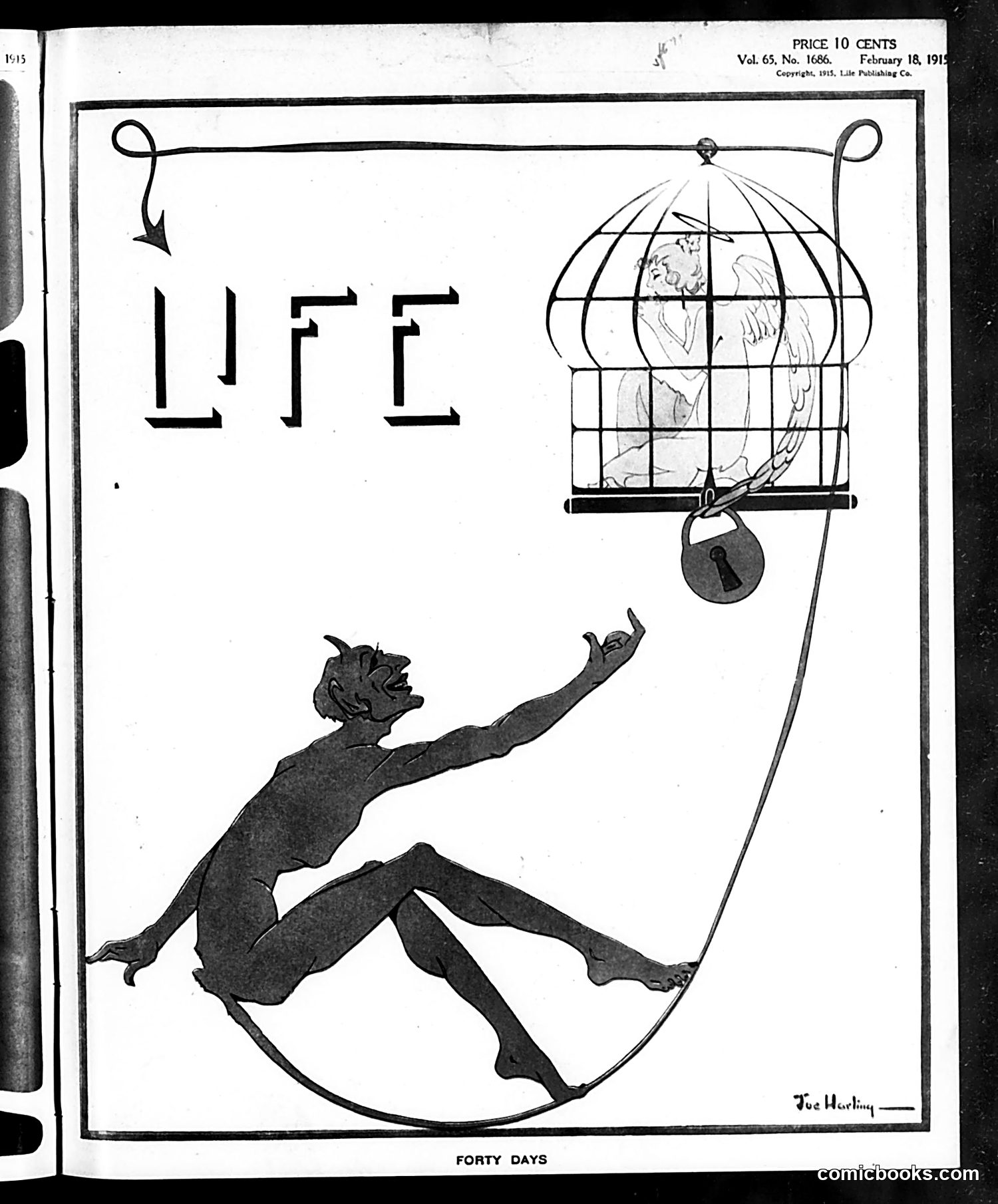
This cover satirizes the concept of "Lent," the 40-day Christian period of sacrifice preceding Easter. The silhouetted figure appears to be a cupid or cherub trapped in a birdcage, reaching upward desperately while a nude male figure sits below in a swing-like pose, also reaching toward the caged figure. The title "LIFE" and caption "FORTY DAYS" reference Lenten self-denial and fasting. The satire likely mocks the difficulty of maintaining restraint or abstinence—the figure's struggle to reach what he cannot have suggests the common failure to maintain Lenten vows. The artist signature reads "Joe Herling" (or similar). This represents typical early-20th-century satirical commentary on religious observance and human weakness.
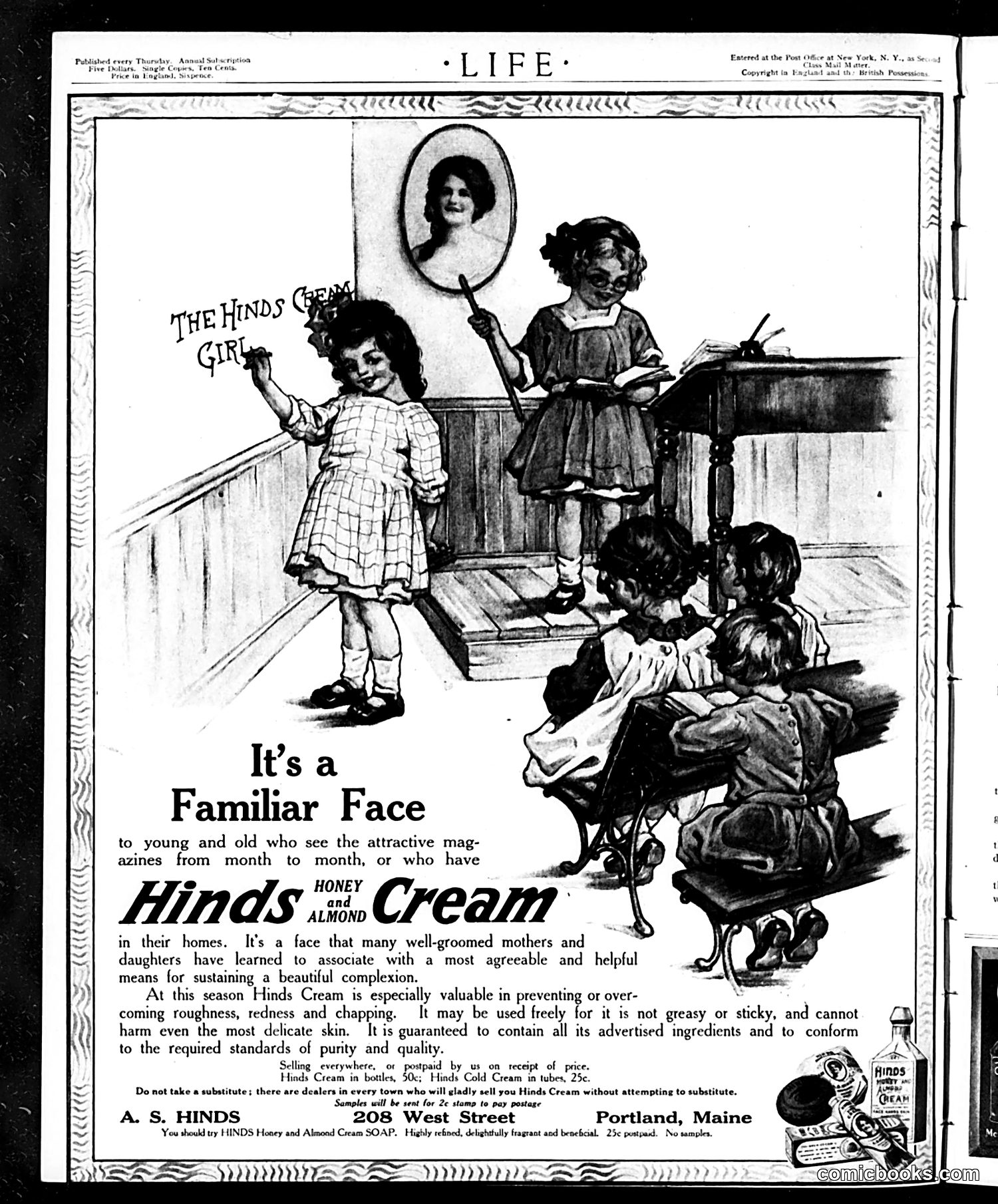
This is primarily a **product advertisement**, not political satire. It promotes Hinds Honey and Almond Cream, a skincare product manufactured by A.S. Hinds of Portland, Maine. The illustration depicts children in a performance or recitation scene—one girl stands prominently holding a mirror (labeled "The Hinds Girl"), while others sit as an audience. The advertisement's headline states it's "a Familiar Face to young and old," suggesting the product's widespread recognition. The ad emphasizes the cream's benefits for complexion care, claiming it prevents roughness, redness, and chapping while remaining non-greasy. The message targets "well-groomed mothers and daughters," positioning skincare as essential for maintaining beauty. This represents typical early 20th-century beauty advertising, though the racial/ethnic caricaturing in the illustration reflects problematic period conventions.
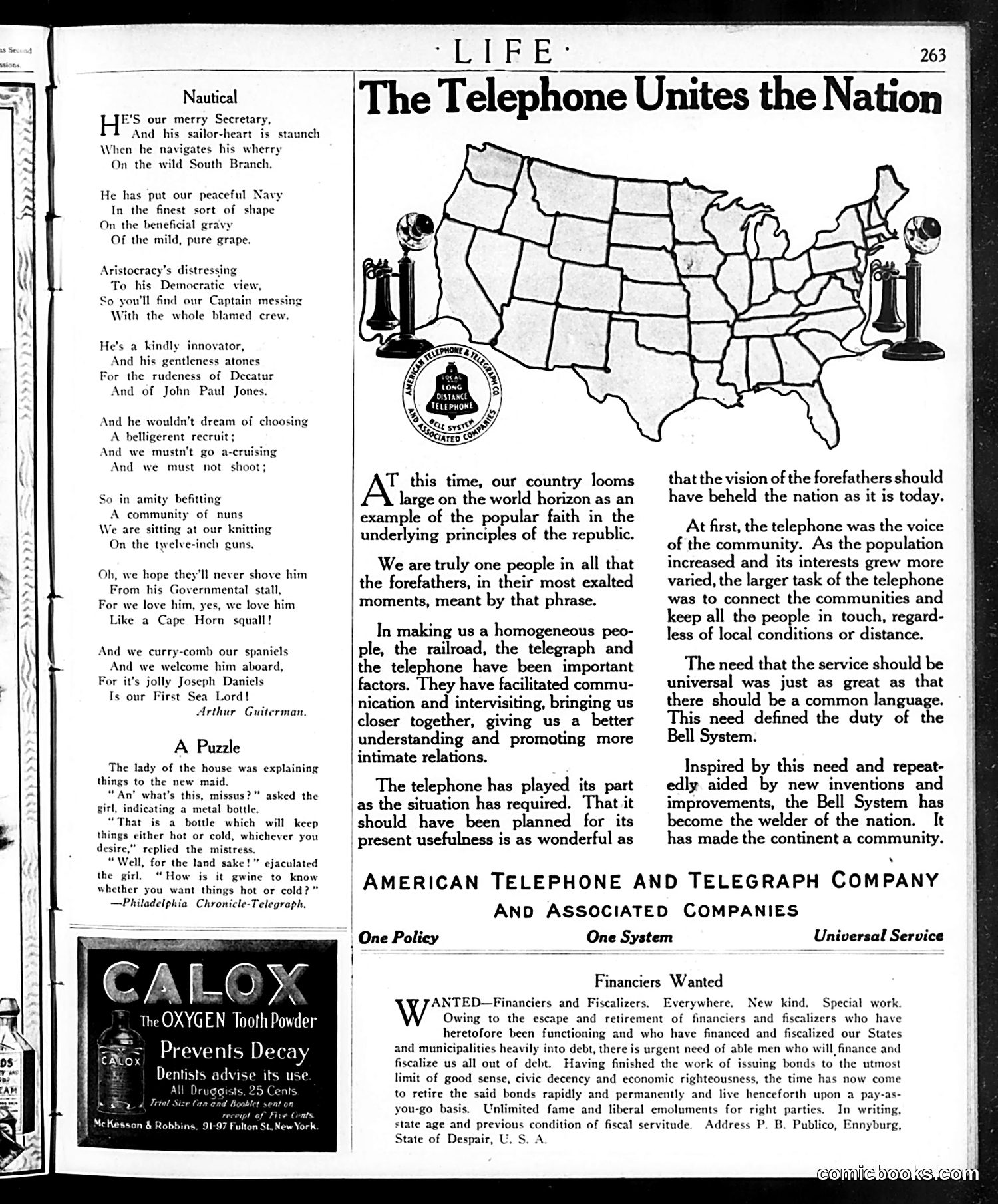
This page contains **primarily advertising and corporate messaging** rather than political satire. The main feature is a full-page advertisement from American Telephone and Telegraph Company promoting the telephone as a unifying national technology. The accompanying illustration shows a map of the United States flanked by two telephone operators, emphasizing nationwide connectivity. The left column contains light humor pieces: a nautical poem about a Navy secretary and a brief joke about a woman asking a girl how to determine if bathwater is hot or cold. Below is a Calox tooth powder advertisement. At the bottom is a job posting seeking "Financiers and Fiscalizers." The telephone ad's rhetoric celebrates technological progress binding the nation together—a common early-20th-century corporate messaging theme—but this is advertising copy rather than satirical commentary.
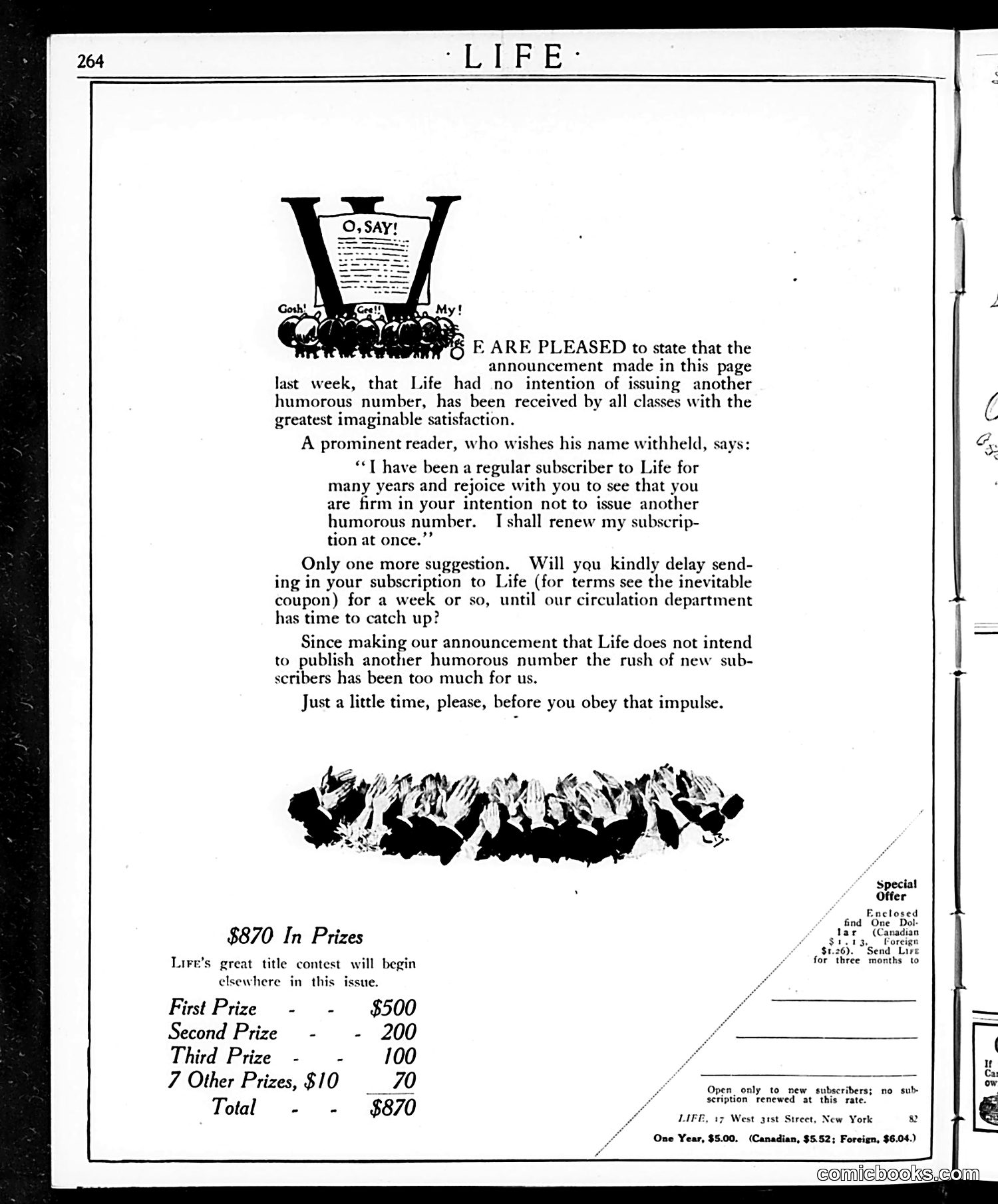
This page announces Life magazine's retraction of a previous promise not to publish humorous issues. The editors humorously acknowledge they've been overwhelmed by subscriber enthusiasm following their announcement—so many new subscriptions arrived that their circulation department couldn't keep up. The top cartoon shows a megaphone labeled "O, SAY!" with voices shouting "Gosh!" and "My!" expressing excitement about the retraction announcement. The lower decorative illustration appears to be a crowd of enthusiastic figures cheering. The page also promotes a title contest with $870 in prizes (first prize $500), asking readers to delay renewals briefly while the department catches up with the subscription surge. This is essentially a self-congratulatory, tongue-in-cheek editorial addressing operational chaos caused by unexpected popularity.
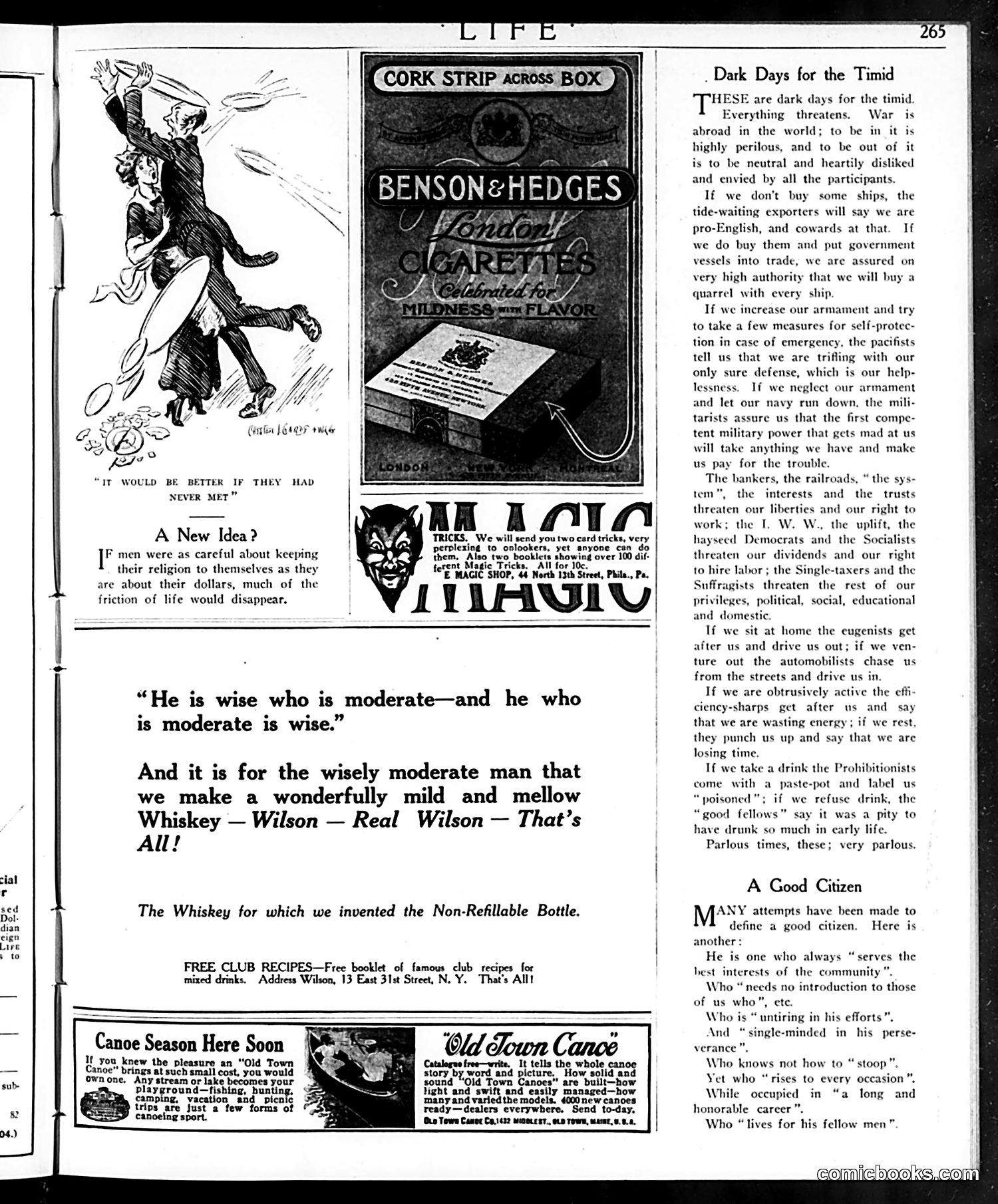
The cartoon "It Would Be Better if They Had Never Met" depicts two figures in a chaotic embrace, likely representing competing political or social forces in collision. The style suggests early 20th-century satirical commentary on conflict. The main editorial, "Dark Days for the Timid," expresses anxiety about World War I and its domestic consequences. It criticizes pacifists, neutrality advocates, and various reform movements (Prohibitionists, suffragists, eugenics advocates) as threats to national stability during wartime. The author fears both militarism and civilian agitation undermine the war effort and social order. The piece reflects wartime anxieties about dissent and social fragmentation, viewing multiple reform movements as distractions from unified national purpose during crisis.
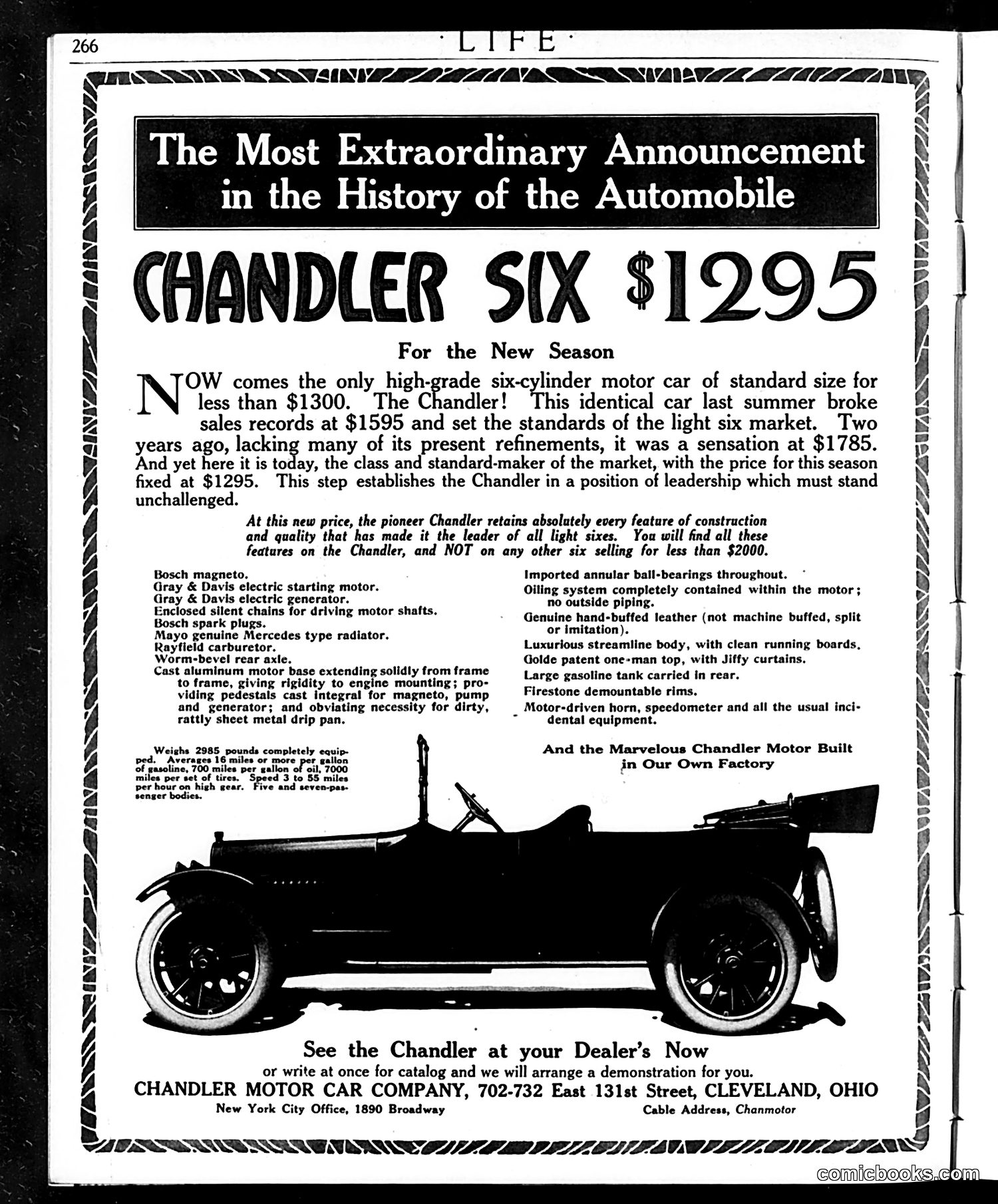
This is not a political cartoon or satire—it's a straightforward automobile advertisement. The page contains a full-page ad for the **Chandler Six automobile**, priced at $1,295 for the new season. The ad emphasizes that this six-cylinder car costs less than $1,300, positioning it as an affordable luxury vehicle. It references the car's previous price ($1,595) and claims market leadership in the "light six" category. The ad highlights engineering features like Bosch magneto, enclosed silent shafts, and leather upholstery. The silhouette illustration shows an open-air roadster typical of 1920s automobiles. The company was based in Cleveland, Ohio. This represents standard commercial advertising from *Life* magazine's era, not political or social satire.
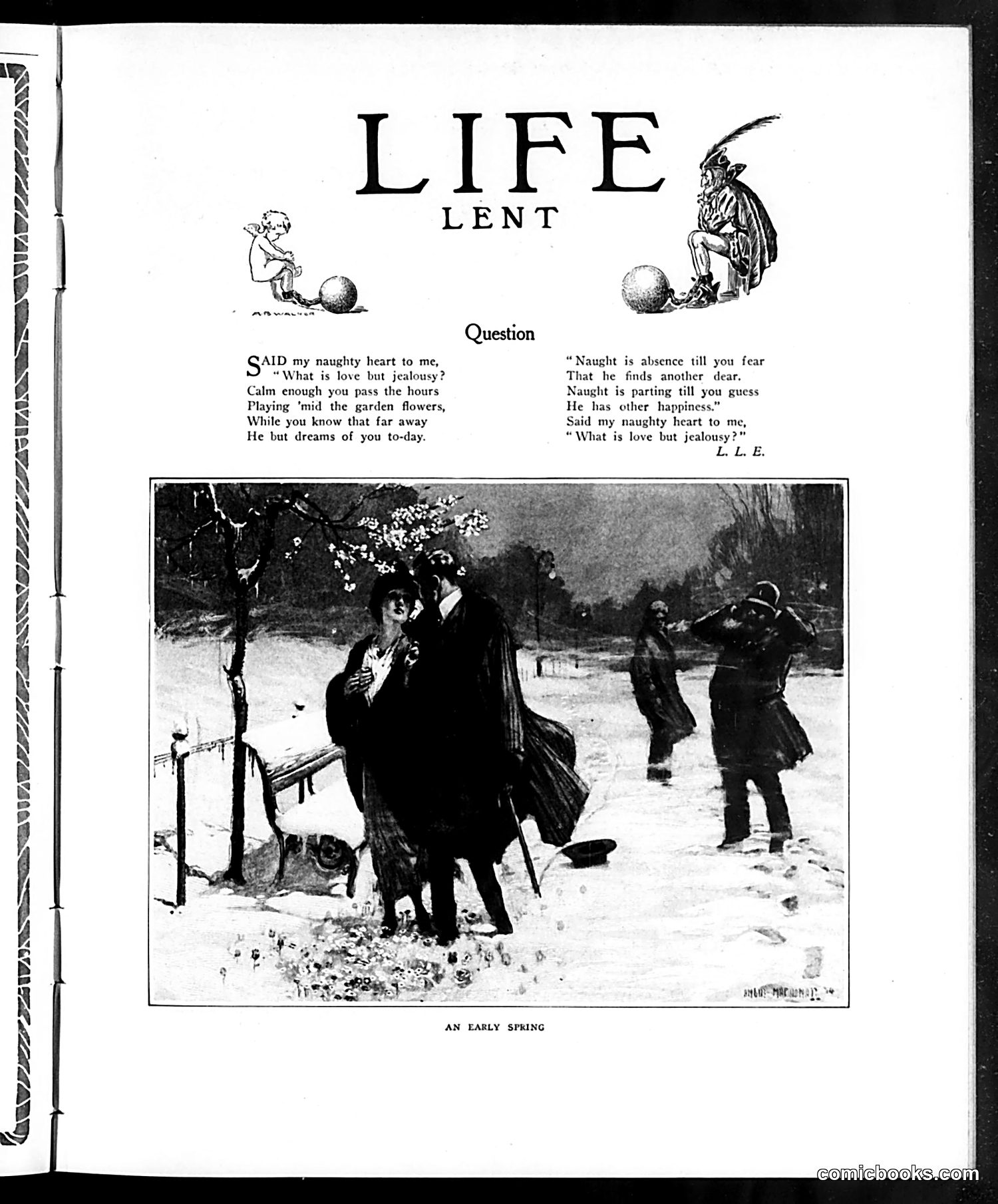
This page from *Life* magazine presents a poem titled "Question" attributed to L.L.E., accompanied by illustrations and a photograph captioned "An Early Spring." The poem's speaker asks their "naughty heart" whether love is jealousy, while away from someone dear. The response suggests that absence strengthens love by allowing the beloved to find "other happiness" without feeling guilty. The decorative header shows cherubs with spheres (likely representing earth or fate), evoking classical allegorical imagery common to Lenten meditations on love and sacrifice. The photograph shows people outdoors in early spring conditions—fitting the theme of renewal and separation. The page combines sentimental Victorian-era poetry with visual symbolism typical of *Life*'s blend of humor, philosophy, and social commentary on relationships and emotional life.
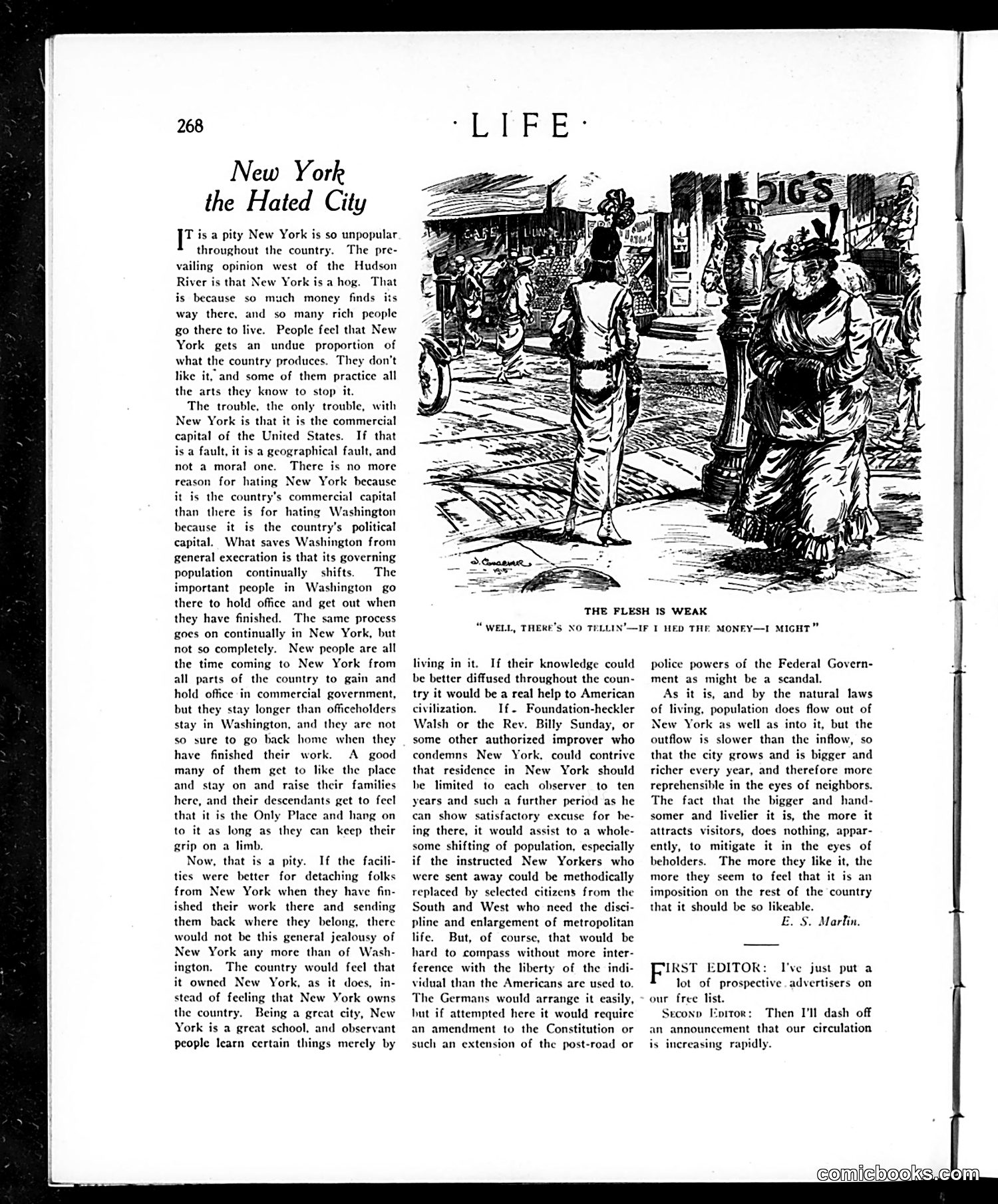
This satirical piece critiques New York's unpopular reputation nationwide. The accompanying sketch, titled "The Flesh Is Weak" with the caption "Well, there's no tellin'—if I had the money, I might," depicts a street scene where figures appear to be soliciting or engaging in vice—likely referencing prostitution or urban moral decay. The text argues New York's unpopularity stems from it being the commercial capital rather than moral failings, and that dispersing New York's population (like Washington's rotating government officials) would benefit the country. The cartoon illustrates the very urban vices that fuel anti-New York sentiment: poverty, vice, and moral corruption visibly present on city streets—the stereotypical "hated city" behavior that provincial Americans feared and resented.
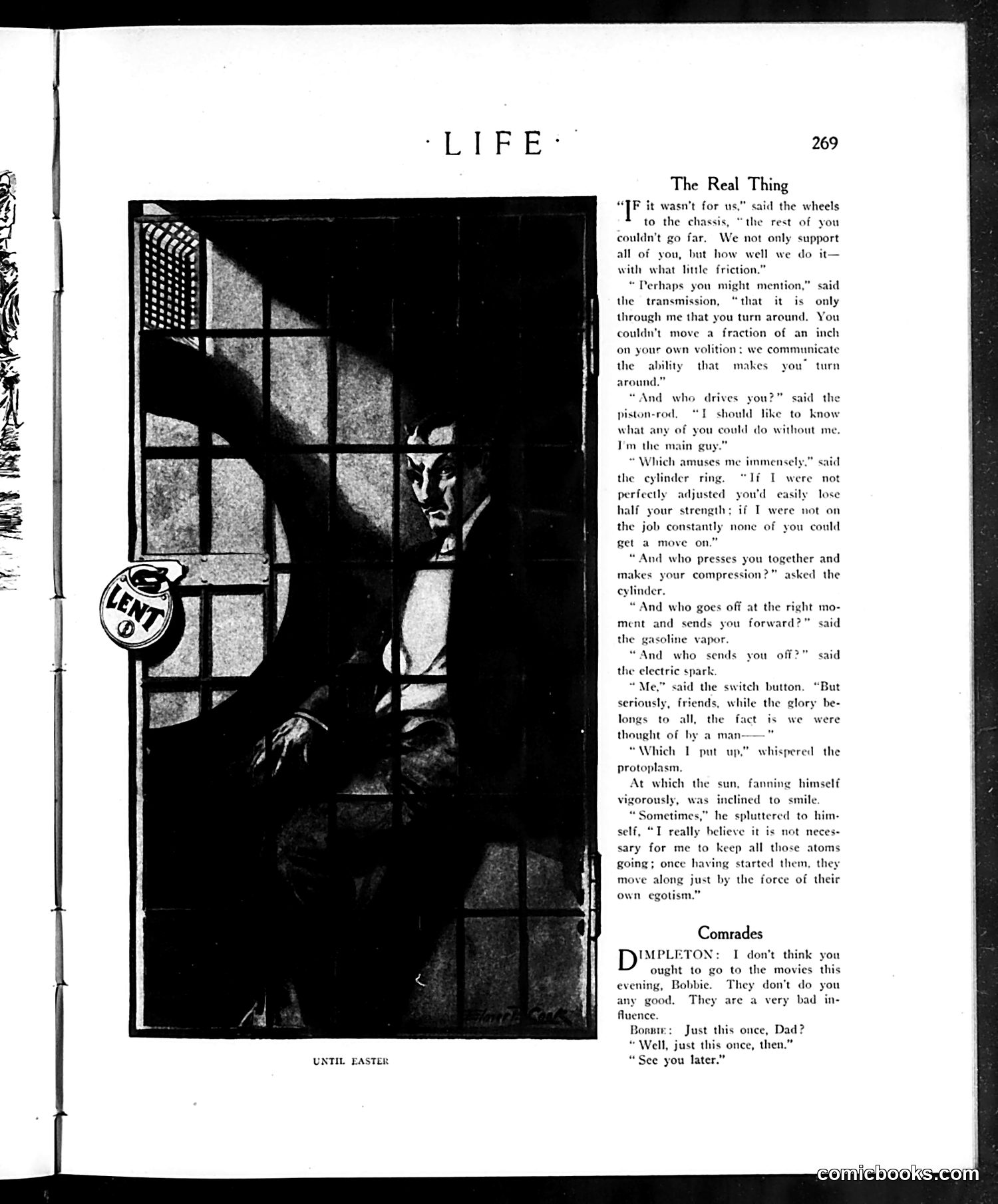
This page contains two distinct pieces. "The Real Thing" is an anthropomorphic fable where car parts (wheels, transmission, piston-rod, cylinder ring, gasoline vapor, electric spark, and protoplasm/sun) debate their relative importance to the vehicle's function. Each claims credit for making the car work, until the sun—representing some ultimate force—notes that a *man* designed the whole system, humorously deflating their collective ego. "Comrades" is a brief dialogue where Dimpleton advises his son Bonnie against attending movies, calling them "a very bad influence." Bonnie negotiates for "just this once," securing permission. The illustration shows a figure peering through a window grid, likely accompanying one of these stories, though its specific connection is unclear from context alone.
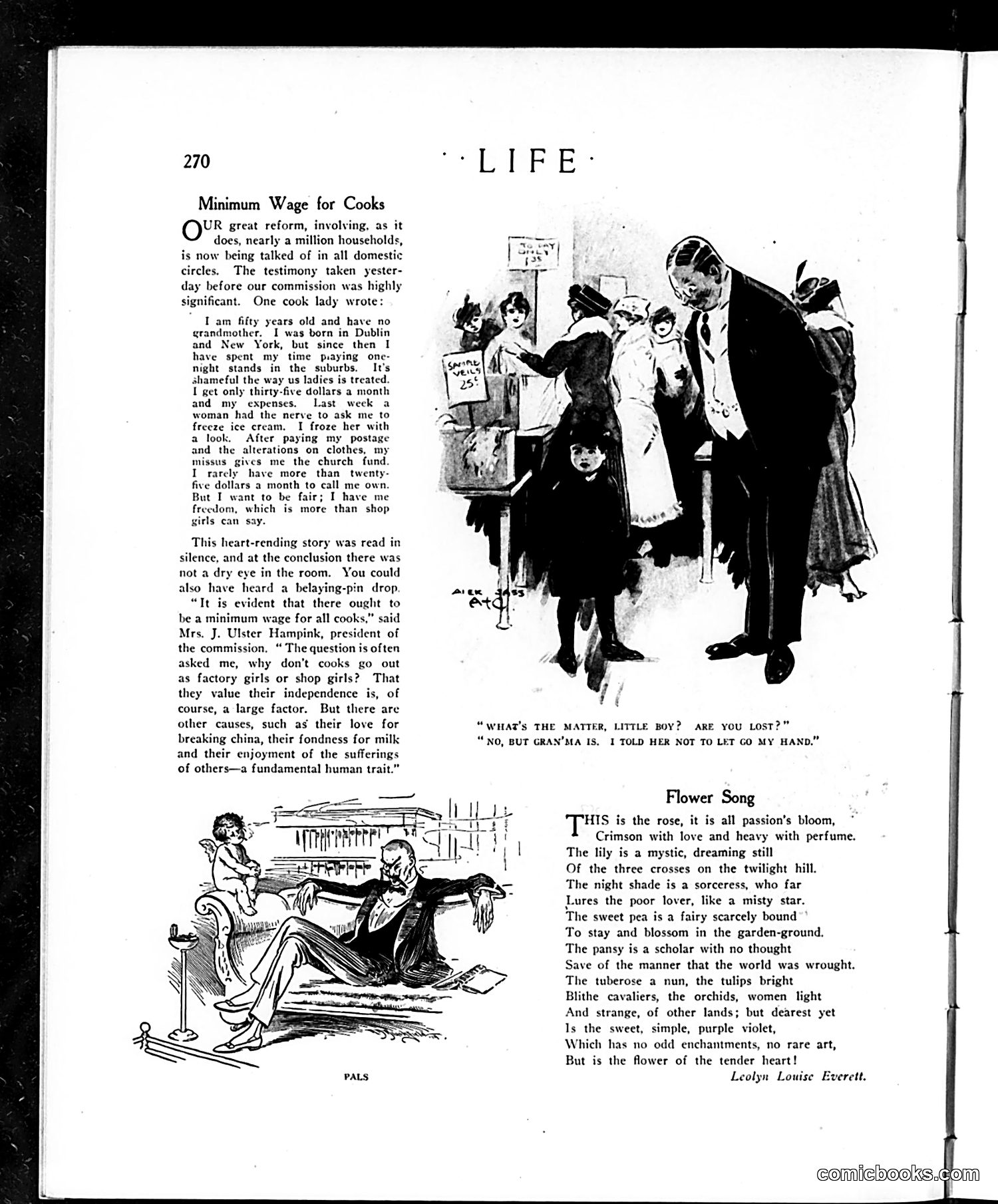
**Main Article & Cartoon:** This section presents testimony from a 50-year-old cook describing exploitative working conditions—earning only $35/month with additional unpaid domestic duties (laundry, church work). The accompanying illustration shows a woman cook with children gathered around her, apparently discussing wages or employment. The article advocates for minimum wage legislation for domestic workers, with Mrs. J. Ulster Hampkin (commission president) arguing that cooks deserve better pay and independence comparable to factory workers. The satire critiques society's undervaluation of domestic labor and the physical/emotional toll on working women. **"Flower Song" Poem:** Below is an unrelated romantic poem by Leolyn Louise Everett celebrating various flowers. The "PALS" sketch at bottom left appears to be a separate humorous illustration.
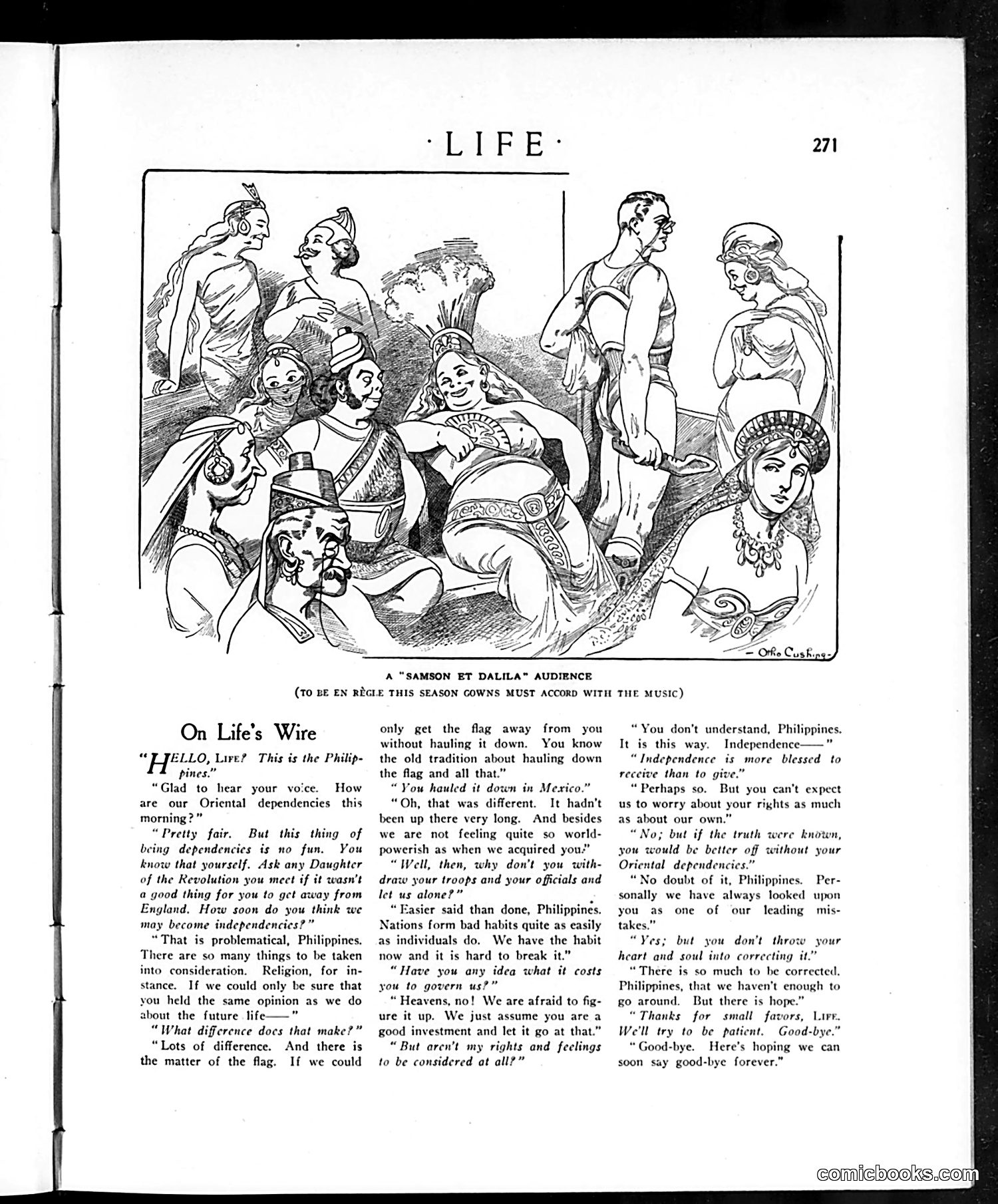
The illustration titled "A 'Samson et Dalila' Audience" depicts an ornate theatrical gathering, with the caption noting that "gowns must accord with the music" — a satirical comment on opera-goers' pretentiousness. The accompanying dialogue "On Life's Wire" features a conversation between "Life" and "Philippines," personified as characters debating Philippine independence. The Philippine character argues for self-governance, while Life counsels caution, warning that independence brings responsibility. Life suggests the Philippines should remain dependent on American oversight. This reflects early 20th-century American imperialist attitudes, where the U.S. justified colonial control of the Philippines as protective guardianship rather than acknowledging independence movements. The satire critiques both American paternalism and the earnest independence advocates.
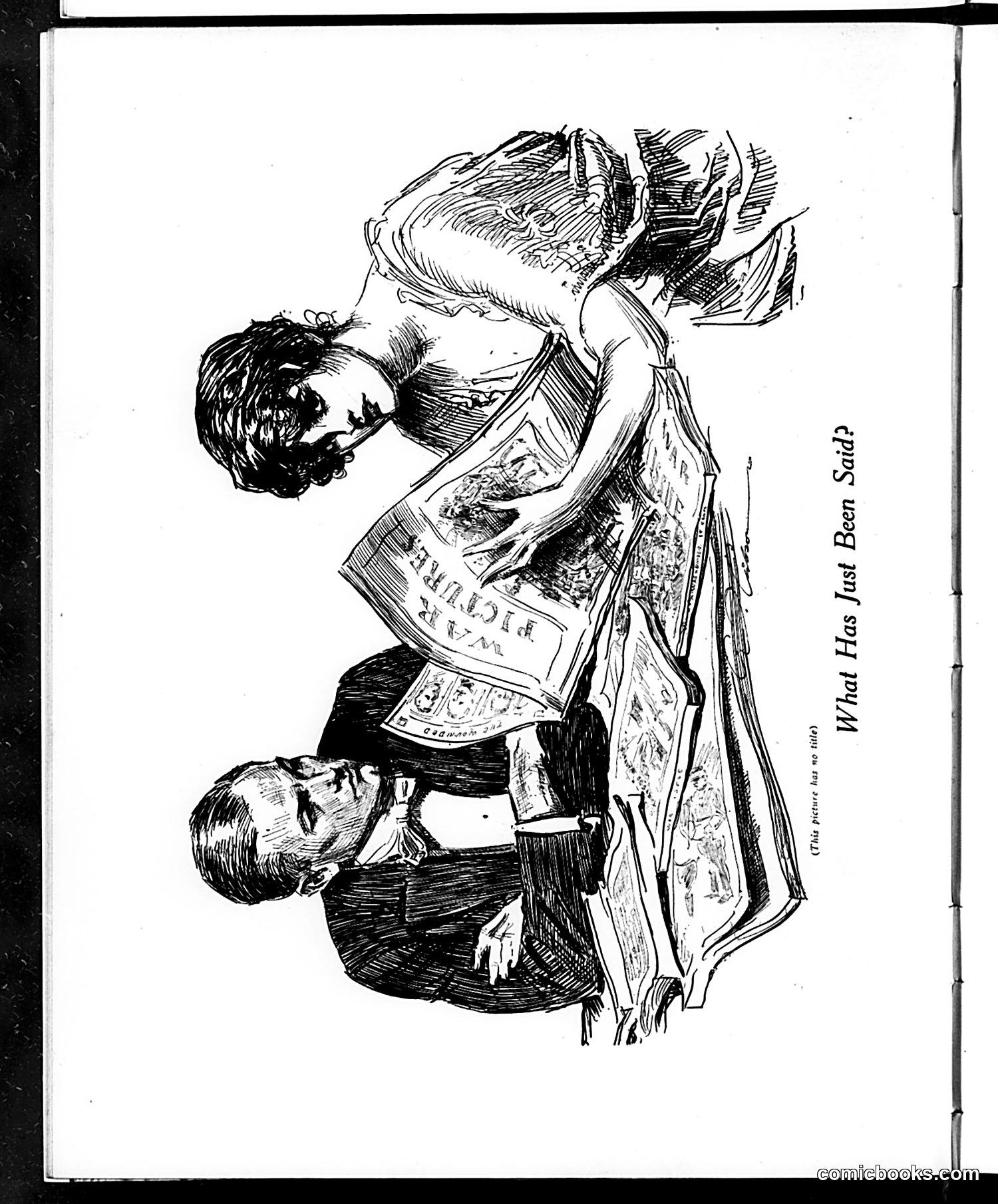
This is a political cartoon titled "Wild Has Just Been Said" (or similar). The image shows two figures in what appears to be a satirical scene: one person reading or holding what looks like a newspaper or publication, while another figure (drawn with exaggerated features) gestures dramatically above them. The cartoon appears to be satirizing contemporary political discourse or a specific recent statement that has caused controversy. The dramatic pose and the emphasis on something "having been said" suggests the cartoon mocks either an inflammatory political statement, a scandalous claim, or absurd rhetoric that has just been made public. Without clearer context about the specific date and figures depicted, I cannot identify the exact political figures or events referenced. The style and technique suggest this is from an early-to-mid 20th century issue of Life magazine.
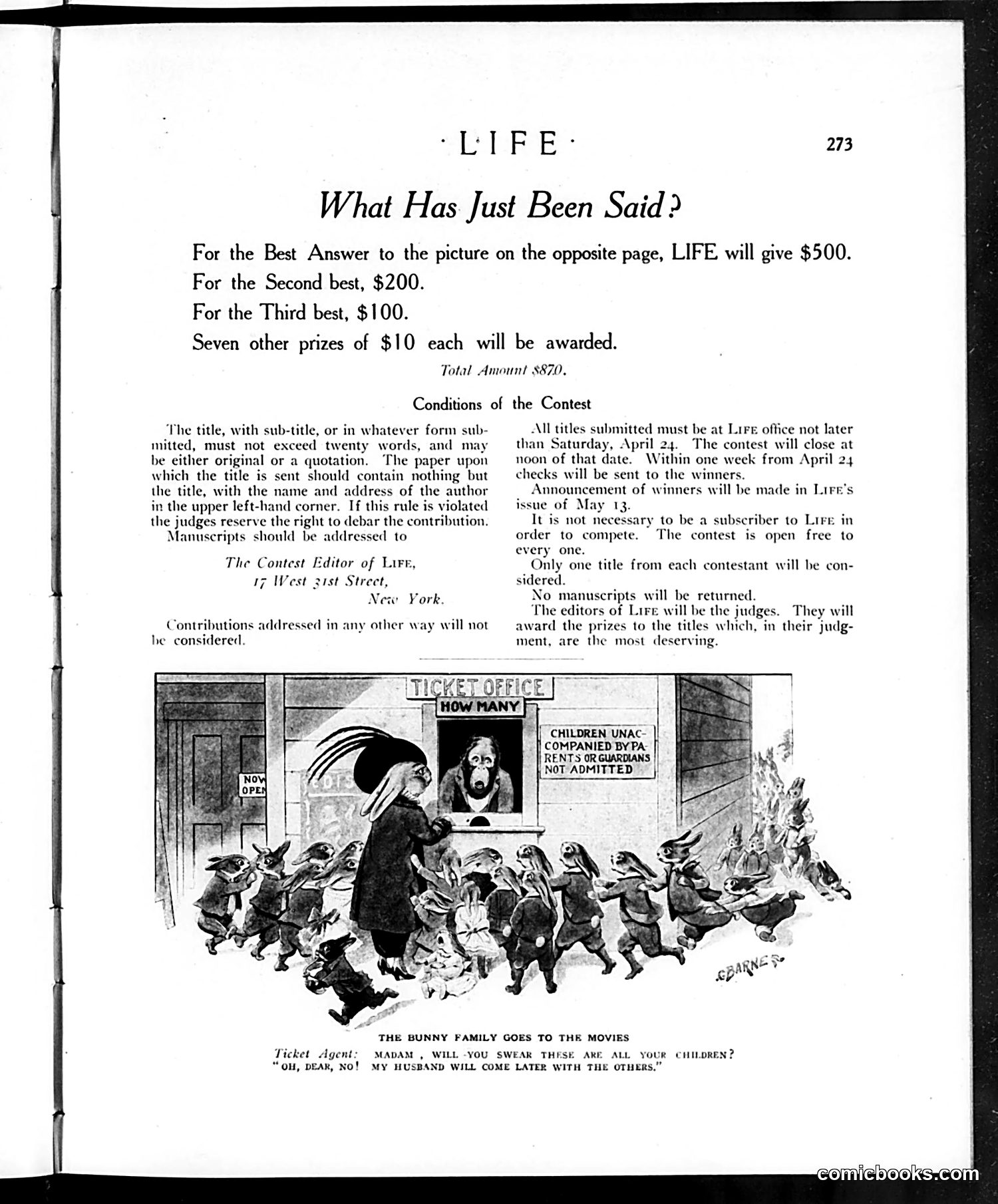
This page contains a contest announcement and one cartoon. The cartoon, titled "The Bunny Family Goes to the Movies," satirizes cinema attendance policies of the era. It depicts a mother rabbit with numerous children approaching a movie theater ticket office. The ticket agent displays a sign reading "Children Unaccompanied by Parent or Guardians Not Admitted." The mother rabbit's response—"Oh, dear, no! My husband will come later with the others"—suggests she's attempting to circumvent the rule by claiming some children will arrive with the father later, implying they're all her children regardless of who accompanies them. The satire targets both theater admission restrictions for children and parents' creative attempts to work around such rules during the early cinema era, when theaters imposed rules to manage child behavior and safety.
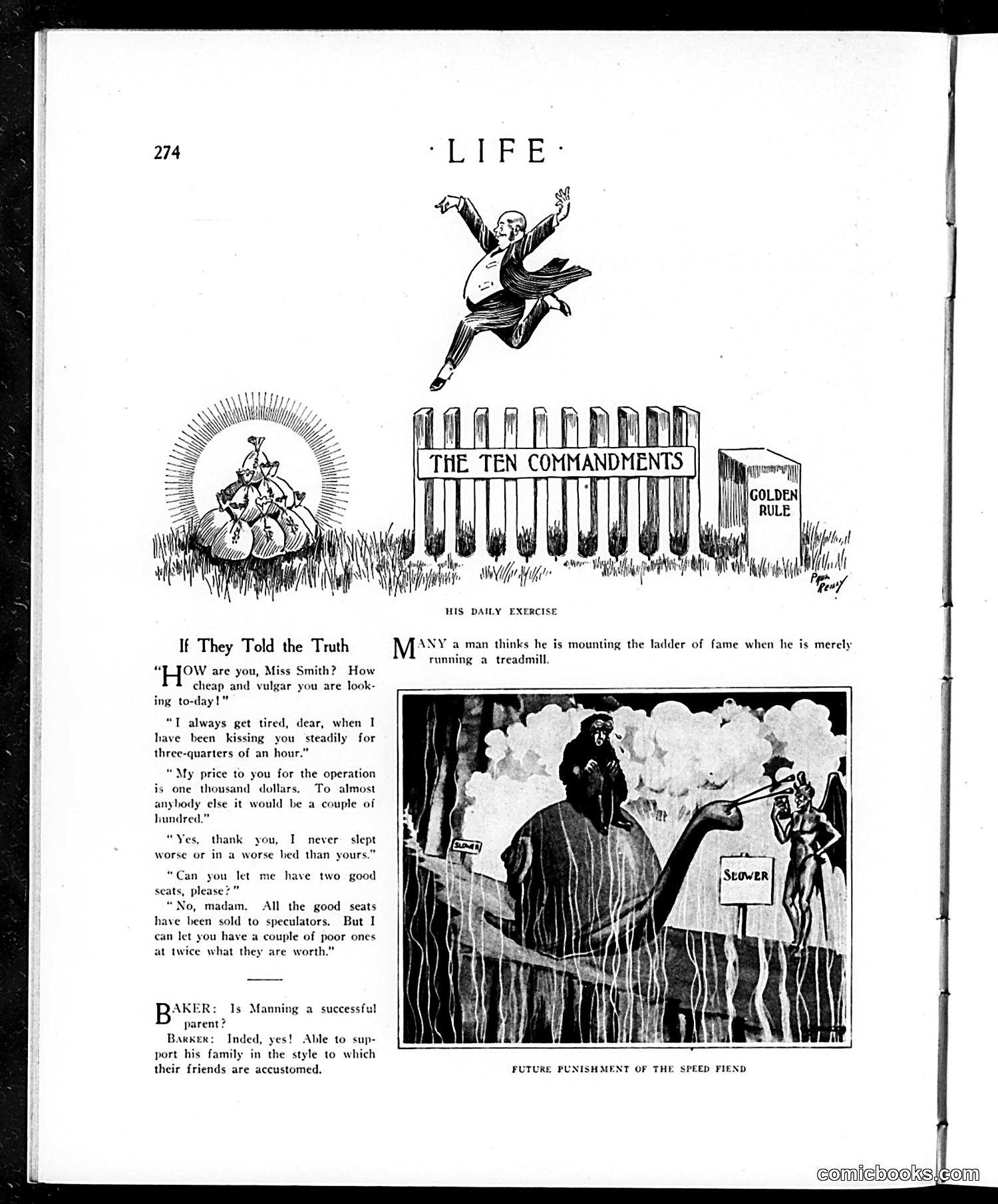
This page contains satirical commentary on materialism and social climbing in early 20th-century America. The top illustration depicts a man jumping over "The Ten Commandments" toward a "Golden Rule" sign—suggesting people abandon religious ethics for personal gain. "If They Told the Truth" presents a cynical dialogue between a man and "Miss Smith," exposing transactional attitudes in courtship: he mentions his expensive "operation" (likely cosmetic/medical), she values his wealth, and he sells theater seats at inflated prices. The "Baker" dialogue below mocks successful parents who support their families lavishly through questionable means. The bottom cartoon, "Future Punishment of the Speed Fiend," shows a hellish scene with a "Sewer" sign, punishing reckless drivers—reflecting contemporary anxieties about automobiles and dangerous driving. Overall, the page satirizes greed, hypocrisy, and modern vice.
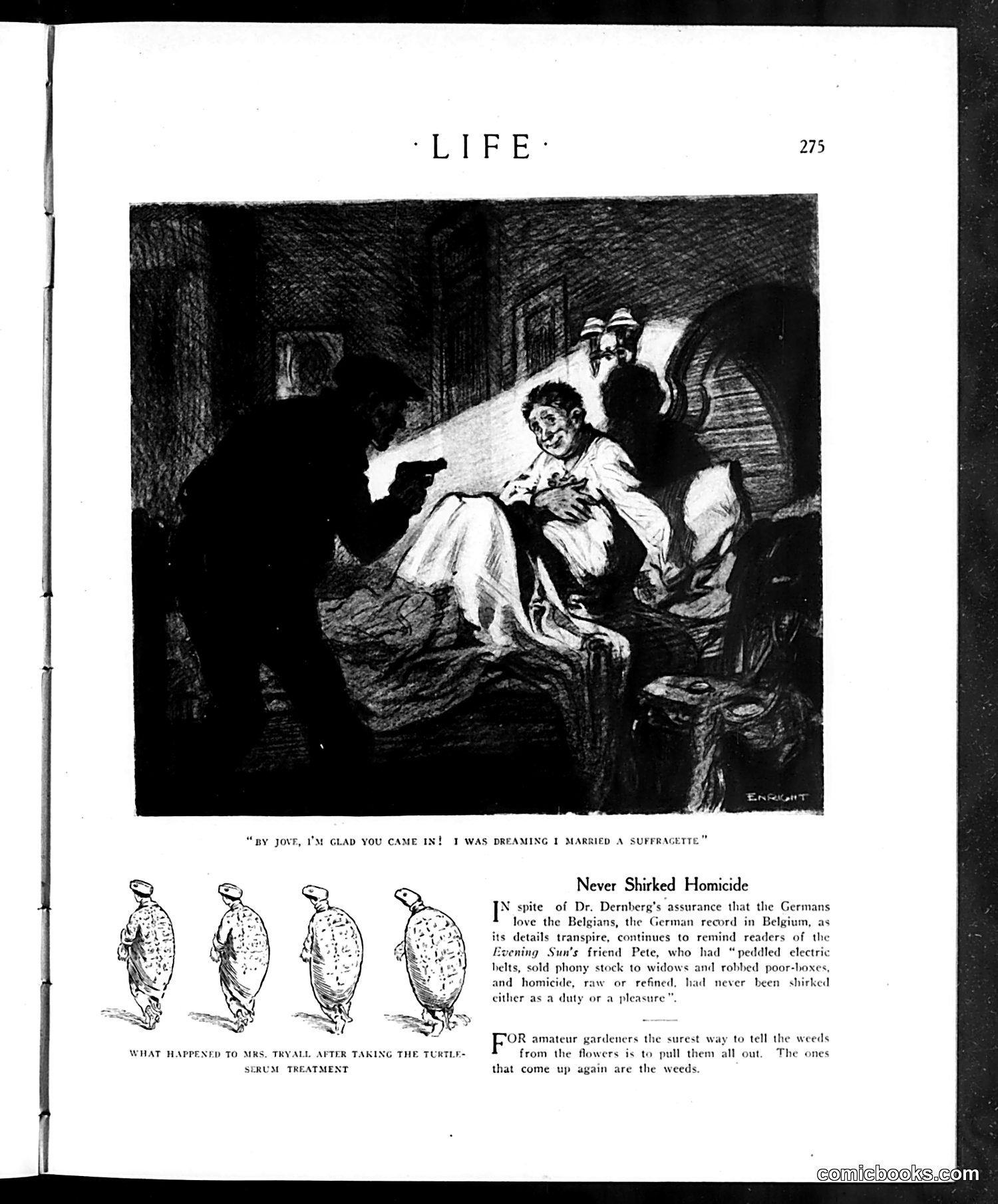
This page contains multiple satirical pieces targeting different subjects: **Top cartoon**: A man dreams of marrying a suffragette—presented as a nightmare. The humor relies on anti-suffrage sentiment, portraying women's voting rights advocates as threatening or undesirable partners. This reflects early 20th-century opposition to women's suffrage. **"Never Shirked Homicide"**: References Dr. Dernberg (likely a German official) claiming Germans love Belgians, while sarcastically noting Germany's brutal record in Belgium. The piece compares German conduct to a character named Pete who committed various crimes "without shirking" homicide—biting criticism of German military violence during WWI. **Bottom section**: "What Happened to Mrs. Tryall After Taking the Turtle-Serum Treatment" appears to be a quack-medicine satire, mocking dubious health products. The gardening advice is straightforward practical humor. The page reflects Life's era as a satirical publication addressing suffrage opposition, WWI politics, and medical fraud.
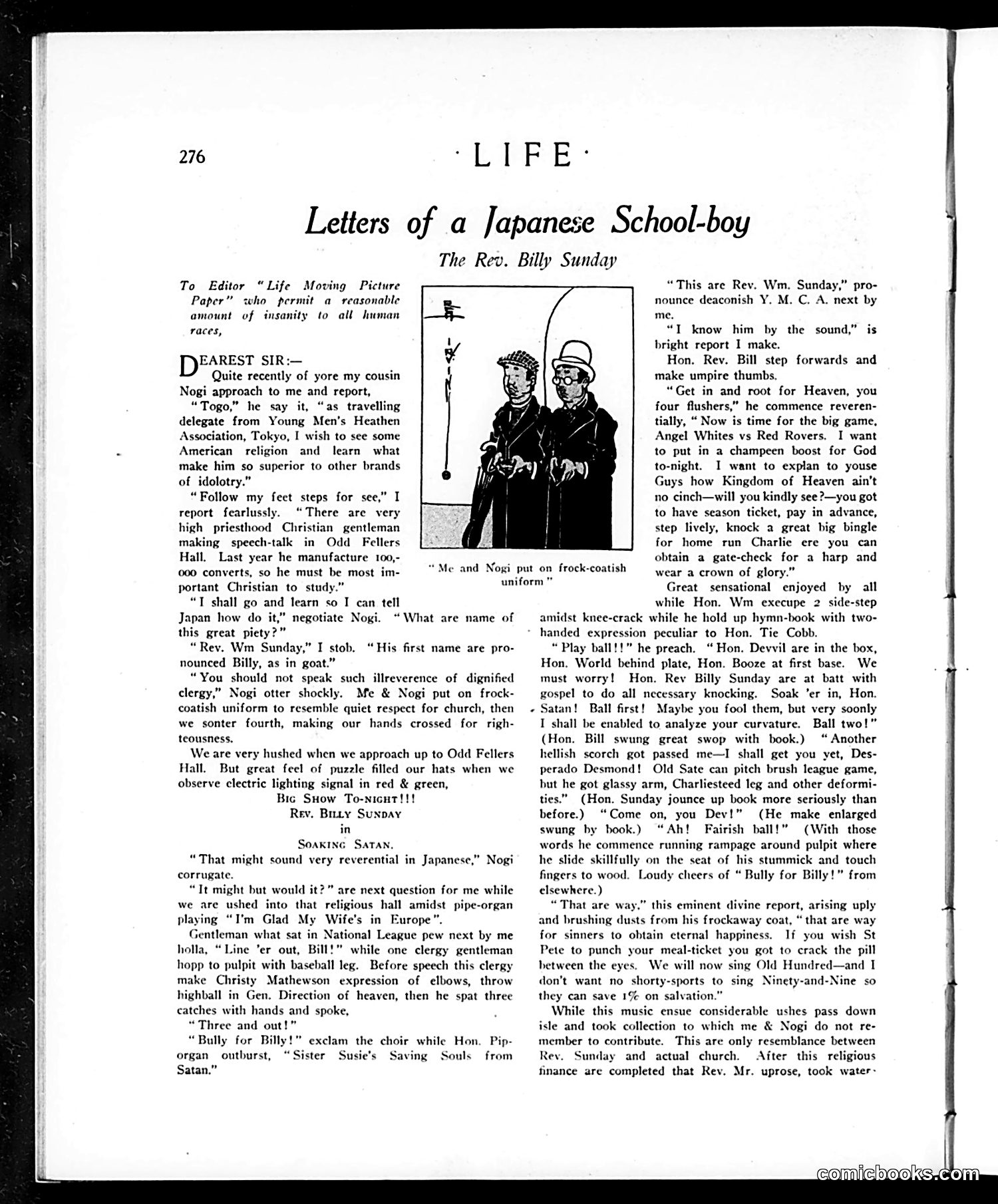
This satirical piece mocks **Reverend Billy Sunday**, a famous American evangelist known for energetic, unorthodox preaching. The satire is narrated by a Japanese observer visiting America through letters, using broken English for comic effect. The cartoon shows two figures in formal dress observing the spectacle. The joke: Sunday preaches using **baseball terminology and theatrical gestures** (umpire thumbs, violent arm motions mimicking baseball star Ty Cobb), treating salvation like a sports game with "converts" as scores. He uses colloquial language ("you four flushers," "soak 'er in") and dramatic physicality incongruous with traditional religious decorum. The satire critiques Sunday's commercialization of religion—he's described as manufacturing "100,000 converts," with entry requiring tickets and payment. The "electric lighting signal in red & green" at the hall suggests carnival-like showmanship rather than spiritual reverence. By filtering this through an innocent Japanese perspective, the piece highlights how absurd and irreverent American evangelical theatricality appears to outside observers—exposing the gap between Christianity's dignified ideals and Sunday's sensationalized practice.
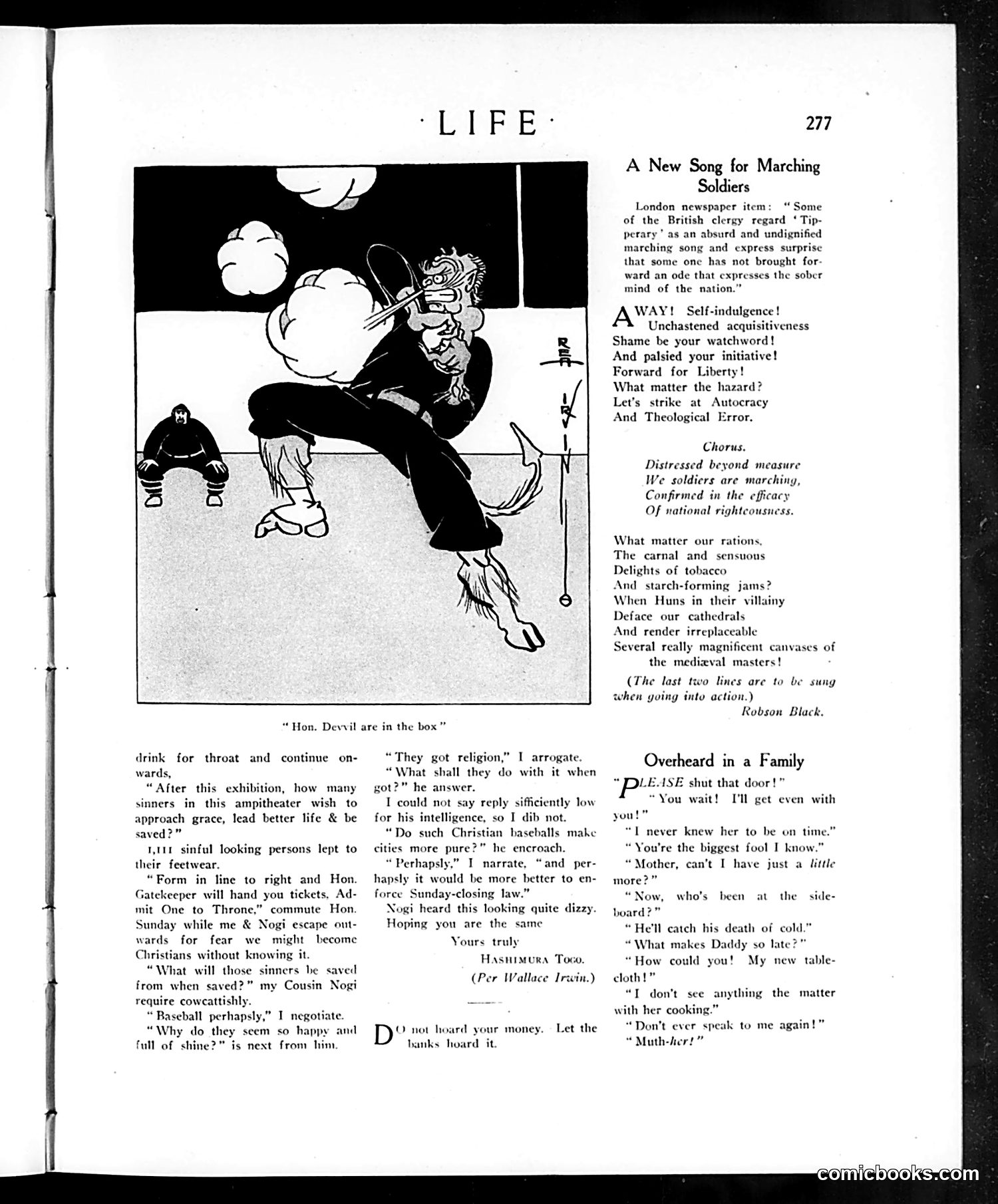
This Life magazine page contains three distinct pieces of satire: **Main Cartoon ("Hon. Devvil are in the box"):** A caricatured revival preacher (labeled "Hon.") converts 1,111 "sinful" attendees in what appears to be a boxing venue. The satire mocks both evangelical religion and boxing culture—the narrator's cousin Nogi represents a naïve questioner, asking absurdly literal questions about what converts will "do" with their religion and whether Christian "baseballs" purify cities. The humor targets superficial religious conversion and American materialism. **"A New Song for Marching Soldiers":** This is anti-war satire responding to a real British clergy complaint about "Tipperary" as an undignified war song. The mock replacement song by "Robson Black" sarcastically celebrates sacrifice while simultaneously mocking it—soldiers march for abstract ideals while ignoring physical needs, and the final couplet about defending medieval art collections from "Huns" (Germans) ridicules the grandiose justifications for World War I. **"Overheard in a Family":** A collection of domestic squabbles illustrating petty family conflict and nagging.
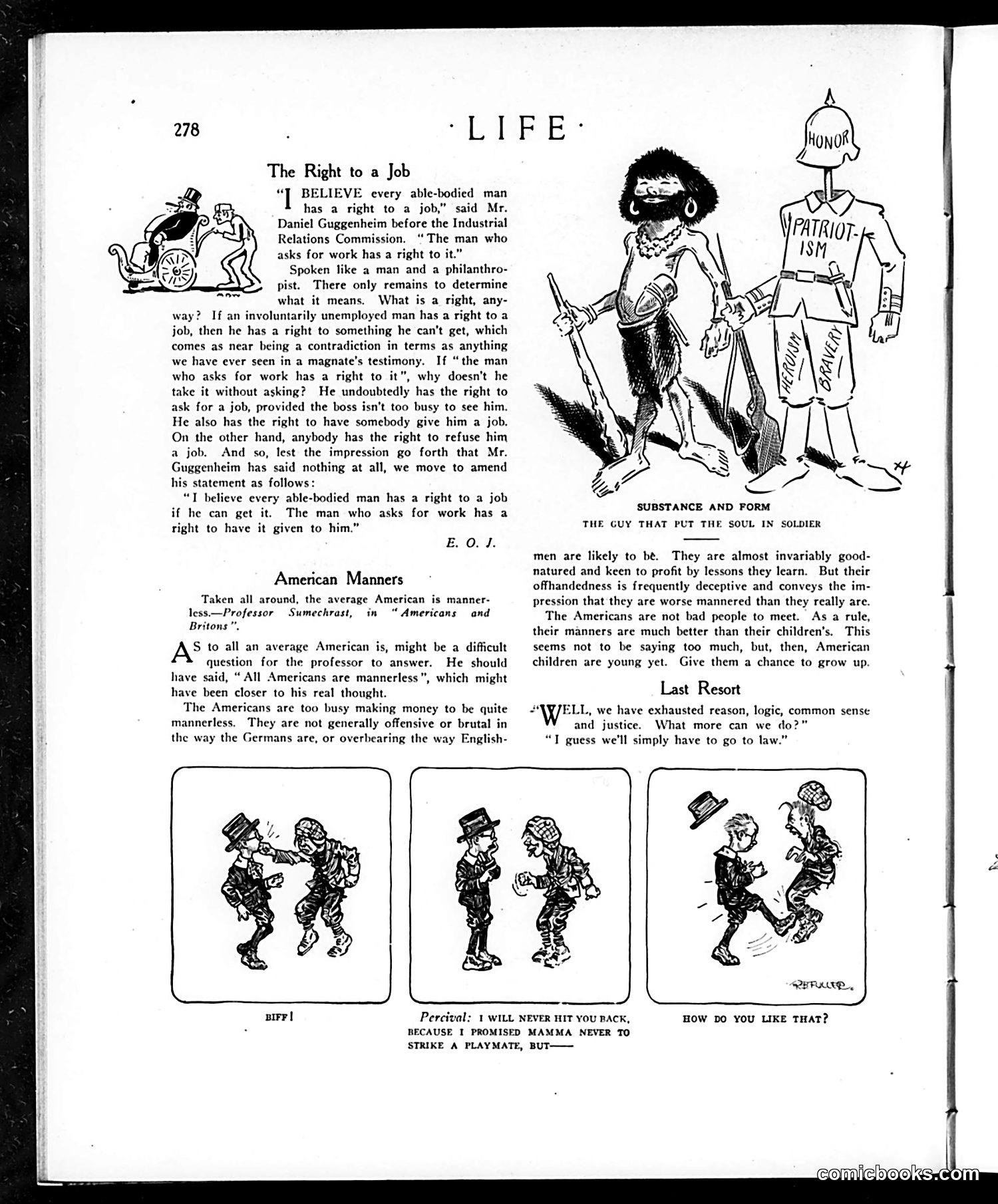
This page contains three distinct pieces of social commentary: **"The Right to a Job"** satirizes industrialist Daniel Guggenheim's testimony before the Industrial Relations Commission. Guggenheim claimed workers have a "right" to employment, but the author (E.O.J.) exposes this as meaningless—one cannot have a "right" to something one cannot obtain. The satire highlights the contradiction between philanthropic rhetoric and economic reality during labor disputes of the early 20th century. **"American Manners"** critiques Professor Sumechrast's claim that Americans lack manners. The piece argues Americans are merely *busy* and offhand rather than genuinely rude, and that their informality masks decent character. It reflects period anxieties about American social refinement versus European standards. **"Last Resort"** and the three cartoon panels below present a grim joke about conflict resolution: after exhausting reason and logic, "going to law" remains—suggesting litigation as society's ultimate recourse. The panels show physical altercations between two figures, with the final caption cynically implying legal action as the only remaining option.
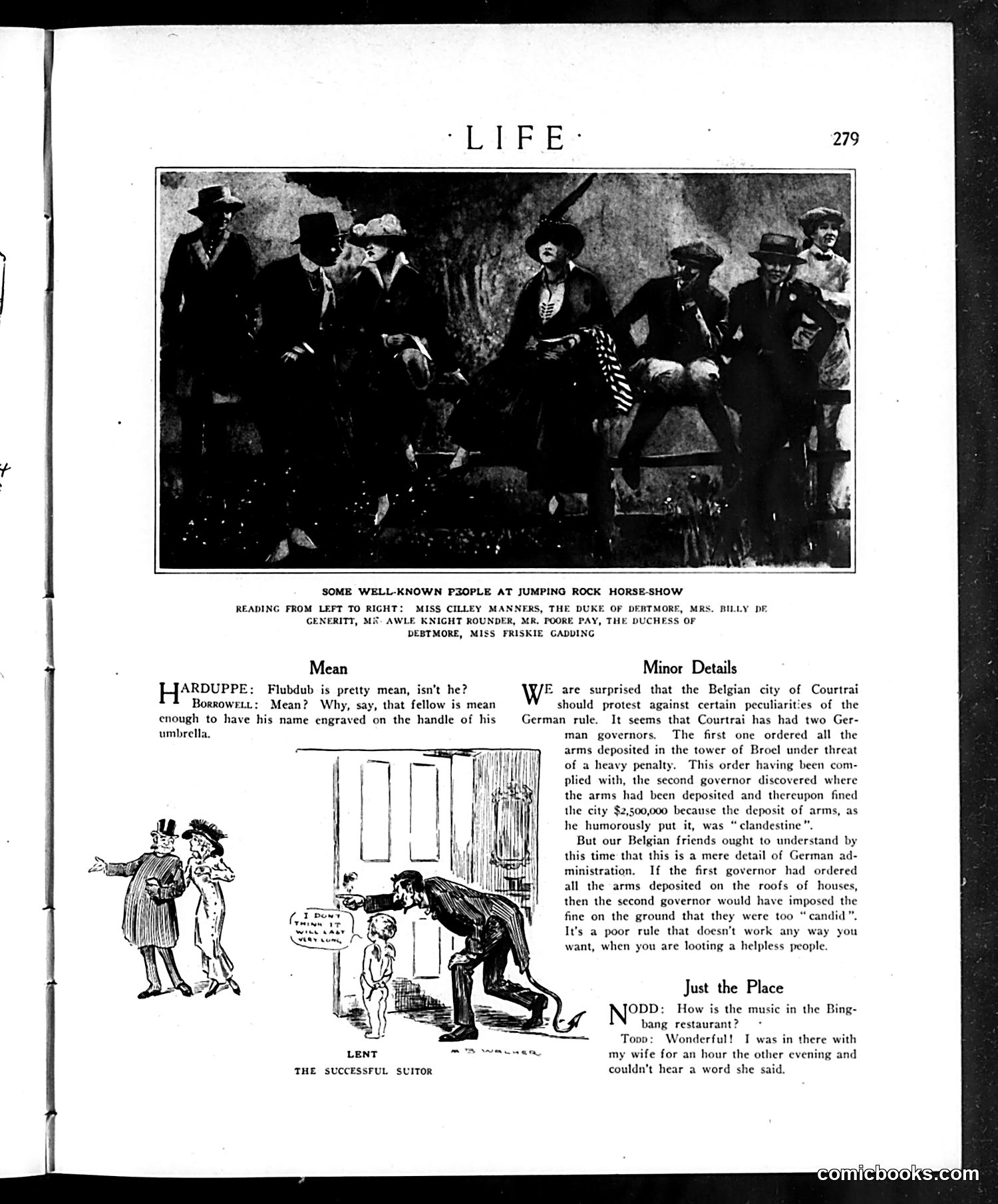
This page contains satirical humor typical of early 20th-century *Life* magazine: **Top Image:** A photo caption of socialites at a horse show, with playfully mocking names like "Mr. Poore Pay" and "The Duke of Debtmore"—puns suggesting financial irresponsibility among the wealthy elite. **"Mean" Cartoon:** Two men discuss someone's stinginess; the joke is that this person is so miserly he had his name engraved on his umbrella (presumably to prevent losing it to others). **"Minor Details":** Political satire about German occupation of Belgian Courtrai during WWI. The irony: the first German governor confiscates weapons; the second governor punishes the city for complying, imposing a massive fine ($2.5 million). The piece satirizes German administrative hypocrisy—any outcome provides an excuse to exploit occupied territories. **"Just the Place":** A domestic joke: a husband praises a noisy restaurant because the noise prevented him from hearing his wife talk. The page reflects wartime American attitudes toward Germany and period humor about marriage dynamics.
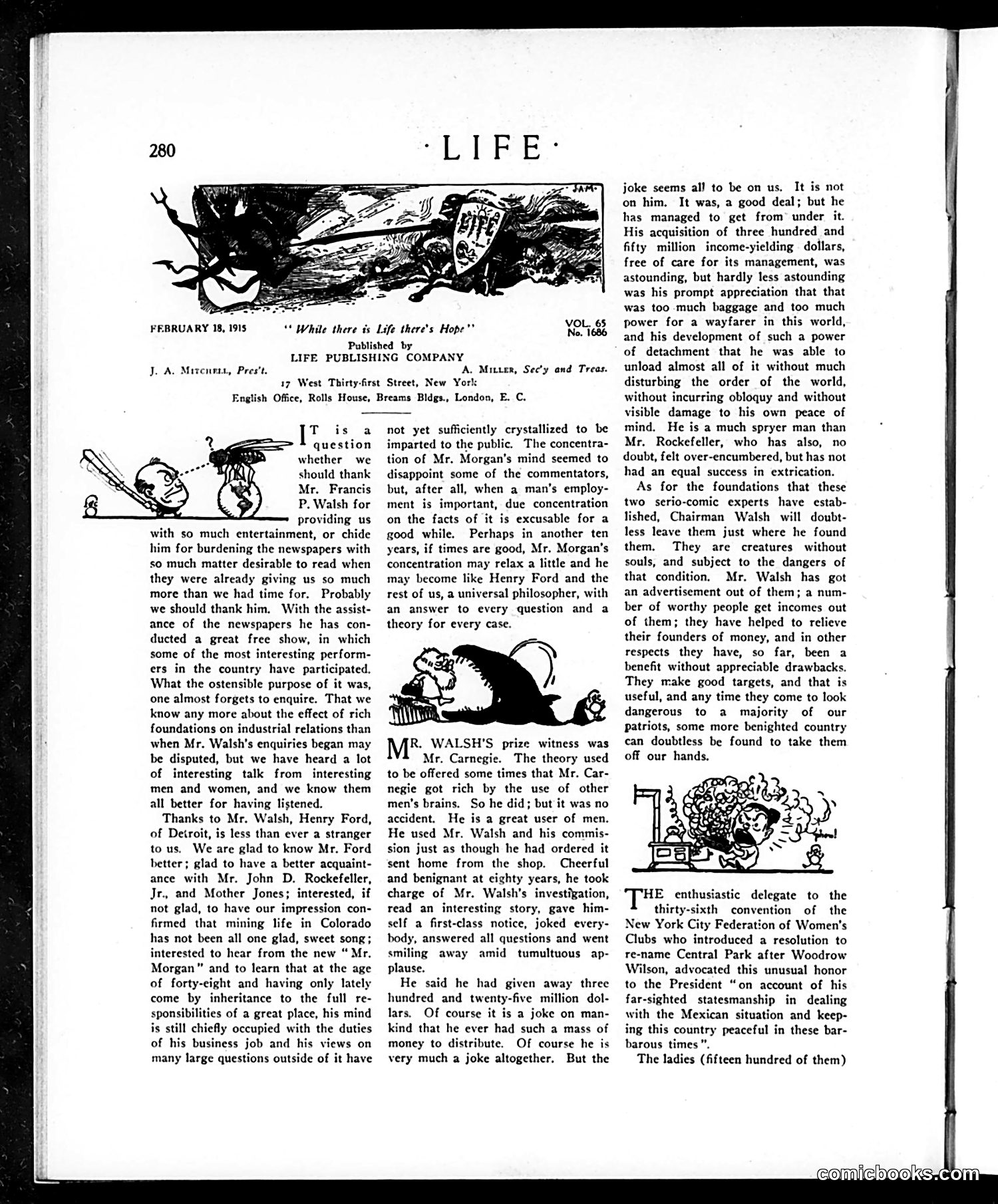
This page discusses Francis P. Walsh's investigation into the effects of wealthy philanthropic foundations on industrial relations. The satirical commentary centers on the industrialists who testified, particularly **Andrew Carnegie** (depicted in the cartoon as a rotund figure). The article's point: While Carnegie claims to have given away $325 million and presents himself as benevolent and humble, Life's editors note the true "joke" is structural—that Carnegie ever accumulated such wealth in the first place, and that he managed to divest himself of it while avoiding criticism. The satire critiques not Carnegie's charity itself, but the system allowing such vast accumulation and the self-congratulatory tone surrounding its redistribution. The piece also discusses **J.D. Rockefeller Jr.** and **Henry Ford**, comparing their levels of engagement with public questions. The overall message: these industrial titans remain primarily focused on their business operations rather than becoming "universal philosophers" with answers to society's larger problems.
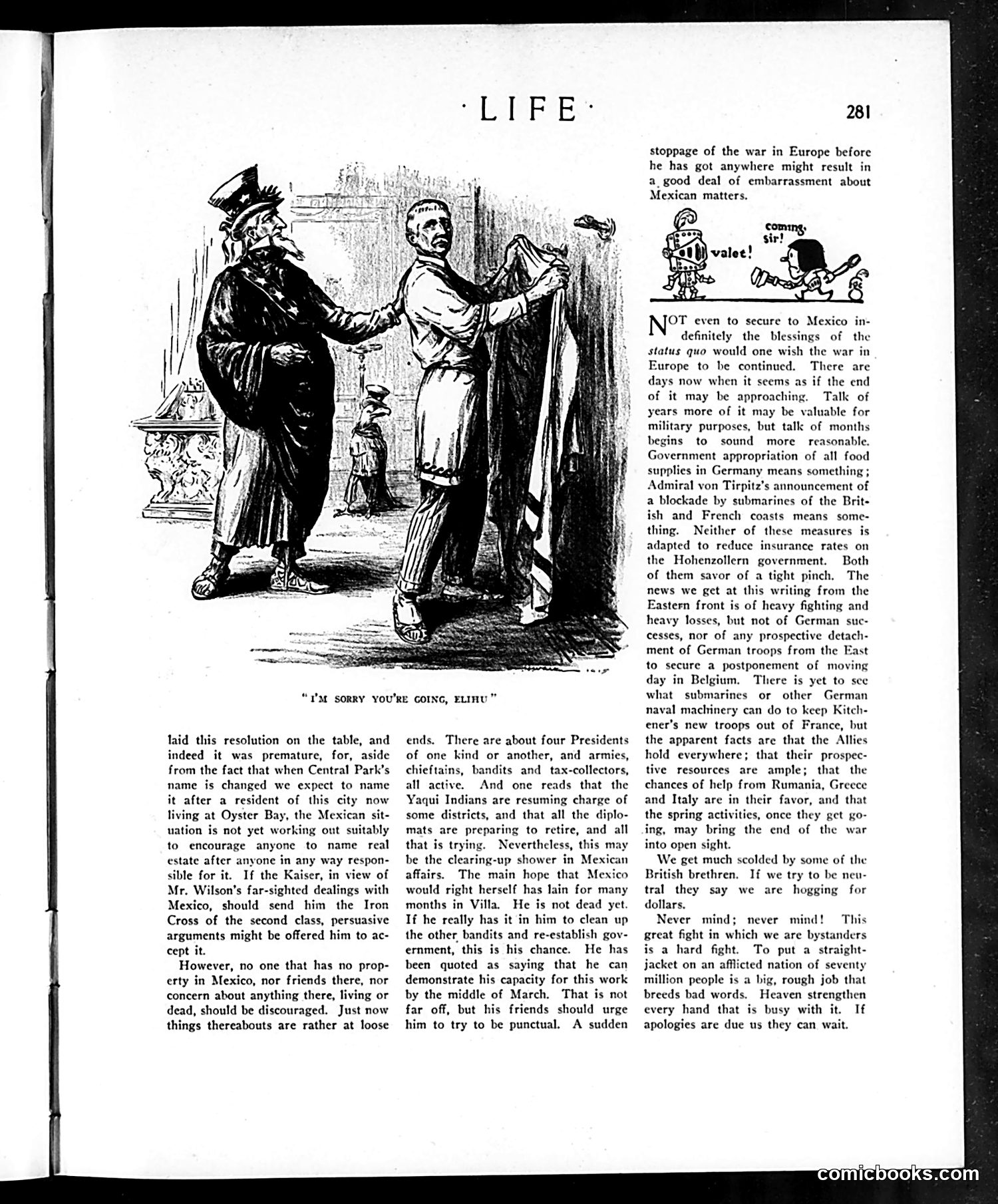
This page satirizes President Woodrow Wilson's foreign policy, particularly his handling of Mexico during the Mexican Revolution. The cartoon caption "I'M SORRY YOU'RE GOING, ELIHU" shows a farewell scene, likely referencing Secretary of State Elihu Root or another official departing over frustrations with Wilson's Mexico policy. The text mocks Wilson's "far-sighted dealings with Mexico" as ineffectual—sarcastically suggesting the German Kaiser might award Wilson the Iron Cross for bungling the situation so badly. Mexico is described as chaotic with multiple competing factions, including Pancho Villa, whom the article notes has promised to stabilize the country "by the middle of March." The piece also addresses World War I, cautiously hopeful Europe's conflict may end soon, while warning that European belligerents' desperation (Germany's submarine blockade, food rationing) suggests prolonged fighting. It defends American neutrality against British criticism about American profit-seeking, arguing the nation should support the Allies' difficult struggle morally while remaining officially neutral.
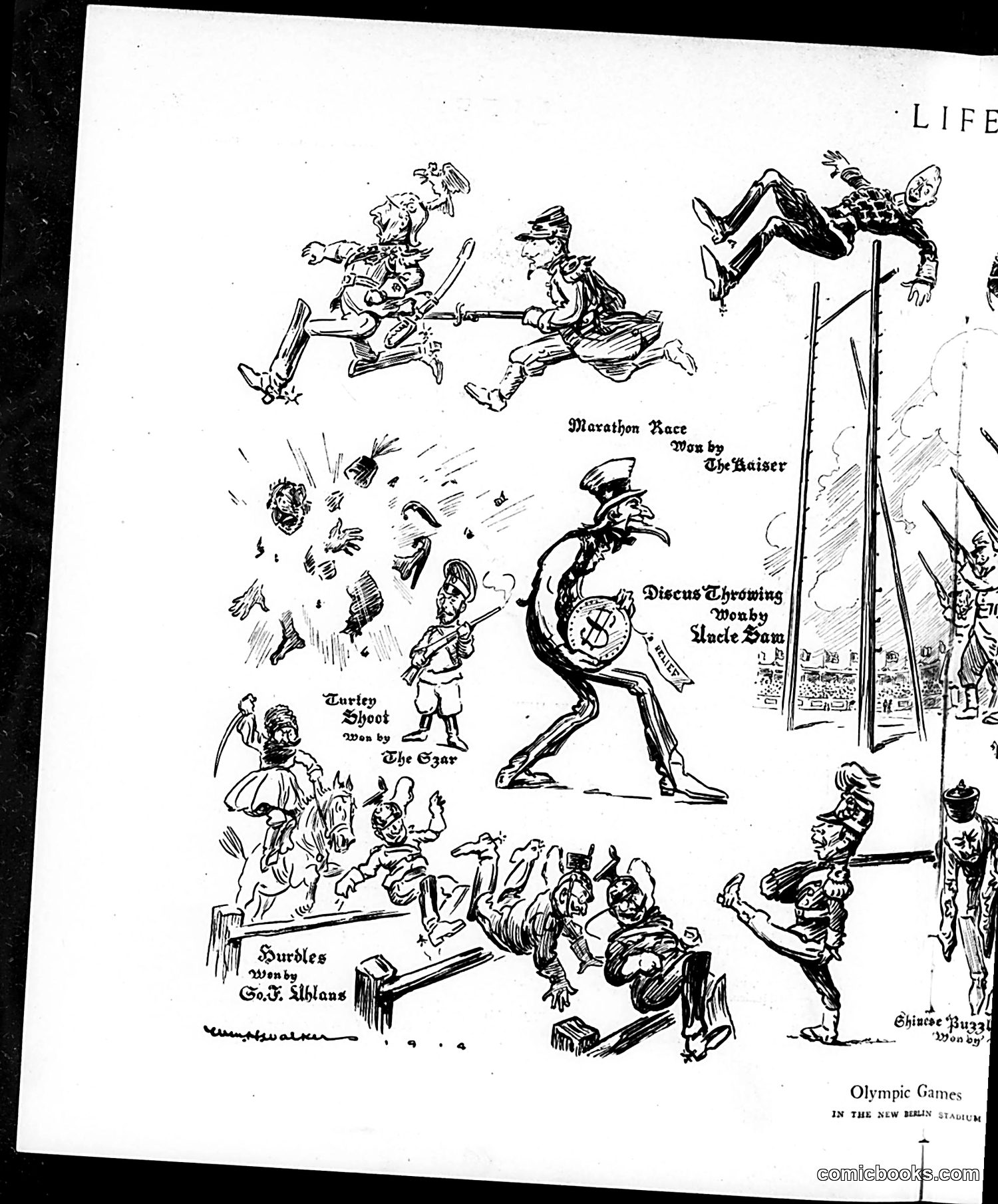
This is a satirical cartoon mocking the 1936 Berlin Olympics held under Nazi rule. The page depicts various Olympic events reimagined as violent, chaotic Nazi spectacles rather than dignified athletic competitions. Visible events include: - **Marathon Race** (won by "The Kaiser") - **Discus Throwing** (by "Shacte Dam") - **Turkey Shoot** (by "The Czar") - **Hurdles** (by "G.D. Albans") The exaggerated, grotesque caricatures and violent imagery transform athletic competition into crude brutality, suggesting the Olympics were corrupted by Nazi ideology. The reference to "the Kaiser" and other rulers implies fascist aggression and militarism. The cartoonist uses satire to critique how authoritarian regimes weaponized international sporting events for propaganda purposes.
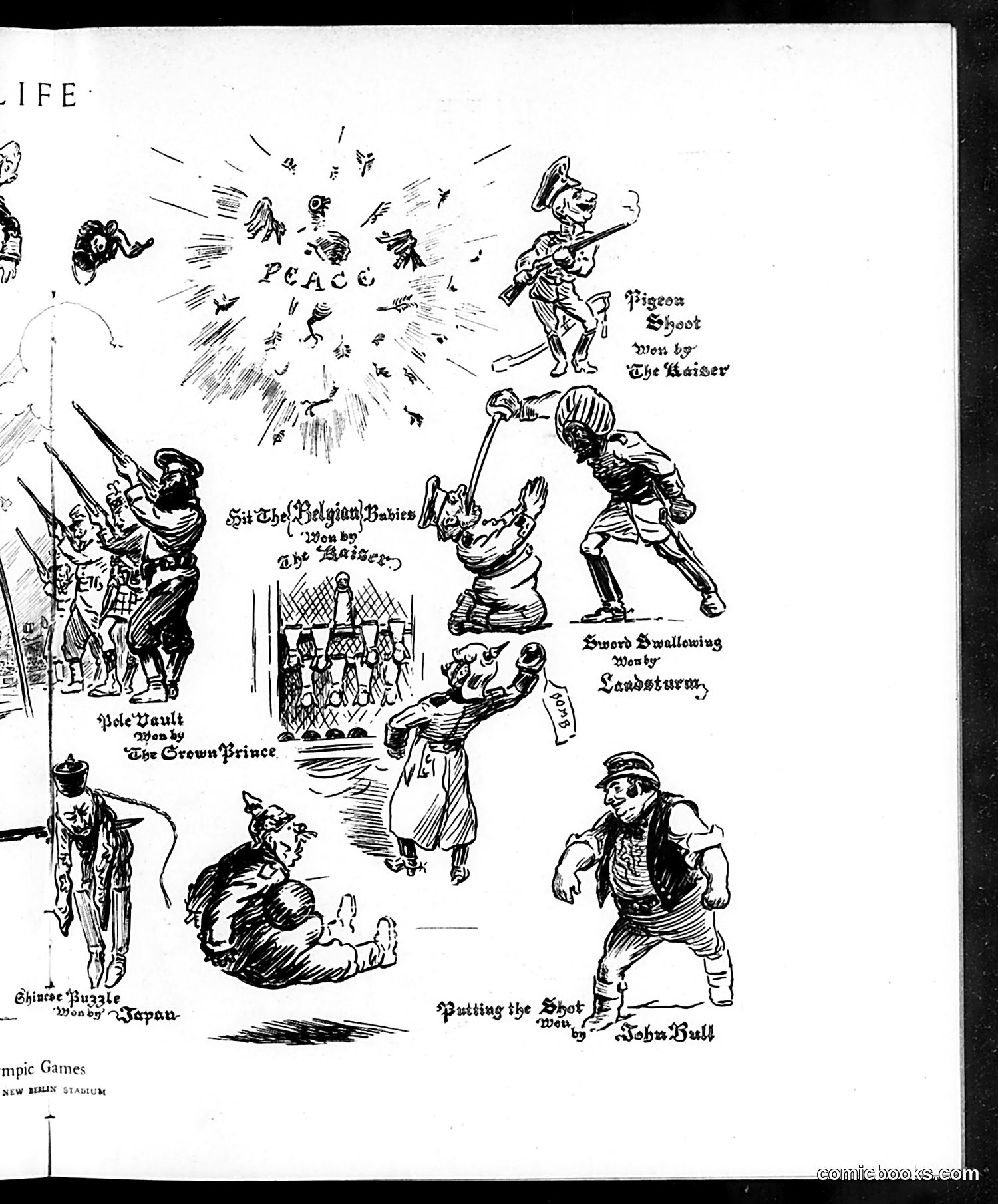
This page presents WWI-era satirical "Olympic Games" featuring enemy leaders as competitors. Each labeled event mocks a military or political figure: - **"Pigeon Shoot" (The Kaiser)**: Mocks German Emperor Wilhelm II's military incompetence - **"Pole Vault" (Crown Prince)**: Ridicules the German heir's leadership - **"Chinese Puzzle" (Japan)**: References Japan's diplomatic ambiguity during the war - **"Sword Swallowing" (Landsturm)**: Derides German reserve forces - **"Putting the Shot" (John Bull)**: Represents Britain's wartime efforts The cartoon uses grotesque caricature and athletic metaphors to demean opposing leaders and nations. "Peace" explodes at center, suggesting the chaos these leaders cause. This propagandistic humor reinforced American and Allied audiences' superiority during the conflict, turning serious military opponents into ridiculous competitors unfit for actual leadership.
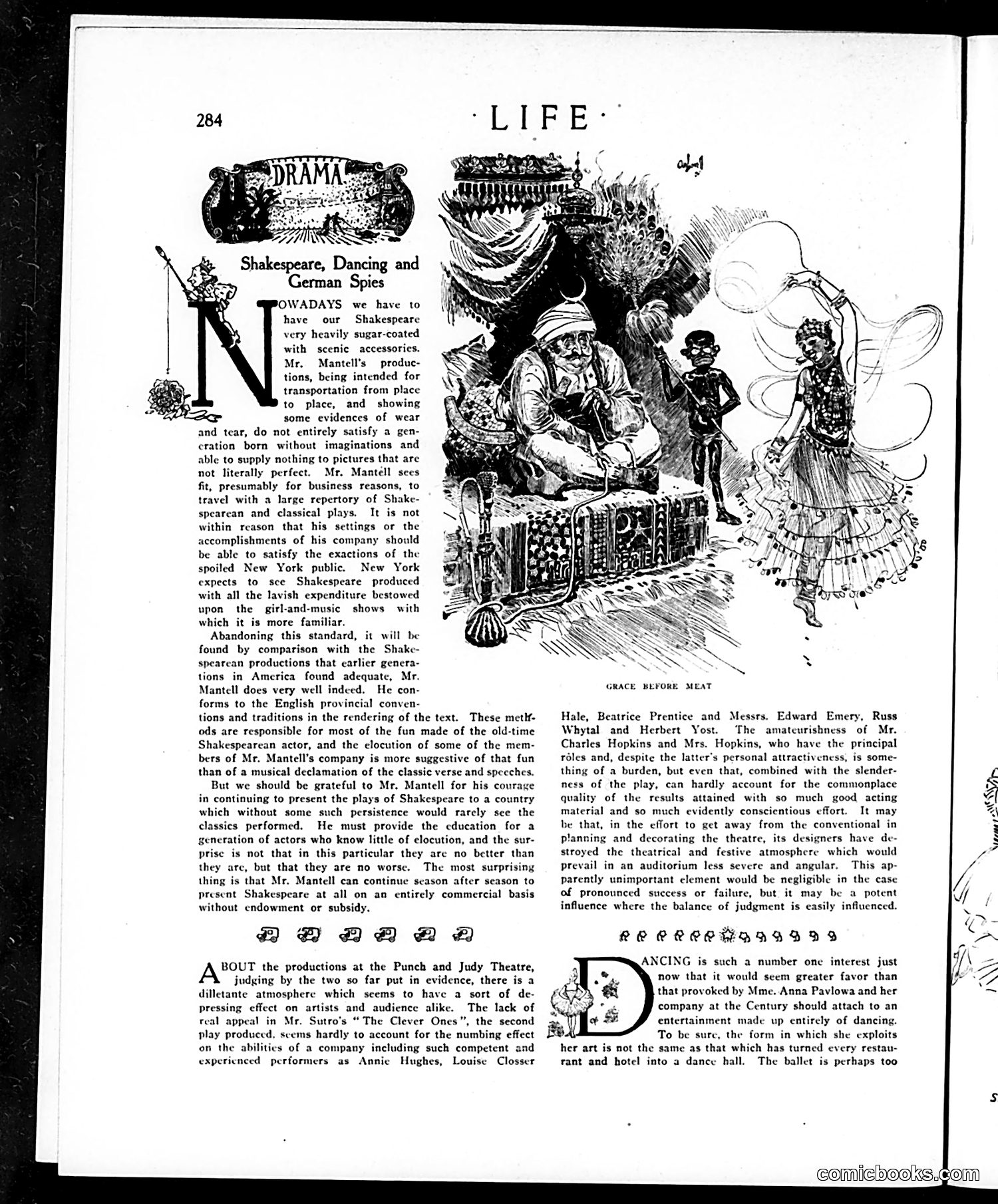
This page critiques three theatrical entertainments in early 20th-century New York: **Shakespeare Productions**: The writer defends actor Richard Mantell's traveling Shakespeare company against critics who expect lavish Broadway production values. The article argues New York audiences have become spoiled by spectacle-heavy "girl-and-music shows" and unfairly judge classical theater by contemporary standards. It credits Mantell for persisting in presenting Shakespeare commercially without subsidy, though acknowledges his actors' old-fashioned elocution style seems dated. **The Punch and Judy Theatre**: A damning review of a production at this venue, where talented performers (including Charles Hopkins and his wife) seemingly underperform due to the theater's austere, unconventional design that undermines theatrical atmosphere. **Anna Pavlowa's Dancing**: Brief mention suggesting her dance company at the Century Theater deserves greater acclaim than it receives, despite dancing being a major public interest. The cartoon "Grace Before Meat" illustrates theatrical excess—likely mocking over-elaborate staging.
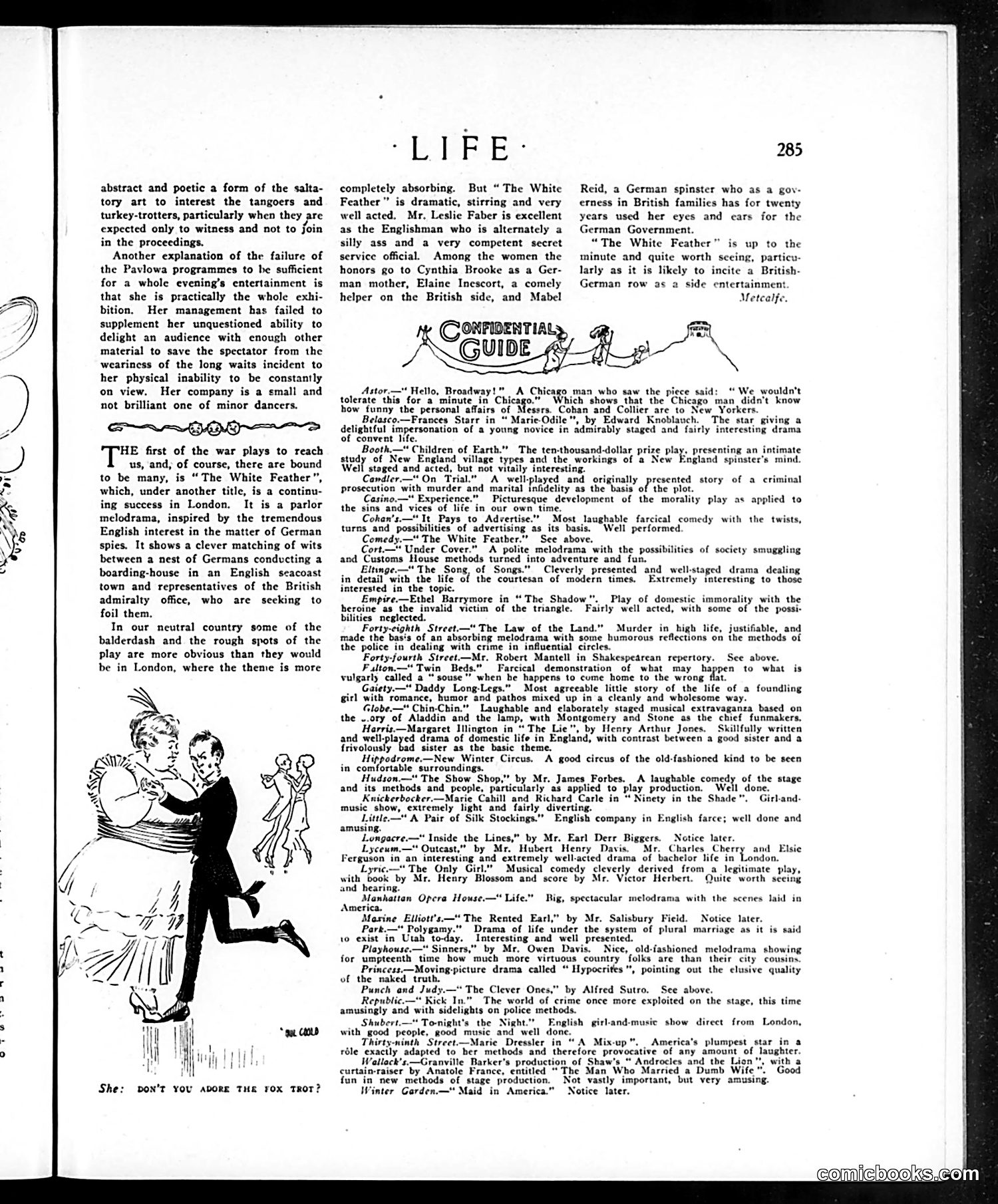
This page reviews theatrical productions, primarily focusing on "The White Feather," a war play about German spies operating from a boarding house in an English coastal town during WWI. The review praises it as dramatic and well-acted, noting British audiences find it more absorbing than American spectators. The cartoon shows a man dancing the fox trot with a large woman, captioned "She: DON'T YOU ADORE THE FOX TROT?" The joke satirizes the fox trot's popularity—the man appears to be struggling under the woman's weight, suggesting the dance craze, while fashionable, may be physically taxing or ridiculous. The page also briefly criticizes the Pavlova ballet program for being insufficient evening entertainment, claiming the famous dancer's small supporting cast creates tedious waits between performances. Other theater reviews follow in condensed form.
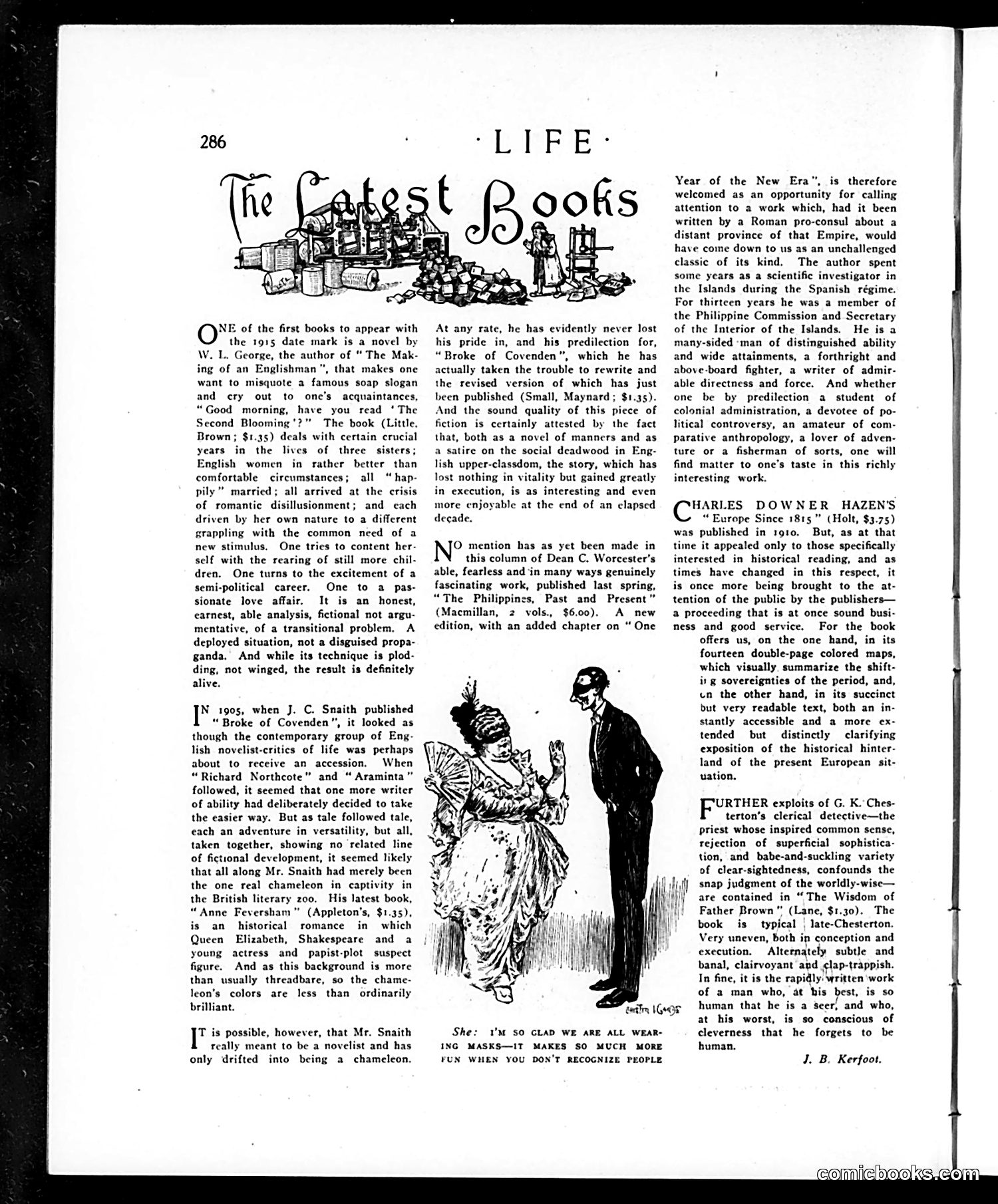
This page primarily comprises book reviews rather than political cartoons. The main illustration shows a couple at what appears to be a masquerade ball, with the woman saying she's "glad we are all wearing masks" because it makes social interaction more fun when people aren't recognized. The satire is social rather than political: it mocks the artificiality and pretense of upper-class social life, suggesting that masquerade allows people to escape their usual identities and social positions—implying that recognizability constrains authentic interaction. The cartoon suggests early-20th-century anxiety about maintaining false social personas. The page reviews several novels, including works by W.L. George and J.C. Snaith, and discusses Dean C. Worcester's nonfiction about the Philippines under American colonial administration. The reviews assess literary merit and characterize authors' stylistic consistency or inconsistency.
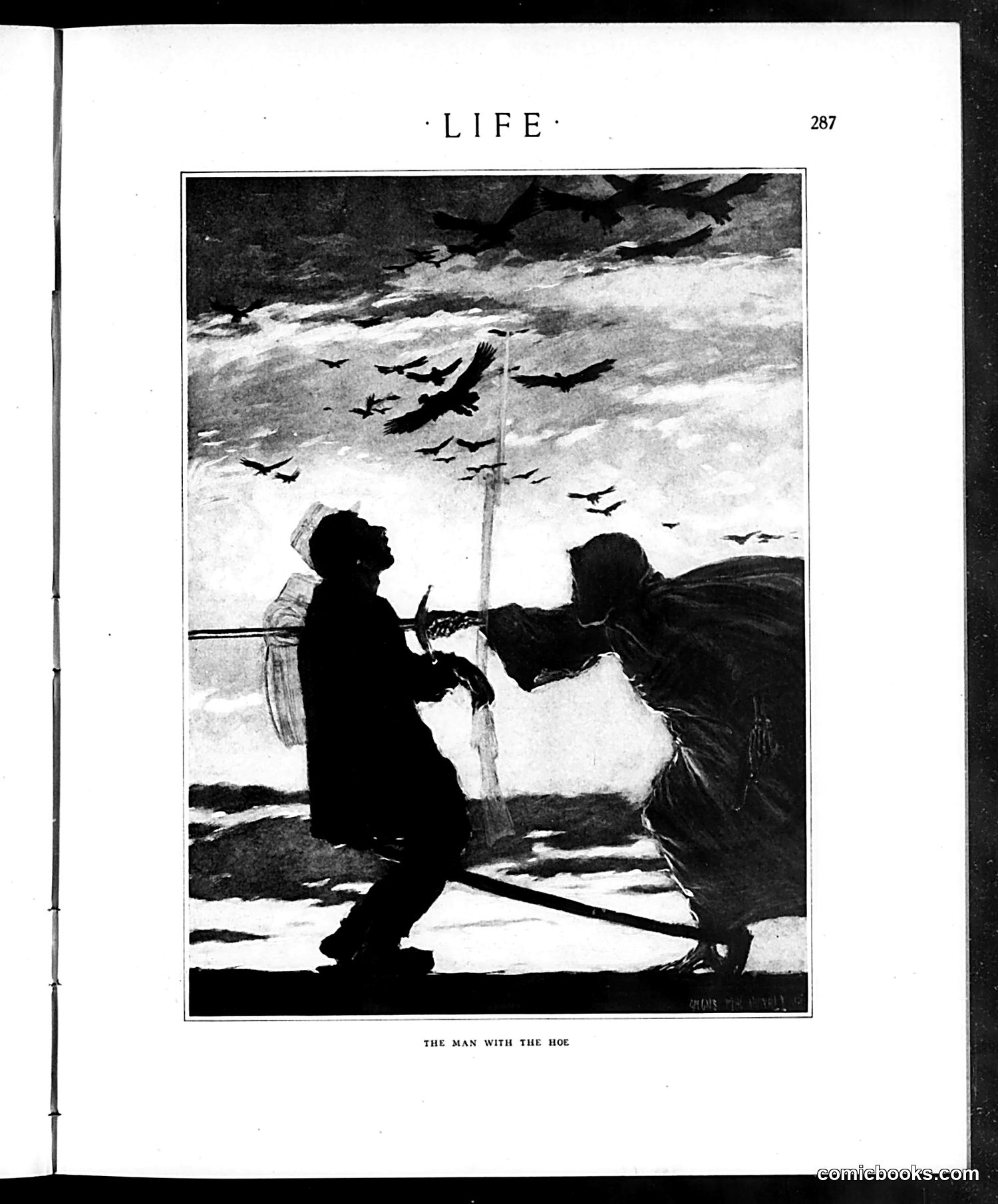
This illustration references the famous 1859 painting by French artist Jean-François Millet, depicting a peasant laborer bent over his work. The title became iconic shorthand for working-class struggle and exploitation. The silhouetted figures appear to show two people in conflict or confrontation over the hoe—likely representing a social commentary on labor disputes, class conflict, or the struggle for workers' rights. The dramatic sky with birds and rocky landscape emphasizes the harsh conditions of manual labor. Without additional context from surrounding text, the specific political message is unclear, but the deliberate reference to Millet's famous work suggests this satirizes attitudes toward working people, labor conditions, or perhaps class relations during the era Life magazine was published.
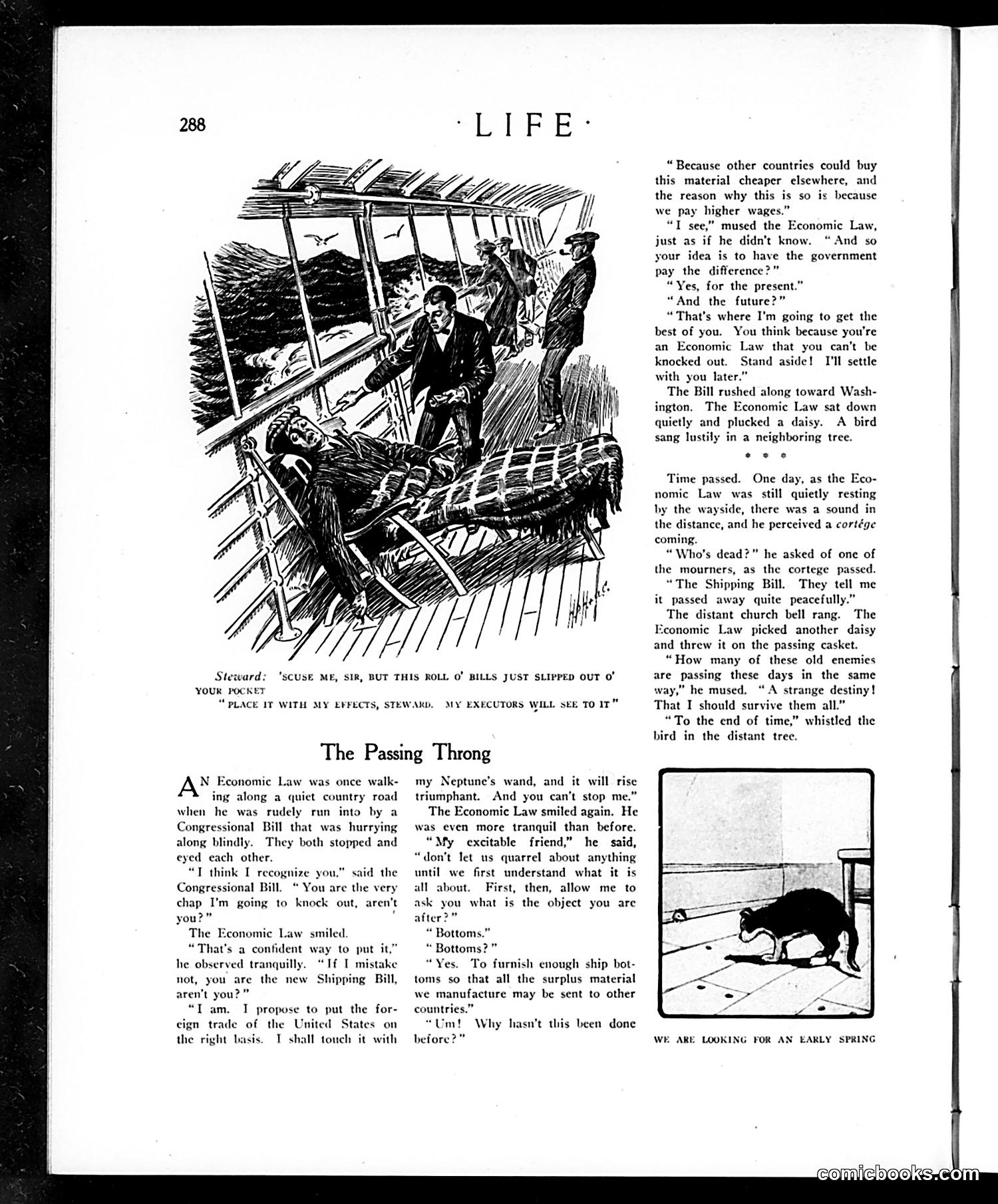
This is political allegory satirizing the Shipping Bill (likely the Merchant Marine Act of 1920). The cartoon personifies "Economic Law" and "Congressional Bill" as opposing forces in a debate about trade policy. The Shipping Bill proposes government subsidies to build ships ("bottoms") so American manufacturers can export surplus goods to other countries. Economic Law points out the logical flaw: this works only because American wages are higher than competitors', making goods expensive. The government must pay the difference—unsustainable. The satire's punch: Economic Law patiently waits by the roadside while the ambitious Bill rushes to Washington. Years later, the Bill passes away quietly, having failed—proving that economic reality outlasts legislative overreach. The cartoon mocks Congress for attempting to overturn fundamental economic principles through legislation alone. The message: good intentions and political will cannot permanently override market forces.
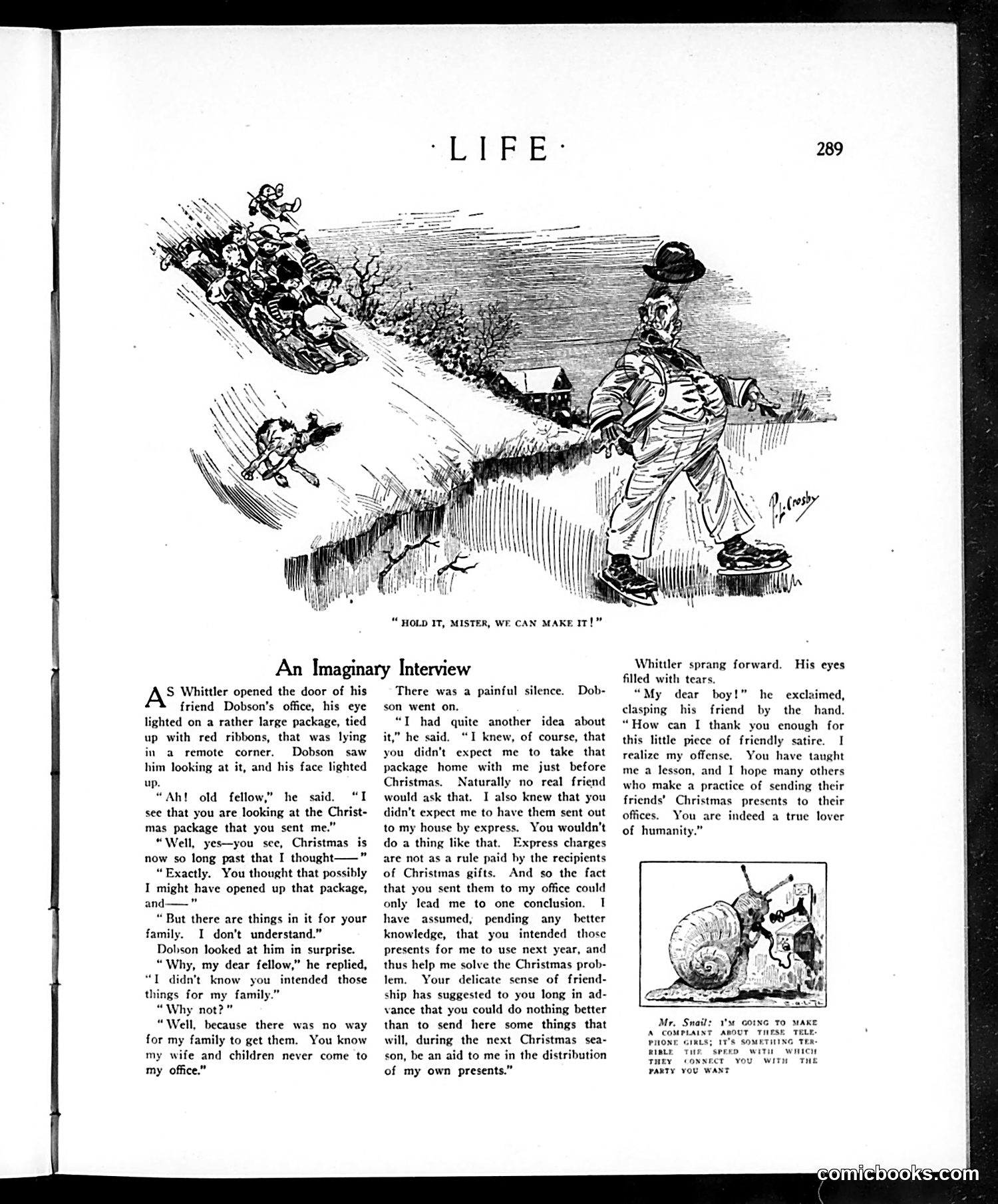
This satirical piece mocks the social awkwardness of Christmas gift-giving among office colleagues. Whittler has sent Dobson a Christmas package to his office, intending it for Dobson's family. Dobson cleverly exposes the impracticality: since Dobson's wife and children never visit his office, Whittler must have actually intended the gifts for *Dobson to regift* to others next Christmas—solving Dobson's own gift-giving burden. The satire targets the absurd logic people use to rationalize uncomfortable social situations. Dobson's elaborate explanation both shames Whittler for his thoughtless gesture and humorously reframes it as intentional charity. The piece satirizes workplace gift-giving customs and the polite fictions people maintain to avoid confronting social missteps. The small cartoon below (Mr. Snail) appears unrelated—a separate joke about telephone complaints.
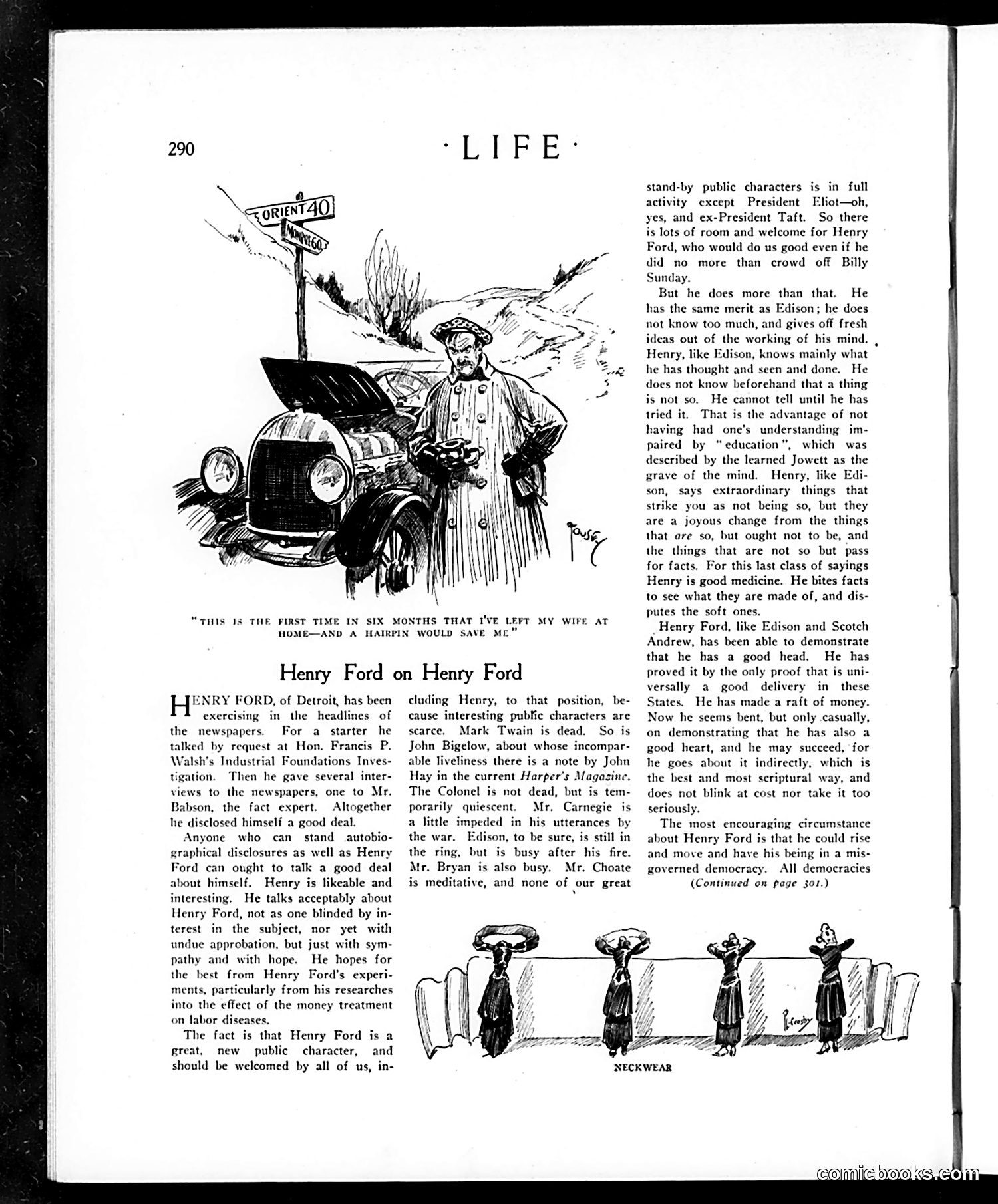
This article praises Henry Ford as a refreshing public figure during a period when other prominent Americans—Mark Twain (deceased), Carnegie, Edison, Bryan, and even ex-President Taft—are either dead or occupied elsewhere. The author argues Ford fills a genuine gap in American public discourse. The cartoon caption jokes that Ford's frequent absences from home for public appearances mean a hairpin would be more useful to his wife than his presence—a contemporary domestic jab. The article's central argument: Ford, like Edison, possesses practical intelligence unburdened by formal education, allowing him to think freshly rather than being constrained by established assumptions. This makes him valuable social medicine—he "bites facts" and challenges soft thinking. The author also credits Ford's business success and growing charitable interests as proof of both competence and character, noting approvingly that his philanthropy operates indirectly, avoiding self-promotion.
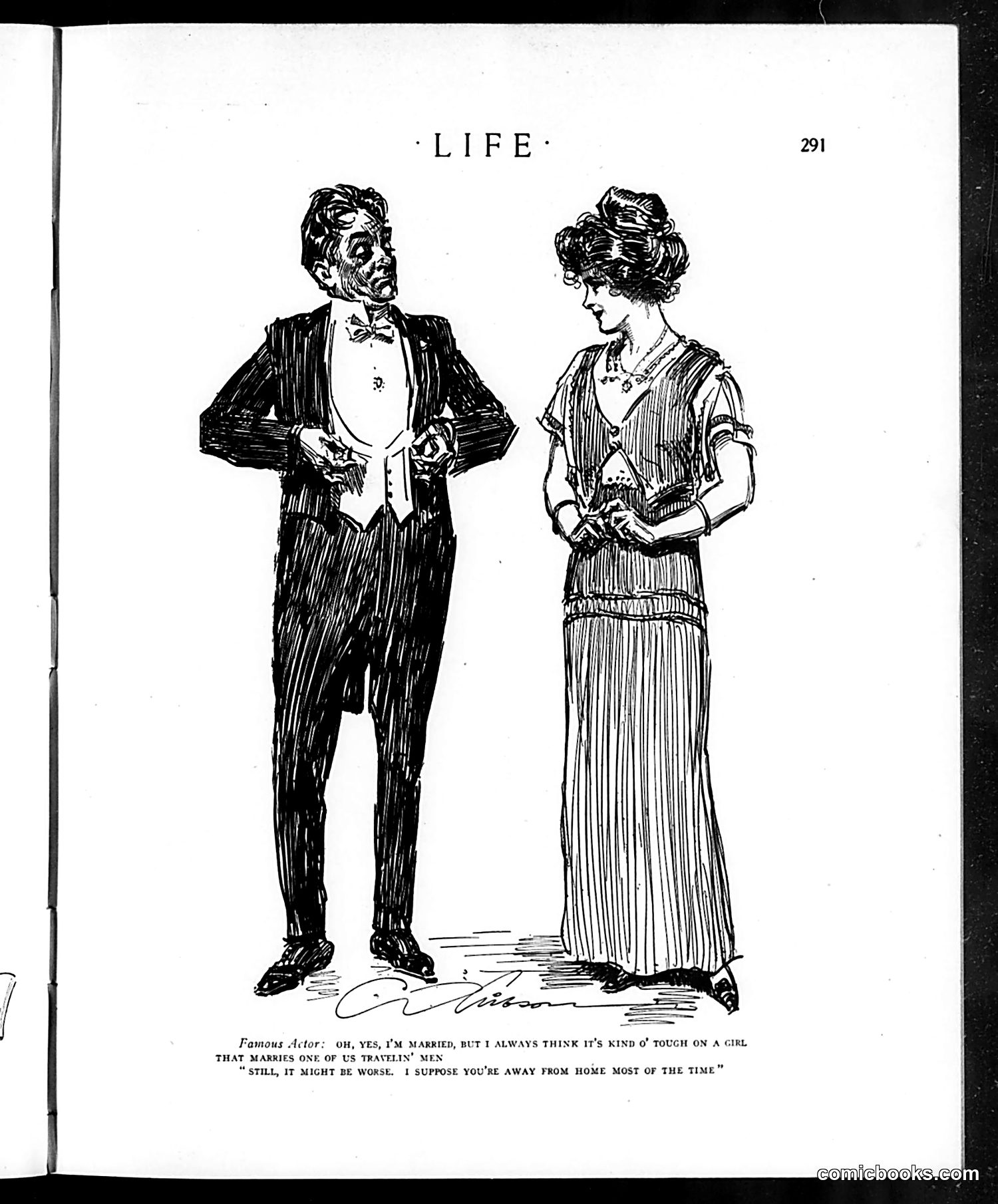
This cartoon satirizes the marital complaints of a famous actor. The well-dressed man (identified as a "Famous Actor") acknowledges that marriage to a traveling performer is difficult for wives, who spend most time alone while husbands tour. His sympathetic framing—"it might be worse"—is ironic understatement meant to mock his self-centered perspective. He views his wife's loneliness as an unfortunate but inevitable consequence of his profession rather than a genuine problem requiring change. The cartoon critiques the era's elite male attitudes: the assumption that wives should accept neglect as the price of marrying successful men. The woman's dignified but resigned posture suggests her acceptance of this arrangement, highlighting the period's limited expectations for married women's happiness.
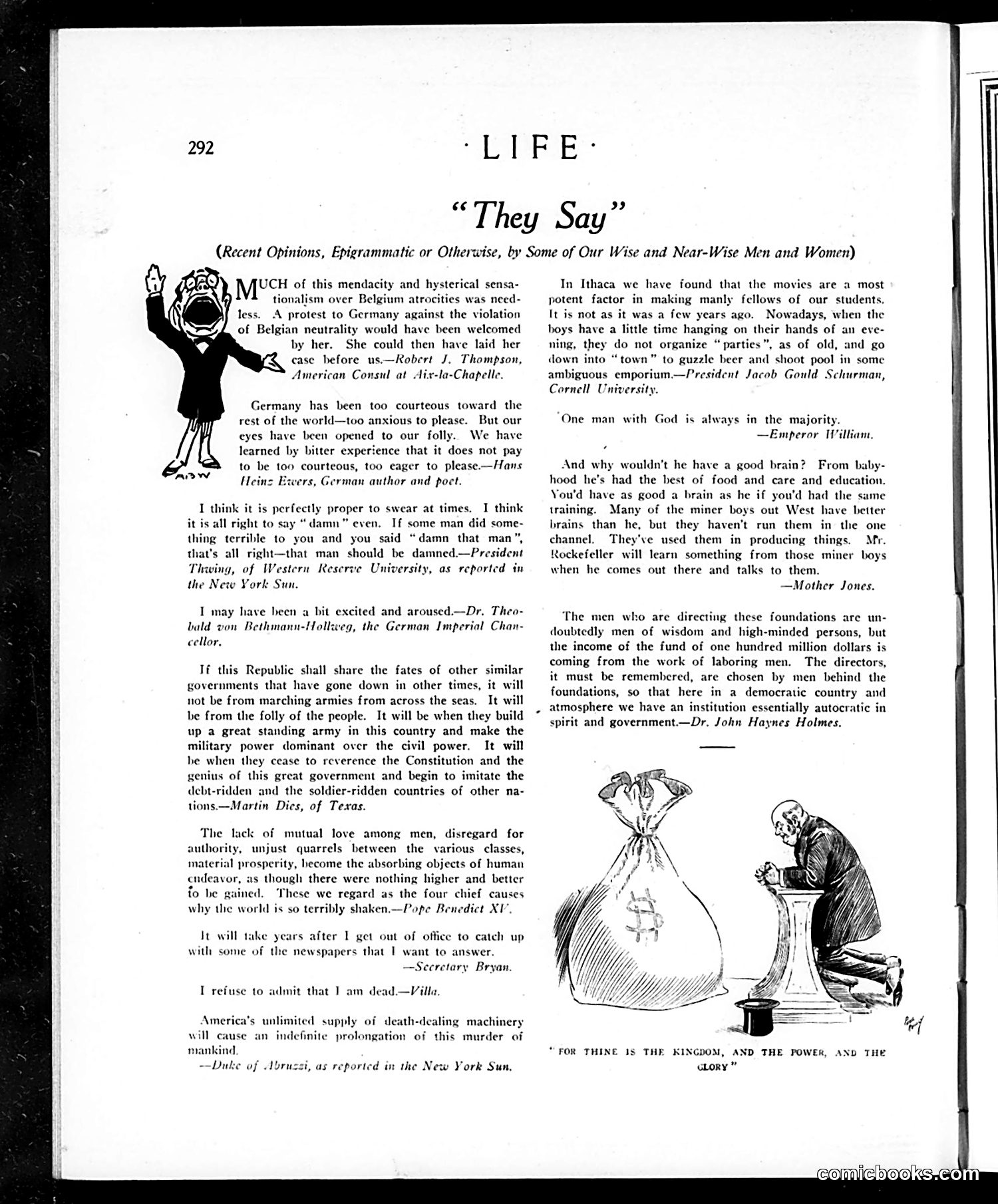
This page collects quoted opinions from prominent figures on World War I and contemporary American issues. The satire works through juxtaposition and irony: **German perspectives** are featured prominently—notably Chancellor Bethmann-Hollweg's claim he was "a bit excited and aroused" about violating Belgian neutrality, and Emperor William's statement that "one man with God is always in the majority." These appear designed to expose German hypocrisy and arrogance. **American voices** include Secretary of State Bryan, President Thwing defending profanity, and Mother Jones critiquing how wealthy industrialists like Rockefeller benefit from workers' labor while claiming superior intellect. **The cartoon** (bottom) depicts a religious or charitable figure examining a money bag, suggesting critique of how institutional wealth operates. The page's overall message: powerful figures—especially German leaders and American industrialists—reveal their self-serving logic when quoted directly. The satire exposes contradictions between their stated principles and actual conduct during WWI and regarding labor/class issues.
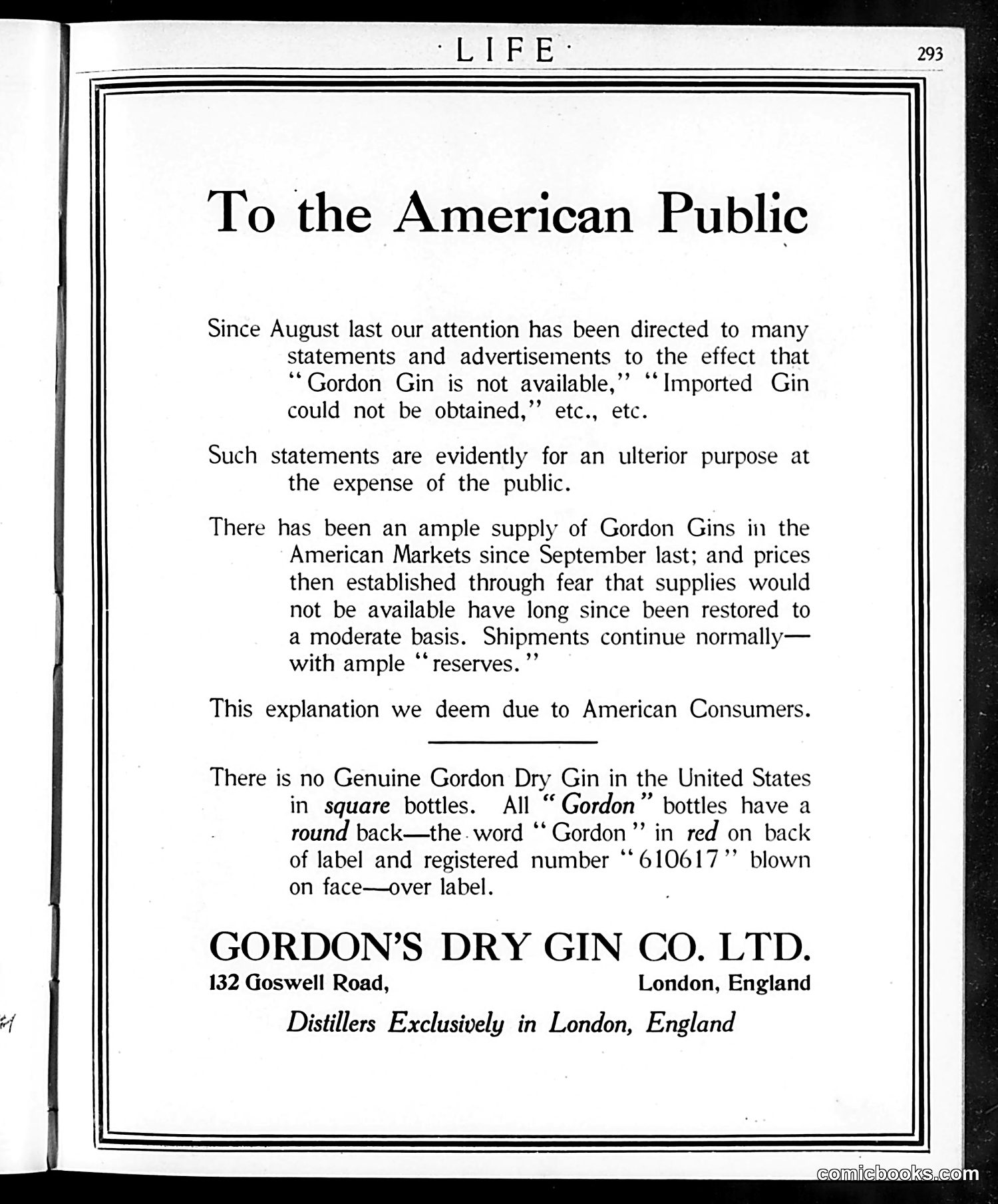
This is a **public notice, not a cartoon**—a full-page advertisement from Gordon's Dry Gin addressing wartime supply panic. **Context:** The reference to "August last" and import concerns suggests this appears during or shortly after World War I, when German submarine warfare disrupted transatlantic shipping and created genuine supply anxieties. **The Message:** Gordon's accuses competitors or retailers of spreading false scarcity claims—stating gin "is not available"—to artificially inflate prices and profit from consumer fear. The company asserts supplies have been adequate since September and prices have normalized. **The Authenticity Warning:** The ad includes an anti-counterfeiting notice, explaining that genuine Gordon's comes in *round* bottles (not square) with "Gordon" in red on the label and a specific registered number blown into the glass. **The Point:** Gordon's positions itself as honest and consumer-friendly while denouncing opportunistic competitors exploiting wartime uncertainty. It's damage control and brand protection combined.
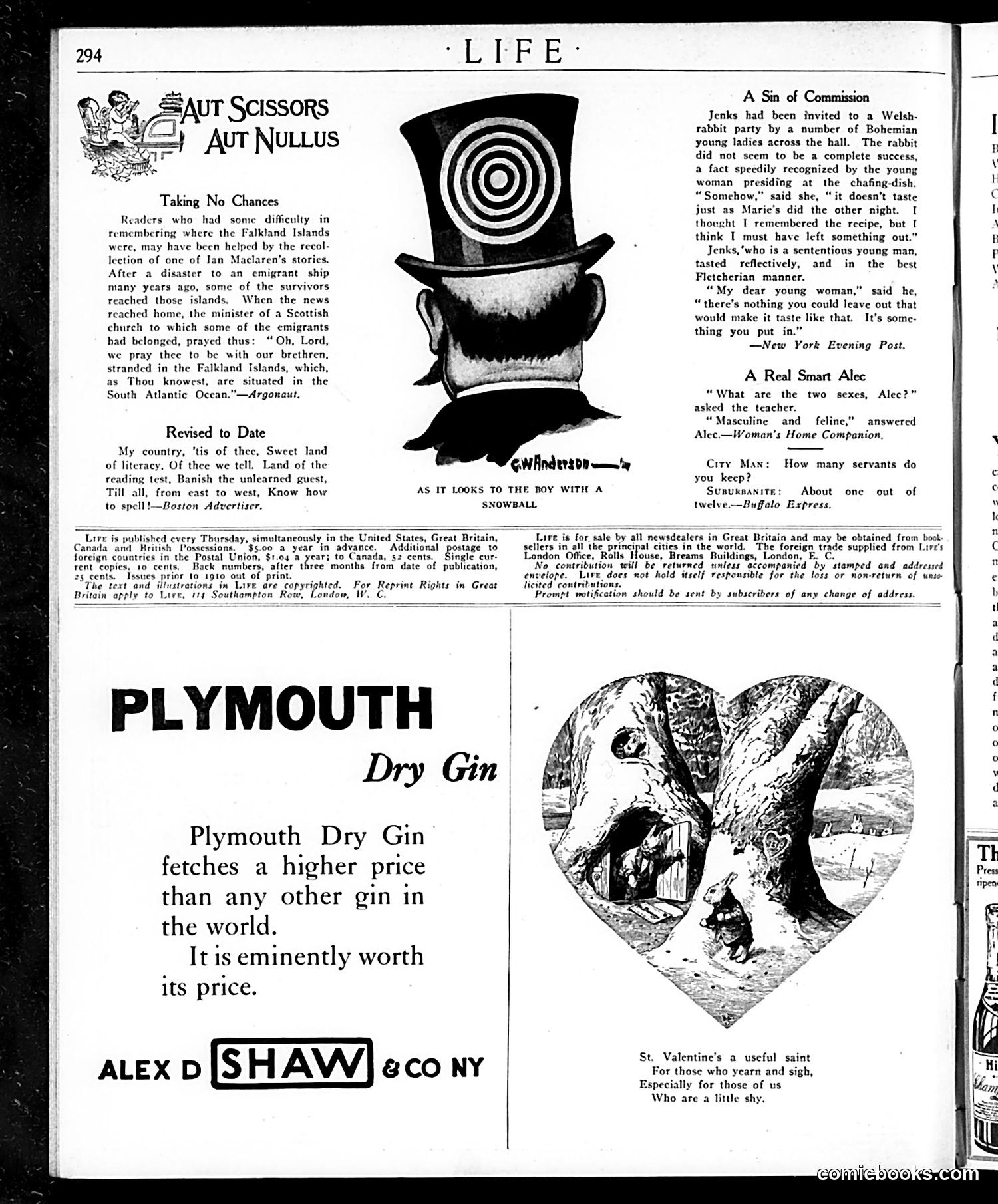
This page contains several brief satirical pieces typical of Life's humor style: **"Taking No Chances"** mocks Scottish religiosity through a story about a minister praying for Falkland Islands survivors—the joke being the minister feels obliged to clarify *where* the islands are, as if God might not know. **"Revised to Date"** is a patriotic parody replacing a patriotic song's lyrics with emphasis on literacy and spelling—satirizing American educational concerns of the era. **The Top Cartoon** (titled "As It Looks to the Boy With a Snowball") shows a top hat with concentric circles—a visual pun representing how a snowball's impact would distort one's perception of a formal gentleman. **"A Sin of Commission"** and **"A Real Smart Alec"** are brief joke anecdotes about word-play and pedantic responses. The page is primarily **advertising** (Plymouth Dry Gin occupies significant space) interspersed with light humor. A Valentine's Day illustration appears at bottom right, promoting courtship for the shy. Overall: typical early 20th-century American magazine content mixing genteel satire with commercial promotion.
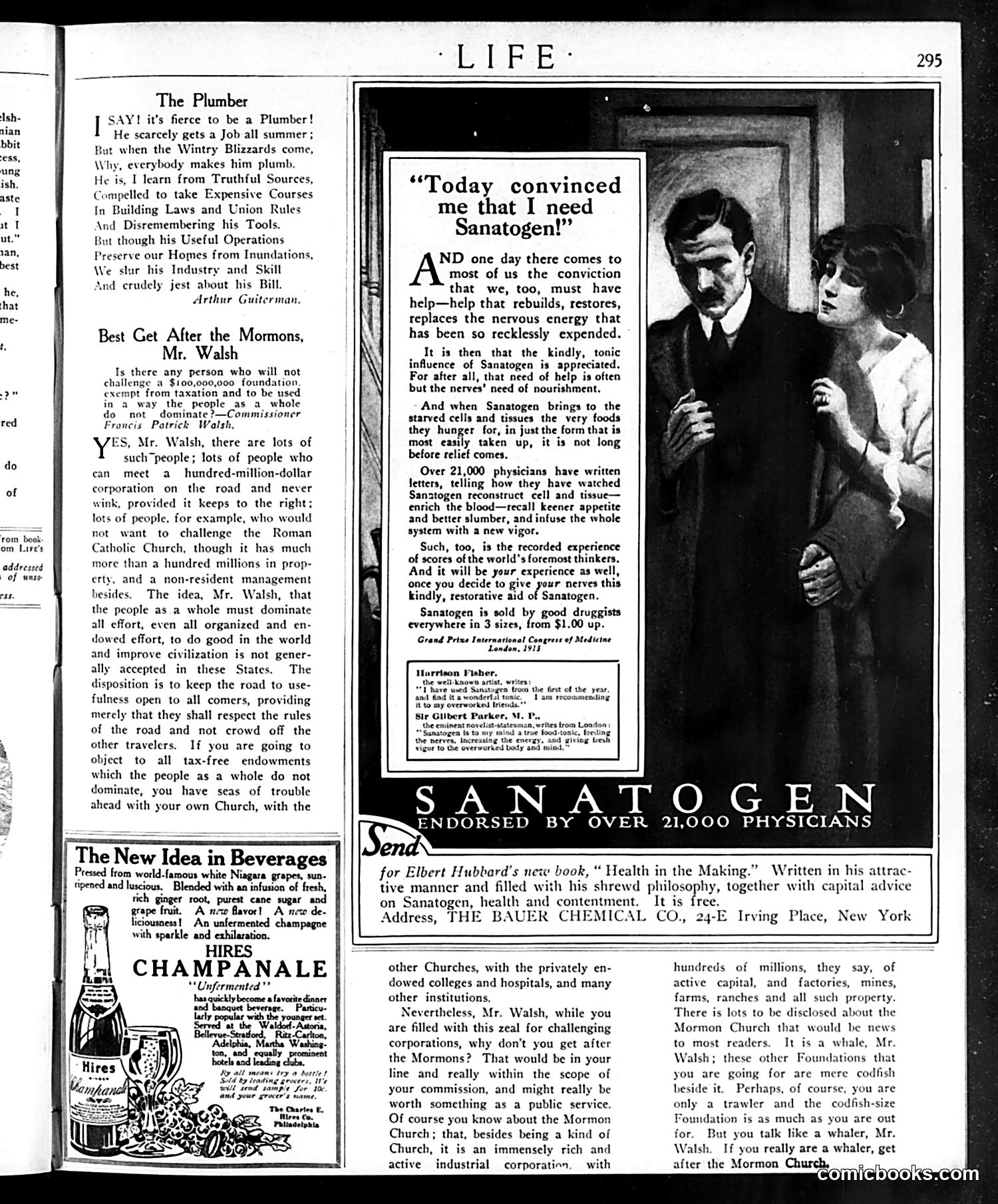
This page mixes satirical poetry with period advertising. **"The Plumber" poem** by Arthur Guiterman humorously depicts the plumber's paradoxical status: scarce employment in summer, sudden indispensability during winter emergencies. The satire mocks how society simultaneously depends on and disdains tradespeople, forcing them through expensive union courses while begrudging their bills. **"Best Get After the Mormons, Mr. Walsh"** appears to be editorial commentary criticizing tax-exempt institutional wealth. It challenges Francis Patrick Walsh's (likely a real figure) argument about democratic control of endowments, sarcastically noting that the Roman Catholic Church maintains vast tax-free property without public dominance—yet society accepts this. The piece argues against the principle that "people as a whole" must control charitable institutions. **The Sanatogen advertisement** occupies the right half—a patent medicine claiming endorsement by 21,000 physicians, promising nervous system restoration through nutritional tonic. This exemplifies early 20th-century medical marketing's dubious credibility claims. The page satirizes working-class exploitation, institutional hypocrisy, and medical quackery—all contemporary concerns.
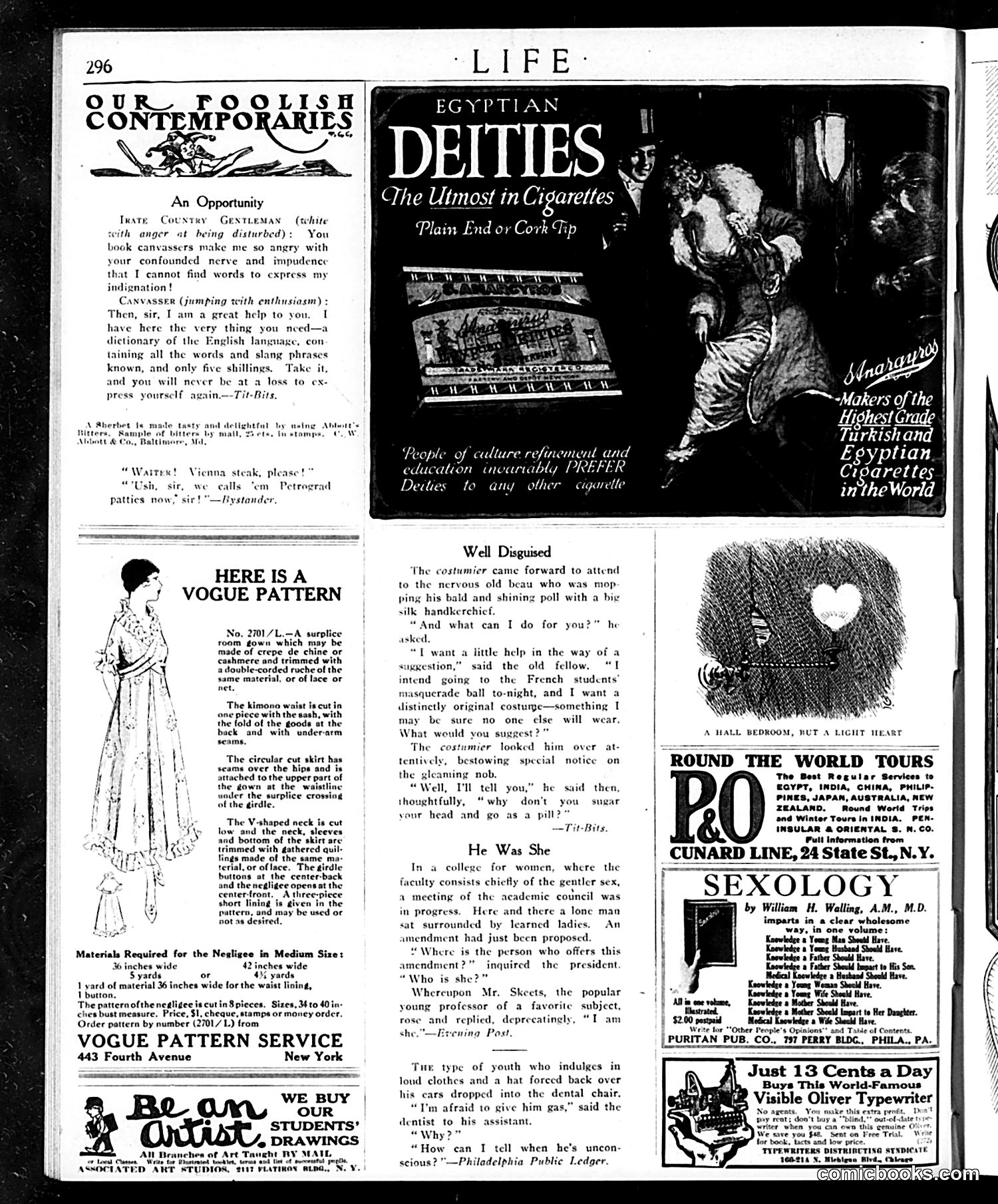
This page from *Life* magazine consists primarily of advertisements, humorous short pieces, and fashion content rather than political cartoons. The humor pieces include: - "An Opportunity": A book canvasser responds to an angry gentleman's complaint about being disturbed by offering him a dictionary—allowing him to "express yourself again." - "Well Disguised": An elderly man seeks costume advice for a masquerade ball; the costumier suggests he wear a pill to disguise his appearance. - "He Was She": A college faculty amendment goes unattributed until a male professor admits he proposed it, implying women should receive credit for ideas attributed to men. These are gentle satires of social awkwardness, vanity, and gender dynamics typical of early 20th-century *Life* magazine humor. The page also features fashion patterns, cigarette advertisements (Egyptian Deities brand), travel tours, and book advertisements. No significant political content is apparent.
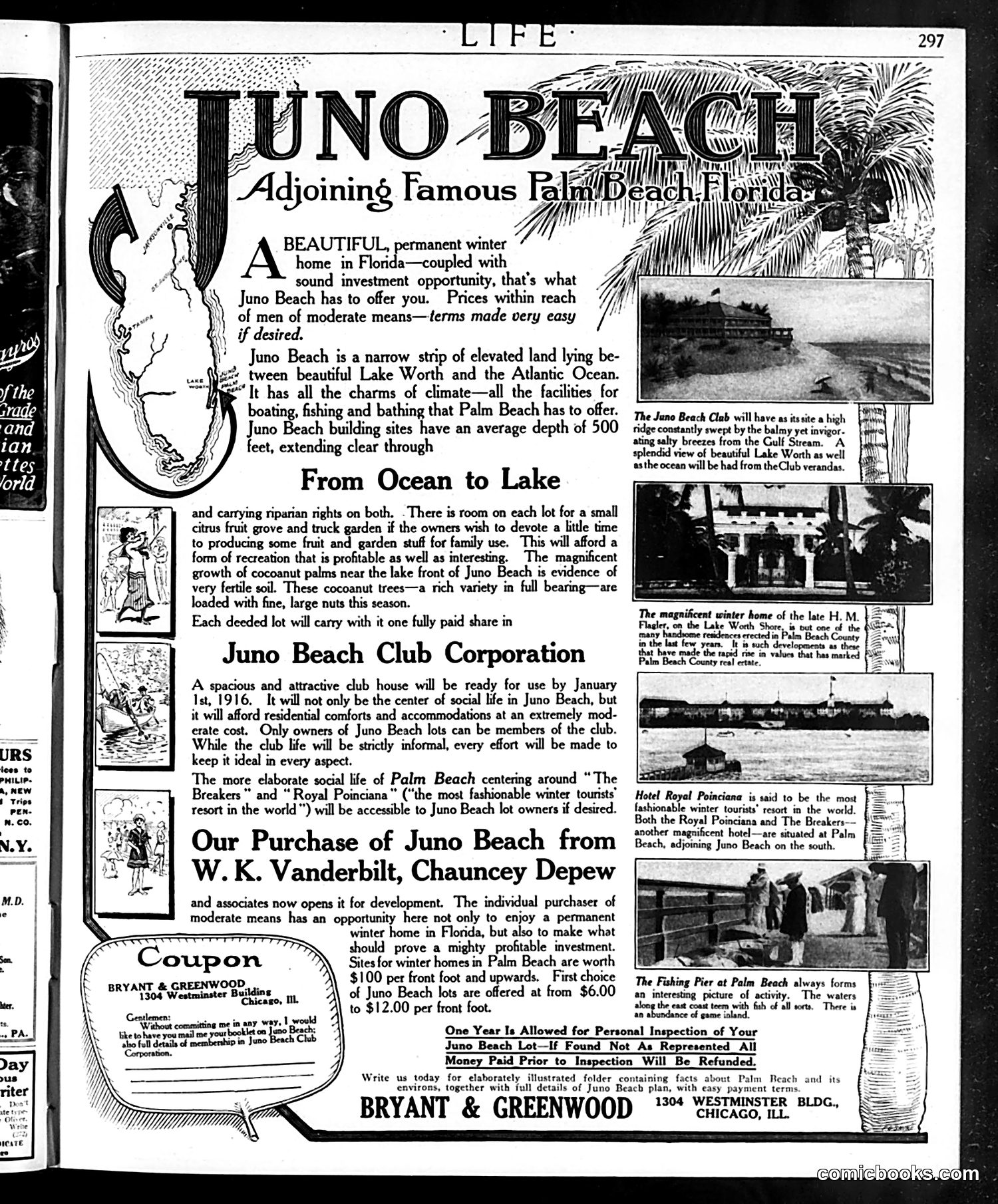
This is **not a political cartoon or satire**—it's a real estate advertisement disguised as editorial content in *Life* magazine (circa 1916). The page promotes Juno Beach, Florida, a development purchased from prominent wealthy figures W.K. Vanderbilt and Chauncey Depew. The pitch targets "men of moderate means" with affordable lots ($6-$12 per front foot) and flexible payment terms, marketed as both a winter home and investment opportunity. Key selling points include riparian rights (lakefront and oceanfront access), fertile soil suitable for citrus and coconut palms, and proximity to fashionable Palm Beach resorts like The Breakers and Royal Poinciana—suggesting buyers could enjoy elite social life while owning modest properties. The exclusive Juno Beach Club Corporation promised to provide social amenities for lot owners. The decorative illustrations on the left margin are standard *Life* magazine design elements, not commentary. This represents early 20th-century real estate speculation in Florida's boom period.
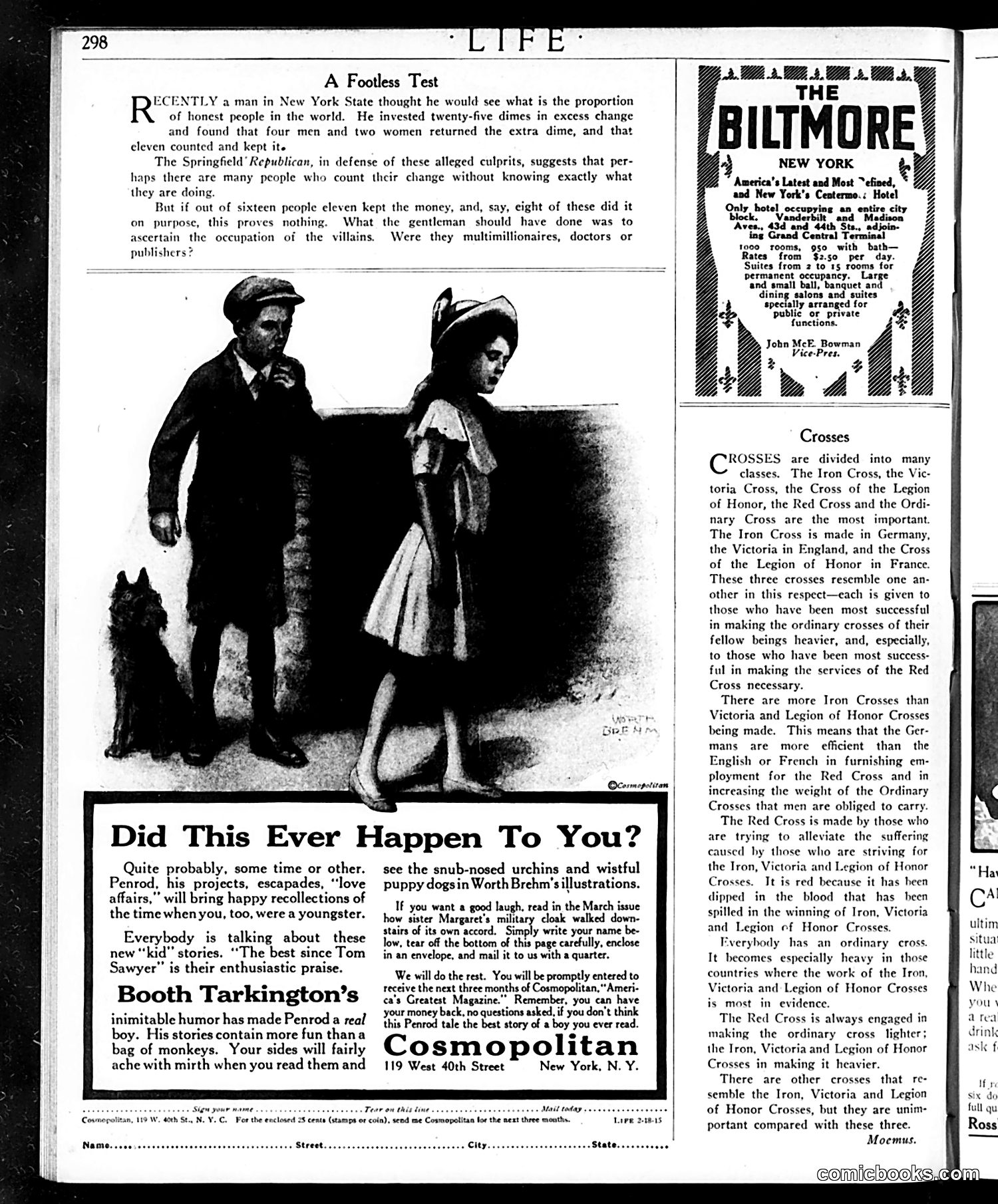
The main cartoon illustrates a satirical piece about a New York State experiment testing honesty. A man gave excess change to 16 people; 11 kept the money. The Springfield Republican defended the keepers, suggesting people simply miscounted. Life's satire mocks this excuse: if 11 of 16 kept money—possibly 8 intentionally—the result proves widespread dishonesty, not carelessness. The piece sarcastically suggests the experimenter should have checked whether the thieves were "multimillionaires, doctors or publishers," implying these professions were particularly prone to moral failings. The page also advertises Booth Tarkington's "Penrod" stories (popular youth fiction) and The Biltmore Hotel, alongside an article on military crosses (Iron Cross, Victoria Cross, Legion of Honor). The crosses article contains dark satire about war: these decorations reward those "most successful in making the ordinary crosses of their fellow beings heavier," referencing both literal weight of crosses and human suffering.
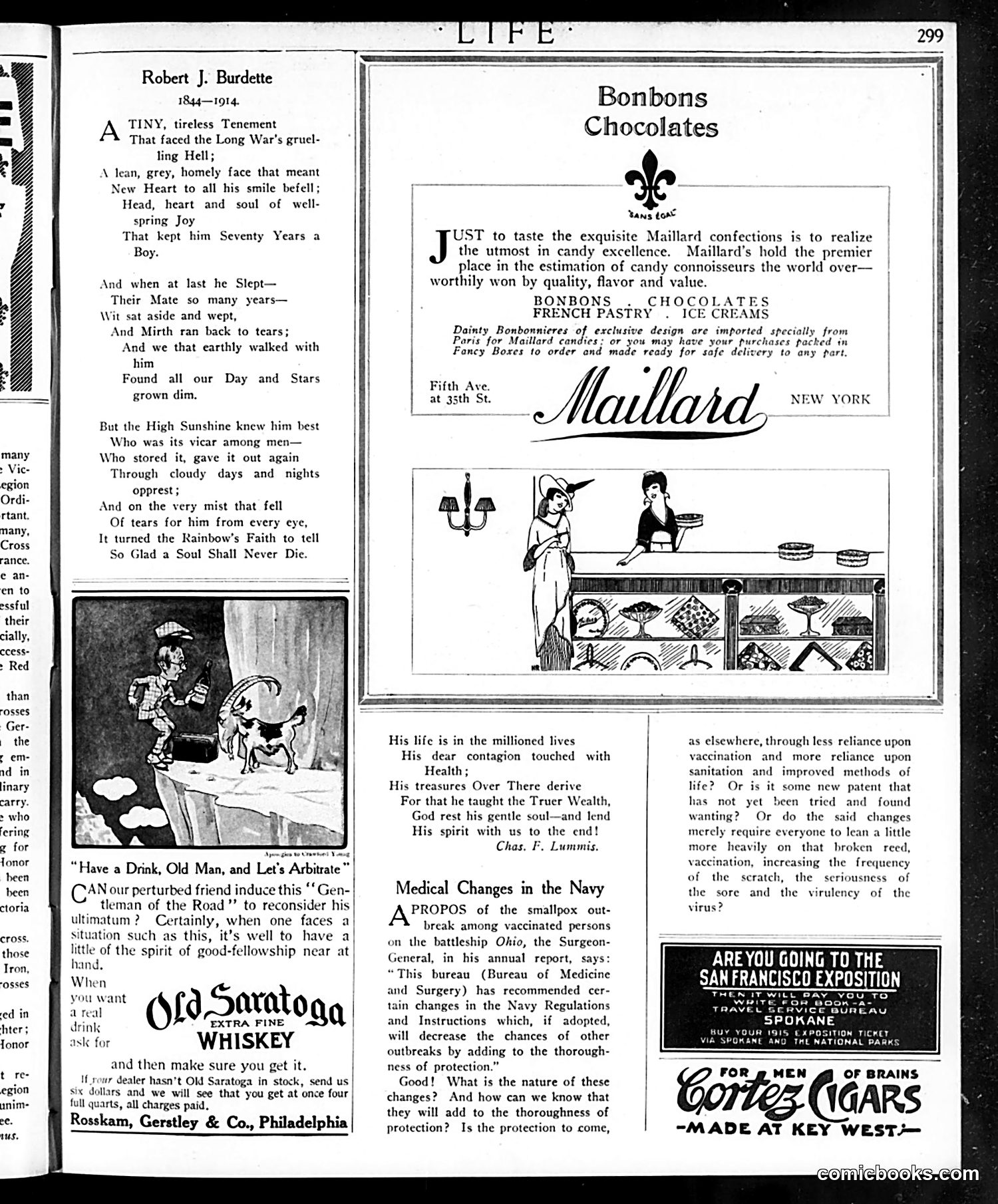
This page from *Life* magazine contains several distinct elements: **Main Content:** A memorial poem by Robert J. Burdette (1844-1914), an American humorist and clergyman. The tribute celebrates his 70 years as a source of joy and good humor, suggesting he was a beloved public figure known for spreading optimism during difficult times ("the Long War's gruelling Hell" likely references WWI). **Cartoon/Advertisement:** "Have a Drink, Old Man, and Let's Arbitrate" depicts a beggar or vagrant confronting a well-dressed man, humorously suggesting whiskey as a solution to conflict resolution. This satirizes the era's attitudes toward alcohol and social dispute-settling. **Editorial Commentary:** The "Medical Changes in the Navy" section discusses a smallpox outbreak aboard the USS *Ohio*. It satirizes the Navy's vague promises of "improved protection" while questioning whether these changes actually address sanitation and hygiene or merely increase vaccination frequency. **Advertisements:** The page includes prominent ads for Maillard chocolates and Old Saratoga whiskey, typical of early 20th-century *Life* magazine content.
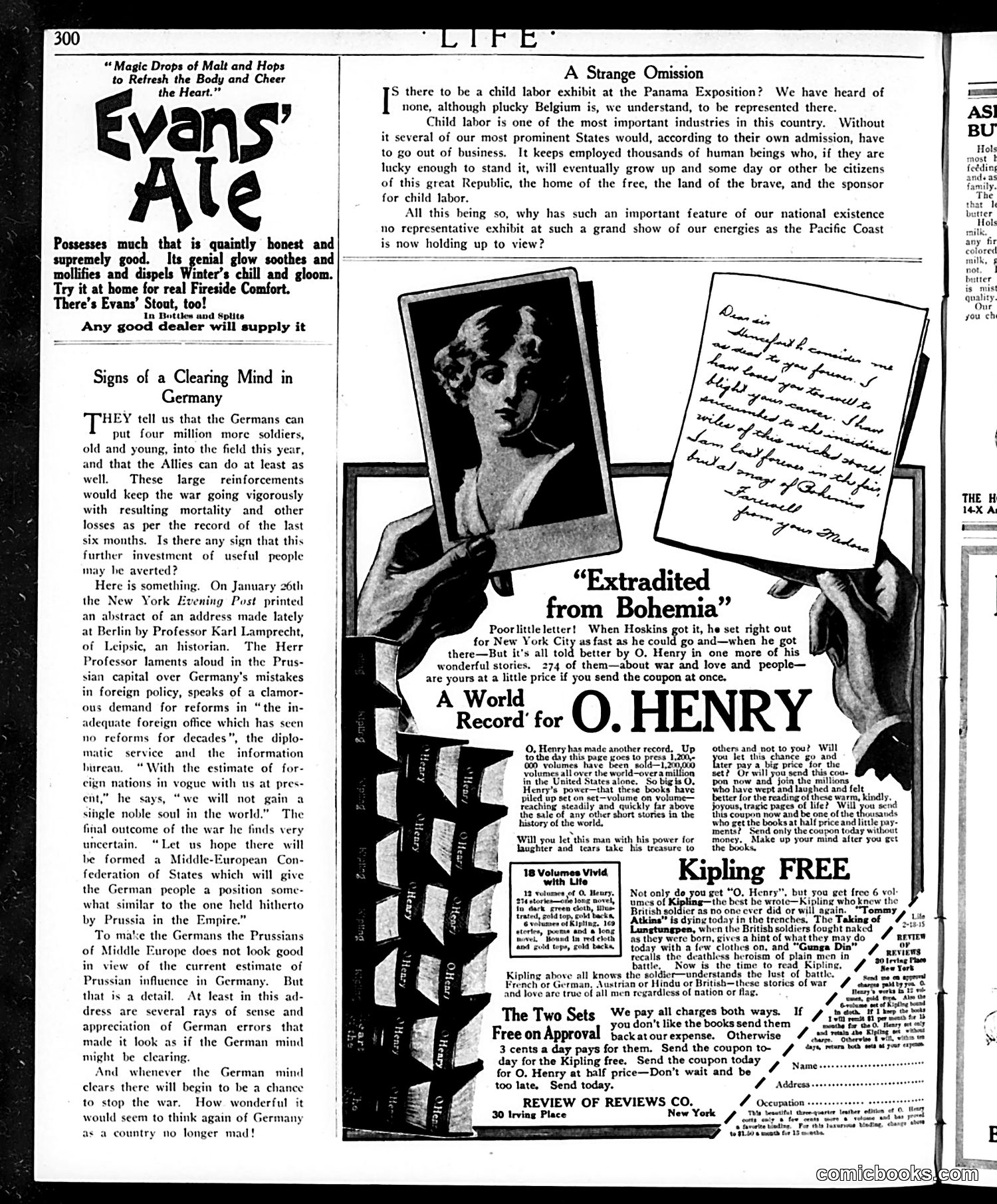
This page contains editorial commentary and advertising from WWI-era Life magazine. **"Signs of a Clearing Mind in Germany"** discusses a January 1915 Berlin speech by historian Karl Lamprecht criticizing German foreign policy mistakes and advocating for a Middle-European confederation rather than Prussian dominance. The piece expresses cautious optimism that German self-criticism might eventually lead to war's end. **"A Strange Omission"** is satirical social commentary attacking American hypocrisy. It notes that while the 1915 Panama-Pacific Exposition will feature Belgium's child labor exhibits, America—which the author argues actually depends on child labor economically—has no such exhibit. The satire highlights this as damning evidence of America's complicity in exploiting children. The remaining content is advertising for Evans' Ale and O. Henry story collections, typical of Life's mixed editorial-commercial format.
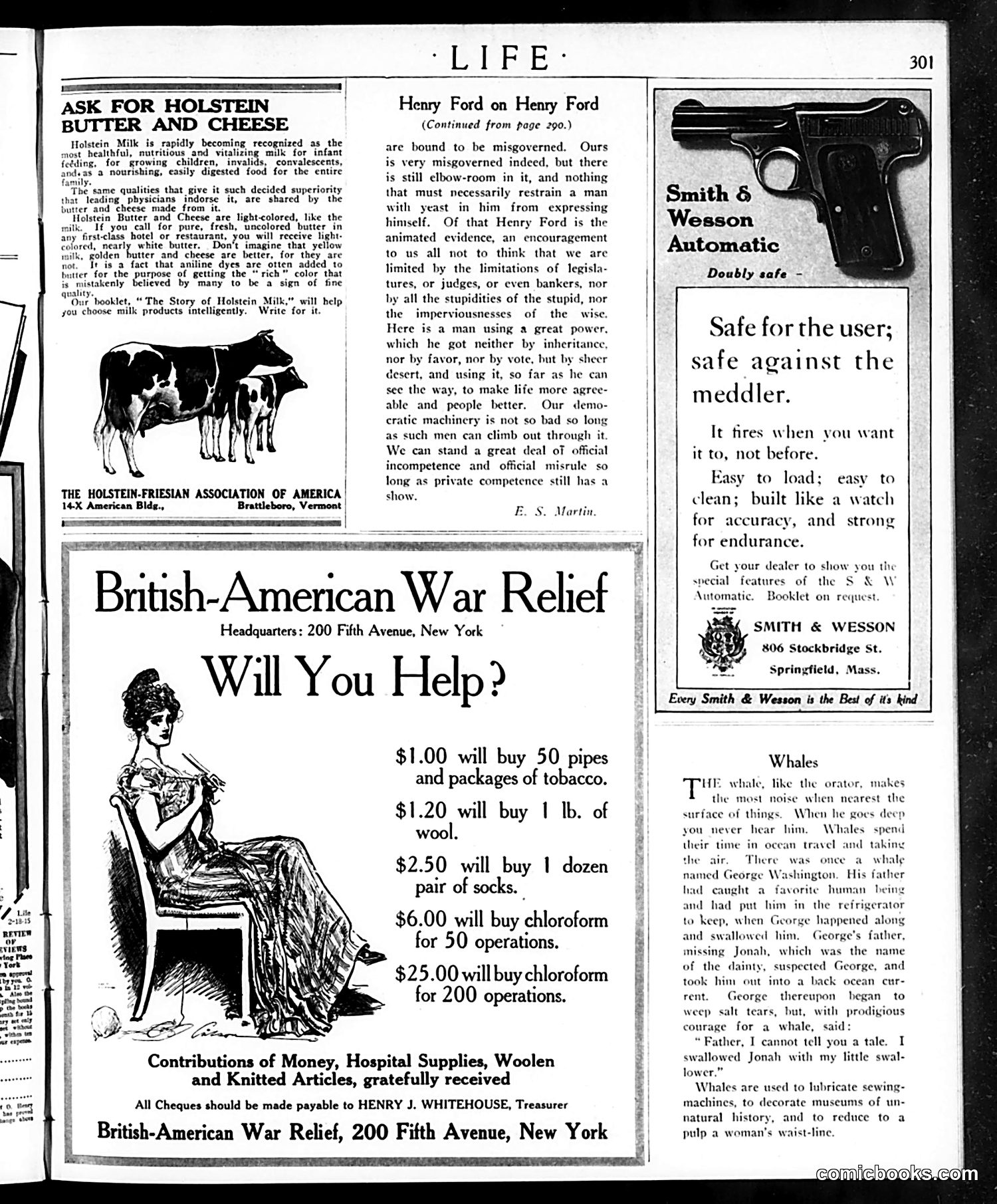
This page mixes advertisements with editorial content from circa World War I era. **Main Editorial**: E.S. Martin's piece praises Henry Ford as evidence that individual enterprise can overcome governmental incompetence and "official misrule." Ford represents a self-made man using power for public good, proof that "private competence still has a show" despite democratic machinery's flaws. **Advertisements**: - Holstein dairy products (top left) - Smith & Wesson automatic pistol (right), emphasizing safety and reliability - British-American War Relief fundraising (center), seeking donations for supplies and chloroform for battlefield operations—indicating this is WWI-era content **"Whales" section** (bottom right): A humorous fable comparing whales to orators, suggesting noise correlates with proximity rather than depth. The George Washington whale tale appears to be pure satire/nonsense humor typical of Life's style. The page reflects early 20th-century American values: admiration for industrial titans, charitable wartime giving, and manufactured humor.
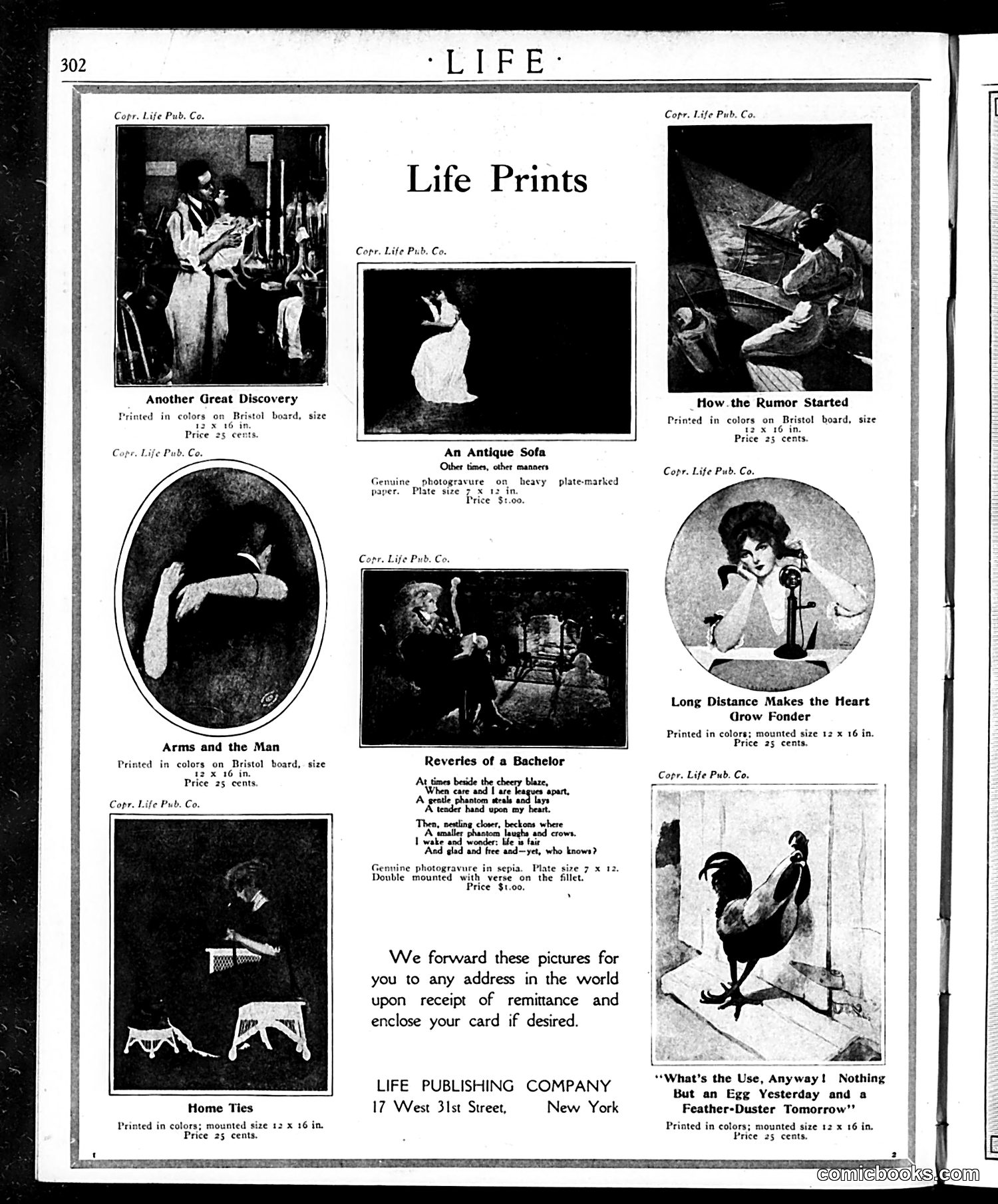
This is primarily a **catalog/advertisement page** from Life Publishing Company featuring satirical prints for sale. Rather than political cartoons, it showcases humorous domestic and romantic scenes typical of early 20th-century Life magazine humor. The prints depict relatable scenarios with titles like "Another Great Discovery" (couple discovery), "Arms and the Man" (romantic embrace), "Home Ties" (domestic life), and "How the Rumor Started" (social gossip). The bottom print mocks male vanity with its rooster illustration captioned "What's the Use, Anyway! Nothing But an Egg Yesterday and a Feather-Duster Tomorrow"—suggesting men's brief importance. The page's satire targets **everyday bourgeois life**: romance, marriage, domesticity, and social pretension. These were popular decorative prints customers could purchase and mail to others. The content reflects Life's formula of gentle social satire about middle-class American life rather than hard political commentary.
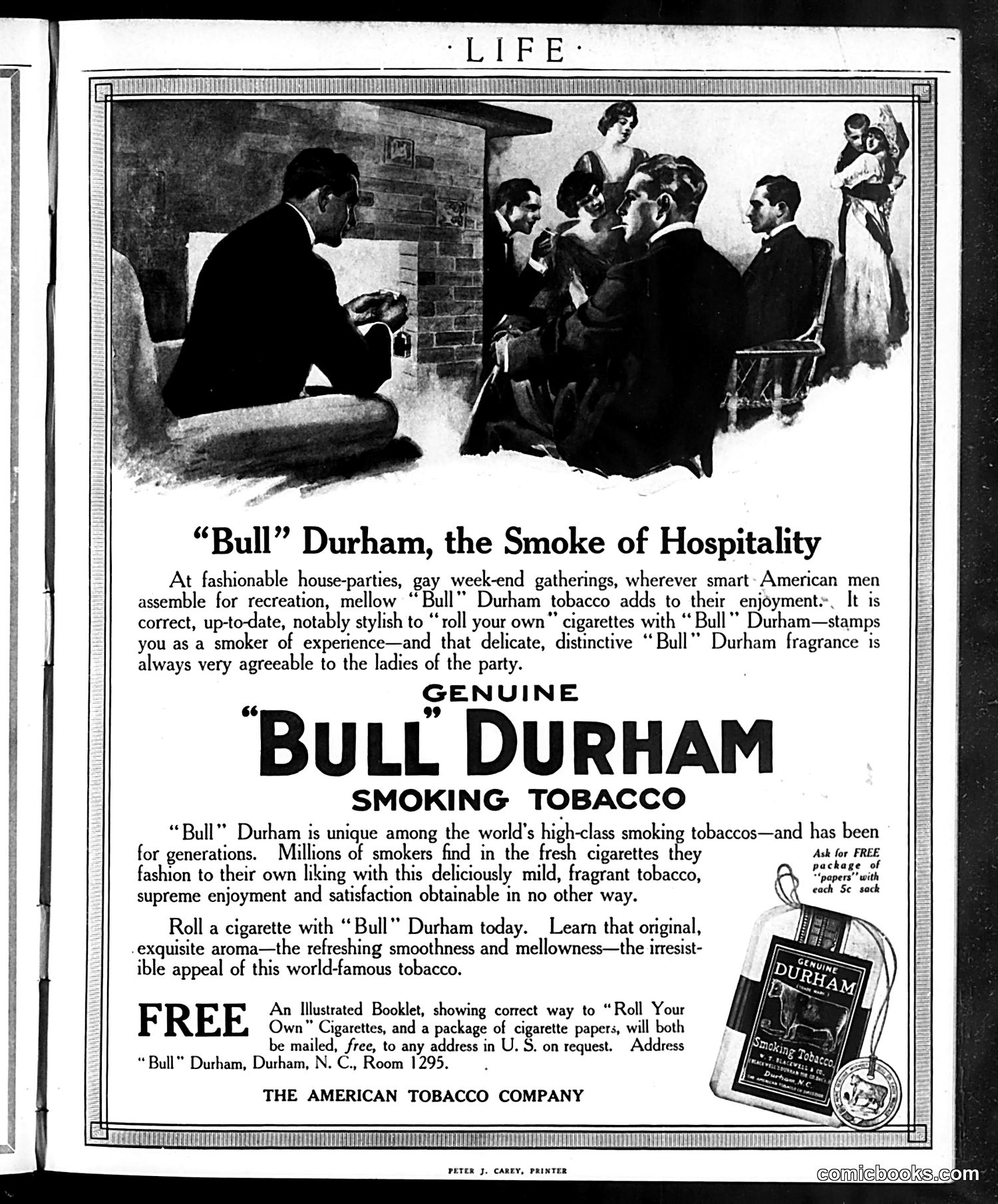
This is a full-page advertisement, not satire—it's a genuine promotional piece for "Bull" Durham smoking tobacco by The American Tobacco Company. The illustration depicts well-dressed men at a fashionable social gathering, with women present. The ad's pitch is that rolling your own cigarettes with Bull Durham tobacco signals sophistication and experience among "smart American men." It emphasizes that the practice is "correct, up-to-date" and socially stylish—the fragrance appeals to women at parties. The advertisement plays on early 20th-century status anxiety: owning the skill to hand-roll cigarettes (rather than buying pre-made ones) demonstrated refinement and leisure time. The free offer of papers and instructional booklet was a common marketing strategy. By modern standards, the casual promotion of smoking as an essential social grace and status symbol is striking, as is the complete absence of health warnings.
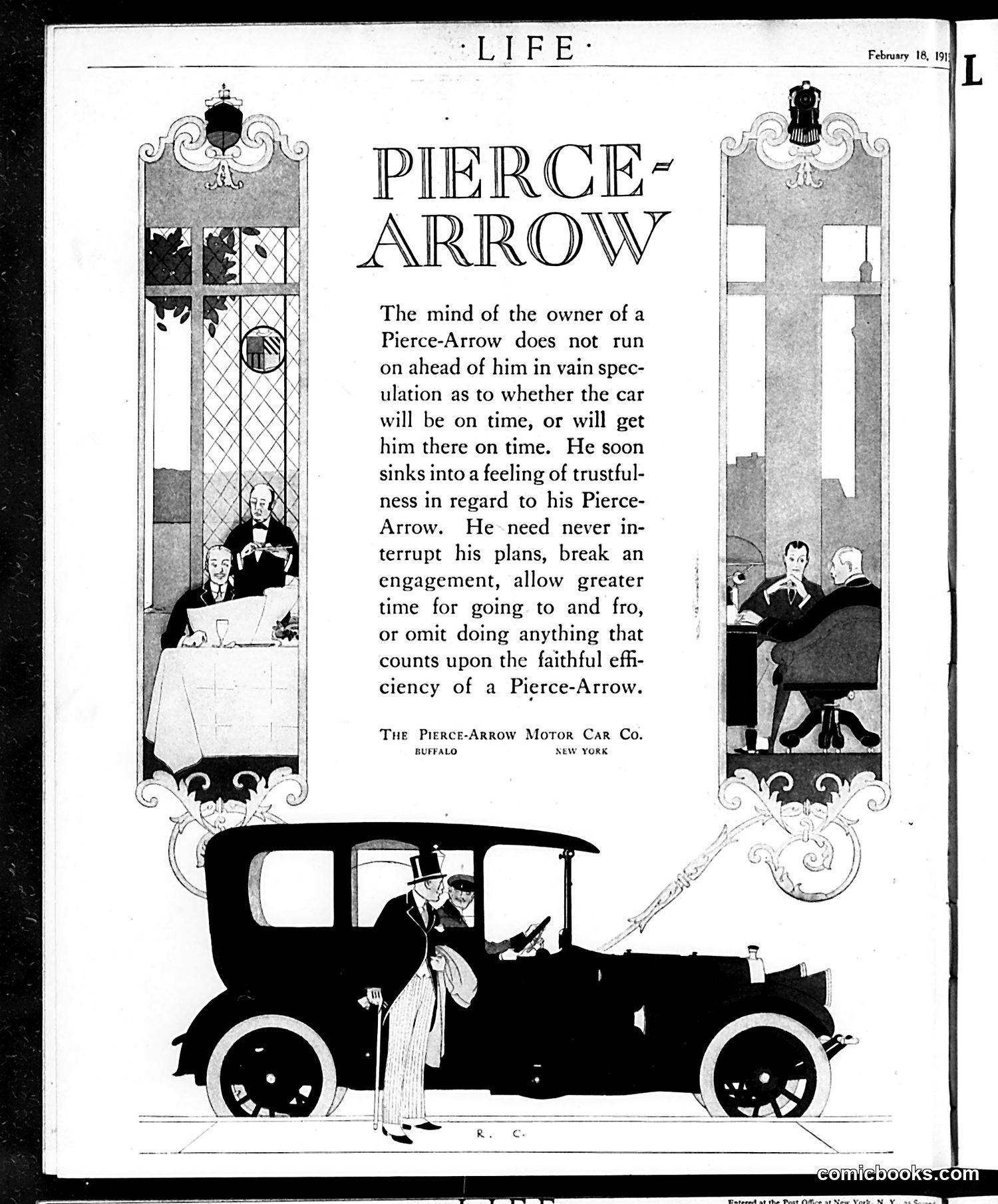
This is a **luxury automobile advertisement** from *Life* magazine (February 18, 1912), not political satire. It promotes the Pierce-Arrow motor car through aspirational imagery. The ad uses three illustrated scenes showing wealthy, well-dressed businesspeople and socialites confidently conducting their affairs—attending meetings, dining, traveling—without worry. The central image depicts a couple in an elegant Pierce-Arrow automobile. The sales pitch emphasizes **reliability and trustworthiness**: owners needn't fret about punctuality or plan extra time because the car is so dependable. This appeals to the leisure class's desire to maintain their social schedules without mechanical anxiety. The ornate decorative frames and refined illustrations reinforce the car's association with **wealth and sophistication**. Pierce-Arrow was a high-end American manufacturer (Buffalo, New York), positioning itself against competitors by targeting affluent professionals who value dependability alongside status.