
Life, 1915-02-18 · page 21 of 44
Life — February 18, 1915 — page 21: what you’re looking at
What you’re looking at
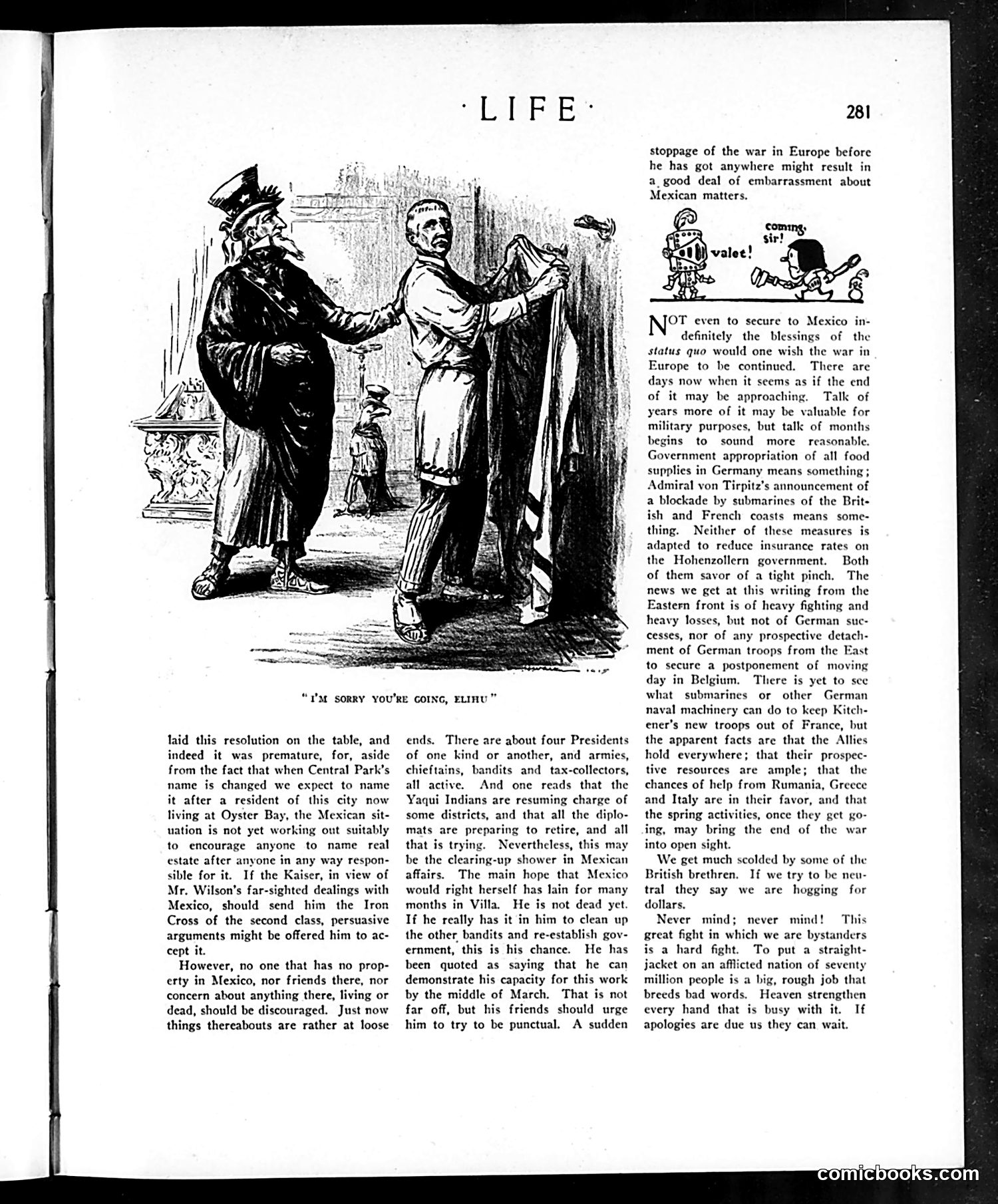
This page satirizes President Woodrow Wilson's foreign policy, particularly his handling of Mexico during the Mexican Revolution. The cartoon caption "I'M SORRY YOU'RE GOING, ELIHU" shows a farewell scene, likely referencing Secretary of State Elihu Root or another official departing over frustrations with Wilson's Mexico policy. The text mocks Wilson's "far-sighted dealings with Mexico" as ineffectual—sarcastically suggesting the German Kaiser might award Wilson the Iron Cross for bungling the situation so badly. Mexico is described as chaotic with multiple competing factions, including Pancho Villa, whom the article notes has promised to stabilize the country "by the middle of March." The piece also addresses World War I, cautiously hopeful Europe's conflict may end soon, while warning that European belligerents' desperation (Germany's submarine blockade, food rationing) suggests prolonged fighting. It defends American neutrality against British criticism about American profit-seeking, arguing the nation should support the Allies' difficult struggle morally while remaining officially neutral.
📄 Transcribed text from this page (OCR, searchable)
Machine-transcribed from the original scan — historical spelling and the odd misread are preserved.
laid this resolution on the table, and indeed it was premature, for, aside from the fact that when Central Park’s name is changed we expect to name it after a resident of this city now living at Oyster Bay, the Mexican sit- uation is not yet working out suitably to encourage anyone to name real estate after anyone in any way respon- sible for it. If the Kaiser, in view of Mr. Wilson's far-sighted dealings with Mexico, should send him the Iron Cross of the second class, persuasive arguments might be offered him to ac- cept it. However, no one that has no prop- erty in Mexico, nor friends there, nor concern about anything there, living or dead, should be discouraged. Just now things thereabouts are rather at loose I'M SORRY YOU'RE GOING, ELIHU” ends. There are about four Presidents of one kind or another, and armies, chieftains, bandits and tax-collectors, all active. And one reads that the Yaqui Indians are resuming charge of some districts, and that all the diplo- mats are preparing to retire, and all that is trying. Nevertheless, this may be the clearing-up shower in Mexican affairs. The main hope that Mexico would right herself has lain for many months in Villa. He is not dead yet If he really has it in him to clean up the other bandits and re-establish gov- ernment, this is his chance. He has been quoted as saying that he can demonstrate his capacity for this work by the middle of March. That is not far off, but his friends should urge him to try to be punctual. A sudden 281 stoppage of the war in Europe before he has got anywhere might result in a_good deal of embarrassment about Mexican matters, OT even to secure to Mexico in- definitely the blessings of the status quo would one wish the war in Europe to be continued. There are days now when it seems as if the end of it may be approaching. Talk of years more of it may be valuable for ry purposes, but talk of months begins to sound more reasonable. Government appropriation of all food supplies in Germany means something ; Admiral von Tirpitz’s announcement of a blockade by submarines of the Brit- ish and French coasts means some- thing. Neither of these measures is adapted to reduce insurance rates on the Hohenzollern government. Both of them savor of a tight pinch, The news we get at this writing from the Eastern front is of heavy fighting and heavy losses, but not of German suc- cesses, nor of any prospective detach- ment of German troops from the East to secure a postponement of moving day in Belgium. There is yet to sce what submarines or other German naval machinery can do to keep Kitch- ener’s new troops out of France, but the apparent facts are that the Allies hold everywhere; that their prospec- tive resources are ample; that the chances of help from Rumania, Greece and Italy are in their favor, and that the spring activities, once they get go- ing, may bring the end of the war into open sight. We get much scolded by some of the British brethren. If we try to be neu- tral they say we are hogging for dollars. Never mind; never mind! This great fight in which we are bystanders is a hard fight. To put a straight- jacket on an ai ed nation of seventy million people is a big, rough job that breeds bad words. Heaven strengthen every hand that is busy with it. If apologies are due us they can wait.