
Life, 1915-02-18 · page 24 of 44
Life — February 18, 1915 — page 24: what you’re looking at
What you’re looking at
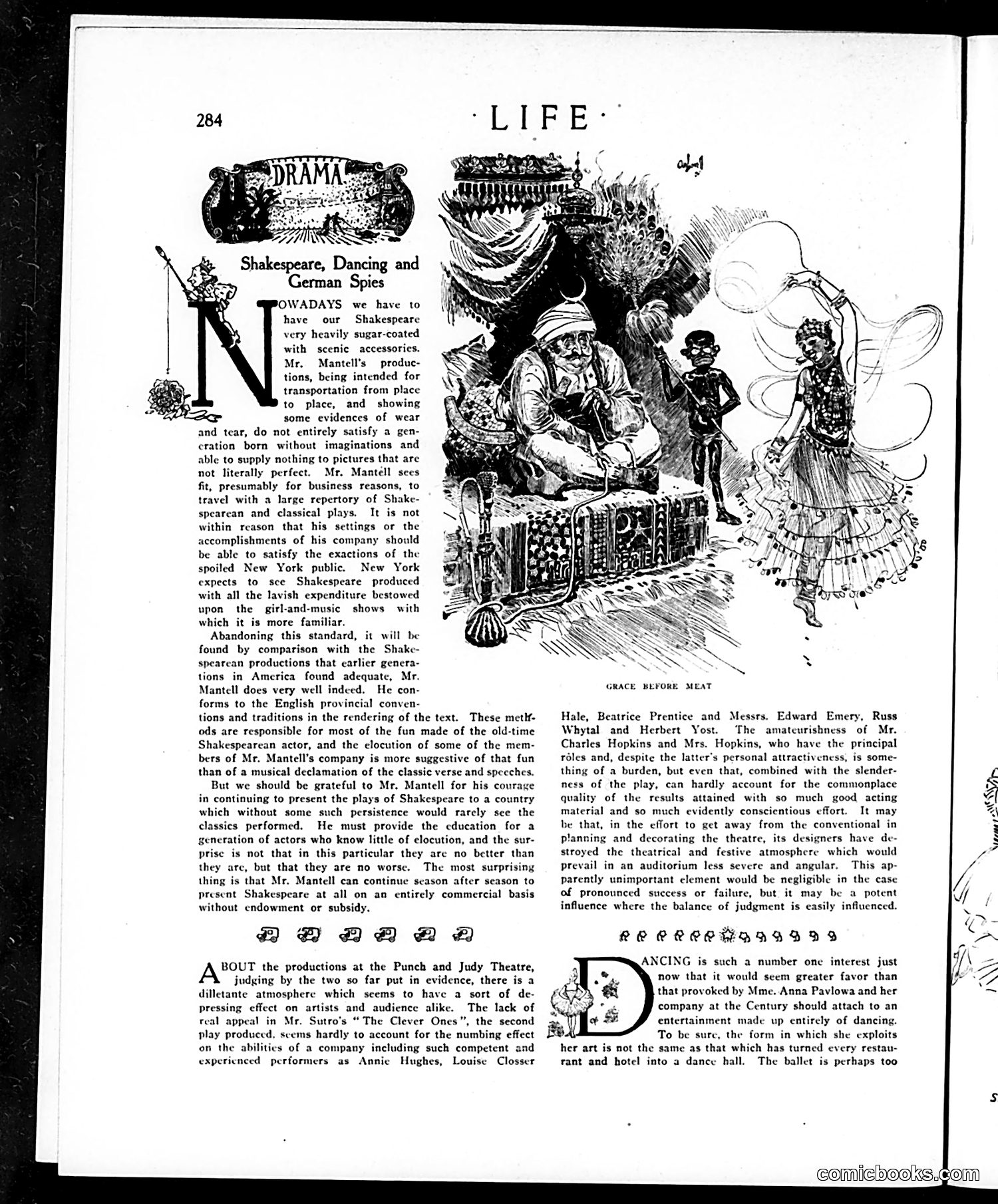
This page critiques three theatrical entertainments in early 20th-century New York: **Shakespeare Productions**: The writer defends actor Richard Mantell's traveling Shakespeare company against critics who expect lavish Broadway production values. The article argues New York audiences have become spoiled by spectacle-heavy "girl-and-music shows" and unfairly judge classical theater by contemporary standards. It credits Mantell for persisting in presenting Shakespeare commercially without subsidy, though acknowledges his actors' old-fashioned elocution style seems dated. **The Punch and Judy Theatre**: A damning review of a production at this venue, where talented performers (including Charles Hopkins and his wife) seemingly underperform due to the theater's austere, unconventional design that undermines theatrical atmosphere. **Anna Pavlowa's Dancing**: Brief mention suggesting her dance company at the Century Theater deserves greater acclaim than it receives, despite dancing being a major public interest. The cartoon "Grace Before Meat" illustrates theatrical excess—likely mocking over-elaborate staging.
📄 Transcribed text from this page (OCR, searchable)
Machine-transcribed from the original scan — historical spelling and the odd misread are preserved.
Shakespeare, Dancing and German Spies IOWADAYS we have to have our Shakespeare very heavily sugar-coated with scenic accessorics. Mr. Mantell’s — produc- tions, being intended for transportation from place to place, and showing some evidences of wear and tear, do not entirely satisfy a gen- cration born without imaginations and able to supply nothing to pictures that arc not literally perfect. Mr. Mantell sees fit, presumably for business reasons, to travel with a large repertory of Shake- spearean and classical plays, It is not within reason that his settings or the accomplishments of his company should be able to satisfy the exactions of the spoiled New York public. New York expects to sce Shakespeare produced with all the lavish expenditure bestowed upon the girl-and-music shows with which it is more familiar. Abandoning this standard, it will be found by comparison with the Shake- spearean productions that earlier genera- ns in America found adequate, Mr. Mantell does very well indeed. He con- forms to the English provincial conven- tions and traditions in the rendering of the text. These metlf- ods are responsible for most of the fun made of the old-time Shakespearean actor, and the elocution of some of the mem- bers of Mr. Mantell’s company is more suggestive of that fun than of a musical declamation of the classic verse and specches. But we should be grateful to Mr. Mantell for his courage in continuing to present the plays of Shakespeare to a country which without some such persistence would rarely see the classics performed. He must provide the education for a generation of actors who know little of elocution, and the sur- prise is not that in this particular they are no better than they are, but that they are no worse. The most surprising thing is that Mr. Mantell can continue season after season to present Shakespeare at all on an entirely commercial basis without endowment or subsidy. HA AA A A BOUT the productions at the Punch and Judy Theatre, judging by the two so far put in evidence, there is a dilletante atmosphere which seems to have a sort of de- pressing effect on artists and audience alike. The lack of real appeal in Mr. Sutro’s “ The Clever Ones”, the second play produced, scems hardly to account for the numbing effect on the abilities of a company including such competent and experienced performers as Annic Hughes, Louise Closser GRACE BEFORE MEAT Hale, Beatrice Prentice and Messrs. Edward Emery, Whytal and Herbert Yost. The amateurishness of Mr. Charles Hopkins and Mrs. Hopkins, who have the principal roles and, despite the latter's personal attractiveness, is some- thing of a burden, but even that, combined with the slender- ness of the play, can hardly account for the commonplace quality of the results attained with so much good acting material and so much evidently conscientious effort. It may be that, in the effort to get away from the conventional in Planning and decorating the theatre, its designers have de- stroyed the theatrical and fe atmosphere which would prevail in an auditorium less severe and angular. This ap- parently unimportant clement would be negligible in the case of pronounced success or failure, but it may be a potent influence where the balance of judgment is easily influenced. RE RCKRCCHIEABS DD ANCING is such a number one interest just now that it would seem greater favor than that provoked by Mme. Anna Pavlowa and her company at the Century should attach to an ve 1) entertainment made up entirely of dancing. &. To be sure, the form in which she exploits her art is not the same as that which has turned every restau- rant and hotel into a dance hall. The ballet is perhaps too comichooks. Kip, ww Roenenee oe