
Life, 1915-02-18 · page 26 of 44
Life — February 18, 1915 — page 26: what you’re looking at
What you’re looking at
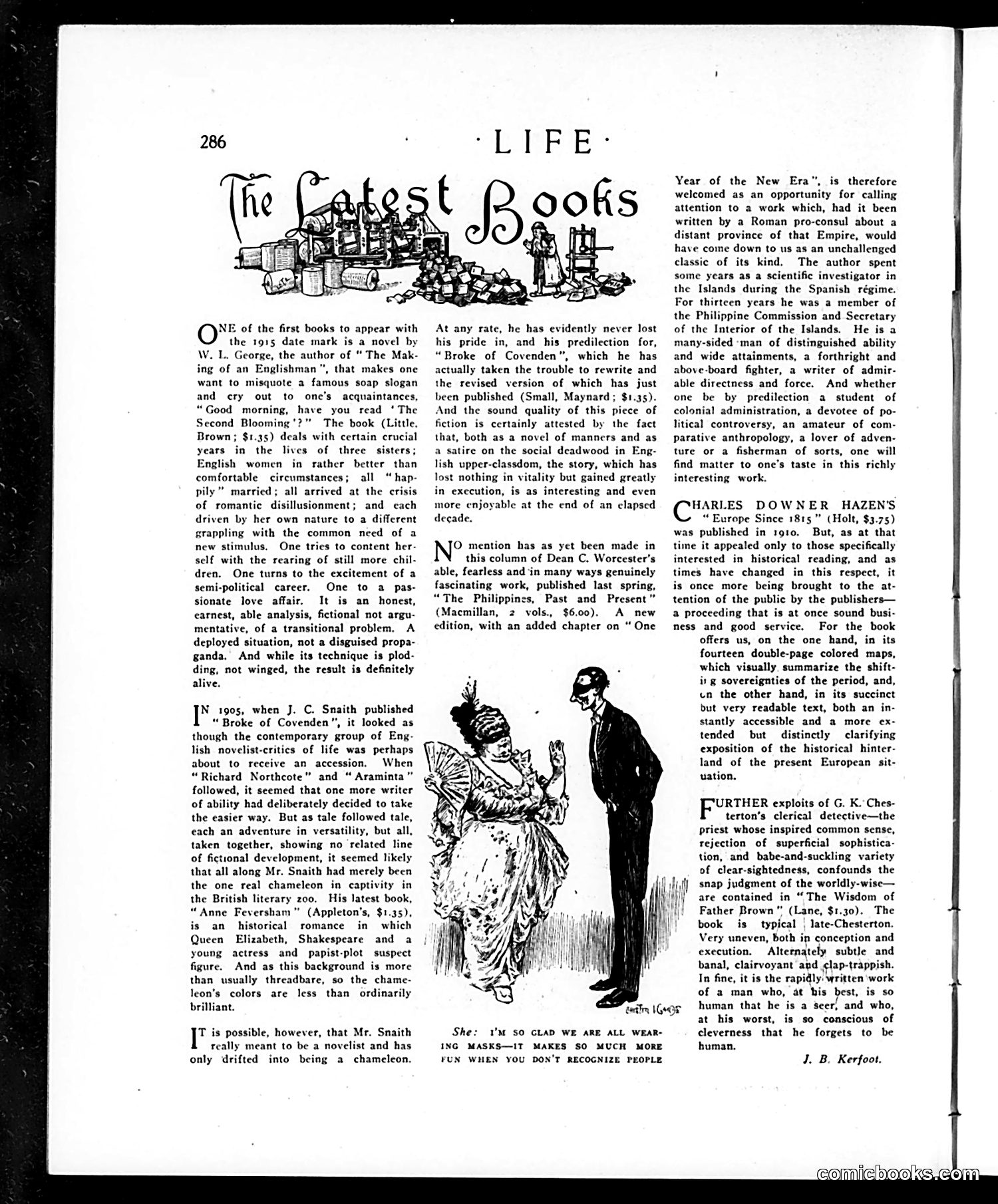
This page primarily comprises book reviews rather than political cartoons. The main illustration shows a couple at what appears to be a masquerade ball, with the woman saying she's "glad we are all wearing masks" because it makes social interaction more fun when people aren't recognized. The satire is social rather than political: it mocks the artificiality and pretense of upper-class social life, suggesting that masquerade allows people to escape their usual identities and social positions—implying that recognizability constrains authentic interaction. The cartoon suggests early-20th-century anxiety about maintaining false social personas. The page reviews several novels, including works by W.L. George and J.C. Snaith, and discusses Dean C. Worcester's nonfiction about the Philippines under American colonial administration. The reviews assess literary merit and characterize authors' stylistic consistency or inconsistency.
📄 Transcribed text from this page (OCR, searchable)
Machine-transcribed from the original scan — historical spelling and the odd misread are preserved.
oO. of the first books to appear with the 1915 date mark is a novel by W. L. George, the author of “ The Mak- ing of an Englishman”, that makes one want to misquote a famous soap slogan and cry out to one’s acquaintances, “Good morning, have you read ‘The Second Blooming'?"” The book (Little. Brown; $1.35) deals with certain crucial years in the lives of three sisters; English women in rather better than comfortable circumstances; all “ hap- pily” married; all arrived at the crisis of romantic disillusionment; and cach driven by her own nature to a different grappling with the common need of a new stimulus. One tries to content her- self with the rearing of still more chil- dren. One turns to the excitement of a semi-political career. One to a pas- sionate love affair. It is an honest, carnest, able analysis, fictional not argu- mentative, of a transitional problem. A deployed situation, not a disguised propa- ganda. And while its technique is plod- ding, not winged, the result is definitely alive. Ix 190s, when J. C. Snaith published “Broke of Covenden", it looked as though the contemporary group of Eng- lish novelist-critics of life was perhaps about to receive an accession. When “Richard Northcote” and “ Araminta” followed, it seemed that one more writer of ability had deliberately decided to take the easier way. But as tale followed tale, each an adventure in versatility, but all, taken together, showing no related line of fictional development, it seemed likely that all along Mr. Snaith had merely been the one real chameleon in captivity in the British literary zoo. His latest book, “Anne Feversham” (Appleton’s, $1.35), is an historical romance in which Queen Elizabeth, Shakespeare and a young actress and papist-plot suspect figure. And as this background is more than usually threadbare, so the chame- leon’s colors are less than ordinarily brilliant. T is possible, however, that Mr. Snaith really meant to be a novelist and has only drifted into being a chameleon. At any rate, he has evidently never lost his pride in, and his predilection for, “Broke of Covenden”, which he has actually taken the trouble to rewrite and the revised version of which has just been published (Small, Maynard; $1.35). And the sound quality of this piece of fiction is certainly attested by the fact that, both as a novel of manners and as a satire on the social deadwood in Eng- lish upper-classdom, the story, which has lost nothing in vitality but gained greatly in execution, is as interesting and even more enjoyable at the end of an elapsed decade, ‘O mention has as yet been made in this column of Dean C. Worcester’s able, fearless and ‘in many ways genuinely fascinating work, published last spring, “The Philippines, Past and Present” (Macmillan, 2 vols., $6.00), A new edition, with an added chapter on “ One Gtiry IGOF She: 1M SO GLAD WE ARE ALL WEAR- ING MASKS—IT MAKES SO MUCH MORE FUN WMEN YOU DON'T RECOGNIZE PEOPLE Year of the New Era”, is therefore welcomed as an opportunity for calling attention to a work which, had it been written by a Roman pro-consul about a distant province of that Empire, would have come down to us as an unchallenged classic of its kind, The author spent some years as a scientific investigator in the Islands during the Spanish régime. For thirtcen years he was a member of the Philippine Commission and Secretary of the Interior of the Islands. He is a many-sided ‘man of distinguished ability and wide attainments, a forthright and above-board fighter, a writer of admir- able directness and force. And whether one be by predilection a student of colonial administration, a devotee of po- litical controversy, an amateur of com- parative anthropology, a lover of adven- ture or a fisherman of sorts, one will find matter to one’s taste in this richly interesting work, HARLES DOWNER _ HAZEN'S urope Since 1815” (Holt, $3.75) was published in 1910, But, as at that time it appealed only to those specifically interested in historical reading, and as times have changed in this respect, it is once more being brought to the at- tention of the public by the publishers— a proceeding that is at once sound busi- ness and good service. For the book offers us, on the one hand, in its fourteen double-page colored maps, which visually. summarize the shift- ig sovereignties of the period, and, on the other hand, in its succinct but very readable text, both an in- stantly accessible and a more ex- tended but distinctly clarifying exposition of the historical hinter- land of the present European sit- uation. 'URTHER exploits of G. K.Ches- terton’s clerical detective—the priest whose inspired common sense, rejection of superficial sophistica- tion, and babe-and-suckling variety of clear-sightedness, confounds the snap judgment of the worldly-wise— are contained in “The Wisdom of Father Brown" (Lane, $1.30). The book is typical | late-Chesterton. Very uneven, both in conception and execution. Alternately subtle and banal, clairvoyant and glap-trappish. In fine, it is the rapidly: written work of a man who, at his best, is so human that he is a seer, and who, at his worst, is so conscious of cleverness that he forgets to be human, J. B. Kerfoot.