
Life, 1915-02-18 · page 20 of 44
Life — February 18, 1915 — page 20: what you’re looking at
What you’re looking at
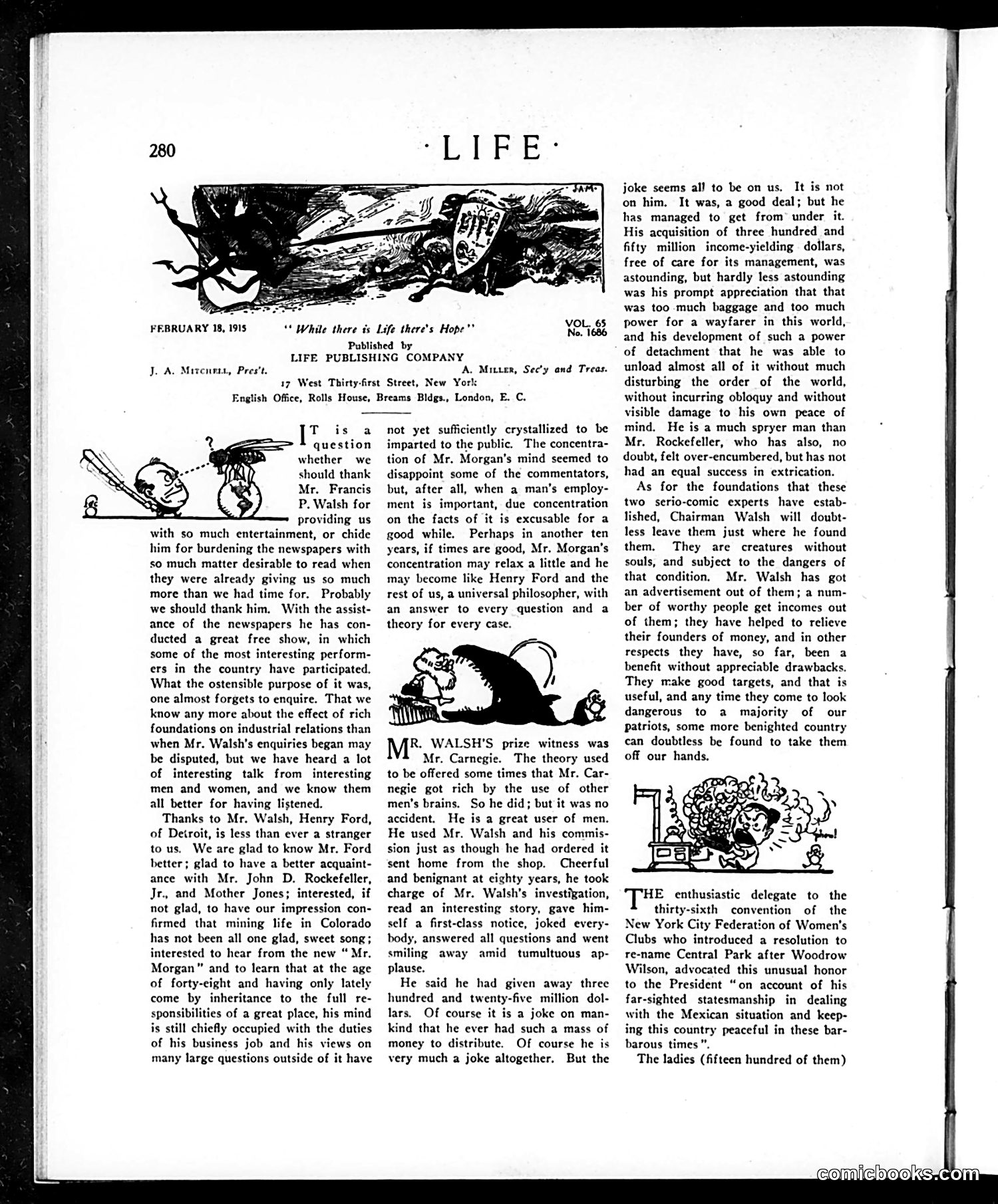
This page discusses Francis P. Walsh's investigation into the effects of wealthy philanthropic foundations on industrial relations. The satirical commentary centers on the industrialists who testified, particularly **Andrew Carnegie** (depicted in the cartoon as a rotund figure). The article's point: While Carnegie claims to have given away $325 million and presents himself as benevolent and humble, Life's editors note the true "joke" is structural—that Carnegie ever accumulated such wealth in the first place, and that he managed to divest himself of it while avoiding criticism. The satire critiques not Carnegie's charity itself, but the system allowing such vast accumulation and the self-congratulatory tone surrounding its redistribution. The piece also discusses **J.D. Rockefeller Jr.** and **Henry Ford**, comparing their levels of engagement with public questions. The overall message: these industrial titans remain primarily focused on their business operations rather than becoming "universal philosophers" with answers to society's larger problems.
📄 Transcribed text from this page (OCR, searchable)
Machine-transcribed from the original scan — historical spelling and the odd misread are preserved.
FEBRUARY 18, 1915 ‘While there ts Life there's Hope"” Published by LIFE PUBLISHING COMPANY J. A. Mitenras, Pres't. A. Minter, Sec’y and Treas. 17 West Thirty-first Street, New York English Office, Rolls House, Breams Bldgs., London, E. C. uestion whether we should thank Mr. Francis P. Walsh for providing us with so much entertainment, or chide him for burdening the newspapers with so much matter desirable to read when they were already giving us so much more than we had time for. Probably we should thank him. With the assist- ance of the newspapers he has con- ducted a great free show, in which some of the most interesting perform- ers in the country have participated. What the ostensible purpose of it was, one almost forgets to enquire. That we know any more about the effect of rich foundations on industrial relations than when Mr. Walsh's enquiries began may be disputed, but we have heard a lot of interesting talk from interesting men and women, and we know them all better for having listened. Thanks to Mr. Walsh, Henry Ford, of Detroit, is less than ever a stranger to us, We are glad to know Mr. Ford better; glad to have a better acquaint- ance with Mr. John D. Rockefeller, Jr., and Mother Jones; interested, if not glad, to have our impression con- firmed that mining life in Colorado has not been all one glad, sweet song; interested to hear from the new “ Mr, Morgan” and to learn that at the age of forty-eight and having only lately come by inheritance to the full re- sponsibilities of a great place, his mind is still chiefly occupied with the duties of his business job and his views on many large questions outside of it have T i ee not yet sufficiently crystallized to be imparted to the public. The concentra- tion of Mr. Morgan’s mind seemed to disappoint some of the commentators, but, after all, when a man’s employ- ment is important, due concentration on the facts of it is excusable for a good while. Perhaps in another ten years, if times are good, Mr. Morgan's concentration may relax a little and he may become like Henry Ford and the rest of us, a universal philosopher, with an answer to every question and a theory for every case. } R. WALSH'S prize witness was Mr. Carnegie. The theory used to be offered some times that Mr. Car- negie got rich by the use of other men’s brains. So he did; but it was no accident. He is a great user of men. He used Mr. Walsh and his commis- sion just as though he had ordered it sent home from the shop. Cheerful and benignant at eighty years, he took charge of Mr. Walsh’s investigation, read an interesting story, gave him- self a first-class notice, joked every- body, answered all questions and went smiling away amid tumultuous ap- plause. He said he had given away three hundred and twenty-five million dol- lars. Of course it is a joke on man- kind that he ever had such a mass of money to distribute. Of course he is very much a joke altogether. But the joke seems all to be on us, It is not on him. It was, a good deal; but he has managed to get from’ under it. His acquisition of three hundred and fifty million income-yielding dollars, free of care for its management, was astounding, but hardly less astounding was his prompt appreciation that that was too much baggage and too much power for a wayfarer in this world, and his development of such a power of detachment that he was able to unload almost all of it without much disturbing the order of the world, without incurring obloquy and without visible damage to his own peace of mind. He is a much spryer man than Mr. Rockefeller, who has also, no doubt, felt over-encumbered, but has not had an equal success in extrication. As for the foundations that these two serio-comic experts have estab- lished, Chairman Walsh will doubt- less leave them just where he found them. They are creatures without souls, and subject to the dangers of that condition. Mr. Walsh has got an advertisement out of them; a num- ber of worthy people get incomes out of them; they have helped to relieve their founders of money, and in other respects they have, so far, been a benefit without appreciable drawbacks. They make good targets, and that is useful, and any time they come to look dangerous to a majority of our Patriots, some more benighted country can doubtless be found to take them off our hands. Es enthusiastic delegate to the thirty-sixth convention of the New York City Federation of Women's Clubs who introduced a resolution to re-name Central Park after Woodrow Wilson, advocated this unusual honor to the President “on account of his far-sighted statesmanship in dealing with the Mexican situation and keep- ing this country peaceful in these bar- barous times”. The ladies (fifteen hundred of them)