
Life, 1915-02-18 · page 18 of 44
Life — February 18, 1915 — page 18: what you’re looking at
What you’re looking at
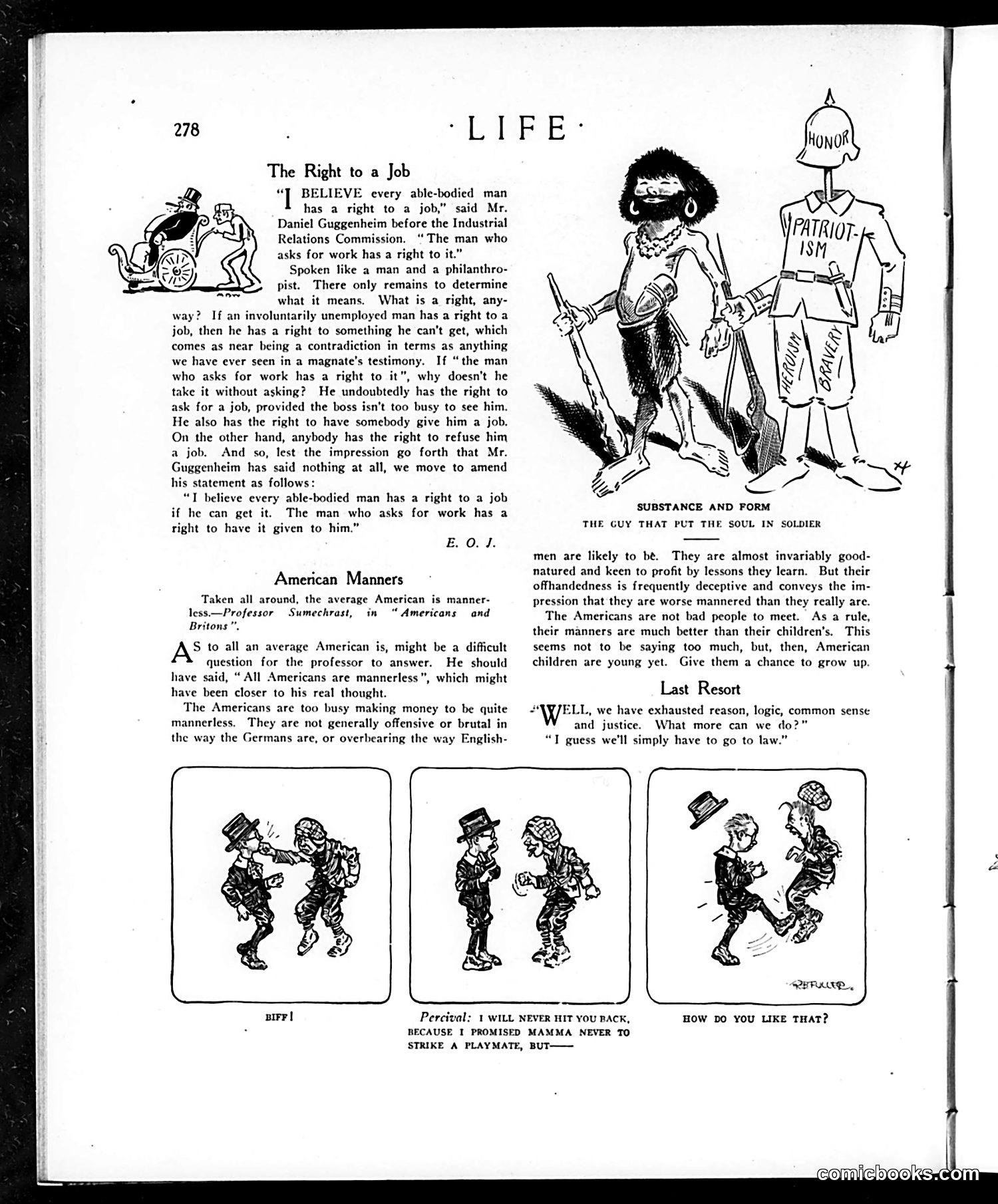
This page contains three distinct pieces of social commentary: **"The Right to a Job"** satirizes industrialist Daniel Guggenheim's testimony before the Industrial Relations Commission. Guggenheim claimed workers have a "right" to employment, but the author (E.O.J.) exposes this as meaningless—one cannot have a "right" to something one cannot obtain. The satire highlights the contradiction between philanthropic rhetoric and economic reality during labor disputes of the early 20th century. **"American Manners"** critiques Professor Sumechrast's claim that Americans lack manners. The piece argues Americans are merely *busy* and offhand rather than genuinely rude, and that their informality masks decent character. It reflects period anxieties about American social refinement versus European standards. **"Last Resort"** and the three cartoon panels below present a grim joke about conflict resolution: after exhausting reason and logic, "going to law" remains—suggesting litigation as society's ultimate recourse. The panels show physical altercations between two figures, with the final caption cynically implying legal action as the only remaining option.
📄 Transcribed text from this page (OCR, searchable)
Machine-transcribed from the original scan — historical spelling and the odd misread are preserved.
“Lb GRE * The Right to a Job “I BELIEVE every able-bodied man has a right to a job,” said Mr. Daniel Guggenheim before the Industrial Relations Commission. ‘The man who asks for work has a right to it.” Spoken like a man and a philanthro- i There only remains to determine what it means. What is a right, any- way? If an involuntarily unemployed man has a right to a job, then he has a right to something he can’t get, which comes as near being a contradiction in terms as anything we have ever seen in a magnate’s testimony. If “the man who asks for work has a right to it”, why doesn’t he take it without asking? He undoubtedly has the right to ask for a job, provided the boss isn’t too busy to see him, He also has the right to have somebody give him a job, On the other hand, anybody has the right to refuse him a job. And so, lest the impression go forth that Mr. Guggenheim has said nothing at all, we move to amend his statement as follows: “T believe every able-bodied man has a right to a job if he can get it. The man who asks for work has a right to have it given to him.” E.0. J. American Manners Taken all around, the average American is manner- less.—Professor Sumechrast, in “Americans and Britons”. AS to all an average American is, might be a difficult question for the professor to answer. He should have said, “ All Americans are mannerless”, which might have been closer to his real thought. The Americans are too busy making money to be quite mannerle: They are not generally offensive or brutal in the way the Germans are, or overbearing the way English- SUBSTANCE AND FORM THE GUY THAT PUT THE SOUL IN SOLDIER men are likely to be. They are almost invariably good- natured and keen to profit by lessons they learn. But their offhandedness is frequently deceptive and conveys the im- pression that they are worse mannered than they really are. The Americans are not bad people to meet. As a rule, their manners are much better than their children’s. This seems not to be saying too much, but, then, American children are young yet. Give them a chance to grow up. Last Resort “VY/ELL, we have exhausted reason, logic, common sense and justice. What more can we do?” “T guess we'll simply have to go to law.” Percival: 1 WILL NEVER HIT YOU BACK, EFURR, HOW DO YOU LIKE THAT? RECAUSE I PROMISED MAMMA NEVER TO STRIKE A PLAYMATE, BUT——