
Life, 1915-02-18 · page 28 of 44
Life — February 18, 1915 — page 28: what you’re looking at
What you’re looking at
This is political allegory satirizing the Shipping Bill (likely the Merchant Marine Act of 1920). The cartoon personifies "Economic Law" and "Congressional Bill" as opposing forces in a debate about trade policy. The Shipping Bill proposes government subsidies to build ships ("bottoms") so American manufacturers can export surplus goods to other countries. Economic Law points out the logical flaw: this works only because American wages are higher than competitors', making goods expensive. The government must pay the difference—unsustainable. The satire's punch: Economic Law patiently waits by the roadside while the ambitious Bill rushes to Washington. Years later, the Bill passes away quietly, having failed—proving that economic reality outlasts legislative overreach. The cartoon mocks Congress for attempting to overturn fundamental economic principles through legislation alone. The message: good intentions and political will cannot permanently override market forces.
📄 Transcribed text from this page (OCR, searchable)
Machine-transcribed from the original scan — historical spelling and the odd misread are preserved.
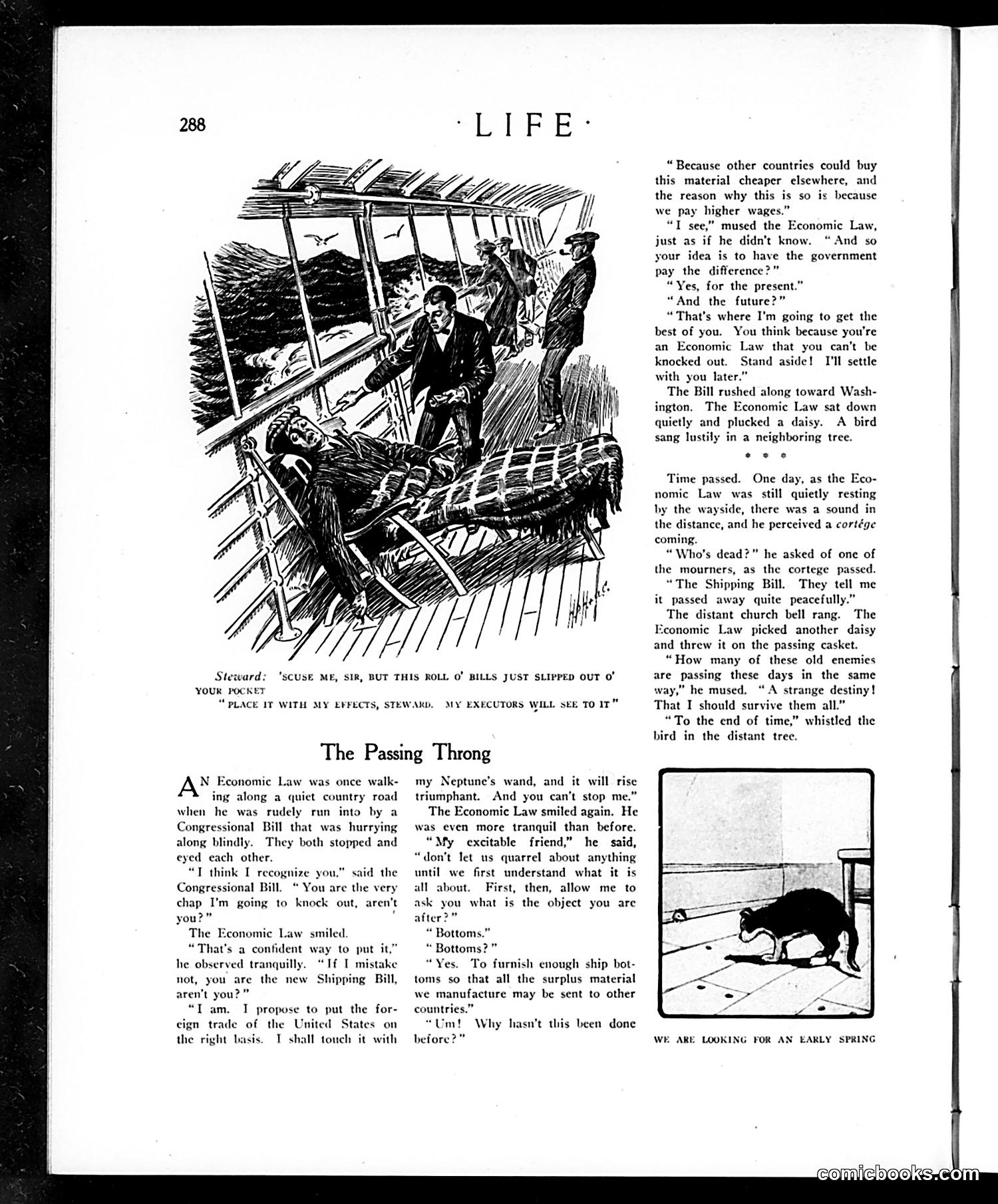
Steward: YOUR POCKET “PLACE IT WITH MY EFFECTS, STEWAKD. 'SCUSE ME, SIR, BUT THIS ROLL 0’ BILLS JUST SLIPPED OUT 0° MY EXECUTORS WILL SEE TO 1T” The Passing Throng Economic Law was once walk- ing along a quiet country road AN when he was rudely run into by a Congressional Bill that was hurrying along blindly, They both stopped and eyed each other. “T think I recognize you,” said the Congressional Bill. “ You are the very chap I’m going to knock out, aren't you?” ‘ The Economic Law smiled. “That's a confident way to put it,” he observed tranquilly. “If [ mistake not, you are the new Shipping Bill, aren't you “IT am. I propose to put the for- eign trade of the United States on the right basis. I shall touch it with my Neptune’s wand, and it will rise triumphant. And you can’t stop me.” The Economic Law smiled again. He was even more tranquil than before. “My excitable friend,” he said, “don’t let us quarrel about anything until we first understand what it is all about. First, then, allow me to ask you what is the object you are “ Bottoms.” “ Bottoms?” “Yes. To furnish enough ship bot- toms so that all the surplus material we manufacture may be sent to other countries.” “Um! before?” Why hasn't this been done “Because other countries could buy this material cheaper elsewhere, and the reason why this is so is because we pay higher wages.” “T see,” mused the Economic Law, just as if he didn’t know. “And so your idea is to have the government pay the difference?” “Yes, for the present.” “And the future?” “That's where I'm going to get the best of you. You think because you're an Economic Law that you can’t be knocked out. Stand aside! I'll settle with you later.” The Bill rushed along toward Wash- ington. The Economic Law sat down quietly and plucked a daisy. A bird sang lustily in a neighboring tree. Time passed. One day, as the Eco- nomic Law was still quietly resting hy the wayside, there was a sound in the distance, and he perceived a cortége coming. “Who's dead?” he asked of one of the mourners, as the cortege passed. “The Shipping Bill. They tell me it passed away quite peacefully.” The distant church bell rang. The Economic Law picked another daisy and threw it on the passing casket. “How many of these old enemies are passing these days in the same way,” he mused. “A strange destiny! That I should survive them all.” “To the end of time,” whistled the bird in the distant tree. WE ARE LOOKING FOR AN EARLY SPRING